2 Samuel 5:9

Hebrew (Westminster Leningrad Codex) 2 Samuel 5:9 appears in the Hebrew Old Testament. The text above is from the Westminster Leningrad Codex. Each word links to its Strong’s number, a concise gloss, and parsing drawn from the Open Scriptures Hebrew Bible morphology. Click any word for its full Brown-Driver-Briggs (BDB) entry.
Download image
Cite this verse

2 Samuel 5:9 (World English Bible). Public Domain. Lemma interlinear Bible study tool, https://lemma.gebible.app/v/2-samuel/5/9.

Show BibTeX & RIS
BibTeX
RIS
English Translation
David lived in the stronghold, and called it the city of David. David built round about from Millo and inward.
World English Bible · Public Domain
Download a study sheet

One document with this verse’s original text, its word-by-word gloss line, the meaning frame, cross-references with their text, attributed commentary, and full source and license credits — printable, and it pastes into notes with its structure intact.

This verse Autodidact and up

Study sheet (.html) Plain text (.txt)

A passage Seminary Student

Up to 50 verses in one chapter. A passage sheet keeps up to 6 commentary sources and 12 cross-references per verse, in the order this page ranks them, and says so on the sheet whenever that leaves anything out. Ask for a single verse and you get the Autodidact verse sheet above.

Everything on this page stays free to read, with no account — the sheet is a download of what is already on screen, not access to it.

Want to remove ads? Support Godless Engineer
Compare translations 3

The same verse in 3 English versions, stacked beneath the original-language interlinear above. Click any original word for its lexicon entry.

Each is an independent rendering of the whole verse — the interlinear is not word-aligned to these translations.

Highlighted words mark where these versions differ — a whole-verse word diff, not a word-by-word alignment.

  • World English Bible Public Domain
    David lived in the stronghold, and called it the city of David. David built round about from Millo and inward.
  • King James Version Public Domain
    So David dwelt in the fort, and called it the city of David. And David built round about from Millo and inward.
  • unfoldingWord Literal Text CC BY-SA 4.0
    And David dwelled in the stronghold, and he called it the City of David. And David built around, from the Millo and toward the house.

unfoldingWord Literal Text — © unfoldingWord, licensed CC BY-SA 4.0. Word-aligned USFM3 via Door43 (git.door43.org/unfoldingWord/en_ult).

Versions to compare (up to 4)

3 of 4 selected

Show all 18 translations

Every available English version of this verse, each an independent rendering of the whole verse.

  • World English Bible Public Domain
    David lived in the stronghold, and called it the city of David. David built round about from Millo and inward.
  • Berean Standard Bible Public Domain
    So David took up residence in the fortress and called it the City of David. He built it up all the way around, from the supporting terraces inward.
  • Majority Standard Bible Public Domain
    So David took up residence in the fortress and called it the City of David. He built it up all the way around, from the supporting terraces inward.
  • King James Version Public Domain
    So David dwelt in the fort, and called it the city of David. And David built round about from Millo and inward.
  • American Standard Version (1901) Public Domain
    And David dwelt in the stronghold, and called it the city of David. And David built round about from Millo and inward.
  • Revised Version (1885) Public Domain
    And David dwelt in the strong hold, and called it the city of David. And David built round about from Millo and inward.
  • Geneva Bible (1599) Public Domain
    So Dauid dwelt in that forte, and called it the citie of Dauid, and Dauid built rounde about it, from Millo, and inward.
  • Douay-Rheims (1899) Public Domain
    For David had offered that day a reward to whosoever should strike the Jebusites and get up to the gutters of the tops of the houses, and take away the blind and the lame that hated the soul of David: therefore it is said in the proverb: The blind and the lame shall not come into the temple.
  • Young's Literal Translation Public Domain
    And David dwelleth in the fortress, and calleth it -- City of David, and David buildeth round about, from Millo and inward,
  • Literal Standard Version CC BY-SA 4.0
    And David dwells in the fortress, and calls it the City of David, and David builds all around, from Millo and inward,
  • Unlocked Literal Bible CC BY-SA 4.0
    So David lived in the stronghold and called it the city of David. He fortified around it, from the terrace toward the inside.
  • unfoldingWord Literal Text CC BY-SA 4.0
    And David dwelled in the stronghold, and he called it the City of David. And David built around, from the Millo and toward the house.
  • Darby Bible Public Domain
    So David dwelt in the stronghold, and called it the city of David. And David built round about from the Millo and inward.
  • World Messianic Bible Public Domain
    David lived in the stronghold, and called it David’s city. David built around from Millo and inward.
  • Webster's Bible Public Domain
    So David dwelt in the fort, and called it the city of David. And David built around from Millo and inward.
  • Free Bible Version CC BY-SA 4.0
    David went and lived in the fortress, and named it The City of David. He extended it in all directions, starting from the outer supporting terraces and moving inwards.
  • Bible in Basic English Public Domain
    So David took the strong tower for his living-place, naming it the town of David. And David took in hand the building of the town all round, starting from the Millo.
  • JPS Tanakh (1917) Public Domain
    And David dwelt in the stronghold, and called it the city of David. And David built round about from Millo and inward.

Literal Standard Version (2020), Covenant Press — licensed CC BY-SA 4.0. Text via the HelloAO Bible API (eBible.org). Unlocked Literal Bible (unfoldingWord) — licensed CC BY-SA 4.0. Text via the HelloAO Bible API (eBible.org). unfoldingWord Literal Text — © unfoldingWord, licensed CC BY-SA 4.0. Word-aligned USFM3 via Door43 (git.door43.org/unfoldingWord/en_ult). Free Bible Version, Dr. Jonathan Gallagher — licensed CC BY-SA 4.0. Text via the HelloAO Bible API (eBible.org).

Word by word

More ways to search: Search by grammar → Find every occurrence → Compare this word →

Practice this passage: Drill this verse → Learn its vocabulary →

הַמִּלּ֖וֹא
millôwʼ
H4407
“the · Millo”
Particle, Definite Article + Noun, Proper
Part of Speech
Particle + Noun
Type
Proper
Full BDB Definition

Origin: from H4390

TWOT: None

Millo = "rampart" or " mound" - a place near Shechem; site unknown - a part of the fortifications of Jerusalem
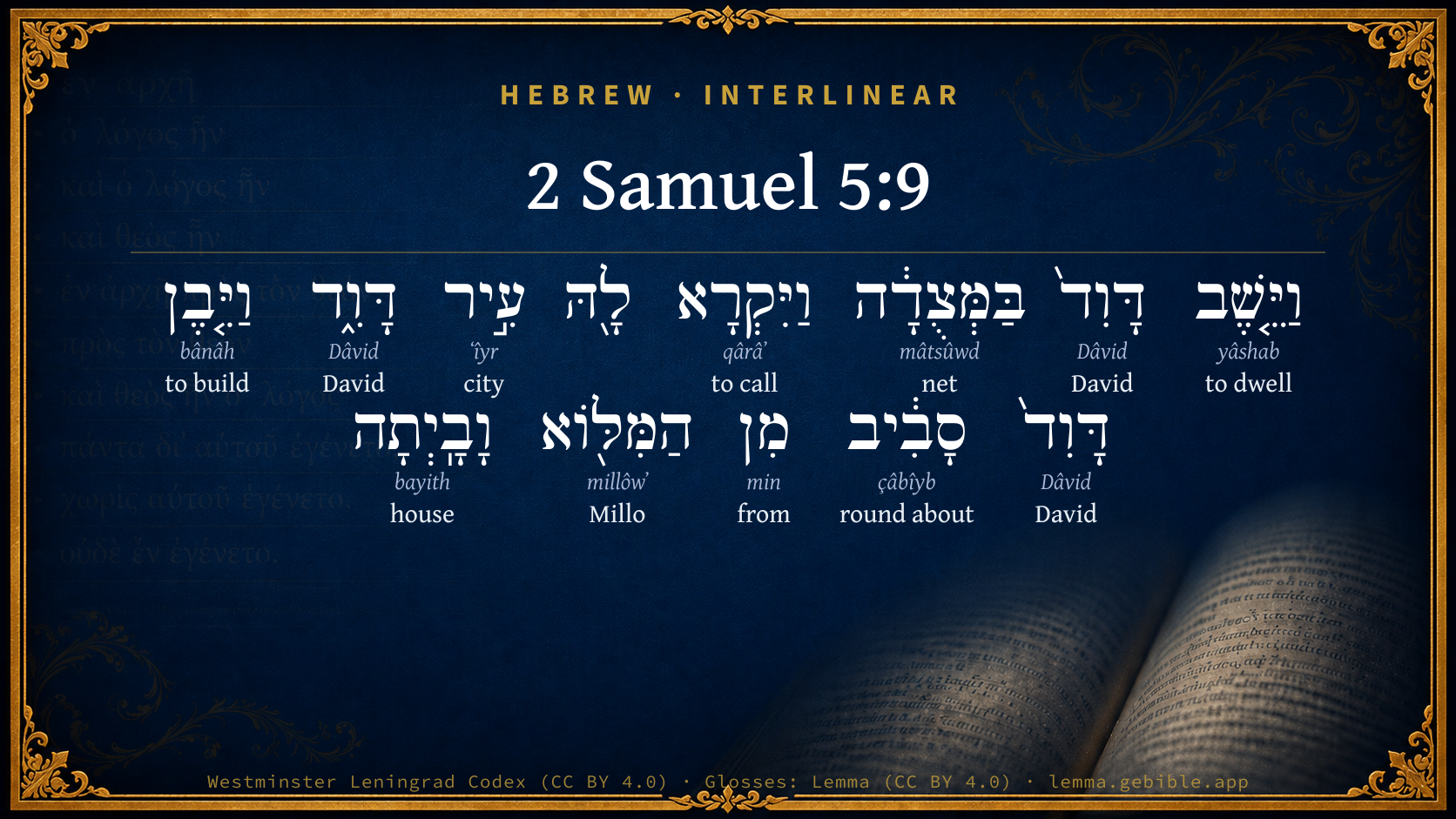
  1. וַיֵּ֤שֶׁב yâshab H3427 “and · to dwell” Conjunction + Verb, Qal, Sequential Imperfect, 3rd Person, Masculine, Singular
  2. דָּוִד֙ Dâvid H1732 “David” Noun, Proper
  3. בַּמְּצֻדָ֔ה mâtsûwd H4686 “in/at the · net” Preposition, Determined + Noun, Common, Both, Singular, Absolute
  4. וַיִּקְרָא qârâʼ H7121 “and · to call” Conjunction + Verb, Qal, Sequential Imperfect, 3rd Person, Masculine, Singular
  5. עִ֣יר ʻîyr H5892 “city of” Noun, Common, Feminine, Singular, Construct
  6. דָּוִ֑ד Dâvid H1732 “David” Noun, Proper
  7. וַיִּ֤בֶן bânâh H1129 “and · to build” Conjunction + Verb, Qal, Sequential Imperfect, 3rd Person, Masculine, Singular
  8. דָּוִד֙ Dâvid H1732 “David” Noun, Proper
  9. סָבִ֔יב çâbîyb H5439 “round about” Noun, Common, Both, Singular, Absolute
  10. מִן min H4480 “from” Preposition
  11. וָבָֽיְתָה bayith H1004 “and · house · toward” Conjunction + Noun, Common, Masculine, Singular, Absolute + Suffix, Demonstrative

About this verse

These counts appear in no published source. They are computed here, from the morphology-tagged text and Lemma’s own curated glosses. What Lemma adds →

13
words
10
distinct lemmas
Historical
section

Notable vocabulary

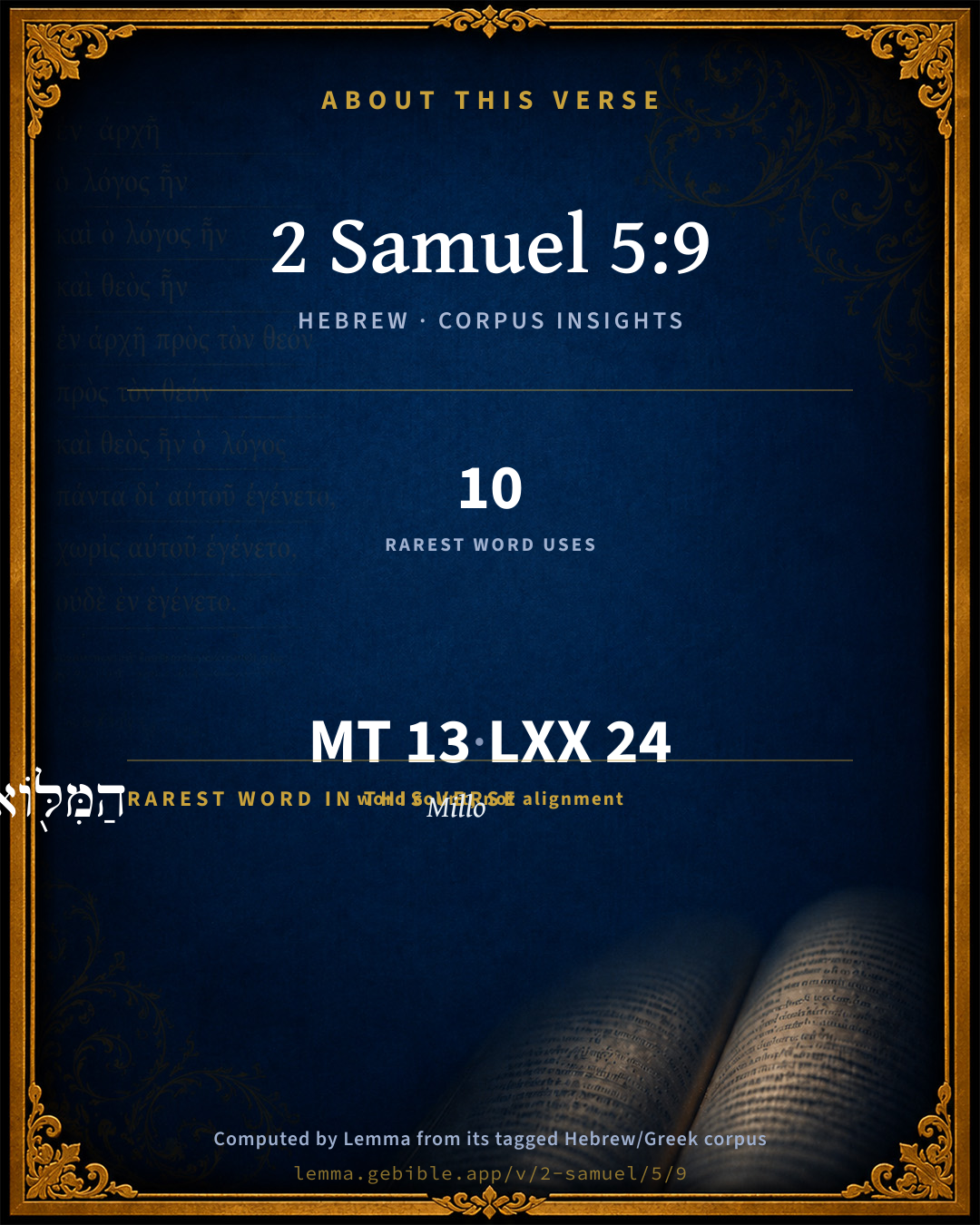
The rarest word here is הַמִּלּ֖וֹא Millo H4407 — appearing just 10 times in the whole Hebrew Bible.

Shared distinctive vocabulary

הַמִּלּ֖וֹא Millo H4407 occurs in 9 verses of the Hebrew Bible. Also found in:

Grammatical profile

  • 3 verbs
  • 8 nouns
  • 2 prepositions

Verb forms

  • וַיֵּ֤שֶׁב Qal · Sequential Imperfect
  • וַיִּקְרָא Qal · Sequential Imperfect
  • וַיִּ֤בֶן Qal · Sequential Imperfect

Repetition

A word recurs within this verse — often emphatic in Hebrew:

  • דָּוִד֙ David H1732 ×3

Hebrew & Septuagint length

In English translation the verse runs 20 words from the Hebrew and 31 from the Septuagint (LXX English) — the Septuagint runs noticeably longer here. See the side-by-side →

A rough comparison of the two English renderings, which tokenize alike — not a word-level alignment.

Word counts can differ between the Hebrew and the Greek without any difference in meaning — e.g. the Hebrew direct-object marker אֵת has no separate Greek word, and Greek often adds the article ὁ.

In the original languages it is 13 Hebrew tokens and 24 Greek tokens — but the two are counted differently (Hebrew bundles its prefixes and suffixes into one token; the Greek is in lemma form), so that isn’t a like-for-like length.

Cross-references

8

Topical passages linked to 2 Samuel 5:9 in the Treasury of Scripture Knowledge — connected by theme and wording, ordered by reader-vote popularity; previews shown in the World English Bible.

  • 1 Kings 9:15 This is the reason of the levy which king Solomon raised, to build the house of Yahweh, and his own house, and Millo, and the wall of Jerusalem, and Hazor, and Megiddo, and Gezer.
  • 1 Kings 9:24 But Pharaoh's daughter came up out of the city of David to her house which [Solomon] had built for her: then did he build Millo.
  • 2 Samuel 5:7 Nevertheless David took the stronghold of Zion; the same is the city of David.
  • 1 Kings 11:27 This was the reason why he lifted up his hand against the king: Solomon built Millo, and repaired the breach of the city of David his father.
  • 2 Chronicles 32:5 He took courage, and built up all the wall that was broken down, and raised [it] up to the towers, and the other wall outside, and strengthened Millo [in] the city of David, and made weapons and shields in abundance.
  • Judges 9:20 but if not, let fire come out from Abimelech, and devour the men of Shechem, and the house of Millo; and let fire come out from the men of Shechem, and from the house of Millo, and devour Abimelech.
  • 1 Chronicles 11:8 He built the city round about, from Millo even round about; and Joab repaired the rest of the city.
  • Judges 9:6 All the men of Shechem assembled themselves together, and all the house of Millo, and went and made Abimelech king, by the oak of the pillar that was in Shechem.

Cross-references courtesy of OpenBible.info (CC BY 4.0).

Hebrew and Greek witnesses Masoretic Hebrew ↔ Greek Septuagint

The same verse in the two great witnesses to the Old Testament, shown verse-for-verse.

Here the Septuagint runs noticeably longer than the Hebrew — LXX2012 (modern English Septuagint) 31 words vs World English Bible 20. A rough length comparison of the two English translations, not a word-level alignment — read both below.

These are two independent witnesses, not word-aligned to each other, and the Septuagint is shown in lemma (dictionary) form.

Hebrew 2 Samuel 5:9 Masoretic · Westminster Leningrad Codex

וַיֵּ֤שֶׁב דָּוִד֙ בַּמְּצֻדָ֔ה וַיִּקְרָא לָ֖הּ עִ֣יר דָּוִ֑ד וַיִּ֤בֶן דָּוִד֙ סָבִ֔יב מִן הַמִּלּ֖וֹא וָבָֽיְתָה

David lived in the stronghold, and called it the city of David. David built round about from Millo and inward.

World English Bible · Public Domain

Greek LXX 2 Samuel 5:9 Septuagint · lemma form

καί καταἵζω δαυίδ ἐν ὁ περιοχή καί καλέω οὗτος ὁ πόλις δαυίδ καί οἰκοδομέω ὁ πόλις κύκλος ἀπό ὁ ἄκρα καί ὁ οἶκος αὐτός

And David lived in the hold, and it was called the city of David, and he built the city itself round about from the citadel, and he built his own house.

LXX2012 (modern English Septuagint) · Public Domain

On this verse, Haydock's Catholic Bible Commentary discusses the Septuagint’s reading. Read the note in Commentary ↓

Hebrew: Westminster Leningrad Codex (CC BY 4.0). Greek: Septuagint (public domain); English from LXX2012 (modern English Septuagint) (Public Domain). How the Septuagint differs from the Hebrew →

Targum (Aramaic paraphrase)

1

The Targum is the ancient Jewish Aramaic paraphrase of the Hebrew Scriptures — an interpretive translation, not the Hebrew text itself. Onkelos (literal) and Pseudo-Jonathan (expansive) render the Torah, and Jonathan the Prophets. Coverage is partial: where no permissively-licensed English translation exists for a verse, only the Aramaic is shown. This is verse-level text, not a word-by-word alignment to the Hebrew.

  1. Targum Jonathan Prophets (Joshua–Malachi)
    וְיָתִיב דָוִד בִּחַקְרָא וּקְרָא לָהּ קַרְתָּא דְדָוִד וּבְנָא דָוִד סְחוֹר סְחוֹר מִן מַלְיָתָא וּלְגָיו:

    (no public-domain English translation for this verse)

    Targum Jonathan — Aramaic: “Mikraot Gedolot” (public domain). English: “Sefaria Community Translation” (CC0 1.0 (public-domain dedication)); “London "Chaldee Paraphrase," 1871” (public domain). Text via Sefaria.

Commentary

Notes on 2 Samuel 5:9 from classic Christian and Jewish commentators (each source and its license shown beneath its notes). The classic Christian expositions comment on the surrounding passage and are grouped to its opening verse, so a note may address several verses; the Jewish commentaries on the Tanakh (Rashi and others) are per-verse, so they appear only where the commentator wrote on this verse.

Lemma curates 59 commentaries, every one of them public domain or Creative Commons licensed, each selected and text-cleaned for this edition rather than reprinted as found. About our sources →

Trapp's Complete Commentary

John Trapp

2Sa 5:9 So David dwelt in the fort, and called it the city of David. And David built round about from Millo and inward.

Ver. 9. So David dwelt in the fort.] After that he had slain all the old inhabitants, save one Araunah, saith Josephus, who afterwards proved his very friend.

And called it, The city of David.] As Constantine called Bizantium Constantinople, after his own name: making it likewise the metropolis and seat of the empire.

And David built round about, from Millo.] A certain tower or fortress. {2Ch 32:5} All the inside of the city David rebuilt, leaving the care of building the walls to Joab. {1Ch 11:8}

John Trapp, A Commentary or Exposition upon All the Books of the Old and New Testament (1647–1656) — public domain. Text from a community e-Sword module.

Joseph Benson's Commentary

2Sa 5:9-10. From Millo — Which seems to have been the town-hall, or state-house, near the wall of the city of Zion; or, as some think, a tower or armory. The Lord God of hosts was with him — This was the cause of his great prosperity, that God, who commands all the armies of heaven and earth, directed and blessed him in all his enterprises.

Joseph Benson's Commentary on the Old and New Testaments (1811–1818) — public domain. Text from a community e-Sword module.

Tyndale Open Study Notes

Tyndale Open Resources

5:9 made the fortress his home: Jerusalem was a practical place from which David could effectively administer the extended kingdom. It was a centrally located neutral city on the border between Judah and the northern territories, and its natural fortifications and water tunnel were useful in case of siege. • the supporting terraces: See study note on 1 Kgs 9:15.

Tyndale Open Study Notes — © Tyndale Open Resources, licensed CC BY-SA 4.0. Text via the HelloAO Bible API.

Geneva Bible (1599)

Geneva Bible translators

He built from the town house round about to his own house, 1 Chron. 11:8.

Geneva Bible (1599) marginal notes — public domain. Text via Bolls.life.

Jamieson, Fausset & Brown

Robert Jamieson, A. R. Fausset & David Brown

David dwelt in the fort, &c.--Having taken it by storm, he changed its name to "the city of David," to signify the importance of the conquest, and to perpetuate the memory of the event.

David built round about from Millo and inward--probably a row of stone bastions placed on the northern side of Mount Zion, and built by David to secure himself on that side from the Jebusites, who still lived in the lower part of the city. The house of Millo was perhaps the principal corner tower of that fortified wall.

Jamieson, Fausset & Brown — Commentary Critical and Explanatory on the Whole Bible (1871) — public domain (CC PDM 1.0). Text via the HelloAO Bible API.

Ellicott's Commentary for English Readers

(9) The fort.—The same word as strong hold in 2Sa_5:7.

Millo.—A word always used in Hebrew with the definite article (except in Jdg_9:6; Jdg_9:20), the Millo. It is probably an old Canaanitish name for the fortification on the northern end of Mount Zion, “inward” from which the palace was situated. Subsequent kings, as Solomon (1Ki_11:27) and Hezekiah (2Ch_32:5), saw its importance and added to its strength. On all other sides Zion was protected by precipitous ravines. There is, however, some difference of opinion about the topography of ancient Jerusalem.

A Bible Commentary for English Readers, edited by Charles John Ellicott (1878–1897) — public domain. Text from a community e-Sword module.

The Cambridge Bible for Schools and Colleges

gen. ed. J. J. S. Perowne

9. in the fort] In the strong hold, the same word as in 2Sa_5:7, and in 1Ch_11:5 (E. V. castle).

Millo] The Millo. See Additional Note VI., p. 241.

and inward] Within or under the protection of the Millo, which was the outermost defence of the city.

Chron. adds “And Joab repaired the rest of the city.”

The Cambridge Bible for Schools and Colleges (gen. ed. J. J. S. Perowne; Cambridge University Press, 1878–1918) — public domain. Text from a community e-Sword module.

John Gill's Exposition

So David dwelt in the fort,.... The strong hold of Zion, which he took:

and called it the city of David; from his own name, to keep up the memory of his taking it, and of his habitation in it:

and David built round about, from Millo and inward; built a wall about it, and enlarged the place, increased the buildings both within and without. Millo is supposed to be a ditch round the fort, full of water, from whence it had its name; or was a large hollow place which divided the fort from the lower city, and which afterwards Solomon filled up, and made it a level, and therefore is called so here by anticipation; though Jarchi says it was done by David. According to Dr. Lightfoot (o), it was a part or Sion, or some hillock, east up against it on the west side; his first sense is best, Millo being no other than the fortress or citadel; which, as Josephus says (p), David joined to the lower city, and made them one body, and erecting walls about it made Joab superintendent of them; and this was the "round about", or circuit, which David made, reaching from Millo, or the citadel, to that again, which is meant by "inward", or "to the house" (q), as it should be rendered; that is, to the house of Millo, as in Kg2 12:20; and so it is said Ch1 11:8; that David built the city "from Millo round about"; that is, to the same place from whence he began (r).

(o) Works, vol. 2. Chorograph. Cent. c. 24. p. 25. (p) Antiqu. l. 7. c. 3. sect. 2. (q) "et ad domum". (r) See Dr. Kennicott, ut supra, (Dissert. 1.) p. 49, &c.

John Gill's Exposition of the Whole Bible (1746–1763) — public domain (CC PDM 1.0). Text via the HelloAO Bible API.

Albert Barnes' Notes on the Bible

David dwelt in the fort - or stronghold, (as in 2Sa 5:7) i. e. eventually, when the buildings were completed, which may not have been for two or three years. Millo appears to have been a fortress of some kind, the northern defense of the city of David, and to have been a part of the original Canaanite defenses of Zion, as appears probable also from there having been a fortress called the house of Millo in the Canaanite city of Shechem. (Jdg 9:6 note, and 2Sa 9:1-13 :20.) Millo may be the native name. Some identify it with the great platform called the Haram es Sherif.

David built round about - Probably meaning built his own house and other houses and streets, all, in short, that caused it to be coiled the city of David. (Compare 1Ch 11:8.) The buildings were within, on the south of Millo, so as to be protected by it on the north, as they were east, west. and south, by the precipitous ravines.

Albert Barnes' Notes on the Bible (1834–1885) — public domain. Text from a community e-Sword/MySword module.

Haydock's Catholic Bible Commentary

Inwards. He built or repaired the higher "city of David," beginning at Mello, to "fill up" the valley, which Solomon finished, and adorned with a palace, 3 Kings ix. 15., and 4 Kings xii. 20. The place is probably called Asaramel, 1 Machabees xiv. 27. (Calmet) --- Septuagint and Josephus generally understand Mello to designate the citadel of Sion, or "a complete fortification," to defend the city. Instead of inwards, the Septuagint have, "and his house." But ubithe means, "and to the house," temple, or fort, whence he began the enclosure, so as to make a complete communication. (Kennicott) --- This city became "the most famous in all the East." (Pliny, [Natural History?] v. 14.) --- "Walls, built in a crooked manner, according to the rules of art, enclosing two hills, immensely high." (Tacitus, Hist. v.) --- These hills were multiplied, on account of their different summits, so that Josephus speaks of five hills. The palace of David stood on Sion, the temple on Moria, which was a part of it still more elevated, towards the east. The other hill is often called Acra, by Josephus, and lay southward of Sion. Here the ancient town of Jebus was built. The Machabees took in an adjoining eminence. (Josephus, Jewish Wars vi. 6.) --- Bethsetta, or the new city, was afterwards enclosed. Herod adorned the city with may superb monuments, both of a public and of a private nature. (Calmet) --- We read of ten gates, and of four towers, belonging to this city. It was not well supplied with water, and what it had was brackish. The walls seem never to have exceeded four and a half miles; now they are only three, and include Mount Calvary, which was formerly no part of the city. Button says a valley run from west to east, between the two hills of Zion on the south, and Acra on the north; which contradicts the former statement. (Haydock) --- Villalpand supposes that the citadel was nine and a half stadia, and all the city thirty-five stadia in circumference, eight of which make an Italian mile. (Menochius)

George Leo Haydock (1774–1849), Haydock's Catholic Family Bible and Commentary, 1859 edition — public domain. Excludes Psalms (Douay-Rheims chapter numbering differs from Protestant) and Deuterocanonical books (Catholic canon only).

Matthew Poole's English Annotations

Millo seems to have been some large and well fortified building, Jdg 9:6; 2Ch 32:5, adjoining or near to the wall of the city of Zion.

Matthew Poole's English Annotations on the Holy Bible (1683–1685) — public domain. Text from a community e-Sword/MySword module.

Whedon's Commentary on the Bible

Daniel D. Whedon

9. Built round about from Millo and inward — Millo was a fortress or rampart of ancient Zion, apparently so called from having been filled in (מלא) with earth and stones. The article connected with the Hebrew word serves to designate it as some well known fortress, and it was evidently a noted stronghold before the city was occupied by David. It was afterwards built up again and strengthened by Solomon, (1Ki_9:15; 1Ki_9:24; 1Ki_11:27,) and later still by Hezekiah. 2Ch_32:5. It seems to have been situated on the northern side of Zion, where the natural defences were less strong than on the other sides; and from it, as a bulwark, David built all round the northern side a strong wall, and fortified it inward towards the south, so as to make it more secure against assault than it had ever been before.

Daniel D. Whedon (gen. ed.), Commentary on the Old and New Testaments (1874–1909) — public domain. Text from a community e-Sword module.

The Pulpit Commentary

David dwelt in the fort. It was the stronghold or citadel of Zion which David took for his abode; but as he needed space for the dwellings of his mighty men, and for those who would soon flock for trade and security to the capital, David proceeded to fortify the whole of the summit. His works began from "the Millo," rendered "the citadel" by the LXX Many, deriving the name from a Hebrew root signifying to fill, thinkthat it was a mound, but Nature had herself supplied fit heights for defence, and it is evident that the place was called "the Millo" when David captured the city. We find "Beth-Millo" also in Jud_1:9:6, 20, where it signifies those who held the citadel of Shechem; and this Mills at Jerusalem was without doubt the old Jebusite keep, and the explanation of its name must be sought in the Jebusite language. As it formed one of the strongest defences of the city, it was rebuilt by Solomon, (1Ki_9:24 1Ki_11:27) and repaired by Hezekiah (2Ch_32:5) in preparation for the Assyrian attack. Probably it stood at a corner, whence the phrase, "round about from the Millo and inward," or, as it is expressed in 1Ch_11:8, "from the Millo inward," that is, starting from. the Millo, the walls enclosed the space behind it. In the parallel place (1Ch_11:8) we find an interesting addition to the narrative, namely, that "Joab repaired the rest of the city." It appears from this that the Jebusites had occupied a good deal of the ground with their habitations, though probably the number of the tribe was not great; or possibly there remained old buildings which were the remains of the Hittite city, and which, being of massive construction, were easily made fit once again for human habitation. We see also proof of Joab"s great ability in peace as well as in war. He it was who had captured the stronghold, and it was now his office to arrange the streets and plan of the city, and to assign dwellings to David"s mighty men. This would be a work sure to cause jealousy and heart burnings, and no one but Joab, their old commander, could have satisfied them. We find that he assigned to one of them, Uriah the Hittite, a space of ground for a dwelling close to the royal palace. We may suppose, then, that David was now fully reconciled to the "hard sons of Zeruiah", (2Sa_3:39) and in the stern wars which followed David"s election, he needed and had the full benefit of their vigour and ability.

The Pulpit Commentary (1880–1919), ed. H.D.M. Spence-Jones & Joseph S. Exell — public domain. Text from a community e-Sword module.

John Wesley's Explanatory Notes

Millo - Which seems to have been the town-hall or, state-house, near the wall of the city of Zion.

John Wesley, Explanatory Notes Upon the Whole Bible (1754–1765) — public domain. Text via the GEBible commentary corpus.

Rashi

Rabbi Shlomo Yitzchaki (Rashi)

From it's low wall and inwards. A surrounding low wall; they would fill it up with earth, the summit of the mound would be in it's middle, and it would slant in all directions, that is called a מלוא, and Dovid built houses on [the wall]. That low wall surrounded the fortress.

Rashi on the Tanakh — English translations: “The Judaica Press complete Tanach with Rashi, translated by A. J. Rosenberg” (CC BY 4.0); “Pentateuch with Rashi's commentary by M. Rosenbaum and A.M. Silbermann, 1929-1934” (public domain); “The Metsudah Tanach series, Lakewood, N.J” (CC BY 4.0); and “The Book of Joshua, Metsudah Publications, 1997” (CC BY 4.0). Text via Sefaria.

Lesson kit

Teaching starters — assembled from the data on this page, not authored interpretation. Every prompt links to the verse data it draws on. Edit before teaching.

2 Samuel, in the Historical, opens this verse with 13 words (10 distinct Hebrew lemmas). Its most distinctive word is millôwʼ (“Millo”). The Greek Septuagint runs longer here. A historical commentator’s framing appears above. Read the whole chapter for the surrounding context.

Discussion questions

  1. What does “Millo” (millôwʼ) contribute to the verse as a whole?
  2. How does Judges 9:6, which shares the word «Millo», read alongside this verse?
  3. What does the repetition of “David” (3× in this one verse) do in this verse?
  4. The Septuagint runs longer here than the Hebrew. What might account for the difference?
  5. These translations render this verse differently. What is at stake in choosing one wording over another?
  6. «וַיֵּ֤שֶׁב» is a Qal Sequential Imperfect verb. How does that grammatical form shape the action described?
  7. Compare how Trapp's Complete Commentary and Joseph Benson's Commentary read this verse. Where do they agree or differ?

Things to notice

Reading settings

Reading text

Shown beneath each verse's original-language words.

Old Testament
Old Testament edition

Read the OT as the Masoretic Hebrew (MT) or the Greek Septuagint (LXX).

English shown for the Greek Septuagint (in the Hebrew ↔ Greek comparison).

Comparing translations? Open the Compare panel on any verse page to stack up to four side by side.