
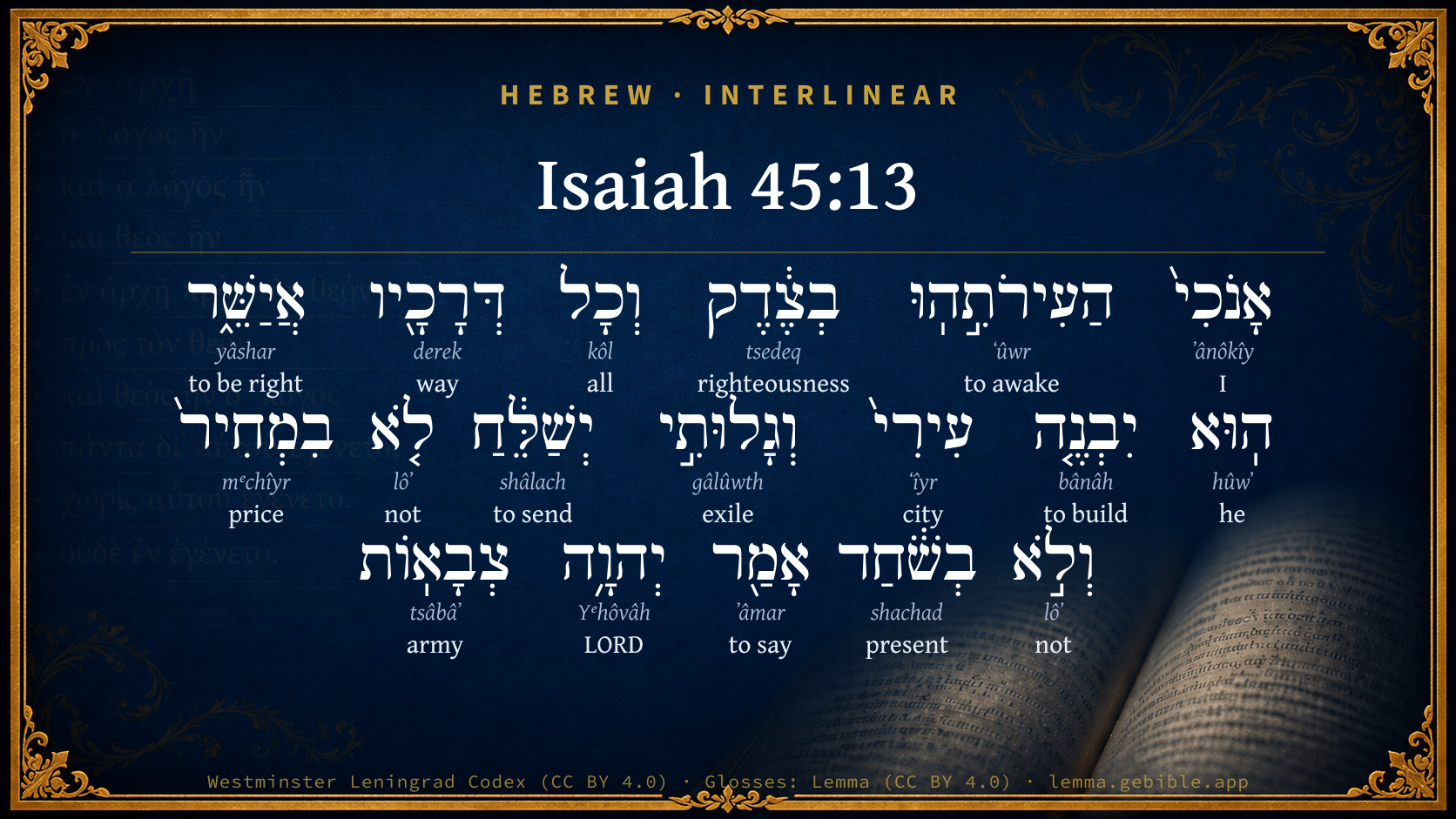
Isaiah 45:13

Hebrew (Westminster Leningrad Codex) Isaiah 45:13 appears in the Hebrew Old Testament. The text above is from the Westminster Leningrad Codex. Each word links to its Strong’s number, a concise gloss, and parsing drawn from the Open Scriptures Hebrew Bible morphology. Click any word for its full Brown-Driver-Briggs (BDB) entry.
Download image
Cite this verse

Isaiah 45:13 (World English Bible). Public Domain. Lemma interlinear Bible study tool, https://lemma.gebible.app/v/isaiah/45/13.

Show BibTeX & RIS
BibTeX
RIS
English Translation
I have raised him up in righteousness, and I will make straight all his ways: he shall build my city, and he shall let my exiles go free, not for price nor reward, says Yahweh of Hosts.
World English Bible · Public Domain
Download a study sheet

One document with this verse’s original text, its word-by-word gloss line, the meaning frame, cross-references with their text, attributed commentary, and full source and license credits — printable, and it pastes into notes with its structure intact.

This verse Autodidact and up

Study sheet (.html) Plain text (.txt)

A passage Seminary Student

Up to 50 verses in one chapter. A passage sheet keeps up to 6 commentary sources and 12 cross-references per verse, in the order this page ranks them, and says so on the sheet whenever that leaves anything out. Ask for a single verse and you get the Autodidact verse sheet above.

Everything on this page stays free to read, with no account — the sheet is a download of what is already on screen, not access to it.

Want to remove ads? Support Godless Engineer
Compare translations 3

The same verse in 3 English versions, stacked beneath the original-language interlinear above. Click any original word for its lexicon entry.

Each is an independent rendering of the whole verse — the interlinear is not word-aligned to these translations.

Highlighted words mark where these versions differ — a whole-verse word diff, not a word-by-word alignment.

  • World English Bible Public Domain
    I have raised him up in righteousness, and I will make straight all his ways: he shall build my city, and he shall let my exiles go free, not for price nor reward, says Yahweh of Hosts.
  • King James Version Public Domain
    I have raised him up in righteousness, and I will direct all his ways: he shall build my city, and he shall let go my captives, not for price nor reward, saith the LORD of hosts.
  • unfoldingWord Literal Text CC BY-SA 4.0
    I, I have awakened him in righteousness, and I will straighten all of his ways. He, he will build my city, and my captivity he will send out, not for a price and not for a bribe,” says Yahweh of Armies.

unfoldingWord Literal Text — © unfoldingWord, licensed CC BY-SA 4.0. Word-aligned USFM3 via Door43 (git.door43.org/unfoldingWord/en_ult).

Versions to compare (up to 4)

3 of 4 selected

Show all 18 translations

Every available English version of this verse, each an independent rendering of the whole verse.

  • World English Bible Public Domain
    I have raised him up in righteousness, and I will make straight all his ways: he shall build my city, and he shall let my exiles go free, not for price nor reward, says Yahweh of Hosts.
  • Berean Standard Bible Public Domain
    I will raise up Cyrus in righteousness, and I will make all his ways straight. He will rebuild My city and set My exiles free, but not for payment or reward, says the LORD of Hosts.”
  • Majority Standard Bible Public Domain
    I will raise up Cyrus in righteousness, and I will make all his ways straight. He will rebuild My city and set My exiles free, but not for payment or reward, says the LORD of Hosts.”
  • King James Version Public Domain
    I have raised him up in righteousness, and I will direct all his ways: he shall build my city, and he shall let go my captives, not for price nor reward, saith the LORD of hosts.
  • American Standard Version (1901) Public Domain
    I have raised him up in righteousness, and I will make straight all his ways: he shall build my city, and he shall let my exiles go free, not for price nor reward, saith Jehovah of hosts.
  • Revised Version (1885) Public Domain
    I have raised him up in righteousness, and I will make straight all his ways: he shall build my city, and he shall let my exiles go free, not for price nor reward, saith the LORD of hosts.
  • Geneva Bible (1599) Public Domain
    I haue raised him vp in righteousnesse, and I will direct all his wayes: he shall build my citie, and he shall let goe my captiues, not for price nor rewarde, saith the Lord of hostes.
  • Douay-Rheims (1899) Public Domain
    I have raised him up to justice, and I will direct all his ways: he shall build my city, and let go my captives, not for ransom, nor for presents, saith the Lord the God of hosts.
  • Young's Literal Translation Public Domain
    I have stirred him up in righteousness, And all his ways I make straight, He doth build My city, and My captivity doth send out, Not for price, nor for bribe, said Jehovah of Hosts.
  • Literal Standard Version CC BY-SA 4.0
    I have stirred him up in righteousness, || And I make all his ways straight, || He builds My city, and sends out My captivity, || Not for price, nor for bribe,” said YHWH of Hosts.
  • Unlocked Literal Bible CC BY-SA 4.0
    I stirred Cyrus up in righteousness, and I will smooth out all his paths. He will build my city; he will let my exiled people go home, and not for price nor bribe,'” says Yahweh of hosts.
  • unfoldingWord Literal Text CC BY-SA 4.0
    I, I have awakened him in righteousness, and I will straighten all of his ways. He, he will build my city, and my captivity he will send out, not for a price and not for a bribe,” says Yahweh of Armies.
  • Darby Bible Public Domain
    It is I that have raised him up in righteousness, and I will make all his ways straight: he shall build my city, and he shall let go my captives, not for price nor reward, saith Jehovah of hosts.
  • World Messianic Bible Public Domain
    I have raised him up in righteousness, and I will make all his ways straight. He shall build my city, and he shall let my exiles go free, not for price nor reward,” says the LORD of Hosts.
  • Webster's Bible Public Domain
    I have raised him up in righteousness, and I will direct all his ways: he shall build my city, and he shall let go my captives, not for price nor reward, saith the LORD of hosts.
  • Free Bible Version CC BY-SA 4.0
    Because I do what's right, I will encourage him and smooth out all the roads he takes. He will rebuild my city and will set my exiles free without being paid or bribed to do so, says the Lord Almighty.
  • Bible in Basic English Public Domain
    I have sent him out to overcome the nations, and I will make all his ways straight: I will give him the work of building my town, and he will let my prisoners go free, without price or reward, says the Lord of armies.
  • JPS Tanakh (1917) Public Domain
    I have roused him up in victory, and I make level all his ways; he shall build My city, and he shall let Mine exiles go free, not for price nor reward, saith the LORD of hosts.

Literal Standard Version (2020), Covenant Press — licensed CC BY-SA 4.0. Text via the HelloAO Bible API (eBible.org). Unlocked Literal Bible (unfoldingWord) — licensed CC BY-SA 4.0. Text via the HelloAO Bible API (eBible.org). unfoldingWord Literal Text — © unfoldingWord, licensed CC BY-SA 4.0. Word-aligned USFM3 via Door43 (git.door43.org/unfoldingWord/en_ult). Free Bible Version, Dr. Jonathan Gallagher — licensed CC BY-SA 4.0. Text via the HelloAO Bible API (eBible.org).

Word by word

More ways to search: Search by grammar → Find every occurrence → Compare this word →

Practice this passage: Drill this verse → Learn its vocabulary →

וְגָלוּתִ֣י
gâlûwth
H1546
“and · exile · my”
Conjunction + Noun, Common, Feminine, Singular, Construct + Suffix, Personal, 1st Person, Common, Singular
Part of Speech
Conjunction + Noun
Type
Common
Gender
Feminine
Number
Singular
State
Construct
Full BDB Definition

Origin: from H1540

TWOT: 350b

exile, exiles - (TWOT) captivity
  1. אָנֹכִי֙ ʼânôkîy H595 “I” Pronoun, Personal, 1st Person, Common, Singular
  2. הַעִירֹתִ֣הֽוּ ʻûwr H5782 “to awake · him” Verb, Hiphil, Perfect, 1st Person, Common, Singular + Suffix, Personal, 3rd Person, Masculine, Singular
  3. בְצֶ֔דֶק tsedeq H6664 “in/at · righteousness” Preposition + Noun, Common, Masculine, Singular, Absolute
  4. וְכָל kôl H3605 “and · all of” Conjunction + Noun, Common, Masculine, Singular, Construct
  5. דְּרָכָ֖יו derek H1870 “ways · his” Noun, Common, Both, Plural, Construct + Suffix, Personal, 3rd Person, Masculine, Singular
  6. אֲיַשֵּׁ֑ר yâshar H3474 “to be right” Verb, Piel, Imperfect, 1st Person, Common, Singular
  7. הֽוּא hûwʼ H1931 “he” Pronoun, Personal, 3rd Person, Masculine, Singular
  8. יִבְנֶ֤ה bânâh H1129 “to build” Verb, Qal, Imperfect, 3rd Person, Masculine, Singular
  9. עִירִי֙ ʻîyr H5892 “city · my” Noun, Common, Feminine, Singular, Construct + Suffix, Personal, 1st Person, Common, Singular
  10. יְשַׁלֵּ֔חַ shâlach H7971 “to send” Verb, Piel, Imperfect, 3rd Person, Masculine, Singular
  11. לֹ֤א lôʼ H3808 “not” Particle, Negative
  12. בִמְחִיר֙ mᵉchîyr H4242 “in/at · price” Preposition + Noun, Common, Masculine, Singular, Absolute
  13. וְלֹ֣א lôʼ H3808 “and · not” Conjunction + Particle, Negative
  14. בְשֹׁ֔חַד shachad H7810 “in/at · present” Preposition + Noun, Common, Masculine, Singular, Absolute
  15. אָמַ֖ר ʼâmar H559 “to say” Verb, Qal, Perfect, 3rd Person, Masculine, Singular
  16. יְהוָ֥ה Yᵉhôvâh H3068 “LORD” Noun, Proper
  17. צְבָאֽוֹת tsâbâʼ H6635 “armies” Noun, Common, Both, Plural, Absolute

About this verse

These counts appear in no published source. They are computed here, from the morphology-tagged text and Lemma’s own curated glosses. What Lemma adds →

18
words
17
distinct lemmas
Prophets
section

Notable vocabulary

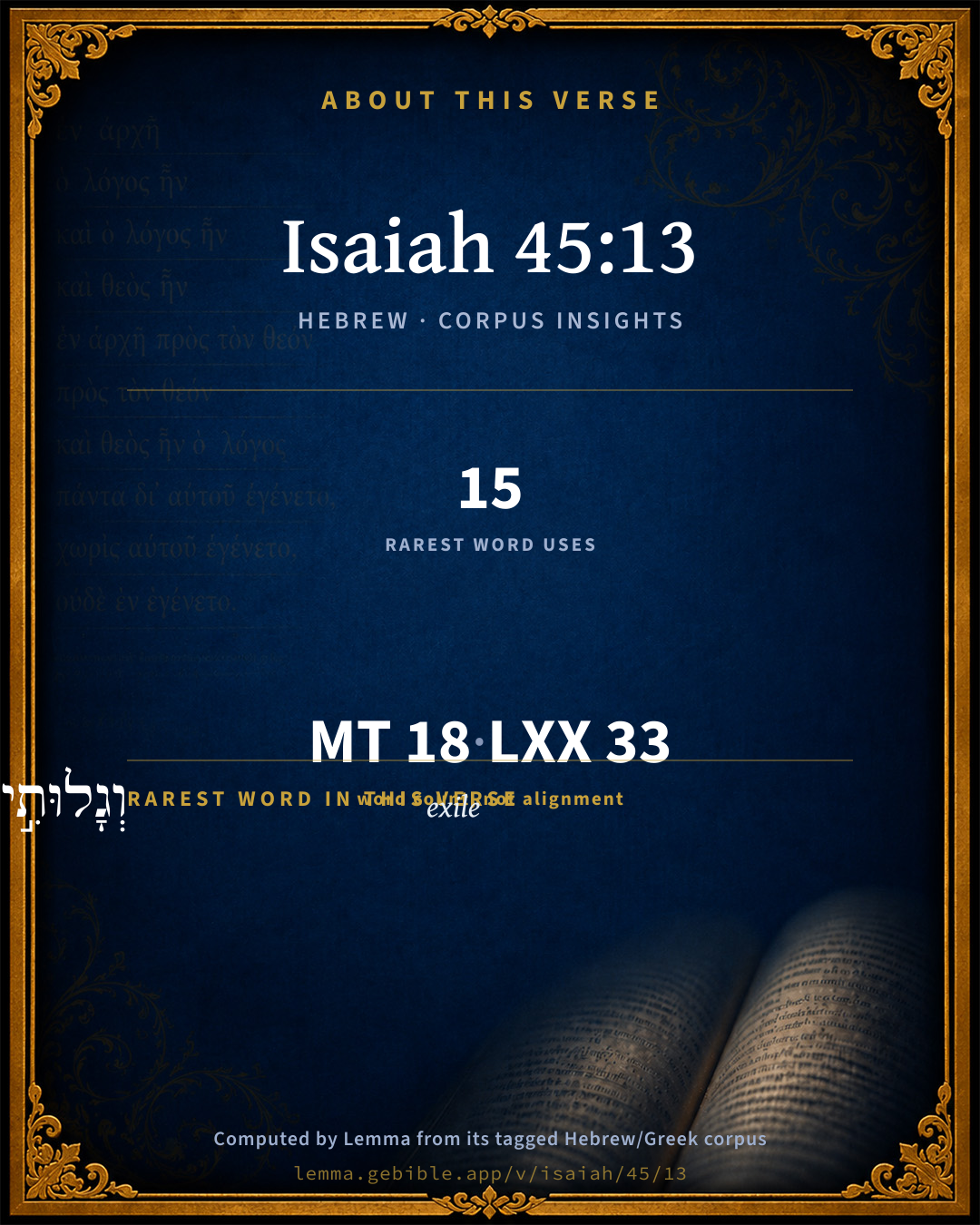
The rarest word here is וְגָלוּתִ֣י exile H1546 — appearing just 15 times in the whole Hebrew Bible.

Shared distinctive vocabulary

וְגָלוּתִ֣י exile H1546 occurs in 14 verses of the Hebrew Bible. Also found in:

Grammatical profile

  • 5 verbs
  • 9 nouns
  • 2 pronouns
  • 2 particles

Verb forms

  • הַעִירֹתִ֣הֽוּ Hiphil · Perfect
  • אֲיַשֵּׁ֑ר Piel · Imperfect
  • יִבְנֶ֤ה Qal · Imperfect
  • יְשַׁלֵּ֔חַ Piel · Imperfect
  • אָמַ֖ר Qal · Perfect

Repetition

A word recurs within this verse — often emphatic in Hebrew:

Hebrew & Septuagint length

In English translation the verse runs 37 words from the Hebrew and 41 from the Septuagint (LXX English) — closely comparable.

A rough comparison of the two English renderings, which tokenize alike — not a word-level alignment.

Word counts can differ between the Hebrew and the Greek without any difference in meaning — e.g. the Hebrew direct-object marker אֵת has no separate Greek word, and Greek often adds the article ὁ.

In the original languages it is 18 Hebrew tokens and 33 Greek tokens — but the two are counted differently (Hebrew bundles its prefixes and suffixes into one token; the Greek is in lemma form), so that isn’t a like-for-like length.

Cross-references

14

Topical passages linked to Isaiah 45:13 in the Treasury of Scripture Knowledge — connected by theme and wording, ordered by reader-vote popularity; previews shown in the World English Bible.

  • Isaiah 41:2 Who has raised up one from the east, whom he calls in righteousness to his foot? he gives nations before him, and makes him rule over kings; he gives them as the dust to his sword, as the driven stubble to his bow.
  • 2 Chronicles 36:22–23 Now in the first year of Cyrus king of Persia, that the word of Yahweh by the mouth of Jeremiah might be accomplished, Yahweh stirred up the spirit of Cyrus king of Persia, so that he made a proclamation throughout all his kingdom, and [put it] also in writing, saying,
  • Isaiah 13:17 Behold, I will stir up the Medes against them, who shall not regard silver, and as for gold, they shall not delight in it.
  • Isaiah 41:25 I have raised up one from the north, and he has come; from the rising of the sun one who calls on my name: and he shall come on rulers as on mortar, and as the potter treads clay.
  • Isaiah 49:25 But thus says Yahweh, Even the captives of the mighty shall be taken away, and the prey of the terrible shall be delivered; for I will contend with him who contends with you, and I will save your children.
  • Isaiah 42:6 I, Yahweh, have called you in righteousness, and will hold your hand, and will keep you, and give you for a covenant of the people, for a light of the Gentiles;
  • Isaiah 46:11 calling a ravenous bird from the east, the man of my counsel from a far country; yes, I have spoken, I will also bring it to pass; I have purposed, I will also do it.
  • Ezra 1:3 Whoever there is among you of all his people, his God be with him, and let him go up to Jerusalem, which is in Judah, and build the house of Yahweh, the God of Israel (he is God), which is in Jerusalem.
  • Psalms 65:5 By awesome deeds of righteousness, you answer us, God of our salvation. You who are the hope of all the ends of the earth, Of those who are far away on the sea;
  • Isaiah 44:28–45:6 Who says of Cyrus, [He is] my shepherd, and shall perform all my pleasure, even saying of Jerusalem, She shall be built; and of the temple, Your foundation shall be laid.
  • Isaiah 48:14–15 Assemble yourselves, all you, and hear; who among them has declared these things? He whom Yahweh loves shall perform his pleasure on Babylon, and his arm [shall be on] the Chaldeans.
  • Isaiah 52:2–3 Shake yourself from the dust; arise, sit [on your throne], Jerusalem: loose yourself from the bonds of your neck, captive daughter of Zion.
  • Isaiah 52:5 Now therefore, what do I here, says Yahweh, seeing that my people is taken away for nothing? those who rule over them do howl, says Yahweh, and my name continually all the day is blasphemed.
  • 1 Peter 1:18–19 knowing that you were redeemed, not with corruptible things, with silver or gold, from the useless way of life handed down from your fathers,

Cross-references courtesy of OpenBible.info (CC BY 4.0).

Hebrew and Greek witnesses Masoretic Hebrew ↔ Greek Septuagint

The same verse in the two great witnesses to the Old Testament, shown verse-for-verse.

These are two independent witnesses, not word-aligned to each other, and the Septuagint is shown in lemma (dictionary) form.

Hebrew Isaiah 45:13 Masoretic · Westminster Leningrad Codex

אָנֹכִי֙ הַעִירֹתִ֣הֽוּ בְצֶ֔דֶק וְכָל דְּרָכָ֖יו אֲיַשֵּׁ֑ר הֽוּא יִבְנֶ֤ה עִירִי֙ וְגָלוּתִ֣י יְשַׁלֵּ֔חַ לֹ֤א בִמְחִיר֙ וְלֹ֣א בְשֹׁ֔חַד אָמַ֖ר יְהוָ֥ה צְבָאֽוֹת

I have raised him up in righteousness, and I will make straight all his ways: he shall build my city, and he shall let my exiles go free, not for price nor reward, says Yahweh of Hosts.

World English Bible · Public Domain

Greek LXX Isaiah 45:13 Septuagint · lemma form

ἐγώ ἀγείρω αὐτός μετά δικαιοσύνη βασιλεύς καί πᾶς ὁ ὁδός αὐτός εὐθύς οὗτος οἰκοδομέω ὁ πόλις ἐγώ καί ὁ αἰχμαλωσία ὁ λαός ἐγώ ἐπιστρέφω οὐ μετά λύτρον οὐδέ μετά δῶρον εἶπον κύριος σαβαωθ

I have raised him up to be a king with righteousness, and all his ways are right: he shall build my city, and shall turn the captivity of my people, not for ransoms, nor for rewards, says the Lord of hosts.

LXX2012 (modern English Septuagint) · Public Domain

On this verse, John Gill's Exposition discusses the Septuagint’s reading. Read the note in Commentary ↓

Hebrew: Westminster Leningrad Codex (CC BY 4.0). Greek: Septuagint (public domain); English from LXX2012 (modern English Septuagint) (Public Domain). How the Septuagint differs from the Hebrew →

Targum (Aramaic paraphrase)

1

The Targum is the ancient Jewish Aramaic paraphrase of the Hebrew Scriptures — an interpretive translation, not the Hebrew text itself. Onkelos (literal) and Pseudo-Jonathan (expansive) render the Torah, and Jonathan the Prophets. Coverage is partial: where no permissively-licensed English translation exists for a verse, only the Aramaic is shown. This is verse-level text, not a word-by-word alignment to the Hebrew.

  1. Targum Jonathan Prophets (Joshua–Malachi)
    אֲנָא אַיְתִינֵהּ בִּגְלֵי בִקְשׁוֹט וְכָל אוֹרְחָתֵהּ אֲתַקֵן הוּא יִבְנֵי קַרְתִּי וְגַלְוַת עַמִי יְשַׁלַח לָא בְדָמִין וְלָא בְּמָמוֹן אֲמַר יְיָ צְבָאוֹת:

    It is I who will verily bring him forth publicly, and all his paths I will direct: he shall build my city, and he shall let the captives of my people go, not for a price nor for money, saith the Lord of hosts.

    Targum Jonathan — Aramaic: “Mikraot Gedolot” (public domain). English: “Sefaria Community Translation” (CC0 1.0 (public-domain dedication)); “London "Chaldee Paraphrase," 1871” (public domain). Text via Sefaria.

Commentary

Notes on Isaiah 45:13 from classic Christian and Jewish commentators (each source and its license shown beneath its notes). The classic Christian expositions comment on the surrounding passage and are grouped to its opening verse, so a note may address several verses; the Jewish commentaries on the Tanakh (Rashi and others) are per-verse, so they appear only where the commentator wrote on this verse.

Lemma curates 59 commentaries, every one of them public domain or Creative Commons licensed, each selected and text-cleaned for this edition rather than reprinted as found. About our sources →

Trapp's Complete Commentary

John Trapp

Isa 45:13 I have raised him up in righteousness, and I will direct all his ways: he shall build my city, and he shall let go my captives, not for price nor reward, saith the LORD of hosts.

Ver. 13. I have raised him up,] i.e., Cyrus. {Ezr 1:1}

And I will direct all his ways,] sc., When he cometh against the Babylonians, Lydians, &c., on mine errand. But when moved by his ambition, he invaded Scythia, and cruelly wasted the country, God took no further charge of him; as I may say, He that is out of God’s precincts, is out of his protection.

John Trapp, A Commentary or Exposition upon All the Books of the Old and New Testament (1647–1656) — public domain. Text from a community e-Sword module.

Geneva Bible (1599)

Geneva Bible translators

To wit, Cyrus, that I may show by him the faithfulness of my promise in delivering my people.

Meaning, freely and without ransom, or any grievous condition.

Geneva Bible (1599) marginal notes — public domain. Text via Bolls.life.

Jamieson, Fausset & Brown

Robert Jamieson, A. R. Fausset & David Brown

him--Cyrus, type of Messiah, who redeems the captives of Satan "without money and without price" (Isa 55:1), "freely" (gratuitously) (Isa 52:3; Isa 61:1; Zac 9:11; Rom 3:24).

in righteousness--to fulfil My righteous purpose (see on Isa 41:2; Isa 42:6; Jer 23:6).

Jamieson, Fausset & Brown — Commentary Critical and Explanatory on the Whole Bible (1871) — public domain (CC PDM 1.0). Text via the HelloAO Bible API.

Adam Clarke's Commentary

Verse 13. I have raised him up] This evidently refers to Cyrus, and to what he did for the Jews; and informs us by whom he was excited to do it.

Adam Clarke's Commentary on the Bible (1810–1826) — public domain. Text from a community e-Sword/MySword module.

Ellicott's Commentary for English Readers

(13) I have raised him up in righteousness . . .—This was the answer to the murmurers. It would be seen by the results, the city rebuilt, the exiles restored to their home, that the conquests of Cyrus had been ordered by the loving righteousness of Jehovah; and he would do this, not through the greed and ambition of other conquerors, but because the spirit of the Lord stirred him (2Ch_36:22).

A Bible Commentary for English Readers, edited by Charles John Ellicott (1878–1897) — public domain. Text from a community e-Sword module.

The Cambridge Bible for Schools and Colleges

gen. ed. J. J. S. Perowne

13. I (again emphatic) have raised him (Cyrus) up in righteousness] i.e. in accordance with a consistent, straightforward and right purpose (cf. ch. Isa_42:6). Cf. also chs. Isa_41:2; Isa_41:25, etc.

he (and no other) shall build my city &c.] See ch. Isa_44:27 f.

not for price nor reward] Lit. “not for hire and not for a bribe.” These words remove a difficulty which would naturally suggest itself to the exiles: viz., that there was no conceivable motive that could induce Cyrus to espouse the cause of Israel. The divine answer is that he will do so from an inward impulse (ὁρμή τις, as Josephus expresses it) inspired by Jehovah. There is an apparent but no real contradiction between this assurance and the idea of ch. Isa_43:3 f. The restoration of Israel is conceived as preceding the Persian conquest of Egypt and Ethiopia (Isa_45:14); that is the reward subsequently given to Cyrus, but not the inducement on which he acted.

The Cambridge Bible for Schools and Colleges (gen. ed. J. J. S. Perowne; Cambridge University Press, 1878–1918) — public domain. Text from a community e-Sword module.

John Gill's Exposition

I have raised him up in righteousness,.... Though this may be said with some respect to Cyrus, yet chiefly to Christ, of whom Cyrus was a type; him the Lord appointed and determined to be the Saviour and Redeemer of his people; him he sent forth in time for that purpose, in righteousness or faithfulness to concerning him: or, "unto righteousness" (s), as the Vulgate Latin version; to bring in an everlasting righteousness for the justification of his people: or, "with righteousness", as the Septuagint version is (t):

I have raised him up a King with righteousness; a righteous King, a King that reigns in righteousness, as Christ does, and better agrees with him than Cyrus; see Jer 23:5,

and I will direct all his ways; or "make them plain" (u); remove all difficulties and obstructions out of his way; he shall succeed and prosper, as the "pleasure of the Lord did prosper" in the hands of Christ; God being at his right hand as man and Mediator, to direct, counsel, and assist him, and to make him successful:

he shall build my city; not Cyrus, for he did not build the city of Jerusalem, whatever orders he might give for it, Isa 44:28 though his proclamation only mentions the temple, Ezr 1:2, but Christ, the builder of the church, often compared to a city, and called the city of God, of which the saints are fellow citizens; and which is built by Christ, upon himself the Rock, against which the gates of hell cannot prevail, Mat 16:18,

and he shall let go my captives, not for price, nor reward, saith the Lord of hosts; the Lord's people are captives to sin, Satan, and the law; Christ has not only redeemed these captives, but has proclaimed liberty to them, and delivered them from their bondage by his Spirit and grace; and all this freely, not through any merits of theirs, but of his own rich grace and mercy; and though they are redeemed with a price; yet not with corruptible things, as silver and gold, but with the precious blood of Christ; and whatever their redemption and freedom cost him, it costs them nothing, it is to them without money and without price, Isa 52:3.

(s) "adjustitiam", V. L. (t) , Sept. "cum justitia", Forerius. (u) "aequabo", Piscator; "aequaturus", Junius & Tremellius; "rectificabo", Vatablus; "rectificabam", Cocceius; "aequas faciam", Vitringa.

John Gill's Exposition of the Whole Bible (1746–1763) — public domain (CC PDM 1.0). Text via the HelloAO Bible API.

Albert Barnes' Notes on the Bible

I have raised him up - That is. Cyrus (see the notes at Isa 41:2).

In righteousness - In Isa 41:2, he is called ‘the righteous man.’ He had raised him up to accomplish his own righteous plans. It does not necessarily mean that Cyrus was a righteous man (see the notes at Isa 41:2).

And I will direct all his ways - Margin, ‘Make straight.’ This is the meaning of the Hebrew word (see the notes at Isa 40:4). The sense here is, I will make his paths all smooth and level, that is, whatever obstacles are in his way I will remove, and give him eminent success.

He shall build my city - Jerusalem. See Ezr 1:2, where, in his proclamation, Cyrus says, ‘Jehovah, God of heaven, hath given me all the kingdoms of the earth; and he hath charged me to build him an house at Jerusalem, which is in Judah.’ It is very probable that Cyrus was made acquainted with these predictions of Isaiah. Nothing would be more natural than that the Jews in Babylon, when he should become master of the city, knowing that he was the monarch to whom Isaiah referred, and that he had been raised up for their deliverance, should acquaint him with these remarkable prophecies, and show him that God bad long before designated aim to accomplish this great work (compare the notes at Isa 44:28).

And he shall let go my captives - Hebrew, ‘My captivity,’ or ‘my migration;’ that is, those of his people who were in captivity.

Not for price - They shall not be purchased of him as slaves, nor shall they be required to purchase their own freedom. They shall be sent away as freemen, and no price shall be exacted for their ransom (compare Isa 52:3). The Jews in Babylon were regarded as captives in war, and therefore as slaves.

Nor for reward - The Hebrew word used here (שׁחד shochad) denotes properly that which is given to conciliate the favor of others, and hence, often a bribe. Here it means, that nothing should be given to Cyrus for their purchase, or to induce him to set them at liberty. He should do it of his own accord. It was a fact that he not only released them, but that he endowed them with rich arid valuable gifts, to enable them to restore their temple and city Ezr 1:7-11.

Albert Barnes' Notes on the Bible (1834–1885) — public domain. Text from a community e-Sword/MySword module.

Haydock's Catholic Bible Commentary

Justice. Cyrus shall punish the Chaldeans and restore the Jews. (Calmet) --- The prophet returns to him after having mentioned a greater Saviour, ver. 8. (Houbigant)

George Leo Haydock (1774–1849), Haydock's Catholic Family Bible and Commentary, 1859 edition — public domain. Excludes Psalms (Douay-Rheims chapter numbering differs from Protestant) and Deuterocanonical books (Catholic canon only).

Matthew Poole's English Annotations

I have raised him; Cyrus, who; was named before, Isa 45:1.

In righteousness; not in a way of absolute sovereignty, as I might have done, but most justly, to punish the wicked Babylonians, to plead the cause of the innocent oppressed ones, to manifest my own righteousness, and truth, and goodness.

Direct all his ways; guide and assist him in all his travels and marches, in all his attempts, and battles, and sieges, crowning him with success in all his undertakings.

Not for price nor reward; freely, without requiring any ransom for or from them, as is usual in such cases. Such an exact prediction of these things, which depended wholly upon the mind and will of Cyrus, is mentioned here, as an infallible evidence of the certainty of God’s foreknowledge, and of his being the only true God, because idols could discover no such things at such a distance of time.

Matthew Poole's English Annotations on the Holy Bible (1683–1685) — public domain. Text from a community e-Sword/MySword module.

The Pulpit Commentary

I have raised him up. "Him" can only be referred to Cyrus, the one individual mentioned previously in the chapter (vers. 1-5). The expression," raised up," had been already used of him. (Isa_41:25) In righteousness means "to carry out my righteous purposes." I will direct; rather, as in the margin, make straight. He... shall let go my captives, not for price nor reward. Captives were often "redeemed for a price". (Neh_6:8) In Greece a fixed sum was established by general consent as the ransom of a captive (Aristot., "Eth. Nic.," 5:6). Cyrus, however, in letting the Jews go free, would not be actuated by the paltry motive of pecuniary profit. He may, as Mr. Cheyne remarks, have been actuated in part "by a consideration of the usefulness of such a faithful advanced guard at the border of Egypt;" but mainly it is probable that "he obeyed the dictates of religious sympathy with the Jews." The recent contention, that he was not a Zoroastrian (Sayce, Academy, October 16, 1880; "Ancient Empires," p. 439; Cheyne, "Isaiah," vol. 2. p. 279) rests upon insufficient evidence, his so-called inscription being a document not put forth by himself, but by the priests of Merodach at Babylon; and the first introduction of Zoroastrian monotheism into the state religion of Persia by Darius Hystaspis (Sayce, "Ancient Empires," p. 440) being expressly disclaimed by him in the Be-histun inscription, where he declares his reformation to have consisted in the rebuilding of the temples which Gomates the Magian had destroyed, and the reinstitutier for the state of the religious chants and the worship which he had put down (col 1. par. 14).

The Pulpit Commentary (1880–1919), ed. H.D.M. Spence-Jones & Joseph S. Exell — public domain. Text from a community e-Sword module.

John Wesley's Explanatory Notes

Him - Cyrus. In righteousness - Most justly, to punish the wicked Babylonians, to plead the cause of the oppressed ones, to manifest my righteousness, and truth, and goodness.

John Wesley, Explanatory Notes Upon the Whole Bible (1754–1765) — public domain. Text via the GEBible commentary corpus.

Keil & Delitzsch

C. F. Keil & F. Delitzsch

He who created all things, and called all things into existence, had also raised up this Cyrus, whose victorious career had increased the anxieties and fears of the exiles, instead of leading them to lift up their heads, because their redemption was drawing nigh. "I, I have raised him up in righteousness, and all his ways shall I make smooth: He will build my city, and release my banished ones, not for price nor for reward, saith Jehovah of hosts." All the anxieties of the exiles are calmed by the words "in righteousness," which trace back the revolutions that Cyrus was causing to the righteousness of Jehovah, i.e., to His interposition, which was determined by love alone, and tended directly to the salvation of His people, and in reality to that of all nations. And they are fully quieted by the promise, which is now expressed in the clearest and most unequivocal words, that Cyrus would build up Jerusalem again, and set the captivity free (gâlūth, as in Isa 20:4), and that without redemption with money (Isa 52:3) - a clear proof that Jehovah had not only raised up Cyrus himself, but had put his spirit within him, i.e., had stirred up within him the resolution to do this (see the conclusion to the books of Chronicles, and the introduction to that of Ezra). This closes the first half of our sixth prophecy.

Keil & Delitzsch — Biblical Commentary on the Old Testament (1861–1891) — public domain (CC PDM 1.0). Text via the HelloAO Bible API. (Old Testament only.)

J. A. Alexander on Isaiah

Joseph Addison Alexander

“I (and no other) raised him up in righteousness, and all his ways will I make straight (or level); (it is) he (that) shall build my city, and my captivity (or exiles) he will send (home), not for reward, and not for hire, saith Jehovah of Hosts.” From the general proof of divine power afforded by creation He descends to the particular exercise of His omnipotence and wisdom in the raising up of Cyrus, who is thus referred to without the express mention of his name, because he had been previously made the subject of a similar appeal, and the Prophet simply takes up the thread which he had dropped at the close of the fifth verse, or perhaps of the seventh. For the sense of raising up in righteousness see above, on Isa 41:2; Isa 41:25; Isa 42:6. In this, as well as in the other places, some suppose an allusion to the personal character of Cyrus, which they defend with great warmth against Burnet’s remark in his History of the Reformation, that God sometimes uses bad men as his instruments, such as the cruel Cyrus. The statements of Herodotus to this effect they treat as fabulous, and claim full credit for the glowing pictures of the Cyropaedia. This distinction is not only strange in itself; but completely at war with the conclusions of the ablest modern critics and historians. Nor is there the least need of insisting thus upon the moral excellence of Cyrus, who in either case was just as really a consecrated instrument of the divine righteousness as the Medes and Persians generally, who are so described in Isa 13:3. At the same time allowance must be made for the difference between what Cyrus was before and after he became acquainted with the true religion. (See above, on Isa 45:3) The figure of straight or level paths has the same sense as in Isa 40:3. ‘My city’, (i.e., the holy city, Jerusalem, of which Cyrus was indirectly the rebuilder). The form of the verb send here used is not, infrequently applied to the setting free of prisoners or slaves. The last clause seems decisive of the question whether Isa 43:3-4. should be understood as a general declaration of God’s distinguishing affection for His people, disposing Him to favor them at the expense of other nations, or as a specific promise that Cyrus should conquer Ethiopia and Egypt, as a compensation for releasing Israel, in which case he could not be said, in any appropriate sense, to have set them free without reward or hire.

Joseph Addison Alexander, The Prophecies of Isaiah (1846–1847; New York: Scribner, 1870–1878) — public domain. Text from a community e-Sword module.

unfoldingWord translationNotes

Door43 World Missions Community

General Information:

Yahweh continues speaking.

I stirred Cyrus up in righteousness

Here the word "righteousness" refers to right action. Possible meanings are 1) that Yahweh has stirred up Cyrus to do the right thing or 2) that Yahweh was right to stir up Cyrus.

I stirred Cyrus

Yahweh speaks of causing Cyrus to act as if it were stirring him from slumber. (See: Metaphor)

I will smooth out all his paths

Yahweh speaks of removing obstacles and causing Cyrus to be successful as if he were making the paths smooth on which Cyrus walks. (See: Metaphor)

He will build my city

This refers to Jerusalem.

not for price nor bribe

Here the words "price" and "bribe" share similar meanings. Cyrus will not do these things for financial gain. AT: "he will not do these things for money" (See: Doublet)

Yahweh of hosts

See how you translated this phrase in Isaiah 1:9.

translationWords

Cyrus

righteous

exile

bribe

Yahweh of hosts

unfoldingWord translationNotes — © Distant Shores Media and the Door43 World Missions Community, licensed CC BY-SA 4.0. Source: git.door43.org/Door43/en_tn.

Ibn Ezra

Rabbi Abraham ibn Ezra

I have raised him, namely Cyrus.

And I will make straight all his ways, and all this only because He shall build, etc.

Ibn Ezra on the Tanakh — English translations: “Sefaria Community Translation” (CC0 1.0 (public-domain dedication)); “Yalkut, Sifsei Chachomim Chumash, Metsudah Publications, 2009” (CC BY 4.0); and “Commentary of Ibn Ezra on Isaiah - trans. by M. Friedlander, 1873” (public domain). Text via Sefaria.

Lesson kit

Teaching starters — assembled from the data on this page, not authored interpretation. Every prompt links to the verse data it draws on. Edit before teaching.

Isaiah, in the Prophets, opens this verse with 18 words (17 distinct Hebrew lemmas). Its most distinctive word is gâlûwth (“exile”). A historical commentator’s framing appears above. Read the whole chapter for the surrounding context.

Discussion questions

  1. How does “exile” (gâlûwth) shape what this verse is saying?
  2. 2 Kings 25:27 shares the word «exile» with this verse. How do the two illuminate each other?
  3. “not” occurs 2× in this one verse. What is the effect of the repetition?
  4. These translations render this verse differently; the difference is in the English rendering, not the original. What questions does that raise?
  5. The verb «הַעִירֹתִ֣הֽוּ» is Hiphil Perfect. How does its form color the action?
  6. Reading how Trapp's Complete Commentary and Geneva Bible (1599) read this verse, where do the two commentators agree and where do they part?

Things to notice

Reading settings

Reading text

Shown beneath each verse's original-language words.

Old Testament
Old Testament edition

Read the OT as the Masoretic Hebrew (MT) or the Greek Septuagint (LXX).

English shown for the Greek Septuagint (in the Hebrew ↔ Greek comparison).

Comparing translations? Open the Compare panel on any verse page to stack up to four side by side.