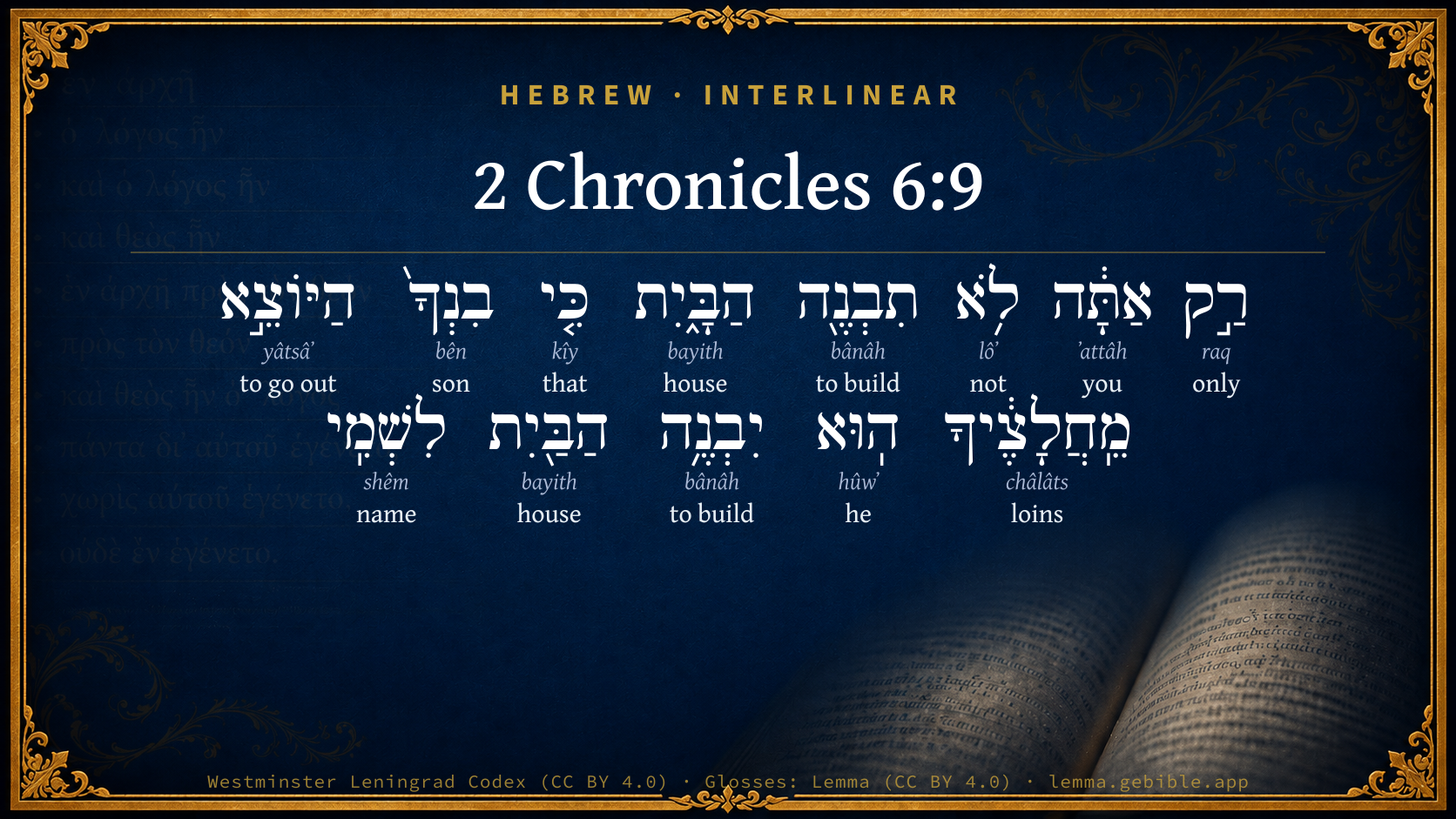
2 Chronicles 6:9

Hebrew (Westminster Leningrad Codex) 2 Chronicles 6:9 appears in the Hebrew Old Testament. The text above is from the Westminster Leningrad Codex. Each word links to its Strong’s number, a concise gloss, and parsing drawn from the Open Scriptures Hebrew Bible morphology. Click any word for its full Brown-Driver-Briggs (BDB) entry.
Download image
Cite this verse

2 Chronicles 6:9 (World English Bible). Public Domain. Lemma interlinear Bible study tool, https://lemma.gebible.app/v/2-chronicles/6/9.

Show BibTeX & RIS
BibTeX
RIS
English Translation
nevertheless you shall not build the house; but your son who shall come forth out of your loins, he shall build the house for my name.
World English Bible · Public Domain
Download a study sheet

One document with this verse’s original text, its word-by-word gloss line, the meaning frame, cross-references with their text, attributed commentary, and full source and license credits — printable, and it pastes into notes with its structure intact.

This verse Autodidact and up

Study sheet (.html) Plain text (.txt)

A passage Seminary Student

Up to 50 verses in one chapter. A passage sheet keeps up to 6 commentary sources and 12 cross-references per verse, in the order this page ranks them, and says so on the sheet whenever that leaves anything out. Ask for a single verse and you get the Autodidact verse sheet above.

Everything on this page stays free to read, with no account — the sheet is a download of what is already on screen, not access to it.

Want to remove ads? Support Godless Engineer
Compare translations 3

The same verse in 3 English versions, stacked beneath the original-language interlinear above. Click any original word for its lexicon entry.

Each is an independent rendering of the whole verse — the interlinear is not word-aligned to these translations.

Highlighted words mark where these versions differ — a whole-verse word diff, not a word-by-word alignment.

  • World English Bible Public Domain
    nevertheless you shall not build the house; but your son who shall come forth out of your loins, he shall build the house for my name.
  • King James Version Public Domain
    Notwithstanding thou shalt not build the house; but thy son which shall come forth out of thy loins, he shall build the house for my name.
  • unfoldingWord Literal Text CC BY-SA 4.0
    Only you yourself must not build the house; instead, your son who comes from your loins, he himself will build the house for my name.’

unfoldingWord Literal Text — © unfoldingWord, licensed CC BY-SA 4.0. Word-aligned USFM3 via Door43 (git.door43.org/unfoldingWord/en_ult).

Versions to compare (up to 4)

3 of 4 selected

Show all 18 translations

Every available English version of this verse, each an independent rendering of the whole verse.

  • World English Bible Public Domain
    nevertheless you shall not build the house; but your son who shall come forth out of your loins, he shall build the house for my name.
  • Berean Standard Bible Public Domain
    Nevertheless, you are not the one to build it; but your son, your own offspring, will build the house for My Name.’
  • Majority Standard Bible Public Domain
    Nevertheless, you are not the one to build it; but your son, your own offspring, will build the house for My Name.’
  • King James Version Public Domain
    Notwithstanding thou shalt not build the house; but thy son which shall come forth out of thy loins, he shall build the house for my name.
  • American Standard Version (1901) Public Domain
    nevertheless thou shalt not build the house; but thy son that shall come forth out of thy loins, he shall build the house for my name.
  • Revised Version (1885) Public Domain
    nevertheless thou shalt not build the house; but thy son that shall come forth out of thy loins, he shall build the house for my name.
  • Geneva Bible (1599) Public Domain
    Notwithstanding thou shalt not build the house, but thy sonne which shall come out of thy loynes, he shall buylde an house vnto my Name.
  • Douay-Rheims (1899) Public Domain
    But thou shalt not build the house, but thy son, who shall come out of thy loins, he shall build a house to my name.
  • Young's Literal Translation Public Domain
    but thou dost not build the house, for thy son who cometh forth out from thy loins, he doth build the house for My name.
  • Literal Standard Version CC BY-SA 4.0
    but you do not build the house, for your son who comes forth out from your loins, he builds the house for My Name.
  • Unlocked Literal Bible CC BY-SA 4.0
    Nevertheless, you must not build the house; instead, your son, one who will come from your loins, will build the house for my name.'
  • unfoldingWord Literal Text CC BY-SA 4.0
    Only you yourself must not build the house; instead, your son who comes from your loins, he himself will build the house for my name.’
  • Darby Bible Public Domain
    nevertheless thou shalt not build the house; but thy son that shall come forth out of thy loins, he shall build the house unto my name.
  • World Messianic Bible Public Domain
    nevertheless you shall not build the house, but your son who will come out of your body, he shall build the house for my name.’
  • Webster's Bible Public Domain
    Notwithstanding thou shalt not build the house; but thy son who shall come forth out of thy loins, he shall build the house for my name.
  • Free Bible Version CC BY-SA 4.0
    But you are not going to build the Temple. Your son, one of your children, will build the Temple to honor me.’
  • Bible in Basic English Public Domain
    But you yourself will not be the builder of the house; but your son, the offspring of your body, he it is who will put up a house for my name.
  • JPS Tanakh (1917) Public Domain
    nevertheless thou shalt not build the house, but thy son that shall come forth out of thy loins, he shall build the house for My name.

Literal Standard Version (2020), Covenant Press — licensed CC BY-SA 4.0. Text via the HelloAO Bible API (eBible.org). Unlocked Literal Bible (unfoldingWord) — licensed CC BY-SA 4.0. Text via the HelloAO Bible API (eBible.org). unfoldingWord Literal Text — © unfoldingWord, licensed CC BY-SA 4.0. Word-aligned USFM3 via Door43 (git.door43.org/unfoldingWord/en_ult). Free Bible Version, Dr. Jonathan Gallagher — licensed CC BY-SA 4.0. Text via the HelloAO Bible API (eBible.org).

Word by word

More ways to search: Search by grammar → Find every occurrence → Compare this word →

Practice this passage: Drill this verse → Learn its vocabulary →

מֵֽחֲלָצֶ֔יךָ
châlâts
H2504
“from · loins · your”
Preposition + Noun, Common, Both, Dual, Construct + Suffix, Personal, 2nd Person, Masculine, Singular
Part of Speech
Preposition + Noun
Type
Common
Gender
Both
Number
Dual
State
Construct
Full BDB Definition

Origin: from H2502 (in the sense of strength)

TWOT: 668 ? ( 668b )

loins - as seat of virility - as girded - as seat of pain (woman's travail)
  1. רַ֣ק raq H7535 “only” Particle, Accusative
  2. אַתָּ֔ה ʼattâh H859 “you” Pronoun, Personal, 2nd Person, Masculine, Singular
  3. לֹ֥א lôʼ H3808 “not” Particle, Negative
  4. תִבְנֶ֖ה bânâh H1129 “to build” Verb, Qal, Imperfect, 2nd Person, Masculine, Singular
  5. הַבָּ֑יִת bayith H1004 “the · house” Particle, Definite Article + Noun, Common, Masculine, Singular, Absolute
  6. כִּ֤י kîy H3588 “that” Conjunction
  7. בִנְךָ֙ bên H1121 “son · your” Noun, Common, Masculine, Singular, Construct + Suffix, Personal, 2nd Person, Masculine, Singular
  8. הַיּוֹצֵ֣א yâtsâʼ H3318 “the · going out” Particle, Definite Article + Verb, Qal, Participle Active, Masculine, Singular, Absolute
  9. הֽוּא hûwʼ H1931 “he” Pronoun, Personal, 3rd Person, Masculine, Singular
  10. יִבְנֶ֥ה bânâh H1129 “to build” Verb, Qal, Imperfect, 3rd Person, Masculine, Singular
  11. הַבַּ֖יִת bayith H1004 “the · house” Particle, Definite Article + Noun, Common, Masculine, Singular, Absolute
  12. לִשְׁמִֽי shêm H8034 “to/for · name · my” Preposition + Noun, Common, Masculine, Singular, Construct + Suffix, Personal, 1st Person, Common, Singular

About this verse

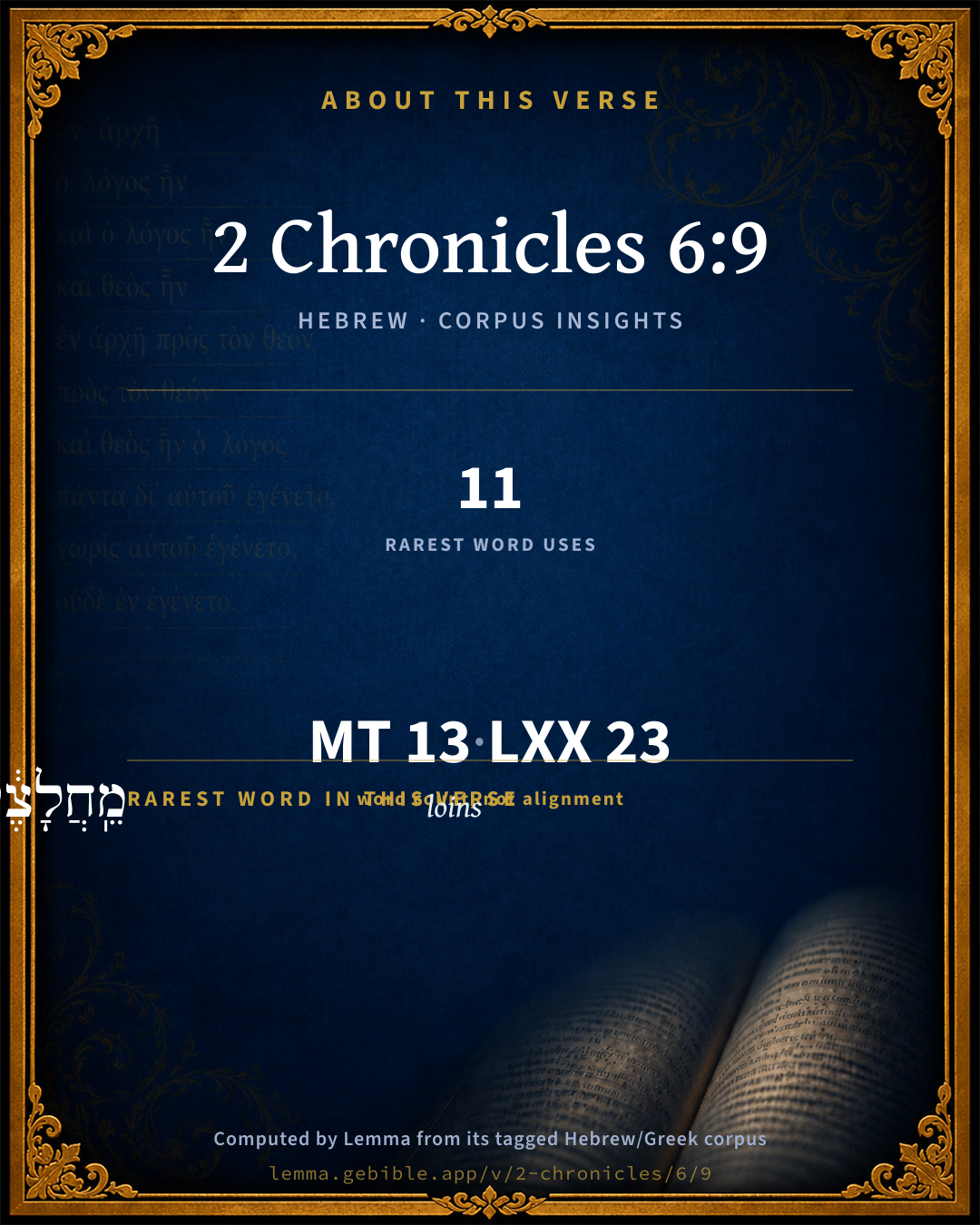
These counts appear in no published source. They are computed here, from the morphology-tagged text and Lemma’s own curated glosses. What Lemma adds →

13
words
11
distinct lemmas
Historical
section

Notable vocabulary

The rarest word here is מֵֽחֲלָצֶ֔יךָ loins H2504 — appearing just 11 times in the whole Hebrew Bible.

Shared distinctive vocabulary

מֵֽחֲלָצֶ֔יךָ loins H2504 occurs in 10 verses of the Hebrew Bible. Also found in:

Grammatical profile

  • 3 verbs
  • 5 nouns
  • 2 pronouns
  • 1 conjunction
  • 2 particles

Verb forms

  • תִבְנֶ֖ה Qal · Imperfect
  • הַיּוֹצֵ֣א Qal · Participle Active
  • יִבְנֶ֥ה Qal · Imperfect

Repetition

Words recur within this verse — often emphatic in Hebrew:

  • תִבְנֶ֖ה to build H1129 ×2
  • הַבָּ֑יִת house H1004 ×2

Hebrew & Septuagint length

In English translation the verse runs 26 words from the Hebrew and 26 from the Septuagint (LXX English) — the same length.

A rough comparison of the two English renderings, which tokenize alike — not a word-level alignment.

Word counts can differ between the Hebrew and the Greek without any difference in meaning — e.g. the Hebrew direct-object marker אֵת has no separate Greek word, and Greek often adds the article ὁ.

In the original languages it is 13 Hebrew tokens and 23 Greek tokens — but the two are counted differently (Hebrew bundles its prefixes and suffixes into one token; the Greek is in lemma form), so that isn’t a like-for-like length.

Cross-references

3

Topical passages linked to 2 Chronicles 6:9 in the Treasury of Scripture Knowledge — connected by theme and wording, ordered by reader-vote popularity; previews shown in the World English Bible.

  • 2 Samuel 7:12–13 When your days are fulfilled, and you shall sleep with your fathers, I will set up your seed after you, who shall proceed out of your bowels, and I will establish his kingdom.
  • 1 Chronicles 17:4 Go and tell David my servant, Thus says Yahweh, You shall not build me a house to dwell in:
  • 1 Chronicles 17:11–12 It shall happen, when your days are fulfilled that you must go to be with your fathers, that I will set up your seed after you, who shall be of your sons; and I will establish his kingdom.

Cross-references courtesy of OpenBible.info (CC BY 4.0).

Hebrew and Greek witnesses Masoretic Hebrew ↔ Greek Septuagint

The same verse in the two great witnesses to the Old Testament, shown verse-for-verse.

These are two independent witnesses, not word-aligned to each other, and the Septuagint is shown in lemma (dictionary) form.

Hebrew 2 Chronicles 6:9 Masoretic · Westminster Leningrad Codex

רַ֣ק אַתָּ֔ה לֹ֥א תִבְנֶ֖ה הַבָּ֑יִת כִּ֤י בִנְךָ֙ הַיּוֹצֵ֣א מֵֽחֲלָצֶ֔יךָ הֽוּא יִבְנֶ֥ה הַבַּ֖יִת לִשְׁמִֽי

nevertheless you shall not build the house; but your son who shall come forth out of your loins, he shall build the house for my name.

World English Bible · Public Domain

Greek LXX 2 Chronicles 6:9 Septuagint · lemma form

πλήν σύ οὐ οἰκοδομέω ὁ οἶκος ὅτι ὁ υἱός σύ ὅς ἐκἔρχομαι ἐκ ὁ ὀσφύς σύ οὗτος οἰκοδομέω ὁ οἶκος ὁ ὄνομα ἐγώ

Nevertheless you shall not build the house; for your son who shall come forth out of your loins, he shall build the house for my name.

LXX2012 (modern English Septuagint) · Public Domain

On this verse, Ellicott's Commentary for English Readers discusses the Septuagint’s reading. Read the note in Commentary ↓

Hebrew: Westminster Leningrad Codex (CC BY 4.0). Greek: Septuagint (public domain); English from LXX2012 (modern English Septuagint) (Public Domain). How the Septuagint differs from the Hebrew →

Commentary

Notes on 2 Chronicles 6:9 from classic Christian and Jewish commentators (each source and its license shown beneath its notes). The classic Christian expositions comment on the surrounding passage and are grouped to its opening verse, so a note may address several verses; the Jewish commentaries on the Tanakh (Rashi and others) are per-verse, so they appear only where the commentator wrote on this verse.

Lemma curates 59 commentaries, every one of them public domain or Creative Commons licensed, each selected and text-cleaned for this edition rather than reprinted as found. About our sources →

Joseph Benson's Commentary

2Ch 6:9. Thy son, he shall build the house, &c. — Thus one sows and another reaps: and one age begins that which the next brings to perfection. And let not the wisest of men think it any disparagement to them to pursue the good designs which those that went before them had formed, and to build on their foundation.

Joseph Benson's Commentary on the Old and New Testaments (1811–1818) — public domain. Text from a community e-Sword module.

Ellicott's Commentary for English Readers

(9) Notwithstanding thou shalt not build.—Only thou, thou shalt not build; with stress on the pronoun.

But thy son.—Heb., for thy son; so LXX.; Kings, “but;” and so some MSS. and the Syriac, Vulg., and Arabic here. Otherwise the whole verse is as in Kings.

A Bible Commentary for English Readers, edited by Charles John Ellicott (1878–1897) — public domain. Text from a community e-Sword module.

The Cambridge Bible for Schools and Colleges

gen. ed. J. J. S. Perowne

9. thou shalt not build] Cp. 1Ch_22:8, note.

The Cambridge Bible for Schools and Colleges (gen. ed. J. J. S. Perowne; Cambridge University Press, 1878–1918) — public domain. Text from a community e-Sword module.

John Wesley's Explanatory Notes

But thy son, &c. - Thus one sows, and another reaps. And let not the wisest of men, think it any disparagement to pursue the good designs which those that went before them had laid.

John Wesley, Explanatory Notes Upon the Whole Bible (1754–1765) — public domain. Text via the GEBible commentary corpus.

Lesson kit

Teaching starters — assembled from the data on this page, not authored interpretation. Every prompt links to the verse data it draws on. Edit before teaching.

2 Chronicles, in the Historical, opens this verse with 13 words (11 distinct Hebrew lemmas). Its most distinctive word is châlâts (“loins”). A historical commentator’s framing appears above. Read the whole chapter for the surrounding context.

Discussion questions

  1. The word châlâts carries the sense “loins.” How does it shape the verse?
  2. How does Genesis 35:11, which shares the word «loins», read alongside this verse?
  3. What does the repetition of “to build” (2× in this one verse) do in this verse?
  4. These translations render this verse differently. What is at stake in choosing one wording over another?
  5. «תִבְנֶ֖ה» is a Qal Imperfect verb. How does that grammatical form shape the action described?
  6. Compare how Joseph Benson's Commentary and Ellicott's Commentary for English Readers read this verse. Where do they agree or differ?

Things to notice

Reading settings

Reading text

Shown beneath each verse's original-language words.

Old Testament
Old Testament edition

Read the OT as the Masoretic Hebrew (MT) or the Greek Septuagint (LXX).

English shown for the Greek Septuagint (in the Hebrew ↔ Greek comparison).

Comparing translations? Open the Compare panel on any verse page to stack up to four side by side.