
Jeremiah 12:16

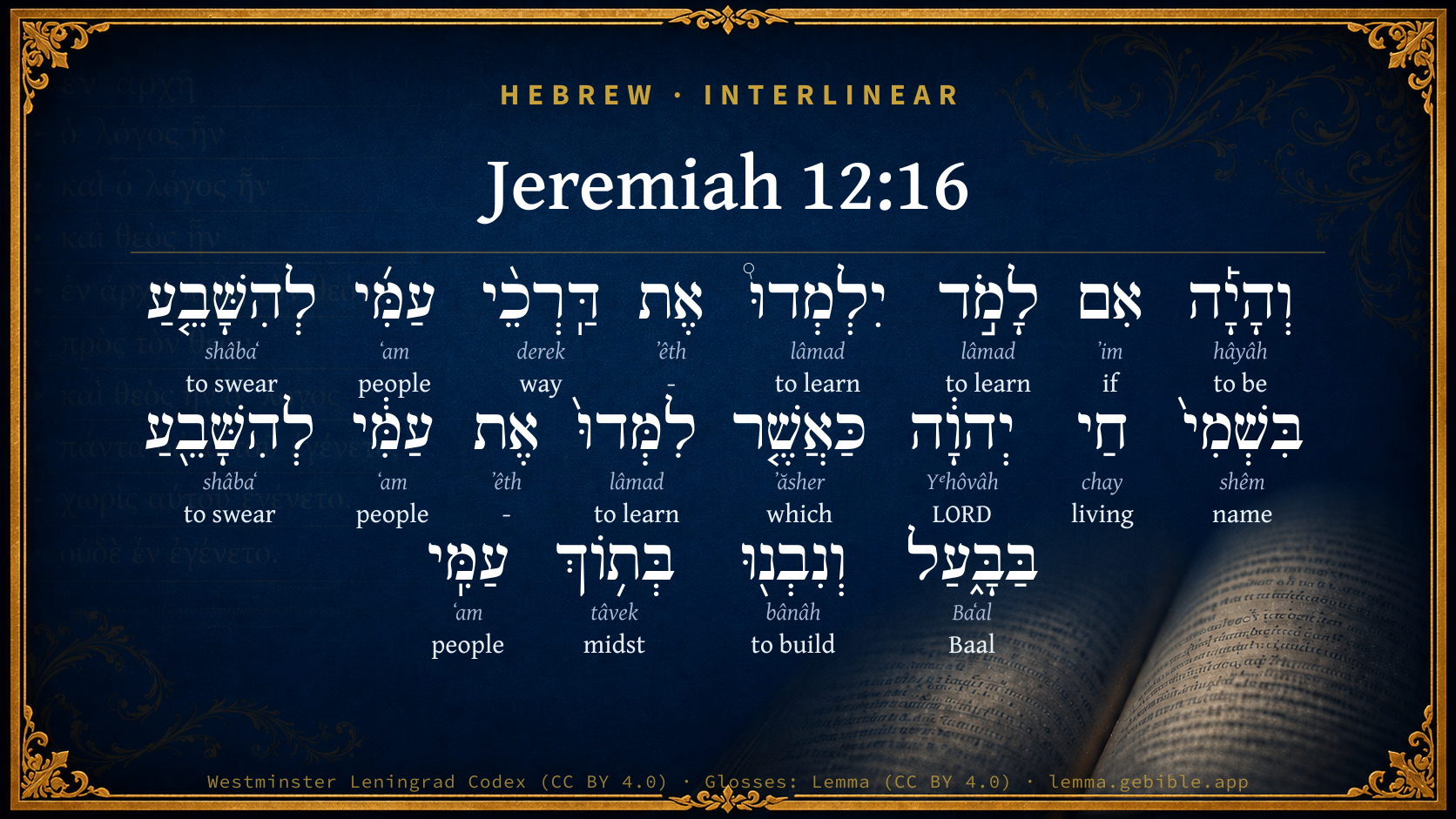
Hebrew (Westminster Leningrad Codex) Jeremiah 12:16 appears in the Hebrew Old Testament. The text above is from the Westminster Leningrad Codex. Each word links to its Strong’s number, a concise gloss, and parsing drawn from the Open Scriptures Hebrew Bible morphology. Click any word for its full Brown-Driver-Briggs (BDB) entry.
Download image
Cite this verse

Jeremiah 12:16 (World English Bible). Public Domain. Lemma interlinear Bible study tool, https://lemma.gebible.app/v/jeremiah/12/16.

Show BibTeX & RIS
BibTeX
RIS
English Translation
It shall happen, if they will diligently learn the ways of my people, to swear by my name, As Yahweh lives; even as they taught my people to swear by Baal; then shall they be built up in the midst of my people.
World English Bible · Public Domain
Download a study sheet

One document with this verse’s original text, its word-by-word gloss line, the meaning frame, cross-references with their text, attributed commentary, and full source and license credits — printable, and it pastes into notes with its structure intact.

This verse Autodidact and up

Study sheet (.html) Plain text (.txt)

A passage Seminary Student

Up to 50 verses in one chapter. A passage sheet keeps up to 6 commentary sources and 12 cross-references per verse, in the order this page ranks them, and says so on the sheet whenever that leaves anything out. Ask for a single verse and you get the Autodidact verse sheet above.

Everything on this page stays free to read, with no account — the sheet is a download of what is already on screen, not access to it.

Want to remove ads? Support Godless Engineer
Compare translations 3

The same verse in 3 English versions, stacked beneath the original-language interlinear above. Click any original word for its lexicon entry.

Each is an independent rendering of the whole verse — the interlinear is not word-aligned to these translations.

Highlighted words mark where these versions differ — a whole-verse word diff, not a word-by-word alignment.

  • World English Bible Public Domain
    It shall happen, if they will diligently learn the ways of my people, to swear by my name, As Yahweh lives; even as they taught my people to swear by Baal; then shall they be built up in the midst of my people.
  • King James Version Public Domain
    And it shall come to pass, if they will diligently learn the ways of my people, to swear by my name, The LORD liveth; as they taught my people to swear by Baal; then shall they be built in the midst of my people.
  • unfoldingWord Literal Text CC BY-SA 4.0
    And it will happen, if learning, they will learn the ways of my people, to swear by my name ‘As Yahweh lives’ just as they have taught my people to swear by Baal, then they will be built in the midst of my people.

unfoldingWord Literal Text — © unfoldingWord, licensed CC BY-SA 4.0. Word-aligned USFM3 via Door43 (git.door43.org/unfoldingWord/en_ult).

Versions to compare (up to 4)

3 of 4 selected

Show all 18 translations

Every available English version of this verse, each an independent rendering of the whole verse.

  • World English Bible Public Domain
    It shall happen, if they will diligently learn the ways of my people, to swear by my name, As Yahweh lives; even as they taught my people to swear by Baal; then shall they be built up in the midst of my people.
  • Berean Standard Bible Public Domain
    And if they will diligently learn the ways of My people and swear by My name, saying, ‘As surely as the LORD lives’—just as they once taught My people to swear by Baal—then they will be established among My people.
  • Majority Standard Bible Public Domain
    And if they will diligently learn the ways of My people and swear by My name, saying, ‘As surely as the LORD lives’—just as they once taught My people to swear by Baal—then they will be established among My people.
  • King James Version Public Domain
    And it shall come to pass, if they will diligently learn the ways of my people, to swear by my name, The LORD liveth; as they taught my people to swear by Baal; then shall they be built in the midst of my people.
  • American Standard Version (1901) Public Domain
    And it shall come to pass, if they will diligently learn the ways of my people, to swear by my name, As Jehovah liveth; even as they taught my people to swear by Baal; then shall they be built up in the midst of my people.
  • Revised Version (1885) Public Domain
    and it shall come to pass, if they will diligently learn the ways of my people, to swear by my name, As the LORD liveth; even as they taught my people to swear by Baal; then shall they be built up in the midst of my people.
  • Geneva Bible (1599) Public Domain
    And if they will learne the wayes of my people, to sweare by my Name, (The Lord liueth, as they taught my people to sweare by Baal) then shall they be built in the middes of my people.
  • Douay-Rheims (1899) Public Domain
    And it shall come to pass, if they will be taught, and will learn the ways of my people, to swear by my name: The Lord liveth, as they have taught my people to swear by baal: that they shall be built up in the midst of my people.
  • Young's Literal Translation Public Domain
    And it hath come to pass, If they learn well the ways of My people, To swear by My name, `Jehovah liveth,' As they taught My people to swear by Baal, Then they have been built up in the midst of My people.
  • Literal Standard Version CC BY-SA 4.0
    And it has come to pass, || If they learn the ways of My people well, || To swear by My Name, YHWH lives, || As they taught My people to swear by Ba‘al, || Then they have been built up in the midst of My people.
  • Unlocked Literal Bible CC BY-SA 4.0
    It will come about that if those nations carefully learn the ways of my people, to swear by my name 'As Yahweh lives' just as they have taught my people to swear by Baal, then they will be built up in the midst of my people.
  • unfoldingWord Literal Text CC BY-SA 4.0
    And it will happen, if learning, they will learn the ways of my people, to swear by my name ‘As Yahweh lives’ just as they have taught my people to swear by Baal, then they will be built in the midst of my people.
  • Darby Bible Public Domain
    And it shall come to pass, if they will diligently learn the ways of my people, to swear by my name, [As] Jehovah liveth -- even as they taught my people to swear by Baal -- they shall be built up in the midst of my people.
  • World Messianic Bible Public Domain
    It will happen, if they will diligently learn the ways of my people, to swear by my name, ‘As the LORD lives;’ even as they taught my people to swear by Baal, then they will be built up in the middle of my people.
  • Webster's Bible Public Domain
    And it shall come to pass, if they will diligently learn the ways of my people, to swear by my name, The LORD liveth; as they taught my people to swear by Baal; then shall they be built in the midst of my people.
  • Free Bible Version CC BY-SA 4.0
    If they will honestly learn the ways of my people and respect me, making their vows to me, just as they once taught my people to swear by Baal, then they will do well among my people.
  • Bible in Basic English Public Domain
    And it will be that, if they give their minds to learning the ways of my people, using my name in their oaths, By the living Lord; as they have been teaching my people to take oaths by the Baal; then their place will be made certain among my people.
  • JPS Tanakh (1917) Public Domain
    And it shall come to pass, if they will diligently learn the ways of My people to swear by My name: 'As the LORD liveth,' even as they taught My people to swear by Baal; then shall they be built up in the midst of My people.

Literal Standard Version (2020), Covenant Press — licensed CC BY-SA 4.0. Text via the HelloAO Bible API (eBible.org). Unlocked Literal Bible (unfoldingWord) — licensed CC BY-SA 4.0. Text via the HelloAO Bible API (eBible.org). unfoldingWord Literal Text — © unfoldingWord, licensed CC BY-SA 4.0. Word-aligned USFM3 via Door43 (git.door43.org/unfoldingWord/en_ult). Free Bible Version, Dr. Jonathan Gallagher — licensed CC BY-SA 4.0. Text via the HelloAO Bible API (eBible.org).

Word by word

More ways to search: Search by grammar → Find every occurrence → Compare this word →

Practice this passage: Drill this verse → Learn its vocabulary →

בַּבָּ֑עַל
Baʻal
H1168
“in/at the · Baal”
Preposition, Determined + Noun, Proper
Part of Speech
Preposition + Noun
Type
Proper
Full BDB Definition

Origin: the same as H1167

TWOT: 262a

Baal = "lord" - supreme male divinity of the Phoenicians or Canaanites (noun proper masculine) - a Reubenite (noun proper masculine) - the son of Jehiel and grandfather of Saul (noun proper masculine) - a town of Simeon, probably identical to Baalath-beer (noun proper locative)
  1. וְהָיָ֡ה hâyâh H1961 “and · to be” Conjunction + Verb, Qal, Sequential Perfect, 3rd Person, Masculine, Singular
  2. אִם ʼim H518 “if” Conjunction
  3. לָמֹ֣ד lâmad H3925 “to learn” Verb, Qal, Infinitive Absolute
  4. יִלְמְדוּ֩ lâmad H3925 “to learn” Verb, Qal, Imperfect, 3rd Person, Masculine, Plural
  5. אֶת ʼêth H853 “-” Particle, Direct Object
  6. דַּֽרְכֵ֨י derek H1870 “ways of” Noun, Common, Both, Plural, Construct
  7. עַמִּ֜י ʻam H5971 “people · my” Noun, Common, Masculine, Singular, Construct + Suffix, Personal, 1st Person, Common, Singular
  8. לְהִשָּׁבֵ֤עַ shâbaʻ H7650 “to swear” Preposition + Verb, Niphal, Infinitive Construct
  9. בִּשְׁמִי֙ shêm H8034 “in/at · name · my” Preposition + Noun, Common, Masculine, Singular, Construct + Suffix, Personal, 1st Person, Common, Singular
  10. חַי chay H2416 “living” Adjective, Adjective, Masculine, Singular, Absolute
  11. יְהוָ֔ה Yᵉhôvâh H3068 “LORD” Noun, Proper
  12. כַּאֲשֶׁ֤ר ʼăsher H834 “like/as · which” Preposition + Particle, Relative
  13. לִמְּדוּ֙ lâmad H3925 “to learn” Verb, Piel, Perfect, 3rd Person, Common, Plural
  14. אֶת ʼêth H853 “-” Particle, Direct Object
  15. עַמִּ֔י ʻam H5971 “people · my” Noun, Common, Masculine, Singular, Construct + Suffix, Personal, 1st Person, Common, Singular
  16. לְהִשָּׁבֵ֖עַ shâbaʻ H7650 “to swear” Preposition + Verb, Niphal, Infinitive Construct
  17. וְנִבְנ֖וּ bânâh H1129 “and · to build” Conjunction + Verb, Niphal, Sequential Perfect, 3rd Person, Common, Plural
  18. בְּת֥וֹךְ tâvek H8432 “in/at · midst of” Preposition + Noun, Common, Masculine, Singular, Construct
  19. עַמִּֽי ʻam H5971 “people · my” Noun, Common, Masculine, Singular, Construct + Suffix, Personal, 1st Person, Common, Singular

About this verse

These counts appear in no published source. They are computed here, from the morphology-tagged text and Lemma’s own curated glosses. What Lemma adds →

20
words
14
distinct lemmas
Prophets
section

Grammatical profile

  • 7 verbs
  • 8 nouns
  • 1 adjective
  • 1 conjunction
  • 3 particles

Verb forms

  • וְהָיָ֡ה Qal · Sequential Perfect
  • לָמֹ֣ד Qal · Infinitive Absolute
  • יִלְמְדוּ֩ Qal · Imperfect
  • לְהִשָּׁבֵ֤עַ Niphal · Infinitive Construct
  • לִמְּדוּ֙ Piel · Perfect
  • לְהִשָּׁבֵ֖עַ Niphal · Infinitive Construct
  • וְנִבְנ֖וּ Niphal · Sequential Perfect

Repetition

Words recur within this verse — often emphatic in Hebrew:

  • לָמֹ֣ד to learn H3925 ×3
  • עַמִּ֜י people H5971 ×3
  • לְהִשָּׁבֵ֤עַ to swear H7650 ×2

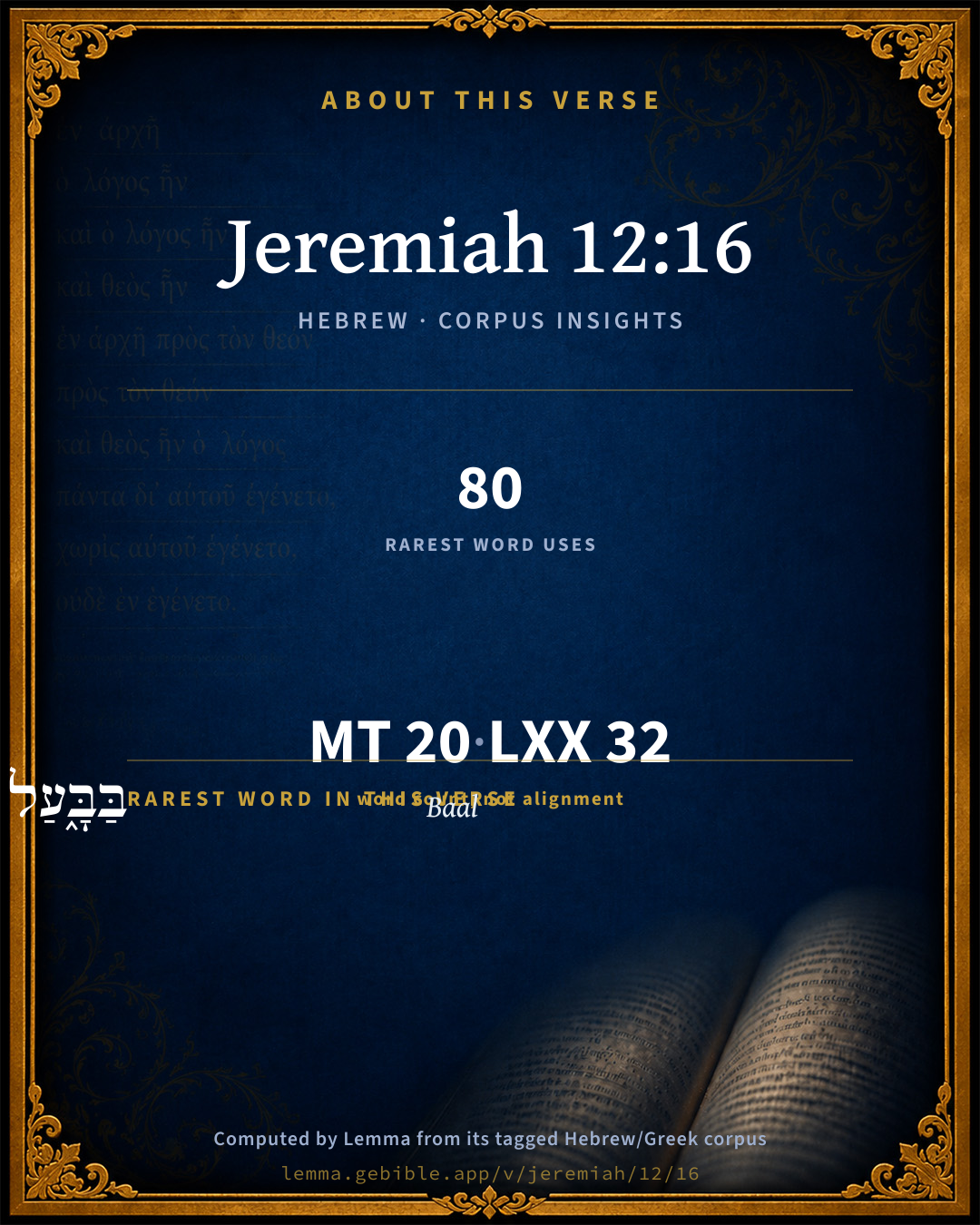
Hebrew & Septuagint length

In the original languages it is 20 Hebrew tokens and 32 Greek tokens — but the two are counted differently (Hebrew bundles its prefixes and suffixes into one token; the Greek is in lemma form), so that isn’t a like-for-like length.

Cross-references

19

Topical passages linked to Jeremiah 12:16 in the Treasury of Scripture Knowledge — connected by theme and wording, ordered by reader-vote popularity; previews shown in the World English Bible.

  • Jeremiah 4:2 and you shall swear, As Yahweh lives, in truth, in justice, and in righteousness; and the nations shall bless themselves in him, and in him shall they glory.
  • Joshua 23:7 that you not come among these nations, these that remain among you; neither make mention of the name of their gods, nor cause to swear [by them], neither serve them, nor bow down yourselves to them;
  • Zephaniah 1:5 those who worship the host of the sky on the housetops, those who worship and swear by Yahweh and also swear by Malcam,
  • Deuteronomy 10:20–21 You shall fear Yahweh your God; him shall you serve; and to him shall you cleave, and by his name shall you swear.
  • Jeremiah 3:17 At that time they shall call Jerusalem the throne of Yahweh; and all the nations shall be gathered to it, to the name of Yahweh, to Jerusalem: neither shall they walk any more after the stubbornness of their evil heart.
  • Zechariah 2:11 Many nations shall join themselves to Yahweh in that day, and shall be my people; and I will dwell in the midst of you, and you shall know that Yahweh of Hosts has sent me to you.
  • Psalms 106:35–36 But mixed themselves with the nations, And learned their works.
  • Isaiah 9:18–21 For wickedness burns as the fire; it devours the briers and thorns; yes, it kindles in the thickets of the forest, and they roll upward in a column of smoke.
  • Isaiah 45:23 By myself have I sworn, the word is gone forth from my mouth [in] righteousness, and shall not return, that to me every knee shall bow, every tongue shall swear.
  • Isaiah 49:6 yes, he says, It is too light a thing that you should be my servant to raise up the tribes of Jacob, and to restore the preserved of Israel: I will also give you for a light to the Gentiles, that you may be my salvation to the end of the earth.
  • Isaiah 56:5–6 To them will I give in my house and within my walls a memorial and a name better than of sons and of daughters; I will give them an everlasting name, that shall not be cut off.
  • Isaiah 65:16 so that he who blesses himself in the earth shall bless himself in the God of truth; and he who swears in the earth shall swear by the God of truth; because the former troubles are forgotten, and because they are hid from my eyes.
  • Jeremiah 5:2 Though they say, As Yahweh lives; surely they swear falsely.
  • Ephesians 2:19–22 So then you are no longer strangers and foreigners, but you are fellow citizens with the saints, and of the household of God,
  • Isaiah 19:23–25 In that day shall there be a highway out of Egypt to Assyria, and the Assyrian shall come into Egypt, and the Egyptian into Assyria; and the Egyptians shall worship with the Assyrians.
  • Romans 14:11 For it is written, "'As I live,' says the Lord, 'to me every knee will bow. Every tongue will confess to God.'"
  • 1 Corinthians 3:9 For we are God's fellow workers. You are God's farming, God's building.
  • 1 Peter 2:4–6 coming to him, a living stone, rejected indeed by men, but chosen by God, precious.
  • Song of Solomon 1:8 If you don't know, most beautiful among women, Follow the tracks of the sheep. Graze your young goats beside the shepherds' tents.

Cross-references courtesy of OpenBible.info (CC BY 4.0).

Hebrew and Greek witnesses Masoretic Hebrew ↔ Greek Septuagint

The same verse in the two great witnesses to the Old Testament, shown verse-for-verse.

These are two independent witnesses, not word-aligned to each other, and the Septuagint is shown in lemma (dictionary) form.

Hebrew Jeremiah 12:16 Masoretic · Westminster Leningrad Codex

וְהָיָ֡ה אִם לָמֹ֣ד יִלְמְדוּ֩ אֶת דַּֽרְכֵ֨י עַמִּ֜י לְהִשָּׁבֵ֤עַ בִּשְׁמִי֙ חַי יְהוָ֔ה כַּאֲשֶׁ֤ר לִמְּדוּ֙ אֶת עַמִּ֔י לְהִשָּׁבֵ֖עַ בַּבָּ֑עַל וְנִבְנ֖וּ בְּת֥וֹךְ עַמִּֽי

It shall happen, if they will diligently learn the ways of my people, to swear by my name, As Yahweh lives; even as they taught my people to swear by Baal; then shall they be built up in the midst of my people.

World English Bible · Public Domain

Greek LXX Structure differs

In the Septuagint, Jeremiah is about an eighth shorter than the Hebrew and arranges its material differently — the Oracles Against the Nations (Hebrew chapters 46–51) appear in the middle of the Greek book, after 25:13. Because the chapter and verse boundaries do not line up, a verse-for-verse comparison with the Hebrew is not shown.

A verse-for-verse comparison isn’t shown here because the chapters and verses don’t line up. Switch to the LXX edition with the MT / LXX toggle above to read the Greek directly.

Hebrew: Westminster Leningrad Codex (CC BY 4.0). Greek: Septuagint (public domain); English from a public-domain English Septuagint. How the Septuagint differs from the Hebrew →

Targum (Aramaic paraphrase)

1

The Targum is the ancient Jewish Aramaic paraphrase of the Hebrew Scriptures — an interpretive translation, not the Hebrew text itself. Onkelos (literal) and Pseudo-Jonathan (expansive) render the Torah, and Jonathan the Prophets. Coverage is partial: where no permissively-licensed English translation exists for a verse, only the Aramaic is shown. This is verse-level text, not a word-by-word alignment to the Hebrew.

  1. Targum Jonathan Prophets (Joshua–Malachi)
    וִיהֵי אִם מֵילַף יֵילְפוּן מֵאוֹרְחַת כְּנִשְׁתָּא דְעַמִי לְקַיָמָא בִשְׁמִי קַיָם הוּא יְיָ כְּמָא דְאַלִיפוּ יַת עַמִי לְקַיָמָא בְּשׁוּם טַעֲוָתָא וְיִתְקַיְמִין בְּגוֹ עַמִי:

    (no public-domain English translation for this verse)

    Targum Jonathan — Aramaic: “Mikraot Gedolot” (public domain). English: “Sefaria Community Translation” (CC0 1.0 (public-domain dedication)); “London "Chaldee Paraphrase," 1871” (public domain). Text via Sefaria.

Commentary

Notes on Jeremiah 12:16 from classic Christian and Jewish commentators (each source and its license shown beneath its notes). The classic Christian expositions comment on the surrounding passage and are grouped to its opening verse, so a note may address several verses; the Jewish commentaries on the Tanakh (Rashi and others) are per-verse, so they appear only where the commentator wrote on this verse.

Lemma curates 59 commentaries, every one of them public domain or Creative Commons licensed, each selected and text-cleaned for this edition rather than reprinted as found. About our sources →

Trapp's Complete Commentary

John Trapp

Jer 12:16 And it shall come to pass, if they will diligently learn the ways of my people, to swear by my name, The LORD liveth; as they taught my people to swear by Baal; then shall they be built in the midst of my people.

Ver. 16. If they will diligently learn.] Heb., Learning, learn the ways of my people, chalked out unto them in my Word, and their conformity thereunto; for the lives of God’s people are but the Word exemplified, they walk as patterns of the rule, and are of exemplary holiness. {as Luk 1:6}

To swear by my name.] In righteousness, in truth, and in judgment. {as Jer 4:2}

Then shall they be built,] i.e., Blest.

John Trapp, A Commentary or Exposition upon All the Books of the Old and New Testament (1647–1656) — public domain. Text from a community e-Sword module.

Joseph Benson's Commentary

Jer 12:16-17. If they will diligently learn the ways of my people — If they will leave their idolatries, and learn of my people who lived among them to be worshippers of me the true God, and to swear by my name, The Lord liveth — That is, pay that homage, which they owe to the Divine Being, to me, the living and true God: as they taught my people to swear by Baal — As they drew in my backsliding people to join with them in the service of idols. Then shall they be built in the midst of my people — They shall have a portion among my people. The acceptance of the believing Gentiles is here clearly intimated, and their union with the church of God, the middle wall of partition being thrown down. Concerning the actual accomplishment of this prophecy, see Eph 2:13-22. But if they will not obey, I will utterly pluck up, &c. — But as for those, whether they be Jews or Gentiles, that shall continue in their idolatrous and superstitious practices, or that shall reject the Messiah, and continue in unbelief and disobedience, I will utterly destroy that people. Thus Isa 60:12, The nation and kingdom that will not serve thee shall perish: yea, those nations shall be utterly wasted. Those that will not be ruled by the grace of God, shall be ruled by the justice of God. And if disobedient nations shall be destroyed, much more shall disobedient churches, from which better things are expected.

Joseph Benson's Commentary on the Old and New Testaments (1811–1818) — public domain. Text from a community e-Sword module.

Tyndale Open Study Notes

Tyndale Open Resources

12:16 To experience God’s compassion (12:15), the people of other nations needed to convert from idolatry and learn the ways of God’s people. This conversion would require a public submission to the terms of the Sinai covenant that included the words, as surely as the Lord lives. In addition, they would need to reject any oaths made in the name of Baal, by which they had persuaded Israelites to worship foreign idols.

Tyndale Open Study Notes — © Tyndale Open Resources, licensed CC BY-SA 4.0. Text via the HelloAO Bible API.

Geneva Bible (1599)

Geneva Bible translators

The true doctrine and manner to serve God.

Read Jer. 4:2.

They shall be of the number of the faithful, and have a place in my Church.

Geneva Bible (1599) marginal notes — public domain. Text via Bolls.life.

Jamieson, Fausset & Brown

Robert Jamieson, A. R. Fausset & David Brown

swear by my name-- (Jer 4:2; Isa 19:18; Isa 65:16); that is, confess solemnly the true God.

built--be made spiritually and temporally prosperous: fixed in sure habitations (compare Jer 24:6; Jer 42:10; Jer 45:4; Psa 87:4-5; Eph 2:20-21; Pe1 2:5).

Jamieson, Fausset & Brown — Commentary Critical and Explanatory on the Whole Bible (1871) — public domain (CC PDM 1.0). Text via the HelloAO Bible API.

John Calvin's Commentaries

We see that this refers to the Gentiles, who were previously aliens to the grace of God; nay, they entertained the most dire hatred towards his chosen people. In short, God declares that he would be merciful and propitious to these miserable nations, of whose salvation no hope was entertained, for they had been rejected by him, and they had oftell and long, and in various ways, provoked his vengeance; and though he speaks of neighbors, as we have seen, yet this prediction belongs generally to the whole world, and was at length fulfined in the call of the Gentiles; for God then gathered a Church indiscriminately both from the Jews and the Gentiles.

But a condition is here laid down — If the Gentiles, who had hitherto opposed the true worship of God, received his law. We indeed know how much hated was true religion, especially by the neighboring nations; for their hatred was increased, because they saw that their superstitions were condenmed by this one people. As then they had been greatly incensed against God and the pure doctrine of his law, he now requires a change in them; If they will learn, he says, the ways of my people By the ways of his people he understands what he had commanded. The people of Israel had indeed often departed from true religion; but God here refers to himself rather than to their perverse conduct, for the law had not been abolished by the wickedness and ingratitude of his people. We hence see that, by the ways of his people, we are not to understand those glosses which the Jews had devised, but the law itself, which God had delivered to them. The authority of men, therefore, cannot be hence established, as though they had power to frame a religion for themselves; but God means only that by his good pleasure alone the Jews had been taught what was right. In short, Jeremiah understands the ways of the people passively, not those which the people had contrived for themselves, but such as they had received from above.

It is then added, That they may swear in my name The expression is a part for the whole, for in it is included the whole worship and service of God. Swearing, as we have said elsewhere, is a part of God’s worship and of true religion, for we profess that we ourselves and our life are in God’s hand when we swear by his name; and we also refer judgment to him, and own that he is really God, inasmuch as he knows our hearts and judges of hidden things. All these things are included in swearing. It is therefore no wonder that, in this place and in many other places, the whole of religion is designated by this expression, according to what is said elsewhere,

“Swear shall they all in my name, Live do I, saith Jehovah; to me shall bend every knee, and by me shall every tongue swear.” (Isaiah 45:23)

And as by the altar, in another place, is meant the worship of God, so here by swearing. The meaning is, — that if the Gentiles became so changed as to submit their neck to the yoke of the law, and allow themselves to be ruled by God, they would be made partakers of the mercy which the Jews had before enjoyed.

Then follows the common form of swearing, Live does Jehovah So the Scripture speaks everywhere; and by these words men do not merely testify that they swear by the life of God, but they also ascribe eternity to him, as though it was said, “God alone exists:” for no life is anywhere to be found but in God. Men, indeed, and brute animals, and even trees, are said to live; but in trees there is only vigor without the senses, in brutes the senses without reason and understanding; but in men the life is light; yet they live not by or of themselves, but they derive life from God, according to what we see on the earth, on which light shines; but we know that there is really no light where we dwell but what descends and is conveyed to us by the rays of the sun. In the same manner it may be said that life dwells in men, being conveyed to them by the hidden power of God. Nor do angels, properly speaking, live of themselves. We hence see the meaning of the words, Live does Jehovah The eternity of God is hereby set forth; he is also owned as the Judge of the world; and further, whatever he claims for himself, men thus testify that it is justly and by right his due.

It afterwards follows, As they taught my people to swear by Baal The corruptions of heathens had greatly prevailed among the chosen people; and the greater part, when they saw that the nations prospered, had cast aside every care for true worship and sincere religion. As then the Jews had been so much given to the superstitions of the heathens, the Prophet says, speaking in God’s name, — “If the Gentiles, who have hitherto taught my people to swear by Baal, who have drawn them away to their own idolatries and fictitious and false forms of worship, begin now to swear by my name, faithfully to worship me alone, they shall be built in the midst of my people.” The metaphor of building is very common; but in this place God intimates no more than that the Gentiles would become a part of his flock, when they cast away their superstitions, and embraced the pure worship prescribed in the law. Nor is this to be applied to any particular place, as some have frigidly explained it, but “in the midst of the people,” is the same as though he had said, — “I will count those nations my people, as a part of my Church,” according to what is said in the Psalms, — that though the Tyrians and Sidonians, and Egyptians, and others who had been hostile nations, were born here and there, yet they would boast that they were all born at Jerusalem when God owned them as members of his own people. (Psalm 138:3, 4) It follows —

John Calvin's Commentaries (1540-1563) — public domain. Text from the Calvin Translation Society English edition (1840s-50s) via the Christian Classics Ethereal Library (ccel.org). Calvin's coverage is partial (roughly two-thirds of the Bible); uncommented books and verses are honest gaps, never fabricated. The 19th-century editor's footnotes and remarks are omitted so the notes are faithfully Calvin's own voice.

Ellicott's Commentary for English Readers

(16) To swear by my name.—There is an obvious reference to the hopes expressed in Jer_4:2. To acknowledge Jehovah in all the most solemn forms of adjuration (comp. Jer_5:2; Psa_63:11), and to do this, not hypocritically, but in the spirit of reverence and righteousness, was the ideal state of the restored Judah. To be led by her example of faith and holiness, instead of leading her to acknowledge Baal by like forms of speech as they had done, was the ideal state of the nations round about her. In this hope the prophet was echoing that of Isa_2:3; Mic_4:2.

A Bible Commentary for English Readers, edited by Charles John Ellicott (1878–1897) — public domain. Text from a community e-Sword module.

The Cambridge Bible for Schools and Colleges

gen. ed. J. J. S. Perowne

16. to swear by my name] See on ch. Jer_4:2.

The Cambridge Bible for Schools and Colleges (gen. ed. J. J. S. Perowne; Cambridge University Press, 1878–1918) — public domain. Text from a community e-Sword module.

John Gill's Exposition

And it shall come to pass, if they will diligently learn the ways of my people,.... Not their evil ways of sin or superstition, they sometimes stray into; but the ways which God has prescribed to them, and has directed them to walk in, and in which they do walk; and which are to be learned of the Lord, by a diligent attendance with his people on his word and ordinances; see Isa 2:3,

to swear by my name, the Lord liveth; that is, to worship and serve the living God, a self-existent Being, who has life in himself, and of himself, and not another; and is the fountain, author, and giver of natural life to all creatures, and spiritual and eternal life to his true worshippers: swearing is here put for the whole of religious worship, as in Deu 6:13,

(as they taught my people to swear by Baal;) to worship him, and other idols:

then shall they be built in the midst of my people; become part of the spiritual building the church; being laid upon the same foundation of the apostles and prophets, and built up a holy temple; a spiritual house for the Lord to dwell in; partaking of the same privileges and ordinances as the people of God; being fellow heirs, and of the same body, and partakers of the promise in Christ by the Gospel, Eph 2:20, it denotes the settlement and establishment of the Gentiles with the Jews in a Gospel church state. So the Targum,

"and they shall be established in the midst of my people.''

John Gill's Exposition of the Whole Bible (1746–1763) — public domain (CC PDM 1.0). Text via the HelloAO Bible API.

Albert Barnes' Notes on the Bible

The accomplishment of this blessing depends upon both Judah and the Gentiles reversing their past conduct. Then shall the believing Gentile be admitted within the fold of the true, because spiritual, Israel - Christ’s Church.

Albert Barnes' Notes on the Bible (1834–1885) — public domain. Text from a community e-Sword/MySword module.

Haydock's Catholic Bible Commentary

People. After the captivity, converts were more cherished. Yet the predictions concerning the call of the Gentiles were accomplished only by the preaching of the gospel. (Calmet)

George Leo Haydock (1774–1849), Haydock's Catholic Family Bible and Commentary, 1859 edition — public domain. Excludes Psalms (Douay-Rheims chapter numbering differs from Protestant) and Deuterocanonical books (Catholic canon only).

Matthew Poole's English Annotations

Though these people be heathens, yet if they will leave their idolatries, and superstitious ways of worship, and learn to worship and serve me, as my people do and ought to worship me, and

swear by my name, The Lord liveth; that is, pay that homage which they pay to the Divine Being to me, the living and true God; owning me alone as the fountain of life, and searcher of the hearts (for there is a great homage paid to the true God in swearing by his name only, which showeth the great impiety and profaneness of other oaths); then, saith God, I will bless and prosper them also, and they shall not only have a portion in the earth, but amongst my people; which was eminently fulfilled in the conversion of the Gentiles, Rom 11:17; they were originally wild olives, and grafted in amongst the Jews, and with them made partakers of the root and fatness of the olive tree.

Matthew Poole's English Annotations on the Holy Bible (1683–1685) — public domain. Text from a community e-Sword/MySword module.

Whedon's Commentary on the Bible

Daniel D. Whedon

16. Learn the ways of my people — That is, adopt the worship of Jehovah. As they led God’s people away into the worship of Baalim, so they shall be led by Israel into “the ways” of Jehovah, and thus be built up with his “people” into a spiritual unity.

Daniel D. Whedon (gen. ed.), Commentary on the Old and New Testaments (1874–1909) — public domain. Text from a community e-Sword module.

The Pulpit Commentary

Israel has been converted and restored, and if the other nations follow his example and swear by my name, i.e. adopt the religion of Jehovah, (comp. Isa_19:18) they shall be rewarded by being suffered to dwell safely in Israel"s midst. Observe the contrast with Ver. 14. Before, Israel had dwelt amidst them to his own detriment; now they shall dwell amidst Israel to their profit.

The Pulpit Commentary (1880–1919), ed. H.D.M. Spence-Jones & Joseph S. Exell — public domain. Text from a community e-Sword module.

John Wesley's Explanatory Notes

If - If they will leave their idolatries, and learn to worship me, and swear by my name the Lord liveth, that is, pay that homage which they owe to the Divine being to me, the living and true God. Then - They shall have a portion among my people, which was eminently fulfilled in the conversion of the Gentiles.

John Wesley, Explanatory Notes Upon the Whole Bible (1754–1765) — public domain. Text via the GEBible commentary corpus.

unfoldingWord translationNotes

Door43 World Missions Community

General Information:

God's word about Judah's neighbors.

It will come about that

"It will happen that"

As Yahweh lives

"As surely as Yahweh is alive." The people use this expression to show that what they say next is certainly true. This is a way of making a solemn promise. Swearing in Yahweh's name instead of in Baal's name indicates that they worship Yahweh instead of Baal. See how you translated this in Jeremiah 4:2. AT: "I solemnly swear" (See: Idiom)

they will be built up in the midst of my people

This speaks of the people becoming prosperous as if they were a building that was being built. This can be stated in active form. AT: "I will build them up in the midst of my people" or "I will make them wealthy and they will live among my people" (See: Metaphor and Active or Passive)

midst

middle

I will uproot that nation. It will certainly be uprooted and destroyed

God speaks of forcing the people to leave their land and destroying their nation as if they were plants that he was pulling out of the ground. These two sentences have the same meaning and may be combined. AT: "I will certainly and completely exile and destroy that nation" (See: Metaphor and Parallelism)

It will certainly be uprooted and destroyed

This can be stated in active form. AT: "I will certainly uproot and destroy it" (See: Active or Passive)

this is Yahweh's declaration

Yahweh speaks of himself by name to express the certainty of what he is declaring. See how you translated this in Jeremiah 1:8. AT: "this is what Yahweh has declared" or "this is what I, Yahweh, have declared" (See: First, Second, or Third Person)

translationWords

oath

name

Baal

unfoldingWord translationNotes — © Distant Shores Media and the Door43 World Missions Community, licensed CC BY-SA 4.0. Source: git.door43.org/Door43/en_tn.

Rashi

Rabbi Shlomo Yitzchaki (Rashi)

if they learn If they proselytize.

they shall be built up an expression of building.

Rashi on the Tanakh — English translations: “The Judaica Press complete Tanach with Rashi, translated by A. J. Rosenberg” (CC BY 4.0); “Pentateuch with Rashi's commentary by M. Rosenbaum and A.M. Silbermann, 1929-1934” (public domain); “The Metsudah Tanach series, Lakewood, N.J” (CC BY 4.0); and “The Book of Joshua, Metsudah Publications, 1997” (CC BY 4.0). Text via Sefaria.

Lesson kit

Teaching starters — assembled from the data on this page, not authored interpretation. Every prompt links to the verse data it draws on. Edit before teaching.

Jeremiah, in the Prophets, opens this verse with 20 words (14 distinct Hebrew lemmas). Its most distinctive word is Baʻal (“Baal”). A historical commentator’s framing appears above. Read the whole chapter for the surrounding context.

Discussion questions

  1. How does “Baal” (Baʻal) shape what this verse is saying?
  2. How does Jeremiah 4:2, which shares this passage’s theme, read alongside this verse?
  3. What does the repetition of “to learn” (3× in this one verse) do in this verse?
  4. These translations render this verse differently; the difference is in the English rendering, not the original. What questions does that raise?
  5. «וְהָיָ֡ה» is a Qal Sequential Perfect verb. How does that grammatical form shape the action described?
  6. Compare how Trapp's Complete Commentary and Joseph Benson's Commentary read this verse. Where do they agree or differ?

Things to notice

Reading settings

Reading text

Shown beneath each verse's original-language words.

Old Testament
Old Testament edition

Read the OT as the Masoretic Hebrew (MT) or the Greek Septuagint (LXX).

English shown for the Greek Septuagint (in the Hebrew ↔ Greek comparison).

Comparing translations? Open the Compare panel on any verse page to stack up to four side by side.