2 Chronicles 8:12

Hebrew (Westminster Leningrad Codex) 2 Chronicles 8:12 appears in the Hebrew Old Testament. The text above is from the Westminster Leningrad Codex. Each word links to its Strong’s number, a concise gloss, and parsing drawn from the Open Scriptures Hebrew Bible morphology. Click any word for its full Brown-Driver-Briggs (BDB) entry.
Download image
Cite this verse

2 Chronicles 8:12 (World English Bible). Public Domain. Lemma interlinear Bible study tool, https://lemma.gebible.app/v/2-chronicles/8/12.

Show BibTeX & RIS
BibTeX
RIS
English Translation
Then Solomon offered burnt-offerings to Yahweh on the altar of Yahweh, which he had built before the porch,
World English Bible · Public Domain
Download a study sheet

One document with this verse’s original text, its word-by-word gloss line, the meaning frame, cross-references with their text, attributed commentary, and full source and license credits — printable, and it pastes into notes with its structure intact.

This verse Autodidact and up

Study sheet (.html) Plain text (.txt)

A passage Seminary Student

Up to 50 verses in one chapter. A passage sheet keeps up to 6 commentary sources and 12 cross-references per verse, in the order this page ranks them, and says so on the sheet whenever that leaves anything out. Ask for a single verse and you get the Autodidact verse sheet above.

Everything on this page stays free to read, with no account — the sheet is a download of what is already on screen, not access to it.

Want to remove ads? Support Godless Engineer
Compare translations 3

The same verse in 3 English versions, stacked beneath the original-language interlinear above. Click any original word for its lexicon entry.

Each is an independent rendering of the whole verse — the interlinear is not word-aligned to these translations.

Highlighted words mark where these versions differ — a whole-verse word diff, not a word-by-word alignment.

  • World English Bible Public Domain
    Then Solomon offered burnt-offerings to Yahweh on the altar of Yahweh, which he had built before the porch,
  • King James Version Public Domain
    Then Solomon offered burnt offerings unto the LORD on the altar of the LORD, which he had built before the porch,
  • unfoldingWord Literal Text CC BY-SA 4.0
    Then Solomon brought up burnt offerings to Yahweh on the altar of Yahweh that he had built before the porch.

unfoldingWord Literal Text — © unfoldingWord, licensed CC BY-SA 4.0. Word-aligned USFM3 via Door43 (git.door43.org/unfoldingWord/en_ult).

Versions to compare (up to 4)

3 of 4 selected

Show all 18 translations

Every available English version of this verse, each an independent rendering of the whole verse.

  • World English Bible Public Domain
    Then Solomon offered burnt-offerings to Yahweh on the altar of Yahweh, which he had built before the porch,
  • Berean Standard Bible Public Domain
    At that time Solomon offered burnt offerings to the LORD on the altar of the LORD he had built in front of the portico.
  • Majority Standard Bible Public Domain
    At that time Solomon offered burnt offerings to the LORD on the altar of the LORD he had built in front of the portico.
  • King James Version Public Domain
    Then Solomon offered burnt offerings unto the LORD on the altar of the LORD, which he had built before the porch,
  • American Standard Version (1901) Public Domain
    Then Solomon offered burnt-offerings unto Jehovah on the altar of Jehovah, which he had built before the porch,
  • Revised Version (1885) Public Domain
    Then Solomon offered burnt offerings unto the LORD on the altar of the LORD, which he had built before the porch,
  • Geneva Bible (1599) Public Domain
    Then Salomon offered burnt offrings vnto the Lord, on the altar of the Lord, which he had built before the porche,
  • Douay-Rheims (1899) Public Domain
    Then Solomon offered holocausts to the Lord upon the altar of the Lord which he had built before the porch,
  • Young's Literal Translation Public Domain
    Then hath Solomon caused to ascend burnt-offerings to Jehovah on the altar of Jehovah that he built before the porch,
  • Literal Standard Version CC BY-SA 4.0
    Then Solomon has caused burnt-offerings to ascend to YHWH on the altar of YHWH that he built before the porch,
  • Unlocked Literal Bible CC BY-SA 4.0
    Then Solomon offered burnt offerings to Yahweh on his altar that he had built in front of the portico.
  • unfoldingWord Literal Text CC BY-SA 4.0
    Then Solomon brought up burnt offerings to Yahweh on the altar of Yahweh that he had built before the porch.
  • Darby Bible Public Domain
    Then Solomon offered up burnt-offerings to Jehovah on the altar of Jehovah, which he had built before the porch;
  • World Messianic Bible Public Domain
    Then Solomon offered burnt offerings to the LORD on the LORD’s altar which he had built before the porch,
  • Webster's Bible Public Domain
    Then Solomon offered burnt-offerings to the LORD on the altar of the LORD, which he had built before the porch,
  • Free Bible Version CC BY-SA 4.0
    Then Solomon presented burnt offerings to the Lord on the altar of the Lord he had built in front of the Temple's porch.
  • Bible in Basic English Public Domain
    Then Solomon made burned offerings to the Lord on the altar of the Lord which he had put up in front of the covered way,
  • JPS Tanakh (1917) Public Domain
    Then Solomon offered burnt-offerings unto the LORD on the altar of the LORD, which he had built before the porch,

Literal Standard Version (2020), Covenant Press — licensed CC BY-SA 4.0. Text via the HelloAO Bible API (eBible.org). Unlocked Literal Bible (unfoldingWord) — licensed CC BY-SA 4.0. Text via the HelloAO Bible API (eBible.org). unfoldingWord Literal Text — © unfoldingWord, licensed CC BY-SA 4.0. Word-aligned USFM3 via Door43 (git.door43.org/unfoldingWord/en_ult). Free Bible Version, Dr. Jonathan Gallagher — licensed CC BY-SA 4.0. Text via the HelloAO Bible API (eBible.org).

Word by word

More ways to search: Search by grammar → Find every occurrence → Compare this word →

Practice this passage: Drill this verse → Learn its vocabulary →

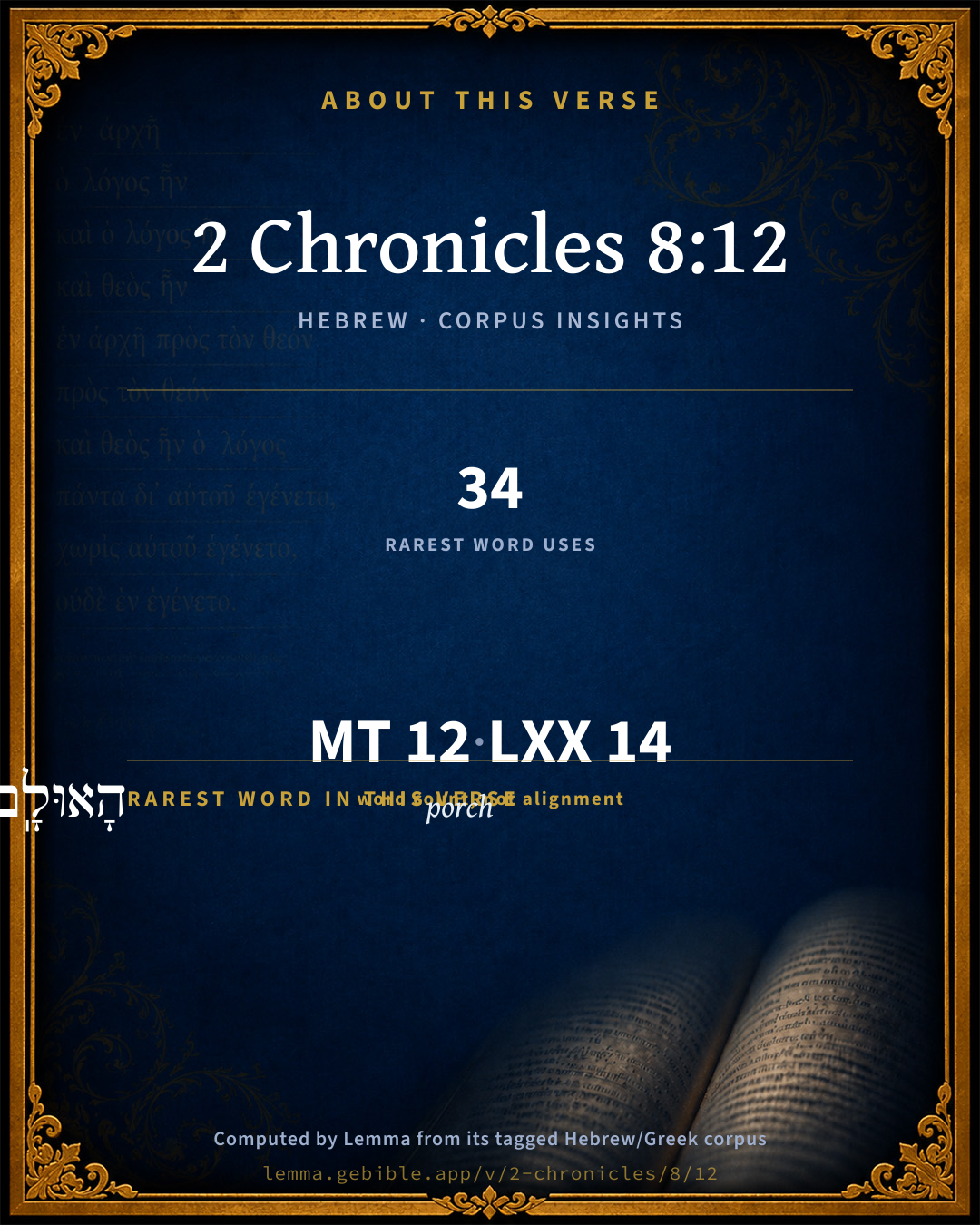
הָאוּלָֽם
ʼûwlâm
H197
“the · porch”
Particle, Definite Article + Noun, Common, Masculine, Singular, Absolute
Part of Speech
Particle + Noun
Type
Common
Gender
Masculine
Number
Singular
State
Absolute
Full BDB Definition

Origin: from H481 (in the sense of tying)

TWOT: 45c

porch - in Solomon's temple - in Solomon's palace - in temple of Ezekiel's vision
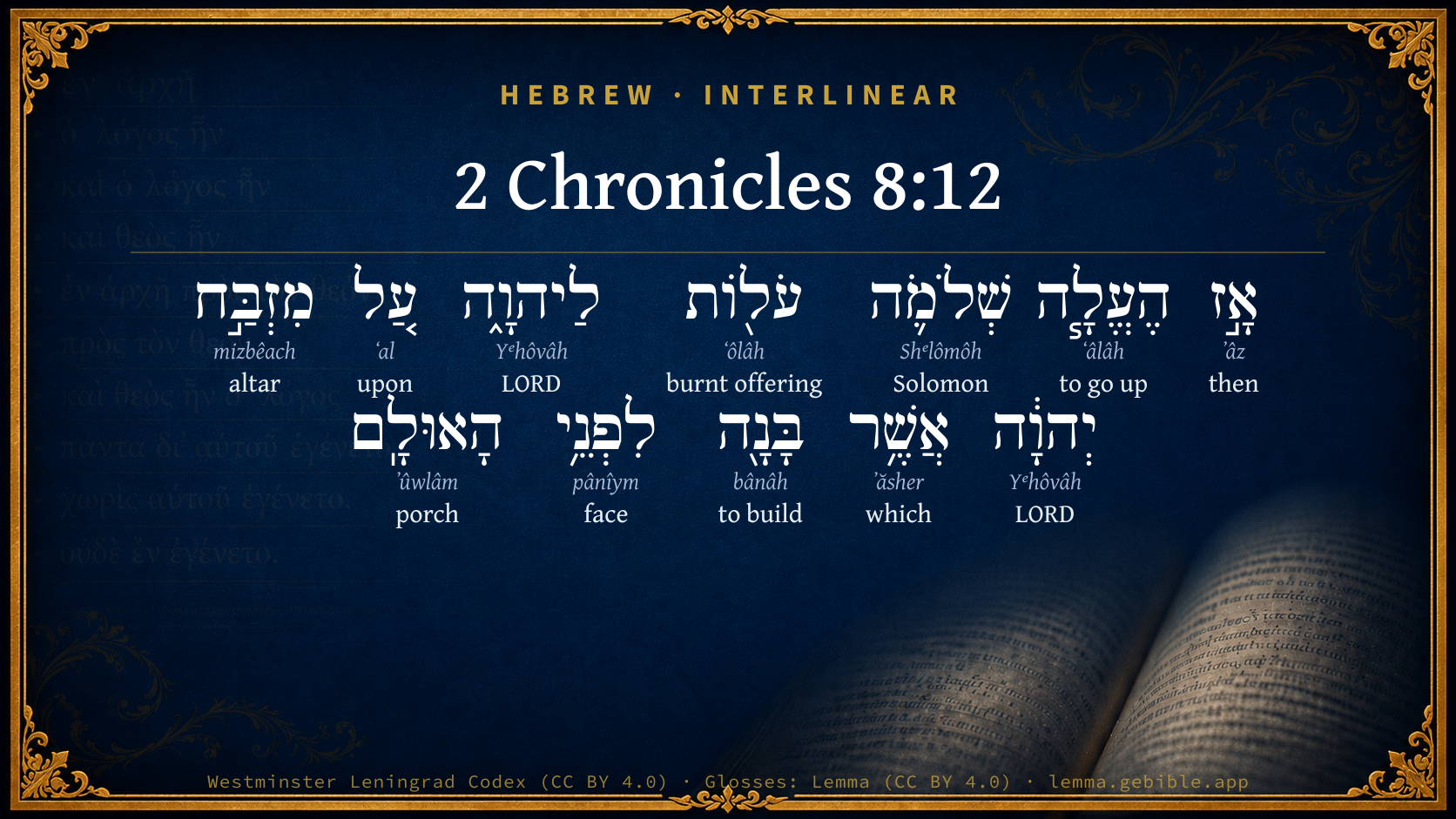
  1. אָ֣ז ʼâz H227 “then” Adverb
  2. הֶעֱלָ֧ה ʻâlâh H5927 “to go up” Verb, Hiphil, Perfect, 3rd Person, Masculine, Singular
  3. שְׁלֹמֹ֛ה Shᵉlômôh H8010 “Solomon” Noun, Proper
  4. עֹל֖וֹת ʻôlâh H5930 “burnt offerings” Noun, Common, Feminine, Plural, Absolute
  5. לַיהוָ֑ה Yᵉhôvâh H3068 “to/for · LORD” Preposition + Noun, Proper
  6. עַ֚ל ʻal H5921 “upon” Preposition
  7. מִזְבַּ֣ח mizbêach H4196 “altar of” Noun, Common, Masculine, Singular, Construct
  8. יְהוָ֔ה Yᵉhôvâh H3068 “LORD” Noun, Proper
  9. אֲשֶׁ֥ר ʼăsher H834 “which” Particle, Relative
  10. בָּנָ֖ה bânâh H1129 “to build” Verb, Qal, Perfect, 3rd Person, Masculine, Singular
  11. לִפְנֵ֥י pânîym H6440 “to/for · face(s) of” Preposition + Noun, Common, Both, Plural, Construct

About this verse

These counts appear in no published source. They are computed here, from the morphology-tagged text and Lemma’s own curated glosses. What Lemma adds →

12
words
11
distinct lemmas
Historical
section

Shared distinctive vocabulary

הָאוּלָֽם porch H197 occurs in 29 verses of the Hebrew Bible. Also found in:

Grammatical profile

  • 2 verbs
  • 7 nouns
  • 1 preposition
  • 1 adverb
  • 1 particle

Verb forms

  • הֶעֱלָ֧ה Hiphil · Perfect
  • בָּנָ֖ה Qal · Perfect

Repetition

A word recurs within this verse — often emphatic in Hebrew:

  • לַיהוָ֑ה LORD H3068 ×2

Hebrew & Septuagint length

In English translation the verse runs 18 words from the Hebrew and 23 from the Septuagint (LXX English) — closely comparable.

A rough comparison of the two English renderings, which tokenize alike — not a word-level alignment.

Word counts can differ between the Hebrew and the Greek without any difference in meaning — e.g. the Hebrew direct-object marker אֵת has no separate Greek word, and Greek often adds the article ὁ.

In the original languages it is 12 Hebrew tokens and 14 Greek tokens — but the two are counted differently (Hebrew bundles its prefixes and suffixes into one token; the Greek is in lemma form), so that isn’t a like-for-like length.

Cross-references

6

Topical passages linked to 2 Chronicles 8:12 in the Treasury of Scripture Knowledge — connected by theme and wording, ordered by reader-vote popularity; previews shown in the World English Bible.

  • 2 Chronicles 4:1 Moreover he made an altar of brass, twenty cubits the length of it, and twenty cubits the breadth of it, and ten cubits the height of it.
  • 1 Chronicles 28:17 and the flesh-hooks, and the basins, and the cups, of pure gold; and for the golden bowls by weight for every bowl; and for the silver bowls by weight for every bowl;
  • 2 Chronicles 15:8 When Asa heard these words, and the prophecy of Oded the prophet, he took courage, and put away the abominations out of all the land of Judah and Benjamin, and out of the cities which he had taken from the hill-country of Ephraim; and he renewed the altar of Yahweh, that was before the porch of Yahweh.
  • Ezekiel 8:16 He brought me into the inner court of Yahweh's house; and see, at the door of the temple of Yahweh, between the porch and the altar, were about twenty-five men, with their backs toward the temple of Yahweh, and their faces toward the east; and they were worshipping the sun toward the east.
  • Joel 2:17 Let the priests, the ministers of Yahweh, weep between the porch and the altar, And let them say, "Spare your people, Yahweh, And don't give your heritage to reproach, That the nations should rule over them. Why should they say among the peoples, 'Where is their God?'"
  • John 10:23 It was winter, and Jesus was walking in the temple, in Solomon's porch.

Cross-references courtesy of OpenBible.info (CC BY 4.0).

Hebrew and Greek witnesses Masoretic Hebrew ↔ Greek Septuagint

The same verse in the two great witnesses to the Old Testament, shown verse-for-verse.

These are two independent witnesses, not word-aligned to each other, and the Septuagint is shown in lemma (dictionary) form.

Hebrew 2 Chronicles 8:12 Masoretic · Westminster Leningrad Codex

אָ֣ז הֶעֱלָ֧ה שְׁלֹמֹ֛ה עֹל֖וֹת לַיהוָ֑ה עַ֚ל מִזְבַּ֣ח יְהוָ֔ה אֲשֶׁ֥ר בָּנָ֖ה לִפְנֵ֥י הָאוּלָֽם

Then Solomon offered burnt-offerings to Yahweh on the altar of Yahweh, which he had built before the porch,

World English Bible · Public Domain

Greek LXX 2 Chronicles 8:12 Septuagint · lemma form

τότε ἀναφέρω σαλωμών ὁλοκαύτωμα ὁ κύριος ἐπί ὁ θυσιαστήριον ὅς οἰκοδομέω ἀπέναντι ὁ ναός

Then Solomon offered up to the Lord whole burnt offerings on the altar which he had built to the Lord before the temple,

LXX2012 (modern English Septuagint) · Public Domain

Hebrew: Westminster Leningrad Codex (CC BY 4.0). Greek: Septuagint (public domain); English from LXX2012 (modern English Septuagint) (Public Domain). How the Septuagint differs from the Hebrew →

Commentary

Notes on 2 Chronicles 8:12 from classic Christian and Jewish commentators (each source and its license shown beneath its notes). The classic Christian expositions comment on the surrounding passage and are grouped to its opening verse, so a note may address several verses; the Jewish commentaries on the Tanakh (Rashi and others) are per-verse, so they appear only where the commentator wrote on this verse.

Lemma curates 59 commentaries, every one of them public domain or Creative Commons licensed, each selected and text-cleaned for this edition rather than reprinted as found. About our sources →

Matthew Henry's Commentary

Here is, I. Solomon's devotion. The building of the temple was in order to the service of the temple. Whatever cost he was at in rearing the structure, if he had neglected the worship that was to be performed there, it would all have been to no purpose. Assisting the devotion of others will not atone for our own neglects. When Solomon had built the temple, 1. He kept up the holy sacrifices there, according to the law of Moses, Ch2 8:12, Ch2 8:13. In vain had the altar been built, and in vain had fire come down from heaven, if sacrifices had not been constantly brought as the food of the altar and the fuel of that fire. There were daily sacrifices, a certain rate every day, as duly as the day came, weekly sacrifices on the sabbath, double to what was offered on other days, monthly sacrifices on the new moons, and yearly sacrifices at the three solemn feasts. Those are spiritual sacrifices that are now required of us, which we are to bring daily and weekly; and it is good to be in a settled method of devotion. 2. He kept up the holy songs there, according to the law of David, who is here called the man of God, as Moses was, because he was both instructed and authorised of God to make these establishments; and Solomon took care to see them observed as the duty of every day required, Ch2 8:14. Solomon, though a wise and great man and the builder of the temple, did not attempt to amend, alter, or add to what the man of God had, in God's name, commanded, but closely adhered to that, and used his authority to have that duly observed; and then none departed from the commandment of the king concerning any matter, Ch2 8:15. He observed God's laws, and then all obeyed his orders. When the service of the temple was put into this good order, then it is said, The house of the Lord was perfected, Ch2 8:16. The work was the main matter, not the place; the temple was unfinished till all this was done.

II. Solomon's merchandise. He did himself in person visit the sea-port towns of Eloth and Ezion-geber; for those that deal much in the world will find it their interest, as far as they can, to inspect their affairs themselves and to see with their own eyes, Ch2 8:17. Canaan was a rich country, and yet must send to Ophir for gold; the Israelites were a wise and understanding people, and yet must be beholden to the king of Tyre for men that had knowledge of the seas, Ch2 8:18. Yet Canaan was God's peculiar land, and Israel God's peculiar people. This teaches us that grace, and not gold, is the best riches, and acquaintance with God and his law, not with arts and sciences, the best knowledge.

Matthew Henry's Commentary on the Whole Bible (1708–1710) — public domain (CC PDM 1.0). Text via the HelloAO Bible API.

Ellicott's Commentary for English Readers

(c) REGULATION OF THE TEMPLE WORSHIP

(2Ch_8:12-16).

This whole section corresponds to the single verse, 1Ki_9:25, which the chronicler has paraphrased in 2Ch_8:12-13, and extended by the addition of further details in 2Ch_8:14-15.

(12) Then.—After the consecration of the Temple.

Offered.—Not once, but habitually; according to the prescriptions of the Mosaic Law (2Ch_8:13).

On the altar . . . which he had built.—And apparently no longer at Gibeon (2Ch_1:3).

Before the porch.—Not in Kings.

A Bible Commentary for English Readers, edited by Charles John Ellicott (1878–1897) — public domain. Text from a community e-Sword module.

Trapp's Complete Commentary

John Trapp

2Ch 8:12 Then Solomon offered burnt offerings unto the LORD on the altar of the LORD, which he had built before the porch,

Ver. 12. Then Solomon offered.] These sacrifices were their sacraments, visible words directing them to Christ.

John Trapp, A Commentary or Exposition upon All the Books of the Old and New Testament (1647–1656) — public domain. Text from a community e-Sword module.

The Biblical Illustrator

Joseph S. Exell

2Ch_8:12; 2Ch_8:18

Then Solomon offered burnt offerings unto the Lord.

Solomons burnt offerings

Solomon was great in burnt offerings. Do not men sometimes make up in burnt offerings what they lack in moral consistency? Is not an ostentatious religion sometimes the best proof of internal decay? It ought not to be so. The outward and inward should correspond. The action should be the incarnation of the thought. It is beautiful to look upon the Church engaged in much church-building and in strenuous endeavours against public sin; yet we must never forget that all this may possibly coexist with internal loss, decay, corruption. All action does not spring from life. Sometimes we try to make up by complex mechanism what is wanting in real vitality. It is often easier to offer burnt offering than to do some deed of moral heroism. (J. Parker, D. D.)

The Biblical Illustrator, edited by Joseph S. Exell (c. 1880s–1900s) — public domain. Text from a community e-Sword module.

Keil & Delitzsch

C. F. Keil & F. Delitzsch

The sacrificial service in the new temple. Cf. Kg1 9:25, where it is merely briefly recorded that Solomon offered sacrifices three times a year on the altar built by him to the Lord. In our verses we have a detailed account of it. אז, at that time, scil. when the temple building had been finished and the temple dedicated (cf. Ch2 8:1), Solomon offered burnt-offerings upon the altar which he had built before the porch of the temple. He no longer now sacrifices upon the altar of the tabernacle at Gibeon, as in the beginning of his reign (Ch2 1:3.).

Ch2 8:13

"Even sacrificing at the daily rate, according to the direction of Moses." These words give a supplementary and closer definition of the sacrificing in the form of an explanatory subordinate clause, which is interpolated in the principal sentence. For the following words וגו לשּׁבּתות belong to the principal sentence (Ch2 8:12): he offered sacrifices ... on the sabbaths, the new moons, etc. The ו before בּדבר is explicative, and that = viz.; and the infin. להעלות, according to the later usage, instead of infin. absol.; cf. Ew. 280, d. The preposition בּ (before דּבר) is the so-called b essentiae: consisting in the daily (rate) to sacrifice (this); cf. Ew. 299, b. The daily rate, i.e., that which was prescribed in the law of Moses for each day, cf. Lev 23:37. למּועדות is further explained by the succeeding clause: on the three chief festivals of the year.

Ch2 8:14

He ordered the temple service, also, entirely according to the arrangement introduced by David as to the service of the priests and Levites. He appointed, according to the ordinance of David his father, i.e., according to the ordinance established by David, the classes of the priests (see on 1 Chron 24) to that service, and the Levites to their stations (משׁמרות as in Ch2 7:6), to praise (cf. 1 Chron 25), and to serve before the priests (Ch1 23:28.), according to that which was appointed for every day, and the doorkeepers according to their courses, etc. (see 1 Chron 27:1-19). With the last words cf. Neh 12:24.

Ch2 8:15-16

This arrangement was faithfully observed by the priests and Levites. The verb סוּר is here construed c. accus. in the signification to transgress a command (cf. Ew. 282, a), and it is therefore not necessary to alter מצות into ממּצות. על־הכּהנים depends upon מצות: the king's command concerning the priests and the Levites, i.e., that which David commanded them. וגו לכל־דּבר, in regard to all things, and especially also in regard to the treasures; cf. Ch1 26:20-28. - With Ch2 8:16 the account of what Solomon did for the public worship is concluded: "Now all the work of Solomon was prepared until the (this) day, the foundation of the house of Jahve until its completion; the house of Jahve was finished." מלאכת is explained by מוּסד. היּום is the day on which, after the consecration of the completed temple, the regular public worship was commenced in it, which doubtless was done immediately after the dedication of the temple. Only when the regular worship according to the law of Moses, and with the arrangements as to the service of the priests and Levites established by David, had been commenced, was Solomon's work in connection with the temple completed, and the house of God שׁלם, integer, perfect in all its parts, as it should be. The last clause, בית י שׁלם, is connected rhetorically with what precedes without the conjunction, and is not to be regarded as a subscription, "with which the historian concludes the whole narrative commencing with Ch2 2:1" (Berth.); for שׁלם does not signify "ended," or to be at an end, but to be set thoroughly (perfectly) in order.

Keil & Delitzsch — Biblical Commentary on the Old Testament (1861–1891) — public domain (CC PDM 1.0). Text via the HelloAO Bible API. (Old Testament only.)

MacLaren's Expositions of Holy Scripture

Alexander MacLaren

2 Chronicles

THE DUTY OF EVERY DAY

2Ch 8:12 - 2Ch 8:13.

This is a description of the elaborate provision, in accordance with the commandment of Moses, which Solomon made for the worship in his new Temple. The writer is enlarging on the precise accordance of the ritual with the regulations laid down in the law. He expresses, by the phrase which we have taken as our text, not only the accordance of the worship with the commandment, but its unbroken continuity, and also the variety in it, according to the regulations for different days. For the verse runs on, ‘on the Sabbaths, and on the new moons, and on the solemn feasts, three times in the year, even in the Feast of unleavened bread, and in the Feast of weeks, and in the Feast of Tabernacles.’ There were, then, these characteristics in the ritual of Solomon’s Temple, precise compliance with the Divine commandment, unbroken continuity, and beautiful flexibility and variety of method.

But passing altogether from the original application of the words, I venture to do now what I very seldom do, and that is, to take this verse as a kind of motto. ‘Even according as the duty of every day required’; the phrase may suggest three thoughts: that each day has its own work, its own worship, and its own supplies, ‘even as the duty of every day required.’

Each day has its own work.

Of course there is a great uniformity in our lives, and many of us who are set down to one continuous occupation can tell twelve months before what, in all probability, we shall be doing at each hour of each day in the week. But for all that, there is a certain individual physiognomy about each new day as it comes to us; and the oldest, most habitual, and therefore in some degree easiest and least stimulating, work has its own special characteristics as it comes again to us day by day for the hundredth time.

So there are three pieces of practical wisdom that I would suggest, and one is-be content to take your work in little bits as it comes. There is a great deal of practical wisdom in taking short views of things, for although we have often to look ahead, yet it is better on the whole that a man should, as far as he can, confine his anticipations to the day that is passing, and leave the day that is coming to look after itself. Take short views and be content to let each day prescribe its tasks, and you have gone a long way to make all your days quiet and peaceful. For it is far more the anticipation of difficulties than the realisation of them that wears and wearies us. If a man says to himself, ‘This sorrow that I am carrying, or this work that I have to do, is going to last for many days to come,’ his heart will fail. If he said to himself, ‘It will be no worse to-morrow than it is at this moment, and I can live through it, for am I not living through it at this moment, and getting power to endure or do at this moment? and to-morrow will probably be like today,’ things would not be so difficult.

You remember the homely old parable of the clock on the stair that gave up ticking altogether because it began to calculate how many thousands of seconds there are in the year, and that twice that number of times it would have to wag backwards and forwards. The lesson that it learned was-tick one tick and never mind the next. You will be able to do it when the time to do it comes. Let us act ‘as the duty of every day requireth.’ ‘Sufficient for the day is the work thereof.’

Then there is another piece of advice from this thought of each day having its own work, and that is-keep your ears open, and your eyes too, to learn the lesson of what the day’s work is. There is generally abundance of direction for us if only we are content with the one-step-at-a-time direction, which we get, and if another condition is fulfilled, if we try to suppress our own wishes and the noisy babble of our own yelping inclinations, and take the whip to them until they cease their barking, that we may hear what God says. It is not because He does not speak, but because we are too anxious to have our own way to listen quietly to His voice, that we make most of our blunders as to what the duty of every day requires. If we will be still and listen, and stand in the attitude of the boy-prophet before the glimmering lamp in the sacred place, saying, ‘Speak, Lord! for Thy servant heareth,’ we shall get sufficient instruction for our next step.

Another piece of practical wisdom that I would suggest is that if every day has its own work, we should buckle ourselves to do the day’s work before night falls and not leave any over for to-morrow, which will be quite full enough. ‘Do the duty that lies nearest thee,’ was the preaching of one of our sages, and it is wholesome advice. For when we do that duty, the doing of it has a wonderful power of opening up further steps, and showing us more clearly what is the next duty. Only let us be sure of this, that no moment comes from God which has not in it boundless possibilities; and that no moment comes from God which has not in it stringent obligations. We neither avail ourselves of the one, nor discharge the other, unless we come, morning by morning, to the new day that is dawning upon us, with some fresh consciousness of the large issues that may be wrapped in its unseen hours, and the great things for Him that we may do ere its evening falls.

Each day has its tasks, and if we do not do the tasks of each day in its day, we shall fling away life. If a man had L. 100,000 for a fortune, and turned it all into halfpence, and tossed them out of the window, he could soon get rid of his whole fortune. And if you fling away your moments or live without the consciousness of their solemn possibilities and mystic awfulness, you will find at the last that you have made ‘ducks and drakes’ of your years, and have flung them away in moments without knowing what you were doing, and without possibility of recovery. ‘Take care of the pence, the pounds will take care of themselves.’ Take care of the days, and the years will show a fair record.

Secondly, we have here the suggestion that every day has its own worship.

As I remarked at the beginning of my observations, the chronicler dwells, with a certain kind of satisfaction, in accordance with the tone of his whole writings, upon the external ritual of the Temple; and points out its entire conformity with the divine precept, and the unbroken continuity of worship day after day, year in year out, and the variation of the characteristics of that worship according as the day was more or less ritually important. From his words we may deduce a very needful though obvious and commonplace lesson. What we want is every-day religion, and that every-day religion is the only thing that will enable us to do what the duty of every day requires. But that every-day religion which will be our best ally, and power for the discharge of the obligations that each moment brings with it, must have its points of support, as it were, in special moments and methods of worship.

So, then, take that first thought: What we want is a religion that will go all through our lives. A great many of you keep your religion where you keep your best clothes: putting it on on Sunday and locking it away on the Sunday night in a wardrobe because it is not the dress that you go to work in. And some of you keep your religion in your pew, and lock it up in the little box where you put your hymn-books and your Bibles, which you read only once a week, devoting yourselves to ledgers or novels and newspapers for the rest of your time. We want a religion that will go all through our life; and if there is anything in our life that will not stand its presence, the sooner we get rid of that element the better. A mountain road has generally a living brooklet leaping and flashing by the side of it. So our lives will be dusty and dead and cold and poor and prosaic unless that river runs along by the roadside and makes music for us as it flows. Take your religion wherever you go. If you cannot take it in to any scenes or company, stop you outside.

There is nothing that will help a man to do his day’s work so much as the realisation of Christ’s Presence. And that realisation, along with its certain results, devotion of heart to Him and submission of will to His commandment, and desire to shape our lives to be like His, will make us masters of all circumstances and strong enough for the hardest work that God can lay upon us.

There is nothing so sure to make life beautiful, and noble, and pure, and peaceful, and strong as this-the application to its monotonous trifles of religious principles. If you do not do little things as Christian men and women, and under the influence of Christian principle, pray what are you going to do under the influence of Christian principle? If you are keeping your religion to influence the crises of your lives, and are content to let the trifles be ruled by the devil or the world and yourselves, you will find out, when you come to the end, that there were perhaps three or four crises in your experience, and that all the rest of life was made of trifles, and that when the crises came you could not lay your hand on the religious principle that would have enabled you to deal with them. The sword had got so rusty in its scabbard because it had never been drawn for long years, that it could not be readily drawn in the moment of sudden peril; and if you could have drawn it, you would have found its edge blunted. Use your religion on the trifles, or you will not be able to make much of it in the crises. ‘He that is faithful in that which is least is faithful also in much.’ The worship of every day is the preparation for the work of that day.

Further, that worship, that religion, wearing its common, modest suit of workaday clothes, must also, if there is to be any power in it, have a certain variety in its methods. ‘Solomon offered burnt offerings . . . on the Sabbaths, on the new moons,’ which had a little more ceremonial than the Sabbaths, ‘and on the solemn feasts three times in a year,’ which had still more ceremonial than the new moons, ‘even in the Feast of unleavened bread, and in the Feast of weeks, and in the Feast of tabernacles.’ These were spring-tides when the sea of worship rose beyond its usual level, and they kept it from stagnating. We, too, if we wish to have this every-day religion running with any strength of scour and current through our lives, will need to have moments when it touches high-water mark, else it will not flush the foulness out of our hearts and our lives.

Lastly, take the other suggestion, that every day has its own supplies.

That does not lie in the text properly, but for the sake of completeness I add it. Every day has its own supplies. The manna fell every day, and was gathered and consumed on the day on which it fell. God gives us strength measured accurately by the needs of the day. You will get as much as you require, and if ever you do not get as much as you require, which is very often the case with Christian people, that is not because God did not send enough manna, but because their omer was not ready to catch it as it fell. The day’s supply is measured by the day’s need. Suppose an Israelite had sat in his tent and said, ‘I am not going out to gather,’ would he have had any in his empty vessel? Certainly not. The manna lay all around the tent, but each man had to go out and gather it. God makes no mistakes in His weights and measures. He gives us each sufficient strength to do His will and to walk in His ways; and if we do not do His will or walk in His ways, or if we find our burden too heavy, our sorrows too sharp, our loneliness too dreary, our difficulties too great, it is not because ‘the Lord’s hand is shortened that it cannot’ supply, but because our hands are so slack that they will not take the sufficiency which He gives. In the midst of abundance we are starving. We let the water run idly through the open sluice instead of driving the wheels of life.

My friend! God’s measure of supply is correct. If we were more faithful and humble, and if we understood better and felt more how deep is our need and how little is our strength, we should more continually be able to rejoice that He has given, and we have received, ‘even as the duty of every day required.’

Alexander MacLaren, Expositions of Holy Scripture (1904–1910) — public domain. Text from a community e-Sword module.

The Cambridge Bible for Schools and Colleges

gen. ed. J. J. S. Perowne

12–16 (cp. 1Ki_9:25). Solomon’s arrangements for the Temple Worship

This paragraph is in the main an expansion of 1Ki_9:25.

12. on the altar of the Lord, which he had built before the porch] This refers to the great brasen altar of burnt-offering (2Ch_4:1). In 1 Kin. the statement is that Solomon burnt incense upon the altar that was before the Lord (referring to the altar of incense; cp. Exo_30:1-10). Such an act, according to the Chronicler, was of the nature of trespass, being punished in the case of Uzziah with leprosy (2Ch_26:16), and was therefore not to be attributed to such a king as Solomon.

The Cambridge Bible for Schools and Colleges (gen. ed. J. J. S. Perowne; Cambridge University Press, 1878–1918) — public domain. Text from a community e-Sword module.

John Gill's Exposition

And he appointed, according to the order of David his father, the courses of the priests to their service,.... The twenty four courses which served weekly in their turns, Ch1 24:1.

and the Levites to their charges, to praise and minister before the priests, as duty of every day required; who also had their courses by lot, to sing the praises of God, when the priests sacrificed, or blew the trumpets, Ch1 25:1,

the porters also by their courses at every gate; from hence Dr. Lightfoot concludes that these were divided into twenty four classes, as the priests and Levite singers were:

for so had David the man of God commanded, Ch1 26:1, who in all these affairs acted as a prophet, under the inspiration and direction of the Holy Spirit of God.

John Gill's Exposition of the Whole Bible (1746–1763) — public domain (CC PDM 1.0). Text via the HelloAO Bible API.

The Pulpit Commentary

Parallel in compressed form dbiW; (1Ki_9:25. After a certain rate every day; Hebrew, the probable meaning is, according to the fixed appointment of day after day (Exo_23:14 Exo_29:23, Exo_29:38; Num_28:3; Deu_16:16)

Vers. 12-16.

Perfecting the sanctuary.

It was indeed a great thing to be able to write that "the house of the Lord was perfected" (ver. 16). Much had to be done, however, before that could be written. It was necessary

I THAT THE MATERIAL SHOULD SUBSERVE THE SPIRITUAL. Though the last stone had been carved and carried, and the last piece of furniture placed in its position, though the temple stood and shone before the eyes of Israel in all architectural completeness, yet was it not truly "finished" (ver. 16) until it was made a right use of, until sacrifice smoked on its altar, until "Solomon offered burnt offerings unto the Lord" (ver. 12). No edifice or erection of any kind, no work of art, nothing that is visible and material, can be said to have attained its end as an instrument of worship until it has been the means and medium by which the soul of man ascends to the Spirit of God and makes its offering "unto the Lord." Until that point is reached, it is as the sacrifice without the consuming fire; it is essentially imperfect. It is the wise, the true, the spiritual use we make of them that crowns and completes all instrumentalities in the service of God.

II THAT METHOD BE EMPLOYED AS WELL AS INSPIRATION CALLED FORTH. "After a certain rate every day, according to the commandment" (ver. 13); "according to the order" (ver. 14). It is well, it is needful, to do everything to elicit zeal, to call forth spontaneous service; without this there is no life, and therefore no acceptance with Clod. But there must be method also. That Christian Church (or that Christian man) that thinks it (he) can dispense with regulation and order in its (his)devotion makes a serious mistake. The waters of a river are more essential than the banks; but the river would do very ill without these it would soon be lost in diffusion. Piety that is not regulated is liable to be thus lost. Method is far lower down than inspiration, but it is an aid which the strongest and the worthiest can by no means afford to despise or to neglect.

III THAT ATTENTION BE GIVEN TO THE HUMBLE AND MINUTE. Prevision was made for "the courses of the priests;" but the "porters also" were considered and cared for (ver. 14). These humbler ministrants had a part to play, a service to render, as well as the higher officials, and their work was specified and recorded. And all arrangements were made "as the duty of every day required;" regard was had to hourly necessity, and no smallest service was overlooked. In the worship we render and in the work we do for so great a Lord as our God, for so gracious a Master as our Divine Friend and Saviour, there is nothing actually small. One post may be lower than another, one duty may be slighter than another; but everything we do for him "that loved us and gave himself for us" is redeemed from insignificance; and if we have the true spirit in us we shall leave nothing of any kind undone which will make the smallest contribution to the perfecting of his service; we shall give heed to the humble and the minute as well as to the lofty and the large.

IV THAT OFFERING BE PRESENTED TO GOD AS WELL AS BLESSINGS ASKED OF HIM. The priests and the Levites were to "praise" as well as to "minister" (ver. 14). They were to sing as well as to sacrifice to offer gratitude to God as well as to seek mercy and grace of him. And surely the service of the sanctuary will by no means be perfected until we bring to God the best we have to offer. We seek greatest things of him, let us bring greatest things to him; let us bring to his house and to himself our most reverent thought, our warmest gratitude, our meat serious and fixed resolution, our sweetest and purest song. Unto him that loved us we will yield the richest and worthiest offering our heart can render, our voice can raise. C.

Vers. 12-16.

The house of the Lord perfected.

I THE SACRIFICES ARRANGED. (Vers. 12, 13.)

1. The place on which these should henceforth be offered. "The altar of Jehovah before the porch." Hitherto Solomon and others,had presented burnt offerings before the tabernacle at Gibeon (2Ch_1:3) and elsewhere. (2Sa_6:13) Henceforth these should be laid upon the brazen altar in the temple court. Solomon"s doing so at the close of the dedication service was a formal inauguration of the practice meant to be followed.

2. The times when these should be offered.

(1) Every day in the morning and evening sacrifice. So God demands the devotions and spiritual sacrifices of his people at early morn and dewy eve.

(2) At special seasons on the sabbaths, the weekly sabbaths and those occurring in the midst of festivals, as on the great Day of Atonement, (Lev_16:31) and on the first and eighth days of the Feast of Ingathering; (Lev_23:39) on the new moons (1Sa_20:5, 1Sa_20:18; 2Ki_4:23; Psa_81:3; Isa_1:13, 14 66:2-6) and on thesolemn feasts three times a year, i.e. the Passover, on the fourteenth day of the first month; the Feast of Harvest, or of the Firstfruits, in the beginning of harvest; and the Feast of Ingathering, or the Feast of Tabernacles, on the fifteenth day of the seventh month. (Exo_23:14-16 Le 23) 444 Other times might be chosen by the worshippper; these the worshipper was not at liberty to neglect. Under Christianity there is an irreducible minimum beneath which one cannot go in serving God and yet claim to be a disciple.

3. The measure according to which these should be offered. According to the daily rate prescribed by Moses (Exo_23:14; Lev_23:37; Deu_16:16, Deu_16:17) Though Solomon had been honoured to erect a temple, he did not feel himself at liberty to propound a new ritual, and far less to institute a new religion. For him, as for all before and after, until the fulness of the times, Moses was the sole authority in doctrine and in worship. Since the fulness of the times, Christ, the greater than Moses, is; and will-worship (Col_2:23) is as little permissible under the new dispensation as it was under the old.

II THE PRIESTLY COURSES APPOINTED. (Ver. 14.)

1. The pattern followed. The order of David. (1Ch 24) Whether, in thus arranging the priesthood, David acted under Divine direction or not, is not material. This detail could safely be left to sanctified prudence; and David, in effecting it, only showed his sagacity in knowing how to get a difficult work performed with ease and efficiency, as well as his regard for order and decorum in all things pertaining to the sanctuary. Solomon, in following David"s example instead of resorting to new experiments, approved himself wise.

2. The number of the courses. Twenty-four. (1Ch_24:1-19) When these were arranged by David, twenty-four chief men were found who claimed descent from the house of Aaron. Of these, sixteen belonged to the sons of Eleazar, and eight to the sons of Ithamar. Consequently, these were selected as the heads of the several courses, their order of succession being determined by lot to avoid all ground of complaint on the score of favouritism, and to lend the sanction of Divine authority to the order so established. (Pro_16:33) As this arrangement was made in David"s old age, and not after the Exile by another than David (De Wette, Herzfeld), it is probable that few important alterations required to be made.

3. The nature of their services. To conduct the sacrificial worship of the nation. The Christian Church has only one Priest, who, having once for all offered himself a Sacrifice for sin, and having passed within the veil with his own blood, there to appear in the presence of God for us, has been consecrated for evermore. (Heb_7:28 Heb_9:11, 12 10:10)

III THE LEVITES INSTRUCTED. (Ver. 14.)

1. Their courses. Three the Gershonites, the Kohathites, the Merarites, according to the three great families of the sons of Levi; the first two consisting of nine, and the third of six, the three of twenty-four fathers" houses. Hence their courses were probably, like those of the priests", twenty-four in number (Josephus, "Ant.," 7:14. 7).

2. Their charges. To praise and minister before the priests, as the duty of every day required. They were no longer needed to carry the tabernacle or any of its vessels for the service thereof, seeing that Jehovah had given rest unto his people, that they might dwell in Jerusalem for ever. (1Ch_23:24-32 1Ch_25:1-6)

IV THE PORTERS STATIONED. (Ver. 14.)

1. Their courses. Twenty-four. At least twenty-four men are mentioned as keeping daily guard at the temple gates; (1Ch_26:13-19) and these, it is conjectured, were the heads of twenty-four divisions.

2. Their stations. "At every gate." Every day were planted at the east gate six men; at the north, four; at the south, four; at the storehouses in the vicinity of the south gate, two and two, i.e. four; at Parbar towards the west, six; in all, twenty-four at the different gates. (1Ch_26:17, 1Ch_26:18)

3. Their work. To keep the gates esteemed an honourable service, and called ministering in the house of the Lord (1Ch_26:12; cf. Psa_84:10)

LESSONS.

1. The necessity and beauty of order in Divine worship.

2. The diversity of offices and gifts in the Church of God.

3. The dignity of even the humblest service in connection withreligion. W.

The Pulpit Commentary (1880–1919), ed. H.D.M. Spence-Jones & Joseph S. Exell — public domain. Text from a community e-Sword module.

unfoldingWord translationNotes

Door43 World Missions Community

his altar that he had built

The author writes about Solomon having his workers build the altar as if he himself had built it. AT: "on Yahweh's altar that Solomon had his workers build" or "the Yahweh's altar that he had commanded his workers to build" (See: Metonymy)

his altar

"Yahweh's altar" or "the altar of Yahweh"

the portico

"the temple porch" or "the entrance to the temple." This was a covered porch supported by columns, attached to the front of the temple.

the daily schedule required

"as was required each day"

following the directions

Here "following the directions" represents obeying them. AT: "obeying the directions" (See: Metaphor)

the directions found in the commandment of Moses

"what Moses had commanded them"

the set festivals three times every year

"the three festivals that they were to celebrate every year"

the Festival of Shelters

"the Festival of Tents." This is a festival to celebrate God's provision for his people. When the people of Israel wandered in the desert, they lived in temporary shelters. Each year when they harvested their crops, they stayed in temporary shelters in their gardens. In both situations, God provided for them.

translationWords

burnt offering

altar

command

Moses

Sabbath

new moon

festival

unleavened bread

Pentecost

unfoldingWord translationNotes — © Distant Shores Media and the Door43 World Missions Community, licensed CC BY-SA 4.0. Source: git.door43.org/Door43/en_tn.

Rashi

Rabbi Shlomo Yitzchaki (Rashi)

on the altar of the Lord This was the copper altar that Solomon built. Some explain that this was the copper altar that Solomon made instead of the copper altar that Moses built, but this is astounding, because it is written (II Kings 16:15): “and the burnt offerings of the entire people of the land, etc. and the blood of every burnt offering, etc. shall be for me to visit,” i.e., the copper altar, which was there heretofore, shall be for me to visit. This proves that Moses’ copper altar was still there.

Rashi on the Tanakh — English translations: “The Judaica Press complete Tanach with Rashi, translated by A. J. Rosenberg” (CC BY 4.0); “Pentateuch with Rashi's commentary by M. Rosenbaum and A.M. Silbermann, 1929-1934” (public domain); “The Metsudah Tanach series, Lakewood, N.J” (CC BY 4.0); and “The Book of Joshua, Metsudah Publications, 1997” (CC BY 4.0). Text via Sefaria.

Lesson kit

Teaching starters — assembled from the data on this page, not authored interpretation. Every prompt links to the verse data it draws on. Edit before teaching.

2 Chronicles, in the Historical, opens this verse with 12 words (11 distinct Hebrew lemmas). Its most distinctive word is ʼûwlâm (“porch”). A historical commentator’s framing appears above. Read the whole chapter for the surrounding context.

Discussion questions

  1. What does “porch” (ʼûwlâm) contribute to the verse as a whole?
  2. How does 1 Kings 6:3, which shares the word «porch», read alongside this verse?
  3. What does the repetition of “LORD” (2× in this one verse) do in this verse?
  4. These translations render this verse differently. What is at stake in choosing one wording over another?
  5. «הֶעֱלָ֧ה» is a Hiphil Perfect verb. How does that grammatical form shape the action described?
  6. Compare how Matthew Henry's Commentary and Ellicott's Commentary for English Readers read this verse. Where do they agree or differ?

Things to notice

Reading settings

Reading text

Shown beneath each verse's original-language words.

Old Testament
Old Testament edition

Read the OT as the Masoretic Hebrew (MT) or the Greek Septuagint (LXX).

English shown for the Greek Septuagint (in the Hebrew ↔ Greek comparison).

Comparing translations? Open the Compare panel on any verse page to stack up to four side by side.