Isaiah 61:4

Hebrew (Westminster Leningrad Codex) Isaiah 61:4 appears in the Hebrew Old Testament. The text above is from the Westminster Leningrad Codex. Each word links to its Strong’s number, a concise gloss, and parsing drawn from the Open Scriptures Hebrew Bible morphology. Click any word for its full Brown-Driver-Briggs (BDB) entry.
Download image
Cite this verse

Isaiah 61:4 (World English Bible). Public Domain. Lemma interlinear Bible study tool, https://lemma.gebible.app/v/isaiah/61/4.

Show BibTeX & RIS
BibTeX
RIS
English Translation
They shall build the old wastes, they shall raise up the former desolations, and they shall repair the waste cities, the desolations of many generations.
World English Bible · Public Domain
Download a study sheet

One document with this verse’s original text, its word-by-word gloss line, the meaning frame, cross-references with their text, attributed commentary, and full source and license credits — printable, and it pastes into notes with its structure intact.

This verse Autodidact and up

Study sheet (.html) Plain text (.txt)

A passage Seminary Student

Up to 50 verses in one chapter. A passage sheet keeps up to 6 commentary sources and 12 cross-references per verse, in the order this page ranks them, and says so on the sheet whenever that leaves anything out. Ask for a single verse and you get the Autodidact verse sheet above.

Everything on this page stays free to read, with no account — the sheet is a download of what is already on screen, not access to it.

Want to remove ads? Support Godless Engineer
Compare translations 3

The same verse in 3 English versions, stacked beneath the original-language interlinear above. Click any original word for its lexicon entry.

Each is an independent rendering of the whole verse — the interlinear is not word-aligned to these translations.

Highlighted words mark where these versions differ — a whole-verse word diff, not a word-by-word alignment.

  • World English Bible Public Domain
    They shall build the old wastes, they shall raise up the former desolations, and they shall repair the waste cities, the desolations of many generations.
  • King James Version Public Domain
    And they shall build the old wastes, they shall raise up the former desolations, and they shall repair the waste cities, the desolations of many generations.
  • unfoldingWord Literal Text CC BY-SA 4.0
    And they will build the desolations of eternity; they will raise the former devastations. And they will renew the cities of desolation, the devastations of generation and generation.

unfoldingWord Literal Text — © unfoldingWord, licensed CC BY-SA 4.0. Word-aligned USFM3 via Door43 (git.door43.org/unfoldingWord/en_ult).

Versions to compare (up to 4)

3 of 4 selected

Show all 18 translations

Every available English version of this verse, each an independent rendering of the whole verse.

  • World English Bible Public Domain
    They shall build the old wastes, they shall raise up the former desolations, and they shall repair the waste cities, the desolations of many generations.
  • Berean Standard Bible Public Domain
    They will rebuild the ancient ruins; they will restore the places long devastated; they will renew the ruined cities, the desolations of many generations.
  • Majority Standard Bible Public Domain
    They will rebuild the ancient ruins; they will restore the places long devastated; they will renew the ruined cities, the desolations of many generations.
  • King James Version Public Domain
    And they shall build the old wastes, they shall raise up the former desolations, and they shall repair the waste cities, the desolations of many generations.
  • American Standard Version (1901) Public Domain
    And they shall build the old wastes, they shall raise up the former desolations, and they shall repair the waste cities, the desolations of many generations.
  • Revised Version (1885) Public Domain
    And they shall build the old wastes, they shall raise up the former desolations, and they shall repair the waste cities, the desolations of many generations.
  • Geneva Bible (1599) Public Domain
    And they shall builde the olde waste places, and raise vp the former desolations, and they shall repaire the cities that were desolate and waste through many generations.
  • Douay-Rheims (1899) Public Domain
    And they shall build the places that have been waste from of old, and shall raise up ancient ruins, and shall repair the desolate cities, that were destroyed for generation and generation.
  • Young's Literal Translation Public Domain
    And they have built the wastes of old, The desolations of the ancients they raise up, And they have renewed waste cities, The desolations of generation and generation.
  • Literal Standard Version CC BY-SA 4.0
    And they have built the ancient ruins, || They raise up the desolations of the ancients, || And they have renewed ruined cities, || The desolations of generation and generation.
  • Unlocked Literal Bible CC BY-SA 4.0
    They will rebuild the ancient ruins; they will restore the former desolations. They will restore the ruined cities, the desolations from many former generations.
  • unfoldingWord Literal Text CC BY-SA 4.0
    And they will build the desolations of eternity; they will raise the former devastations. And they will renew the cities of desolation, the devastations of generation and generation.
  • Darby Bible Public Domain
    And they shall build the old wastes, they shall raise up the former desolations, and they shall repair the waste cities, the places desolate from generation to generation.
  • World Messianic Bible Public Domain
    They will rebuild the old ruins. They will raise up the former devastated places. They will repair the ruined cities that have been devastated for many generations.
  • Webster's Bible Public Domain
    And they shall build the old wastes, they shall raise up the former desolations, and they shall repair the waste cities, the desolations of many generations.
  • Free Bible Version CC BY-SA 4.0
    They will rebuild the old ruins; they will restore places abandoned long ago; they will restore towns that were destroyed, places left desolate for generation after generation.
  • Bible in Basic English Public Domain
    And they will be building again the old broken walls, and will make new the old waste places, and will put up again the towns which have been waste for long generations.
  • JPS Tanakh (1917) Public Domain
    And they shall build the old wastes, they shall raise up the former desolations, and they shall renew the waste cities, the desolations of many generations.

Literal Standard Version (2020), Covenant Press — licensed CC BY-SA 4.0. Text via the HelloAO Bible API (eBible.org). Unlocked Literal Bible (unfoldingWord) — licensed CC BY-SA 4.0. Text via the HelloAO Bible API (eBible.org). unfoldingWord Literal Text — © unfoldingWord, licensed CC BY-SA 4.0. Word-aligned USFM3 via Door43 (git.door43.org/unfoldingWord/en_ult). Free Bible Version, Dr. Jonathan Gallagher — licensed CC BY-SA 4.0. Text via the HelloAO Bible API (eBible.org).

Word by word

More ways to search: Search by grammar → Find every occurrence → Compare this word →

Practice this passage: Drill this verse → Learn its vocabulary →

וְחִדְּשׁוּ֙
châdash
H2318
“and · to renew”
Conjunction + Verb, Piel, Sequential Perfect, 3rd Person, Common, Plural
Part of Speech
Conjunction + Verb
Stem
Piel
Form
Sequential Perfect
Person
3rd Person
Gender
Common
Number
Plural
Full BDB Definition

Origin: a primitive root

TWOT: 613

to be new, renew, repair - (Piel) - to renew, make anew - to repair - (Hithpael) to renew oneself
  1. וּבָנוּ֙ bânâh H1129 “and · to build” Conjunction + Verb, Qal, Sequential Perfect, 3rd Person, Common, Plural
  2. חָרְב֣וֹת chorbâh H2723 “ruins of” Noun, Common, Feminine, Plural, Construct
  3. עוֹלָ֔ם ʻôwlâm H5769 “forever” Noun, Common, Masculine, Singular, Absolute
  4. שֹׁמְמ֥וֹת shâmêm H8074 “being desolate” Verb, Qal, Participle Active, Feminine, Plural, Construct
  5. רִֽאשֹׁנִ֖ים riʼshôwn H7223 “first” Adjective, Adjective, Masculine, Plural, Absolute
  6. יְקוֹמֵ֑מוּ qûwm H6965 “to rise” Verb, Polel, Imperfect, 3rd Person, Masculine, Plural
  7. עָ֣רֵי ʻîyr H5892 “cities of” Noun, Common, Feminine, Plural, Construct
  8. חֹ֔רֶב chôreb H2721 “dryness” Noun, Common, Masculine, Singular, Absolute
  9. שֹׁמְמ֖וֹת shâmêm H8074 “being desolate” Verb, Qal, Participle Active, Feminine, Plural, Construct
  10. דּ֥וֹר dôwr H1755 “generation” Noun, Common, Masculine, Singular, Absolute
  11. וָדֽוֹר dôwr H1755 “and · generation” Conjunction + Noun, Common, Masculine, Singular, Absolute

About this verse

These counts appear in no published source. They are computed here, from the morphology-tagged text and Lemma’s own curated glosses. What Lemma adds →

12
words
10
distinct lemmas
Prophets
section

Notable vocabulary

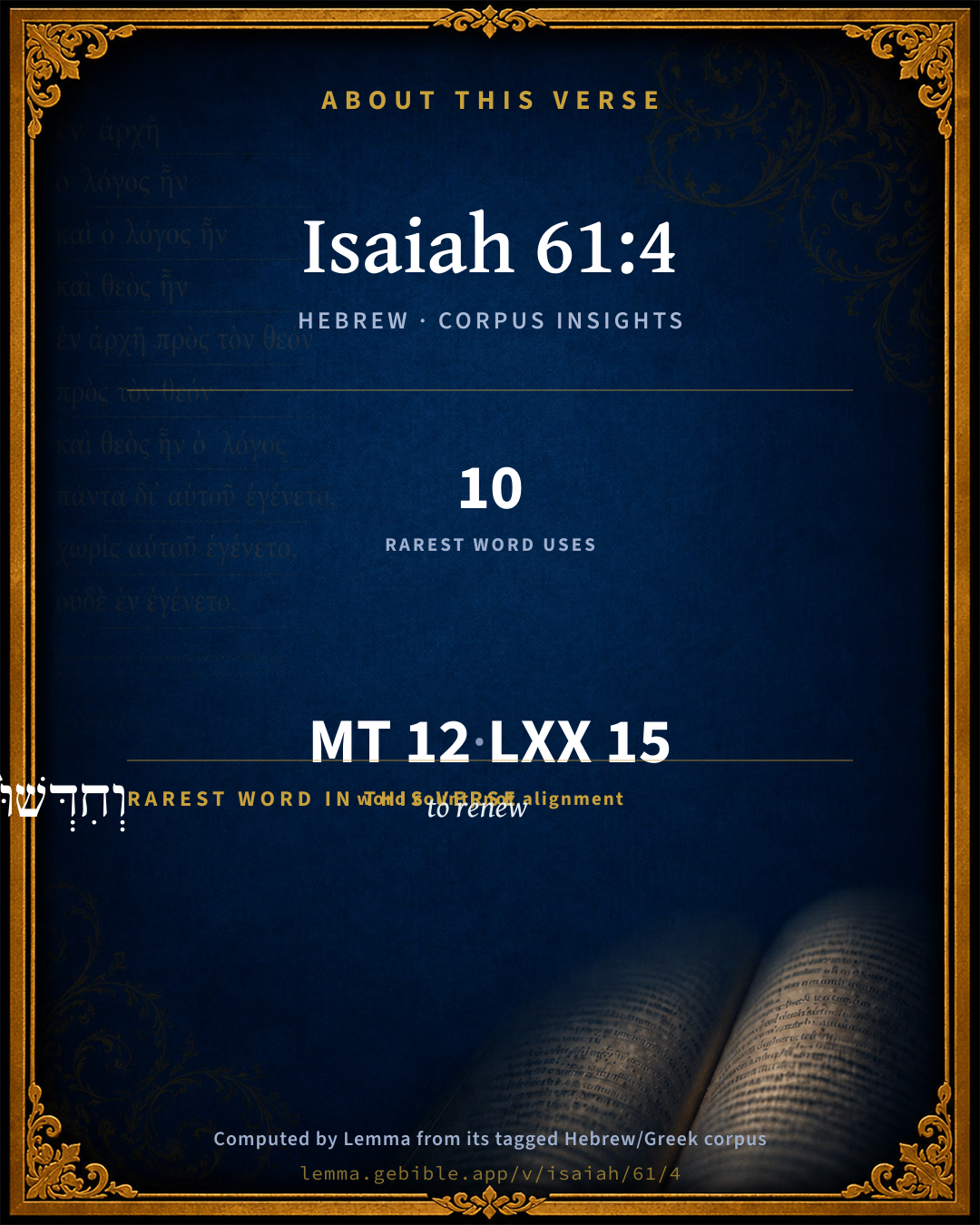
The rarest word here is וְחִדְּשׁוּ֙ to renew H2318 — appearing just 10 times in the whole Hebrew Bible.

Shared distinctive vocabulary

וְחִדְּשׁוּ֙ to renew H2318 occurs in 10 verses of the Hebrew Bible. Also found in:

Grammatical profile

  • 5 verbs
  • 6 nouns
  • 1 adjective

Verb forms

  • וּבָנוּ֙ Qal · Sequential Perfect
  • שֹׁמְמ֥וֹת Qal · Participle Active
  • יְקוֹמֵ֑מוּ Polel · Imperfect
  • וְחִדְּשׁוּ֙ Piel · Sequential Perfect
  • שֹׁמְמ֖וֹת Qal · Participle Active

Repetition

Words recur within this verse — often emphatic in Hebrew:

  • שֹׁמְמ֥וֹת to be desolate H8074 ×2
  • דּ֥וֹר generation H1755 ×2

Hebrew & Septuagint length

In English translation the verse runs 25 words from the Hebrew and 33 from the Septuagint (LXX English) — closely comparable.

A rough comparison of the two English renderings, which tokenize alike — not a word-level alignment.

Word counts can differ between the Hebrew and the Greek without any difference in meaning — e.g. the Hebrew direct-object marker אֵת has no separate Greek word, and Greek often adds the article ὁ.

In the original languages it is 12 Hebrew tokens and 15 Greek tokens — but the two are counted differently (Hebrew bundles its prefixes and suffixes into one token; the Greek is in lemma form), so that isn’t a like-for-like length.

Cross-references

5

Topical passages linked to Isaiah 61:4 in the Treasury of Scripture Knowledge — connected by theme and wording, ordered by reader-vote popularity; previews shown in the World English Bible.

  • Isaiah 58:12 Those who shall be of you shall build the old waste places; you shall raise up the foundations of many generations; and you shall be called The repairer of the breach, The restorer of paths to dwell in.
  • Amos 9:14–15 I will bring back the captivity of my people Israel, And they will rebuild the ruined cities, and inhabit them; and they will plant vineyards, and drink wine from them. They shall also make gardens, And eat the fruit of them.
  • Ezekiel 36:33–36 Thus says the Lord Yahweh: In the day that I cleanse you from all your iniquities, I will cause the cities to be inhabited, and the waste places shall be built.
  • Ezekiel 36:23–26 I will sanctify my great name, which has been profaned among the nations, which you have profaned in the midst of them; and the nations shall know that I am Yahweh, says the Lord Yahweh, when I shall be sanctified in you before their eyes.
  • Isaiah 49:6–8 yes, he says, It is too light a thing that you should be my servant to raise up the tribes of Jacob, and to restore the preserved of Israel: I will also give you for a light to the Gentiles, that you may be my salvation to the end of the earth.

Cross-references courtesy of OpenBible.info (CC BY 4.0).

Hebrew and Greek witnesses Masoretic Hebrew ↔ Greek Septuagint

The same verse in the two great witnesses to the Old Testament, shown verse-for-verse.

These are two independent witnesses, not word-aligned to each other, and the Septuagint is shown in lemma (dictionary) form.

Hebrew Isaiah 61:4 Masoretic · Westminster Leningrad Codex

וּבָנוּ֙ חָרְב֣וֹת עוֹלָ֔ם שֹׁמְמ֥וֹת רִֽאשֹׁנִ֖ים יְקוֹמֵ֑מוּ וְחִדְּשׁוּ֙ עָ֣רֵי חֹ֔רֶב שֹׁמְמ֖וֹת דּ֥וֹר וָדֽוֹר

They shall build the old wastes, they shall raise up the former desolations, and they shall repair the waste cities, the desolations of many generations.

World English Bible · Public Domain

Greek LXX Isaiah 61:4 Septuagint · lemma form

καί οἰκοδομέω ἔρημος αἰώνιος ἐκἐρημόω πρότερον ἐκ ἀναἵστημι καί καινίζω πόλις ἔρημος ἐκἐρημόω εἰς γενεά

And they shall build the old waste places, they shall raise up those that were before made desolate, and shall renew the desert cities, even those that had been desolate for many generations.

LXX2012 (modern English Septuagint) · Public Domain

On this verse, Keil & Delitzsch discusses the Septuagint’s reading. Read the note in Commentary ↓

Hebrew: Westminster Leningrad Codex (CC BY 4.0). Greek: Septuagint (public domain); English from LXX2012 (modern English Septuagint) (Public Domain). How the Septuagint differs from the Hebrew →

Targum (Aramaic paraphrase)

1

The Targum is the ancient Jewish Aramaic paraphrase of the Hebrew Scriptures — an interpretive translation, not the Hebrew text itself. Onkelos (literal) and Pseudo-Jonathan (expansive) render the Torah, and Jonathan the Prophets. Coverage is partial: where no permissively-licensed English translation exists for a verse, only the Aramaic is shown. This is verse-level text, not a word-by-word alignment to the Hebrew.

  1. Targum Jonathan Prophets (Joshua–Malachi)
    וְיִבְנוֹן חָרְבַת עֲלָם צַדְיָת קַדְמָאֵי יְקוֹמְמוּן וִיחַדְתּוּן קִירְוִין דַהֲוָאָה חָרְבָּן צַדְיָא דָר וְדָר:

    And they shall build the old wastes, they shall raise up the former desolations, and they shall repair the cities which were wastes, the desolations of many generations.

    Targum Jonathan — Aramaic: “Mikraot Gedolot” (public domain). English: “Sefaria Community Translation” (CC0 1.0 (public-domain dedication)); “London "Chaldee Paraphrase," 1871” (public domain). Text via Sefaria.

Commentary

Notes on Isaiah 61:4 from classic Christian and Jewish commentators (each source and its license shown beneath its notes). The classic Christian expositions comment on the surrounding passage and are grouped to its opening verse, so a note may address several verses; the Jewish commentaries on the Tanakh (Rashi and others) are per-verse, so they appear only where the commentator wrote on this verse.

Lemma curates 59 commentaries, every one of them public domain or Creative Commons licensed, each selected and text-cleaned for this edition rather than reprinted as found. About our sources →

Matthew Henry's Commentary

Promises are here made to the Jews now returned out of captivity, and settled again in their own land, which are to be extended to the gospel church, and all believers, who through grace are delivered out of spiritual thraldom; for they are capable of being spiritually applied.

I. It is promised that their houses shall be rebuilt (Isa 61:4), that their cities shall be raised out of the ruins in which they had long lain, and be fitted up for their use again: They shall build the old wastes; the old wastes shall be built, the waste cities shall be repaired, the former desolations, even the desolations of many generations, which it was feared would never be repaired, shall be raised up. The setting up of Christianity in the world repaired the decays of natural religion and raised up those desolations both of piety and honesty which had been for many generations the reproach of mankind. An unsanctified soul is like a city that is broken down and has no walls, like a house in ruins; but by the power of Christ's gospel and grace it is repaired, it is put in order again, and fitted to be a habitation of God through the Spirit. And they shall do this, those that are released out of captivity; for we are brought out of the house of bondage that we may serve God, both in building up ourselves to his glory and in helping to build up his church on earth.

II. Those that were so lately servants themselves, working for their oppressors and lying at their mercy, shall now have servants to do their work for them and be at their command, not of their brethren (they are all the Lord's freemen), but of the strangers, and the sons of the alien, who shall keep their sheep, till their ground, and dress their gardens, the ancient employments of Abel, Cain, and Adam: Strangers shall feed your flocks, Isa 61:5. When, by the grace of God, we attain to a holy indifference as to all the affairs of this world, buying as though we possessed not - when, though our hands are employed about them, our hearts are not entangled with them, but reserved entire for God and his service - then the sons of the alien are our ploughmen and vine-dressers.

III. They shall not only be released out of their captivity, but highly preferred and honourably employed (Isa 61:6): "While the strangers are keeping your flocks, you shall be keeping the charge of the sanctuary; instead of being slaves to your task-masters, you shall be named the priests of the Lord, a high and holy calling." Priests were princes' peers, and in Hebrew were called by the same name. You shall be the ministers of our God, as the Levites were. Note, Those whom God sets at liberty he sets to work; he delivers them out of the hands of their enemies that they may serve him, Luk 1:74, Luk 1:75; Psa 116:16. But his service is perfect freedom, nay, it is the greatest honour. When God brought Israel out of Egypt he took them to be to him a kingdom of priests, Exo 19:6. And the gospel church is a royal priesthood, Pe1 2:9. All believers are made to our God kings and priests; and they ought to conduct themselves as such in their devotions and in their whole conversation, with holiness to the Lord written upon their foreheads, that men may call them the priests of the Lord.

IV. The wealth and honour of the Gentile converts shall redound to the benefit and credit of the church, Isa 61:6. The Gentiles shall be brought into the church. Those that were strangers shall become fellow-citizens with the saints; and with themselves they shall bring all they have, to be devoted to the glory of God and used in his service; and the priests, the Lord's ministers, shall have the advantage of it. It will be a great strengthening and quickening, as well as a comfort and encouragement, to all good Christians, to see the Gentiles serving the interests of God's kingdom. 1. They shall eat the riches of the Gentiles, not which they have themselves seized by violence, but which are fairly and honourably presented to them, as gifts brought to the altar, which the priests and their families lived comfortably upon. It is not said, "You shall hoard the riches of the Gentiles, and treasure them," but, "You shall eat them;" for there is nothing better in riches than to use them and to do good with them. 2. They shall boast themselves in their glory. Whatever was the honour of the Gentiles converts before their conversion - their nobility, estates, learning, virtue, or places of trust and power - it shall all turn to the reputation of the church to which they have joined themselves; and whatever is their glory after their conversion - their holy zeal and strictness of conversation, their usefulness, their patient suffering, and all the displays of that blessed change which divine grace has made in them - shall be very much for the glory of God and therefore all good men shall glory in it.

V. They shall have abundance of comfort and satisfaction in their own bosoms, Isa 61:7. The Jews no doubt were thus privileged after their return; they were in a new world, and now knew how to value their liberty and property, the pleasures of which were continually fresh and blooming. Much more do all those rejoice whom Christ has brought into the glorious liberty of God's children, especially when the privileges of their adoption shall be completed in the resurrection of the body. 1. They shall rejoice in their portion; they shall not only have their own again, but (which is a further gift of God) they shall have the comfort of it, and a heart to rejoice in it, Ecc 3:13. Though the houses of the returned Jews, as well as their temple, be much inferior to what they were before the captivity, yet they shall be well pleased with them and thankful for them. It is a portion in their land, their own land, the holy land, Immanuel's land, and therefore they shall rejoice in it, having so lately known what it was to be strangers in a strange land. Those that have God and heaven for their portion have reason to say that they have a worthy portion and to rejoice in it. 2. Everlasting joy shall be unto them, that is, a joyful state of their people, which shall last long, much longer than the captivity had lasted. Yet that joy of the Jewish nation was so much allayed, so often interrupted, and so soon brought to an end, that we must look for the accomplishment of this promise in the spiritual joy which believers have in God and the eternal joy they hope for in heaven. 3. This shall be a double recompence to them, and more than double, for all the reproach and vexation they have lain under in the land of their captivity: "For your shame you shall have double honour, and in your land you shall possess double wealth, to what you lost; the blessing of God upon it, and the comfort you shall have in it, shall make an abundant reparation for all the damages you have received. You shall be owned not only as God's sons, but as his first-born (Exo 4:22), and therefore entitled to a double portion." As the miseries of their captivity were so great that in them they are said to have received double for all their sins (Isa 40:2), so the joys of their return shall be so great that in them they shall receive double for all their shame. The former is applicable to the fulness of Christ's satisfaction, in which God received double for all our sins; the latter to the fulness of heaven's joys, in which we shall receive more than double for all our services and sufferings. Job's case illustrates this: when God turned again his captivity, he gave him twice as much as he had before.

VI. God will be their faithful guide and a God in covenant with them (Isa 61:8): I will direct their work in truth. God by his providence will order their affairs for the best, according to the word of his truth. He will guide them in the ways of true prosperity, by the rules of true policy. He will by his grace direct the works of good people in the right way, the true way that leads to happiness; he will direct them to be done in sincerity and then they are pleasing to him. God desires truth in the inward parts; and, if we do our works in truth, he will make an everlasting covenant with us; for to those that walk before him and are upright he will certainly be a God all-sufficient. Now, as a reason both of this and of the foregoing promise, that God will recompense to them double for their shame, those words come in, in the former part of the verse, I the Lord love judgment. He loves that judgment should be done among men, both between magistrates and subjects and between neighbour and neighbour, and therefore he hates all injustice; and, when wrongs are done to his people by their oppressors and persecutors, he is displeased with them, not only because they are done to his people, but because they are wrongs, and against the eternal rules of equity. If men do not do justice, he loves to do judgment himself in giving redress to those that suffer wrong and punishing those that do wrong. God pleads his people's injured cause, not only because he is jealous for them, but because he is jealous for justice. To illustrate this, it is added that he hates robbery for burnt-offering. He hates injustice even in his own people, who honour him with what they have in their burnt-offerings, much more does he hate it when it is against his own people; if he hates robbery when it is for burnt-offerings to himself, much more when it is for burnt-offerings to idols, and when not only his people are robbed of their estates, but he is robbed of his offerings. It is a truth much to the honour of God that ritual services will never atone for the violation of moral precepts, nor will it justify any man's robbery to say, "It was for burnt-offerings," or Corban - It is a gift. Behold, to obey is better than sacrifice, to do justly and love mercy better than thousands of rams; nay, that robbery is most of all hateful to God which is covered with this pretence, for it makes the righteous God to be the patron of unrighteousness. Some make this a reason of the rejection of the Jews upon the bringing in of the Gentiles (Isa 61:6), because they were so corrupt in their morals, and, while they tithed mint and cummin, made nothing of judgment and mercy (Mat 23:23), whereas God loves judgment and insists upon that, and he hates both robbery for burnt offerings and burnt-offerings for robbery too, as that of the Pharisees, who made long prayers that they might the more plausibly devour widows' houses. Others read these words thus: I hate rapine by iniquity, that is, the spoil which the enemies of God's people had unjustly made of them; God hated this, and therefore would reckon with them for it.

VII. God will entail a blessing upon their posterity after them (Isa 61:9): Their seed (the children of those persons themselves that are now the blessed of the Lord, or their successors in profession, the church's seed) shall be accounted to the Lord for a generation, Psa 22:30. 1. They shall signalize themselves and make their neighbours to take notice of them: They shall be known among the Gentiles, shall distinguish themselves by the gravity, seriousness, humility, and cheerfulness of their conversation, especially by that brotherly love by which all men shall know them to be Christ's disciples. And, they thus distinguishing themselves, God shall dignify them, by making them the blessings of their age and instruments of his glory, and by giving them remarkable tokens of his favour, which shall make them eminent and gain them respect from all about them. Let the children of godly parents love in such a manner that they may be known to be such, that all who observe them may see in them the fruits of a good education, and an answer to the prayers that were put up for them; and then they may expect that God will make them known, by the fulfilling of that promise to them, that the generation of the upright shall be blessed. 2. God shall have the glory of this, for every one shall attribute it to the blessing of God; all that see them shall see so much of the grace of God in them, and his favour towards them, that they shall acknowledge them to be the seed which the Lord has blessed and doth bless, for it includes both. See what it is to be blessed of God. Whatever good appears in any it must be taken notice of as the fruit of God's blessing and he must be glorified in it.

Matthew Henry's Commentary on the Whole Bible (1708–1710) — public domain (CC PDM 1.0). Text via the HelloAO Bible API.

Trapp's Complete Commentary

John Trapp

Isa 61:4 And they shall build the old wastes, they shall raise up the former desolations, and they shall repair the waste cities, the desolations of many generations.

Ver. 4. And they shall build the old wastes.] Desolationes saeculi, the Gentiles that have long lain forlorn and desolate, as ruined houses; or the wild waste, shall, by the apostles and other doctors of the Church, be brought to Christ, and built up in holiness.

And they shall repair.] The same thing is four different times said over for better assurance, and to set forth the miracle.

John Trapp, A Commentary or Exposition upon All the Books of the Old and New Testament (1647–1656) — public domain. Text from a community e-Sword module.

The Biblical Illustrator

Joseph S. Exell

Isa_61:4

And they shall build the old wastes

Building the old wastes

There are many wastes in the world, and there are all sorts of them.

But of all sad and melancholy waste places, there is none so melancholy, so terrible, so desperate as a waste soul--a soul in which there is no sense of right and wrong in the tribunal of conscience; a soul where there is no distinct, manly, nobly inspiring purpose for spending and occupying life; a soul in which the mind is not instructed or Fed with useful knowledge, but which lies fallow; a soul where the heart is a cage of unclean birds.

I. As to THE METHODS of building up these waste places. Let us honestly confess that there are many of them, and none of them to be despised; and each is to be put in its proper order, and none can be dispensed with--one comes first, another second, and another third. There are in this earth of ours whole nations which may be called waste places.

1. The first thing to be done with the waste place of a great nation is to bring civilization into it; then the soil of the heart is prepared for better things to come.

2. Then many of our missionaries have to form a language: there are many words missing in the peoples dialect, without which they could not understand the truths of the Gospel. Then when a man is educated, he finds his imagination filled with new ideas; he feels he has taken his place in the great society of mankind, and is ready to listen to the truths which a little while before he trampled under his feet.

3. Another great means of building waste places is commerce and trade.

4. Good government is necessary. No man can receive the greatest and loftiest truths when they are living in a constant state of danger.

5. Preach the Gospel of Christ.

II. THE INSTRUMENTS. Whom does God use to build up the waste places?

1. His Sou is the great Builder (Luk_4:18, etc.).

2. Then as His representative, and, so to speak, in His place, His minister, His ambassador, His mouthpiece, HIS witness, the Church of God. Her great mission is to preach the Word of God, and administer the sacraments of Christ. Then there are other ways. The Church must try to enter into all the needs, and difficulties, and wants of those to whom she ministers. (A. W.Thorold, D. D.)

Social needs: religious duties

Our work is a work of restoration. This message is infinitely varied in its tone. If we are indeed to build the old wastes, we must see what has made them wastes; and we shall find that there have been three great enemies that have done this--disease and ignorance and sin.

I. We must bring a message of good news to THE BODY. We must recognize its needs--its need of pure air, and wholesome food, and healthy homes; and, also, its craving, especially in the days of youth, for leisure and amusement, and even excitement. We must meet these cravings, not with the forbidding frown of the Puritan, as though they were in themselves sinful, nor yet with the easy-going smile of the good-natured Epicurean, as though they were the all in all of human happiness, but with sympathy and good sense and forethought, in the belief that they represent one part of the Fathers will for His human children.

II. We must to the full recognize the rights of THE MIND. A Gospel that has no message of good news to the intellect of man is but a mutilated Gospel. Literature, art, science, music, have not, indeed, the last word to say on mans relation to God, but they have a mighty and a lovely word to say; and it ought to be the joy of all Christs truest ministers, lay and clerical, to help in conveying such words to the ear and to the heart even of the poorest and dullest. Public libraries and museums, cheap concerts and cheap magazines, arc among the truest weapons of those who would in our day destroy the works of the devil.

III. Chiefly must we come face to face with sin, not only with a message against sin; we must have a message of good tidings also to HUMAN SOULS. And when I say good tidings, I do not necessarily mean agreeable and attractive tidings. When Jesus said, Repent ye and believe the Gospel, the call to repent, though hardly attractive, was in itself a Gospel. We cannot build the waste places in England, in morals and social customs, in ways of thinking and talking and feeling, unless we very plainly denounce what is unchristian in contemporary life. The message of the Gospel is not only a soothing message of forgiveness to the sinner who is troubled in mind, nor a tender message of companionship to the lonely and the bereaved, nor a consoling message of eventual justice to the wronged and the overborne. But there is also the voice which convinces the world of sin, the voice which says to society, irrespective of class, to rich as well as to poor, to poor as well as to rich: In this and that you are wholly wrong; you are wrong in your expenditure of time, wrong in your expenditure of money, wrong in your estimate of the true prizes of life, wrong in your worship of comfort, wrong in your class isolation; wrong, many of you, in your very conception of religion. We have, if we are indeed witnesses of our Master, a message of good tidings to all alike, to all classes, to the rich and to the poor, to the highly cultivated and-to the ignorant. (H. M. Butler, D. D.)

Antiquities revived

I. THE ANTIQUITIES THAT ARE LAID WASTE.

1. Vital godliness.

2. Apostolic doctrine. The sovereignty of God, substitution, sanctity, etc.

3. Loyalty to Jesus.

4. The unity of the Spirit.

II. THE PROMISE OF THE SPECIAL REVIVALS THAT TO TAKE PLACE. They shall build, etc. (J. Irons.)

The Biblical Illustrator, edited by Joseph S. Exell (c. 1880s–1900s) — public domain. Text from a community e-Sword module.

Joseph Benson's Commentary

Isa 61:4-5. They shall build the old wastes — See on chap. 58:12. As this is evidently to be understood of gospel times, the meaning seems to be, that the establishment of Christianity in the world should repair the decays of true religion, of genuine piety and virtue, which had been at a very low ebb, not only in the Gentile nations, which were all idolatrous, but also among the Jews, for many centuries. By the ministry of John the Baptist, of our Lord, and his apostles, many thousands of spiritual worshippers were raised up to God in Judea, and the adjacent parts; and when the ministers of the word were sent into the Gentile countries, the cities and provinces which had been as a wilderness, overrun with briers and thorns, became as Eden, and the deserts like the garden of the Lord: truth and grace, wisdom and piety, godliness and righteousness, with joy and gladness, were found therein, thanksgiving and the voice of melody, Isa 51:3. And strangers — Namely, Gentiles, such as were not of the natural race of the Jews, but Gentile converts; shall stand — Ready to be at thy service; and feed your flocks — The churches, with the word of God. And the sons of the alien — The same with the strangers before mentioned, or their successors; shall be your ploughmen, &c. — Shall manage the whole work of God’s spiritual husbandry. See 1Co 3:6-9.

Joseph Benson's Commentary on the Old and New Testaments (1811–1818) — public domain. Text from a community e-Sword module.

Keil & Delitzsch

C. F. Keil & F. Delitzsch

Even in Isa 61:3 with להם וקרא a perfect was introduced in the place of the infinitives of the object, and affirmed what was to be accomplished through the mediation of the Servant of Jehovah. The second turn in the address, which follows in Isa 61:4-9, continues the use of such perfects, which afterwards pass into futures. But the whole is still governed by the commencement in Isa 61:1. The Servant of Jehovah celebrates the glorious office committed to him, and expounds the substance of the gospel given him to proclaim. It points to the restoration of the promised land, and to the elevation of Israel, after its purification in the furnace of judgment, to great honour and dignity in the midst of the world of nations. "And they will build up wastes of the olden time, raise up desolations of the forefathers, and renew desolate cities, desolations of former generations. And strangers stand and feed your flocks, and foreigners become your ploughmen and vinedressers. But ye will be called priests of Jehovah; Servants of our God, will men say to you: ye will eat the riches of the nations, and pride yourselves in their glory." The desolations and wastes of ‛ōlâm and dōr vâdōr, i.e., of ages remote and near (Isa 58:12), are not confined to what had lain in ruins during the seventy years of the captivity. The land will be so thickly populated, that the former places of abode will not suffice (Isa 49:19-20); so that places must be referred to which are lying waste beyond the present bounds of the promised land (Isa 54:3), and which will be rebuilt, raised up, and renewed by those who return from exile, and indeed by the latest generations (Isa 58:12, מםּ; cf., Isa 60:14). Chōrebh, in the sense of desolation, is a word belonging to the alter period of the language (Zeph., Jer., and Ezek.). The rebuilding naturally suggests the thought of assistance on the part of the heathen (Isa 60:10). But the prophet expresses the fact that they will enter into the service of Israel (Isa 61:5), in a new and different form. They "stand there" (viz., at their posts ready for service, ‛al-mish-martâm, Ch2 7:6), "and feed your flocks" (צאן singularetantum, cf., Gen 30:43), and foreigners are your ploughmen and vinedressers. Israel is now, in the midst of the heathen who have entered into the congregation of Jehovah and become the people of God (ch Isa 19:25), what the Aaronites formerly were in the midst of Israel itself. It stands upon the height of its primary destination to be a kingdom of priests (Exo 19:6). They are called "priests of Jehovah," and the heathen call them "servants of our God;" for even the heathen speak with believing reverence of the God, to whom Israel renders priestly service, as "our God." This reads as if the restored Israelites were to stand in the same relation to the converted heathen as the clergy to the laity; but it is evident, from Isa 66:21, that the prophet has no such hierarchical separation as this in his mind. All that we can safely infer from his prophecy is, that the nationality of Israel will not be swallowed up by the entrance of the heathen into the community of the God of revelation. The people created by Jehovah, to serve as the vehicle of the promise of salvation and the instrument in preparing the way for salvation, will also render Him special service, even after that salvation has been really effected. At the same time, we cannot take the attitude, which is here assigned to the people of sacred history after it has become the teacher of the nations, viz., as the leader of its worship also, and shape it into any clear and definite form that shall be reconcilable with the New Testament spirit of liberty and the abolition of all national party-walls. The Old Testament prophet utters New Testament prophecies in an Old Testament form. Even when he continues to say, "Ye will eat the riches of the Gentiles, and pride yourselves in their glory," i.e., be proud of the glorious things which have passed from their possession into yours, this is merely colouring intended to strike the eye, which admits of explanation on the ground that he saw the future in the mirror of the present, as a complete inversion of the relation in which the two had stood before. The figures present themselves to him in the form of contrasts. The New Testament apostle, on the other hand, says in Rom 11:12 that the conversion of all Israel to Christ will be "the riches of the Gentiles." But if even then the Gentile church should act according to the words of the same apostle in Rom 15:27, and show her gratitude to the people whose spiritual debtor she is, by ministering to them in carnal things, all that the prophet has promised here will be amply fulfilled. We cannot adopt the explanation proposed by Hitzig, Stier, etc., "and changing with them, ye enter into their glory" (hithyammēr from yâmar = mūr, Hiph.: hēmı̄r, Jer 2:11; lit., to exchange with one another, to enter into one another's places); for yâmar = ‛âmar (cf., yâchad = 'âchad; yâsham = 'âsham; yâlaph = 'âlaph), to press upwards, to rise up (related to tâmar, see at Isa 17:9; sâmar, Symm. ὀρθοτριχεῖν, possibly also ‛âmar with the hithpael hith‛ammēr, lxx καταδυναστεύειν), yields a much simpler and more appropriate meaning. From this verb we have hith'ammēr in Psa 94:4, "to lift one's self up (proudly)," and here hithyammēr; and it is in this way that the word has been explained by Jerome (superbietis), and possibly by the lxx (θαυμασθήσεσθε, in the sense of spectabiles eritis), by the Targum, and the Syriac, as well as by most of the ancient and modern expositors.

Keil & Delitzsch — Biblical Commentary on the Old Testament (1861–1891) — public domain (CC PDM 1.0). Text via the HelloAO Bible API. (Old Testament only.)

Geneva Bible (1599)

Geneva Bible translators

That is, for a long time.

Geneva Bible (1599) marginal notes — public domain. Text via Bolls.life.

Jamieson, Fausset & Brown

Robert Jamieson, A. R. Fausset & David Brown

old wastes--Jerusalem and the cities of Judah which long lay in ruins (see on Isa 58:12).

Jamieson, Fausset & Brown — Commentary Critical and Explanatory on the Whole Bible (1871) — public domain (CC PDM 1.0). Text via the HelloAO Bible API.

Adam Clarke's Commentary

Verse 4. "And they that spring from thee"] A word is lost here likewise. After ובנו ubanu, "they shall build," add ממך mimmecha, they that spring from thee. Four MSS. have it so, (two of them ancient,) and one of mine has it in the margin, and it is confirmed by Isa 58:12, where the sentence is the very same, this word being here added. Kimchi makes the same remark: "the word ממך mimmecha is omitted here; but is found in Isa 58:12."

The desolations of many generations] It seems that these words cannot refer to the Jews in the Babylonish captivity, for they were not there many generations; but it may refer to their dispersions and state of ruin since the advent of our Lord; and consequently this may be a promise of the restoration of the Jewish people.

Adam Clarke's Commentary on the Bible (1810–1826) — public domain. Text from a community e-Sword/MySword module.

Ellicott's Commentary for English Readers

(4) They shall build the old wastes . . .—Literally the waste places of olden time: i.e., not merely the cities that had fallen into ruins during the exile, but those that had been lying waste for generations. The words are parallel with those of Isa_58:12. By some commentators strangers is supplied from Isa_61:5 as the implied subject, as in Isa_60:10. Here, however, it would seem as if the prophet looked on the rebuilding as being Israel’s own work, while service of another kind was assigned to the aliens.

A Bible Commentary for English Readers, edited by Charles John Ellicott (1878–1897) — public domain. Text from a community e-Sword module.

The Cambridge Bible for Schools and Colleges

gen. ed. J. J. S. Perowne

4. Comp. ch. Isa_49:8, Isa_58:12, Isa_60:10.

The Cambridge Bible for Schools and Colleges (gen. ed. J. J. S. Perowne; Cambridge University Press, 1878–1918) — public domain. Text from a community e-Sword module.

John Gill's Exposition

And they shall build the old wastes,.... The captives set at liberty, and who are called trees of righteousness, and the planting of the Lord; righteous and good men, who shall be employed in the spiritual building of the church in Gospel times, and especially in the latter day; for here begins an account of the benefits and blessings the church of Christ should partake of, particularly at the time of the calling and conversion of the Jews: after having described the work and office of the Messiah, and his fitness for it, the Holy Ghost returns to the same subject with the preceding chapter, and which is carried on in the next. What is here said was literally true, when the Jews returned from Babylon, and built their ruined houses and cities; or, at least, there is an allusion to it: but it respects either the setting up of the interest of Christ, and forming churches in the Gentile world, where nothing but blindness and ignorance reigned; where there were no preaching nor ordinances, but all things were in ruin and confusion; as they were before the ministry of the Gospel by the apostles, who were wise master builders, and instruments of converting multitudes, and of raising churches to the honour of the great Redeemer there: or rather it respects the building up of the tabernacle of David, that is fallen down, or the church of God among the Jews, which will be in the latter day, when they are turned to the Lord, Amo 9:11 and the same sense have all the following expressions,

they shall raise up the former desolations, and they shall repair the waste cities, the desolations of many generations; setting forth the desolate state and condition of the Jews; their long continuance in it, age after age; and their recovery and restoration, when they shall become a flourishing people again, both in civil and spiritual things.

John Gill's Exposition of the Whole Bible (1746–1763) — public domain (CC PDM 1.0). Text via the HelloAO Bible API.

Albert Barnes' Notes on the Bible

And they shall build the old wastes - (See the notes at Isa 58:12).

Albert Barnes' Notes on the Bible (1834–1885) — public domain. Text from a community e-Sword/MySword module.

Haydock's Catholic Bible Commentary

Ruins, as the Jews did, chap. lviii. 12. The apostles preached to the Gentiles, who had been long neglected.

George Leo Haydock (1774–1849), Haydock's Catholic Family Bible and Commentary, 1859 edition — public domain. Excludes Psalms (Douay-Rheims chapter numbering differs from Protestant) and Deuterocanonical books (Catholic canon only).

Matthew Poole's English Annotations

See Isa 58:12. As it is applied to gospel times, the meaning may be, that Gentilism, which was as a wilderness overgrown with briers and thorns, shall be cultivated; and those cities and provinces of the Gentiles that lay as it were waste, void of all true religion, shall now by the ministry of the word be edified in the true worship of God.

Matthew Poole's English Annotations on the Holy Bible (1683–1685) — public domain. Text from a community e-Sword/MySword module.

Whedon's Commentary on the Bible

Daniel D. Whedon

4. And they — The strong flourishing “trees of righteousness,” of Isa_61:3; the sound and the efficient, whom the grace of the Gospel brought out and made grand workers in Messiah’s kingdom.

Waste cities — Destruction occasioned in consequence of the sins of the people in days gone by. Of this import, also, are the parallel expressions in the verse.

Daniel D. Whedon (gen. ed.), Commentary on the Old and New Testaments (1874–1909) — public domain. Text from a community e-Sword module.

The Pulpit Commentary

Vers. 4-9. GOD"S PURPOSE OF DEALING GRACIOUSLY WITH ISRAEL. Having proclaimed the objects of his own mission, "the Servant" proceeds to declare God"s gracious purposes towards Israel. Taking the Captivity period for his standpoint, he promises, first, the restoration of the cities of Judah (ver. 4), and then a flourishing time in which Jews and Gentiles shall dwell together in one community peacefully and gloriously, Israel having a certain pre-eminence (vers. 5-9).

They shall build the old wastes. (On the "waste" condition, not of Jerusalem only, but of the cities of Judith generally, see Isa_44:26 Isa_49:8, 19 64:10, 11, etc.) The first step in the recovery of Israel from the misery of the Captivity would be a return to Palestine, and a general restoration of the ruined towns. It was a ruin of "many generations," having commenced, probably, with the invasion of Pharaoh-Necho in B.C. 608, and being continued till the edict of Cyrus (B.C. 538).

Restoration.

"They shall build the old wastes." All waste is wicked. It is so in war. Even taken at its lowest estimate, think of the ruin of glorious temples, and exquisite sculptures, and works of art, all ground to dust, as Mr. Ruskin says, by mere human rage. Florence, and many of the Southern cities, have been the war-fields of Europe. What waste! There genius toiled; there multitudes, in sweat of brow, built the aqueduct and decorated the capitol; and there, from time to time, the rude hand of the despoiler has come. History has made record of victories and glorified conquerors, and some minstrel has caught the infection and sung the lay of the wasters. What a satire on man! Why smile at the child who builds houses for the sea to smite down? Man builds, and then with the waves of maddened war-lust dashes to pieces his own best works. So it is. The history of Europe has been, in this sense, a history of waste, and instead of the glorious works of Phidias to gaze upon, we have broken arms, fractured columns. In devastated districts we dig for relics. This is only the material side of the waste of war. I say all waste is wicked. And I have to speak of human hearts and lives. Much more precious these than sculptured column or lofty fane. Yes; do not let us forget that the words of Christ refer to life present as well as life to come. "What shall it profit a man, if he gain the whole world and lose his own life?

I ALL LIVES WERE DESIGNED TO HAVE A DIVINE IDEAL IN THEM. We cannot understand the "why" of creation at all apart from that. "Lo, this only have I found, that God hath made man upright; but they have sought out many inventions". (Ecc_7:29) They have, in fact, invented many ideals for themselves, and have wasted in these inventions the fine God-created faculties of their souls. If the end is missed all is missed. If the column does not stand erect and uphold the building, it is nothing to me that you decorate it when on the ground. That is not its place, its use; it is a pillar or nothing. So man was made in this highest end to glorify God; and his life is blighted if it is rich in cultivation, elevated in taste, artistic in style, comprehensive in erudition, useful in applied mechanics if he does not glorify God. Our Saviour said, "My meat and my drink is to do the will of him that sent me, and to finish his work.

1. Lives are blighted, if certain seasons of spring and seed-time, which cannot return, pass idly by. Men may be saved; for the precious blood of Christ can cleanse from all sin, even in old age. But they cannot bear the fruit of a spiritual manhood, or of a Christian childhood.

2. Lives are blighted, if not filled with the power of immortality. However noble and glorious they may appear, their fruits wither; there is no deep soil; the roots do not strike into the eternal life.

3. Lives are blighted, if not influential as good soil to be used for harvests. Man does not live for the mere enjoyment and admiration of spiritual beauty in hours of meditation. There must be fruit in the tree for others to gather. It is disappointing in the autumn to lift the leaves and find no rich bloom of purple fruit, "Abide in me." "So," says Christ, "shall ye bear much fruit.

II ALL WASTING OF LIFE IS TRACEABLE. What to? Well, you can trace the blight to something in the atmosphere, something at the root, or some confinement from the free breath of heaven. So you can trace human waste and moral waste.

1. Sometimes it comes from absence of faith. There has been energy or heroic determination to conquer evil, to pursue the good, but this has been mere doing, not being; men need faith to win Christ; to have him in them, the Hope of glory. "If a man abide not in me, he is cast forth as a branch, and is withered.

2. Sometimes it comes from absence of love. It is love that makes the other graces grow and bring forth fruit. Love is warmth and life when inspired by Christ. Let me say also that I wanted to speak of lives in a human sense blighted, and there are some such. Why? Because love is absent; they are treated coldly, contemptuously, cruelly; the fire of love, at first damped, has now died out in their hearts; they know, they feel it is. Mated to coarseness and rudeness, with the first thin superficial refinement and tenderness all worn away, they find life worse than a blank it is a bitter, bitter bondage to the selfishness and tyranny of others. Poor heart! God help thee wherever thou art. Love can bear much and hope on. But when love"s ashes are white, life is blighted indeed.

3. Sometimes it comes from indifference. Let it alone. That is enough. Leave religion to take care of itself. Then, like the best garden, it soon becomes desolate.

III WASTED LIVES ARE REPARABLE ONLY BY REDEMPTION. In the body there is a kind of self-healing after sickness. Not so with the soul; that requires a Divine Physician.

1. Christ does more than forgive. He renews and restores. Perhaps you desire now that God should restore unto you the joy of salvation. You are sad about your own fruitlessness. So little peace and joy in the Holy Ghost. Then, just as spring sweet spring comes in time, and the tender herb appears, and Nature puts on her new garment of beauty, rejoicing to have her incense-cup filled again by the hand of the Most High, so you desire that new graces should spring forth. Christ can make you abound with life through the abundant grace which he is waiting to bestow.

2. Christ does wore than teach. He will live in you. The fruit is not yours, but Christ"s. He is the Vine, we are the branches. A closer union with him is what we need. If we seek to be grafted into the true Vine, then, and then only, shall we bring forth fruit in our season. Christ is sometimes tailed the great Teacher. So he is! All his teaching is that of the infinite mind. "In him are hid all the treasures of wisdom and knowledge." What, then, is his first teaching? Believe on me! Then we become one with him, and our character has life in it.

3. Christ does more even than commence this life. He completes it. He carries it on to perfection. So that we, sinful and weak as we are, are made perfect in every good work. Waste, then, is not to be mourned over only; it is to be restored. The satirist speaks scornfully of evil when seen and lived out. The optimist says all is the best possible in the best of worlds, could we but understand all. The Christian says, "No; evil is here, and evil is not of God." And then by the aid of the Holy Ghost he seeks to have the old man crucified with Christ, and to live unto God. May renewal come to us all! May blight and waste give place to life and fruit! W.M.S.

The Pulpit Commentary (1880–1919), ed. H.D.M. Spence-Jones & Joseph S. Exell — public domain. Text from a community e-Sword module.

J. A. Alexander on Isaiah

Joseph Addison Alexander

“And they shall build up the ruins of antiquity, the desolations of the ancients they shall raise, and shall renew the cities of ruin (i.e., ruined cities), the desolations of age and age.” Both the thought and language of this verse have been explained already. (See above, on Isa 49:8; Isa 54:3; Isa 58:12). The verb ‘renew’ is applied as in 2Ch 15:8; 2Ch 24:4.

Joseph Addison Alexander, The Prophecies of Isaiah (1846–1847; New York: Scribner, 1870–1878) — public domain. Text from a community e-Sword module.

unfoldingWord translationNotes

Door43 World Missions Community

General Information:

Isaiah continues speaking using parallelisms in each line. (See: Parallelism)

translationWords

ruin

restore

desolate

generation

alien

flocks

works

vineyard

unfoldingWord translationNotes — © Distant Shores Media and the Door43 World Missions Community, licensed CC BY-SA 4.0. Source: git.door43.org/Door43/en_tn.

Ibn Ezra

Rabbi Abraham ibn Ezra

עולם Of old.

ראשנים Of former generations.

Ibn Ezra on the Tanakh — English translations: “Sefaria Community Translation” (CC0 1.0 (public-domain dedication)); “Yalkut, Sifsei Chachomim Chumash, Metsudah Publications, 2009” (CC BY 4.0); and “Commentary of Ibn Ezra on Isaiah - trans. by M. Friedlander, 1873” (public domain). Text via Sefaria.

Lesson kit

Teaching starters — assembled from the data on this page, not authored interpretation. Every prompt links to the verse data it draws on. Edit before teaching.

Isaiah, in the Prophets, opens this verse with 12 words (10 distinct Hebrew lemmas). Its most distinctive word is châdash (“to renew”). A historical commentator’s framing appears above. Read the whole chapter for the surrounding context.

Discussion questions

  1. What does “to renew” (châdash) contribute to the verse as a whole?
  2. 1 Samuel 11:14 shares the word «to renew» with this verse. How do the two illuminate each other?
  3. “to be desolate” occurs 2× in this one verse. What is the effect of the repetition?
  4. These translations render this verse differently. What is at stake in choosing one wording over another?
  5. The verb «וּבָנוּ֙» is Qal Sequential Perfect. How does its form color the action?
  6. Reading how Matthew Henry's Commentary and Trapp's Complete Commentary read this verse, where do the two commentators agree and where do they part?

Things to notice

Reading settings

Reading text

Shown beneath each verse's original-language words.

Old Testament
Old Testament edition

Read the OT as the Masoretic Hebrew (MT) or the Greek Septuagint (LXX).

English shown for the Greek Septuagint (in the Hebrew ↔ Greek comparison).

Comparing translations? Open the Compare panel on any verse page to stack up to four side by side.