
2 Chronicles 11:5

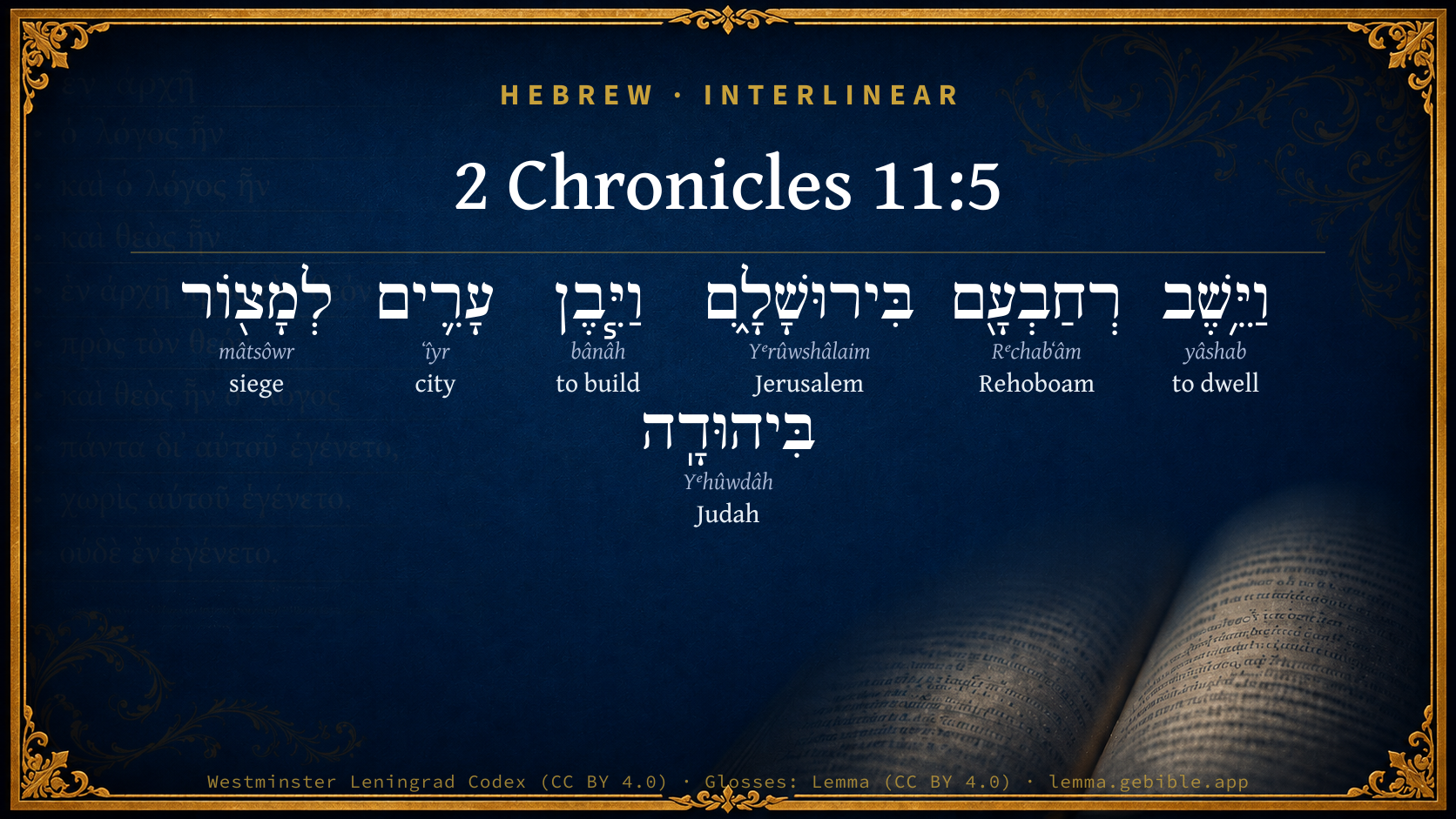
Hebrew (Westminster Leningrad Codex) 2 Chronicles 11:5 appears in the Hebrew Old Testament. The text above is from the Westminster Leningrad Codex. Each word links to its Strong’s number, a concise gloss, and parsing drawn from the Open Scriptures Hebrew Bible morphology. Click any word for its full Brown-Driver-Briggs (BDB) entry.
Download image
Cite this verse

2 Chronicles 11:5 (World English Bible). Public Domain. Lemma interlinear Bible study tool, https://lemma.gebible.app/v/2-chronicles/11/5.

Show BibTeX & RIS
BibTeX
RIS
English Translation
Rehoboam lived in Jerusalem, and built cities for defense in Judah.
World English Bible · Public Domain
Download a study sheet

One document with this verse’s original text, its word-by-word gloss line, the meaning frame, cross-references with their text, attributed commentary, and full source and license credits — printable, and it pastes into notes with its structure intact.

This verse Autodidact and up

Study sheet (.html) Plain text (.txt)

A passage Seminary Student

Up to 50 verses in one chapter. A passage sheet keeps up to 6 commentary sources and 12 cross-references per verse, in the order this page ranks them, and says so on the sheet whenever that leaves anything out. Ask for a single verse and you get the Autodidact verse sheet above.

Everything on this page stays free to read, with no account — the sheet is a download of what is already on screen, not access to it.

Want to remove ads? Support Godless Engineer
Compare translations 3

The same verse in 3 English versions, stacked beneath the original-language interlinear above. Click any original word for its lexicon entry.

Each is an independent rendering of the whole verse — the interlinear is not word-aligned to these translations.

Highlighted words mark where these versions differ — a whole-verse word diff, not a word-by-word alignment.

  • World English Bible Public Domain
    Rehoboam lived in Jerusalem, and built cities for defense in Judah.
  • King James Version Public Domain
    And Rehoboam dwelt in Jerusalem, and built cities for defense in Judah.
  • unfoldingWord Literal Text CC BY-SA 4.0
    And Rehoboam dwelled in Jerusalem, and he built cities for fortification in Judah.

unfoldingWord Literal Text — © unfoldingWord, licensed CC BY-SA 4.0. Word-aligned USFM3 via Door43 (git.door43.org/unfoldingWord/en_ult).

Versions to compare (up to 4)

3 of 4 selected

Show all 18 translations

Every available English version of this verse, each an independent rendering of the whole verse.

  • World English Bible Public Domain
    Rehoboam lived in Jerusalem, and built cities for defense in Judah.
  • Berean Standard Bible Public Domain
    Rehoboam continued to live in Jerusalem, and he built up cities for defense in Judah.
  • Majority Standard Bible Public Domain
    Rehoboam lived in Jerusalem, and he built up cities for defense in Judah.
  • King James Version Public Domain
    And Rehoboam dwelt in Jerusalem, and built cities for defense in Judah.
  • American Standard Version (1901) Public Domain
    And Rehoboam dwelt in Jerusalem, and built cities for defence in Judah.
  • Revised Version (1885) Public Domain
    And Rehoboam dwelt in Jerusalem, and built cities for defence in Judah.
  • Geneva Bible (1599) Public Domain
    And Rehoboam dwelt in Ierusalem, and buylt strong cities in Iudah.
  • Douay-Rheims (1899) Public Domain
    And Roboam dwelt in Jerusalem, and built walled cities in Juda.
  • Young's Literal Translation Public Domain
    And Rehoboam dwelleth in Jerusalem, and buildeth cities for a bulwark in Judah,
  • Literal Standard Version CC BY-SA 4.0
    And Rehoboam dwells in Jerusalem, and builds cities for a bulwark in Judah,
  • Unlocked Literal Bible CC BY-SA 4.0
    Rehoboam lived in Jerusalem and built cities in Judah for defense.
  • unfoldingWord Literal Text CC BY-SA 4.0
    And Rehoboam dwelled in Jerusalem, and he built cities for fortification in Judah.
  • Darby Bible Public Domain
    And Rehoboam dwelt in Jerusalem, and built cities for defence in Judah.
  • World Messianic Bible Public Domain
    Rehoboam lived in Jerusalem, and built cities for defense in Judah.
  • Webster's Bible Public Domain
    And Rehoboam dwelt in Jerusalem, and built cities for defense in Judah.
  • Free Bible Version CC BY-SA 4.0
    Rehoboam stayed in Jerusalem, and he strengthened the defenses of the towns in Judah.
  • Bible in Basic English Public Domain
    Now Rehoboam kept in Jerusalem, building walled towns in Judah.
  • JPS Tanakh (1917) Public Domain
    And Rehoboam dwelt in Jerusalem, and built cities for defence in Judah.

Literal Standard Version (2020), Covenant Press — licensed CC BY-SA 4.0. Text via the HelloAO Bible API (eBible.org). Unlocked Literal Bible (unfoldingWord) — licensed CC BY-SA 4.0. Text via the HelloAO Bible API (eBible.org). unfoldingWord Literal Text — © unfoldingWord, licensed CC BY-SA 4.0. Word-aligned USFM3 via Door43 (git.door43.org/unfoldingWord/en_ult). Free Bible Version, Dr. Jonathan Gallagher — licensed CC BY-SA 4.0. Text via the HelloAO Bible API (eBible.org).

Word by word

More ways to search: Search by grammar → Find every occurrence → Compare this word →

Practice this passage: Drill this verse → Learn its vocabulary →

About this verse

These counts appear in no published source. They are computed here, from the morphology-tagged text and Lemma’s own curated glosses. What Lemma adds →

7
words
7
distinct lemmas
Historical
section

Shared distinctive vocabulary

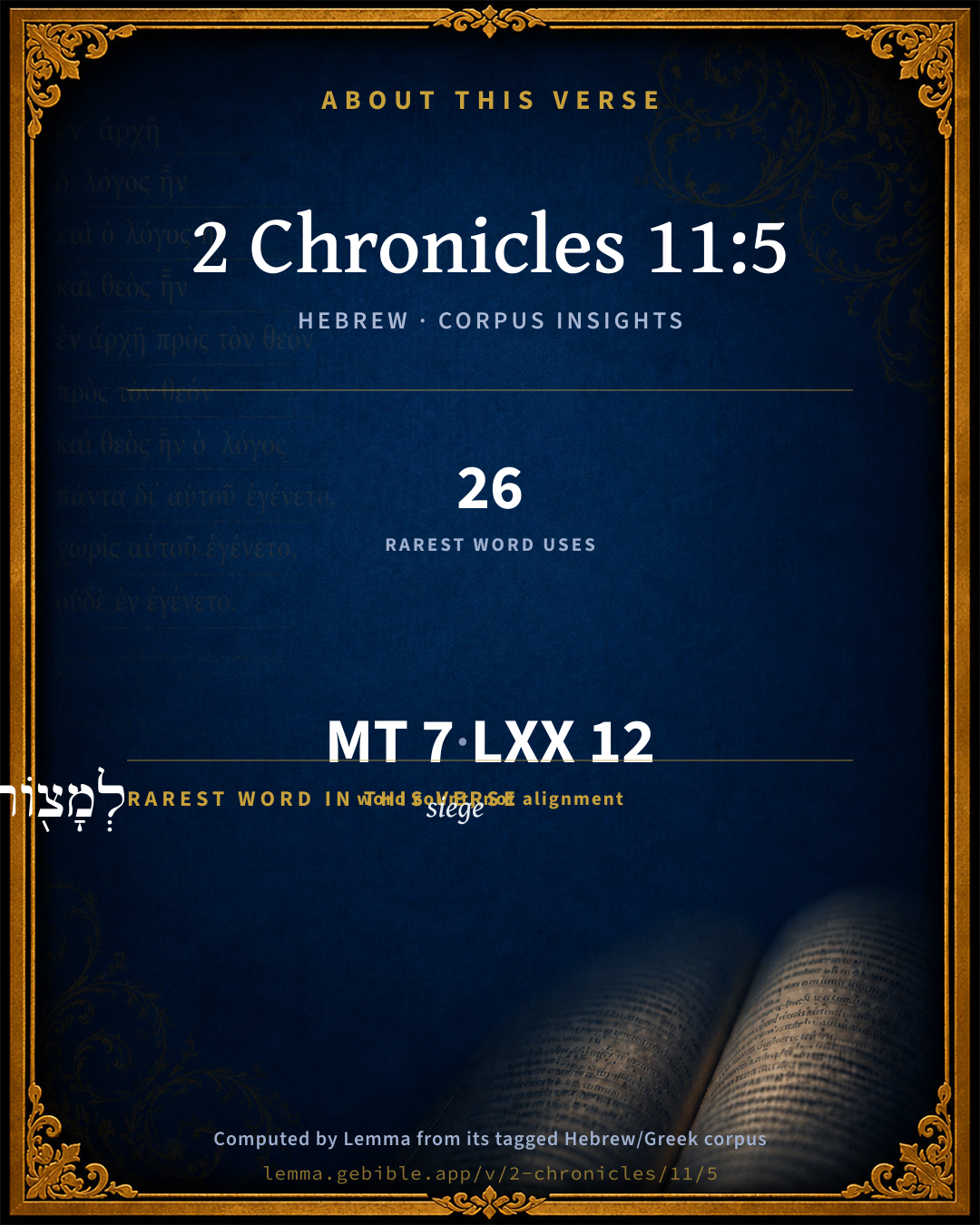
לְמָצ֖וֹר siege H4692 occurs in 26 verses of the Hebrew Bible. Also found in:

Grammatical profile

  • 2 verbs
  • 5 nouns

Verb forms

  • וַיֵּ֥שֶׁב Qal · Sequential Imperfect
  • וַיִּ֧בֶן Qal · Sequential Imperfect

Hebrew & Septuagint length

In English translation the verse runs 11 words from the Hebrew and 12 from the Septuagint (LXX English) — closely comparable.

A rough comparison of the two English renderings, which tokenize alike — not a word-level alignment.

Word counts can differ between the Hebrew and the Greek without any difference in meaning — e.g. the Hebrew direct-object marker אֵת has no separate Greek word, and Greek often adds the article ὁ.

In the original languages it is 7 Hebrew tokens and 12 Greek tokens — but the two are counted differently (Hebrew bundles its prefixes and suffixes into one token; the Greek is in lemma form), so that isn’t a like-for-like length.

Cross-references

8

Topical passages linked to 2 Chronicles 11:5 in the Treasury of Scripture Knowledge — connected by theme and wording, ordered by reader-vote popularity; previews shown in the World English Bible.

  • 2 Chronicles 8:2–6 that the cities which Huram had given to Solomon, Solomon built them, and caused the children of Israel to dwell there.
  • 2 Chronicles 11:23 He dealt wisely, and dispersed of all his sons throughout all the lands of Judah and Benjamin, to every fortified city: and he gave them food in abundance. He sought [for them] many wives.
  • 2 Chronicles 14:6–7 He built fortified cities in Judah; for the land was quiet, and he had no war in those years, because Yahweh had given him rest.
  • 2 Chronicles 16:6 Then Asa the king took all Judah; and they carried away the stones of Ramah, and the timber of it, with which Baasha had built; and he built therewith Geba and Mizpah.
  • 2 Chronicles 17:12 Jehoshaphat grew great exceedingly; and he built in Judah castles and cities of store.
  • 2 Chronicles 26:6 He went forth and warred against the Philistines, and broke down the wall of Gath, and the wall of Jabneh, and the wall of Ashdod; and he built cities in [the country of] Ashdod, and among the Philistines.
  • 2 Chronicles 27:4 Moreover he built cities in the hill-country of Judah, and in the forests he built castles and towers.
  • Isaiah 22:8–11 He took away the covering of Judah; and you did look in that day to the armor in the house of the forest.

Cross-references courtesy of OpenBible.info (CC BY 4.0).

Hebrew and Greek witnesses Masoretic Hebrew ↔ Greek Septuagint

The same verse in the two great witnesses to the Old Testament, shown verse-for-verse.

These are two independent witnesses, not word-aligned to each other, and the Septuagint is shown in lemma (dictionary) form.

Hebrew 2 Chronicles 11:5 Masoretic · Westminster Leningrad Codex

וַיֵּ֥שֶׁב רְחַבְעָ֖ם בִּירוּשָׁלִָ֑ם וַיִּ֧בֶן עָרִ֛ים לְמָצ֖וֹר בִּיהוּדָֽה

Rehoboam lived in Jerusalem, and built cities for defense in Judah.

World English Bible · Public Domain

Greek LXX 2 Chronicles 11:5 Septuagint · lemma form

καί καταοἰκέω ροβοαμ εἰς ἰερουσαλήμ καί οἰκοδομέω πόλις τειχήρης ἐν ὁ ἰουδαία

And Roboam lived in Jerusalem, and he built walled cities in Judea.

LXX2012 (modern English Septuagint) · Public Domain

On this verse, Ellicott's Commentary for English Readers discusses the Septuagint’s reading. Read the note in Commentary ↓

Hebrew: Westminster Leningrad Codex (CC BY 4.0). Greek: Septuagint (public domain); English from LXX2012 (modern English Septuagint) (Public Domain). How the Septuagint differs from the Hebrew →

Commentary

Notes on 2 Chronicles 11:5 from classic Christian and Jewish commentators (each source and its license shown beneath its notes). The classic Christian expositions comment on the surrounding passage and are grouped to its opening verse, so a note may address several verses; the Jewish commentaries on the Tanakh (Rashi and others) are per-verse, so they appear only where the commentator wrote on this verse.

Lemma curates 59 commentaries, every one of them public domain or Creative Commons licensed, each selected and text-cleaned for this edition rather than reprinted as found. About our sources →

Ellicott's Commentary for English Readers

(b) REHOBOAM STRENGTHENS THE DEFENCES OF HIS KINGDOM (2Ch_11:5-12).

This section is peculiar to the chronicler.

(5) Dwelt in Jerusalem.—As the capital.

Cities for defence.—(‘Arîm l’mâçôr = ‘arê mâçôr; 2Ch_8:5), “embattled cities; “LXX., πόλεις τειχήρεις.

In Judah.—Not the territory of the tribe, but the kingdom is intended, for some of the fortresses were in Benjamin (2Ch_11:10).

A Bible Commentary for English Readers, edited by Charles John Ellicott (1878–1897) — public domain. Text from a community e-Sword module.

Trapp's Complete Commentary

John Trapp

2Ch 11:5 And Rehoboam dwelt in Jerusalem, and built cities for defence in Judah.

Ver. 5. And Rehoboam dwelt, &c.] See 1Ki 12:18.

John Trapp, A Commentary or Exposition upon All the Books of the Old and New Testament (1647–1656) — public domain. Text from a community e-Sword module.

Joseph Benson's Commentary

2Ch 11:5. Rehoboam built cities for defence in Judah — That is, repaired, enlarged, and fortified them: for these cities, or divers of them, were built before, as appears from Jos 10:10; Jos 12:15; Jos 15:24; Jos 15:33-58; Jos 19:42.

Joseph Benson's Commentary on the Old and New Testaments (1811–1818) — public domain. Text from a community e-Sword module.

Tyndale Open Study Notes

Tyndale Open Resources

11:5-23 The Lord’s blessing on Rehoboam is demonstrated in his building activities, the defection of the faithful priests from the north to the south, the migration of the faithful in the north to Jerusalem, and his large family.

11:5-12 Rehoboam . . . fortified various towns to defend Judah from east, south, and west, protecting the valleys leading into the Judean hill country and the important crossroads. Rehoboam’s first task was to strengthen a minimal but defensible position. The defensive lines made strategic sense against an Egyptian attack, and likely began before the invasion of Pharaoh Shishak (926/925 BC).

Tyndale Open Study Notes — © Tyndale Open Resources, licensed CC BY-SA 4.0. Text via the HelloAO Bible API.

Geneva Bible (1599)

Geneva Bible translators

Or, repaired them and made them strong to be more able to resist Jeroboam.

Geneva Bible (1599) marginal notes — public domain. Text via Bolls.life.

Jamieson, Fausset & Brown

Robert Jamieson, A. R. Fausset & David Brown

built cities for defence in Judah--This is evidently used as the name of the southern kingdom. Rehoboam, having now a bitter enemy in Israel, deemed it prudent to lose no time in fortifying several cities that lay along the frontier of his kingdom. Jeroboam, on his side, took a similar precaution (Kg1 12:25). Of the fifteen cities named, Aijalon, now Yalo, and Zorah, now Surah, between Jerusalem and Jabneh [ROBINSON], lay within the province of Benjamin. Gath, though a Philistine city, had been subject to Solomon. And Etham, which was on the border of Simeon, now incorporated with the kingdom of Israel, was fortified to repel danger from that quarter. These fortresses Rehoboam placed under able commanders and stocked them with provisions and military stores, sufficient, if necessary, to stand a siege. In the crippled state of his kingdom, he seems to have been afraid lest it might be made the prey of some powerful neighbors.

Jamieson, Fausset & Brown — Commentary Critical and Explanatory on the Whole Bible (1871) — public domain (CC PDM 1.0). Text via the HelloAO Bible API.

Adam Clarke's Commentary

Verse 5. And built cities for defense in Judah.] He was obliged to strengthen his frontiers against the encroachments of the men of Israel; and Jeroboam did the same thing on his part to prevent the inroads of Judah. See 1Kg 12:25.

Adam Clarke's Commentary on the Bible (1810–1826) — public domain. Text from a community e-Sword/MySword module.

The Cambridge Bible for Schools and Colleges

gen. ed. J. J. S. Perowne

5. built cities for defence] This does not mean that all these cities were then built for the first time; certainly Beth-lehem, Tekoa, and Hebron were ancient places. Rebuilding, strengthening, and fortifying are included in the meaning of the Hebrew verb bânâh = build. The cities mentioned were situated some in the Hill Country of Judah, some in the Shephelah.

5–23. The Prosperity of Rehoboam

This section has no corresponding section in 1 Kin. On the other hand the Chronicler omits three important sections of 1Ki_12:25-33 (the setting up of the golden calves), 2Ch_13:1-22 (the episode of the prophet who cried against the altar in Beth-el) and 2Ch_14:1-15 (the death of the son of Jeroboam).

The Cambridge Bible for Schools and Colleges (gen. ed. J. J. S. Perowne; Cambridge University Press, 1878–1918) — public domain. Text from a community e-Sword module.

John Gill's Exposition

He built even Bethlehem,.... The place of our Lord's birth, about six miles from Jerusalem:

and Etam; another city in the tribe of Judah; see Ch1 4:32, there was a rock of this name, Jdg 15:8 and a fountain from whence waters were conveyed into the pool at Jerusalem, spoken of in Jewish writings (b):

and Tekoah; of which place Amos the prophet was, and which was about twelve miles from Jerusalem. Rauwolff (c) speaks of it as a fortified place now; he says it has a strong and mighty castle, built on a great and high hill.

(b) Cippi Heb. p. 10. (c) Travels, par. 3. c. 22. p. 321. Ed. Ray.

John Gill's Exposition of the Whole Bible (1746–1763) — public domain (CC PDM 1.0). Text via the HelloAO Bible API.

Albert Barnes' Notes on the Bible

Rehoboam was between two dangers: on the north he might be attacked by Jeroboam, on the south by Jeroboam’s ally, Egypt. From this side was the greater peril, and therefore out of the 15 cities fortified, all but three were on the southern or western frontier, where Egypt would be most likely to attack.

Albert Barnes' Notes on the Bible (1834–1885) — public domain. Text from a community e-Sword/MySword module.

Haydock's Catholic Bible Commentary

Juda. This was now become a frontier country, and both kings were forced to erect fortifications, 3 Kings xii. 25.

George Leo Haydock (1774–1849), Haydock's Catholic Family Bible and Commentary, 1859 edition — public domain. Excludes Psalms (Douay-Rheims chapter numbering differs from Protestant) and Deuterocanonical books (Catholic canon only).

Matthew Poole's English Annotations

Built cities, i.e. repaired, and enlarged, and fortified them; as building is oft used in Scripture, as hath been formerly proved; for these cities, or divers of them, were built before, as appears from Jos 10:10; 12:15; 15:21,33,35,58; 19:42.

Matthew Poole's English Annotations on the Holy Bible (1683–1685) — public domain. Text from a community e-Sword/MySword module.

The Pulpit Commentary

Vers. 5-12. These eight verses tell how Rehoboam, relieved of the responsibility of attempting to reconquer the revolted, wisely betakes himself to strengthening and defending what was left to him. He builds fifteen "fenced cities," or "cities for defence," twelve of them south and west of Jerusalem, for lear of Egypt; he fortifies certain strongholds, officering them, provisioning them, and supplying to them and "every several city" the necessary weapons of warfare and shields.

Vers. 5-17.

The strengthening of a kingdom.

I THE ERECTION OF FORTRESSES. (Vers. 5-12.)

1. Their object. To defend the frontiers of the kingdom, against both Israel on the north and Egypt on the south, for which last special need existed, considering the friendly relations which had subsisted between Jeroboam and Shishak. Shishak"s invasion, which soon followed, showed Rehoboam"s apprehensions not to have been baseless. Though wars are seldom justifiable, it is never wrong or unwise on the part of a prudent monarch to consult for the protection of his country and people.

2. Their names.

(1) In the land of Judah.

(a) On the southern frontier: Bethlehem, mentioned in Jacob"s time, (Gen_35:19) two hours south of Jerusalem, the birthplace of David and of Christ (1Sa_16:1; Mic_5:1; Mat_2:5, Mat_2:11) now Beit-Lahm. Etam, a town probably between Bethlehem and Tekoa, the present village Urtas, south of Bethlehem, near which is the spring called Ain Atan. Tekoa, now Tekua, "on the summit of a hill covered with ancient ruins, two hours south of Bethlehem" (Keil). Beth-zur, (Jos_15:58) a town on the watershed, identified with the modern Beth-sur, a ruin midway between Urtas and Hebron.

(b) On the western boundary towards the Philistines: Soco, (Jos_15:35) the present Shuweike in Wady Sumt, three hours and a half southwest from Jerusalem. Adullam, (Jos_15:35) a very old Canaanitish town, that lay in the so-called Shephelah, or lowland, of Judah, probably to be identified with the present Deir Dubban, two hours north of Eleutheropolis. Gath one of the five chief towns of the Philistines, (Jos_13:3) first subjected to the Israelites by David, (1Ch_18:1) and under Solomon ruled by its own king, who paid tribute to the Israelitish throne; (1Ki_2:39) according to the "Onomasticon," situated five Roman miles from Eleutheropolis, on the road to Dios-polis; otherwise not yet identified, though Conder looks for it in the direction of Tell-es-Safi. Mareshah, (Jos_15:44) near to which Asa defeated the Ethiopian king Zemh, (2Ch_14:9) according to Eusebius, lay two Roman miles from, and in all probability is to be sought for in, the ruin Merash, twenty-four minutes south of Beit Jibrin (Eleu-theropolis). Adoram, shortened into Dora (Josephus, "Ant.," 14:5. 3), is the present-day Dura, a village seven miles and a half west of Hebron, surrounded by olive-groves and corn-fields (Robinson). Lachish, in the lowland of Judah, (Jos_15:39) is probably the present ruin Lakis, three miles west-south-west from Beit Jibrin, situated "on a circular height covered with ancient walls and marble fragments, and overgrown with thistles and bushes" (Robinson, Ritter, Keil; Pressel in Herzog, 8:157; Reihm, 1:876), though Conder prefers to find it in Tell-el-hesy, near Egion.

Azekah, (Jos_15:35) east of Ephes-dammim, (1Sa_17:1) has not been discovered.

(c) On the border of the Edomites: Hebron, originally Kirjath-arba, i.e. the city of Arba, "a great man among the Anakims", (Jos_14:15 Jos_15:13 Jos_21:11) afterwards a settlement of the patriarchs, (Gen_23:2 Gen_35:27) now called El-Khalil, "the friend of God," in the hill country of Judah, seven hours from Jerusalem, one of the oldest towns of which we possess knowledge, having been "built seven years before Zoan in Egypt". (Num_13:22) Ziph, probably in the hill country of Judah, (Jos_15:55) to be looked for in the present ruin Tall Ziph, an hour and a quarter south-east of Hebron.

(2) In the land of Benjamin, as a protection against the north. Zorah, (Jos_15:33) not Samson"s birthplace, (Jud_1:13:2) represented by the ruin Sura, ten Roman miles from Eleutheropolis, on the road to Nicopolis, but a place lying on a high peak of the northern slope of the Wadi-Serar. Aijalon, the present village of Jalo, on the verge of the plain Merj-ibn-Omeir, four leagues west of Gibeon. These last-named towns belonged originally to Dan, but after the disruption of the kingdom they appear to have fallen to the tribe of Benjamin.

3. The equipment of these strongholds. Captains were appointed, provisions laid up, and shields and spears stored up in every city (ver. 11).

II THE REFORMATION OF RELIGION. (Vers. 13-17.)

1. The priests and Levites out of all Israel returned to the temple. The occasion of this falling away from Jeroboam was that he and his sons had practically renounced the religion of Jehovah, had set up "high places" of his own in Dan and Bethel, where Jehovah was worshipped in the form of two ox-images, or golden calves, in imitation, most likely, of the images of Apis and Mnevis in Egypt, or of the "calf" made by Aaron in the wilderness, the notion of which doubtless was also borrowed from Egypt. (1Ki_12:28) These calves and other images of animals the Chronicler calls sheerim (Hebrew), "devils" (Authorized Version), "hegoats" or "satyrs" (Revised Version), after which the Israelites had gone a-whoring in Egypt, (Jos_24:14) and even in the wilderness (Lev_17:7; Amo_5:25, Amo_5:26) "In later times they appear to have connected with it this worship notions of goblins, in the form of goats, who haunted the wilderness and laid in wait for women" (Gerlach). Jeroboam, then, having set up this rival form of worship, had no further use for the regularly ordained priests and Levites, unless they would conform to the new cultus; and because they would not, he cast them out from their offices and would no more allow them "to sacrifice unto the Lord." It says a good deal for their conscientiousness and courage that, rather than renounce what they believed to be the true religion, or worship God otherwise than according to their consciences, they cheerfully abandoned "their suburbs and possession in modern phraseology, their residences and emoluments; Scottice, their manses and glebes. They were the first nonconformists in the northern kingdom.

2. The pious worshippers of Jehovah out o/ all Israel returned to Jerusalem. These are described:

(1) By their characters. "Such as set their hearts to seek the Lord God of Israel." The essence of all religion is "to seek the Lord God of Israel," in whose favour is life, and whose "loving-kindness is better than life", (Psa_30:5 Psa_63:3) the knowledge of whom is also life eternal. (Joh_17:2) Nor can God be sought unless with the heart as distinguished from the mind, and with the whole as contrasted with a divided heart (2Ch_15:12; Psa_119:2, Psa_119:10; Jer_29:13) And even this is impossible without determination, energy, and perseverance on the part of him who desires to be religious (Psa_9:1; 2Ki_10:31; Act_11:3)

(2) By their worship. They "came to Jerusalem to sacrifice unto the Lord God of their fathers." True religion cannot subsist alongside of false worship. A serious mistake it is to suppose that any form of expression will suffice as an outlet for pious feeling. God must be approached and served in the way and through the forms he has himself prescribed.

3. Rehoboam and his princes returned to the service of Jehovah.

(1) Their reformation was probably sincere so far as it went. But

(2) it did not go far enough. They did not abandon entirely the idol-worship of Solomon, but conjoined with it the service of Jehovah. And

(3) it was of short duration, lasting only three years (ver. 17), i.e. so long as the fright of invasion was on them, but disappearing when all fear on that score was at an end. (2Ch_12:1)

Learn:

1. The worthlessness to a kingdom of fortresses without religion.

2. The worthlessness to a person of religion without sincerity andtruth.

3. The worthlessness to a state of a king without a God.

4. The worthlessness to either state or individual of goodness thatis not permanent. W.

The Pulpit Commentary (1880–1919), ed. H.D.M. Spence-Jones & Joseph S. Exell — public domain. Text from a community e-Sword module.

John Wesley's Explanatory Notes

Built - Repaired, enlarged, and fortified them. They were built before.

John Wesley, Explanatory Notes Upon the Whole Bible (1754–1765) — public domain. Text via the GEBible commentary corpus.

unfoldingWord translationNotes

Door43 World Missions Community

Rehoboam lived in Jerusalem and built cities

It might be best to translate so that the reader understands that other people helped Rehoboam build these cities. AT: "Rehoboam lived in Jerusalem and had his workers build cities" (See: Metonymy)

Etam, Tekoa ... Zorah, Aijalon

All of the names in this list refer to cities. (See: How to Translate Names)

translationWords

Bethlehem

Hebron

unfoldingWord translationNotes — © Distant Shores Media and the Door43 World Missions Community, licensed CC BY-SA 4.0. Source: git.door43.org/Door43/en_tn.

Rashi

Rabbi Shlomo Yitzchaki (Rashi)

and he built cities for fortification - Heb. לְמָצוֹר. He built small cities and surrounded them with water for strength, and this is [called] מָצוֹר as it is written in Isaiah (37:25): “I dug and drank water, and I dried up with the soles of my feet all rivers of fortification (מַָצוֹר).” And this was now necessary because Israel rebelled against him.

Rashi on the Tanakh — English translations: “The Judaica Press complete Tanach with Rashi, translated by A. J. Rosenberg” (CC BY 4.0); “Pentateuch with Rashi's commentary by M. Rosenbaum and A.M. Silbermann, 1929-1934” (public domain); “The Metsudah Tanach series, Lakewood, N.J” (CC BY 4.0); and “The Book of Joshua, Metsudah Publications, 1997” (CC BY 4.0). Text via Sefaria.

Lesson kit

Teaching starters — assembled from the data on this page, not authored interpretation. Every prompt links to the verse data it draws on. Edit before teaching.

2 Chronicles, in the Historical, opens this verse with 7 words (7 distinct Hebrew lemmas). Its most distinctive word is mâtsôwr (“siege”). A historical commentator’s framing appears above. Read the whole chapter for the surrounding context.

Discussion questions

  1. The word mâtsôwr carries the sense “siege.” How does it shape the verse?
  2. How does Deuteronomy 20:19, which shares the word «siege», read alongside this verse?
  3. These translations render this verse differently; the difference is in the English rendering, not the original. What questions does that raise?
  4. «וַיֵּ֥שֶׁב» is a Qal Sequential Imperfect verb. How does that grammatical form shape the action described?
  5. Compare how Ellicott's Commentary for English Readers and Trapp's Complete Commentary read this verse. Where do they agree or differ?

Things to notice

Reading settings

Reading text

Shown beneath each verse's original-language words.

Old Testament
Old Testament edition

Read the OT as the Masoretic Hebrew (MT) or the Greek Septuagint (LXX).

English shown for the Greek Septuagint (in the Hebrew ↔ Greek comparison).

Comparing translations? Open the Compare panel on any verse page to stack up to four side by side.