
Ezekiel 28:26

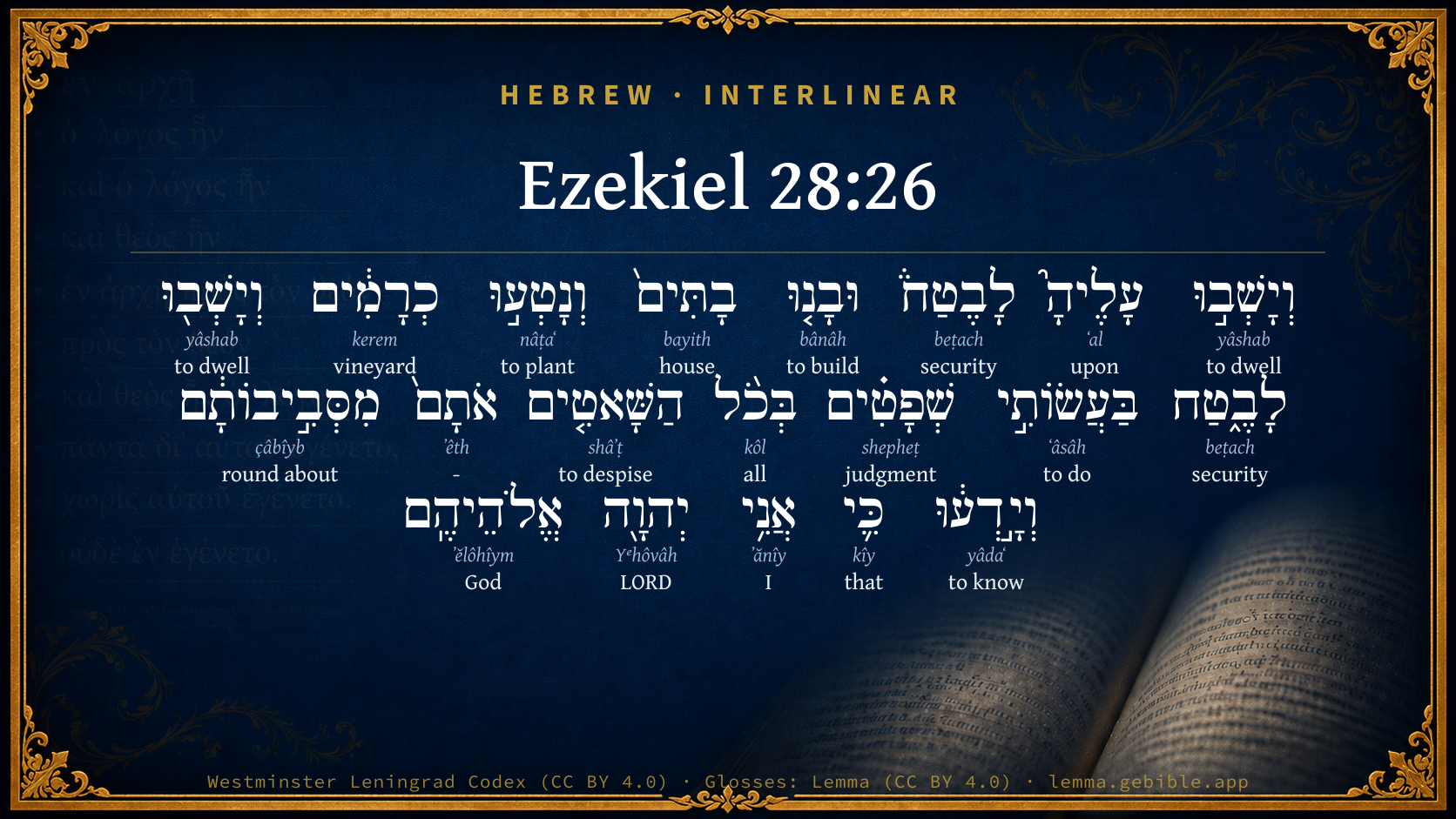
Hebrew (Westminster Leningrad Codex) Ezekiel 28:26 appears in the Hebrew Old Testament. The text above is from the Westminster Leningrad Codex. Each word links to its Strong’s number, a concise gloss, and parsing drawn from the Open Scriptures Hebrew Bible morphology. Click any word for its full Brown-Driver-Briggs (BDB) entry.
Download image
Cite this verse

Ezekiel 28:26 (World English Bible). Public Domain. Lemma interlinear Bible study tool, https://lemma.gebible.app/v/ezekiel/28/26.

Show BibTeX & RIS
BibTeX
RIS
English Translation
They shall dwell securely therein; yes, they shall build houses, and plant vineyards, and shall dwell securely, when I have executed judgments on all those who do them despite round about them; and they shall know that I am Yahweh their God.
World English Bible · Public Domain
Download a study sheet

One document with this verse’s original text, its word-by-word gloss line, the meaning frame, cross-references with their text, attributed commentary, and full source and license credits — printable, and it pastes into notes with its structure intact.

This verse Autodidact and up

Study sheet (.html) Plain text (.txt)

A passage Seminary Student

Up to 50 verses in one chapter. A passage sheet keeps up to 6 commentary sources and 12 cross-references per verse, in the order this page ranks them, and says so on the sheet whenever that leaves anything out. Ask for a single verse and you get the Autodidact verse sheet above.

Everything on this page stays free to read, with no account — the sheet is a download of what is already on screen, not access to it.

Want to remove ads? Support Godless Engineer
Compare translations 3

The same verse in 3 English versions, stacked beneath the original-language interlinear above. Click any original word for its lexicon entry.

Each is an independent rendering of the whole verse — the interlinear is not word-aligned to these translations.

Highlighted words mark where these versions differ — a whole-verse word diff, not a word-by-word alignment.

  • World English Bible Public Domain
    They shall dwell securely therein; yes, they shall build houses, and plant vineyards, and shall dwell securely, when I have executed judgments on all those who do them despite round about them; and they shall know that I am Yahweh their God.
  • King James Version Public Domain
    And they shall dwell safely therein, and shall build houses, and plant vineyards; yea, they shall dwell with confidence, when I have executed judgments upon all those that despise them round about them; and they shall know that I am the LORD their God.
  • unfoldingWord Literal Text CC BY-SA 4.0
    Then they will live securely within her and build houses, plant vineyards, and live securely when I execute justice on all the ones who now despise them from all around; so they will know that I am Yahweh their God!’”

unfoldingWord Literal Text — © unfoldingWord, licensed CC BY-SA 4.0. Word-aligned USFM3 via Door43 (git.door43.org/unfoldingWord/en_ult).

Versions to compare (up to 4)

3 of 4 selected

Show all 18 translations

Every available English version of this verse, each an independent rendering of the whole verse.

  • World English Bible Public Domain
    They shall dwell securely therein; yes, they shall build houses, and plant vineyards, and shall dwell securely, when I have executed judgments on all those who do them despite round about them; and they shall know that I am Yahweh their God.
  • Berean Standard Bible Public Domain
    And there they will dwell securely, build houses, and plant vineyards. They will dwell securely when I execute judgments against all those around them who treat them with contempt. Then they will know that I am the LORD their God.’”
  • Majority Standard Bible Public Domain
    And there they will dwell securely, build houses, and plant vineyards. They will dwell securely when I execute judgments against all those around them who treat them with contempt. Then they will know that I am the LORD their God.’”
  • King James Version Public Domain
    And they shall dwell safely therein, and shall build houses, and plant vineyards; yea, they shall dwell with confidence, when I have executed judgments upon all those that despise them round about them; and they shall know that I am the LORD their God.
  • American Standard Version (1901) Public Domain
    And they shall dwell securely therein; yea, they shall build houses, and plant vineyards, and shall dwell securely, when I have executed judgments upon all those that do them despite round about them; and they shall know that I am Jehovah their God.
  • Revised Version (1885) Public Domain
    And they shall dwell securely therein; yea, they shall build houses, and plant vineyards, and shall dwell securely; when I have executed judgments upon all those that do them despite round about them; and they shall know that I am the LORD their God.
  • Geneva Bible (1599) Public Domain
    And they shall dwell safely therein, and shall builde houses, and plant vineyards: yea, they shall dwell safely, when I haue executed iudgements vpon al round about them that despise them, and they shall knowe that I am the Lord their God.
  • Douay-Rheims (1899) Public Domain
    And they shall dwell therein secure, and they shall build houses, and shall plant vineyards, and shall dwell with confidence, when I shall have executed judgments upon all that are their enemies round about: and they shall know that I am the Lord their God.
  • Young's Literal Translation Public Domain
    And they have dwelt on it confidently, And builded houses, and planted vineyards, And dwelt confidently -- in My doing judgments, On all those despising them round about, And they have known that I, Jehovah, `am' their God!'
  • Literal Standard Version CC BY-SA 4.0
    And they have dwelt confidently on it, || And built houses, and planted vineyards, || And dwelt confidently—in My doing judgments, || On all those despising them all around, || And they have known that I [am] their God YHWH!”
  • Unlocked Literal Bible CC BY-SA 4.0
    Then they will live securely within her and build houses, plant vineyards, and live securely when I execute justice on all the ones who now despise them from all around; so they will know that I am Yahweh their God!'”
  • unfoldingWord Literal Text CC BY-SA 4.0
    Then they will live securely within her and build houses, plant vineyards, and live securely when I execute justice on all the ones who now despise them from all around; so they will know that I am Yahweh their God!’”
  • Darby Bible Public Domain
    They shall dwell in it in safety, and shall build houses and plant vineyards; and they shall dwell in safety, when I have executed judgments upon all those that despised them round about them: and they shall know that I [am] Jehovah their God.
  • World Messianic Bible Public Domain
    They will dwell in it securely. Yes, they will build houses, plant vineyards, and will dwell securely when I have executed judgments on all those around them who have treated them with contempt. Then they will know that I am the LORD their God.”’”
  • Webster's Bible Public Domain
    And they shall dwell safely therein, and shall build houses, and plant vineyards; yes, they shall dwell with confidence, when I have executed judgments upon all those that despise them around them; and they shall know that I am the LORD their God.
  • Free Bible Version CC BY-SA 4.0
    They will live there in safety, building houses and planting vineyards. They will live there in safety when I punish all those around them who treat them with contempt. Then they will know that I am the Lord their God.”
  • Bible in Basic English Public Domain
    And they will be safe there, building houses and planting vine-gardens and living without fear; when I have sent my punishments on all those who put shame on them round about them; and they will be certain that I am the Lord their God.
  • JPS Tanakh (1917) Public Domain
    And they shall dwell safely therein, and shall build houses, and plant vineyards; yea, they shall dwell safely; when I have executed judgments upon all those that have them in disdain round about them; and they shall know that I am the LORD their God.'

Literal Standard Version (2020), Covenant Press — licensed CC BY-SA 4.0. Text via the HelloAO Bible API (eBible.org). Unlocked Literal Bible (unfoldingWord) — licensed CC BY-SA 4.0. Text via the HelloAO Bible API (eBible.org). unfoldingWord Literal Text — © unfoldingWord, licensed CC BY-SA 4.0. Word-aligned USFM3 via Door43 (git.door43.org/unfoldingWord/en_ult). Free Bible Version, Dr. Jonathan Gallagher — licensed CC BY-SA 4.0. Text via the HelloAO Bible API (eBible.org).

Word by word

More ways to search: Search by grammar → Find every occurrence → Compare this word →

Practice this passage: Drill this verse → Learn its vocabulary →

הַשָּׁאטִ֤ים
shâʼṭ
H7590
“the · despising”
Particle, Definite Article + Verb, Qal, Participle Active, Masculine, Plural, Absolute
Part of Speech
Particle + Verb
Stem
Qal
Form
Participle Active
Gender
Masculine
Number
Plural
State
Absolute
Full BDB Definition

Origin: for active part of H7750 [compare H7589 ]

TWOT: 2345

to treat with contempt or despite - (Qal) - to treat with contempt or despite - haters (participle)
  1. וְיָשְׁב֣וּ yâshab H3427 “and · to dwell” Conjunction + Verb, Qal, Sequential Perfect, 3rd Person, Common, Plural
  2. עָלֶיהָ֮ ʻal H5921 “upon · her” Preposition + Suffix, Personal, 3rd Person, Feminine, Singular
  3. לָבֶטַח֒ beṭach H983 “to/for · security” Preposition + Noun, Common, Masculine, Singular, Absolute
  4. וּבָנ֤וּ bânâh H1129 “and · to build” Conjunction + Verb, Qal, Sequential Perfect, 3rd Person, Common, Plural
  5. בָתִּים֙ bayith H1004 “houses” Noun, Common, Masculine, Plural, Absolute
  6. וְנָטְע֣וּ nâṭaʻ H5193 “and · to plant” Conjunction + Verb, Qal, Sequential Perfect, 3rd Person, Common, Plural
  7. כְרָמִ֔ים kerem H3754 “vineyards” Noun, Common, Both, Plural, Absolute
  8. וְיָשְׁב֖וּ yâshab H3427 “and · to dwell” Conjunction + Verb, Qal, Sequential Perfect, 3rd Person, Common, Plural
  9. לָבֶ֑טַח beṭach H983 “to/for · security” Preposition + Noun, Common, Masculine, Singular, Absolute
  10. בַּעֲשׂוֹתִ֣י ʻâsâh H6213 “in/at · to do · me” Preposition + Verb, Qal, Infinitive Construct + Suffix, Personal, 1st Person, Common, Singular
  11. שְׁפָטִ֗ים shepheṭ H8201 “judgments” Noun, Common, Masculine, Plural, Absolute
  12. בְּכֹ֨ל kôl H3605 “in/at · all of” Preposition + Noun, Common, Masculine, Singular, Construct
  13. אֹתָם֙ ʼêth H853 “- · them” Particle, Direct Object + Suffix, Personal, 3rd Person, Masculine, Plural
  14. מִסְּבִ֣יבוֹתָ֔ם çâbîyb H5439 “from · surroundings · their” Preposition + Noun, Common, Both, Plural, Construct + Suffix, Personal, 3rd Person, Masculine, Plural
  15. וְיָ֣דְע֔וּ yâdaʻ H3045 “and · to know” Conjunction + Verb, Qal, Sequential Perfect, 3rd Person, Common, Plural
  16. כִּ֛י kîy H3588 “that” Conjunction
  17. אֲנִ֥י ʼănîy H589 “I” Pronoun, Personal, 1st Person, Common, Singular
  18. יְהוָ֖ה Yᵉhôvâh H3068 “LORD” Noun, Proper
  19. אֱלֹהֵיהֶֽם ʼĕlôhîym H430 “God(s) · their” Noun, Common, Masculine, Plural, Construct + Suffix, Personal, 3rd Person, Masculine, Plural

About this verse

These counts appear in no published source. They are computed here, from the morphology-tagged text and Lemma’s own curated glosses. What Lemma adds →

20
words
18
distinct lemmas
Prophets
section

Notable vocabulary

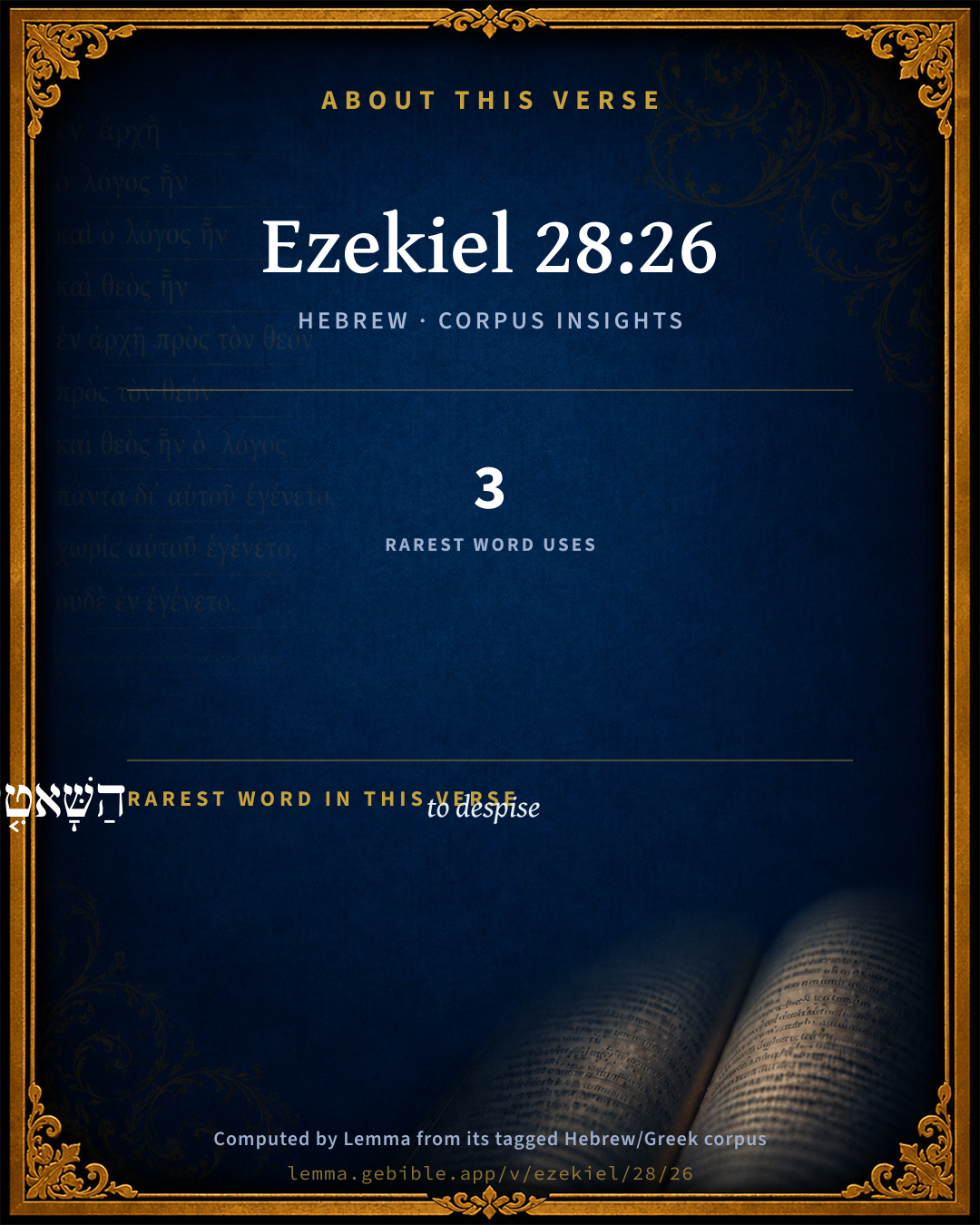
The rarest word here is הַשָּׁאטִ֤ים to despise H7590 — appearing just 3 times in the whole Hebrew Bible.

Shared distinctive vocabulary

הַשָּׁאטִ֤ים to despise H7590 occurs in 3 verses of the Hebrew Bible. Also found in:

Grammatical profile

  • 7 verbs
  • 9 nouns
  • 1 pronoun
  • 1 preposition
  • 1 conjunction
  • 1 particle

Verb forms

  • וְיָשְׁב֣וּ Qal · Sequential Perfect
  • וּבָנ֤וּ Qal · Sequential Perfect
  • וְנָטְע֣וּ Qal · Sequential Perfect
  • וְיָשְׁב֖וּ Qal · Sequential Perfect
  • בַּעֲשׂוֹתִ֣י Qal · Infinitive Construct
  • הַשָּׁאטִ֤ים Qal · Participle Active
  • וְיָ֣דְע֔וּ Qal · Sequential Perfect

Repetition

Words recur within this verse — often emphatic in Hebrew:

  • וְיָשְׁב֣וּ to dwell H3427 ×2
  • לָבֶטַח֒ security H983 ×2

Hebrew & Septuagint length

In English translation the verse runs 42 words from the Hebrew and 54 from the Septuagint (LXX English) — closely comparable.

A rough comparison of the two English renderings, which tokenize alike — not a word-level alignment.

Word counts can differ between the Hebrew and the Greek without any difference in meaning — e.g. the Hebrew direct-object marker אֵת has no separate Greek word, and Greek often adds the article ὁ.

Cross-references

33

Topical passages linked to Ezekiel 28:26 in the Treasury of Scripture Knowledge — connected by theme and wording, ordered by reader-vote popularity; previews shown in the World English Bible.

  • Ezekiel 28:24 There shall be no more a pricking brier to the house of Israel, nor a hurting thorn of any that are round about them, that did despite to them; and they shall know that I am the Lord Yahweh.
  • Ezekiel 28:22 and say, Thus says the Lord Yahweh: Behold, I am against you, Sidon; and I will be glorified in the midst of you; and they shall know that I am Yahweh, when I shall have executed judgments in her, and shall be sanctified in her.
  • Jeremiah 32:15 For thus says Yahweh of Hosts, the God of Israel: Houses and fields and vineyards shall yet again be bought in this land.
  • Ezekiel 34:25–28 I will make with them a covenant of peace, and will cause evil animals to cease out of the land; and they shall dwell securely in the wilderness, and sleep in the woods.
  • Ezekiel 38:8 After many days you shall be visited: in the latter years you shall come into the land that is brought back from the sword, that is gathered out of many peoples, on the mountains of Israel, which have been a continual waste; but it is brought forth out of the peoples, and they shall dwell securely, all of them.
  • Amos 9:13–14 "Behold, the days come," says Yahweh, "That the plowman shall overtake the reaper, And the one treading grapes him who sows seed; And sweet wine will drip from the mountains, And flow from the hills.
  • Proverbs 14:26 In the fear of Yahweh is a secure fortress, And he will be a refuge for his children.
  • Exodus 29:46 They shall know that I am Yahweh their God, who brought them forth out of the land of Egypt, that I might dwell among them: I am Yahweh their God.
  • Leviticus 25:18–19 "'Therefore you shall do my statutes, and keep my ordinances and do them; and you shall dwell in the land in safety.
  • Deuteronomy 12:10 But when you go over the Jordan, and dwell in the land which Yahweh your God causes you to inherit, and he gives you rest from all your enemies round about, so that you dwell in safety;
  • 1 Kings 4:25 Judah and Israel lived safely, every man under his vine and under his fig tree, from Dan even to Beersheba, all the days of Solomon.
  • Isaiah 17:14 At evening, behold, terror; [and] before the morning they are no more. This is the portion of those who despoil us, and the lot of those who rob us.
  • Ezekiel 39:10 so that they shall take no wood out of the field, neither cut down any out of the forests; for they shall make fires of the weapons; and they shall plunder those who plundered them, and rob those who robbed them, says the Lord Yahweh.
  • Hosea 2:18 In that day I will make a covenant for them with the animals of the field, And with the birds of the sky, And with the creeping things of the ground. I will break the bow, the sword, and the battle out of the land, And will make them lie down safely.
  • Zephaniah 2:8–9 I have heard the reproach of Moab, and the insults of the children of Ammon, with which they have reproached my people, and magnified themselves against their border.
  • Zechariah 1:15 I am very angry with the nations that are at ease; for I was but a little displeased, but they added to the calamity."
  • Zechariah 2:4–5 and said to him, "Run, speak to this young man, saying, 'Jerusalem will be inhabited as villages without walls, because of the multitude of men and cattle in it.
  • Isaiah 13:1–21 The burden of Babylon, which Isaiah the son of Amoz did see.
  • Isaiah 33:1 Woe to you who destroy, and you weren't destroyed; and deal treacherously, and they didn't deal treacherously with you! When you have ceased to destroy, you shall be destroyed; and when you have made an end of dealing treacherously, they shall deal treacherously with you.
  • Isaiah 65:21–22 They shall build houses, and inhabit them; and they shall plant vineyards, and eat the fruit of them.
  • Jeremiah 23:6–8 In his days Judah shall be saved, and Israel shall dwell safely; and this is his name by which he shall be called: Yahweh our righteousness.
  • Jeremiah 29:5–6 Build you houses, and dwell in them; and plant gardens, and eat the fruit of them.
  • Jeremiah 29:28 because he has sent to us in Babylon, saying, [The captivity] is long: build you houses, and dwell in them; and plant gardens, and eat the fruit of them?
  • Jeremiah 30:16 Therefore all those who devour you shall be devoured; and all your adversaries, everyone of them, shall go into captivity; and those who despoil you shall be a spoil, and all who prey on you will I give for a prey.
  • Jeremiah 31:4–5 Again will I build you, and you shall be built, O virgin of Israel: again shall you be adorned with your tambourines, and shall go forth in the dances of those who make merry.
  • Jeremiah 33:16 In those days shall Judah be saved, and Jerusalem shall dwell safely; and this is [the name] by which she shall be called: Yahweh our righteousness.
  • Jeremiah 46:1–28 The word of Yahweh which came to Jeremiah the prophet concerning the nations.
  • Lamentations 1:8 Jerusalem has grievously sinned; therefore she is become as an unclean thing; All who honored her despise her, because they have seen her nakedness: Yes, she sighs, and turns backward.
  • Ezekiel 25:1–17 The word of Yahweh came to me, saying,
  • Ezekiel 34:31–35:15 You my sheep, the sheep of my pasture, are men, and I am your God, says the Lord Yahweh.
  • Ezekiel 36:22–23 Therefore tell the house of Israel, Thus says the Lord Yahweh: I don't do [this] for your sake, house of Israel, but for my holy name, which you have profaned among the nations, where you went.
  • Ezekiel 38:11 and you shall say, I will go up to the land of unwalled villages; I will go to those who are at rest, who dwell securely, all of them dwelling without walls, and having neither bars nor gates;
  • Habakkuk 2:8 Because you have plundered many nations, all the remnant of the peoples will plunder you, because of men's blood, and for the violence done to the land, to the city and to all who dwell in it.

Cross-references courtesy of OpenBible.info (CC BY 4.0).

Hebrew and Greek witnesses Masoretic Hebrew ↔ Greek Septuagint

The same verse in the two great witnesses to the Old Testament, shown verse-for-verse.

These are two independent witnesses, not word-aligned to each other, and the Septuagint is shown in lemma (dictionary) form.

Hebrew Ezekiel 28:26 Masoretic · Westminster Leningrad Codex

וְיָשְׁב֣וּ עָלֶיהָ֮ לָבֶטַח֒ וּבָנ֤וּ בָתִּים֙ וְנָטְע֣וּ כְרָמִ֔ים וְיָשְׁב֖וּ לָבֶ֑טַח בַּעֲשׂוֹתִ֣י שְׁפָטִ֗ים בְּכֹ֨ל הַשָּׁאטִ֤ים אֹתָם֙ מִסְּבִ֣יבוֹתָ֔ם וְיָ֣דְע֔וּ כִּ֛י אֲנִ֥י יְהוָ֖ה אֱלֹהֵיהֶֽם

They shall dwell securely therein; yes, they shall build houses, and plant vineyards, and shall dwell securely, when I have executed judgments on all those who do them despite round about them; and they shall know that I am Yahweh their God.

World English Bible · Public Domain

Greek LXX Ezekiel 28:26 Septuagint · lemma form

καί καταοἰκέω ἐπί αὐτός ἐν ἐλπίς καί οἰκοδομέω οἰκία καί φυτεύω ἀμπελών καί καταοἰκέω ἐν ἐλπίς ὅταν ποιέω κρίμα ἐν πᾶς ὁ ἀτιμάζω αὐτός ἐν ὁ κύκλος αὐτός καί γιγνώσκω ὅτι ἐγώ εἰμί κύριος ὁ θεός αὐτός καί ὁ θεός ὁ πατήρ αὐτός

Yes, they shall dwell upon it safely, and they shall build houses, and plant vineyards, and dwell securely, when I shall execute judgment on all that have dishonored them, even on those that are round about them; and they shall know that I am the Lord their God, and the God of their fathers.

LXX2012 (modern English Septuagint) · Public Domain

Hebrew: Westminster Leningrad Codex (CC BY 4.0). Greek: Septuagint (public domain); English from LXX2012 (modern English Septuagint) (Public Domain). How the Septuagint differs from the Hebrew →

Targum (Aramaic paraphrase)

1

The Targum is the ancient Jewish Aramaic paraphrase of the Hebrew Scriptures — an interpretive translation, not the Hebrew text itself. Onkelos (literal) and Pseudo-Jonathan (expansive) render the Torah, and Jonathan the Prophets. Coverage is partial: where no permissively-licensed English translation exists for a verse, only the Aramaic is shown. This is verse-level text, not a word-by-word alignment to the Hebrew.

  1. Targum Jonathan Prophets (Joshua–Malachi)
    וִיתוּבוּן עֲלָהּ לְרוֹחֲצָן וְיִבְנוּן בָּתִּין וְיִצְבוּן כַּרְמִין וְיֵתְבוּן לְרוֹחֲצָן כַּד אַעְבֵיד פּוּרְעֲנוּת דִינִין מִכֹּל דְבָּזְזִין יַתְהוֹן מִסָחְרָנֵיהוֹן וְיֵדְעוּן אֲרֵי אֲנָא יְיָ אֱלָהָהוֹן:

    (no public-domain English translation for this verse)

    Targum Jonathan — Aramaic: “Mikraot Gedolot” (public domain). English: “Sefaria Community Translation” (CC0 1.0 (public-domain dedication)); “London "Chaldee Paraphrase," 1871” (public domain). Text via Sefaria.

Commentary

Notes on Ezekiel 28:26 from classic Christian and Jewish commentators (each source and its license shown beneath its notes). The classic Christian expositions comment on the surrounding passage and are grouped to its opening verse, so a note may address several verses; the Jewish commentaries on the Tanakh (Rashi and others) are per-verse, so they appear only where the commentator wrote on this verse.

Lemma curates 59 commentaries, every one of them public domain or Creative Commons licensed, each selected and text-cleaned for this edition rather than reprinted as found. About our sources →

Trapp's Complete Commentary

John Trapp

Eze 28:26 And they shall dwell safely therein, and shall build houses, and plant vineyards; yea, they shall dwell with confidence, when I have executed judgments upon all those that despise them round about them; and they shall know that I [am] the LORD their God.

Ver. 26. And they shall dwell safely therein.] Or, In confidence. And this is reiterated here to show what a mercy of God it is to live secure, and free from the fear of enemies.

John Trapp, A Commentary or Exposition upon All the Books of the Old and New Testament (1647–1656) — public domain. Text from a community e-Sword module.

The Cambridge Bible for Schools and Colleges

gen. ed. J. J. S. Perowne

26. dwell safely] Or, with confidence, feeling secure, Jer_23:6; Amo_9:14; Isa_65:21; Eze_34:27; Eze_38:8; Eze_39:26. An illustration of the promise is seen in ch. 38–9.

know that I am the Lord] This oft-repeated phrase is not a mere formula. The prophet’s idea is that Jehovah does all, brings all calamities, causes all catastrophes and revolutions in states, and guides the fortunes of Israel in the sight of the nations, with one great design in view—to make himself, the true and only God, known to all mankind.

The Cambridge Bible for Schools and Colleges (gen. ed. J. J. S. Perowne; Cambridge University Press, 1878–1918) — public domain. Text from a community e-Sword module.

John Gill's Exposition

And they shall dwell safely therein,.... There being none to make them afraid, all their enemies being destroyed, and they also under the protection of Christian princes:

and they shall build houses and plant vineyards; signifying their continuance in their land, and their enjoyment of the blessings of it. Cocceius understands this of churches gathered in the name of Christ; of which no doubt there will be many in Judea, as in the first times of the Gospel, and more abundantly:

yea, they shall dwell with confidence: in the utmost safety and security, having nothing to fear from any quarter:

when I have executed judgment upon all those that despise them round about them; took vengeance on them, and utterly destroyed them that despised or spoiled them, even all around them; they will all be cut off, so that there will be none to give them the least disturbance:

and they shall know that I am the Lord their God: not only God, as before, Eze 28:24, but their God, their Lord and their God, their Redeemer and Saviour, whom they formerly denied, persecuted, and pierced.

Next: Ezekiel Chapter 29

John Gill's Exposition of the Whole Bible (1746–1763) — public domain (CC PDM 1.0). Text via the HelloAO Bible API.

Matthew Poole's English Annotations

Safely; which is to be understood comparatively, safer than before; it must be accommodated to the circumstances of human condition; in such safety as excludes continual inward cares, and fears, and perplexities, as it is said of Laish, Jdg 18:7; or as in the days of Solomon, 1Ki 4:25; or as Job 11:18,19.

When I have executed judgments: that seems to intimate, that there might be some attempts, as by Sanballat and Tobias, but God blasted these; or it may refer more properly to the destruction of Babylon, and the nations confederate with them, who ruined and despised the Jews.

And they, the returned captives, shall own, and know by experience, that I sin not only the Lord, but their God too.

Matthew Poole's English Annotations on the Holy Bible (1683–1685) — public domain. Text from a community e-Sword/MySword module.

Whedon's Commentary on the Bible

Daniel D. Whedon

26. Shall build houses — Very like Eze_36:28; Jer_23:6. These chastisements of the heathen, following Israel’s chastisement and to be followed by the restoration of repentant Israel, will make Jehovah known as the true God throughout the earth.

Daniel D. Whedon (gen. ed.), Commentary on the Old and New Testaments (1874–1909) — public domain. Text from a community e-Sword module.

The Pulpit Commentary

Shall build houses, etc. The words sound almost like a direct quotation from Jer_23:6 and Jer_36:28; and, at all events, present a suggestive parallel. The restoration was to include also the blessing of confidence and hope; no longer a groundless and false confidence, like that Jer_2:37 and Jer_48:13, but one resting on the fact that God was in very deed the Judge of all the earth. We may note, at the close of the chapter, how its juxtaposition of the two Phoenician cities seems to have been present to the mind of the Christ in his references to the judgment that should come upon both of them. (Mat_11:21; Luk_10:13) He himself, it will be remembered, passed through the coasts of Tyre and, (Mat_15:21) and probably, according to the best text of Mar_7:24, actually trod the streets of the latter city. They supplied some of the great multitude of Mar_3:8, who listened to his teaching.

Confidence.

I CHRISTIANS MAY ENJOY CONFIDENCE. This is named as part of the blessedness of the restoration: "Yea, they shall dwell with confidence." Confidence is good on many accounts.

1. It glorifies God. To be forever doubting, questioning, and fearing shows an unworthy want of appreciation of God"s glorious redemption. We honor God by taking him at his word, and quietly trusting in his grace.

2. It confers peace on the soul. We can possess our souls in quietness when we have confidence. Diffidence keeps up a sense of perpetual unrest.

3. It inspires energy. "They shall build houses, and plant vineyards." So long as the restored Jews expected to be surprised at any moment by their foes and driven away again from their homes, they would not have much heart to build up the walls of Zion. Tents are sufficient for sojourners. Confidence, however, will give a motive for laying good foundations and building solid structures. The confident Church will launch out in daring enterprises, or carry on long patient toil in sure expectation of enduring results.

4. It gives leisure for service. The distrustful workmen must carry the sword as well as the trowel, and thus be hampered in their work. Confidence dismisses fear of danger. The confident servant of God may give himself wholly to his Master"s work.

5. It wins others to confidence. Timorous Christians will make but few converts, but one person"s confidence infuses a corresponding confidence in others.

II TRUE CONFIDENCE IS BASED ON SAFETY. Confidence is a feeling; safety is a fact. The one is only justified by the other. Confidence without security is mere bravado. There is no security in the bare sense of safety. Thus often they are most confident who have least reason to be so. The first inquiry is as to facts, not feelings. If we lack confidence our business is not to endeavor to stimulate it, to lull fear with spiritual opiates, or to rouse assurance with spiritual intoxicants. Such conduct is as foolish as it is dangerous. The right course is to look into the question of the justification of confidence. If we want to know whether the house will stand, let us have its foundations examined. When we can be assured of safety, confidence will be a natural result.

III THE SAFETY ON WHICH TRUE CONFIDENCE IS BASED IS ACCOMPLISHED BY THE REDEEMING WORK OF GOD. The Jews were to dwell in confidence when God had destroyed the power of their enemies. Thus they were to "despise them round about them." It is shown in the Old Testament as well as the New that the sources of confidence as well as the grounds of safety are not to be found in man. We are not to be confident nor to count ourselves safe because of anything we have done, or because of our assurance of our own strength and resources. Our confidence is in God; therefore the feeblest souls may be confident, as the weakest of men may be quite safe within a strong fortress. Judgment reveals God to the wicked. Thus Zidon knows that God is the Lord (Ver. 22). Redemption reveals him still more to his people, to those who trust and acknowledge him. They will be confident when they are brought by the gracious goodness of the Lord to know him by experience as indeed "their God."

The Pulpit Commentary (1880–1919), ed. H.D.M. Spence-Jones & Joseph S. Exell — public domain. Text from a community e-Sword module.

Lesson kit

Teaching starters — assembled from the data on this page, not authored interpretation. Every prompt links to the verse data it draws on. Edit before teaching.

Ezekiel, in the Prophets, opens this verse with 20 words (18 distinct Hebrew lemmas). Its most distinctive word is shâʼṭ (“to despise”). A historical commentator’s framing appears above. Read the whole chapter for the surrounding context.

Discussion questions

  1. What does “to despise” (shâʼṭ) contribute to the verse as a whole?
  2. How does Ezekiel 16:57, which shares the word «to despise», read alongside this verse?
  3. What does the repetition of “to dwell” (2× in this one verse) do in this verse?
  4. These translations render this verse differently; the difference is in the English rendering, not the original. What questions does that raise?
  5. «וְיָשְׁב֣וּ» is a Qal Sequential Perfect verb. How does that grammatical form shape the action described?
  6. Compare how Trapp's Complete Commentary and The Cambridge Bible for Schools and Colleges read this verse. Where do they agree or differ?

Things to notice

Reading settings

Reading text

Shown beneath each verse's original-language words.

Old Testament
Old Testament edition

Read the OT as the Masoretic Hebrew (MT) or the Greek Septuagint (LXX).

English shown for the Greek Septuagint (in the Hebrew ↔ Greek comparison).

Comparing translations? Open the Compare panel on any verse page to stack up to four side by side.