
2 Chronicles 11:6

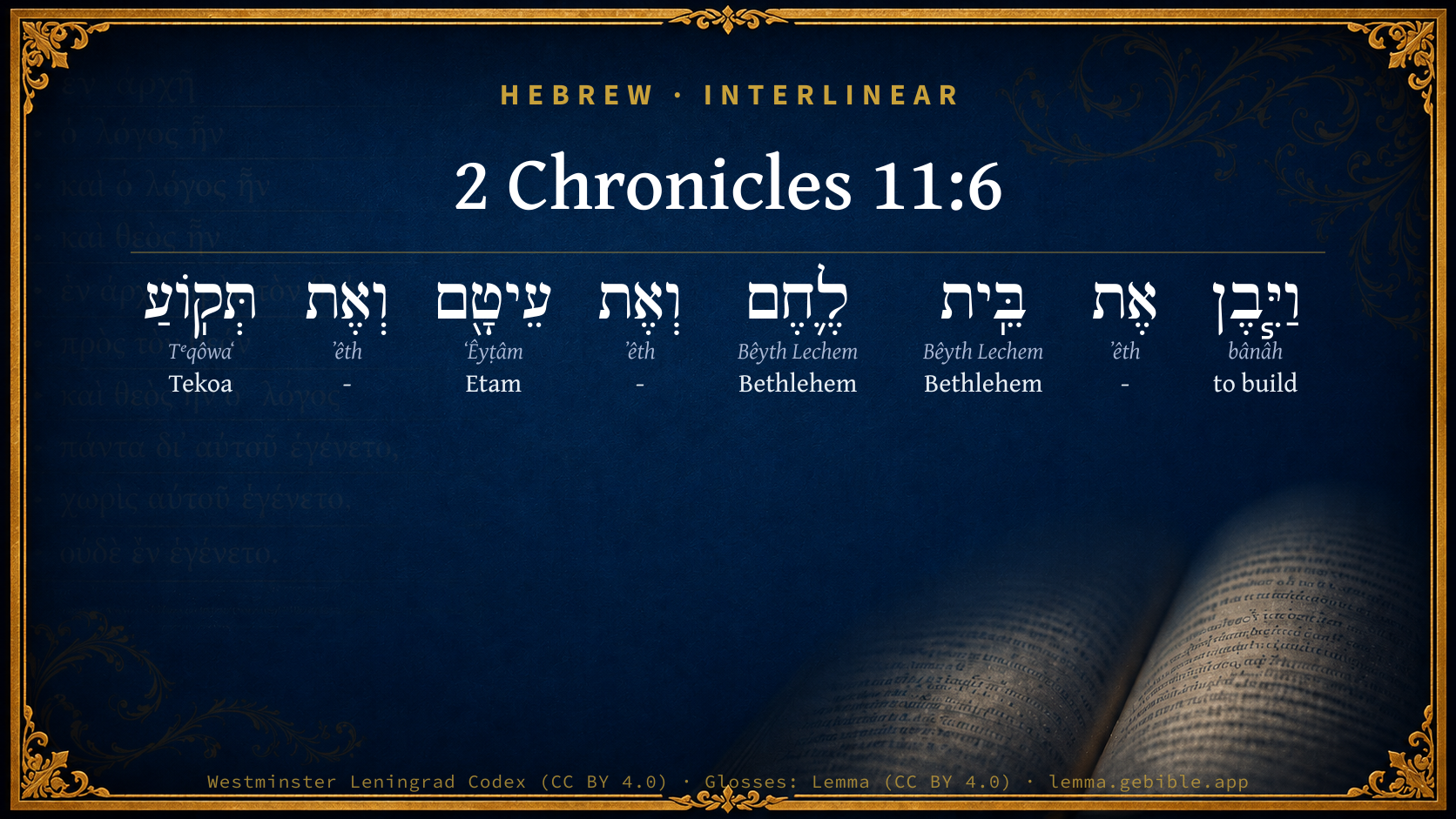
Hebrew (Westminster Leningrad Codex) 2 Chronicles 11:6 appears in the Hebrew Old Testament. The text above is from the Westminster Leningrad Codex. Each word links to its Strong’s number, a concise gloss, and parsing drawn from the Open Scriptures Hebrew Bible morphology. Click any word for its full Brown-Driver-Briggs (BDB) entry.
Download image
Cite this verse

2 Chronicles 11:6 (World English Bible). Public Domain. Lemma interlinear Bible study tool, https://lemma.gebible.app/v/2-chronicles/11/6.

Show BibTeX & RIS
BibTeX
RIS
English Translation
He built Bethlehem, and Etam, and Tekoa,
World English Bible · Public Domain
Download a study sheet

One document with this verse’s original text, its word-by-word gloss line, the meaning frame, cross-references with their text, attributed commentary, and full source and license credits — printable, and it pastes into notes with its structure intact.

This verse Autodidact and up

Study sheet (.html) Plain text (.txt)

A passage Seminary Student

Up to 50 verses in one chapter. A passage sheet keeps up to 6 commentary sources and 12 cross-references per verse, in the order this page ranks them, and says so on the sheet whenever that leaves anything out. Ask for a single verse and you get the Autodidact verse sheet above.

Everything on this page stays free to read, with no account — the sheet is a download of what is already on screen, not access to it.

Want to remove ads? Support Godless Engineer
Compare translations 3

The same verse in 3 English versions, stacked beneath the original-language interlinear above. Click any original word for its lexicon entry.

Each is an independent rendering of the whole verse — the interlinear is not word-aligned to these translations.

Highlighted words mark where these versions differ — a whole-verse word diff, not a word-by-word alignment.

  • World English Bible Public Domain
    He built Bethlehem, and Etam, and Tekoa,
  • King James Version Public Domain
    He built even Bethlehem, and Etam, and Tekoa,
  • unfoldingWord Literal Text CC BY-SA 4.0
    And he built Bethlehem, and Etam, and Tekoa,

unfoldingWord Literal Text — © unfoldingWord, licensed CC BY-SA 4.0. Word-aligned USFM3 via Door43 (git.door43.org/unfoldingWord/en_ult).

Versions to compare (up to 4)

3 of 4 selected

Show all 18 translations

Every available English version of this verse, each an independent rendering of the whole verse.

  • World English Bible Public Domain
    He built Bethlehem, and Etam, and Tekoa,
  • Berean Standard Bible Public Domain
    He built up Bethlehem, Etam, Tekoa,
  • Majority Standard Bible Public Domain
    He built up Bethlehem, Etam, Tekoa,
  • King James Version Public Domain
    He built even Bethlehem, and Etam, and Tekoa,
  • American Standard Version (1901) Public Domain
    He built Beth-lehem, and Etam, and Tekoa,
  • Revised Version (1885) Public Domain
    He built even Beth-lehem, and Etam, and Tekoa,
  • Geneva Bible (1599) Public Domain
    Hee buylt also Beth-lehem, and Etam, and Tekoa,
  • Douay-Rheims (1899) Public Domain
    And he built Bethlehem, and Etam, and Thecue,
  • Young's Literal Translation Public Domain
    yea, he buildeth Beth-Lehem and Etam, and Tekoa,
  • Literal Standard Version CC BY-SA 4.0
    indeed, he builds Beth-Lehem, and Etam, and Tekoa,
  • Unlocked Literal Bible CC BY-SA 4.0
    He built Bethlehem, Etam, Tekoa,
  • unfoldingWord Literal Text CC BY-SA 4.0
    And he built Bethlehem, and Etam, and Tekoa,
  • Darby Bible Public Domain
    And he built Bethlehem, and Etam, and Tekoa,
  • World Messianic Bible Public Domain
    He built Bethlehem, Etam, Tekoa,
  • Webster's Bible Public Domain
    He built even Beth-lehem, and Etam, and Tekoa,
  • Free Bible Version CC BY-SA 4.0
    He built up Bethlehem, Etam, Tekoa,
  • Bible in Basic English Public Domain
    He was the builder of Beth-lehem and Etam and Tekoa
  • JPS Tanakh (1917) Public Domain
    He built even Beth-lehem, and Etam, and Tekoa,

Literal Standard Version (2020), Covenant Press — licensed CC BY-SA 4.0. Text via the HelloAO Bible API (eBible.org). Unlocked Literal Bible (unfoldingWord) — licensed CC BY-SA 4.0. Text via the HelloAO Bible API (eBible.org). unfoldingWord Literal Text — © unfoldingWord, licensed CC BY-SA 4.0. Word-aligned USFM3 via Door43 (git.door43.org/unfoldingWord/en_ult). Free Bible Version, Dr. Jonathan Gallagher — licensed CC BY-SA 4.0. Text via the HelloAO Bible API (eBible.org).

Word by word

More ways to search: Search by grammar → Find every occurrence → Compare this word →

Practice this passage: Drill this verse → Learn its vocabulary →

About this verse

These counts appear in no published source. They are computed here, from the morphology-tagged text and Lemma’s own curated glosses. What Lemma adds →

8
words
5
distinct lemmas
Historical
section

Notable vocabulary

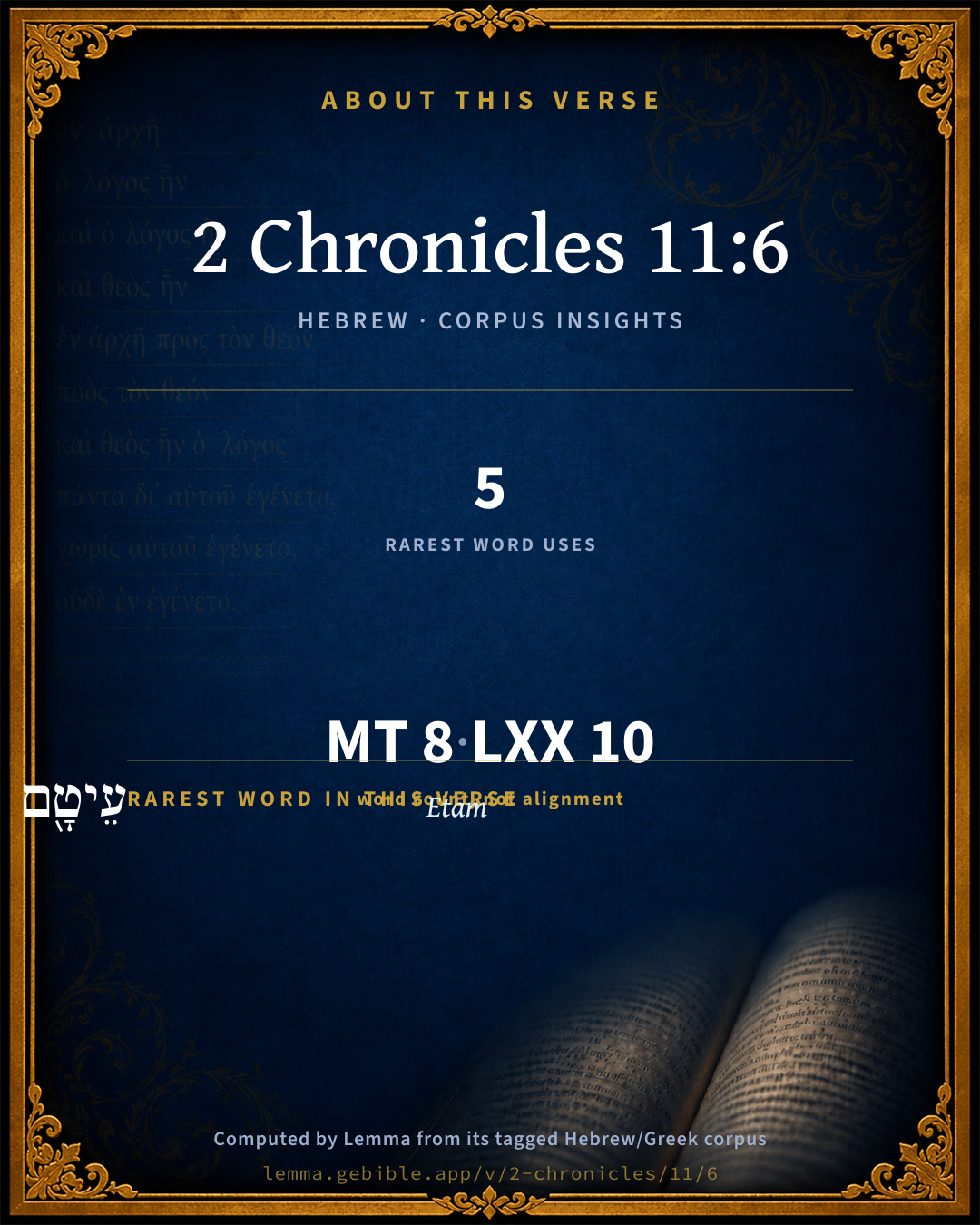
The rarest word here is עֵיטָ֖ם Etam H5862 — appearing just 5 times in the whole Hebrew Bible.

Shared distinctive vocabulary

עֵיטָ֖ם Etam H5862 occurs in 5 verses of the Hebrew Bible. Also found in:

Grammatical profile

  • 1 verb
  • 4 nouns
  • 3 particles

Verb forms

  • וַיִּ֧בֶן Qal · Sequential Imperfect

Repetition

A word recurs within this verse — often emphatic in Hebrew:

  • בֵּֽית Bethlehem H1035 ×2

Hebrew & Septuagint length

In English translation the verse runs 7 words from the Hebrew and 8 from the Septuagint (LXX English) — closely comparable.

A rough comparison of the two English renderings, which tokenize alike — not a word-level alignment.

Word counts can differ between the Hebrew and the Greek without any difference in meaning — e.g. the Hebrew direct-object marker אֵת has no separate Greek word, and Greek often adds the article ὁ.

In the original languages it is 8 Hebrew tokens and 10 Greek tokens — but the two are counted differently (Hebrew bundles its prefixes and suffixes into one token; the Greek is in lemma form), so that isn’t a like-for-like length.

Cross-references

11

Topical passages linked to 2 Chronicles 11:6 in the Treasury of Scripture Knowledge — connected by theme and wording, ordered by reader-vote popularity; previews shown in the World English Bible.

  • Genesis 35:19 Rachel died, and was buried in the way to Ephrath (the same is Bethlehem).
  • Judges 15:8 He struck them hip and thigh with a great slaughter: and he went down and lived in the cleft of the rock of Etam.
  • 1 Samuel 17:12 Now David was the son of that Ephrathite of Bethlehem Judah, whose name was Jesse; and he had eight sons: and the man was an old man in the days of Saul, stricken [in years] among men.
  • 2 Samuel 14:2 Joab sent to Tekoa, and fetched there a wise woman, and said to her, please act like a mourner, and put on mourning clothing, Please, and don't anoint yourself with oil, but be as a woman who has a long time mourned for the dead:
  • 1 Chronicles 4:32 Their villages were Etam, and Ain, Rimmon, and Tochen, and Ashan, five cities;
  • 2 Chronicles 20:20 They rose early in the morning, and went forth into the wilderness of Tekoa: and as they went forth, Jehoshaphat stood and said, Hear me, Judah, and you inhabitants of Jerusalem: believe in Yahweh your God, so shall you be established; believe his prophets, so shall you prosper.
  • Nehemiah 3:5 Next to them the Tekoites repaired; but their nobles didn't put their necks to the work of their lord.
  • Nehemiah 3:27 After him the Tekoites repaired another portion, over against the great tower that stands out, and to the wall of Ophel.
  • Jeremiah 6:1 Flee for safety, you children of Benjamin, out of the midst of Jerusalem, and blow the trumpet in Tekoa, and raise up a signal on Beth Haccherem; for evil looks forth from the north, and a great destruction.
  • Amos 1:1 The words of Amos, who was among the herdsmen of Tekoa, which he saw concerning Israel in the days of Uzziah king of Judah, and in the days of Jeroboam the son of Joash king of Israel, two years before the earthquake.
  • Matthew 2:5–6 They said to him, "In Bethlehem of Judea, for thus it is written through the prophet,

Cross-references courtesy of OpenBible.info (CC BY 4.0).

Hebrew and Greek witnesses Masoretic Hebrew ↔ Greek Septuagint

The same verse in the two great witnesses to the Old Testament, shown verse-for-verse.

These are two independent witnesses, not word-aligned to each other, and the Septuagint is shown in lemma (dictionary) form.

Hebrew 2 Chronicles 11:6 Masoretic · Westminster Leningrad Codex

וַיִּ֧בֶן אֶת בֵּֽית לֶ֛חֶם וְאֶת עֵיטָ֖ם וְאֶת תְּקֽוֹעַ

He built Bethlehem, and Etam, and Tekoa,

World English Bible · Public Domain

Greek LXX 2 Chronicles 11:6 Septuagint · lemma form

καί οἰκοδομέω ὁ βαιθλεεμ καί ὁ αιταμ καί ὁ θεκωε

And he built Bethleem, and Aetan and Thecoe,

LXX2012 (modern English Septuagint) · Public Domain

On this verse, Whedon's Commentary on the Bible discusses the Septuagint’s reading. Read the note in Commentary ↓

Hebrew: Westminster Leningrad Codex (CC BY 4.0). Greek: Septuagint (public domain); English from LXX2012 (modern English Septuagint) (Public Domain). How the Septuagint differs from the Hebrew →

Commentary

Notes on 2 Chronicles 11:6 from classic Christian and Jewish commentators (each source and its license shown beneath its notes). The classic Christian expositions comment on the surrounding passage and are grouped to its opening verse, so a note may address several verses; the Jewish commentaries on the Tanakh (Rashi and others) are per-verse, so they appear only where the commentator wrote on this verse.

Lemma curates 59 commentaries, every one of them public domain or Creative Commons licensed, each selected and text-cleaned for this edition rather than reprinted as found. About our sources →

Ellicott's Commentary for English Readers

(6) He built even.—And he built—i.e., fortified.

Beth-lehem.—Beit-lahm, on a rocky eminence, two hours south of Jerusalem (Gen_35:19; Mic_5:2; Mat_2:6). The birthplace of David and of Christ.

Etam.—Ain Attân; different from the place mentioned in 1Ch_4:32 and Jdg_15:8, which lay in Simeonite territory.

Tekoa.—Teku’a; ruins on a hill two hours south of Bethlehem. (See Jos_15:59, Note.)

A Bible Commentary for English Readers, edited by Charles John Ellicott (1878–1897) — public domain. Text from a community e-Sword module.

The Cambridge Bible for Schools and Colleges

gen. ed. J. J. S. Perowne

6. Etam] Probably represented by some ruins a little to the S.W. of Beth-lehem, by which is a spring called Ain ‘Atân. Cp. 1Ch_4:3 Bädeker, p. 132.

The Cambridge Bible for Schools and Colleges (gen. ed. J. J. S. Perowne; Cambridge University Press, 1878–1918) — public domain. Text from a community e-Sword module.

John Gill's Exposition

And Bethzur, and Shocho, and Adullam. All in the tribe of Judah, of which see Jos 15:35.

.

2 Chronicles 11:8

ch2 11:8

ch2 11:8

ch2 11:8And Gath,.... Which cannot be that Gath which was one of the principalities of the Philistines, but a city in the tribe of Judah; though of it we nowhere else read; unless this is the same with Moreshethgath, Mic 1:14, which is probable, since it follows:

and Mareshah; the birth place of Micah the prophet, Mic 1:1,

and Ziph; there were two cities of this name in the tribe of Judah, Jos 15:24.

John Gill's Exposition of the Whole Bible (1746–1763) — public domain (CC PDM 1.0). Text via the HelloAO Bible API.

Albert Barnes' Notes on the Bible

See Josh. 15 and notes at Jos 15:33-36, notes; Jos 15:48-51, notes; Jos 15:58-59, notes.

For Adullam see 1Sa 22:1 note. It was in the near neighborhood of Socoh Jos 15:35; but its site cannot be actually fixed. It was a place of great antiquity Gen 38:1.

Albert Barnes' Notes on the Bible (1834–1885) — public domain. Text from a community e-Sword/MySword module.

Haydock's Catholic Bible Commentary

Etam, famous for fine waters and gardens, (Josephus, [Antiquities?] viii. 2.) about ten miles from Jerusalem, on the road to Hebron. It was fortified against the inroads of Simeon and Dan. (Calmet)

George Leo Haydock (1774–1849), Haydock's Catholic Family Bible and Commentary, 1859 edition — public domain. Excludes Psalms (Douay-Rheims chapter numbering differs from Protestant) and Deuterocanonical books (Catholic canon only).

Whedon's Commentary on the Bible

Daniel D. Whedon

6. Beth-lehem — The city of David and of Christ. See on Rth_1:1; Mat_2:1.

Etam — Identified by Dr. Robinson with the ruined village Urtas, about a mile south of Beth-lehem. Here he found “traces of an ancient site — the foundations of a square tower, a low thick wall of large squared stones, rocks hewn and scarped, and the like.” Tobler, however, identifies Etam with Ain Attan, a little-south-west of Urtas. Comp. note on Jdg_15:8.

Tekoa — Twelve miles south of Jerusalem. See on 2Sa_14:2. All three of these places are mentioned in the Septuagint version of Jos_15:59, but are wanting in the Hebrew text.

Daniel D. Whedon (gen. ed.), Commentary on the Old and New Testaments (1874–1909) — public domain. Text from a community e-Sword module.

The Pulpit Commentary

Bethlehem. This was a case not of actual new building of a city, but of restoring and strengthening it. Bethlehem, originally Ephrath, (Gen_35:16 Gen_48:7) was one of the very oldest towns existent in Jacob"s time. It was not called Bethlehem till long after the settlement of the tribes. It was six miles from Jerusalem, on the east of the road to Hebron. Etam. A place near Bethlehem 1Ch_4:3, 1Ch_4:4, not 32; Septuagint of; (Jos_15:60) possibly the resort of Samson after his revenge on the Philistines. (Jud_1:15:8, 11) It was not the Etam mentioned as belonging to Simeon. (1Ch_4:32) Tekoa . According to Jerome, as also Eusebius, six Roman miles from Bethlehem, and nine from Jerusalem, or else, possibly by another road, twelve (Jerome"s "Pro-oemium in Amos," and his "Onomasticon"). It is absent from the Hebrew catalogue of Judah towns, (Jos_15:49) but is in the Septuagint Version of it. It was the place of the "wise woman" of 2Sa_14:2.

The Pulpit Commentary (1880–1919), ed. H.D.M. Spence-Jones & Joseph S. Exell — public domain. Text from a community e-Sword module.

Lesson kit

Teaching starters — assembled from the data on this page, not authored interpretation. Every prompt links to the verse data it draws on. Edit before teaching.

2 Chronicles, in the Historical, opens this verse with 8 words (5 distinct Hebrew lemmas). Its most distinctive word is ʻÊyṭâm (“Etam”). A historical commentator’s framing appears above. Read the whole chapter for the surrounding context.

Discussion questions

  1. What does “Etam” (ʻÊyṭâm) contribute to the verse as a whole?
  2. Judges 15:8 shares the word «Etam» with this verse. How do the two illuminate each other?
  3. “Bethlehem” occurs 2× in this one verse. What is the effect of the repetition?
  4. These translations render this verse differently. What is at stake in choosing one wording over another?
  5. The verb «וַיִּ֧בֶן» is Qal Sequential Imperfect. How does its form color the action?
  6. Reading how Ellicott's Commentary for English Readers and The Cambridge Bible for Schools and Colleges read this verse, where do the two commentators agree and where do they part?

Things to notice

Reading settings

Reading text

Shown beneath each verse's original-language words.

Old Testament
Old Testament edition

Read the OT as the Masoretic Hebrew (MT) or the Greek Septuagint (LXX).

English shown for the Greek Septuagint (in the Hebrew ↔ Greek comparison).

Comparing translations? Open the Compare panel on any verse page to stack up to four side by side.