1 Chronicles 6:10

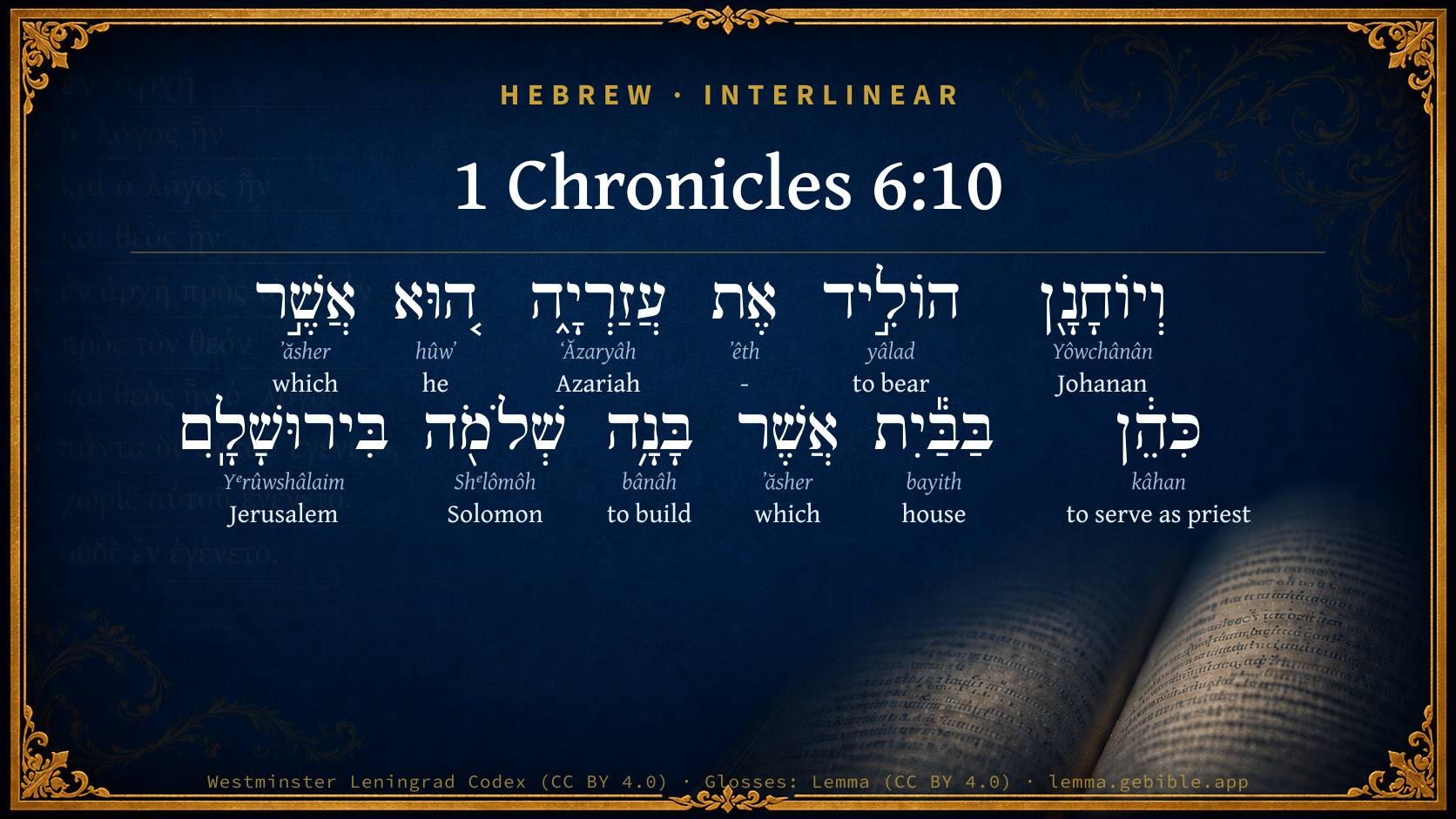
Hebrew (Westminster Leningrad Codex) 1 Chronicles 6:10 appears in the Hebrew Old Testament. The text above is from the Westminster Leningrad Codex. Each word links to its Strong’s number, a concise gloss, and parsing drawn from the Open Scriptures Hebrew Bible morphology. Click any word for its full Brown-Driver-Briggs (BDB) entry.
Download image
Cite this verse

1 Chronicles 6:10 (World English Bible). Public Domain. Lemma interlinear Bible study tool, https://lemma.gebible.app/v/1-chronicles/6/10.

Show BibTeX & RIS
BibTeX
RIS
English Translation
and Johanan became the father of Azariah, (he it is who executed the priest's office in the house that Solomon built in Jerusalem),
World English Bible · Public Domain
Download a study sheet

One document with this verse’s original text, its word-by-word gloss line, the meaning frame, cross-references with their text, attributed commentary, and full source and license credits — printable, and it pastes into notes with its structure intact.

This verse Autodidact and up

Study sheet (.html) Plain text (.txt)

A passage Seminary Student

Up to 50 verses in one chapter. A passage sheet keeps up to 6 commentary sources and 12 cross-references per verse, in the order this page ranks them, and says so on the sheet whenever that leaves anything out. Ask for a single verse and you get the Autodidact verse sheet above.

Everything on this page stays free to read, with no account — the sheet is a download of what is already on screen, not access to it.

Want to remove ads? Support Godless Engineer
Compare translations 3

The same verse in 3 English versions, stacked beneath the original-language interlinear above. Click any original word for its lexicon entry.

Each is an independent rendering of the whole verse — the interlinear is not word-aligned to these translations.

Highlighted words mark where these versions differ — a whole-verse word diff, not a word-by-word alignment.

  • World English Bible Public Domain
    and Johanan became the father of Azariah, (he it is who executed the priest's office in the house that Solomon built in Jerusalem),
  • King James Version Public Domain
    And Johanan begat Azariah, (he it is that executed the priest's office in the temple that Solomon built in Jerusalem:)
  • unfoldingWord Literal Text CC BY-SA 4.0
    And Johanan fathered Azariah, he who served as priest in the house that Solomon built in Jerusalem.

unfoldingWord Literal Text — © unfoldingWord, licensed CC BY-SA 4.0. Word-aligned USFM3 via Door43 (git.door43.org/unfoldingWord/en_ult).

Versions to compare (up to 4)

3 of 4 selected

Show all 18 translations

Every available English version of this verse, each an independent rendering of the whole verse.

  • World English Bible Public Domain
    and Johanan became the father of Azariah, (he it is who executed the priest's office in the house that Solomon built in Jerusalem),
  • Berean Standard Bible Public Domain
    Johanan was the father of Azariah, who served as priest in the temple that Solomon built in Jerusalem,
  • Majority Standard Bible Public Domain
    Johanan was the father of Azariah, who served as priest in the temple that Solomon built in Jerusalem,
  • King James Version Public Domain
    And Johanan begat Azariah, (he it is that executed the priest's office in the temple that Solomon built in Jerusalem:)
  • American Standard Version (1901) Public Domain
    and Johanan begat Azariah, (he it is that executed the priest's office in the house that Solomon built in Jerusalem),
  • Revised Version (1885) Public Domain
    and Johanan begat Azariah (he it is that executed the priest’s office in the house that Solomon built in Jerusalem:)
  • Geneva Bible (1599) Public Domain
    And Iohanan begate Azariah (it was hee that was Priest in the house that Salomon built in Ierusalem)
  • Douay-Rheims (1899) Public Domain
    Johanan beget Azarias. This is he that executed the priestly office in the house which Solomon built in Jerusalem.
  • Young's Literal Translation Public Domain
    and Johanan begat Azariah, him who acted as priest in the house that Solomon built in Jerusalem.
  • Literal Standard Version CC BY-SA 4.0
    and Johanan begot Azariah—him who acted as priest in the house that Solomon built in Jerusalem.
  • Unlocked Literal Bible CC BY-SA 4.0
    Johanan became the father of Azariah, who served in the temple that Solomon built in Jerusalem.
  • unfoldingWord Literal Text CC BY-SA 4.0
    And Johanan fathered Azariah, he who served as priest in the house that Solomon built in Jerusalem.
  • Darby Bible Public Domain
    and Johanan begot Azariah (he is it that exercised the priesthood in the house that Solomon built in Jerusalem);
  • World Messianic Bible Public Domain
    Yochanan became the father of Azariah, who executed the priest’s office in the house that Solomon built in Jerusalem.
  • Webster's Bible Public Domain
    And Johanan begat Azariah, (he it is that executed the priest's office in the temple that Solomon built in Jerusalem:)
  • Free Bible Version CC BY-SA 4.0
    Johanan was the father of Azariah (he was the one who was serving as priest when Solomon built the Temple in Jerusalem),
  • Bible in Basic English Public Domain
    And Johanan was the father of Azariah, (he was priest in the house which Solomon put up in Jerusalem:)
  • JPS Tanakh (1917) Public Domain
    (5-36) and Johanan begot Azariah — he it is that executed the priest's office in the house that Solomon built in Jerusalem —

Literal Standard Version (2020), Covenant Press — licensed CC BY-SA 4.0. Text via the HelloAO Bible API (eBible.org). Unlocked Literal Bible (unfoldingWord) — licensed CC BY-SA 4.0. Text via the HelloAO Bible API (eBible.org). unfoldingWord Literal Text — © unfoldingWord, licensed CC BY-SA 4.0. Word-aligned USFM3 via Door43 (git.door43.org/unfoldingWord/en_ult). Free Bible Version, Dr. Jonathan Gallagher — licensed CC BY-SA 4.0. Text via the HelloAO Bible API (eBible.org).

Word by word

More ways to search: Search by grammar → Find every occurrence → Compare this word →

Practice this passage: Drill this verse → Learn its vocabulary →

וְיוֹחָנָ֖ן
Yôwchânân
H3110
“and · Johanan”
Conjunction + Noun, Proper
Part of Speech
Conjunction + Noun
Type
Proper
Full BDB Definition

Origin: a form of H3076

TWOT: None

Johanan = "Jehovah has graced" - a priest during the high priesthood of Joiakim who returned with Zerubbabel - a Jewish captain after the fall of Jerusalem - the eldest son of king Josiah - a post-exilic prince of the line of David - father of Azariah, priest in Solomon's time - a Benjamite, one of David's mighty warriors - a Gadite, one of David's mighty warriors - a returning exile
  1. הוֹלִ֣יד yâlad H3205 “to bear” Verb, Hiphil, Perfect, 3rd Person, Masculine, Singular
  2. אֶת ʼêth H853 “-” Particle, Direct Object
  3. עֲזַרְיָ֑ה ʻĂzaryâh H5838 “Azariah” Noun, Proper
  4. ה֚וּא hûwʼ H1931 “he” Pronoun, Personal, 3rd Person, Masculine, Singular
  5. אֲשֶׁ֣ר ʼăsher H834 “which” Particle, Relative
  6. כִּהֵ֔ן kâhan H3547 “to serve as priest” Verb, Piel, Perfect, 3rd Person, Masculine, Singular
  7. בַּבַּ֕יִת bayith H1004 “in/at the · house” Preposition, Determined + Noun, Common, Masculine, Singular, Absolute
  8. אֲשֶׁר ʼăsher H834 “which” Particle, Relative
  9. בָּנָ֥ה bânâh H1129 “to build” Verb, Qal, Perfect, 3rd Person, Masculine, Singular
  10. שְׁלֹמֹ֖ה Shᵉlômôh H8010 “Solomon” Noun, Proper
  11. בִּירוּשָׁלִָֽם Yᵉrûwshâlaim H3389 “in/at · Jerusalem” Preposition + Noun, Proper

About this verse

These counts appear in no published source. They are computed here, from the morphology-tagged text and Lemma’s own curated glosses. What Lemma adds →

12
words
11
distinct lemmas
Historical
section

Notable vocabulary

The rarest word here is וְיוֹחָנָ֖ן Johanan H3110 — appearing just 22 times in the whole Hebrew Bible.

Shared distinctive vocabulary

וְיוֹחָנָ֖ן Johanan H3110 occurs in 22 verses of the Hebrew Bible. Also found in:

Grammatical profile

  • 3 verbs
  • 5 nouns
  • 1 pronoun
  • 3 particles

Verb forms

  • הוֹלִ֣יד Hiphil · Perfect
  • כִּהֵ֔ן Piel · Perfect
  • בָּנָ֥ה Qal · Perfect

Repetition

A word recurs within this verse — often emphatic in Hebrew:

  • אֲשֶׁ֣ר which H834 ×2

Hebrew & Septuagint length

In English translation the verse runs 23 words from the Hebrew and 16 from the Septuagint (LXX English) — the Septuagint runs noticeably shorter here. See the side-by-side →

A rough comparison of the two English renderings, which tokenize alike — not a word-level alignment.

Word counts can differ between the Hebrew and the Greek without any difference in meaning — e.g. the Hebrew direct-object marker אֵת has no separate Greek word, and Greek often adds the article ὁ.

Cross-references

4

Topical passages linked to 1 Chronicles 6:10 in the Treasury of Scripture Knowledge — connected by theme and wording, ordered by reader-vote popularity; previews shown in the World English Bible.

  • 1 Kings 6:1–7 It happened in the four hundred and eightieth year after the children of Israel were come out of the land of Egypt, in the fourth year of Solomon's reign over Israel, in the month Ziv, which is the second month, that he began to build the house of Yahweh.
  • 2 Chronicles 3:1 Then Solomon began to build the house of Yahweh at Jerusalem on Mount Moriah, where [Yahweh] appeared to David his father, which he made ready in the place that David had appointed, in the threshing floor of Ornan the Jebusite.
  • 2 Chronicles 3:4 The porch that was before [the house], the length of it, according to the breadth of the house, was twenty cubits, and the height one hundred twenty; and he overlaid it within with pure gold.
  • 2 Chronicles 26:17–20 Azariah the priest went in after him, and with him eighty priests of Yahweh, who were valiant men:

Cross-references courtesy of OpenBible.info (CC BY 4.0).

Hebrew and Greek witnesses Masoretic Hebrew ↔ Greek Septuagint

The same verse in the two great witnesses to the Old Testament, shown verse-for-verse.

Here the Septuagint runs noticeably shorter than the Hebrew — LXX2012 (modern English Septuagint) 16 words vs World English Bible 23. A rough length comparison of the two English translations, not a word-level alignment — read both below.

These are two independent witnesses, not word-aligned to each other, and the Septuagint is shown in lemma (dictionary) form.

Hebrew 1 Chronicles 6:10 Masoretic · Westminster Leningrad Codex

וְיוֹחָנָ֖ן הוֹלִ֣יד אֶת עֲזַרְיָ֑ה ה֚וּא אֲשֶׁ֣ר כִּהֵ֔ן בַּבַּ֕יִת אֲשֶׁר בָּנָ֥ה שְׁלֹמֹ֖ה בִּירוּשָׁלִָֽם

and Johanan became the father of Azariah, (he it is who executed the priest's office in the house that Solomon built in Jerusalem),

World English Bible · Public Domain

Greek LXX 1 Chronicles 6:10 Septuagint · lemma form

καί υἱός ελκανα αμασι καί αχιμωθ

and Joanan begot Azarias: he ministered as priest in the house which Solomon built in Jerusalem.

LXX2012 (modern English Septuagint) · Public Domain

Hebrew: Westminster Leningrad Codex (CC BY 4.0). Greek: Septuagint (public domain); English from LXX2012 (modern English Septuagint) (Public Domain). How the Septuagint differs from the Hebrew →

Commentary

Notes on 1 Chronicles 6:10 from classic Christian and Jewish commentators (each source and its license shown beneath its notes). The classic Christian expositions comment on the surrounding passage and are grouped to its opening verse, so a note may address several verses; the Jewish commentaries on the Tanakh (Rashi and others) are per-verse, so they appear only where the commentator wrote on this verse.

Lemma curates 59 commentaries, every one of them public domain or Creative Commons licensed, each selected and text-cleaned for this edition rather than reprinted as found. About our sources →

Trapp's Complete Commentary

John Trapp

1Ch 6:10 And Johanan begat Azariah, (he [it is] that executed the priest’s office in the temple that Solomon built in Jerusalem:)

Ver. 10. And Johanan.] Alias Jehoiadah. {2Ch 23:1}

He it is that executed the priest’s office.] Whether we understand it of the father or the son, we do not amiss: Nam uterque se strenue gessit in sacerdotio, they were gallant men both.

John Trapp, A Commentary or Exposition upon All the Books of the Old and New Testament (1647–1656) — public domain. Text from a community e-Sword module.

Joseph Benson's Commentary

1Ch 6:10. He it is that executed the priest’s office, &c. — So did all the rest: but it is implied that he did it worthily; he filled his place well, and valiantly discharged his office. For it is supposed this was that Azariah who boldly opposed the presumption of King Uzziah, when he invaded the priest’s office, 2Ch 26:17. This remark may, however, relate to Johanan, otherwise called Jehoiada, who is so highly commended for the good service which he did to the house of God, and of the king; of whom see 2 Kings 11. In the temple that Solomon built — In Solomon’s temple; so denominated to distinguish it from the second temple, which was built, or in building, when these books were written.

Joseph Benson's Commentary on the Old and New Testaments (1811–1818) — public domain. Text from a community e-Sword module.

Tyndale Open Study Notes

Tyndale Open Resources

6:10 Most Old Testament scholars agree that the phrase the high priest at the Temple built by Solomon in Jerusalem belongs in 6:9 (connected to the first Azariah) but that the order was transposed through a scribal error. Making this correction yields 12 generations between Aaron and the building of the Temple, which conforms to the date in 1 Kgs 6:1 (480 years is the equivalent of 12 generations of 40 years each in numerical typology). The correction also results in 12 generations between the building of the Temple under Azariah to the rebuilding of the Temple under Jeshua (Ezra 3:2).

Tyndale Open Study Notes — © Tyndale Open Resources, licensed CC BY-SA 4.0. Text via the HelloAO Bible API.

Geneva Bible (1599)

Geneva Bible translators

And did valiantly resist king Uzziah, who would have usurped the Priest’s office, 2 Chron. 26:17, 18.

Geneva Bible (1599) marginal notes — public domain. Text via Bolls.life.

Jamieson, Fausset & Brown

Robert Jamieson, A. R. Fausset & David Brown

he it is that executed the priest's office in the temple that Solomon built in Jerusalem--It is doubtful whether the person in favor of whom this testimony is borne be Johanan or Azariah. If the former, he is the same as Jehoiada, who rendered important public services (2Ki. 11:1-20); if the latter, it refers to the worthy and independent part he acted in resisting the unwarrantable encroachments of Uzziah (Ch2 26:17).

in the temple that Solomon built in Jerusalem--described in this particular manner to distinguish it from the second temple, which was in existence at the time when this history was written.

Jamieson, Fausset & Brown — Commentary Critical and Explanatory on the Whole Bible (1871) — public domain (CC PDM 1.0). Text via the HelloAO Bible API.

Adam Clarke's Commentary

Verse 10. Johanan] Supposed to be the same as Jehoiada.

Executed the priest's office] Probably this refers to the dignified manner in which Azariah opposed King Uzziah, who wished to invade the priest's office, and offer incense in the temple. See 2Ch 26:17-18.

Adam Clarke's Commentary on the Bible (1810–1826) — public domain. Text from a community e-Sword/MySword module.

Haydock's Catholic Bible Commentary

This may refer to either. (Calmet) --- The Holy Ghost gives an encomium to Joiada, for re-establishing the divine worship, (Junius) or to Azarias, for withstanding the impious attempt of king Osias. (Estius; Tirinus, &c.) (2 Paralipomenon xxvi. 17. (Menochius)

George Leo Haydock (1774–1849), Haydock's Catholic Family Bible and Commentary, 1859 edition — public domain. Excludes Psalms (Douay-Rheims chapter numbering differs from Protestant) and Deuterocanonical books (Catholic canon only).

Matthew Poole's English Annotations

He it is that executed the priest’s office: so did all the rest, but it is implied that lie did it worthily, he filled his place and valiantly discharged his office in Uzziah’s time; of which see 2Ch 26:17, &c. Or this he may relate to Johanan, otherwise called Jehoiada, who is so highly commended for the good service which he did to the house of God and of the king; of whom see 2Ki 11.

In the temple that Solomon built; in Solomon’s temple; so called to distinguish it from the second temple, which was built or in building when these books were written.

Matthew Poole's English Annotations on the Holy Bible (1683–1685) — public domain. Text from a community e-Sword/MySword module.

The Pulpit Commentary

Of Johanan and Azariah, his son, nothing can be found with any certainty. It is presumable that they were priests in the reigns of Abijah and Asa.

HOMILIES BY J.R. THOMSON Vers. 10, 15.

Two high priests.

Among the sons of Levi the family of Aaron was the most conspicuous, inasmuch as the Lord selected this family for the priestly office. The high priest was always of Aaronic blood. And the succession of high priests could no more be omitted from the chronicles of Israel than the succession of popes from those of Rome or the series of Archbishops of Canterbury from those of England. We select two high priests for special notice.

I THE HIGH PRIESTHOOD IN NATIONAL PROSPERITY. Azariah executed this very important office during that part of the reign of Solomon which saw the dedication of the magnificent first temple. This was the very culmination of the splendour of the Hebrew monarchy, and the office and duties of the national pontiff would be encompassed with peculiar glory. As the religious representative of the nation, Azariah had sacred functions to discharge, especially on the day of atonement, when the sins belonging to the people"s prosperity were brought and confessed before the Lord, and favour shown to the sacrificing and repentant nation.

II THE HIGH PRIESTHOOD IN NATIONAL ADVERSITY. Jehozadak, as in the succession, nominally filled the same office when the Jews were carried into captivity. He shared the lot, the exile, of his countrymen. It was well that he should go with the others and rather share the fate of the nation, than remain in Jerusalem to fulfil the form of his office. Where the nation was, it became its religious head to be also.

III THE CONJUNCTION OF THESE TWO HIGH PRIESTS TEACHES A VALUABLE LESSON. Ministers of religion should dwell among the people, partake their lot, interest themselves in their concerns, and be their leaders in praise, in obedience, in submission. Touched, like their Master, with the feeling of the people"s infirmities, they are thus able to "rejoice with those who do rejoice, and weep with those who weep." In such sympathy lies their true, their spiritual and legitimate, strength. Not as lords over God"s heritage, but as shepherds, sharing the lot of their flock, may they follow Christ, serve the people, and do the will of God. T.

The Pulpit Commentary (1880–1919), ed. H.D.M. Spence-Jones & Joseph S. Exell — public domain. Text from a community e-Sword module.

John Wesley's Explanatory Notes

The priest's office - So did all the rest, but it is implied that he did it worthily, he filled his place, and valiantly discharged his office in Uzziah's time. Solomon built - In Solomon's temple; so called to distinguish it from the second temple which was built or in building when these books were written.

John Wesley, Explanatory Notes Upon the Whole Bible (1754–1765) — public domain. Text via the GEBible commentary corpus.

unfoldingWord translationNotes

Door43 World Missions Community

Amariah ... Ahitub ... Zadok ... Shallum

These are the names of men. (See: How to Translate Names)

Solomon built

The reader should understand that Solomon probably hired workers to do the work. (See: Metonymy)

translationWords

Azariah

servant

temple

Solomon

Jerusalem

unfoldingWord translationNotes — © Distant Shores Media and the Door43 World Missions Community, licensed CC BY-SA 4.0. Source: git.door43.org/Door43/en_tn.

Lesson kit

Teaching starters — assembled from the data on this page, not authored interpretation. Every prompt links to the verse data it draws on. Edit before teaching.

1 Chronicles, in the Historical, opens this verse with 12 words (11 distinct Hebrew lemmas). Its most distinctive word is Yôwchânân (“Johanan”). The Greek Septuagint runs shorter here. A historical commentator’s framing appears above. Read the whole chapter for the surrounding context.

Discussion questions

  1. How does “Johanan” (Yôwchânân) shape what this verse is saying?
  2. 2 Kings 25:23 shares the word «Johanan» with this verse. How do the two illuminate each other?
  3. “which” occurs 2× in this one verse. What is the effect of the repetition?
  4. Compared with the Hebrew, the Septuagint runs shorter here. What questions does that raise?
  5. These translations render this verse differently; the difference is in the English rendering, not the original. What questions does that raise?
  6. The verb «הוֹלִ֣יד» is Hiphil Perfect. How does its form color the action?
  7. Reading how Trapp's Complete Commentary and Joseph Benson's Commentary read this verse, where do the two commentators agree and where do they part?

Things to notice

Reading settings

Reading text

Shown beneath each verse's original-language words.

Old Testament
Old Testament edition

Read the OT as the Masoretic Hebrew (MT) or the Greek Septuagint (LXX).

English shown for the Greek Septuagint (in the Hebrew ↔ Greek comparison).

Comparing translations? Open the Compare panel on any verse page to stack up to four side by side.