
1 Kings 10:4

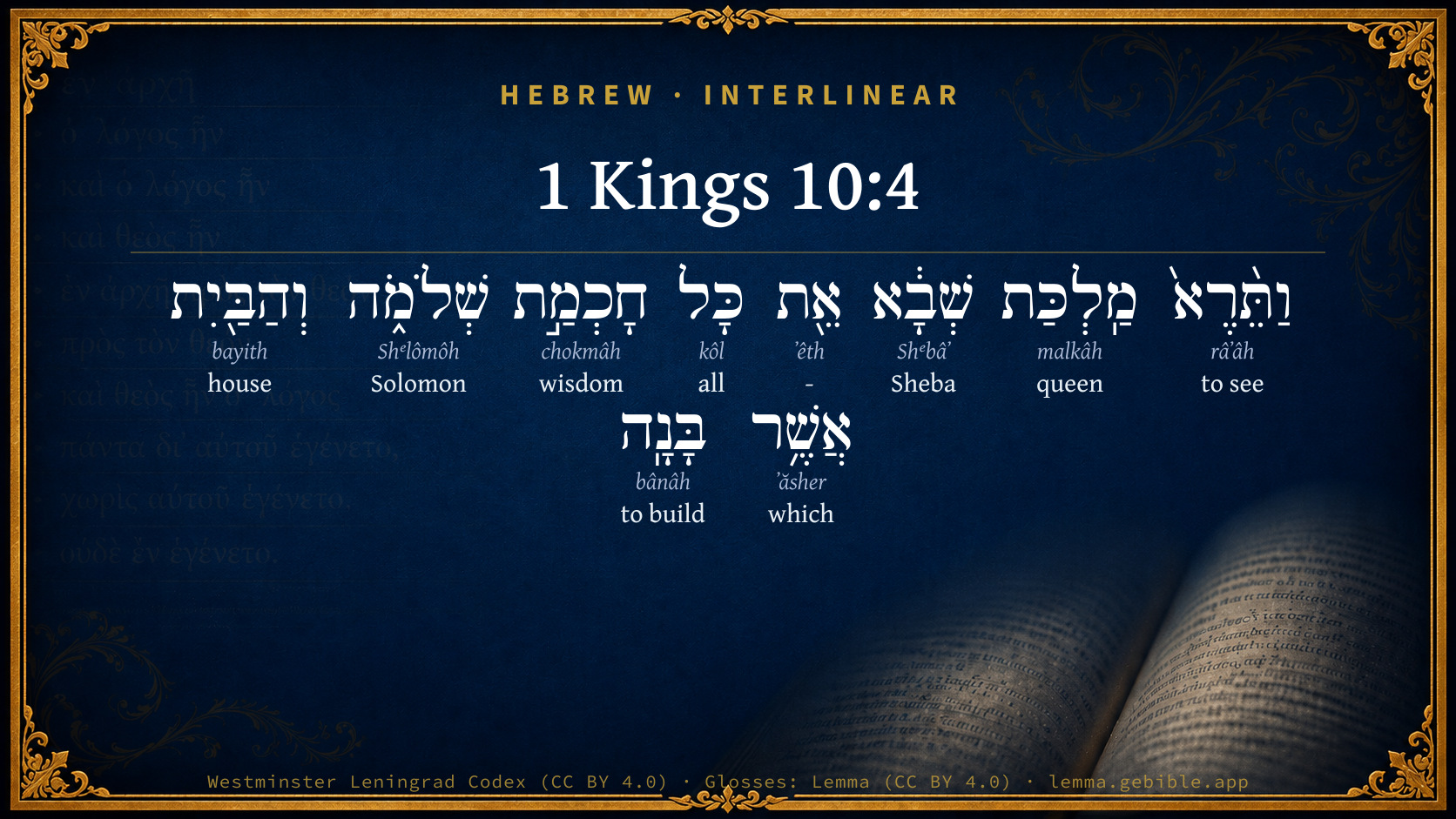
Hebrew (Westminster Leningrad Codex) 1 Kings 10:4 appears in the Hebrew Old Testament. The text above is from the Westminster Leningrad Codex. Each word links to its Strong’s number, a concise gloss, and parsing drawn from the Open Scriptures Hebrew Bible morphology. Click any word for its full Brown-Driver-Briggs (BDB) entry.
Download image
Cite this verse

1 Kings 10:4 (World English Bible). Public Domain. Lemma interlinear Bible study tool, https://lemma.gebible.app/v/1-kings/10/4.

Show BibTeX & RIS
BibTeX
RIS
English Translation
When the queen of Sheba had seen all the wisdom of Solomon, and the house that he had built,
World English Bible · Public Domain
Download a study sheet

One document with this verse’s original text, its word-by-word gloss line, the meaning frame, cross-references with their text, attributed commentary, and full source and license credits — printable, and it pastes into notes with its structure intact.

This verse Autodidact and up

Study sheet (.html) Plain text (.txt)

A passage Seminary Student

Up to 50 verses in one chapter. A passage sheet keeps up to 6 commentary sources and 12 cross-references per verse, in the order this page ranks them, and says so on the sheet whenever that leaves anything out. Ask for a single verse and you get the Autodidact verse sheet above.

Everything on this page stays free to read, with no account — the sheet is a download of what is already on screen, not access to it.

Want to remove ads? Support Godless Engineer
Compare translations 3

The same verse in 3 English versions, stacked beneath the original-language interlinear above. Click any original word for its lexicon entry.

Each is an independent rendering of the whole verse — the interlinear is not word-aligned to these translations.

Highlighted words mark where these versions differ — a whole-verse word diff, not a word-by-word alignment.

  • World English Bible Public Domain
    When the queen of Sheba had seen all the wisdom of Solomon, and the house that he had built,
  • King James Version Public Domain
    And when the queen of Sheba had seen all Solomon's wisdom, and the house that he had built,
  • unfoldingWord Literal Text CC BY-SA 4.0
    And the Queen of Sheba saw all of the wisdom of Solomon and the house that he had built

unfoldingWord Literal Text — © unfoldingWord, licensed CC BY-SA 4.0. Word-aligned USFM3 via Door43 (git.door43.org/unfoldingWord/en_ult).

Versions to compare (up to 4)

3 of 4 selected

Show all 18 translations

Every available English version of this verse, each an independent rendering of the whole verse.

  • World English Bible Public Domain
    When the queen of Sheba had seen all the wisdom of Solomon, and the house that he had built,
  • Berean Standard Bible Public Domain
    When the queen of Sheba saw all the wisdom of Solomon, the palace he had built,
  • Majority Standard Bible Public Domain
    When the queen of Sheba saw all the wisdom of Solomon, the palace he had built,
  • King James Version Public Domain
    And when the queen of Sheba had seen all Solomon's wisdom, and the house that he had built,
  • American Standard Version (1901) Public Domain
    And when the queen of Sheba had seen all the wisdom of Solomon, and the house that he had built,
  • Revised Version (1885) Public Domain
    And when the queen of Sheba had seen all the wisdom of Solomon, and the house that he had built,
  • Geneva Bible (1599) Public Domain
    Then the Queene of Sheba sawe all Salomons wisedome, and the house that he had built,
  • Douay-Rheims (1899) Public Domain
    And when the queen of Saba saw all the wisdom of Solomon, and the house which he had built,
  • Young's Literal Translation Public Domain
    And the queen of Sheba seeth all the wisdom of Solomon, and the house that he built,
  • Literal Standard Version CC BY-SA 4.0
    And the queen of Sheba sees all the wisdom of Solomon, and the house that he built,
  • Unlocked Literal Bible CC BY-SA 4.0
    When the queen of Sheba saw all Solomon's wisdom, the palace that he had built,
  • unfoldingWord Literal Text CC BY-SA 4.0
    And the Queen of Sheba saw all of the wisdom of Solomon and the house that he had built
  • Darby Bible Public Domain
    And when the queen of Sheba saw all Solomon's wisdom, and the house that he had built,
  • World Messianic Bible Public Domain
    When the queen of Sheba had seen all the wisdom of Solomon, the house that he had built,
  • Webster's Bible Public Domain
    And when the queen of Sheba had seen all Solomon's wisdom, and the house that he had built,
  • Free Bible Version CC BY-SA 4.0
    When the queen of Sheba saw Solomon's wisdom, and the palace he had built,
  • Bible in Basic English Public Domain
    And when the queen of Sheba had seen all the wisdom of Solomon, and the house which he had made,
  • JPS Tanakh (1917) Public Domain
    And when the queen of Sheba had seen all the wisdom of Solomon, and the house that he had built,

Literal Standard Version (2020), Covenant Press — licensed CC BY-SA 4.0. Text via the HelloAO Bible API (eBible.org). Unlocked Literal Bible (unfoldingWord) — licensed CC BY-SA 4.0. Text via the HelloAO Bible API (eBible.org). unfoldingWord Literal Text — © unfoldingWord, licensed CC BY-SA 4.0. Word-aligned USFM3 via Door43 (git.door43.org/unfoldingWord/en_ult). Free Bible Version, Dr. Jonathan Gallagher — licensed CC BY-SA 4.0. Text via the HelloAO Bible API (eBible.org).

Word by word

More ways to search: Search by grammar → Find every occurrence → Compare this word →

Practice this passage: Drill this verse → Learn its vocabulary →

שְׁבָ֔א
Shᵉbâʼ
H7614
“Sheba”
Noun, Proper
Part of Speech
Noun
Type
Proper
Full BDB Definition

Origin: of foreign origin

TWOT: None

Sheba = "seven" or " an oath" - son of Joktan and a descendant of Seth (noun proper masculine) - son of Raamah, grandson of Cush, and a descendant of Ham (noun proper masculine) - son of Jokshan, the son of Abraham by Keturah (noun proper masculine) - a nation in southern Arabia (noun proper locative)
  1. וַתֵּ֨רֶא֙ râʼâh H7200 “and · to see” Conjunction + Verb, Qal, Sequential Imperfect, 3rd Person, Feminine, Singular
  2. מַֽלְכַּת malkâh H4436 “queen of” Noun, Common, Feminine, Singular, Construct
  3. אֵ֖ת ʼêth H853 “-” Particle, Direct Object
  4. כָּל kôl H3605 “all of” Noun, Common, Masculine, Singular, Construct
  5. חָכְמַ֣ת chokmâh H2451 “wisdom of” Noun, Common, Feminine, Singular, Construct
  6. שְׁלֹמֹ֑ה Shᵉlômôh H8010 “Solomon” Noun, Proper
  7. וְהַבַּ֖יִת bayith H1004 “and · the · house” Conjunction + Particle, Definite Article + Noun, Common, Masculine, Singular, Absolute
  8. אֲשֶׁ֥ר ʼăsher H834 “which” Particle, Relative
  9. בָּנָֽה bânâh H1129 “to build” Verb, Qal, Perfect, 3rd Person, Masculine, Singular

About this verse

These counts appear in no published source. They are computed here, from the morphology-tagged text and Lemma’s own curated glosses. What Lemma adds →

10
words
10
distinct lemmas
Historical
section

Notable vocabulary

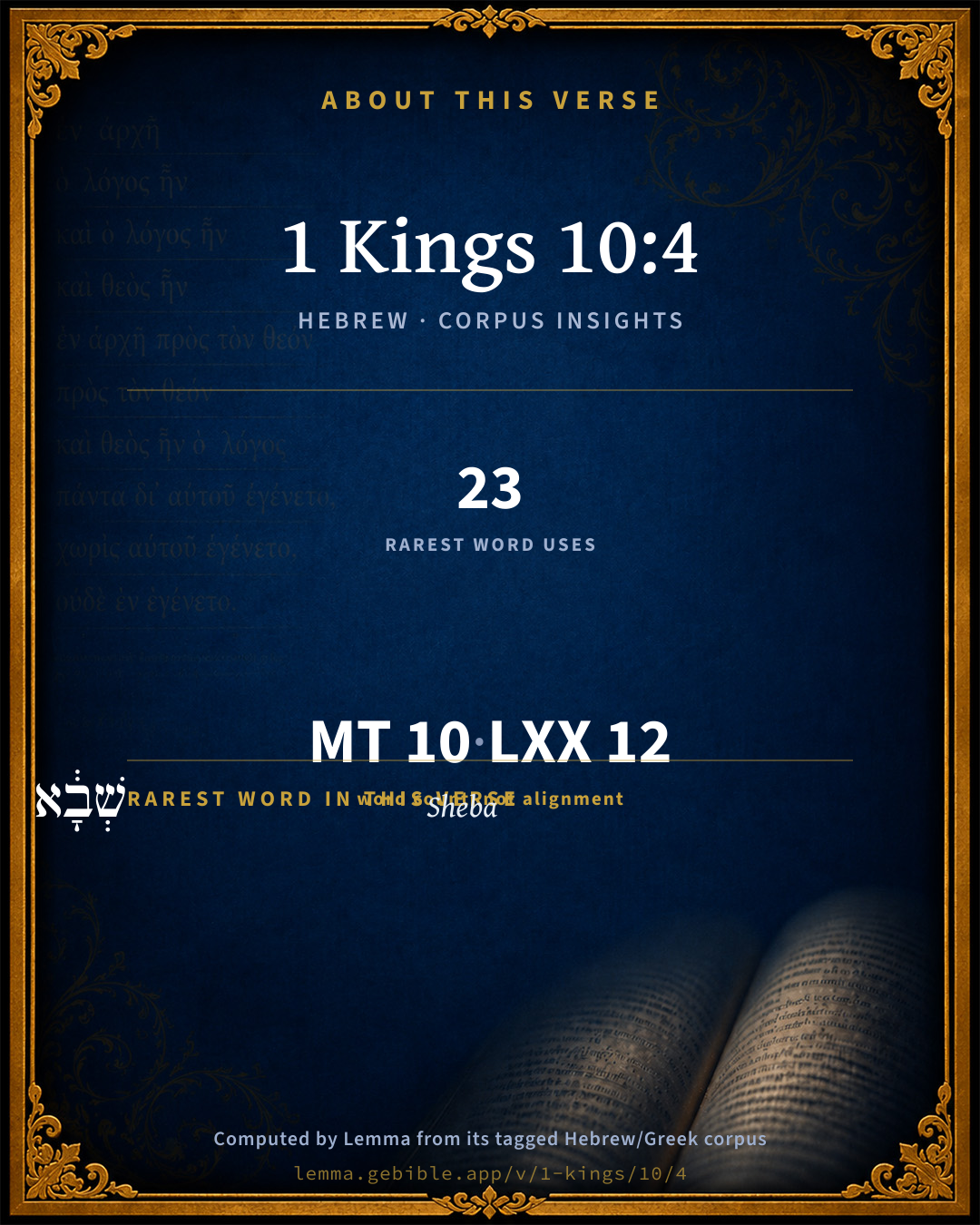
The rarest word here is שְׁבָ֔א Sheba H7614 — appearing just 23 times in the whole Hebrew Bible.

Shared distinctive vocabulary

שְׁבָ֔א Sheba H7614 occurs in 23 verses of the Hebrew Bible. Also found in:

Grammatical profile

  • 2 verbs
  • 6 nouns
  • 2 particles

Verb forms

  • וַתֵּ֨רֶא֙ Qal · Sequential Imperfect
  • בָּנָֽה Qal · Perfect

Hebrew & Septuagint length

In English translation the verse runs 19 words from the Hebrew and 17 from the Septuagint (LXX English) — closely comparable.

A rough comparison of the two English renderings, which tokenize alike — not a word-level alignment.

Word counts can differ between the Hebrew and the Greek without any difference in meaning — e.g. the Hebrew direct-object marker אֵת has no separate Greek word, and Greek often adds the article ὁ.

In the original languages it is 10 Hebrew tokens and 12 Greek tokens — but the two are counted differently (Hebrew bundles its prefixes and suffixes into one token; the Greek is in lemma form), so that isn’t a like-for-like length.

Cross-references

6

Topical passages linked to 1 Kings 10:4 in the Treasury of Scripture Knowledge — connected by theme and wording, ordered by reader-vote popularity; previews shown in the World English Bible.

  • Matthew 12:42 The queen of the south will rise up in the judgment with this generation, and will condemn it, for she came from the ends of the earth to hear the wisdom of Solomon; and behold, someone greater than Solomon is here.
  • 1 Kings 3:28 All Israel heard of the judgment which the king had judged; and they feared the king: for they saw that the wisdom of God was in him, to do justice.
  • 1 Kings 4:29–31 God gave Solomon wisdom and understanding exceeding much, and very great understanding, even as the sand that is on the sea-shore.
  • 1 Kings 6:1–7 It happened in the four hundred and eightieth year after the children of Israel were come out of the land of Egypt, in the fourth year of Solomon's reign over Israel, in the month Ziv, which is the second month, that he began to build the house of Yahweh.
  • 2 Chronicles 9:3–4 When the queen of Sheba had seen the wisdom of Solomon, and the house that he had built,
  • Ecclesiastes 12:9 Further, because the Preacher was wise, he still taught the people knowledge. Yes, he pondered, sought out, and set in order many proverbs.

Cross-references courtesy of OpenBible.info (CC BY 4.0).

Hebrew and Greek witnesses Masoretic Hebrew ↔ Greek Septuagint

The same verse in the two great witnesses to the Old Testament, shown verse-for-verse.

These are two independent witnesses, not word-aligned to each other, and the Septuagint is shown in lemma (dictionary) form.

Hebrew 1 Kings 10:4 Masoretic · Westminster Leningrad Codex

וַתֵּ֨רֶא֙ מַֽלְכַּת שְׁבָ֔א אֵ֖ת כָּל חָכְמַ֣ת שְׁלֹמֹ֑ה וְהַבַּ֖יִת אֲשֶׁ֥ר בָּנָֽה

When the queen of Sheba had seen all the wisdom of Solomon, and the house that he had built,

World English Bible · Public Domain

Greek LXX 1 Kings 10:4 Septuagint · lemma form

καί ὁράω βασίλισσα σαβα πᾶς φρόνησις σαλωμών καί ὁ οἶκος ὅς οἰκοδομέω

And the queen of Saba saw all the wisdom of Solomon, and the house which he built,

LXX2012 (modern English Septuagint) · Public Domain

On this verse, Ellicott's Commentary for English Readers discusses the Septuagint’s reading. Read the note in Commentary ↓

Hebrew: Westminster Leningrad Codex (CC BY 4.0). Greek: Septuagint (public domain); English from LXX2012 (modern English Septuagint) (Public Domain). How the Septuagint differs from the Hebrew →

Targum (Aramaic paraphrase)

1

The Targum is the ancient Jewish Aramaic paraphrase of the Hebrew Scriptures — an interpretive translation, not the Hebrew text itself. Onkelos (literal) and Pseudo-Jonathan (expansive) render the Torah, and Jonathan the Prophets. Coverage is partial: where no permissively-licensed English translation exists for a verse, only the Aramaic is shown. This is verse-level text, not a word-by-word alignment to the Hebrew.

  1. Targum Jonathan Prophets (Joshua–Malachi)
    וַחֲזַת מַלְכַּת שְׁבָא יַת כָּל חוּכְמַת שְׁלֹמֹה וּבֵיתָא דִי בְנָא:

    (no public-domain English translation for this verse)

    Targum Jonathan — Aramaic: “Mikraot Gedolot” (public domain). English: “Sefaria Community Translation” (CC0 1.0 (public-domain dedication)); “London "Chaldee Paraphrase," 1871” (public domain). Text via Sefaria.

Commentary

Notes on 1 Kings 10:4 from classic Christian and Jewish commentators (each source and its license shown beneath its notes). The classic Christian expositions comment on the surrounding passage and are grouped to its opening verse, so a note may address several verses; the Jewish commentaries on the Tanakh (Rashi and others) are per-verse, so they appear only where the commentator wrote on this verse.

Lemma curates 59 commentaries, every one of them public domain or Creative Commons licensed, each selected and text-cleaned for this edition rather than reprinted as found. About our sources →

Trapp's Complete Commentary

John Trapp

1Ki 10:4 And when the queen of Sheba had seen all Solomon’s wisdom, and the house that he had built,

Ver. 4. Had seen all Solomon’s wisdom,] i.e., Heard it, and well weighed it. "O generation, see ye the word of the Lord." {Jer 2:31}

John Trapp, A Commentary or Exposition upon All the Books of the Old and New Testament (1647–1656) — public domain. Text from a community e-Sword module.

The Biblical Illustrator

Joseph S. Exell

1Ki_10:4-9

And when the Queen of Sheba had seen all Solomons wisdom.

The Queen of the South versus the men of this generation

1. When the Queen of Sheba came to Jerusalem she did not come to find fault, she did not come to drive away whatever she might see by an envious or jealous, or petulant or unbelieving, questioning disposition. She evidently was prepared for a feast, and she got it. Come dull, come with the blinds pulled down and the shutters up, and you will go away thus. I think that element is in the gospel, and the other side of it is--come with the pure spirit, and you will get the pure blessing. Come expecting nothing, and you will get nothing. What is nothing? Nothing is what you get in church, for you came for it. Oh, come expecting! Although the preacher may be very dull and very flat, the Lord will remember you, and the Lord will remember Himself, and before you or I are aware, through His grace, our hearts may be made like the chariots of Amminadab! Sometimes the Lord comes with wonderful suddenness, just because there are people sitting here who are worth their room, and He cannot disappoint them.

2. And Solomon told her all her questions. There was not anything hid, or secret thing, which he told her not. And if this woman came from the uttermost ends of the earth, to speak of hard questions, so may we well come to the heavenly Solomon. Which of us has not his hard question--your torturing question, that tortures your own soul; your question that you can get no answer to anywhere else? Oh, what deep hard questions, I had almost said, are natural to our minds when we begin just to reflect and to think ever so little! Whom am I? Where am I going? Yes, there are hard questions. Come to Christ with them! I despise no mans researches and no mans science, but as the truth of the heavenly Solomon is in me, and is loved by me, I trust I have increasingly a most healthy and perfect contempt for their contempt of the Christ of God. Let us all be dowered with the hate of their hate, the scorn of their scorn. Ay, come to Him who is a greater than Solomon, and He will answer the hard questions.

3. Further, And when the Queen of Sheba had seen of Solomons wisdom, etc. When she had seen,--what? When she had seen all Solomons wisdom, and the house that he had built. Have you seen the heavenly Solomons house? That is to say, have you seen His person? He is fairer than the sons of men. You never saw His like. Think of His Godhead, and think of His manhood, and think of the perfect way in which these two are joined together. There He is walking by the Lake of Galilee, a man among men; and yet the eternal glory of the Godhead is in that man from Nazareth. This is the house that the Father built for Him -this human frame, and this human flesh, and this human nature of ours; think of that! Who--what architect piled a house like the house that Gods Son dwelt in and will dwell in for ever and ever? The Eternal in the human; think of it! So like ourselves after a human plan, and after a human model, bone of our bone; else we never could understand Him. His glory would just be a blinding blur and blaze that would reveal nothing to us. But God built Christs person a second Adam; bone of our bone, flesh of our flesh, and yet so high and towering and over-topping, so broad and wide, like us, and yet so unlike us.

4. And the sitting of his servants and the attendance of his ministers, and their apparel. When she saw that, then as the eighth verse says, she broke out, Happy are thy men, happy are these thy servants that stand continually before thee and hear thy wisdom. Oh, believer, I want to re-echo the Queen of Shebas word, spoken in that far-distant day! Dost thou know the Son of God? Hast thou come into the household of faith? Art thou His, and in such close relationship with Him, that thou art yielding thyself, body, soul, and spirit, a living sacrifice and help, for His service and glory? Then hear this word: Happy art thou. Rejoice, oh, man; rejoice, oh, believer; lift up the hands that hang down, and the feeble knees! Wherefore art thou moping and sighing and groaning, and for ever hanging thy head like a bulrush? What i in the presence of such a King wilt thou dare to mope and sigh? What! wilt thou sit down at such banquet as this, and begin with a soiled, tear-stained face? Why art thou cast down, oh, my soul, and why art thou disquieted within me? If thou art the close servant of this King of kings and Lord of lords, be more like your work; look as if a great honour and glory had suddenly and unexpectedly come to one who was a bond-slave till this Christ, by His truth and wisdom and grace, redeemed and made thee anew, and gave thee a place in His house for ever and ever. The meat of His table. Have you thought of that. And what a splendid table! and the dishes on the table! and the meat in the dishes! You could not have translated the menu card if you had got a kings ransom. And you tell about it to your children, and it has filled your whole soul, and your memory, and your imagination. Well, well, if that is in the things of life, and it is genuine, and it is legitimate, there is a good thing in it--that, man, that is in religion. The meat of His table; think of it. Look at the dishes on that table! Look at the abundance provided to that people, not of the corporal and carnal kind, but the abundant feast for your reason, for your conscience, for your heart! Look at the piles that are there, the things you need, absolutely need, to fill your soul! Look at the wine and bread of heaven; look at the grace, look at the pardon! In this mountain doth the Lord make for all people a feast of fat things; of wines upon the lees! Look at the delicacies as well as the essentials! Look--look--all things in Christ that the heart can possibly conceive. The meat of His table, and the sitting of His servants, and the attendance of His ministers, and their apparel. The world can show great things in dress, and so can the Church; so can Christ. Oh, poor man, poor woman, poor preacher, let us only get a look at ourselves as we are reflected in some of those flashing mirrors in the banqueting-hall of Christs love and grace, and we will see something in the way of magnificent apparel! Clothed upon with what? With Christ Himself. With wonderful grace and power He that comes puts Himself, as a flowing garment, right over every soul into allegiance with Him.

5. There is one thing more to notice that took the heart out of the Queen of Sheba. The ascent by which Solomon went up into the house of the Lord. She was almost overcome; heart and flesh began just a little to reel and stagger at the sight of this material splendour. What is the ascent to the house of the Lord? When I think of the ascent by which He has gone up to the temple of the Lord; that is to say, when I think of Christs resurrection, the splendid staircase by which, O Lord, Thou hast ascended on high; when I see Christs resurrection; when I gaze up that shining stairway, then glories upon glories burst in upon mind and heart and imagination. Thou hast ascended up on high, Thou hast led captivity captive! Surely, when that magnificent stairway was open, when Christ ascended to the highest glory, then the angels and archangels burst forth, Lift up your heads, oh ye gates, and be ye lifted up, ye everlasting doors, and let the King of Glory come in. Again I charge you, again I charge myself, look--Behold the glories of the Lamb! Look at your ascended Lord, see His resurrection glory; see His resurrection magnificence, and never let your eyes shut to it again, never. Now, what are we going to say of all this? Oh, it is a pity to criticise, but when one thinks of how people creep and crawl into Gods house and sit with their hands in their pockets, and then creep and crawl out again, and begin to grumble; and instead of saying, Blessed, blessed! Happy, happy! Oh, my Saviour! Oh, His wisdom! Oh, the depths of the riches of the wisdom and knowledge of God, how unsearchable are His judgments and His ways past finding out; may His name endure for ever, and last as long as the sun--no, instead of that, you drag yourself out, and what can you grumble at, and what can you find fault with, and how dark and dreary can you look! May it not be so! (J. MNeill.)

.

The wisdom of Solomon

Good was the quest of the earnest queen, and great was Solomon, whose wisdom she sought to hear; but far better the yearning for the wisdom from above, as the Son of God is greater than the earthly son of David.

I. Wisdom is worthy of diligent pursuit.

1. Wisdom does not come unsought. The Balearic mothers hang their childrens food on the limbs of trees, and they must go hungry until they can bring them down with the bow. So God lets the vein of gold look through but not lie open upon the rock. He puts the star-depths within reach of the telescope, but not of the naked eye. The secrets of Nature are given up to the wit and not to the listlessness of men. The clouds may drop down titles and estates, but wisdom must be bought. In vain, however, is the price of wisdom in the hand of a fool, if he have no heart to it.

2. Wisdom is the principal thing. All else is appendage. Dean Stanley says, our success in life depends not only on a right perspective--that is seeing great things as great--but on a right order--that is, seeking first things first. In vain does the rich man lay up much goods for many years for his soul, if he has not first made certain that he will have a soul beyond to-night. Wisdom held (even) in her left hand riches and honour for Solomon. She, and not they, made him known in the uttermost parts of the earth.

3. Wisdom is akin to piety. It is the righteousness of the mind as that is the righteousness of heart and life. The wise man knows the truth, the religious man does the truth. And this is practical wisdom; for all sin is folly. The sinner breaks himself upon or grinds himself to powder under the rock which is always in the way, and on which the wise man builds. True science is no more at right angles with true religion than the multiplication table with honest dealing.

II. The truly wise are truly great.

1. He had a rare acquaintance with the facts of Nature, with trees and herbs and fowls and creeping things and fishes.

2. He knew better than most what was in man. His writings show ample knowledge of affairs and of the subtler agencies by which men are affected.

3. He had largeness of heart. His large intercourse with other peoples had brought breadth of view and deliberateness. His utterances are neither provincial nor ephemeral; they are the fruit of judgment, not of passion, and so belong to all men in all times.

4. He had an eminently quick and penetrative glance. He did not look round the circumference, but shot at once to the centre.

III. The earthly is but the shadow of the true. Commendable as was the zeal of the queen, and splendid as were the attainments of the king, there were manifest flaws in both, for--

1. Her notion of the nature and function of wisdom was low. Her supreme test was the ability to answer hard questions, and when her riddles were mastered she was satisfied.

2. The wisdom of Solomon could not save him from ruin. All worldly wisdom is fallible, being limited in scope to the inductions of experience, and narrow in appeal, since it points mainly to prudential motives. The wise are taken in their own craftiness; wise in the abstract and for others, they are blind and weak for themselves.

3. In his old age he pronounced it vanity and pointed beyond. (J. B. Thomas, D. D.)

The worth of wisdom

We may regard the Queen of Sheba as a woman who paid a great price for wisdom.

I. The sense in which wisdom is open to us all.

1. The objects of nature are about us; human life is spent in our presence; we need but the open eye, the hearing ear, the understanding mind, and we shall be wise in that direction.

2. The record of revealed religion, of Divine truth, is to be had for a few pence.

3. Jesus Christ, who Himself is the wisdom of God, is offering Himself to us as our Saviour, our Friend, our Guide, if we will give Him our heart, if we will take His hand.

4. Eternal life, with all that it includes, both here and hereafter, is the gift of God (Rom_6:23).

II. The sense in which it is costly.

1. Much of the practical wisdom of life is only to be gained from a suffering experience. We buy them at the counter of experience.

2. The fixed persuasion of the Divine origin of the Christian faith is often only to be reached after the upbreaking of early confidence; after painful and perplexing doubt; after earnest and prolonged inquiry; after prayerful waiting. With much tribulation many spirits enter the kingdom of truth.

3. Entrance on our Christian course is often attended with inward strife or outward loss.

4. Attainment of the loftier heights of wisdom is the result of patient effort, of sacred thought, of fervent prayer, of self-sacrifice. For we can only see God with the pure heart (Mat_5:8). Only love understands love; nothing but spiritual excellency will appreciate spiritual beauty. Only the good discern the good.

III. The supreme worth of wisdom. (Anon.)

The Biblical Illustrator, edited by Joseph S. Exell (c. 1880s–1900s) — public domain. Text from a community e-Sword module.

Joseph Benson's Commentary

1Ki 10:4-5. When the queen — had seen all Solomon’s wisdom — Had fully discovered the wonderful variety of knowledge wherewith he was endowed. And the house that he had built — Or, the houses, the temple and the king’s house, in both which there were evidences of singular wisdom. The sitting of his servants — The order and manner in which his courtiers, or other subjects, (who all were his servants in a general sense,) sat down at meals, at several tables in his court. The attendance of his ministers — Who waited on him at his table, in his chamber, and in his court; as also when he went abroad to the temple or other places. And their apparel — The costliness, and especially the agreeableness of it to their several places and offices. The ascent by which, &c. — The state, pomp, and solemnity with which he went up to the house of the Lord. But the ancients, and some others, translate the words thus: and the burnt-offerings which he offered up in the house of the Lord; under which, as the chief, all other sacrifices are understood. When she saw the manner of his offering sacrifices to the Lord, which doubtless she would not neglect to see, and in the ordering of which she might discern many characters of excellent wisdom, especially when she had so excellent an interpreter as Solomon was, to inform her of the reasons of all the circumstances of that service; there was no more spirit in her — She was perfectly astonished, and could scarcely determine whether she really saw these things, or whether it was only a pleasant dream. Or it may be rendered, There was no more pride, or high-mindedness in her; that is, she was humbled under a consciousness that the riches of her own dominions, and the magnificence in which she herself lived, were not comparable to those of Solomon.

Joseph Benson's Commentary on the Old and New Testaments (1811–1818) — public domain. Text from a community e-Sword module.

Adam Clarke's Commentary

Verse 4. Had seen all Solomon's wisdom] By the answers which he gave to her subtle questions.

And the house that he had built] Most probably his own house.

Adam Clarke's Commentary on the Bible (1810–1826) — public domain. Text from a community e-Sword/MySword module.

Ellicott's Commentary for English Readers

(4, 5) And when the queen of Sheba had seen.—There is something curiously inartificial and true to nature in the accumulation of different impressions as made upon the imagination of the queen. First of all comes the primary impression of Solomon’s wisdom, known by his answering all her questions, and “seen” in the various ordinances of his court and his government. Then the magnificence of the palace and all the arrangements of its service are referred to in detail, as especially likely to tell on one whose own splendour was probably of a simpler and more barbaric sort. Lastly, if our translation be correct, the record singles out the ascent or viaduct crossing the valley from the palace to Mount Moriah, and forming the royal entrance into the Temple (see 1Ch_26:16;2Ki_16:18), evidently a unique and remarkable structure. But it must be noticed that the LXX. and Vulgate and other versions render here, “the burnt offerings, which he offered in the house of the Lord,” and Josephus has the same interpretation. The magnificent scale of his sacrifices is illustrated in 1Ki_8:63, and it is certainly natural that this point should not be left unmentioned in the description of the wonders of his court. This rendering, therefore, which the Hebrew will well bear, has much probability to recommend it.

A Bible Commentary for English Readers, edited by Charles John Ellicott (1878–1897) — public domain. Text from a community e-Sword module.

The Cambridge Bible for Schools and Colleges

gen. ed. J. J. S. Perowne

4. the house that he had built] This refers to his own palace, as is evident from the domestic details which immediately follow.

The Cambridge Bible for Schools and Colleges (gen. ed. J. J. S. Perowne; Cambridge University Press, 1878–1918) — public domain. Text from a community e-Sword module.

John Gill's Exposition

And when the queen of Sheba had seen all Solomon's wisdom,.... Which she perceived by his answers to things relative to all sorts of science, natural, civil, and divine:

and the house that he had built; the singular for the plural, "house for houses"; the house of the Lord, his own house, that for Pharaoh's daughter, and the house of the forest of Lebanon; in all which there appeared not only surprising grandeur and magnificence, but exquisite art and skill; there was a great display of his wisdom in the form and contrivance of them. Josephus (p) says, what exceedingly surprised her, and raised her admiration, was the house of the forest of Lebanon.

(p) Antiqu. l. 8. c. 6. sect. 5.

John Gill's Exposition of the Whole Bible (1746–1763) — public domain (CC PDM 1.0). Text via the HelloAO Bible API.

Haydock's Catholic Bible Commentary

House, the palace, or rather the temple, (Calmet) or both. (Menochius) --- Dion (37) and Tacitus extol the grandeur of the temple, which Titus destroyed. What would they have said of that built by Solomon? (Calmet)

George Leo Haydock (1774–1849), Haydock's Catholic Family Bible and Commentary, 1859 edition — public domain. Excludes Psalms (Douay-Rheims chapter numbering differs from Protestant) and Deuterocanonical books (Catholic canon only).

Matthew Poole's English Annotations

Or, the houses, the singular number being put for the plural, to wit, both the temple and the king’s house, in both which there were evidences of singular wisdom.

Matthew Poole's English Annotations on the Holy Bible (1683–1685) — public domain. Text from a community e-Sword/MySword module.

Whedon's Commentary on the Bible

Daniel D. Whedon

4. The house that he had built — His royal palace, not the Lord’s house, which, it would seem, she was not permitted to enter, but only saw the ascent to it by which the king went up.

Daniel D. Whedon (gen. ed.), Commentary on the Old and New Testaments (1874–1909) — public domain. Text from a community e-Sword module.

The Pulpit Commentary

And when the queen of Sheba had seen all Solomon"s wisdom, and the house he had built ver. 5 compels us to understand this of the palace, not of the temple. Josephus says she was especially astonished at the house of the forest of Lebanon,

The Pulpit Commentary (1880–1919), ed. H.D.M. Spence-Jones & Joseph S. Exell — public domain. Text from a community e-Sword module.

John Wesley's Explanatory Notes

House - Or, the houses, the temple and the king's house, in both which there were evidences of singular wisdom.

John Wesley, Explanatory Notes Upon the Whole Bible (1754–1765) — public domain. Text via the GEBible commentary corpus.

Lesson kit

Teaching starters — assembled from the data on this page, not authored interpretation. Every prompt links to the verse data it draws on. Edit before teaching.

1 Kings, in the Historical, opens this verse with 10 words (10 distinct Hebrew lemmas). Its most distinctive word is Shᵉbâʼ (“Sheba”). A historical commentator’s framing appears above. Read the whole chapter for the surrounding context.

Discussion questions

  1. How does “Sheba” (Shᵉbâʼ) shape what this verse is saying?
  2. Genesis 10:7 shares the word «Sheba» with this verse. How do the two illuminate each other?
  3. These translations render this verse differently. What is at stake in choosing one wording over another?
  4. The verb «וַתֵּ֨רֶא֙» is Qal Sequential Imperfect. How does its form color the action?
  5. Reading how Trapp's Complete Commentary and The Biblical Illustrator read this verse, where do the two commentators agree and where do they part?

Things to notice

Reading settings

Reading text

Shown beneath each verse's original-language words.

Old Testament
Old Testament edition

Read the OT as the Masoretic Hebrew (MT) or the Greek Septuagint (LXX).

English shown for the Greek Septuagint (in the Hebrew ↔ Greek comparison).

Comparing translations? Open the Compare panel on any verse page to stack up to four side by side.