

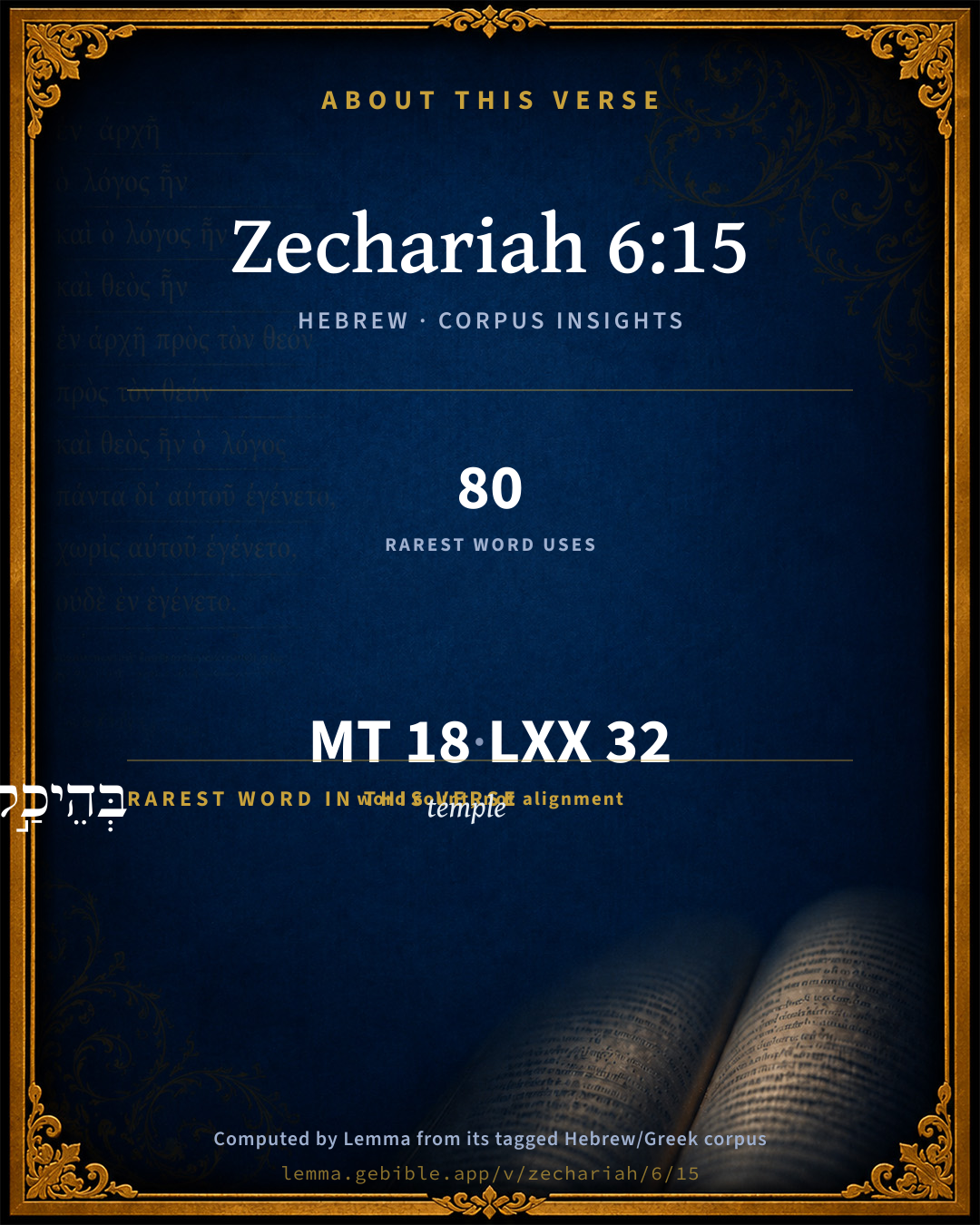
Zechariah 6:15

Hebrew (Westminster Leningrad Codex) Zechariah 6:15 appears in the Hebrew Old Testament. The text above is from the Westminster Leningrad Codex. Each word links to its Strong’s number, a concise gloss, and parsing drawn from the Open Scriptures Hebrew Bible morphology. Click any word for its full Brown-Driver-Briggs (BDB) entry.
Download image
Cite this verse

Zechariah 6:15 (World English Bible). Public Domain. Lemma interlinear Bible study tool, https://lemma.gebible.app/v/zechariah/6/15.

Show BibTeX & RIS
BibTeX
RIS
English Translation
Those who are far off shall come and build in the temple of Yahweh; and you shall know that Yahweh of hosts has sent me to you. This will happen, if you will diligently obey the voice of Yahweh your God."'"
World English Bible · Public Domain
Download a study sheet

One document with this verse’s original text, its word-by-word gloss line, the meaning frame, cross-references with their text, attributed commentary, and full source and license credits — printable, and it pastes into notes with its structure intact.

This verse Autodidact and up

Study sheet (.html) Plain text (.txt)

A passage Seminary Student

Up to 50 verses in one chapter. A passage sheet keeps up to 6 commentary sources and 12 cross-references per verse, in the order this page ranks them, and says so on the sheet whenever that leaves anything out. Ask for a single verse and you get the Autodidact verse sheet above.

Everything on this page stays free to read, with no account — the sheet is a download of what is already on screen, not access to it.

Want to remove ads? Support Godless Engineer
Compare translations 3

The same verse in 3 English versions, stacked beneath the original-language interlinear above. Click any original word for its lexicon entry.

Each is an independent rendering of the whole verse — the interlinear is not word-aligned to these translations.

Highlighted words mark where these versions differ — a whole-verse word diff, not a word-by-word alignment.

  • World English Bible Public Domain
    Those who are far off shall come and build in the temple of Yahweh; and you shall know that Yahweh of hosts has sent me to you. This will happen, if you will diligently obey the voice of Yahweh your God."'"
  • King James Version Public Domain
    And they that are far off shall come and build in the temple of the LORD, and ye shall know that the LORD of hosts hath sent me unto you. And this shall come to pass, if ye will diligently obey the voice of the LORD your God.
  • unfoldingWord Literal Text CC BY-SA 4.0
    And those far off will come and build in the temple of Yahweh, and you will know that Yahweh of Armies has sent me to you. And will happen if listening, you will listen to the voice of Yahweh your God.”

unfoldingWord Literal Text — © unfoldingWord, licensed CC BY-SA 4.0. Word-aligned USFM3 via Door43 (git.door43.org/unfoldingWord/en_ult).

Versions to compare (up to 4)

3 of 4 selected

Show all 18 translations

Every available English version of this verse, each an independent rendering of the whole verse.

  • World English Bible Public Domain
    Those who are far off shall come and build in the temple of Yahweh; and you shall know that Yahweh of hosts has sent me to you. This will happen, if you will diligently obey the voice of Yahweh your God."'"
  • Berean Standard Bible Public Domain
    Even those far away will come and build the temple of the LORD, and you will know that the LORD of Hosts has sent Me to you. This will happen if you diligently obey the voice of the LORD your God.”
  • Majority Standard Bible Public Domain
    Even those far away will come and build the temple of the LORD, and you will know that the LORD of Hosts has sent Me to you. This will happen if you diligently obey the voice of the LORD your God.”
  • King James Version Public Domain
    And they that are far off shall come and build in the temple of the LORD, and ye shall know that the LORD of hosts hath sent me unto you. And this shall come to pass, if ye will diligently obey the voice of the LORD your God.
  • American Standard Version (1901) Public Domain
    And they that are far off shall come and build in the temple of Jehovah; and ye shall know that Jehovah of hosts hath sent me unto you. And `this' shall come to pass, if ye will diligently obey the voice of Jehovah your God.
  • Revised Version (1885) Public Domain
    And they that are far off shall come and build in the temple of the LORD, and ye shall know that the LORD of hosts hath sent me unto you. And this shall come to pass, if ye will diligently obey the voice of the LORD your God.
  • Geneva Bible (1599) Public Domain
    And they that are farre off, shall come and build in the Temple of the Lord, and ye shall know, that the Lord of hostes hath sent me vnto you. And this shall come to passe, if ye will obey the voyce of the Lord your God.
  • Douay-Rheims (1899) Public Domain
    And they that are far off, shall come and shall build in the temple of the Lord: and you shall know that the Lord of hosts sent me to you. But this shall come to pass, if hearing you will hear the voice of the Lord your God.
  • Young's Literal Translation Public Domain
    And the far-off come in, and they have built in the temple of Jehovah, and ye have known that Jehovah of Hosts hath sent me unto you, yea, it hath come to pass, if ye do certainly hearken to the voice of Jehovah your God.'
  • Literal Standard Version CC BY-SA 4.0
    And the far-off come in, and they have built in the temple of YHWH, and you have known that YHWH of Hosts has sent me to you, indeed, it has come to pass, if you certainly listen to the voice of your God YHWH.”
  • Unlocked Literal Bible CC BY-SA 4.0
    Then those who are far off will come and build the temple of Yahweh, so you will know that Yahweh of hosts has sent me to you; for this will happen if you truly listen to the voice of Yahweh your God!'”
  • unfoldingWord Literal Text CC BY-SA 4.0
    And those far off will come and build in the temple of Yahweh, and you will know that Yahweh of Armies has sent me to you. And will happen if listening, you will listen to the voice of Yahweh your God.”
  • Darby Bible Public Domain
    And they that are far off shall come and build at the temple of Jehovah: and ye shall know that Jehovah of hosts hath sent me unto you. And [this] shall come to pass, if ye will diligently hearken to the voice of Jehovah your God.
  • World Messianic Bible Public Domain
    Those who are far off shall come and build in the LORD’s temple; and you shall know that the LORD of Hosts has sent me to you. This will happen, if you will diligently obey the LORD your God’s voice.”’”
  • Webster's Bible Public Domain
    And they that are far off shall come and build in the temple of the LORD, and ye shall know that the LORD of hosts hath sent me to you. And this shall come to pass, if ye will diligently obey the voice of the LORD your God.
  • Free Bible Version CC BY-SA 4.0
    People who live in distant lands will come and build the Temple of the Lord, and you will know that the Lord Almighty sent me to you. This will happen if you listen attentively to what the Lord tells you.
  • Bible in Basic English Public Domain
    And those who are far away will come and be builders in the Temple of the Lord, and it will be clear to you that the Lord of armies has sent me to you.
  • JPS Tanakh (1917) Public Domain
    And they that are far off shall come and build in the temple of the LORD, and ye shall know that the LORD of hosts hath sent me unto you. And it shall come to pass, if ye will diligently hearken to the voice of the LORD your God —.'

Literal Standard Version (2020), Covenant Press — licensed CC BY-SA 4.0. Text via the HelloAO Bible API (eBible.org). Unlocked Literal Bible (unfoldingWord) — licensed CC BY-SA 4.0. Text via the HelloAO Bible API (eBible.org). unfoldingWord Literal Text — © unfoldingWord, licensed CC BY-SA 4.0. Word-aligned USFM3 via Door43 (git.door43.org/unfoldingWord/en_ult). Free Bible Version, Dr. Jonathan Gallagher — licensed CC BY-SA 4.0. Text via the HelloAO Bible API (eBible.org).

Word by word

More ways to search: Search by grammar → Find every occurrence → Compare this word →

Practice this passage: Drill this verse → Learn its vocabulary →

בְּהֵיכַ֣ל
hêykâl
H1964
“in/at · temple of”
Preposition + Noun, Common, Masculine, Singular, Construct
Part of Speech
Preposition + Noun
Type
Common
Gender
Masculine
Number
Singular
State
Construct
Full BDB Definition

Origin: probably from H3201 (in the sense of capacity)

TWOT: 493

palace, temple, nave, sanctuary - palace - temple (palace of God as king) - hall, nave (of Ezekiel's temple) - temple (of heavenly temple)
  1. וּרְחוֹקִ֣ים râchôwq H7350 “and · far” Conjunction + Adjective, Adjective, Masculine, Plural, Absolute
  2. יָבֹ֗אוּ bôwʼ H935 “to enter” Verb, Qal, Imperfect, 3rd Person, Masculine, Plural
  3. וּבָנוּ֙ bânâh H1129 “and · to build” Conjunction + Verb, Qal, Sequential Perfect, 3rd Person, Common, Plural
  4. יְהוָ֔ה Yᵉhôvâh H3068 “LORD” Noun, Proper
  5. וִידַעְתֶּ֕ם yâdaʻ H3045 “and · to know” Conjunction + Verb, Qal, Sequential Perfect, 2nd Person, Masculine, Plural
  6. כִּֽי kîy H3588 “that” Conjunction
  7. יְהוָ֥ה Yᵉhôvâh H3068 “LORD” Noun, Proper
  8. צְבָא֖וֹת tsâbâʼ H6635 “armies” Noun, Common, Both, Plural, Absolute
  9. שְׁלָחַ֣נִי shâlach H7971 “to send · me” Verb, Qal, Perfect, 3rd Person, Masculine, Singular + Suffix, Personal, 1st Person, Common, Singular
  10. אֲלֵיכֶ֑ם ʼêl H413 “to · you” Preposition + Suffix, Personal, 2nd Person, Masculine, Plural
  11. וְהָיָה֙ hâyâh H1961 “and · to be” Conjunction + Verb, Qal, Sequential Perfect, 3rd Person, Masculine, Singular
  12. אִם ʼim H518 “if” Conjunction
  13. שָׁמ֣וֹעַ shâmaʻ H8085 “to hear” Verb, Qal, Infinitive Absolute
  14. תִּשְׁמְע֔וּן shâmaʻ H8085 “to hear” Verb, Qal, Imperfect, 2nd Person, Masculine, Plural + Suffix, n
  15. בְּק֖וֹל qôwl H6963 “in/at · voice of” Preposition + Noun, Common, Masculine, Singular, Construct
  16. יְהוָ֥ה Yᵉhôvâh H3068 “LORD” Noun, Proper
  17. אֱלֹהֵיכֶֽם ʼĕlôhîym H430 “God(s) · your” Noun, Common, Masculine, Plural, Construct + Suffix, Personal, 2nd Person, Masculine, Plural

About this verse

These counts appear in no published source. They are computed here, from the morphology-tagged text and Lemma’s own curated glosses. What Lemma adds →

18
words
15
distinct lemmas
Prophets
section

Grammatical profile

  • 7 verbs
  • 7 nouns
  • 1 adjective
  • 1 preposition
  • 2 conjunctions

Verb forms

  • יָבֹ֗אוּ Qal · Imperfect
  • וּבָנוּ֙ Qal · Sequential Perfect
  • וִידַעְתֶּ֕ם Qal · Sequential Perfect
  • שְׁלָחַ֣נִי Qal · Perfect
  • וְהָיָה֙ Qal · Sequential Perfect
  • שָׁמ֣וֹעַ Qal · Infinitive Absolute
  • תִּשְׁמְע֔וּן Qal · Imperfect

Repetition

Words recur within this verse — often emphatic in Hebrew:

  • יְהוָ֔ה LORD H3068 ×3
  • שָׁמ֣וֹעַ to hear H8085 ×2

Hebrew & Septuagint length

In English translation the verse runs 41 words from the Hebrew and 49 from the Septuagint (LXX English) — closely comparable.

A rough comparison of the two English renderings, which tokenize alike — not a word-level alignment.

Word counts can differ between the Hebrew and the Greek without any difference in meaning — e.g. the Hebrew direct-object marker אֵת has no separate Greek word, and Greek often adds the article ὁ.

In the original languages it is 18 Hebrew tokens and 32 Greek tokens — but the two are counted differently (Hebrew bundles its prefixes and suffixes into one token; the Greek is in lemma form), so that isn’t a like-for-like length.

Cross-references

17

Topical passages linked to Zechariah 6:15 in the Treasury of Scripture Knowledge — connected by theme and wording, ordered by reader-vote popularity; previews shown in the World English Bible.

  • Isaiah 60:10 Foreigners shall build up your walls, and their kings shall minister to you: for in my wrath I struck you, but in my favor have I had mercy on you.
  • Zechariah 3:7 "Thus says Yahweh of hosts: 'If you will walk in my ways, and if you will keep my charge, then you also shall judge my house, and shall also keep my courts, and I will give you a place of access among these who stand by.
  • 1 Peter 2:4–5 coming to him, a living stone, rejected indeed by men, but chosen by God, precious.
  • Isaiah 56:6–8 Also the foreigners who join themselves to Yahweh, to minister to him, and to love the name of Yahweh, to be his servants, everyone who keeps the Sabbath from profaning it, and holds fast my covenant;
  • Isaiah 57:19 I create the fruit of the lips: Peace, peace, to him who is far off and to him who is near, says Yahweh; and I will heal him.
  • Isaiah 58:10–14 and if you draw out your soul to the hungry, and satisfy the afflicted soul: then shall your light rise in darkness, and your obscurity be as the noonday;
  • Acts 2:39 For to you is the promise, and to your children, and to all who are far off, even as many as the Lord our God will call to himself."
  • Romans 16:26
  • 2 Peter 1:5–10 Yes, and for this very cause adding on your part all diligence, in your faith supply moral excellence; and in moral excellence, knowledge;
  • Isaiah 3:10 Tell the righteous "Good!" For they shall eat the fruit of their deeds.
  • Jeremiah 7:23 but this thing I commanded them, saying, Listen to my voice, and I will be your God, and you shall be my people; and walk you in all the way that I command you, that it may be well with you.
  • Zechariah 2:8–11 For thus says Yahweh of hosts: 'For honor he has sent me to the nations which plundered you; for he who touches you touches the apple of his eye.
  • Zechariah 4:8–9 Moreover the word of Yahweh came to me, saying,
  • Zechariah 6:12 and speak to him, saying, 'Thus says Yahweh of Hosts, "Behold, the man whose name is the Branch: and he shall grow up out of his place; and he shall build the temple of Yahweh;
  • John 17:20–21 Not for these only do I pray, but for those also who believe in me through their word,
  • 1 Corinthians 3:10–15 According to the grace of God which was given to me, as a wise master builder I laid a foundation, and another builds on it. But let each man be careful how he builds on it.
  • Ephesians 2:13–22 But now in Christ Jesus you who once were far off are made near in the blood of Christ.

Cross-references courtesy of OpenBible.info (CC BY 4.0).

Hebrew and Greek witnesses Masoretic Hebrew ↔ Greek Septuagint

The same verse in the two great witnesses to the Old Testament, shown verse-for-verse.

These are two independent witnesses, not word-aligned to each other, and the Septuagint is shown in lemma (dictionary) form.

Hebrew Zechariah 6:15 Masoretic · Westminster Leningrad Codex

וּרְחוֹקִ֣ים יָבֹ֗אוּ וּבָנוּ֙ בְּהֵיכַ֣ל יְהוָ֔ה וִידַעְתֶּ֕ם כִּֽי יְהוָ֥ה צְבָא֖וֹת שְׁלָחַ֣נִי אֲלֵיכֶ֑ם וְהָיָה֙ אִם שָׁמ֣וֹעַ תִּשְׁמְע֔וּן בְּק֖וֹל יְהוָ֥ה אֱלֹהֵיכֶֽם

Those who are far off shall come and build in the temple of Yahweh; and you shall know that Yahweh of hosts has sent me to you. This will happen, if you will diligently obey the voice of Yahweh your God."'"

World English Bible · Public Domain

Greek LXX Zechariah 6:15 Septuagint · lemma form

καί ὁ μακράν ἀπό αὐτός ἥκω καί οἰκοδομέω ἐν ὁ οἶκος κύριος καί γιγνώσκω διότι κύριος παντοκράτωρ ἀποστέλλω ἐγώ πρός σύ καί εἰμί ἐάν εἰςἀκούω εἰςἀκούω ὁ φωνή κύριος ὁ θεός σύ

And they that are far from them shall come and build in the house of the Lord, and you⌃ shall know that the Lord Almighty has sent me to you: and this shall come to pass, if you⌃ will diligently listen to the voice of the Lord your God.

LXX2012 (modern English Septuagint) · Public Domain

On this verse, The Cambridge Bible for Schools and Colleges discusses the Septuagint’s reading. Read the note in Commentary ↓

Hebrew: Westminster Leningrad Codex (CC BY 4.0). Greek: Septuagint (public domain); English from LXX2012 (modern English Septuagint) (Public Domain). How the Septuagint differs from the Hebrew →

Targum (Aramaic paraphrase)

1

The Targum is the ancient Jewish Aramaic paraphrase of the Hebrew Scriptures — an interpretive translation, not the Hebrew text itself. Onkelos (literal) and Pseudo-Jonathan (expansive) render the Torah, and Jonathan the Prophets. Coverage is partial: where no permissively-licensed English translation exists for a verse, only the Aramaic is shown. This is verse-level text, not a word-by-word alignment to the Hebrew.

  1. Targum Jonathan Prophets (Joshua–Malachi)
    וּמֵאַרְעָא רְחִיקָא יֵיתוּן וְיִבְנוּן בְּהֵיכְלָא דַייָ וְתֵידְעוּן אֲרֵי יְיָ צְבָאוֹת שַׁלְחָנִי לְאִתְנַבָּאָה לְכוֹן וִיהֵי אִם קַבָּלָא תְקַבְּלוּן לְמֵימְרָא דַייָ אֱלָהָכוֹן:

    (no public-domain English translation for this verse)

    Targum Jonathan — Aramaic: “Mikraot Gedolot” (public domain). English: “Sefaria Community Translation” (CC0 1.0 (public-domain dedication)); “London "Chaldee Paraphrase," 1871” (public domain). Text via Sefaria.

Commentary

Notes on Zechariah 6:15 from classic Christian and Jewish commentators (each source and its license shown beneath its notes). The classic Christian expositions comment on the surrounding passage and are grouped to its opening verse, so a note may address several verses; the Jewish commentaries on the Tanakh (Rashi and others) are per-verse, so they appear only where the commentator wrote on this verse.

Lemma curates 59 commentaries, every one of them public domain or Creative Commons licensed, each selected and text-cleaned for this edition rather than reprinted as found. About our sources →

Trapp's Complete Commentary

John Trapp

Zec 6:15 And they [that are] far off shall come and build in the temple of the LORD, and ye shall know that the LORD of hosts hath sent me unto you. And [this] shall come to pass, if ye will diligently obey the voice of the LORD your God.

Ver. 15. And they that are far off] This was fulfilled in the conversion of the Gentiles, who, together with the Christian Jews, grew up into a holy temple in the Lord, Eph 2:19, &c. It was also in some sense fulfilled in Cyrus, Darius, Artaxerxes, Herod, who were at great charge for the temple work. See Ezr 7:15-16, the king and his council, the Babylonians and Jews, make a contribution to the work.

And ye shall know] sc. By the event, and by your own experience.

If you will diligently obey the voice] That is, If by faith ye receive Christ held forth in the promise: and then persist in the obedience of faith unto the end.

John Trapp, A Commentary or Exposition upon All the Books of the Old and New Testament (1647–1656) — public domain. Text from a community e-Sword module.

Tyndale Open Study Notes

Tyndale Open Resources

6:15 Exiled Jews in Babylon and other distant lands helped to rebuild the Temple; all Israel could identify with the structure.

Tyndale Open Study Notes — © Tyndale Open Resources, licensed CC BY-SA 4.0. Text via the HelloAO Bible API.

Geneva Bible (1599)

Geneva Bible translators

That is, the Gentiles by the preaching of the Gospel, shall help toward the building of the spiritual Temple.

If ye will believe and remain in the obedience of faith.

Geneva Bible (1599) marginal notes — public domain. Text via Bolls.life.

Jamieson, Fausset & Brown

Robert Jamieson, A. R. Fausset & David Brown

they . . . far off shall . . . build--The reason why the crowns were made of gold received from afar, namely, from the Jews of Babylon, was to typify the conversion of the Gentiles to Messiah, King of Israel. This, too, was included in the "peace" spoken of in Zac 6:13 (Act 2:39; Eph 2:12-17). Primarily, however, the return of the dispersed Israelites "from afar" (Isa 60:9) to the king of the Jews at Jerusalem is intended, to be followed, secondly, by the conversion of the Gentiles from "far off" (Zac 2:11; Zec. 8:2-23; Isa 60:10; Isa 57:19).

build in the temple--Christ "builds the temple" (Zac 6:12-13; Heb 3:3-4): His people "build in the temple." Compare Heb 3:2, "Moses in His house."

ye shall know, &c.--when the event corresponds to the prediction (Zac 2:9; Zac 4:9).

this shall come to pass, if ye . . . obey, &c.--To the Jews of Zechariah's day a stimulus is given to diligent prosecution of the temple building, the work which it was meanwhile their duty to fulfil, relying on the hope of the Messiah afterwards to glorify it. The completion of the temple shall "come to pass," if ye diligently on your part "obey the Lord." It is not meant that their unbelief could set aside God's gracious purpose as to Messiah's coming. But there is, secondarily, meant, that Messiah's glory as priest-king of Israel shall not be manifested to the Jews till they turn to Him with obedient penitence. They meanwhile are cast away "branches" until they be grafted in again on the Branch and their own olive tree (Zac 3:8; Zac 12:10-12; Mat 23:39; Rom 11:16-24).

Next: Zechariah Chapter 7

Jamieson, Fausset & Brown — Commentary Critical and Explanatory on the Whole Bible (1871) — public domain (CC PDM 1.0). Text via the HelloAO Bible API.

Adam Clarke's Commentary

Verse 15. And they that are far off shall come] The Gentiles shall come to the Saviour of the world; and build-become a part of this new temple; for they, as living stones, shall become a holy temple, a habitation of God through the Spirit.

Ye shall know that the Lord of hosts hath sent me] These predictions, relative to the regal and sacerdotal offices of the Messiah, shall be so circumstantially fulfilled, that ye, Jews, shall be obliged to acknowledge that the Lord of hosts hath sent me with this message.

And this shall come to pass] Your own temple shall be rebuilt, and God shall dwell among you now, if ye will diligently obey the voice of Jehovah your God.

Adam Clarke's Commentary on the Bible (1810–1826) — public domain. Text from a community e-Sword/MySword module.

John Calvin's Commentaries

The Prophet also states, that men would come from remote lands to contribute labor or wealth towards the building of the temple; for the word building may refer to either of these two things. Come then shall those from far. Before this time gifts had been presented by Gentile nations, but the temple was not built but by Solomon and his people. God then promises here something more, and that is, that helpers would assist in building the temple, who had been till then wholly aliens. It is indeed certain, that in the age of Zechariah contributions had been made by Cyrus; but the Prophet refers to nothing of this kind: he promises something more. It hence follows that this prophecy must necessarily be referred to the promulgation of the gospel; for then it was that strangers began to contribute their labor and their wealth towards building a temple to God. Though then Cyrus gave a large sum of money towards the erection of the temple, yet the allusion here is not to his liberality. And after Cyrus no stranger had been so liberal: for Herod, who raised up a great and a very splendid building, was not from far; nay, he wished to be thought one of the people. We then see that this prophecy cannot be otherwise referred than to the building of the spiritual temple, when Gentiles, formerly remote from God’s people, joined them as friends, and brought their labor to the work of building the temple, not with stones or wood, or with other corruptible materials, but with the doctrine and the gifts of the Holy Spirit.

He then adds, ye shall know that Jehovah of hosts has sent me to you. Of this kind of knowledge we have spoken elsewhere. It indeed behaved the Jews from the first to feel assured respecting the truth of this prophecy; but when the effect or experience itself was added, they then began to know more clearly. It is then the same as thought the Prophet had said, “God, who speaks by my mouth, will not disappoint you, as he will at length accomplish what I now declare; and experience itself will be a witness that I have been a true and faithful Prophet.” And he calls Him the God of hosts, that the Jews, hearing that what he had said proceeded from Him whose power is infinite, might be confirmed in their faith. There was then no reason for them to doubt as to the accomplishment, for there is nothing that can resist God, when it pleases him to unfold his power.

It follows, If by hearing ye will hear the voice of Jehovah your God. Zechariah promises to the Jews here conditionally — if they became obedient to God, and continued in obedience to his word and in his doctrine; for unbelief deprives men of all participation in God’s favor. It is indeed true that had all become unbelieving, Christ would have come; for God as he is true would not change his purpose were the whole world to become false. Since then the faithfulness of God depends not on men, we ought not so to take what the Prophet says here, If ye will hear the voice of Jehovah, as though they could, by being unfaithful to God, have rendered void the accomplishment of this prophecy. Their defection, then, yea, that of the whole nation, could not have prevented Christ from coming forth in his own appointed time. But the Prophet had another thing in view, even this — that the Jews would become partakers of this blessing, or would enjoy, so to speak, this favor, if they embraced God’s promise, and obediently submitted to his law. For though Christ has already come as the Redeemer of the world, yet we know that this benefit is not come to all, and why? Because many through unbelief close the door against God and his grace through Christ. Hence the faithful alone really know that God has spoken, and really partake of his favor, and for this reason, because they hear his voice; that is, they first by faith receive what God offers, and then they fall not away from his truth, but continue in the obedience of faith to the end.

What the Prophet then had in view, was to show to the Jews that those things were spoken in vain, as to them, if they did not attend to God. And he shows the way in which they were to be attentive, even by hearing the voice of God, that is, by renouncing their own thoughts, and by not esteeming God untrue, though he promised what seemed incredible. If then they denied themselves, banished their own imaginations, wholly attended to God’s word, and believed what he had said as a Prophet, he assures them that they would really find that which he taught them to be true to their own salvation, even this — that Christ would come to be a king and a priest, to secure perfect happiness to his people.

John Calvin's Commentaries (1540-1563) — public domain. Text from the Calvin Translation Society English edition (1840s-50s) via the Christian Classics Ethereal Library (ccel.org). Calvin's coverage is partial (roughly two-thirds of the Bible); uncommented books and verses are honest gaps, never fabricated. The 19th-century editor's footnotes and remarks are omitted so the notes are faithfully Calvin's own voice.

Ellicott's Commentary for English Readers

(15) And they that are far off.—Hardly the Jews of the Dispersion only, but non-Jews also. (Comp. Hag_2:7; Zec_2:11.)

And build in—i.e., work at building, as in Psa_128:1. With regard to the fulfilment, see Notes on the passages cited.

And this shall come to pass.—Better, And it shall come to pass, if our God. This must not be looked on as an abrupt aposiopesis, for the hearers could never have filled up the gap for themselves. Nor is the rendering of the English Version (although it has the support of Rashi and Kimchi) admissible. It only remains, therefore, to suppose that the remainder of the passage has been lost, though there is no tradition to that effect, as is the case in several instances.

A Bible Commentary for English Readers, edited by Charles John Ellicott (1878–1897) — public domain. Text from a community e-Sword module.

The Cambridge Bible for Schools and Colleges

gen. ed. J. J. S. Perowne

15. they that are far off] Comp. Eph_2:13; Eph_2:17, where there is perhaps a reminiscence of the οἱ μακρὰν of the LXX. here. “The counsel of peace,” and the “building in the temple of the Lord,” may also have been in St Paul’s mind when he wrote that passage.

if ye will diligently obey] The meaning is not, that the coming and work of Messiah, but that their share in it depended on their obedience. 2Ti_2:13; Mal_4:1-2; Heb_4:9; Heb_4:11.

The Deputation from Bethel. Chaps. 7, 8. After the lapse of nearly two years, Zechariah is again called to prophesy, the occasion of his doing so being the arrival at Jerusalem of a deputation, sent from Bethel to enquire whether they ought still to observe a national fast, which had been instituted in the time of the captivity, Zec_7:1-3. The answer of Almighty God by the prophet falls into four sections (marked by separate paragraphs in R. V.), each of which is introduced by the same formula, Zec_7:4; Zec_7:8; Zec_8:1; Zec_8:18. The return in the last of these sections (Zec_8:19) to the question out of which the whole arose, shews that the prophecy is really one. In the first section the people are reminded that their fasting and feasting had alike been observances terminating upon themselves and devoid of religious motive and spiritual aim, and consequently unacceptable to God; in accordance with the teaching of the earlier prophets, in the times of Jerusalem’s prosperity, Zec_7:4-7. In the next section the substance of this teaching, as insisting on moral reformation and not on outward observances, is given; and to the neglect of it are traced the rejection by God of His people, and the calamities that had come upon them in their captivity and dispersion, Zec_7:8-14. Passing now to a happier strain of hope and promise, the prophetic word tells of the bright days of holiness and prosperity in store for Jerusalem, in contrast with her earlier condition of distress and discord, and urges the people, on the strength of these promises, to holy obedience, Zec_8:1-17. The concluding section predicts that the question from Bethel shall be solved, by the transformation of the fasts of their captivity into joyful feasts, to which willing multitudes shall throng from all parts of the land; heathen nations joining also in their celebration, and counting it an honour and protection to be associated with a Jew, Zec_8:18-23.

The Cambridge Bible for Schools and Colleges (gen. ed. J. J. S. Perowne; Cambridge University Press, 1878–1918) — public domain. Text from a community e-Sword module.

Albert Barnes' Notes on the Bible

And they who are far off shall come - They who came from Babylon with offerings to God, became types of the Gentiles, of whom the Apostle says, “Now in Christ Jesus ye who sometimes were far off have become nigh through the blood of Christ” Eph 2:13; and, “He came and preached peace to you which were far off and to them that were nigh” Eph 2:17; and “the promise is to you and to your children, and to all that are far off, as many as the Lord our God shall call” Act 2:39.

And build in - or upon, the temple of the Lord (Neh 4:4, Neh 4:11 (Neh 4:10, Neh 4:17 in English).) Not “build it” for it was to be built by “the Branch,” but “build on,” labor on, it. It was a building, which should continually be enlarged; of which Paul says, “I, as a wise master-builder, according to the grace given unto me, laid the foundation, and another buildeth thereon; let every man take heed how, he buildeth thereupon” 1Co 3:10. Cyril: “What shall they build? Themselves, compacting themselves with the saints, and joining together in faith to oneness with those of Israel, Jesus Christ Himself being the head cornerstone and uniting together in harmony through Himself, what was of old divided. For He united “the two peoples into one new man, making peace, and reconciling in His own body all things unto the Father” Eph 2:15-16, which being accomplished, we shall own the truth of the holy prophets, and know clearly that it was God who spake in them and declared to us beforehand the mystery of Christ.”

And this shall be - Not as though the coming of Christ depended upon their faithfulness, but their share in it. “Ye shall know (he had said) that the Lord of hosts hath sent me unto you;” but whether this knowledge should reach to individuals, depends upon their obedience and their willingness to know; “it shall be, , if ye will diligently obey the voice of the Lord your God. For none of the wicked,” Daniel says, “shall understand” Dan 12:10; and Hosea, “Who is wise, and he shall understand these things? prudent, and he shall know them? For the ways of the Lord are right, and the just shall walk in them and the transgressors shall stumble at them” ; and the wise man, “he that keepeth the law of the Lord getteth the understanding thereof” (Ecclesiasticus 21:11). So our Lord said, “If any man will do His will, he shall know of the doctrine, whether it be of God or whether I speak of Myself” Joh 7:17; “He that is of God heareth God’s words: ye therefore hear them not because ye are not of God: Joh 8:47 : Everyone that is of the truth heareth My voice” Joh 18:37. Osorius: “Because he had said, And ye shall know that the Lord hath sent me unto you, he warns them, that the fruit of that coming will reach to those only, who should hear God and with ardent mind join themselves to His name. For as many as believed in Him were made sons of God; but the rest were cast into outer darkness. But they receive Christ, who hear His voice and do not refuse His rule. For He was made the cause of eternal salvation to tell who obey Him.”

Albert Barnes' Notes on the Bible (1834–1885) — public domain. Text from a community e-Sword/MySword module.

Haydock's Catholic Bible Commentary

Off. Many Jews now assisted in the building, coming from all parts. The temple was thus finished in four years time; whereas Solomon, with all his riches and workmen, spent seven in building one. (Calmet)

George Leo Haydock (1774–1849), Haydock's Catholic Family Bible and Commentary, 1859 edition — public domain. Excludes Psalms (Douay-Rheims chapter numbering differs from Protestant) and Deuterocanonical books (Catholic canon only).

Matthew Poole's English Annotations

This verse hath certainly a double reference, one to the Jews, and the building of the material temple, which is the literal and historical sense; the other mystical, and refers to the bringing in of the Gentiles.

They that are far off; such Jews as do now abide in Babylon and Persia, or other remote parts. It is also the character of the Gentiles, Act 2:39; Eph 2:13,17.

Shall come and build in the temple; the Jews did so with their gifts, came to Jerusalem and built with their brethren; the Gentiles are come in and build the spiritual temple.

Ye shall know that the Lord of hosts hath sent me unto you; the accomplishment of this shall prove my words to be God’s word, and that I am sent of him.

This shall come to pass; the literal part shall come to pass in your day,

if ye will obey the voice of the Lord your God speaking by me. The mystical part shall come to pass also; and, if you will believe and obey, the Gentiles shall come in and be your brethren, make up one church with you, and help to build the temple, the spiritual temple; but if you obey not, you shall be cast out, and the Gentiles be taken in, to be God’s people, and to build his temple.

Matthew Poole's English Annotations on the Holy Bible (1683–1685) — public domain. Text from a community e-Sword/MySword module.

The Pulpit Commentary

They that are far off; oi makran , (Septuagint); comp. Eph_2:13, Eph_2:17. The Jews who had come from Babylon to Jerusalem are a figure of the conversion of distant nations and their offerings to the Church. (see Hag_2:7, and note there) Build in the temple of the Lord. They shall join in building up the spiritual temple, the universal Church of Christ. Ye shall know, etc. (Zec_2:9, 11 4:9) The Angel of Jehovah is speaking in Jehovah"s name (ver. 9). What takes place in the case of this material temple shall be a token and a prelude of the great fulfilment in Messianic times. If ye will diligently obey. Neither the restoration of the temple nor the advent of Messiah"s kingdom was in itself doubtful; but the people"s share in the former, and their participation in the blessings of the latter, depended on the preparation of the heart, obedience, zeal, and holiness. (Dan_12:10 Mal_4:1, 2Jn_1:12 2Ti_2:11, 2Ti_2:12)

The Pulpit Commentary (1880–1919), ed. H.D.M. Spence-Jones & Joseph S. Exell — public domain. Text from a community e-Sword module.

John Wesley's Explanatory Notes

They that are far off - This verse hath a double reference, one to the Jews, and the building of the material temple, the other to the bringing in of the Gentiles. And this - The literal part shall come to pass in your day, if you will obey the voice of the Lord. The mystical part shall come to pass also, and, if you will believe and obey, the Gentiles shall come in and be your brethren, and help to build the temple, the spiritual temple. But if you rebel and obey not, you shall be cast out and the Gentiles be taken in, to be God's people.

John Wesley, Explanatory Notes Upon the Whole Bible (1754–1765) — public domain. Text via the GEBible commentary corpus.

Rashi

Rabbi Shlomo Yitzchaki (Rashi)

And it shall come to pass if you hearken And this thing shall come to pass for you if you hearken, etc.

Rashi on the Tanakh — English translations: “The Judaica Press complete Tanach with Rashi, translated by A. J. Rosenberg” (CC BY 4.0); “Pentateuch with Rashi's commentary by M. Rosenbaum and A.M. Silbermann, 1929-1934” (public domain); “The Metsudah Tanach series, Lakewood, N.J” (CC BY 4.0); and “The Book of Joshua, Metsudah Publications, 1997” (CC BY 4.0). Text via Sefaria.

Lesson kit

Teaching starters — assembled from the data on this page, not authored interpretation. Every prompt links to the verse data it draws on. Edit before teaching.

Zechariah, in the Prophets, opens this verse with 18 words (15 distinct Hebrew lemmas). Its most distinctive word is hêykâl (“temple”). A historical commentator’s framing appears above. Read the whole chapter for the surrounding context.

Discussion questions

  1. The word hêykâl carries the sense “temple.” How does it shape the verse?
  2. How does Isaiah 60:10, which shares this passage’s theme, read alongside this verse?
  3. What does the repetition of “LORD” (3× in this one verse) do in this verse?
  4. The translations on this page render this verse differently — a whole-verse word diff, not a word-by-word alignment. What might account for the different wordings?
  5. «יָבֹ֗אוּ» is a Qal Imperfect verb. How does that grammatical form shape the action described?
  6. Compare how Trapp's Complete Commentary and Tyndale Open Study Notes read this verse. Where do they agree or differ?

Things to notice

Reading settings

Reading text

Shown beneath each verse's original-language words.

Old Testament
Old Testament edition

Read the OT as the Masoretic Hebrew (MT) or the Greek Septuagint (LXX).

English shown for the Greek Septuagint (in the Hebrew ↔ Greek comparison).

Comparing translations? Open the Compare panel on any verse page to stack up to four side by side.