Malachi 3:15

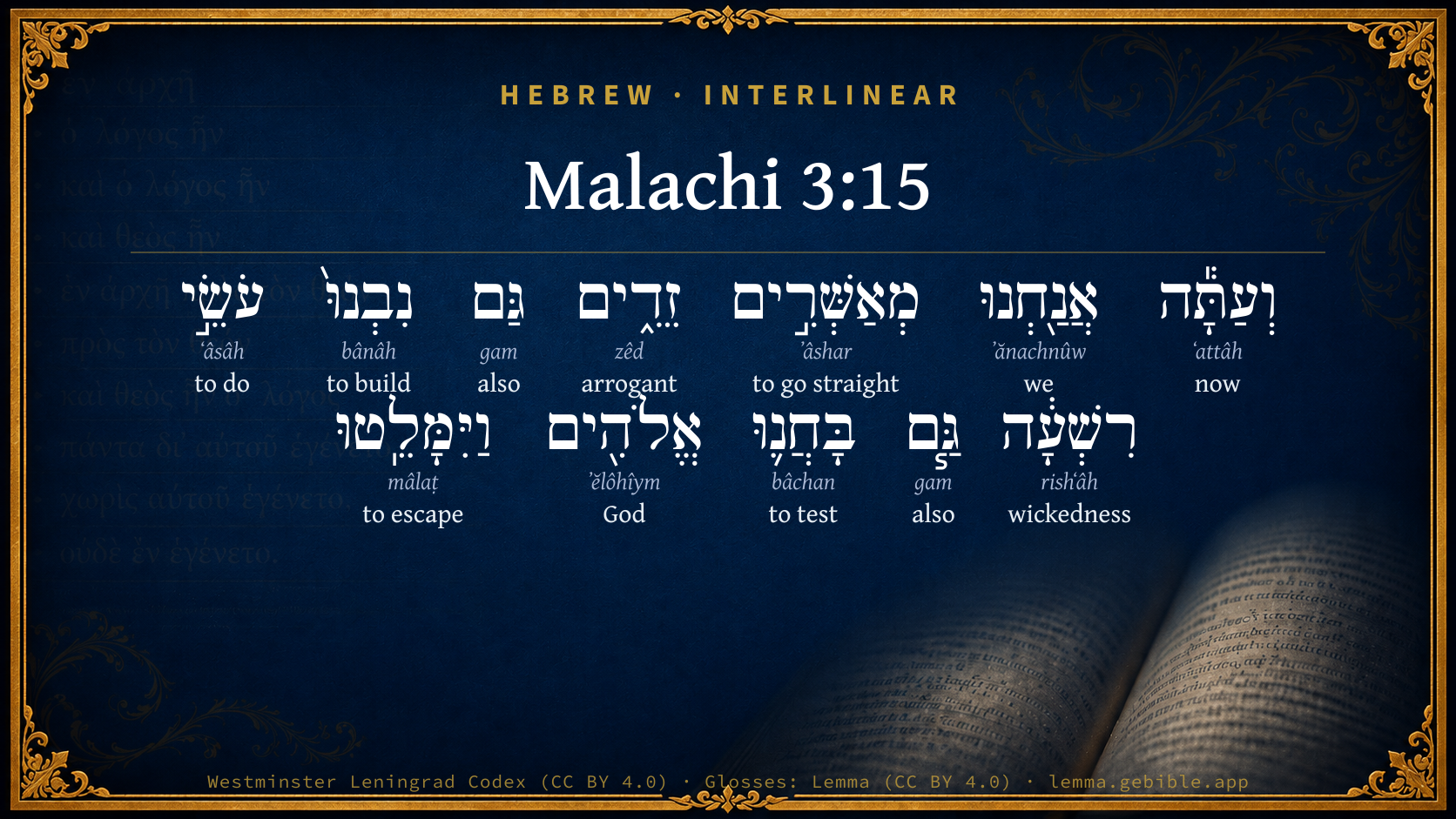
Hebrew (Westminster Leningrad Codex) Malachi 3:15 appears in the Hebrew Old Testament. The text above is from the Westminster Leningrad Codex. Each word links to its Strong’s number, a concise gloss, and parsing drawn from the Open Scriptures Hebrew Bible morphology. Click any word for its full Brown-Driver-Briggs (BDB) entry.
Download image
Cite this verse

Malachi 3:15 (World English Bible). Public Domain. Lemma interlinear Bible study tool, https://lemma.gebible.app/v/malachi/3/15.

Show BibTeX & RIS
BibTeX
RIS
English Translation
Now we call the proud happy; yes, those who work wickedness are built up; yes, they tempt God, and escape.'
World English Bible · Public Domain
Download a study sheet

One document with this verse’s original text, its word-by-word gloss line, the meaning frame, cross-references with their text, attributed commentary, and full source and license credits — printable, and it pastes into notes with its structure intact.

This verse Autodidact and up

Study sheet (.html) Plain text (.txt)

A passage Seminary Student

Up to 50 verses in one chapter. A passage sheet keeps up to 6 commentary sources and 12 cross-references per verse, in the order this page ranks them, and says so on the sheet whenever that leaves anything out. Ask for a single verse and you get the Autodidact verse sheet above.

Everything on this page stays free to read, with no account — the sheet is a download of what is already on screen, not access to it.

Want to remove ads? Support Godless Engineer
Compare translations 3

The same verse in 3 English versions, stacked beneath the original-language interlinear above. Click any original word for its lexicon entry.

Each is an independent rendering of the whole verse — the interlinear is not word-aligned to these translations.

Highlighted words mark where these versions differ — a whole-verse word diff, not a word-by-word alignment.

  • World English Bible Public Domain
    Now we call the proud happy; yes, those who work wickedness are built up; yes, they tempt God, and escape.'
  • King James Version Public Domain
    And now we call the proud happy; yea, they that work wickedness are set up; yea, they that tempt God are even delivered.
  • unfoldingWord Literal Text CC BY-SA 4.0
    So now we ourselves blessing the arrogant. Even doers of wickedness are built up; they even test God and escape.’”

unfoldingWord Literal Text — © unfoldingWord, licensed CC BY-SA 4.0. Word-aligned USFM3 via Door43 (git.door43.org/unfoldingWord/en_ult).

Versions to compare (up to 4)

3 of 4 selected

Show all 18 translations

Every available English version of this verse, each an independent rendering of the whole verse.

  • World English Bible Public Domain
    Now we call the proud happy; yes, those who work wickedness are built up; yes, they tempt God, and escape.'
  • Berean Standard Bible Public Domain
    So now we call the arrogant blessed. Not only do evildoers prosper, they even test God and escape.’”
  • Majority Standard Bible Public Domain
    So now we call the arrogant blessed. Not only do evildoers prosper, they even test God and escape.’”
  • King James Version Public Domain
    And now we call the proud happy; yea, they that work wickedness are set up; yea, they that tempt God are even delivered.
  • American Standard Version (1901) Public Domain
    And now we call the proud happy; yea, they that work wickedness are built up; yea, they tempt God, and escape.
  • Revised Version (1885) Public Domain
    And now we call the proud happy; yea, they that work wickedness are built up; yea, they tempt God, and are delivered.
  • Geneva Bible (1599) Public Domain
    Therefore wee count the proude blessed: euen they that worke wickednesse, are set vp, and they that tempt God, yea, they are deliuered.
  • Douay-Rheims (1899) Public Domain
    Wherefore now we call the proud people happy, for they that work wickedness are built up, and they have tempted God and are preserved.
  • Young's Literal Translation Public Domain
    And now, we are declaring the proud happy, Yea, built up have been those doing wickedness, Yea they have tempted God, and escape.'
  • Literal Standard Version CC BY-SA 4.0
    And now, we are declaring the proud blessed, || Indeed, those doing wickedness have been built up, || Indeed, they have tempted God, and escape.
  • Unlocked Literal Bible CC BY-SA 4.0
    So now we call the arrogant blessed. Evildoers not only prosper, but they even test God and escape.'”
  • unfoldingWord Literal Text CC BY-SA 4.0
    So now we ourselves blessing the arrogant. Even doers of wickedness are built up; they even test God and escape.’”
  • Darby Bible Public Domain
    And now we hold the proud for happy; yea, they that work wickedness are built up; yea, they tempt God, and they escape.
  • World Messianic Bible Public Domain
    Now we call the proud happy; yes, those who work wickedness are built up; yes, they tempt God, and escape.’
  • Webster's Bible Public Domain
    And now we call the proud happy; yes, they that work wickedness are set up; even they that tempt God are delivered.
  • Free Bible Version CC BY-SA 4.0
    From now on we'll say that the proud are blessed. Evil people do well, and nothing happens when they dare God to punish them.”
  • Bible in Basic English Public Domain
    And now to us the men of pride seem happy; yes, the evil-doers are doing well; they put God to the test and are safe.
  • JPS Tanakh (1917) Public Domain
    And now we call the proud happy; yea, they that work wickedness are built up; yea, they try God, and are delivered.'

Literal Standard Version (2020), Covenant Press — licensed CC BY-SA 4.0. Text via the HelloAO Bible API (eBible.org). Unlocked Literal Bible (unfoldingWord) — licensed CC BY-SA 4.0. Text via the HelloAO Bible API (eBible.org). unfoldingWord Literal Text — © unfoldingWord, licensed CC BY-SA 4.0. Word-aligned USFM3 via Door43 (git.door43.org/unfoldingWord/en_ult). Free Bible Version, Dr. Jonathan Gallagher — licensed CC BY-SA 4.0. Text via the HelloAO Bible API (eBible.org).

Word by word

More ways to search: Search by grammar → Find every occurrence → Compare this word →

Practice this passage: Drill this verse → Learn its vocabulary →

זֵדִ֑ים
zêd
H2086
“arrogant”
Adjective, Adjective, Masculine, Plural, Absolute
Part of Speech
Adjective
Type
Adjective
Gender
Masculine
Number
Plural
State
Absolute
Full BDB Definition

Origin: from H2102

TWOT: 547a

arrogant, proud, insolent, presumptuous - the arrogant ones (as noun collective plural) - presumptuous (as adjective)
  1. וְעַתָּ֕ה ʻattâh H6258 “and · now” Conjunction + Adverb
  2. אֲנַ֖חְנוּ ʼănachnûw H587 “we” Pronoun, Personal, 1st Person, Common, Plural
  3. מְאַשְּׁרִ֣ים ʼâshar H833 “going straight” Verb, Piel, Participle Active, Masculine, Plural, Absolute
  4. גַּם gam H1571 “also” Particle, Accusative
  5. נִבְנוּ֙ bânâh H1129 “to build” Verb, Niphal, Perfect, 3rd Person, Common, Plural
  6. עֹשֵׂ֣י ʻâsâh H6213 “doing” Verb, Qal, Participle Active, Masculine, Plural, Construct
  7. רִשְׁעָ֔ה rishʻâh H7564 “wickedness” Noun, Common, Feminine, Singular, Absolute
  8. גַּ֧ם gam H1571 “also” Particle, Accusative
  9. בָּחֲנ֛וּ bâchan H974 “to test” Verb, Qal, Perfect, 3rd Person, Common, Plural
  10. אֱלֹהִ֖ים ʼĕlôhîym H430 “God(s)” Noun, Common, Masculine, Plural, Absolute
  11. וַיִּמָּלֵֽטוּ mâlaṭ H4422 “and · to escape” Conjunction + Verb, Niphal, Sequential Imperfect, 3rd Person, Masculine, Plural

About this verse

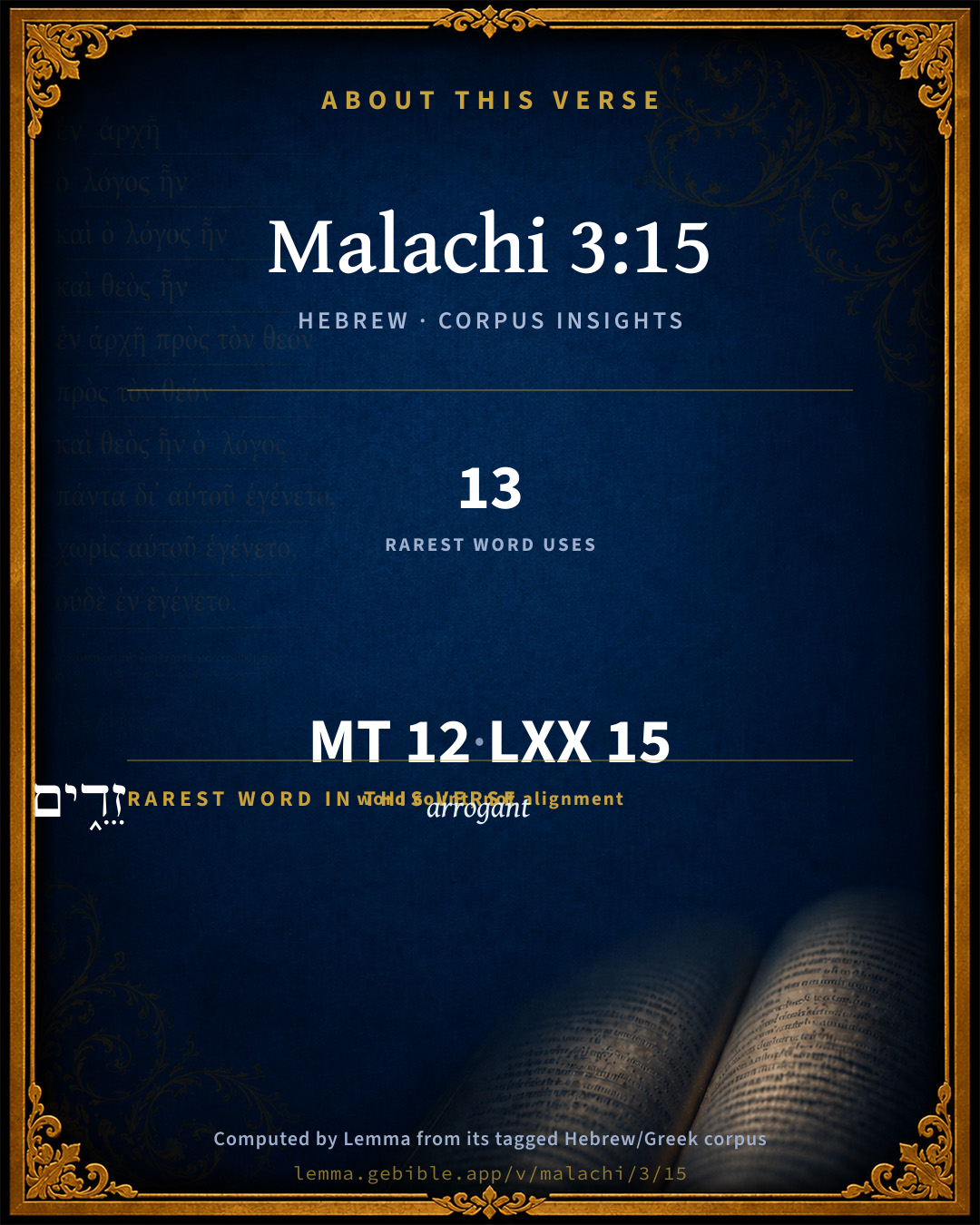
These counts appear in no published source. They are computed here, from the morphology-tagged text and Lemma’s own curated glosses. What Lemma adds →

12
words
11
distinct lemmas
Prophets
section

Notable vocabulary

The rarest word here is זֵדִ֑ים arrogant H2086 — appearing just 13 times in the whole Hebrew Bible.

Shared distinctive vocabulary

זֵדִ֑ים arrogant H2086 occurs in 13 verses of the Hebrew Bible. Also found in:

Grammatical profile

  • 5 verbs
  • 2 nouns
  • 1 adjective
  • 1 pronoun
  • 1 adverb
  • 2 particles

Verb forms

  • מְאַשְּׁרִ֣ים Piel · Participle Active
  • נִבְנוּ֙ Niphal · Perfect
  • עֹשֵׂ֣י Qal · Participle Active
  • בָּחֲנ֛וּ Qal · Perfect
  • וַיִּמָּלֵֽטוּ Niphal · Sequential Imperfect

Repetition

A word recurs within this verse — often emphatic in Hebrew:

  • גַּם also H1571 ×2

Hebrew & Septuagint length

In English translation the verse runs 20 words from the Hebrew and 25 from the Septuagint (LXX English) — closely comparable.

A rough comparison of the two English renderings, which tokenize alike — not a word-level alignment.

Word counts can differ between the Hebrew and the Greek without any difference in meaning — e.g. the Hebrew direct-object marker אֵת has no separate Greek word, and Greek often adds the article ὁ.

In the original languages it is 12 Hebrew tokens and 15 Greek tokens — but the two are counted differently (Hebrew bundles its prefixes and suffixes into one token; the Greek is in lemma form), so that isn’t a like-for-like length.

Cross-references

31

Topical passages linked to Malachi 3:15 in the Treasury of Scripture Knowledge — connected by theme and wording, ordered by reader-vote popularity; previews shown in the World English Bible.

  • Jeremiah 12:1–2 Righteous are you, Yahweh, when I contend with you; yet would I reason the cause with you: why does the way of the wicked prosper? why are all they at ease who deal very treacherously?
  • Job 21:7–15 "Why do the wicked live, Become old, yes, and grow mighty in power?
  • Malachi 2:17 You have wearied Yahweh with your words. Yet you say, 'How have we wearied him?' In that you say, 'Everyone who does evil is good in the sight of Yahweh, and he delights in them;' or 'Where is the God of justice?'
  • Malachi 4:1 "For, behold, the day comes, it burns as a furnace; and all the proud, and all who work wickedness, will be stubble; and the day that comes will burn them up," says Yahweh of Hosts, "that it shall leave them neither root nor branch.
  • Job 22:23 If you return to the Almighty, you shall be built up, If you put away unrighteousness far from your tents.
  • Matthew 4:6–7 and said to him, "If you are the Son of God, throw yourself down, for it is written, 'He will give his angels charge concerning you.' and, 'On their hands they will bear you up, So that you don't dash your foot against a stone.'"
  • Numbers 14:22–23 because all those men who have seen my glory, and my signs, which I worked in Egypt and in the wilderness, yet have tempted me these ten times, and have not listened to my voice;
  • Esther 5:10 Nevertheless Haman refrained himself, and went home; and he sent and fetched his friends and Zeresh his wife.
  • Job 12:6 The tents of robbers prosper, Those who provoke God are secure; Who carry their God in their hands.
  • Job 21:30 That the evil man is reserved to the day of calamity? That they are led forth to the day of wrath?
  • Psalms 10:3 For the wicked boasts of his heart's cravings, He blesses the greedy, and condemns Yahweh.
  • Psalms 49:18 Though while he lived he blessed his soul-- And men praise you when you do well for yourself--
  • Psalms 73:12 Behold, these are the wicked. Being always at ease, they increase in riches.
  • Psalms 78:18 They tempted God in their heart By asking food according to their desire.
  • Psalms 78:41 They turned again and tempted God, And provoked the Holy One of Israel.
  • Psalms 78:56 Yet they tempted and rebelled against the Most High God, And didn't keep his testimonies;
  • Psalms 95:9 When your fathers tempted me, Tested me, and saw my work.
  • Psalms 106:14 But gave in to craving in the desert, And tested God in the wasteland.
  • Proverbs 12:12 The wicked desires the plunder of evil men, But the root of the righteous flourishes.
  • Ecclesiastes 9:1–2 For all this I laid to my heart, even to explore all this: that the righteous, and the wise, and their works, are in the hand of God; whether it is love or hatred, man doesn't know it; all is before them.
  • Jeremiah 7:10 and come and stand before me in this house, which is called by my name, and say, We are delivered; that you may do all these abominations?
  • Daniel 4:30 The king spoke and said, Is not this great Babylon, which I have built for the royal dwelling-place, by the might of my power and for the glory of my majesty?
  • Daniel 4:37 Now I, Nebuchadnezzar, praise and extol and honor the King of heaven; for all his works are truth, and his ways justice; and those who walk in pride he is able to abase.
  • Daniel 5:20–28 But when his heart was lifted up, and his spirit was hardened so that he dealt proudly, he was deposed from his kingly throne, and they took his glory from him:
  • Daniel 6:16 Then the king commanded, and they brought Daniel, and cast him into the den of lions. [Now] the king spoke and said to Daniel, Your God whom you serve continually, he will deliver you.
  • Habakkuk 1:13–17 You who have purer eyes than to see evil, and who cannot look on perversity, why do you tolerate those who deal treacherously, and keep silent when the wicked swallows up the man who is more righteous than he,
  • Acts 5:9 But Peter asked her, "How is it that you have agreed together to tempt the Spirit of the Lord? Behold, the feet of those who have buried your husband are at the door, and they will carry you out."
  • Acts 12:21 On an appointed day, Herod dressed himself in royal clothing, sat on the throne, and gave a speech to them.
  • Hebrews 3:9 Where your fathers tested me by proving me, And saw my works for forty years.
  • 1 Peter 5:5 Likewise, you younger ones, be subject to the elder. Yes, all of you gird yourselves with humility, to subject yourselves to one another; for "God resists the proud, but gives grace to the humble."
  • 1 Corinthians 10:9 Neither let us test the Lord, as some of them tested, and perished by the serpents.

Cross-references courtesy of OpenBible.info (CC BY 4.0).

Hebrew and Greek witnesses Masoretic Hebrew ↔ Greek Septuagint

The same verse in the two great witnesses to the Old Testament, shown verse-for-verse.

These are two independent witnesses, not word-aligned to each other, and the Septuagint is shown in lemma (dictionary) form.

Hebrew Malachi 3:15 Masoretic · Westminster Leningrad Codex

וְעַתָּ֕ה אֲנַ֖חְנוּ מְאַשְּׁרִ֣ים זֵדִ֑ים גַּם נִבְנוּ֙ עֹשֵׂ֣י רִשְׁעָ֔ה גַּ֧ם בָּחֲנ֛וּ אֱלֹהִ֖ים וַיִּמָּלֵֽטוּ

Now we call the proud happy; yes, those who work wickedness are built up; yes, they tempt God, and escape.'

World English Bible · Public Domain

Greek LXX Malachi 3:15 Septuagint · lemma form

καί νῦν ἐγώ μακαρίζω ἀλλότριος καί ἀναοἰκοδομέω πᾶς ποιέω ἄνομος καί ἀντιἵστημι θεός καί σώζω

And now we pronounce strangers blessed; and all they who act unlawfully are built up; and they have resisted God, and yet have been delivered.

LXX2012 (modern English Septuagint) · Public Domain

On this verse, Haydock's Catholic Bible Commentary discusses the Septuagint’s reading. Read the note in Commentary ↓

Hebrew: Westminster Leningrad Codex (CC BY 4.0). Greek: Septuagint (public domain); English from LXX2012 (modern English Septuagint) (Public Domain). How the Septuagint differs from the Hebrew →

Targum (Aramaic paraphrase)

1

The Targum is the ancient Jewish Aramaic paraphrase of the Hebrew Scriptures — an interpretive translation, not the Hebrew text itself. Onkelos (literal) and Pseudo-Jonathan (expansive) render the Torah, and Jonathan the Prophets. Coverage is partial: where no permissively-licensed English translation exists for a verse, only the Aramaic is shown. This is verse-level text, not a word-by-word alignment to the Hebrew.

  1. Targum Jonathan Prophets (Joshua–Malachi)
    וּכְעַן אֲנַחְנָא מְשַׁבְּחִין רַשִׁיעִין אַף אִתְקַיְימוּ עָבְדֵי חֶטְאָה אַף נַסִיאוּ קֳדָם יְיָ וְאִשְׁתֵּיזָבוּ:

    (no public-domain English translation for this verse)

    Targum Jonathan — Aramaic: “Mikraot Gedolot” (public domain). English: “Sefaria Community Translation” (CC0 1.0 (public-domain dedication)); “London "Chaldee Paraphrase," 1871” (public domain). Text via Sefaria.

Commentary

Notes on Malachi 3:15 from classic Christian and Jewish commentators (each source and its license shown beneath its notes). The classic Christian expositions comment on the surrounding passage and are grouped to its opening verse, so a note may address several verses; the Jewish commentaries on the Tanakh (Rashi and others) are per-verse, so they appear only where the commentator wrote on this verse.

Lemma curates 59 commentaries, every one of them public domain or Creative Commons licensed, each selected and text-cleaned for this edition rather than reprinted as found. About our sources →

Ellicott's Commentary for English Readers

(15) And now means and so, consequently. In this verse the prophet gives the words of the murmurers. (See Note on Mal_3:13.) The statements of Mal_3:13 show that they were of a very different character from such faithful servants of Jehovah as were at times sorely tempted against their will to waver in their faith. We may observe here the seeds of sceptical Sadduceism, as in Mal_3:14 of hypocritical Phariseism. (Comp. Psalms 37, 73, and the Books of Job and Eccl.)

Proud . . . they that work wickedness—i.e., the heathen, who do not profess to serve Jehovah. (Comp. Isa_13:11.)

Proud is a common Biblical expression for presumptuous sinners; the same word is also used for ‘presumptuous sins (Psa_19:13).

Tempt.—The same word is used which in Mal_3:10 is translated “prove.” The difference in the two cases consists in the different nature of the actions. In Mal_3:10 the Jews are exhorted to obey the Law faithfully, and prove whether God would not (i.e., experience that God certainly would) perform His part in the covenant. In Mal_3:15 the heathen, by their pride and wickedness, tempt God to judgment.

A Bible Commentary for English Readers, edited by Charles John Ellicott (1878–1897) — public domain. Text from a community e-Sword module.

Trapp's Complete Commentary

John Trapp

Mal 3:15 And now we call the proud happy; yea, they that work wickedness are set up; yea, [they that] tempt God are even delivered.

Ver. 15. And now we call the proud happy] Such as, boiling and swelling with spite and spleen against God and his people, deal arrogantly and insolently, doing wickedly with hands earnestly, Exo 18:11; Exo 21:11, and working their own ends confidently and daringly; these we call and count happy, because wealthy and well underlaid, as they say, because they live in the height of the world’s blandishments. But the whole book of Ecclesiastes is a clear and full confutation of this fond conceit, had they but ever read or regarded it. How can the proud person be happy that hath God for his professed enemy? what was all Haman’s honour to him when the king frowned upon him? what was Ahab the better for his ivory palace, his gold, and his jewels in every place, when the heaven was brass above, the earth iron beneath? Surely God abhorreth pride as an abomination of desolation; and though he preserveth the faithful, yet sooner or later he plentifully rewardeth the proud doer, Psa 31:23. Like metal in the fire, when they shine brightest they are nearest to melting; and, like a bulging wall, they will shortly fall. Swelling is a dangerous symptom in the body, so is pride in the soul. Tolluntur in altum, ut lapsu graviore ruant. Neither are they, therefore, to be reputed ever a whit the more happy because they come not in trouble like other men, but prosper in their wickedness. for God is never more angry with such than when he seems best pleased. Pharaoh had fair weather made him, till he was in the midst of the sea; fatting cattle are but fitting for the meat market. Never was Jerusalem’s condition so desperate as when God said unto her, My fury shall depart from thee, I will be quiet and no more angry, Eze 16:42. Nor Ephraim’s, as when he said, "I will not punish your daughters when they commit whoredom." And, "Ephraim is joined to idols; let him alone," Hos 4:14; Hos 4:17, sc. till I come and fetch my full blow at him. Clement of Alexandria cites Plato expressing himself thus: Although a righteous man be tormented, although his eyes be dug out, yet he remains a blessed man; and the contrary:

They that work wickedness are set up] Heb. They are built up, sc. in posterity, and prosperity of all sorts. The Psalmist expresseth it thus: "They are full of children, and leave the rest of their substance to their babes," Psa 17:14. Thus God built the midwives houses, that is, he gave them children, for their mercy to these newborn babes, Exo 1:21. Thus he builded David a house, 2Sa 7:12-13. And thus those that return to the Almighty have a gracious promise that they shall be built up, Job 22:23. That these stout and stiff stigmatics were built up and prospered, though (after so sweet an invitation) they turned not to him that smote them, we need not wonder, since it is their portion, as David showeth, all they are like to have or must ever look for. Besides, is not God the true proprietary of all? Is not the earth the Lord’s purse with the fulness thereof, and may he not do with his own as he pleaseth? Mat 20:15. Add hereunto that what wicked men have, they have it with a curse, and for mischief; their table is a snare to them; they are like to pay dearly for their sweet morsels, as Haman did for his wine at Esther’s banquet. Bernard calls the wicked man’s prosperity misericordiam omni indignatione crudeliorem, a misery more cruel than any adversity, Psa 91:8. Austin affirmeth, Nullum mare tam profundum, quam est Dei cogitatio ut mali floreant, &c.: No sea is so deep as the Divine dispensation that good men should suffer, bad men prosper. They are built up with blessings, as they say the Phoenix builds her nest with hot spices, wherein she is afterwards burned. They build as those at Babel, and feather their nests, as if their lives were riveted upon eternity; but as their foundation is laid upon kiln, so brimstone is scattered upon their habitations, Job 18:15. If the fire of God’s wrath but touch it, all will be quickly consumed. Dioclesian, that bloody persecutor, despairing of ever rooting out the Christian religion, as he had endeavoured to do, gave over his empire in a discontent, and decreed to lead the rest of his life quietly. But he could not escape so; for, after that, his house was wholly consumed with lightning, and a flame of fire that fell from heaven, he, hiding himself for fear of the lightning, died within a little after (Euseb. de Vita Constant. lib. 5). "Their inward thought is" (saith the Psalmist of such wicked atheists) "that their houses" (honours, riches, nephews) "shall continue for ever; and their dwelling places to all generations; they call their houses after their own names"; as Cain called his newly built city of Enoch, after the name of his son, that he might leave him Lord Enoch of Enoch. "Nevertheless man being in honour abideth not: he is like the beasts that perish," Psa 49:11-12. The use to be made hereof see Mal 3:16 "Be not thou afraid when" (a wicked) "one is made rich, when the glory of his house is increased."

Yea, they that tempt God are even delivered] Still these miscreants are grunting out their grudges against God. What this sin here instanced, viz. of tempting God, is, hath been shown before. {See Trapp on "Mal 3:10"} Here it is to be taken for an audacious daring of God to take vengeance, as Num 16:23-35. These very worst sort of sinners are sometimes not only spared, but prospered, Jer 12:1. Their ephah is not yet full, their iniquity not found to be hateful enough yet. But the wicked is kept (by the patience of God) unto the day of destruction; and shall be brought forth to the day of wrath, as condemned malefactors are to execution, some by a back door and byways, others through the market place; so here. He that hath stolen a good horse rides gallantly mounted for present, till shortly after, followed close by hue and cry, he is soon apprehended, sentenced, and brought to condign punishment. And this is the very state of presumptuous sinners, and will be. I know well, that "because sentence is not presently executed, therefore the hearts of the sons of men are set in them to do wickedly," Ecc 8:11. Felix scelus virtus vocatur calls evil virtue (Cicero), as we see here, The proud are called happy, because, for present, in prosperity. See the like Jer 44:11 Gen 30:18. Dionysius, after the spoil of an idol temple, finding the winds favourable in his navigation, Lo, said he, how the gods approve of sacrilege. But the weakness of this argument see set forth by Solomon, Ecc 9:1-3. {See Trapp on "Ecc 9:1"} {See Trapp on "Ecc 9:2"} {See Trapp on "Ecc 9:3"} God gives outward things to the wicked no otherwise than as if a man should cast a purseful of gold into an outhouse. He gives them riches to furnish their indictment out of them; as Joseph put his cup into their sack to pick a quarrel with them and lay theft to their charge. The sunshine of prosperity ripens their sin apace, and so fits them for destruction. Let God, therefore, be justified, and every mouth stopped.

John Trapp, A Commentary or Exposition upon All the Books of the Old and New Testament (1647–1656) — public domain. Text from a community e-Sword module.

Tyndale Open Study Notes

Tyndale Open Resources

3:15 To call the arrogant blessed was blasphemy against God’s justice (see 3:13).

Tyndale Open Study Notes — © Tyndale Open Resources, licensed CC BY-SA 4.0. Text via the HelloAO Bible API.

Geneva Bible (1599)

Geneva Bible translators

They are not only preferred to honor, but also delivered from dangers.

Geneva Bible (1599) marginal notes — public domain. Text via Bolls.life.

Jamieson, Fausset & Brown

Robert Jamieson, A. R. Fausset & David Brown

And now--Since we who serve Jehovah are not prosperous and "the proud" heathen flourish in prosperity, we must pronounce them the favorites of God (Mal 2:17; Psa 73:12).

set up--literally, "built up": metaphor from architecture (Pro 24:3; compare Gen 16:2, Margin; Gen 30:3, Margin.)

tempt God--dare God to punish them, by breaking His laws (Psa 95:9).

Jamieson, Fausset & Brown — Commentary Critical and Explanatory on the Whole Bible (1871) — public domain (CC PDM 1.0). Text via the HelloAO Bible API.

Adam Clarke's Commentary

Verse 15. And now we call the proud happy] Proud and insolent men are the only happy people, for they domineer everywhere, and none dares to resist them.

They that work wickedness are set up] The humble and holy are depressed and miserable; the proud and wicked are in places of trust and profit. Too often it is so.

They that tempt God are even delivered.] Even those who despise God, and insult his justice and providence, are preserved in and from dangers; while the righteous fall by them.

Adam Clarke's Commentary on the Bible (1810–1826) — public domain. Text from a community e-Sword/MySword module.

John Calvin's Commentaries

This verse is connected with the last, for the force of these words, “We have walked sorrowfully before God and have carefully kept his precepts,” does not fully appear, except this clause be added — that they saw in the meantime that the proud flourished and had their delights, as though they said, “We strive to deserve well of God by our services; he overlooks all our religious acts, and pours as it were all his bounty on our enemies, who are yet ungodly and profane.” We now see how these verses are connected together, for God disappointed the Jews of the reward they thought due to them, and in the meantime bestowed on the impious and undeserving his kindness.

To call any one blessed, as we have before seen, is to acknowledge that God’s blessing is upon him, according to what God had promised, “Behold, all nations shall call thee blessed.” So a changed state of things is here set forth, for the Jews, when they were miserable, called others blessed; not that they willingly declared this, but envy forced them to complain of the cheerful and hamper state of the Gentiles, who were yet ungodly. And by the proud they meant all the despisers of God, a part being mentioned for the whole; and they were so called, because faith alone humbles us. Many unbelievers are indeed lauded for their humility, but no one becomes really humble without being first emptied of every conceit as to his own virtues. Some rise up against God, and rob him of what is his own, and then it is no wonder that they act insolently towards their neighbors, since they dare even to raise up their horns against God himself. And in many parts of Scripture the unbelieving are called proud, in order that we may know that we cannot be formed and habituated to humility until we submit to the yoke of God, so that he may turn us wherever he wishes, and until we cast aside every confidence in ourselves.

As well as, they said; for גם, gam, is here repeated, and must be rendered “as well as,” that is, “All who do iniquity as well as all who tempt God, are built up and are delivered. In the first place what is general is stated, and then what is particular, and yet the Prophet speaks of the same persons, for he first calls God’s despisers iniquitous, and he afterwards says, that the same tempted God, which is more special. The sum of the whole is, — that God’s favor was conspicuous towards the despisers of the law, for they lived prosperously, and were also delivered, and found God their helper in adversity.

The verb, to build, is taken in Hebrew in the sense of prospering, and is applied to many things. When therefore any one grows and increases in honors or in riches, when he accumulates wealth, or when he is raised as it were by degrees to a higher condition, he is said to be built up. It is also added that they were delivered, for it would not be enough to acquire much wealth, except aid from God comes in adversity, for no one, even the most fortunate, is exempt from every evil. Hence to building up the Prophet adds this second clause, — that God delivered the wicked from all evils, as though he covered them under his shadow, and as though they were his clients. With regard to the second verb, when he says that the ungodly tempted God, it is, we know, the work of unbelief to contend with God. The Prophet used the same word shortly before, when he said, “Prove me in this:” but God then, after the manner of men, submitted to a trial; here, on the contrary, the Prophet condemns that insolence which very commonly prevails in the world, when men seek to confine God, and to impose on him a law, and to inquire into his judgements: it is in short as though they had a right to prescribe to him according to their own caprice, so that he should not do this or that, and which if he did, to call on him to plead his own cause. We now then perceive what it is to prove or tempt God. It follows —

John Calvin's Commentaries (1540-1563) — public domain. Text from the Calvin Translation Society English edition (1840s-50s) via the Christian Classics Ethereal Library (ccel.org). Calvin's coverage is partial (roughly two-thirds of the Bible); uncommented books and verses are honest gaps, never fabricated. The 19th-century editor's footnotes and remarks are omitted so the notes are faithfully Calvin's own voice.

The Cambridge Bible for Schools and Colleges

gen. ed. J. J. S. Perowne

15. we call the proud happy] The word we is emphatic, and suggests a reference on the part of the speakers to Mal_3:12 above: “Thou sayest that all nations shall call them that obey Thee happy; we, on the contrary, call the proud rebels against Thee happy.”

set up] Rather, built up, as A.V. margin, and R.V. Comp. Jer_12:16; Job_22:23.

they that tempt, &c.] Rather, yea, they tempt God, and are delivered, as R.V. The persons are the same as in the preceding clause, “they that work wickedness”.

In this as in the earlier section of the prophecy the rebuke and denunciation of evil leads up to the prediction of impending judgment. In the earlier section the discriminating nature of the coming judgment is not lost sight of. It will purify as well as destroy (Mal_3:3-4 with 5). But in this latter section this feature of discrimination becomes more prominent. And the thought is added, for the comfort of the godly, that the discriminating judgment exists already (Mal_3:16-17), though its manifestation must be waited for till “the day” comes (Mal_3:18). The day in which all men shall “discern between the righteous and the wicked, between him that serveth God and him that serveth Him not”, will be the day, not of the inception, but of “the revelation of the righteous judgment of God” (Rom_2:5).

The Cambridge Bible for Schools and Colleges (gen. ed. J. J. S. Perowne; Cambridge University Press, 1878–1918) — public domain. Text from a community e-Sword module.

John Gill's Exposition

And now we call the proud happy,.... Or "therefore now" (q); since this is the case, that the worshippers of God are not regarded, and there is nothing got by serving him; they that are proud and haughty, that neither fear God nor regard men, are the happy persons; even presumptuous sinners, as the word (r) signifies, that stretch out their hands against God, and strengthen themselves against the Almighty; these enjoy all worldly happiness, while they that serve the Lord are mourning in sackcloth, and are in the utmost distress. The Targum explains it of the ungodly, and as it is explained in the following clause:

yea, they that work wickedness are set up: or "built up" (s); or "seeing, because", or "for they that work" (t), &c.; they are increased with children, by which their houses or families are built up; they are in a well settled and established condition; they abound in riches and honours; they are set in high places, and are in great esteem among men, even such who make it their constant business to commit sin:

yea, they that tempt God; or "yea, they tempt God" (u); by their wicked words and actions, and try whether he will cause his judgments to fall upon them, which he has threatened to such sinners; see Isa 5:18,

are even delivered; or, "and are delivered" (w); from the punishment threatened; they escape it, and go on with impunity; from which observations these persons reasoned that there was no God of judgment, or that judged in the earth; that there was no providence concerned about human affairs; and that there was nothing in religion; and these were the hard and stout words which they spoke against the Lord.

(q) "ergo nunc", V. L.; "igitur", Cocceius; "adeoque", Burkius. (r) "arrogantes", V. L.; "feroces", Cocceius. (s) "aedificati sunt", Pagninus, Montanus, Cocceius, Burkius; "aedificantur", Vatablus, Tigurine version, Calvin, Junius & Tremellius. (t) "siquidem", V. L.; "nam", Piscator, Noldius. (u) "etiam probaverunt", Pagninus, Montanus, Burkius. (w) "et evaserunt", Pagninus, Montanus; "et effugerunt", Cocceius.

John Gill's Exposition of the Whole Bible (1746–1763) — public domain (CC PDM 1.0). Text via the HelloAO Bible API.

Albert Barnes' Notes on the Bible

And now we call the proud happy (blessed) - This being so, they sum up the case against God. God had declared that all nations should “call them blessed” Mal 3:12. if they would obey. They answer, using His words; And “now we (they lay stress on the word we,) pronounce blessed,” in fact, those whom God had pronounced cursed: Psa 119:21. “Thou hast rebuked the proud, who are cursed.” Their characteristic, among other bad men, is of insolence Pro 21:24. arrogance, boiling over with self-conceit, and presumptuous toward God. The ground of Babylon’s sentence was “she hath been proud toward the Lord, the Holy One of Israel;” Jethro says of the Egyptians, as a ground of his belief in God (Exo 18:11. It is used of Egypt toward Israel. Neh 9:16.) “for, in the thing that they dealt proudly,” He was “above them.” It describes the character of the act of Israel, when God bade them “not go up, neither fight, and they would not hear, and went up presumptuously into the battle” Deu 1:41, Deu 1:43 the contumacious act of those, who, appealing to the judgment of God, afterward refused it: Deu 17:12-13. of Johanan’s associates, who accuse Jeremiah of speaking falsely in the name of God; Jer 43:2. they are persons who rise up Psa 86:14. forge lies against Psa 119:69. dig pits for Psa 119:85. deal perversely with, Psa 119:78. hold in derision Psa 119:51. oppress Psa 119:122. the pious. Whether or no, they mean specifically the pagan, those, whom these pronounced blessed, were those who were contemptuous toward God.

Yea, the workers of wickedness - , those who habitually work it, whose employment it is, “are built up; yea, they have tried God and have escaped.” God had promised that, if Jer 12:16, “they will diligently learn the ways of My people, they shall be built up in the midst of My people;” these say, the workers of wickedness “had been built up:” God had bidden themselves Jer 3:10, “make trial of Me in this;” these answer, the wicked had made trial of Him, and had been unpunished.

Albert Barnes' Notes on the Bible (1834–1885) — public domain. Text from a community e-Sword/MySword module.

Haydock's Catholic Bible Commentary

Proud. Septuagint, "strange." (Haydock) --- Z has been take for u. --- Built up: have a numerous family, (Calmet) and abundance. --- Tempted. Septuagint, "resisted."

George Leo Haydock (1774–1849), Haydock's Catholic Family Bible and Commentary, 1859 edition — public domain. Excludes Psalms (Douay-Rheims chapter numbering differs from Protestant) and Deuterocanonical books (Catholic canon only).

Matthew Poole's English Annotations

And now, or now therefore; on these false reasonings of these deceived ones, they proceed to further impiety and audacious blasphemy.

We call the proud happy; we (say they) see before our eyes, and must pronounce what we see, that the proud contemners of God and his law are the flourishing ones; they are at present happiest, and there appears no sign of any change of affairs to them. They do boldly and despitefully oppose God, and yet prosper. And could this be, say they, if there were a God of judgment to call men to account, and to deal with them according to their ways?

They that work wickedness are set up who contrive, and then work wickedness; who choose it, study it, and glory in it, as the whole of their life; are built up, are advanced to honours, and filled with riches, and have fair probability that all this will last to them and theirs. And could this be, say these priests and Jews, under the eye of a just and sovereign Judge? where is the God of judgment when such disorders are every where seen?

They that tempt God are even delivered; they that dare him to his very face, that do the highest affronts to God, purposely to prove whether he would or could punish the sinners amongst men. Those escape punishment though the law and prophets threaten them; and would you have us (say these men) believe there is such a God of judgment, when all is so disorderly carried in the world? Thus far the proud behaviour of these against God.

Matthew Poole's English Annotations on the Holy Bible (1683–1685) — public domain. Text from a community e-Sword/MySword module.

The Pulpit Commentary

We call the proud happy. This is still the speech of the murmurers. We, they say, do not reckon the humble and meek blessed; we consider that the only blessed ones are the arrogant heathen, or free thinkers, who meet with prosperity and happiness in this world. For the "proud," the LXX has, allotriouv , "strangers," which, doubtless, gives the meaning. (comp. Isa_13:11) Are set up; literally, are built up have wealth and families, and leave a name behind them. (Psa_17:14; see in the original, Gen_16:2 Gen_30:3; and comp. Exo_1:21 Jer_12:16, where the phrase, "being built," includes all temporal prosperity) They that tempt God are even delivered; they tempt God, and are delivered (ver. 10). They try and provoke God by their impiety, and yet escape punishment. Septuagint, Antesthsan tw Yew kai eswyhsan , "They resist God, and yet are safe."

The Pulpit Commentary (1880–1919), ed. H.D.M. Spence-Jones & Joseph S. Exell — public domain. Text from a community e-Sword module.

John Wesley's Explanatory Notes

And now - You say, we see before our eyes, that the proud contemners of God and his law, are the flourishing ones. Delivered - Escape all punishment.

John Wesley, Explanatory Notes Upon the Whole Bible (1754–1765) — public domain. Text via the GEBible commentary corpus.

Rashi

Rabbi Shlomo Yitzchaki (Rashi)

And now we praise the bold transgressors, etc. We worshipped Him and kept His charge, but now we see that the wicked are prospering - to the extent that we praise them for the wicked deeds.

Yea, they tempt God, saying, “Let us see what He will be able to do to us.” and they have, nevertheless, escaped harm, and they have not stumbled.

Rashi on the Tanakh — English translations: “The Judaica Press complete Tanach with Rashi, translated by A. J. Rosenberg” (CC BY 4.0); “Pentateuch with Rashi's commentary by M. Rosenbaum and A.M. Silbermann, 1929-1934” (public domain); “The Metsudah Tanach series, Lakewood, N.J” (CC BY 4.0); and “The Book of Joshua, Metsudah Publications, 1997” (CC BY 4.0). Text via Sefaria.

Lesson kit

Teaching starters — assembled from the data on this page, not authored interpretation. Every prompt links to the verse data it draws on. Edit before teaching.

Malachi, in the Prophets, opens this verse with 12 words (11 distinct Hebrew lemmas). Its most distinctive word is zêd (“arrogant”). A historical commentator’s framing appears above. Read the whole chapter for the surrounding context.

Discussion questions

  1. What does “arrogant” (zêd) contribute to the verse as a whole?
  2. Psalms 19:13 shares the word «arrogant» with this verse. How do the two illuminate each other?
  3. “also” occurs 2× in this one verse. What is the effect of the repetition?
  4. The translations on this page render this verse differently — a whole-verse word diff, not a word-by-word alignment. What might account for the different wordings?
  5. The verb «מְאַשְּׁרִ֣ים» is Piel Participle Active. How does its form color the action?
  6. Reading how Ellicott's Commentary for English Readers and Trapp's Complete Commentary read this verse, where do the two commentators agree and where do they part?

Things to notice

Reading settings

Reading text

Shown beneath each verse's original-language words.

Old Testament
Old Testament edition

Read the OT as the Masoretic Hebrew (MT) or the Greek Septuagint (LXX).

English shown for the Greek Septuagint (in the Hebrew ↔ Greek comparison).

Comparing translations? Open the Compare panel on any verse page to stack up to four side by side.