
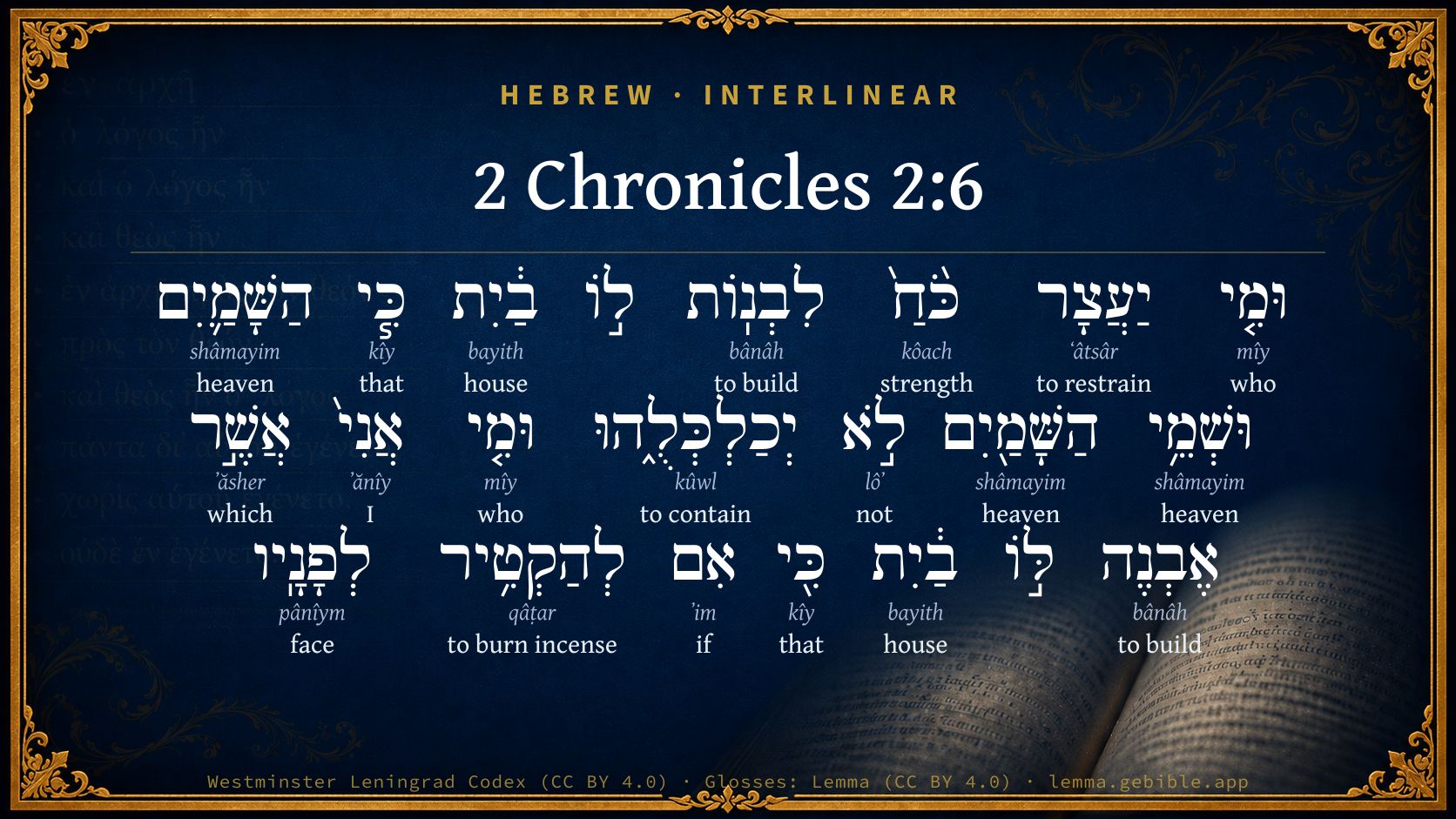
2 Chronicles 2:6

Hebrew (Westminster Leningrad Codex) 2 Chronicles 2:6 appears in the Hebrew Old Testament. The text above is from the Westminster Leningrad Codex. Each word links to its Strong’s number, a concise gloss, and parsing drawn from the Open Scriptures Hebrew Bible morphology. Click any word for its full Brown-Driver-Briggs (BDB) entry.
Download image
Cite this verse

2 Chronicles 2:6 (World English Bible). Public Domain. Lemma interlinear Bible study tool, https://lemma.gebible.app/v/2-chronicles/2/6.

Show BibTeX & RIS
BibTeX
RIS
English Translation
But who is able to build him a house, seeing heaven and the heaven of heavens can't contain him? who am I then, that I should build him a house, save only to burn incense before him?
World English Bible · Public Domain
Download a study sheet

One document with this verse’s original text, its word-by-word gloss line, the meaning frame, cross-references with their text, attributed commentary, and full source and license credits — printable, and it pastes into notes with its structure intact.

This verse Autodidact and up

Study sheet (.html) Plain text (.txt)

A passage Seminary Student

Up to 50 verses in one chapter. A passage sheet keeps up to 6 commentary sources and 12 cross-references per verse, in the order this page ranks them, and says so on the sheet whenever that leaves anything out. Ask for a single verse and you get the Autodidact verse sheet above.

Everything on this page stays free to read, with no account — the sheet is a download of what is already on screen, not access to it.

Want to remove ads? Support Godless Engineer
Compare translations 3

The same verse in 3 English versions, stacked beneath the original-language interlinear above. Click any original word for its lexicon entry.

Each is an independent rendering of the whole verse — the interlinear is not word-aligned to these translations.

Highlighted words mark where these versions differ — a whole-verse word diff, not a word-by-word alignment.

  • World English Bible Public Domain
    But who is able to build him a house, seeing heaven and the heaven of heavens can't contain him? who am I then, that I should build him a house, save only to burn incense before him?
  • King James Version Public Domain
    But who is able to build him an house, seeing the heaven and heaven of heavens cannot contain him? who am I then, that I should build him an house, save only to burn sacrifice before him?
  • unfoldingWord Literal Text CC BY-SA 4.0
    But who can keep strength to build for him a house, since the heavens and the heavens of the heavens do not contain him? And who am I that I would build for him a house, except to sacrifice before him?

unfoldingWord Literal Text — © unfoldingWord, licensed CC BY-SA 4.0. Word-aligned USFM3 via Door43 (git.door43.org/unfoldingWord/en_ult).

Versions to compare (up to 4)

3 of 4 selected

Show all 18 translations

Every available English version of this verse, each an independent rendering of the whole verse.

  • World English Bible Public Domain
    But who is able to build him a house, seeing heaven and the heaven of heavens can't contain him? who am I then, that I should build him a house, save only to burn incense before him?
  • Berean Standard Bible Public Domain
    But who is able to build a house for Him, since the heavens, even the highest heavens, cannot contain Him? Who then am I, that I should build a house for Him, except as a place to burn sacrifices before Him?
  • Majority Standard Bible Public Domain
    But who is able to build a house for Him, since the heavens, even the highest heavens, cannot contain Him? Who then am I, that I should build a house for Him, except as a place to burn sacrifices before Him?
  • King James Version Public Domain
    But who is able to build him an house, seeing the heaven and heaven of heavens cannot contain him? who am I then, that I should build him an house, save only to burn sacrifice before him?
  • American Standard Version (1901) Public Domain
    But who is able to build him a house, seeing heaven and the heaven of heavens cannot contain him? who am I then, that I should build him a house, save only to burn incense before him?
  • Revised Version (1885) Public Domain
    But who is able to build him an house, seeing the heaven and the heaven of heavens cannot contain him? who am I then, that I should build him an house, save only to burn incense before him?
  • Geneva Bible (1599) Public Domain
    Who is he then that can be able to buylde him an house, when the heauen, and the heauen of heauens can not conteine him? who am I then that I should buylde him an house? but I do it to burne incense before him.
  • Douay-Rheims (1899) Public Domain
    Who then can be able to build him a worthy house? if heaven, and the heavens of heavens cannot contain him: who am I that I should be able to build him a house? but to this end only, that incense may be burnt before him.
  • Young's Literal Translation Public Domain
    and who doth retain strength to build to Him a house, for the heavens, even the heavens of the heavens, do not contain Him? and who `am' I that I do build to Him a house, except to make perfume before Him?
  • Literal Standard Version CC BY-SA 4.0
    and who retains strength to build a house for Him, since the heavens, even the heavens of the heavens, do not contain Him? And who [am] I that I build a house for Him, except to make incense before Him?
  • Unlocked Literal Bible CC BY-SA 4.0
    But who is able to build God a house, since the entire universe and even heaven itself cannot contain him? Who am I to build him a house, except to burn sacrifices before him?
  • unfoldingWord Literal Text CC BY-SA 4.0
    But who can keep strength to build for him a house, since the heavens and the heavens of the heavens do not contain him? And who am I that I would build for him a house, except to sacrifice before him?
  • Darby Bible Public Domain
    But who is able to build him a house, seeing the heavens and the heaven of heavens cannot contain him? And who am I that I should build him a house, except to burn sacrifice before him?
  • World Messianic Bible Public Domain
    But who is able to build him a house, since heaven and the heaven of heavens can’t contain him? Who am I then, that I should build him a house, except just to burn incense before him?
  • Webster's Bible Public Domain
    But who is able to build him a house, seeing the heaven and heaven of heavens cannot contain him? who am I then that I should build him a house, save only to burn sacrifice before him?
  • Free Bible Version CC BY-SA 4.0
    But who can build a Temple for him to live in, for the heavens, even highest heaven, cannot contain him, and who am I that I should dare to build him a house, except to burn incense to him?
  • Bible in Basic English Public Domain
    But who may have strength enough to make a house for him, seeing that the heaven and the heaven of heavens are not wide enough to be his resting-place? who am I then to make a house for him? But I am building it only for the burning of perfume before him.
  • JPS Tanakh (1917) Public Domain
    (2-5) But who is able to build Him a house, seeing the heaven and the heaven of heavens cannot contain Him? who am I then, that I should build Him a house, save only to offer before Him?

Literal Standard Version (2020), Covenant Press — licensed CC BY-SA 4.0. Text via the HelloAO Bible API (eBible.org). Unlocked Literal Bible (unfoldingWord) — licensed CC BY-SA 4.0. Text via the HelloAO Bible API (eBible.org). unfoldingWord Literal Text — © unfoldingWord, licensed CC BY-SA 4.0. Word-aligned USFM3 via Door43 (git.door43.org/unfoldingWord/en_ult). Free Bible Version, Dr. Jonathan Gallagher — licensed CC BY-SA 4.0. Text via the HelloAO Bible API (eBible.org).

Word by word

More ways to search: Search by grammar → Find every occurrence → Compare this word →

Practice this passage: Drill this verse → Learn its vocabulary →

יְכַלְכְּלֻ֑הוּ
kûwl
H3557
“to contain · him”
Verb, Pilpel, Imperfect, 3rd Person, Masculine, Singular + Suffix, Personal, 3rd Person, Masculine, Singular
Part of Speech
Verb
Stem
Pilpel
Form
Imperfect
Person
3rd Person
Gender
Masculine
Number
Singular
Full BDB Definition

Origin: a primitive root

TWOT: 962

to seize, contain, measure - (Qal) to measure, calculate - (Pilpel) to sustain, maintain, contain - to sustain, support, nourish - to contain, hold in, restrain - to support, endure - (Polpal) to be supplied - (Hiphil) to contain, hold, hold in, endure - to contain - to sustain, endure
  1. וּמִ֤י mîy H4310 “and · who” Conjunction + Particle, Interrogative
  2. יַעֲצָר ʻâtsâr H6113 “to restrain” Verb, Qal, Imperfect, 3rd Person, Masculine, Singular
  3. כֹּ֨חַ֙ kôach H3581 “strength” Noun, Common, Masculine, Singular, Absolute
  4. לִבְנֽוֹת bânâh H1129 “to build” Preposition + Verb, Qal, Infinitive Construct
  5. בַ֔יִת bayith H1004 “house” Noun, Common, Masculine, Singular, Absolute
  6. כִּ֧י kîy H3588 “that” Conjunction
  7. הַשָּׁמַ֛יִם shâmayim H8064 “the · heaven(s)” Particle, Definite Article + Noun, Common, Masculine, Plural, Absolute
  8. וּשְׁמֵ֥י shâmayim H8064 “and · heaven(s) of” Conjunction + Noun, Common, Masculine, Plural, Construct
  9. הַשָּׁמַ֖יִם shâmayim H8064 “the · heaven(s)” Particle, Definite Article + Noun, Common, Masculine, Plural, Absolute
  10. לֹ֣א lôʼ H3808 “not” Particle, Negative
  11. וּמִ֤י mîy H4310 “and · who” Conjunction + Particle, Interrogative
  12. אֲנִי֙ ʼănîy H589 “I” Pronoun, Personal, 1st Person, Common, Singular
  13. אֲשֶׁ֣ר ʼăsher H834 “which” Particle, Relative
  14. אֶבְנֶה bânâh H1129 “to build” Verb, Qal, Imperfect, 1st Person, Common, Singular
  15. בַ֔יִת bayith H1004 “house” Noun, Common, Masculine, Singular, Absolute
  16. כִּ֖י kîy H3588 “that” Conjunction
  17. אִם ʼim H518 “if” Conjunction
  18. לְהַקְטִ֥יר qâṭar H6999 “to burn incense” Preposition + Verb, Hiphil, Infinitive Construct
  19. לְפָנָֽיו pânîym H6440 “to/for · face(s) · his” Preposition + Noun, Common, Both, Plural, Construct + Suffix, Personal, 3rd Person, Masculine, Singular

About this verse

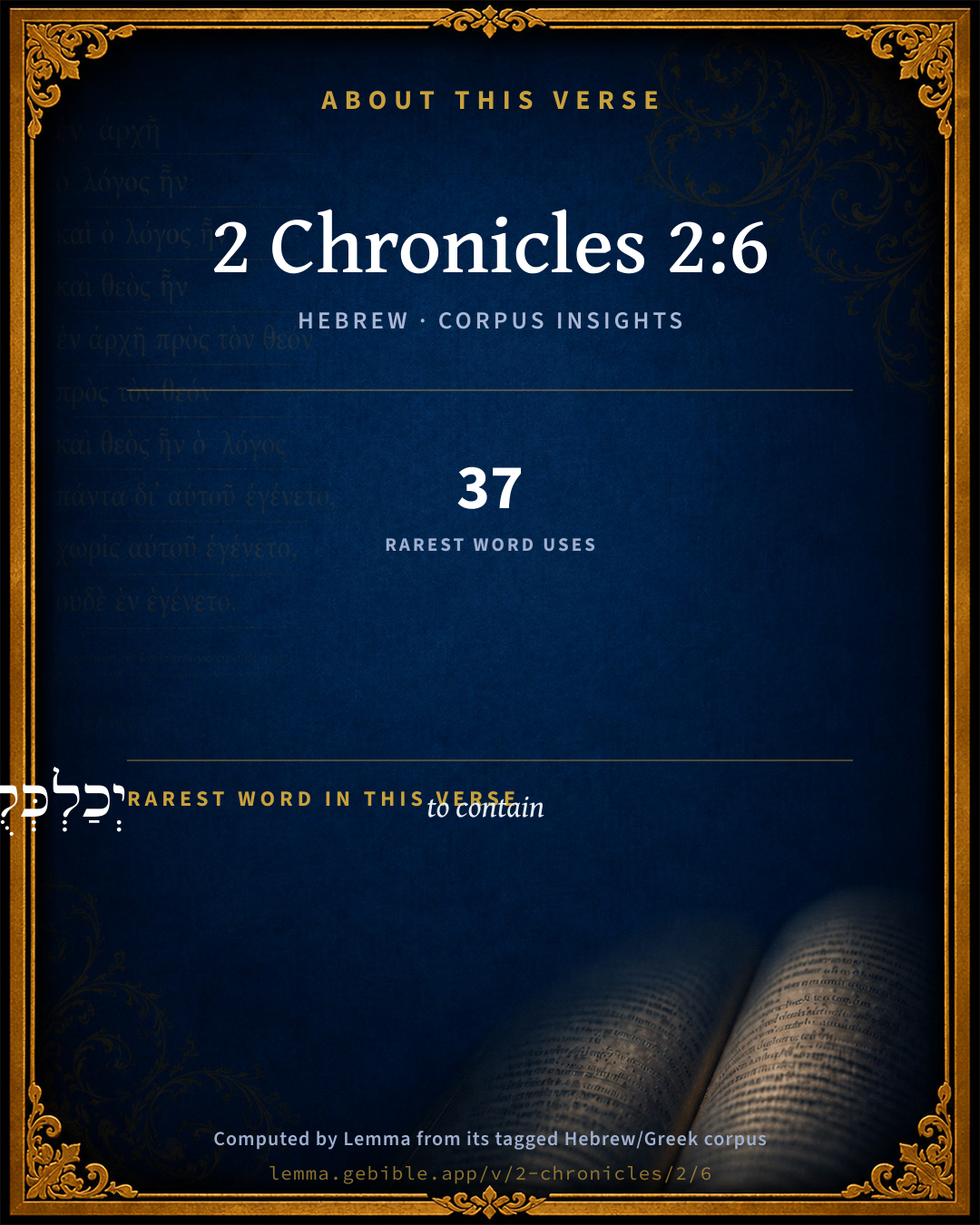
These counts appear in no published source. They are computed here, from the morphology-tagged text and Lemma’s own curated glosses. What Lemma adds →

22
words
14
distinct lemmas
Historical
section

Shared distinctive vocabulary

יְכַלְכְּלֻ֑הוּ to contain H3557 occurs in 36 verses of the Hebrew Bible. Also found in:

Grammatical profile

  • 5 verbs
  • 7 nouns
  • 1 pronoun
  • 2 prepositions
  • 3 conjunctions
  • 4 particles

Verb forms

  • יַעֲצָר Qal · Imperfect
  • לִבְנֽוֹת Qal · Infinitive Construct
  • יְכַלְכְּלֻ֑הוּ Pilpel · Imperfect
  • אֶבְנֶה Qal · Imperfect
  • לְהַקְטִ֥יר Hiphil · Infinitive Construct

Repetition

Words recur within this verse — often emphatic in Hebrew:

  • הַשָּׁמַ֛יִם heaven H8064 ×3
  • לִבְנֽוֹת to build H1129 ×2
  • בַ֔יִת house H1004 ×2
  • וּמִ֤י who H4310 ×2
  • כִּ֧י that H3588 ×2

Hebrew & Septuagint length

In English translation the verse runs 37 words from the Hebrew and 40 from the Septuagint (LXX English) — closely comparable.

A rough comparison of the two English renderings, which tokenize alike — not a word-level alignment.

Word counts can differ between the Hebrew and the Greek without any difference in meaning — e.g. the Hebrew direct-object marker אֵת has no separate Greek word, and Greek often adds the article ὁ.

Cross-references

14

Topical passages linked to 2 Chronicles 2:6 in the Treasury of Scripture Knowledge — connected by theme and wording, ordered by reader-vote popularity; previews shown in the World English Bible.

  • 1 Kings 8:27 But will God in very deed dwell on the earth? behold, heaven and the heaven of heavens can't contain you; how much less this house that I have built!
  • 2 Chronicles 6:18 But will God in very deed dwell with men on the earth? behold, heaven and the heaven of heavens can't contain you; how much less this house which I have built!
  • Isaiah 66:1 Thus says Yahweh, heaven is my throne, and the earth is my footstool: what manner of house will you build to me? and what place shall be my rest?
  • Acts 7:48–49 However, the Most High doesn't dwell in temples made with hands, as the prophet says,
  • Exodus 3:11 Moses said to God, "Who am I, that I should go to Pharaoh, and that I should bring forth the children of Israel out of Egypt?"
  • Deuteronomy 12:5–6 But to the place which Yahweh your God shall choose out of all your tribes, to put his name there, even to his habitation shall you seek, and there you shall come;
  • 2 Samuel 7:18 Then David the king went in, and sat before Yahweh; and he said, Who am I, Lord Yahweh, and what is my house, that you have brought me thus far?
  • 1 Chronicles 29:14 But who am I, and what is my people, that we should be able to offer so willingly as this? For all things come of you, and of your own have we given you.
  • 2 Chronicles 1:10 Give me now wisdom and knowledge, that I may go out and come in before this people; for who can judge this your people, that is so great?
  • Deuteronomy 12:14 but in the place which Yahweh shall choose in one of your tribes, there you shall offer your burnt offerings, and there you shall do all that I command you.
  • Deuteronomy 12:26 Only your holy things which you have, and your vows, you shall take, and go to the place which Yahweh shall choose:
  • 2 Corinthians 2:16 to the one a stench from death to death; to the other a sweet aroma from life to life. Who is sufficient for these things?
  • Ephesians 3:8 To me, the very least of all saints, was this grace given, to preach to the Gentiles the unsearchable riches of Christ,
  • Deuteronomy 12:11 then it shall happen that to the place which Yahweh your God shall choose, to cause his name to dwell there, there shall you bring all that I command you: your burnt offerings, and your sacrifices, your tithes, and the heave-offering of your hand, and all your choice vows which you vow to Yahweh.

Cross-references courtesy of OpenBible.info (CC BY 4.0).

Hebrew and Greek witnesses Masoretic Hebrew ↔ Greek Septuagint

The same verse in the two great witnesses to the Old Testament, shown verse-for-verse.

These are two independent witnesses, not word-aligned to each other, and the Septuagint is shown in lemma (dictionary) form.

Hebrew 2 Chronicles 2:6 Masoretic · Westminster Leningrad Codex

וּמִ֤י יַעֲצָר כֹּ֨חַ֙ לִבְנֽוֹת ל֣וֹ בַ֔יִת כִּ֧י הַשָּׁמַ֛יִם וּשְׁמֵ֥י הַשָּׁמַ֖יִם לֹ֣א יְכַלְכְּלֻ֑הוּ וּמִ֤י אֲנִי֙ אֲשֶׁ֣ר אֶבְנֶה לּ֣וֹ בַ֔יִת כִּ֖י אִם לְהַקְטִ֥יר לְפָנָֽיו

But who is able to build him a house, seeing heaven and the heaven of heavens can't contain him? who am I then, that I should build him a house, save only to burn incense before him?

World English Bible · Public Domain

Greek LXX 2 Chronicles 2:6 Septuagint · lemma form

καί νῦν ἀποστέλλω ἐγώ ἀνήρ σοφός καί εἶδον ὁ ποιέω ἐν ὁ χρυσίον καί ἐν ὁ ἀργύριον καί ἐν ὁ χαλκοῦς καί ἐν ὁ σίδηρος καί ἐν ὁ πορφύρα καί ἐν ὁ κόκκινος καί ἐν ὁ ὑάκινθος καί ἐπίσταμαι γλύφω γλυφή μετά ὁ σοφός ὁ μετά ἐγώ ἐν ἰουδά καί ἐν ἰερουσαλήμ ὅς ἑτοιμάζω δαυίδ ὁ πατήρ ἐγώ

And who will be able to build him a house? for the heaven and heaven of heavens do not bear his glory: and who am I, that I should build him a house, save only to burn incense before him?

LXX2012 (modern English Septuagint) · Public Domain

Hebrew: Westminster Leningrad Codex (CC BY 4.0). Greek: Septuagint (public domain); English from LXX2012 (modern English Septuagint) (Public Domain). How the Septuagint differs from the Hebrew →

Commentary

Notes on 2 Chronicles 2:6 from classic Christian and Jewish commentators (each source and its license shown beneath its notes). The classic Christian expositions comment on the surrounding passage and are grouped to its opening verse, so a note may address several verses; the Jewish commentaries on the Tanakh (Rashi and others) are per-verse, so they appear only where the commentator wrote on this verse.

Lemma curates 59 commentaries, every one of them public domain or Creative Commons licensed, each selected and text-cleaned for this edition rather than reprinted as found. About our sources →

Trapp's Complete Commentary

John Trapp

2Ch 2:6 But who is able to build him an house, seeing the heaven and heaven of heavens cannot contain him? who [am] I then, that I should build him an house, save only to burn sacrifice before him?

Ver. 6. Seeing the heavens and heaven of heavens.] He is ανεπιγραπτος incomprehensible, incircumscriptible: good without quality, great without quantity, everlasting without time, present everywhere without place, containing all things without extent: he filleth all places without compression or straitening of another, or the contraction, extension, condensation, or rarefaction of himself: he is within all things, and contained of nothing: without all things, and sustained of nothing.

John Trapp, A Commentary or Exposition upon All the Books of the Old and New Testament (1647–1656) — public domain. Text from a community e-Sword module.

Joseph Benson's Commentary

2Ch 2:6. But who is able to build him a house — No house, be it ever so great, can be a habitation for him. Behold, the heaven and the heaven of heavens cannot contain him — Nor does he, like the gods of the nations, dwell in temples made with hands. When, therefore, I speak of building a great house for the great God, let none be so foolish as to imagine that I mean to include or comprehend God within it, for he is infinite. Who am I, then, that I should build him a house — He looked upon himself, though a mighty prince, as utterly unworthy of the honour of being employed in this great work. Save only to burn sacrifice before him — As if he had said, We have not such low notions of our God as to suppose we can build a house that will contain him: we only intend it for the convenience of his priests and worshippers, that they may have a suitable place wherein to assemble and offer sacrifices and prayers, and perform other religious duties to him. Thus Solomon guards Hiram against any misapprehension concerning God, which his speaking of building him a house might otherwise have occasioned. And it is one part of the wisdom wherein we ought to walk toward them that are without, in a similar manner carefully to guard against all misapprehension which anything we may say or do may occasion concerning any truth or duty of religion.

Joseph Benson's Commentary on the Old and New Testaments (1811–1818) — public domain. Text from a community e-Sword module.

Geneva Bible (1599)

Geneva Bible translators

That is, to do the service which he hath commanded, signifying that none is able to honor and serve God in that perfection as his majesty deserveth.

Geneva Bible (1599) marginal notes — public domain. Text via Bolls.life.

Adam Clarke's Commentary

Verse 6. Seeing the heaven and heaven of heavens] "For the lower heavens, the middle heavens, and the upper heavens cannot contain him, seeing he sustains all things by the arm of his power. Heaven is the throne of his glory, the earth his footstool; the deep, and the whole world, are sustained by the spirit of his WORD, [ברוח מימריה beruach meymereih.] Who am I, then, that I should build him a house?" - Targum.

Save only to burn sacrifice] It is not under the hope that the house shall be able to contain him, but merely for the purpose of burning incense to him, and offering him sacrifice, that I have erected it.

Adam Clarke's Commentary on the Bible (1810–1826) — public domain. Text from a community e-Sword/MySword module.

Ellicott's Commentary for English Readers

(6) But who is able.—Literally, who could keep strength? (See 1Ch_29:14.)

The heaven . . . cannot contain him.—This high thought occurs in Solomon’s prayer (1Ki_8:27; 2Ch_6:18).

Who am I then . . . before him?—That is, I am not so ignorant of the infinite nature of Deity, as to think of localising it within an earthly dwelling. I build not for His residence, but for His worship and service. (Comp. Isa_40:22.)

To burn sacrifice.—Literally, to burn incense. Here, as in 2Ch_2:4, used in a general sense.

A Bible Commentary for English Readers, edited by Charles John Ellicott (1878–1897) — public domain. Text from a community e-Sword module.

The Cambridge Bible for Schools and Colleges

gen. ed. J. J. S. Perowne

6. is able] Lit. retaineth strength; 1Ch_29:14. Cp. 2Ch_6:2; 2Ch_6:18.

to burn sacrifice] R.V. to burn incense.

The Cambridge Bible for Schools and Colleges (gen. ed. J. J. S. Perowne; Cambridge University Press, 1878–1918) — public domain. Text from a community e-Sword module.

John Gill's Exposition

Send now therefore a man cunning to work in gold, and in silver, and in brass, and in iron,.... There being many things relating to the temple about to be built, and vessels to be put into it, which were to be made of those metals:

and in purple, and crimson, and blue; used in making the vails for it, hung up in different places:

and that can skill to grave; in wood or stone:

with the cunning men that are with me in Judah and Jerusalem, whom my father David did provide; see Ch1 22:15.

John Gill's Exposition of the Whole Bible (1746–1763) — public domain (CC PDM 1.0). Text via the HelloAO Bible API.

Albert Barnes' Notes on the Bible

Save only to burn sacrifice before him - Solomon seems to mean that to build the temple can only be justified on the human - not on the divine - side. “God dwelleth not in temples made with hands;” He cannot be confined to them; He does in no sort need them. The sole reason for building a temple lies in the needs of man: his worship must he local; the sacrifices commanded in the Law had of necessity to be offered somewhere.

Albert Barnes' Notes on the Bible (1834–1885) — public domain. Text from a community e-Sword/MySword module.

Haydock's Catholic Bible Commentary

Before him. For this purpose do I design to build. (Menochius) --- Temples are more for our use than for God’s, as none can be worthy of him. (Calmet)

George Leo Haydock (1774–1849), Haydock's Catholic Family Bible and Commentary, 1859 edition — public domain. Excludes Psalms (Douay-Rheims chapter numbering differs from Protestant) and Deuterocanonical books (Catholic canon only).

Matthew Poole's English Annotations

The heaven of heavens cannot contain him: when I speak of building a great house for our great God, let none be so foolish to think that I mean to include or comprehend God within it, for he is infinite.

To burn sacrifice before him, i.e. to worship him there where he is graciously present.

Matthew Poole's English Annotations on the Holy Bible (1683–1685) — public domain. Text from a community e-Sword/MySword module.

John Wesley's Explanatory Notes

Contain - When I speak of building an house for our great God, let none think I mean to comprehend God within it, for he is infinite. To sacrifice - To worship him there where he is graciously present.

John Wesley, Explanatory Notes Upon the Whole Bible (1754–1765) — public domain. Text via the GEBible commentary corpus.

unfoldingWord translationNotes

Door43 World Missions Community

who is able to build God a house, since the entire universe and even heaven itself cannot contain him? Who am I to build him a house, except to burn sacrifices before him?

Solomon uses a question to emphasize that no one is able or worthy to build a house for God. AT: "no one is able to build a house for God because not even the universe or heaven is big enough to contain him. I am not worthy to build a house for him, except as a place to offer sacrifices to him. (See: Rhetorical Question)

translationWords

heaven

sacrifice

works

gold

silver

bronze

purple

kind

Judah

Jerusalem

David

unfoldingWord translationNotes — © Distant Shores Media and the Door43 World Missions Community, licensed CC BY-SA 4.0. Source: git.door43.org/Door43/en_tn.

Rashi

Rabbi Shlomo Yitzchaki (Rashi)

and with purple אַרְגְּוָן. This is synonymous with אַרְגָּמָן.

and crimson כַּרְמִיל. This is תוֹלַעַת שָׁנִי. The proof is that תוֹלַעַת שָׁנִי is not mentioned here.

and who knows how to make engravings Heb. לְפַתֵּחַ פִּתּוּחִים. An example is (Ex. 28:36) פִּתּוּחֵי חֹתָם, the engravings of a signet; someone who knows how to cut and make forms in stones, graber or greber in Middle German.

Rashi on the Tanakh — English translations: “The Judaica Press complete Tanach with Rashi, translated by A. J. Rosenberg” (CC BY 4.0); “Pentateuch with Rashi's commentary by M. Rosenbaum and A.M. Silbermann, 1929-1934” (public domain); “The Metsudah Tanach series, Lakewood, N.J” (CC BY 4.0); and “The Book of Joshua, Metsudah Publications, 1997” (CC BY 4.0). Text via Sefaria.

Lesson kit

Teaching starters — assembled from the data on this page, not authored interpretation. Every prompt links to the verse data it draws on. Edit before teaching.

2 Chronicles, in the Historical, opens this verse with 22 words (14 distinct Hebrew lemmas). Its most distinctive word is kûwl (“to contain”). A historical commentator’s framing appears above. Read the whole chapter for the surrounding context.

Discussion questions

  1. What does “to contain” (kûwl) contribute to the verse as a whole?
  2. Genesis 45:11 shares the word «to contain» with this verse. How do the two illuminate each other?
  3. “heaven” occurs 3× in this one verse. What is the effect of the repetition?
  4. These translations render this verse differently. What is at stake in choosing one wording over another?
  5. The verb «יַעֲצָר» is Qal Imperfect. How does its form color the action?
  6. Reading how Trapp's Complete Commentary and Joseph Benson's Commentary read this verse, where do the two commentators agree and where do they part?

Things to notice

Reading settings

Reading text

Shown beneath each verse's original-language words.

Old Testament
Old Testament edition

Read the OT as the Masoretic Hebrew (MT) or the Greek Septuagint (LXX).

English shown for the Greek Septuagint (in the Hebrew ↔ Greek comparison).

Comparing translations? Open the Compare panel on any verse page to stack up to four side by side.