2 Chronicles 8:2

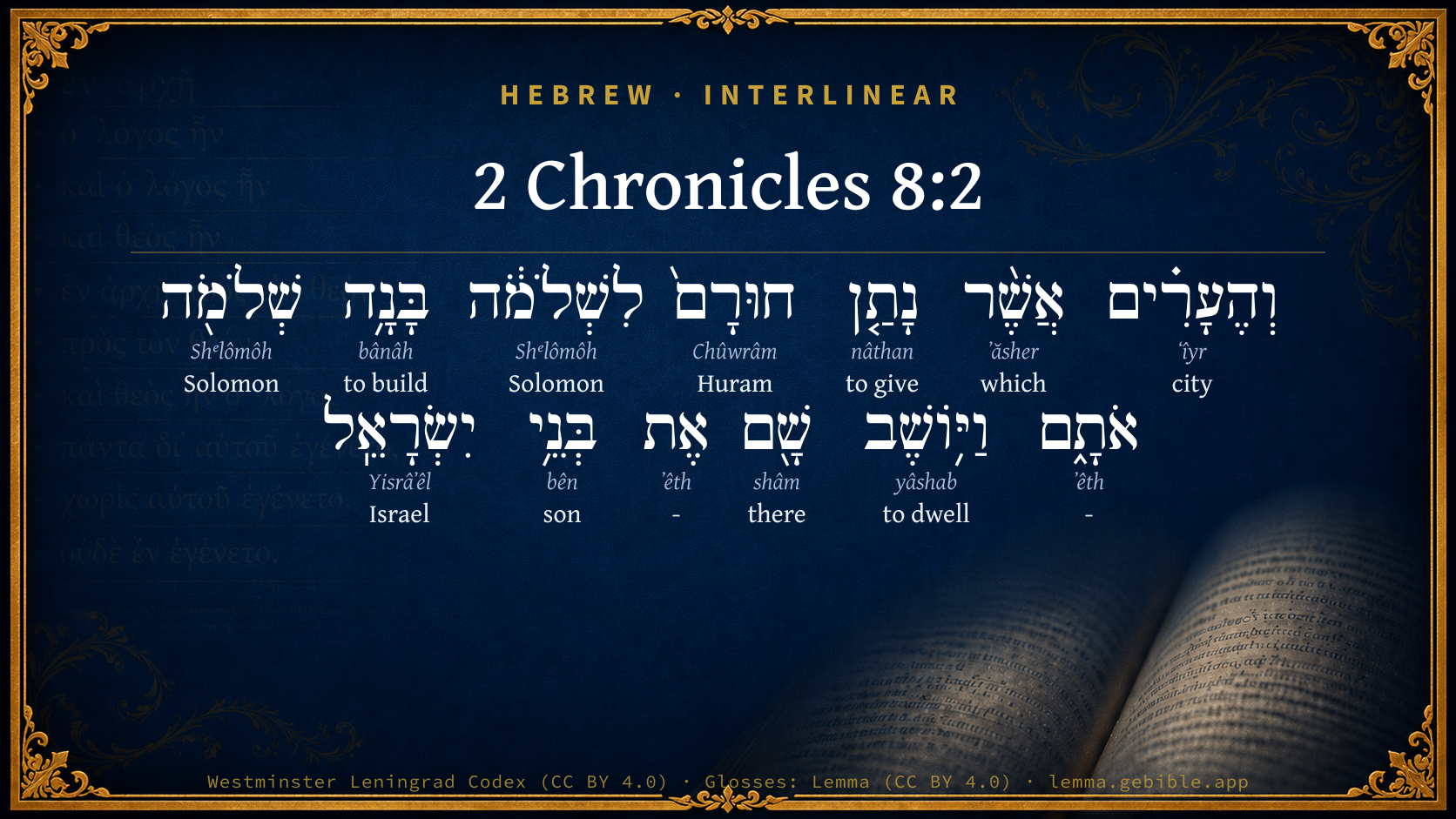
Hebrew (Westminster Leningrad Codex) 2 Chronicles 8:2 appears in the Hebrew Old Testament. The text above is from the Westminster Leningrad Codex. Each word links to its Strong’s number, a concise gloss, and parsing drawn from the Open Scriptures Hebrew Bible morphology. Click any word for its full Brown-Driver-Briggs (BDB) entry.
Download image
Cite this verse

2 Chronicles 8:2 (World English Bible). Public Domain. Lemma interlinear Bible study tool, https://lemma.gebible.app/v/2-chronicles/8/2.

Show BibTeX & RIS
BibTeX
RIS
English Translation
that the cities which Huram had given to Solomon, Solomon built them, and caused the children of Israel to dwell there.
World English Bible · Public Domain
Download a study sheet

One document with this verse’s original text, its word-by-word gloss line, the meaning frame, cross-references with their text, attributed commentary, and full source and license credits — printable, and it pastes into notes with its structure intact.

This verse Autodidact and up

Study sheet (.html) Plain text (.txt)

A passage Seminary Student

Up to 50 verses in one chapter. A passage sheet keeps up to 6 commentary sources and 12 cross-references per verse, in the order this page ranks them, and says so on the sheet whenever that leaves anything out. Ask for a single verse and you get the Autodidact verse sheet above.

Everything on this page stays free to read, with no account — the sheet is a download of what is already on screen, not access to it.

Want to remove ads? Support Godless Engineer
Compare translations 3

The same verse in 3 English versions, stacked beneath the original-language interlinear above. Click any original word for its lexicon entry.

Each is an independent rendering of the whole verse — the interlinear is not word-aligned to these translations.

Highlighted words mark where these versions differ — a whole-verse word diff, not a word-by-word alignment.

  • World English Bible Public Domain
    that the cities which Huram had given to Solomon, Solomon built them, and caused the children of Israel to dwell there.
  • King James Version Public Domain
    That the cities which Huram had restored to Solomon, Solomon built them, and caused the children of Israel to dwell there.
  • unfoldingWord Literal Text CC BY-SA 4.0
    and the cities which Huram gave to Solomon, Solomon built them. And he caused to dwell there the sons of Israel.

unfoldingWord Literal Text — © unfoldingWord, licensed CC BY-SA 4.0. Word-aligned USFM3 via Door43 (git.door43.org/unfoldingWord/en_ult).

Versions to compare (up to 4)

3 of 4 selected

Show all 18 translations

Every available English version of this verse, each an independent rendering of the whole verse.

  • World English Bible Public Domain
    that the cities which Huram had given to Solomon, Solomon built them, and caused the children of Israel to dwell there.
  • Berean Standard Bible Public Domain
    Solomon rebuilt the cities Hiram had given him and settled Israelites there.
  • Majority Standard Bible Public Domain
    Solomon rebuilt the cities Hiram had given him and settled Israelites there.
  • King James Version Public Domain
    That the cities which Huram had restored to Solomon, Solomon built them, and caused the children of Israel to dwell there.
  • American Standard Version (1901) Public Domain
    that the cities which Huram had given to Solomon, Solomon built them, and caused the children of Israel to dwell there.
  • Revised Version (1885) Public Domain
    that the cities which Huram had given to Solomon, Solomon built them, and caused the children of Israel to dwelt there.
  • Geneva Bible (1599) Public Domain
    Then Salomon built the cities that Huram gaue to Salomon, and caused the children of Israel to dwell there.
  • Douay-Rheims (1899) Public Domain
    He built the cities which Hiram had given to Solomon, and caused the children of Israel to dwell there.
  • Young's Literal Translation Public Domain
    As to the cities that Huram hath given to Solomon, Solomon hath built them, and there he causeth the sons of Israel to dwell.
  • Literal Standard Version CC BY-SA 4.0
    As for the cities that Huram has given to Solomon, Solomon has built them, and he causes the sons of Israel to dwell there.
  • Unlocked Literal Bible CC BY-SA 4.0
    that Solomon rebuilt the towns that Hiram had given to him, and he settled the people of Israel in them.
  • unfoldingWord Literal Text CC BY-SA 4.0
    and the cities which Huram gave to Solomon, Solomon built them. And he caused to dwell there the sons of Israel.
  • Darby Bible Public Domain
    that the cities which Huram had given to Solomon, Solomon built them and caused the children of Israel to dwell there.
  • World Messianic Bible Public Domain
    Solomon built the cities which Huram had given to Solomon, and caused the children of Israel to dwell there.
  • Webster's Bible Public Domain
    That the cities which Huram had restored to Solomon, Solomon built them, and caused the children of Israel to dwell there.
  • Free Bible Version CC BY-SA 4.0
    Solomon rebuilt the towns Hiram had given him, and sent Israelites to live there.
  • Bible in Basic English Public Domain
    He took in hand the building up of the towns which Huram had given him, causing the children of Israel to make living-places for themselves there.
  • JPS Tanakh (1917) Public Domain
    that the cities which Huram had given to Solomon, Solomon built them, and caused the children of Israel to dwell there.

Literal Standard Version (2020), Covenant Press — licensed CC BY-SA 4.0. Text via the HelloAO Bible API (eBible.org). Unlocked Literal Bible (unfoldingWord) — licensed CC BY-SA 4.0. Text via the HelloAO Bible API (eBible.org). unfoldingWord Literal Text — © unfoldingWord, licensed CC BY-SA 4.0. Word-aligned USFM3 via Door43 (git.door43.org/unfoldingWord/en_ult). Free Bible Version, Dr. Jonathan Gallagher — licensed CC BY-SA 4.0. Text via the HelloAO Bible API (eBible.org).

Word by word

More ways to search: Search by grammar → Find every occurrence → Compare this word →

Practice this passage: Drill this verse → Learn its vocabulary →

חוּרָם֙
Chûwrâm
H2361
“Huram”
Noun, Proper
Part of Speech
Noun
Type
Proper
Full BDB Definition

Origin: probably from H2353

TWOT: None

Huram = "noble born" - son of Bela and grandson of Benjamin - king of Tyre allied with David and Solomon; alternate spelling for 'Hiram' - a chief architect of Solomon's temple; alternate spelling for 'Hiram'
  1. וְהֶעָרִ֗ים ʻîyr H5892 “and · the · cities” Conjunction + Particle, Definite Article + Noun, Common, Feminine, Plural, Absolute
  2. אֲשֶׁ֨ר ʼăsher H834 “which” Particle, Relative
  3. נָתַ֤ן nâthan H5414 “to give” Verb, Qal, Perfect, 3rd Person, Masculine, Singular
  4. לִשְׁלֹמֹ֔ה Shᵉlômôh H8010 “to/for · Solomon” Preposition + Noun, Proper
  5. בָּנָ֥ה bânâh H1129 “to build” Verb, Qal, Perfect, 3rd Person, Masculine, Singular
  6. שְׁלֹמֹ֖ה Shᵉlômôh H8010 “Solomon” Noun, Proper
  7. אֹתָ֑ם ʼêth H853 “- · them” Particle, Direct Object + Suffix, Personal, 3rd Person, Masculine, Plural
  8. וַיּ֥וֹשֶׁב yâshab H3427 “and · to dwell” Conjunction + Verb, Hiphil, Sequential Imperfect, 3rd Person, Masculine, Singular
  9. שָׁ֖ם shâm H8033 “there” Adverb
  10. אֶת ʼêth H853 “-” Particle, Direct Object
  11. בְּנֵ֥י bên H1121 “sons of” Noun, Common, Masculine, Plural, Construct
  12. יִשְׂרָאֵֽל Yisrâʼêl H3478 “Israel” Noun, Proper

About this verse

These counts appear in no published source. They are computed here, from the morphology-tagged text and Lemma’s own curated glosses. What Lemma adds →

13
words
11
distinct lemmas
Historical
section

Notable vocabulary

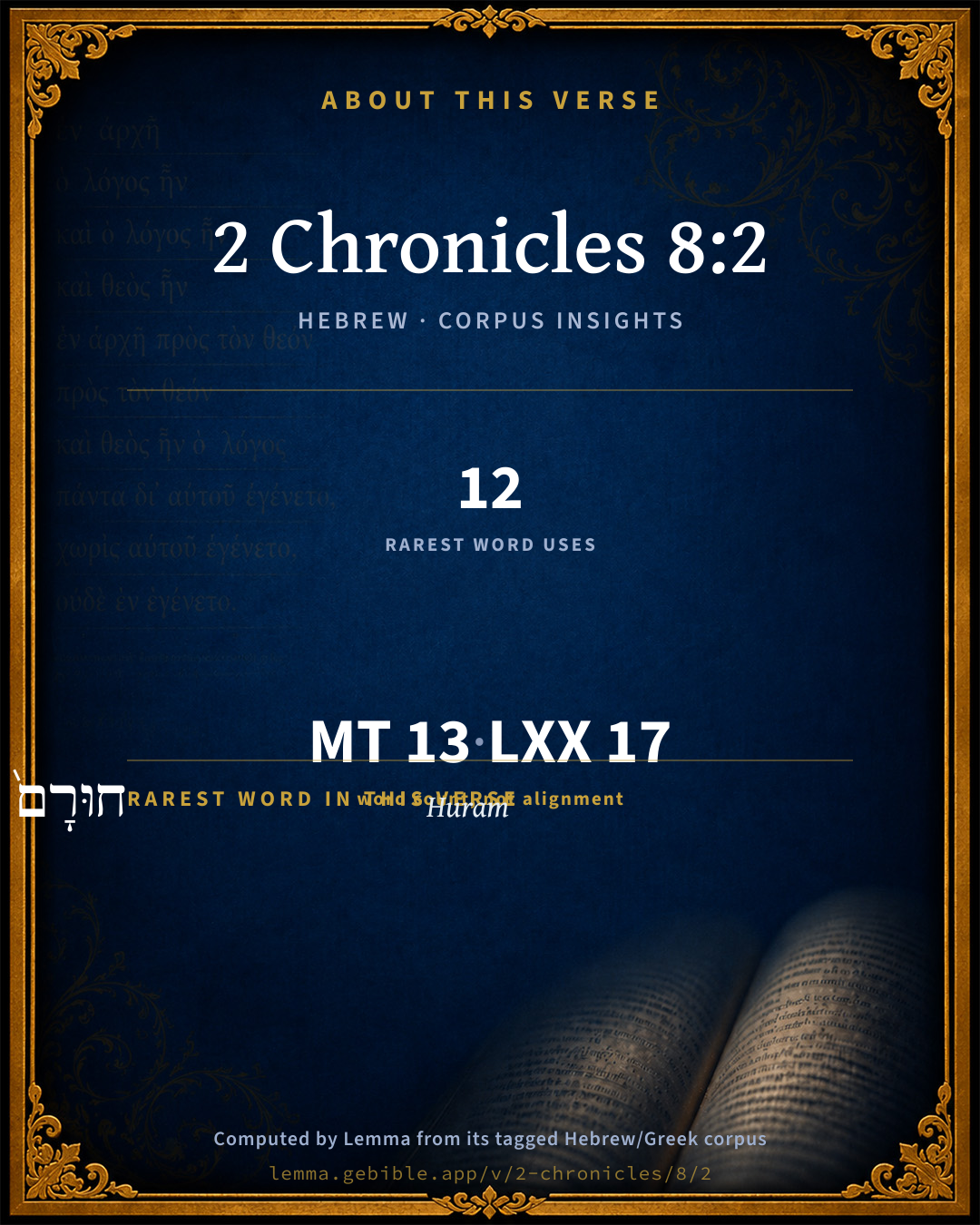
The rarest word here is חוּרָם֙ Huram H2361 — appearing just 12 times in the whole Hebrew Bible.

Shared distinctive vocabulary

חוּרָם֙ Huram H2361 occurs in 11 verses of the Hebrew Bible. Also found in:

Grammatical profile

  • 3 verbs
  • 6 nouns
  • 1 adverb
  • 3 particles

Verb forms

  • נָתַ֤ן Qal · Perfect
  • בָּנָ֥ה Qal · Perfect
  • וַיּ֥וֹשֶׁב Hiphil · Sequential Imperfect

Repetition

A word recurs within this verse — often emphatic in Hebrew:

  • לִשְׁלֹמֹ֔ה Solomon H8010 ×2

Hebrew & Septuagint length

In English translation the verse runs 21 words from the Hebrew and 21 from the Septuagint (LXX English) — the same length.

A rough comparison of the two English renderings, which tokenize alike — not a word-level alignment.

Word counts can differ between the Hebrew and the Greek without any difference in meaning — e.g. the Hebrew direct-object marker אֵת has no separate Greek word, and Greek often adds the article ὁ.

In the original languages it is 13 Hebrew tokens and 17 Greek tokens — but the two are counted differently (Hebrew bundles its prefixes and suffixes into one token; the Greek is in lemma form), so that isn’t a like-for-like length.

Cross-references

1

Topical passages linked to 2 Chronicles 8:2 in the Treasury of Scripture Knowledge — connected by theme and wording, ordered by reader-vote popularity; previews shown in the World English Bible.

  • 1 Kings 9:11–18 (now Hiram the king of Tyre had furnished Solomon with cedar trees and fir trees, and with gold, according to all his desire), that then king Solomon gave Hiram twenty cities in the land of Galilee.

Cross-references courtesy of OpenBible.info (CC BY 4.0).

Hebrew and Greek witnesses Masoretic Hebrew ↔ Greek Septuagint

The same verse in the two great witnesses to the Old Testament, shown verse-for-verse.

These are two independent witnesses, not word-aligned to each other, and the Septuagint is shown in lemma (dictionary) form.

Hebrew 2 Chronicles 8:2 Masoretic · Westminster Leningrad Codex

וְהֶעָרִ֗ים אֲשֶׁ֨ר נָתַ֤ן חוּרָם֙ לִשְׁלֹמֹ֔ה בָּנָ֥ה שְׁלֹמֹ֖ה אֹתָ֑ם וַיּ֥וֹשֶׁב שָׁ֖ם אֶת בְּנֵ֥י יִשְׂרָאֵֽל

that the cities which Huram had given to Solomon, Solomon built them, and caused the children of Israel to dwell there.

World English Bible · Public Domain

Greek LXX 2 Chronicles 8:2 Septuagint · lemma form

καί ὁ πόλις ὅς δίδωμι χιραμ ὁ σαλωμών οἰκοδομέω αὐτός σαλωμών καί καταοἰκίζω ἐκεῖ ὁ υἱός ἰσραήλ

that Solomon rebuilt the cities which Chiram had given to Solomon, and caused the children of Israel to dwell in them.

LXX2012 (modern English Septuagint) · Public Domain

Hebrew: Westminster Leningrad Codex (CC BY 4.0). Greek: Septuagint (public domain); English from LXX2012 (modern English Septuagint) (Public Domain). How the Septuagint differs from the Hebrew →

Commentary

Notes on 2 Chronicles 8:2 from classic Christian and Jewish commentators (each source and its license shown beneath its notes). The classic Christian expositions comment on the surrounding passage and are grouped to its opening verse, so a note may address several verses; the Jewish commentaries on the Tanakh (Rashi and others) are per-verse, so they appear only where the commentator wrote on this verse.

Lemma curates 59 commentaries, every one of them public domain or Creative Commons licensed, each selected and text-cleaned for this edition rather than reprinted as found. About our sources →

Trapp's Complete Commentary

John Trapp

2Ch 8:2 That the cities which Huram had restored to Solomon, Solomon built them, and caused the children of Israel to dwell there.

Ver. 2. Which Huram had restored.] Out of dislike of them. {1Ki 9:12} Or, Which Huram had given to Solomon, that by exchange of courtesies their love might increase.

John Trapp, A Commentary or Exposition upon All the Books of the Old and New Testament (1647–1656) — public domain. Text from a community e-Sword module.

Tyndale Open Study Notes

Tyndale Open Resources

8:2 The twenty towns that Solomon had given Hiram in exchange for gold were unsatisfactory to Hiram (1 Kgs 9:11-14); this implies that Hiram gave them back to Solomon, who apparently provided other compensation.

Tyndale Open Study Notes — © Tyndale Open Resources, licensed CC BY-SA 4.0. Text via the HelloAO Bible API.

Geneva Bible (1599)

Geneva Bible translators

That is, which Hiram gave again to Solomon because they pleased him not: and therefore called them Cabul, that is, dirt or filth, 1 Kings 9:13.

Geneva Bible (1599) marginal notes — public domain. Text via Bolls.life.

Adam Clarke's Commentary

Verse 2. The cities which Huram had restored] 1Kg 9:11.

Adam Clarke's Commentary on the Bible (1810–1826) — public domain. Text from a community e-Sword/MySword module.

Ellicott's Commentary for English Readers

(2) Which Huram had restored.—Literally, which Huram gave.

Solomon built them.—Rebuilt or restored and fortified (Jos_6:26; 1Ki_15:17). The parallel passage (1Ki_9:11-13) records a contrary transaction; that is to say, it represents Solomon as giving to Huram twenty cities in Galilee, as a return for his past services. It is added that these cities did not please Huram, in consequence of which they got the name of “The Land of Kâbûl” (i.e., “Like-nought”). The Authorised Version here assumes that the explanation of Josephus (Antt. viii. 5, § 3) is correct. That writer states that Huram restored the despised cities to Solomon, who thereupon repaired them, and peopled them with Israelites. Others assume an exchange of friendly gifts between the two sovereigns; so that Solomon gave Huram twenty Israelite cities (Kings), and Huram gave Solomon twenty Phenician cities (Chronicles): this seems highly improbable. The former explanation appears to be substantially correct. The chronicler, or the authority which he follows here. has omitted to notice a fact which seems to derogate from the greatness of Solomon, viz., the previous surrender of the territory in question to the Tyrian king; and has chosen to speak of Huram’s non-acceptance or return of Solomon’s present, as a gift. He then goes on to tell of the future fate of the twenty cities. Solomon repaired or fortified them, and colonised them with Israelites; for this border-land was chiefly inhabited by Gentiles (Isa_9:1, “Galilee of the Gentiles”). A border-land is naturally more exposed to the ravages of an invader; and the cities which Solomon ceded to Huram may have been in a half-ruinous condition. This would account for Huram’s disappointment in them. The statement of our text, then, is neither an “effacement,” nor a “travesty” (Reuss), nor even a “remodelling” of that of the older text “in favour of Solomon” (Zöckler). It replaces the older text by another statement which is equally true, and not incompatible with it.

A Bible Commentary for English Readers, edited by Charles John Ellicott (1878–1897) — public domain. Text from a community e-Sword module.

The Cambridge Bible for Schools and Colleges

gen. ed. J. J. S. Perowne

2. the cities which Huram had restored to Solomon,] R.V. the cities which Huram had given to Solomon. According to 1Ki_9:12-13 it was Solomon who gave Huram cities. Huram however was not pleased with them (ibid.), and from this fact the English translators of 1611 concluded that Huram rejected them and “restored” them. Probably however Kin. and Chron. follow different traditions with regard to these border cities, and no reconciliation is possible.

built them] i.e. fortified them.

The Cambridge Bible for Schools and Colleges (gen. ed. J. J. S. Perowne; Cambridge University Press, 1878–1918) — public domain. Text from a community e-Sword module.

John Gill's Exposition

And Solomon went to Hamathzobah,.... In an hostile manner, which is the only instance of any warlike expedition of Solomon's. This was Coelesyria, which though subdued in the times of David, perhaps rebelled, and now Solomon went forth to reduce it:

and prevailed against it; took it.

John Gill's Exposition of the Whole Bible (1746–1763) — public domain (CC PDM 1.0). Text via the HelloAO Bible API.

Albert Barnes' Notes on the Bible

The cities which Huram had restored to Solomon - These cities had not been mentioned previously by the writer of Chronicles, who, however, seems to assume that the fact of their having been given by Hiram to Solomon is known to his readers. See 1Ki 9:11-13.

Albert Barnes' Notes on the Bible (1834–1885) — public domain. Text from a community e-Sword/MySword module.

Haydock's Catholic Bible Commentary

Given back (Tirinus) as he refused to accept of the present. Some think that (Calmet) Hiram gave these cities in exchange for the others. (Salien) (Menochius)

George Leo Haydock (1774–1849), Haydock's Catholic Family Bible and Commentary, 1859 edition — public domain. Excludes Psalms (Douay-Rheims chapter numbering differs from Protestant) and Deuterocanonical books (Catholic canon only).

Matthew Poole's English Annotations

Which Huram had restored to Solomon; which Solomon gave to Huram, who not being pleased with them, 1Ki 9:12,13, here returns them to him again.

Matthew Poole's English Annotations on the Holy Bible (1683–1685) — public domain. Text from a community e-Sword/MySword module.

The Pulpit Commentary

The cities which Huram had restored to Solomon. Kings 9:11 explains the force of the word "restored" here, telling how it was Hiram had come by "twenty cities in the land of Galilee" by way of payment, or part payment, for the "cedar," "fir," and "gold" which he had given Solomon. It is evident that these cities were in need of repair; possibly they had not been previously in the occupation of the Israelites; if they had been, the transaction was scarcely legitimate on the part of Solomon, (Lev_25:12-33) and we may suppose they had become largely deserted when made over to Hiram. It would not, however, be necessary to suppose either that Solomon had given them because they were poor property in his eyes, or that Hiram, whose good will and generous disposition are elsewhere specially notified, had returned them as a thankless gift or as a bad payment, but for the language of vers. 12, 13, (1Ki 9) which distinctly tells us that when Hiram inspected them they did "not please him," and that he named them "the land of Oabul" (see Dr. Smith"s "Bible Dictionary," 1. p. 237). The probability is that, as cities on the borderland, they were what had been at present unoccupied by Israelites, were all the likelier in bad repair, and, unvalued by Hiram, were, when put into good repair by Solomon, such that Solomon might justly cause the children of Israel to dwell in them.

The Pulpit Commentary (1880–1919), ed. H.D.M. Spence-Jones & Joseph S. Exell — public domain. Text from a community e-Sword module.

Lesson kit

Teaching starters — assembled from the data on this page, not authored interpretation. Every prompt links to the verse data it draws on. Edit before teaching.

2 Chronicles, in the Historical, opens this verse with 13 words (11 distinct Hebrew lemmas). Its most distinctive word is Chûwrâm (“Huram”). A historical commentator’s framing appears above. Read the whole chapter for the surrounding context.

Discussion questions

  1. What does “Huram” (Chûwrâm) contribute to the verse as a whole?
  2. 1 Chronicles 8:5 shares the word «Huram» with this verse. How do the two illuminate each other?
  3. “Solomon” occurs 2× in this one verse. What is the effect of the repetition?
  4. The translations on this page render this verse differently — a whole-verse word diff, not a word-by-word alignment. What might account for the different wordings?
  5. The verb «נָתַ֤ן» is Qal Perfect. How does its form color the action?
  6. Reading how Trapp's Complete Commentary and Tyndale Open Study Notes read this verse, where do the two commentators agree and where do they part?

Things to notice

Reading settings

Reading text

Shown beneath each verse's original-language words.

Old Testament
Old Testament edition

Read the OT as the Masoretic Hebrew (MT) or the Greek Septuagint (LXX).

English shown for the Greek Septuagint (in the Hebrew ↔ Greek comparison).

Comparing translations? Open the Compare panel on any verse page to stack up to four side by side.