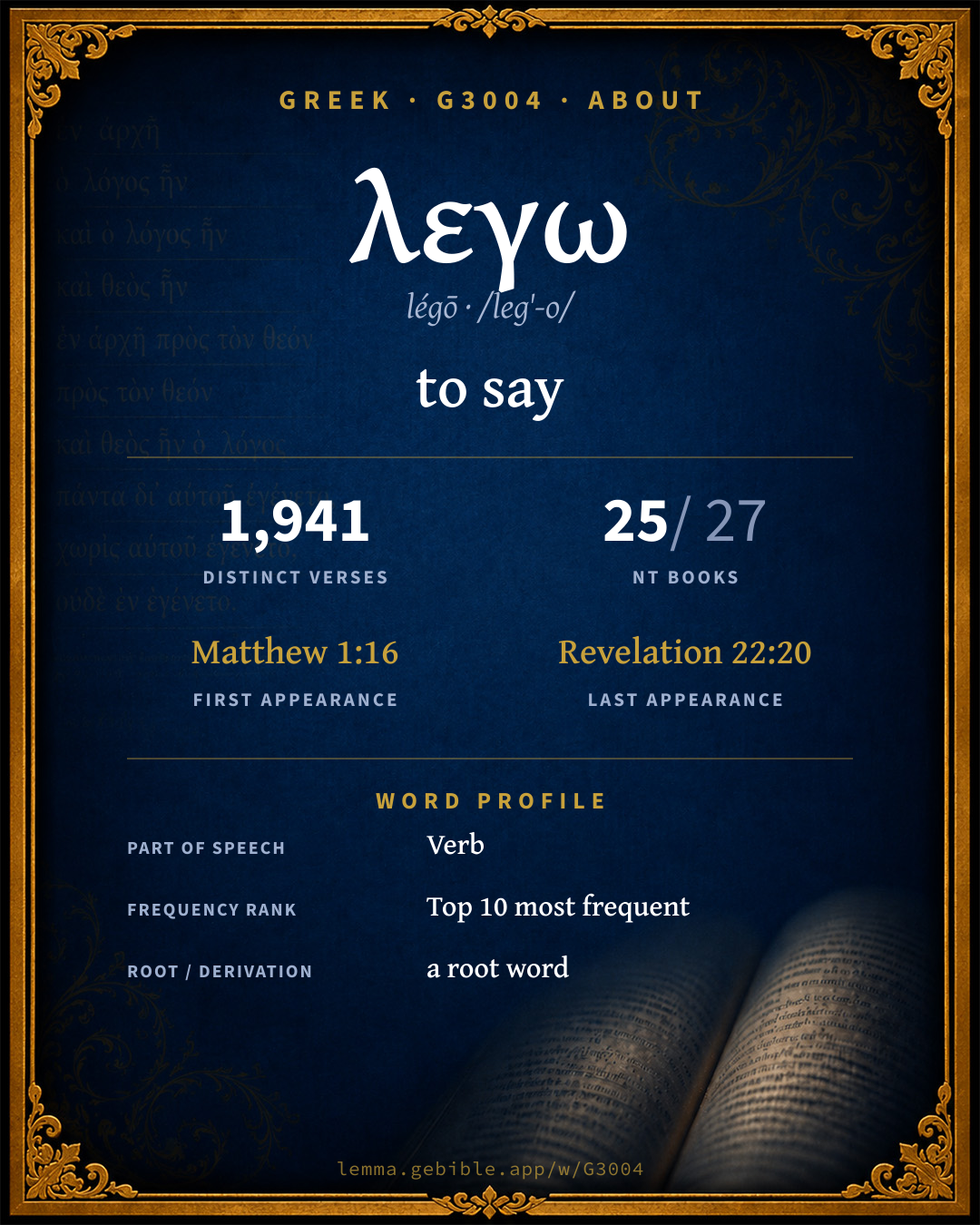
λέγω
to say
‘to say’ is one of 6 main senses fuller range ↓
Full lexicon entry — Thayer's Greek Lexicon
From Thayer's Greek Lexicon
Where this word appears
See every Aorist-tense verb in the Greek New Testament →
Grammar key — what these labels mean
Part of speech
- Verb
- An action or state-of-being word.
Tense
- Aorist
- Action viewed as a simple whole, without regard to duration — often past (perfective aspect).
- Present
- Ongoing or general action in present time (imperfective aspect).
- Imperfect
- Continuous or repeated action in past time (“was writing”).
Voice
- Active
- The subject performs the action.
- Passive
- The subject receives the action.
Mood
- Indicative
- States a fact or asks a factual question (the mood of reality).
- Participle
- A verbal adjective (“writing,” “having written”).
- Infinitive
- A verbal noun (“to write”), unmarked for person or number.
- Subjunctive
- Expresses probability, purpose, or possibility (the mood of contingency).
- Imperative
- Expresses a command or request.
Case
- Nominative
- The case of the subject (and the predicate nominative).
- Genitive
- The case of source, possession, or “of” — answers “whose / from what.”
- Accusative
- The case of the direct object and of extent.
- Dative
- The case of the indirect object, means, or location — “to / for / with / in.”
Person
- 3rd person
- The one spoken about (“he / she / it / they”).
- 1st person
- The speaker (“I / we”).
- 2nd person
- The one addressed (“you”).
Gender
- Masculine
- Grammatically masculine.
- Feminine
- Grammatically feminine.
- Neuter
- Grammatically neuter.
Number
- Singular
- One.
- Plural
- More than one.
Page 2 of 2 — showing verses 201–271 of 271 distinct verses where G3004 appears in the Aorist tense in the Book of Luke. Filtered view — show all forms. Click any verse to open its interlinear word-by-word view. Verse text shown in the World English Bible for context — . Each verse’s Greek form is shown with its reference; the English is not keyword-highlighted, since the data carries no word-level English alignment. Use “Compare translations” on any verse to read it across multiple English versions. This concordance covers the Greek New Testament; Septuagint (Greek Old Testament) occurrences of this word are not indexed here.
Luke
- Luke 19:24 εἶπεν aor act ind 3sg He said to those who stood by, 'Take the mina away from him, and give it to him who has the ten minas.'
- Luke 19:25 εἶπαν aor act ind 3pl "They said to him, 'Lord, he has ten minas!'
- Luke 19:28 εἰπὼν aor act ptcp nom sg masc Having said these things, he went on ahead, going up to Jerusalem.
- Luke 19:30 εἰπών aor act ptcp nom sg masc saying, "Go your way into the village on the other side, in which, as you enter, you will find a colt tied, whereon no man ever yet sat. Untie it, and bring it.
- Luke 19:32 εἶπεν aor act ind 3sg Those who were sent went away, and found things just as he had told them.
- Luke 19:33 εἶπαν aor act ind 3pl As they were untying the colt, the owners of it said to them, "Why are you untying the colt?"
- Luke 19:34 εἶπαν aor act ind 3pl They said, "The Lord needs it."
- Luke 19:39 εἶπαν aor act ind 3pl Some of the Pharisees from the multitude said to him, "Teacher, rebuke your disciples!"
- Luke 19:40 εἶπεν λέγω aor act ind 3sg pres act ind 1sg He answered them, "I tell you that if these were silent, the stones would cry out."
- Luke 20:2 εἶπαν λέγοντες εἰπὸν aor act ind 3pl pres act ptcp nom pl masc aor act impv 2sg They asked him, "Tell us: by what authority do you do these things? Or who is giving you this authority?"
- Luke 20:3 εἶπεν εἴπατέ aor act ind 3sg aor act impv 2pl He answered them, "I also will ask you one question. Tell me:
- Luke 20:5 λέγοντες εἴπωμεν pres act ptcp nom pl masc aor act subj 1pl They reasoned with themselves, saying, "If we say, 'From heaven,' he will say, 'Why didn't you believe him?'
- Luke 20:6 εἴπωμεν aor act subj 1pl But if we say, 'From men,' all the people will stone us, for they are persuaded that John was a prophet."
- Luke 20:8 εἶπεν λέγω aor act ind 3sg pres act ind 1sg Jesus said to them, "Neither will I tell you by what authority I do these things."
- Luke 20:13 εἶπεν aor act ind 3sg The lord of the vineyard said, 'What shall I do? I will send my beloved son. It may be that seeing him, they will respect him.'
- Luke 20:16 εἶπαν aor act ind 3pl He will come and destroy these farmers, and will give the vineyard to others." When they heard it, they said, "May it never be!"
- Luke 20:17 εἶπεν aor act ind 3sg But he looked at them, and said, "Then what is this that is written, 'The stone which the builders rejected, The same was made the chief cornerstone?'
- Luke 20:19 εἶπεν aor act ind 3sg The chief priests and the scribes sought to lay hands on Him that very hour, but they feared the people--for they knew He had spoken this parable against them.
- Luke 20:23 εἶπεν aor act ind 3sg But he perceived their craftiness, and said to them, "Why do you test me?
- Luke 20:24 εἶπαν aor act ind 3pl Show me a denarius. Whose image and inscription are on it?" They answered, "Caesar's."
- Luke 20:25 εἶπεν aor act ind 3sg He said to them, "Then give to Caesar the things that are Caesar's, and to God the things that are God's."
- Luke 20:34 εἶπεν aor act ind 3sg Jesus said to them, "The children of this age marry, and are given in marriage.
- Luke 20:39 εἶπαν εἶπας aor act ind 3pl aor act ind 2sg Some of the scribes answered, "Teacher, you speak well."
- Luke 20:41 Εἶπεν λέγουσιν aor act ind 3sg pres act ind 3pl He said to them, "Why do they say that the Christ is David's son?
- Luke 20:42 λέγει εἶπεν pres act ind 3sg aor act ind 3sg David himself says in the book of Psalms, 'The Lord said to my Lord, "Sit at my right hand,
- Luke 20:45 εἶπεν aor act ind 3sg In the hearing of all the people, he said to his disciples,
- Luke 21:3 εἶπεν λέγω aor act ind 3sg pres act ind 1sg He said, "Truly I tell you, this poor widow put in more than all of them,
- Luke 21:5 λεγόντων εἶπεν pres act ptcp gen pl masc aor act ind 3sg As some were talking about the temple and how it was decorated with beautiful stones and gifts, he said,
- Luke 21:8 εἶπεν λέγοντες aor act ind 3sg pres act ptcp nom pl masc He said, "Watch out that you don't get led astray, for many will come in my name, saying, 'I AM,' and, 'The time is at hand.' Therefore don't follow them.
- Luke 21:29 εἶπεν aor act ind 3sg He told them a parable. "See the fig tree, and all the trees.
- Luke 22:8 εἰπών aor act ptcp nom sg masc He sent Peter and John, saying, "Go and prepare the Passover for us, that we may eat."
- Luke 22:9 εἶπαν aor act ind 3pl They said to him, "Where do you want us to prepare?"
- Luke 22:10 εἶπεν aor act ind 3sg He said to them, "Behold, when you have entered into the city, a man carrying a pitcher of water will meet you. Follow him into the house which he enters.
- Luke 22:15 εἶπεν aor act ind 3sg He said to them, "I have earnestly desired to eat this Passover with you before I suffer,
- Luke 22:17 εἶπεν aor act ind 3sg He received a cup, and when he had given thanks, he said, "Take this, and share it among yourselves,
- Luke 22:25 εἶπεν aor act ind 3sg He said to them, "The kings of the Gentiles lord it over them, and those who have authority over them are called 'benefactors.'
- Luke 22:33 εἶπεν aor act ind 3sg He said to him, "Lord, I am ready to go with you both to prison and to death!"
- Luke 22:34 εἶπεν λέγω aor act ind 3sg pres act ind 1sg He said, "I tell you, Peter, the rooster will by no means crow today until you deny that you know me three times."
- Luke 22:35 εἶπεν εἶπαν aor act ind 3sg aor act ind 3pl He said to them, "When I sent you out without purse, and wallet, and shoes, did you lack anything?" They said, "Nothing."
- Luke 22:36 εἶπεν aor act ind 3sg Then he said to them, "But now, whoever has a purse, let him take it, and likewise a wallet. Whoever has none, let him sell his cloak, and buy a sword.
- Luke 22:38 εἶπαν εἶπεν aor act ind 3pl aor act ind 3sg They said, "Lord, behold, here are two swords." He said to them, "That is enough."
- Luke 22:40 εἶπεν aor act ind 3sg When he was at the place, he said to them, "Pray that you don't enter into temptation."
- Luke 22:46 εἶπεν aor act ind 3sg and said to them, "Why do you sleep? Rise and pray that you may not enter into temptation."
- Luke 22:48 εἶπεν aor act ind 3sg But Jesus said to him, "Judas, do you betray the Son of Man with a kiss?"
- Luke 22:49 εἶπαν aor act ind 3pl When those who were around him saw what was about to happen, they said to him, "Lord, shall we strike with the sword?"
- Luke 22:51 εἶπεν aor act ind 3sg But Jesus answered, "Let me at least do this"--and he touched his ear, and healed him.
- Luke 22:52 εἶπεν aor act ind 3sg Jesus said to the chief priests, captains of the temple, and elders, who had come against him, "Have you come out as against a robber, with swords and clubs?
- Luke 22:56 εἶπεν aor act ind 3sg A certain servant girl saw him as he sat in the light, and looking intently at him, said, "This man also was with him."
- Luke 22:60 εἶπεν λέγεις aor act ind 3sg pres act ind 2sg But Peter said, "Man, I don't know what you are talking about!" Immediately, while he was still speaking, a rooster crowed.
- Luke 22:61 εἶπεν aor act ind 3sg The Lord turned, and looked at Peter. Then Peter remembered the Lord's word, how he said to him, "Before the rooster crows you will deny me three times."
- Luke 22:66 λέγοντες εἰπὸν pres act ptcp nom pl masc aor act impv 2sg As soon as it was day, the assembly of the elders of the people was gathered together, both chief priests and scribes, and they led him away into their council, saying,
- Luke 22:67 εἶπεν εἴπω aor act ind 3sg aor act subj 1sg "If you are the Christ, tell us." But he said to them, "If I tell you, you won't believe,
- Luke 22:70 εἶπαν λέγετε aor act ind 3pl pres act ind 2pl They all said, "Are you then the Son of God?" He said to them, "You say it, because I AM."
- Luke 22:71 εἶπαν aor act ind 3pl They said, "Why do we need any more witness? For we ourselves have heard from his own mouth!"
- Luke 23:4 εἶπεν aor act ind 3sg Pilate said to the chief priests and the multitudes, "I find no basis for a charge against this man."
- Luke 23:14 εἶπεν aor act ind 3sg and said to them, "You brought this man to me as one that perverts the people, and see, I have examined him before you, and found no basis for a charge against this man concerning those things of which you accuse him.
- Luke 23:22 εἶπεν aor act ind 3sg He said to them the third time, "Why? What evil has this man done? I have found no capital crime in him. I will therefore chastise him and release him."
- Luke 23:28 εἶπεν aor act ind 3sg But Jesus, turning to them, said, "Daughters of Jerusalem, don't weep for me, but weep for yourselves and for your children.
- Luke 23:43 εἶπεν λέγω aor act ind 3sg pres act ind 1sg Jesus said to him, "Assuredly I tell you, today you will be with me in Paradise."
- Luke 23:46 εἶπεν εἰπὼν aor act ind 3sg aor act ptcp nom sg masc Jesus, crying with a loud voice, said, "Father, into your hands I commit my spirit!" Having said this, he breathed his last.
- Luke 24:5 εἶπαν aor act ind 3pl Becoming terrified, they bowed their faces down to the earth. They said to them, "Why do you seek the living among the dead?
- Luke 24:17 εἶπεν aor act ind 3sg He said to them, "What are you talking about as you walk, and are sad?"
- Luke 24:18 εἶπεν aor act ind 3sg One of them, named Cleopas, answered him, "Are you the only stranger in Jerusalem who doesn't know the things which have happened there in these days?"
- Luke 24:19 εἶπεν εἶπαν aor act ind 3sg aor act ind 3pl He said to them, "What things?" They said to him, "The things concerning Jesus, the Nazarene, who was a prophet mighty in deed and word before God and all the people;
- Luke 24:24 εἶπον aor act ind 3pl Some of us went to the tomb, and found it just like the women had said, but they didn't see him."
- Luke 24:25 εἶπεν aor act ind 3sg He said to them, "Foolish men, and slow of heart to believe in all that the prophets have spoken!
- Luke 24:32 εἶπαν aor act ind 3pl They said one to another, "Weren't our hearts burning within us, while he spoke to us along the way, and while he opened the Scriptures to us?"
- Luke 24:38 εἶπεν aor act ind 3sg He said to them, "Why are you troubled? Why do doubts arise in your hearts?
- Luke 24:41 εἶπεν aor act ind 3sg While they still didn't believe for joy, and wondered, he said to them, "Do you have anything here to eat?"
- Luke 24:44 Εἶπεν aor act ind 3sg He said to them, "This is what I told you, while I was still with you, that all things which are written in the law of Moses, the prophets, and the psalms, concerning me must be fulfilled."
- Luke 24:46 εἶπεν aor act ind 3sg He said to them, "Thus it is written, and thus it was necessary for the Christ to suffer and to rise from the dead the third day,
About this entry
At a glance — auto-summarized from this page’s data, not written by a person. Every figure links to its source below. This summary describes the numbers; it doesn’t interpret them.
At its core, λεγω (légō) means “to say.” The King James Version usually renders it “saying,” while modern versions prefer “i tell” (Berean Standard Bible) and “said” (unfoldingWord Literal Text) — see the renderings breakdown. Spanning 1,941 verses in 25 books, it ranks among the most common words of the Greek New Testament. Scripture first uses it in Matthew 1:16. Catalogued under 6 senses, its meaning is not single-sense. Each statement above links to its evidence; the full detail follows below.
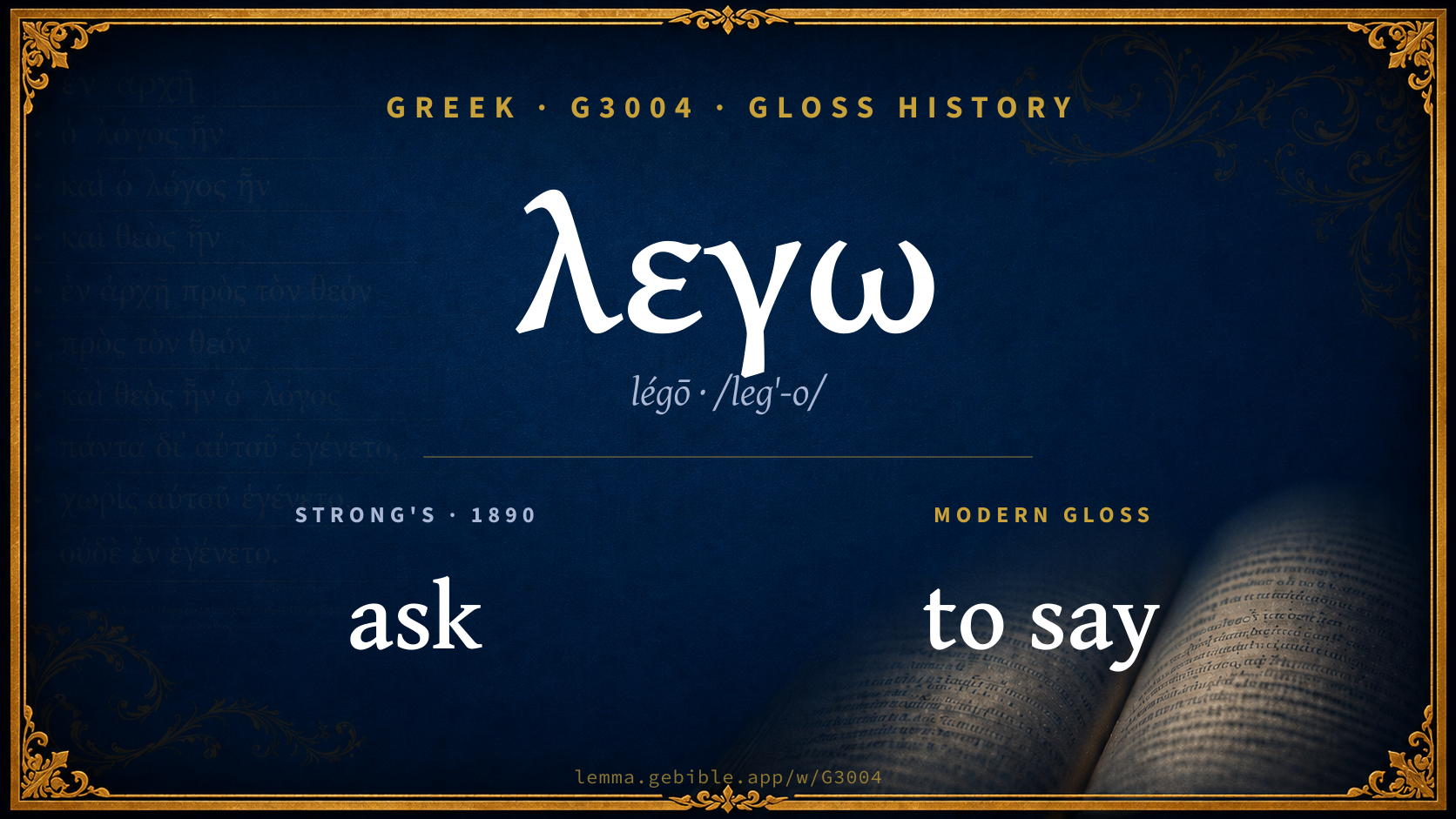
Gloss history
Strong's 1890 vs modern scholarship
About this word
Strong's G3004 catalogs a Greek word from the Greek New Testament.
These counts are not copied from any lexicon or concordance. They are computed here, from the morphology-tagged Greek New Testament. What Lemma adds →
- 1,941
- distinct verses
- The word appears in 1,941 distinct verses.
- 25 / 27
- NT books
- The word appears in 25 of 27 New Testament books.
- #7
- by frequency
- Top 10 most frequent Greek words (rank 7 of 5,347 Greek words by occurrence).
View all 1,941 occurrences in the concordance →
By section of the New Testament
By traditional corpus
Conventional, traditional groupings — biblical authorship is debated, so this is a traditional corpus grouping, not an authorship claim. Some books belong to more than one corpus (Luke is in both the Gospels and the Lukan corpus, and so on), so these shares overlap and need not total 100%. Each figure is a share of the word’s 1,941 distinct verses.
- Gospels 1,468 verses · 76%
- Lukan (Luke–Acts) 649 verses · 33%
- Johannine 488 verses · 25%
- Pauline corpus 108 verses · 6%
- Revelation 94 verses · 5%
- Hebrews 37 verses · 2%
- General (Catholic) Epistles 24 verses · 1%
How translations render this word
Counts come from each version’s own published word-to-Strong’s tagging or interlinear alignment — an approximate guide to how each version renders this word, not a word-level alignment the data otherwise carries. Because each total is that version’s own tagged count, the per-version totals vary from one another and need not match the appearance or distinct-verse counts above. These counts may also differ from a printed concordance because Lemma counts each distinctly tagged rendering and does not collapse phrase taggings into a single head-word total. This is a fixed set of word-tagged versions (KJV, ASV, BSB, ULT) and does not change with the reading translation you choose elsewhere. Each version’s license is shown beside its name below (and on Sources).
- King James Version: Saying 384×, Saith 199×, I say 158×
- American Standard Version: Saying 322×, Saith 207×, I say 143×
- Berean Standard Bible: I tell 142×, Said 123×, Saying 63×
- unfoldingWord Literal Text: Said 556×, Saying 410×, Says 225×
King James Version Public Domain
Renders G3004 across 1,349 tagged occurrences — most commonly:
Plus other, less common renderings. Plus 58 renderings that appear only once — usually multi-word phrases or single function words the recovered tagging swept in, not distinct renderings.
American Standard Version Public Domain
Renders G3004 across 1,274 tagged occurrences — most commonly:
Plus other, less common renderings. Plus 97 renderings that appear only once — usually multi-word phrases or single function words the recovered tagging swept in, not distinct renderings. Not rendered by a distinct English word in 5 further occurrences.
Berean Standard Bible Public Domain
Renders G3004 across 993 tagged occurrences — most commonly:
Plus other, less common renderings. Plus 108 renderings that appear only once — usually multi-word phrases or single function words the recovered tagging swept in, not distinct renderings. Not rendered by a distinct English word in 179 further occurrences.
unfoldingWord Literal Text CC BY-SA 4.0
Renders G3004 across 2,448 tagged occurrences — most commonly:
Plus other, less common renderings. Plus 104 renderings that appear only once — usually multi-word phrases or single function words the recovered tagging swept in, not distinct renderings.
Senses in Thayer's
The 6 senses Thayer's distinguishes for this word, in lexicon order (not ranked by frequency or importance). The full entry — with sub-senses — is in the Lexicon Entry tab.
- affirm over, maintain
- to teach
- to exhort, advise, to command, direct
- to point out with words, intend, mean, mean to say
- to call by name, to call, name
- to speak out, speak of, mention
Word origin
Origin: a root word
A primary verb; properly to lay forth that is (figuratively) relate (in words [usually of systematic or set discourse ; whereas G2036 and G5346 generally refer to an individual expression or speech respectively; while G4483 is properly to break silence merely and G2980 means an extended or random harangue]); by implication to mean : - ask bid boast call describe give out name put forth say (-ing on) shew speak tell utter.
— Strong’s Exhaustive Concordance (1890), public domain.
Forms in the corpus
The 85 distinct written forms G3004 takes in the Greek New Testament, most frequent first — each parse links to that tense’s occurrences in the concordance.
The 60 most common forms are shown; 25 rarer forms follow in the full concordance.
Same root — word family
Other Thayer's entries built from the same root as G3004, grouped by Strong’s listed origin. These share a root / origin per the lexicon — not necessarily a shared meaning. Each links to that word’s own entry.
Derived from this word
Compare all same-root words → They share a root, not necessarily a meaning.
Septuagint usage
The same Greek word λεγω appears 5,715 times in the Greek Old Testament (Septuagint), across 4,644 verses in 38 books.
- 5,715
- LXX occurrences
- Tagged occurrences of this Greek word in the Septuagint.
- 4,644
- verses
- Distinct Septuagint verses containing this word.
- 38 / 39
- OT books
- The word appears in 38 of the 39 Old Testament books.
Sample Septuagint occurrences
- Genesis 1:3 εἶπον
- Exodus 1:9 εἶπον
- Leviticus 1:1 λέγω
- Numbers 1:1 λέγω
- Deuteronomy 1:5 λέγω
- Joshua 1:1 εἶπον
- Judges 1:1 λέγω
- Ruth 1:8 εἶπον
- 1 Samuel 1:8 εἶπον
- 2 Samuel 1:3 εἶπον
- 1 Kings 1:2 εἶπον
- 2 Kings 1:2 εἶπον
Septuagint occurrences (same lexeme)
Every verse where the same Strong’s number (G3004) appears in the Greek Septuagint — showing the first 50 of 4,644. Verse text shown in the World English Bible for context; the Greek form is the matched word — the English is not keyword-highlighted.
- Genesis 1:3 εἶπον God said, "Let there be light," and there was light.
- Genesis 1:6 εἶπον God said, "Let there be an expanse in the midst of the waters, and let it divide the waters from the waters."
- Genesis 1:9 εἶπον God said, "Let the waters under the sky be gathered together to one place, and let the dry land appear," and it was so.
- Genesis 1:11 εἶπον God said, "Let the earth put forth grass, herbs yielding seed, and fruit trees bearing fruit after their kind, with its seed in it, on the earth," and it was so.
- Genesis 1:14 εἶπον God said, "Let there be lights in the expanse of sky to divide the day from the night; and let them be for signs, and for seasons, and for days and years;
- Genesis 1:20 εἶπον God said, "Let the waters swarm with swarms of living creatures, and let birds fly above the earth in the open expanse of sky."
- Genesis 1:22 λέγω God blessed them, saying, "Be fruitful, and multiply, and fill the waters in the seas, and let birds multiply on the earth."
- Genesis 1:24 εἶπον God said, "Let the earth bring forth living creatures after their kind, cattle, creeping things, and animals of the earth after their kind," and it was so.
- Genesis 1:26 εἶπον God said, "Let us make man in our image, after our likeness: and let them have dominion over the fish of the sea, and over the birds of the sky, and over the cattle, and over all the earth, and over every creeping thing that creeps on the earth."
- Genesis 1:28 λέγω God blessed them. God said to them, "Be fruitful, multiply, fill the earth, and subdue it. Have dominion over the fish of the sea, over the birds of the sky, and over every living thing that moves on the earth."
- Genesis 1:29 εἶπον God said, "Behold, I have given you every herb yielding seed, which is on the surface of all the earth, and every tree, which bears fruit yielding seed. It will be your food.
- Genesis 2:16 λέγω Yahweh God commanded the man, saying, "Of every tree of the garden you may freely eat:
- Genesis 2:18 εἶπον Yahweh God said, "It is not good that the man should be alone; I will make him a helper suitable for him."
- Genesis 2:23 εἶπον The man said, "This is now bone of my bones, and flesh of my flesh. She will be called Woman, because she was taken out of Man."
- Genesis 3:1 εἶπον Now the serpent was more subtle than any animal of the field which Yahweh God had made. He said to the woman, "Yes, has God said, 'You shall not eat of any tree of the garden?'"
- Genesis 3:2 εἶπον The woman said to the serpent, "Of the fruit of the trees of the garden we may eat,
- Genesis 3:3 εἶπον but of the fruit of the tree which is in the midst of the garden, God has said, 'You shall not eat of it, neither shall you touch it, lest you die.'"
- Genesis 3:4 εἶπον The serpent said to the woman, "You won't surely die,
- Genesis 3:9 εἶπον Yahweh God called to the man, and said to him, "Where are you?"
- Genesis 3:10 εἶπον The man said, "I heard your voice in the garden, and I was afraid, because I was naked; and I hid myself."
- Genesis 3:11 εἶπον God said, "Who told you that you were naked? Have you eaten from the tree that I commanded you not to eat from?"
- Genesis 3:12 εἶπον The man said, "The woman whom you gave to be with me, she gave me of the tree, and I ate."
- Genesis 3:13 εἶπον Yahweh God said to the woman, "What is this you have done?" The woman said, "The serpent deceived me, and I ate."
- Genesis 3:14 εἶπον Yahweh God said to the serpent, "Because you have done this, cursed are you above all cattle, and above every animal of the field. On your belly shall you go, and you shall eat dust all the days of your life.
- Genesis 3:16 εἶπον To the woman he said, "I will greatly multiply your pain in childbirth. In pain you will bring forth children. Your desire will be for your husband, and he will rule over you."
- Genesis 3:17 εἶπον To Adam he said, "Because you have listened to your wife's voice, and have eaten of the tree, of which I commanded you, saying, 'You shall not eat of it,' cursed is the ground for your sake. In toil you will eat of it all the days of your life.
- Genesis 3:22 εἶπον Yahweh God said, "Behold, the man has become like one of us, knowing good and evil. Now, lest he put forth his hand, and also take of the tree of life, and eat, and live forever..."
- Genesis 4:1 εἶπον The man knew Eve his wife. She conceived, and gave birth to Cain, and said, "I have gotten a man with Yahweh's help."
- Genesis 4:6 εἶπον Yahweh said to Cain, "Why are you angry? Why has the expression of your face fallen?
- Genesis 4:8 εἶπον Cain said to Abel, his brother, "Let's go into the field." It happened, when they were in the field, that Cain rose up against Abel, his brother, and killed him.
- Genesis 4:9 εἶπον Yahweh said to Cain, "Where is Abel, your brother?" He said, "I don't know. Am I my brother's keeper?"
- Genesis 4:10 εἶπον Yahweh said, "What have you done? The voice of your brother's blood cries to me from the ground.
- Genesis 4:13 εἶπον Cain said to Yahweh, "My punishment is greater than I can bear.
- Genesis 4:15 εἶπον Yahweh said to him, "Therefore whoever slays Cain, vengeance will be taken on him sevenfold." Yahweh appointed a sign for Cain, lest any finding him should strike him.
- Genesis 4:23 εἶπον Lamech said to his wives, "Adah and Zillah, Hear my voice, You wives of Lamech, listen to my speech, For I have slain a man for wounding me, A young man for bruising me.
- Genesis 4:25 λέγω Adam knew his wife again. She gave birth to a son, and named him Seth. For, she said, "God has appointed me another child instead of Abel, for Cain killed him."
- Genesis 5:29 λέγω and he named him Noah, saying, "This same will comfort us in our work and in the toil of our hands, because of the ground which Yahweh has cursed."
- Genesis 6:3 εἶπον Yahweh said, "My Spirit will not strive with man forever, because he also is flesh; yet will his days be one hundred twenty years."
- Genesis 6:7 εἶπον Yahweh said, "I will destroy man whom I have created from the surface of the ground; man, along with animals, creeping things, and birds of the sky; for I am sorry that I have made them."
- Genesis 6:13 εἶπον God said to Noah, "The end of all flesh has come before me, for the earth is filled with violence through them. Behold, I will destroy them with the earth.
- Genesis 7:1 εἶπον Yahweh said to Noah, "Come with all of your household into the ark, for I have seen your righteousness before me in this generation.
- Genesis 8:15 εἶπονλέγω God spoke to Noah, saying,
- Genesis 8:21 εἶπον Yahweh smelled the sweet savor. Yahweh said in his heart, "I will not again curse the ground any more for man's sake, because the imagination of man's heart is evil from his youth; neither will I ever again strike everything living, as I have done.
- Genesis 9:1 εἶπον God blessed Noah and his sons, and said to them, "Be fruitful, and multiply, and replenish the earth.
- Genesis 9:8 εἶπονλέγω God spoke to Noah, and to his sons with him, saying,
- Genesis 9:12 εἶπον God said, "This is the token of the covenant which I make between me and you and every living creature that is with you, for perpetual generations:
- Genesis 9:17 εἶπον God said to Noah, "This is the token of the covenant which I have established between me and all flesh that is on the earth."
- Genesis 9:25 εἶπον He said, "Cursed be Canaan; A servant of servants will he be to his brothers."
- Genesis 9:26 εἶπον He said, "Blessed be Yahweh, the God of Shem; Let Canaan be his servant.
- Genesis 10:9 εἶπον He was a mighty hunter before Yahweh. Therefore it is said, "Like Nimrod, a mighty hunter before Yahweh."
These are occurrences of the same Greek lexeme (G3004) in the Septuagint — not a translation of any one Hebrew word. The store carries no word-level Hebrew↔Greek alignment, so no Hebrew original is asserted here. Counts come from the recovered LXX Strong's tagging — high-frequency vocabulary is well covered, while rare or late forms may be untagged — so they reflect tagged occurrences and may slightly undercount.