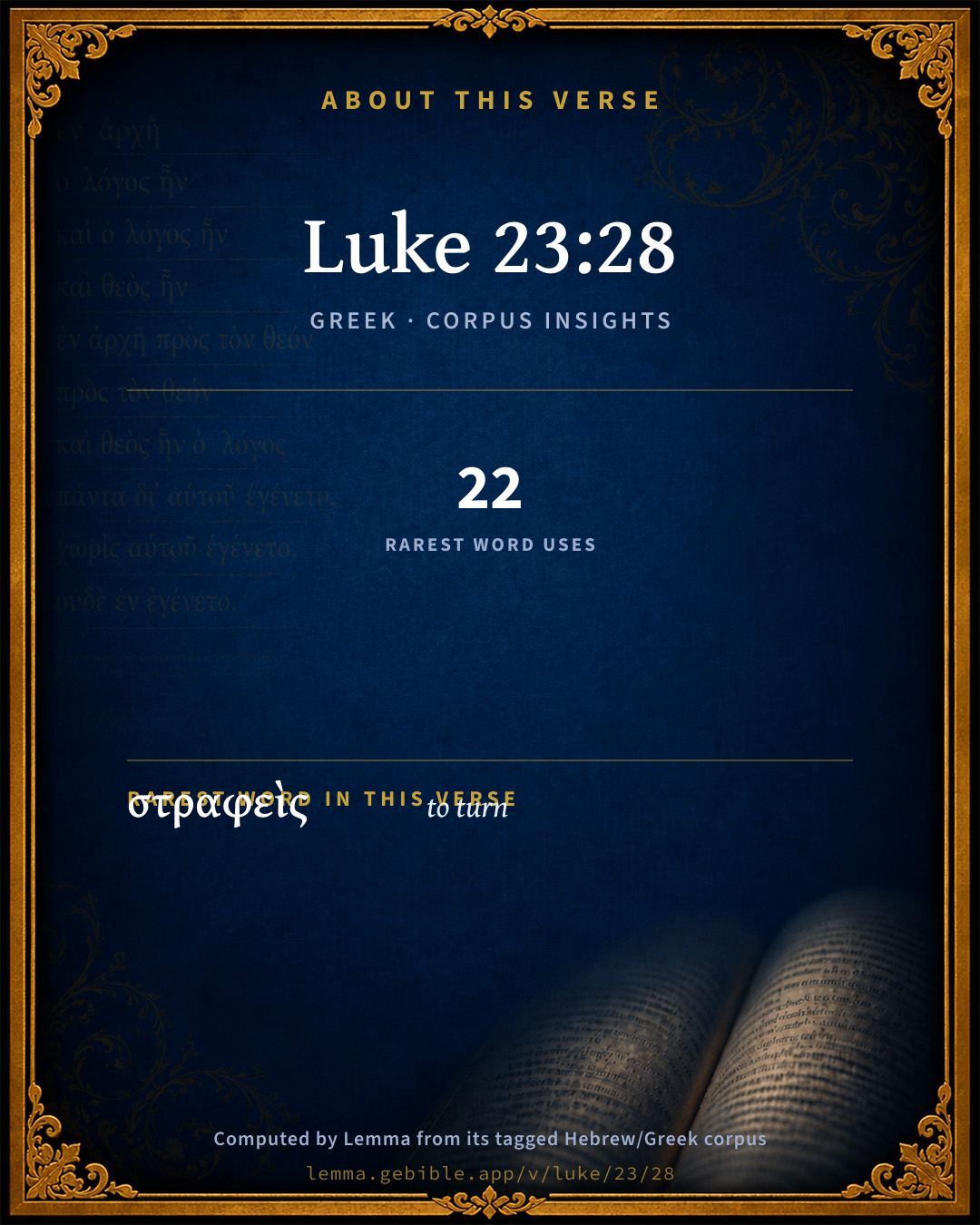
Luke 23:28

Greek (Tischendorf 8th ed.) Luke 23:28 appears in the Greek New Testament. The text above is from the Tischendorf 8th edition. Each word links to its Strong’s number and a concise gloss. Click any word for its full Thayer’s Greek Lexicon entry.
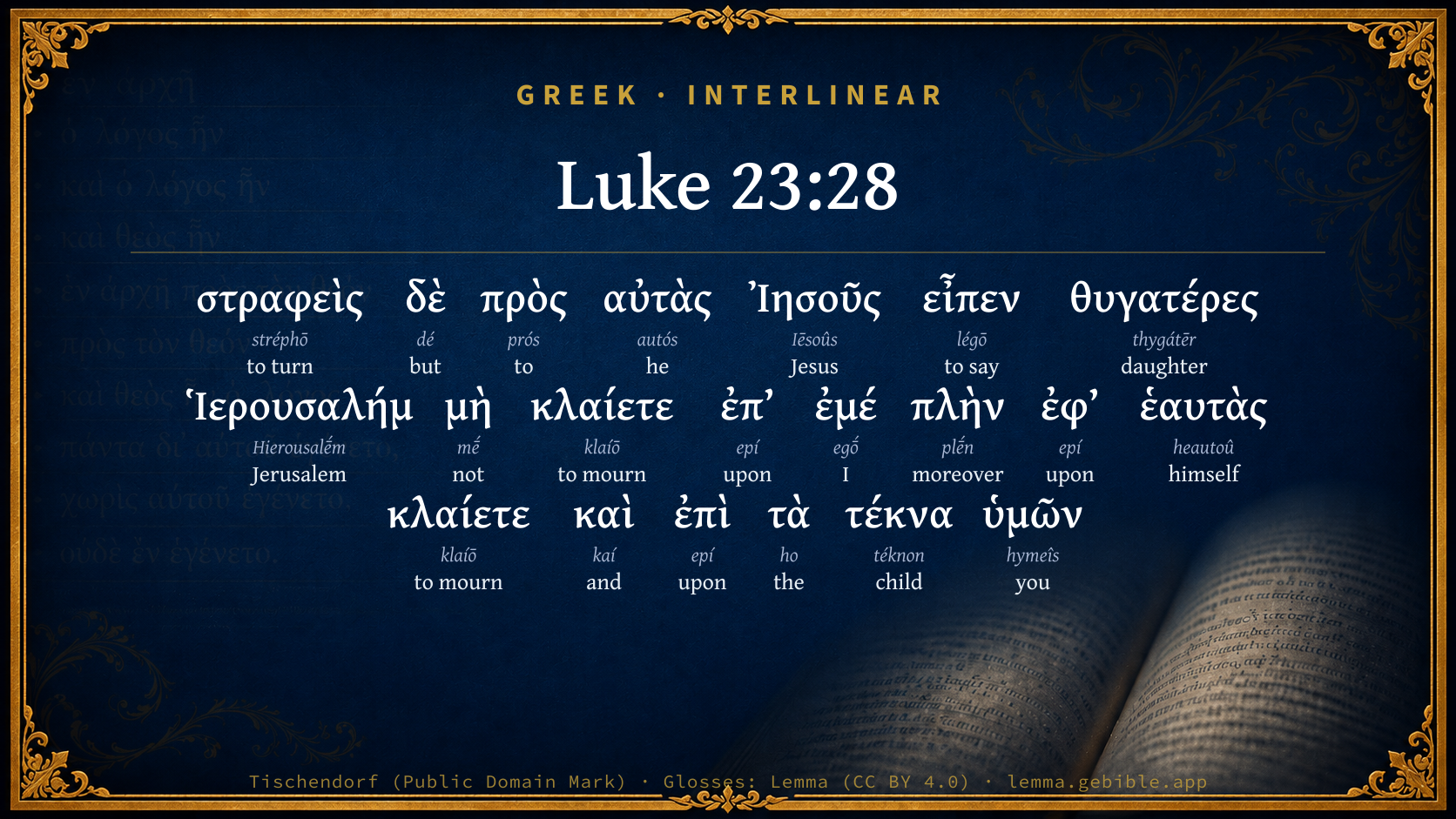
Download image
Cite this verse

Luke 23:28 (World English Bible). Public Domain. Lemma interlinear Bible study tool, https://lemma.gebible.app/v/luke/23/28.

Show BibTeX & RIS
BibTeX
RIS
English Translation
But Jesus, turning to them, said, "Daughters of Jerusalem, don't weep for me, but weep for yourselves and for your children.
World English Bible · Public Domain
Download a study sheet

One document with this verse’s original text, its word-by-word gloss line, the meaning frame, cross-references with their text, attributed commentary, and full source and license credits — printable, and it pastes into notes with its structure intact.

This verse Autodidact and up

Study sheet (.html) Plain text (.txt)

A passage Seminary Student

Up to 50 verses in one chapter. A passage sheet keeps up to 6 commentary sources and 12 cross-references per verse, in the order this page ranks them, and says so on the sheet whenever that leaves anything out. Ask for a single verse and you get the Autodidact verse sheet above.

Everything on this page stays free to read, with no account — the sheet is a download of what is already on screen, not access to it.

Want to remove ads? Support Godless Engineer
Compare translations 3

The same verse in 3 English versions, stacked beneath the original-language interlinear above. Click any original word for its lexicon entry.

Each is an independent rendering of the whole verse — the interlinear is not word-aligned to these translations.

Highlighted words mark where these versions differ — a whole-verse word diff, not a word-by-word alignment.

  • World English Bible Public Domain
    But Jesus, turning to them, said, "Daughters of Jerusalem, don't weep for me, but weep for yourselves and for your children.
  • King James Version Public Domain
    But Jesus turning unto them said, Daughters of Jerusalem, weep not for me, but weep for yourselves, and for your children.
  • unfoldingWord Literal Text CC BY-SA 4.0
    But turning to them, Jesus said, “Daughters of Jerusalem, do not weep for me, but weep for yourselves and for your children.

unfoldingWord Literal Text — © unfoldingWord, licensed CC BY-SA 4.0. Word-aligned USFM3 via Door43 (git.door43.org/unfoldingWord/en_ult).

Versions to compare (up to 4)

3 of 4 selected

Show all 19 translations

Every available English version of this verse, each an independent rendering of the whole verse.

  • World English Bible Public Domain
    But Jesus, turning to them, said, "Daughters of Jerusalem, don't weep for me, but weep for yourselves and for your children.
  • Berean Standard Bible Public Domain
    But Jesus turned to them and said, “Daughters of Jerusalem, do not weep for Me, but weep for yourselves and for your children.
  • Majority Standard Bible Public Domain
    But Jesus turned to them and said, “Daughters of Jerusalem, do not weep for Me, but weep for yourselves and for your children.
  • King James Version Public Domain
    But Jesus turning unto them said, Daughters of Jerusalem, weep not for me, but weep for yourselves, and for your children.
  • American Standard Version (1901) Public Domain
    But Jesus turning unto them said, Daughters of Jerusalem, weep not for me, but weep for yourselves, and for your children.
  • Revised Version (1885) Public Domain
    But Jesus turning unto them said, Daughters of Jerusalem, weep not for me, but weep for yourselves, and for your children.
  • Geneva Bible (1599) Public Domain
    But Iesus turned backe vnto them, and said, Daughters of Hierusalem, weepe not for me, but weepe for your selues, and for your children.
  • Douay-Rheims (1899) Public Domain
    But Jesus turning to them, said: Daughters of Jerusalem, weep not over me; but weep for yourselves, and for your children.
  • Young's Literal Translation Public Domain
    and Jesus having turned unto them, said, `Daughters of Jerusalem, weep not for me, but for yourselves weep ye, and for your children;
  • Literal Standard Version CC BY-SA 4.0
    and Jesus having turned to them, said, “Daughters of Jerusalem, do not weep for Me, but weep for yourselves and for your children;
  • Unlocked Literal Bible CC BY-SA 4.0
    But turning to them, Jesus said, “Daughters of Jerusalem, do not weep for me, but weep for yourselves and for your children.
  • unfoldingWord Literal Text CC BY-SA 4.0
    But turning to them, Jesus said, “Daughters of Jerusalem, do not weep for me, but weep for yourselves and for your children.
  • Darby Bible Public Domain
    And Jesus turning round to them said, Daughters of Jerusalem, do not weep over me, but weep over yourselves and over your children;
  • World Messianic Bible Public Domain
    But Yeshua, turning to them, said, “Daughters of Jerusalem, don’t weep for me, but weep for yourselves and for your children.
  • Webster's Bible Public Domain
    But Jesus turning to them, said, Daughters of Jerusalem, weep not for me, but weep for yourselves, and for your children.
  • Free Bible Version CC BY-SA 4.0
    Jesus turned to them and said, “Daughters of Jerusalem, don't weep for me. Weep for yourselves and your children.
  • Bible in Basic English Public Domain
    But Jesus, turning to them, said, Daughters of Jerusalem, let not your weeping be for me, but for yourselves and for your children.
  • Text-Critical English NT CC BY 4.0
    But Jesus turned to them and said, “Daughters of Jerusalem, do not weep for me, but weep for yourselves and for your children.
  • Tyndale New Testament (1534) Public Domain
    But Iesus turned backe vnto them and sayde: Doughters of Ierusalem, wepe not for me: but wepe for youre selves and for youre chyldren.

Literal Standard Version (2020), Covenant Press — licensed CC BY-SA 4.0. Text via the HelloAO Bible API (eBible.org). Unlocked Literal Bible (unfoldingWord) — licensed CC BY-SA 4.0. Text via the HelloAO Bible API (eBible.org). unfoldingWord Literal Text — © unfoldingWord, licensed CC BY-SA 4.0. Word-aligned USFM3 via Door43 (git.door43.org/unfoldingWord/en_ult). Free Bible Version, Dr. Jonathan Gallagher — licensed CC BY-SA 4.0. Text via the HelloAO Bible API (eBible.org).

Word by word

More ways to search: Search by grammar → Find every occurrence → Compare this word →

Practice this passage: Drill this verse → Learn its vocabulary →

στραφεὶς
stréphō
G4762
“to turn”
Verb, Aorist, Passive, Participle, Nominative, Singular, Masculine
Part of Speech
Verb
Tense
Aorist
Voice
Passive
Mood
Participle
Case
Nominative
Number
Singular
Gender
Masculine
Full Thayer's Definition

Origin: strengthened from the base of G5157

TDNT: 18:54,1

1. to turn, turn around 2. to turn one's self (i.e. to turn the back to one a. of one who no longer cares for another) b. metaph. to turn one's self from one's course of conduct, i.e. to change one's mind
  1. δὲ dé G1161 “but” Conjunction
  2. πρὸς prós G4314 “to” Preposition
  3. αὐτὰς autós G846 “he” Personal pronoun, Accusative, Plural, Feminine
  4. Ἰησοῦς Iēsoûs G2424 “Jesus” Noun, Nominative, Singular, Masculine
  5. εἶπεν légō G3004 “to say” Verb, Aorist, Active, Indicative, 3rd person, Singular
  6. θυγατέρες thygátēr G2364 “daughter” Noun, Vocative, Plural, Feminine
  7. Ἱερουσαλήμ Hierousalḗm G2419 “Jerusalem” Noun, Proper, indeclinable
  8. μὴ mḗ G3361 “not” Particle, Negative
  9. κλαίετε klaíō G2799 “to mourn” Verb, Present, Active, Imperative, 2nd person, Plural
  10. ἐπ’ epí G1909 “upon” Preposition
  11. ἐμέ egṓ G1473 “I” Personal pronoun, 1st person, Accusative, Singular
  12. πλὴν plḗn G4133 “moreover” Adverb
  13. ἐφ’ epí G1909 “upon” Preposition
  14. ἑαυτὰς heautoû G1438 “himself” Reflexive pronoun, 2nd person, Accusative, Plural, Feminine
  15. κλαίετε klaíō G2799 “to mourn” Verb, Present, Active, Imperative, 2nd person, Plural
  16. καὶ kaí G2532 “and” Conjunction
  17. ἐπὶ epí G1909 “upon” Preposition
  18. τὰ ho G3588 “the” Article, Accusative, Plural, Neuter
  19. τέκνα téknon G5043 “child” Noun, Accusative, Plural, Neuter
  20. ὑμῶν hymeîs G5210 “you” Personal pronoun, 2nd person, Genitive, Plural

About this verse

These counts appear in no published source. They are computed here, from the morphology-tagged text and Lemma’s own curated glosses. What Lemma adds →

21
words
18
distinct lemmas
Gospels
section

Notable vocabulary

The rarest word here is στραφεὶς to turn G4762 — appearing just 22 times in the whole Greek New Testament.

Shared distinctive vocabulary

στραφεὶς to turn G4762 occurs in 22 verses of the Greek New Testament. Also found in:

Repetition

Words recur within this verse:

  • ἐπ’ upon G1909 ×3
  • κλαίετε to mourn G2799 ×2

Cross-references

7

Topical passages linked to Luke 23:28 in the Treasury of Scripture Knowledge — connected by theme and wording, ordered by reader-vote popularity; previews shown in the World English Bible.

  • Song of Solomon 8:4 I adjure you, daughters of Jerusalem, That you not stir up, nor awaken love, Until it so desires. Friends
  • Song of Solomon 1:5 I am dark, but lovely, You daughters of Jerusalem, Like Kedar's tents, Like Solomon's curtains.
  • Song of Solomon 2:7 I adjure you, daughters of Jerusalem, By the roes, or by the hinds of the field, That you not stir up, nor awaken love, Until it so desires.
  • Song of Solomon 3:5 I adjure you, daughters of Jerusalem, By the roes, or by the hinds of the field, That you not stir up, nor awaken love, Until it so desires.
  • Song of Solomon 3:10 He made its pillars of silver, Its bottom of gold, its seat of purple, Its midst being paved with love, From the daughters of Jerusalem.
  • Song of Solomon 5:8 I adjure you, daughters of Jerusalem, If you find my beloved, That you tell him that I am faint with love. Friends
  • Song of Solomon 5:16 His mouth is sweetness; Yes, he is altogether lovely. This is my beloved, and this is my friend, Daughters of Jerusalem. Friends

Cross-references courtesy of OpenBible.info (CC BY 4.0).

Commentary

Notes on Luke 23:28 from classic Christian and Jewish commentators (each source and its license shown beneath its notes). The classic Christian expositions comment on the surrounding passage and are grouped to its opening verse, so a note may address several verses; the Jewish commentaries on the Tanakh (Rashi and others) are per-verse, so they appear only where the commentator wrote on this verse.

Lemma curates 59 commentaries, every one of them public domain or Creative Commons licensed, each selected and text-cleaned for this edition rather than reprinted as found. About our sources →

Joseph Benson's Commentary

Luk 23:28-29. But Jesus turning, said, &c. — Jesus, who ever felt the woes of others more than he did his own, forgetting his distress at the very time that it lay heaviest upon him, turned about, and with a benevolence and tenderness truly divine, said to them, Daughters of Jerusalem, weep not for me, &c. — Not that they were to be blamed for weeping for him, but commended rather: those hearts were hard indeed, that were not affected with such sufferings of such a person; but he bids them weep not only for him, but also and especially for themselves, and for their children, namely, because of the destruction that was coming upon Jerusalem, which some of them would probably live to see, and share in the calamities thereof; or at least their children would, for whom it behooved them to be solicitous. For the days are coming in which they shall say, Blessed are the barren, &c. — As if he had said, “The calamities about to fall on you and your children are most terrible, and call for the bitterest lamentations; for in those days of vengeance you will vehemently wish that you had not given birth to a generation whose wickedness has rendered them objects of the divine wrath to a degree that never was experienced in the world before. And the thoughts of those calamities afflict my soul far more than the feeling of my own sufferings.” These words sufficiently imply that the days of distress and misery were coming, and would fall on them and on their children; which indeed they did in a most awful manner; though at that time there was not any appearance of such an immediate ruin: nor would the wisest politician have inferred it from the present state of affairs. The prediction was especially fulfilled during that grievous famine which so miserably afflicted Jerusalem during the siege. For, as Josephus reports, (Bell., Luk 5:10,) mothers snatched the food from their infants out of their very mouths: and again, in another place, (Bell., Luk 5:12,) the houses were full of women and children, who perished by famine. But Josephus relates a still more horrid story, which our Lord, with his spirit of prophecy, had probably in view. He says, (Bell., Luk 6:3,) “There was one Mary, the daughter of Eleazer, illustrious for her family and riches. She, having been stripped and plundered of all her substance and provisions by the soldiers, out of necessity and fury killed her own sucking child, and having boiled him, devoured half of him, and covering up the rest, preserved it for another time. The soldiers soon came, allured by the smell of victuals, and threatened to kill her immediately if she would not produce what she had dressed. But she replied, that she had preserved a good part for them, and uncovered the relict of her son. Dread and astonishment seized them, and they stood stupified at the sight. ‘But this,’ said she, ‘is my own son, and this my work. Eat, for even I have eaten. Be not you more tender than a woman, nor more compassionate than a mother. But, if you have a religious abhorrence of my victim, I truly have eaten half; and let the rest remain for me.’ They went away trembling, fearful to do this one thing; and hardly left this food for the mother. The whole city was struck with horrors” says the historian, “at this wickedness; and they were pronounced blessed, who died before they had heard or seen such great evils.”

Joseph Benson's Commentary on the Old and New Testaments (1811–1818) — public domain. Text from a community e-Sword module.

Tyndale Open Study Notes

Tyndale Open Resources

23:28 Jesus warned of the horrors that would come to Jerusalem during its siege and destruction in AD 70.

Tyndale Open Study Notes — © Tyndale Open Resources, licensed CC BY-SA 4.0. Text via the HelloAO Bible API.

Bengel's Gnomon

Johann Albrecht Bengel

Luk 23:28. [Μὴ—ἐπʼ ἐμὲ, not—concerning Me) Already every moment Jesus was more and more directing His thoughts towards the coming glory. In the way that is pointed out in Zec 12:10, He does not forbid their ‘mourning’ for Him (but only in the way that they were now mourning for Him, viz. as if He and His cause were crushed for ever; whereas He and it were near their glorious triumph).—V. g.]—ἐφʼ ἑαυτὰς—καὶ ἐπὶ τὰ τέκνα ὑμῶν—ἰδοὺ, concerning yourselves—and concerning your children—behold) It is hereby indicated that the punishment about to be inflicted is near at hand. [Indeed that calamity was impending especially over the infants, and yet not so as that the women also who were lamenting Jesus could not live long enough to reach it.—Harm., p. 561.] Jesus Himself too wept for the city, and not for Himself. See ch. Luk 19:41, Luk 18:31-32. [How many men and women there are, who might, if they would, find no want of altogether serious causes for deploring their own state, but who devote the present day to careless security!—V. g.]

Bengel's Gnomon of the New Testament — English translation (T&T Clark, Edinburgh, 1860) — public domain. Text from a community e-Sword module.

Expositor's Greek Testament

ed. W. Robertson Nicoll

Luk 23:28 . ἐπʼ ἐμέ , ἐφʼ ἑαυτὰς are brought close together to emphasise the contrast = weep not for me , but for yourselves weep, hinting at the tragedies of Jerusalem’s fatal day. At such times the greatest joy, that of motherhood, is turned into the greatest misery (Holtzmann, H. C.). The mothers ever have the worst of it (J. Weiss in Meyer).

The Expositor's Greek Testament, edited by W. Robertson Nicoll (1897–1910) — public domain. Text from a community e-Sword module.

Jamieson, Fausset & Brown

Robert Jamieson, A. R. Fausset & David Brown

not for me, &c.--noble spirit of compassion, rising above His own dread endurances, in tender commiseration of sufferings yet in the distance and far lighter, but without His supports and consolations!

Jamieson, Fausset & Brown — Commentary Critical and Explanatory on the Whole Bible (1871) — public domain (CC PDM 1.0). Text via the HelloAO Bible API.

Adam Clarke's Commentary

Verse 28. Weep not for me] Many pious persons have been greatly distressed in their minds, because they could not weep on reading or hearing of the sufferings of Christ. For the relief of all such, let it be for ever known that no human spirit can possibly take any part in the passion of the Messiah. His sufferings were such as only God manifested in the flesh could bear; and, as they were all of an expiatory nature, no man can taste of or share in them. Besides, the sufferings of Christ are not a subject of sorrow to any man; but, on the contrary, of eternal rejoicing to the whole of a lost world. Some have even prayed to participate in the sufferings of Christ. The legend of St. Francis and his stigmata is well known. - He is fabled to have received the marks in his hands, feet, and side.

Relative to this point, there are many unwarrantable expressions used by religious people in their prayers and hymns. To give only one instance, how often do we hear these or similar words said or sung: -

"Give me to feel thy agonies!

One drop of thy sad cup afford!"

Reader! one drop of this cup would bear down thy soul to endless ruin; and these agonies would annihilate the universe. He suffered alone: for of the people there was none with him; because his sufferings were to make an atonement for the sins of the world: and in the work of redemption he had no helper.

Adam Clarke's Commentary on the Bible (1810–1826) — public domain. Text from a community e-Sword/MySword module.

Ellicott's Commentary for English Readers

(28) Daughters of Jerusalem.—It is characteristic of the tenderness of our Lord’s sympathy that these were the first words recorded as coming from His lips after He left the presence of Pilate. The mocking, the scourging, the spitting, had all been borne in silence. Now He speaks, and His thoughts are of the far-off sufferings of others, rather than of those that were then falling upon Himself.

A Bible Commentary for English Readers, edited by Charles John Ellicott (1878–1897) — public domain. Text from a community e-Sword module.

The Cambridge Bible for Schools and Colleges

gen. ed. J. J. S. Perowne

28. turning unto them said] The only recorded words between His condemnation and crucifixion. Pity wrung from Him the utterance which anguish and violence had failed to extort.

Daughters of Jerusalem] The wailing women were not therefore His former Galilaean followers, Luk_8:2-3.

for yourselves] Some of them at least would survive till the terrible days of the Siege.

and for your children] Comp. Mat_27:25, “His blood be on us and on our children.”

The Cambridge Bible for Schools and Colleges (gen. ed. J. J. S. Perowne; Cambridge University Press, 1878–1918) — public domain. Text from a community e-Sword module.

John Gill's Exposition

For behold the days are coming,.... The time is hastening on; yet a little while, a few years more, and such times of distress will be:

in the which they shall say; or it shall be commonly said; it will be in every one's mouth:

blessed are the barren, and the wombs that never bare, and the paps that never gave suck; that is, happy wilt those persons be who have no children, to be starved to death, for want of bread; or to be killed with the sword before their eyes, which must greatly enhance their own miseries. Dr. Hammond thinks, that one passage particularly is referred to, related by Josephus; that when Titus had so closely encompassed the city with a wall, that there was no coming out for provisions, upon which a sore famine commenced, so that they fed on dung and dirt, and shoes, and girdles, one rich and noble woman, whose name was Mary, the daughter of Eleazar, being stripped of all she had, by the seditious, killed her own child, and dressed it, and ate part of it; and the other part being found by the soldiers that broke in upon her, the news of this shocking fact was spread all over the city, and every one looked with horror upon it, and with the same compassion, as if they had done it themselves: and then might those words be said, "blessed are the barren, and the wombs that never bare", &c. who, though starving themselves, were under no temptation to do such a detestable action.

John Gill's Exposition of the Whole Bible (1746–1763) — public domain (CC PDM 1.0). Text via the HelloAO Bible API.

Trapp's Complete Commentary

John Trapp

28 But Jesus turning unto them said, Daughters of Jerusalem, weep not for me, but weep for yourselves, and for your children.

Ver. 28. Weep not for me] We are not so much to lament Christ’s dolorous sufferings (as Papists use to do in their stage playing descriptions of his passion) as to lay to heart and lament our sins, the cause of all. When a Papist came to Master Hooper at the stake, and said, "Sir, I am sorry to see you thus," "Be sorry for thyself, man," said hearty Hooper, "and lament thine own wickedness, for I am well, I thank God, and death to me for Christ’s sake is welcome." (Acts and Mon.)

John Trapp, A Commentary or Exposition upon All the Books of the Old and New Testament (1647–1656) — public domain. Text from a community e-Sword module.

Albert Barnes' Notes on the Bible

Daughters of Jerusalem - Women of Jerusalem. This was a common mode of speaking among the Hebrews.

Weep for yourselves ... - This refers to the calamities that were about to come upon them in the desolation of their city by the Romans.

Albert Barnes' Notes on the Bible (1834–1885) — public domain. Text from a community e-Sword/MySword module.

Haydock's Catholic Bible Commentary

Weep not over me. If you knew the evils that threaten and must soon fall upon your city, upon yourselves, and upon you children, you would preserve your tears to deplore your own misfortunes. My death is for the good of mankind; but it will be fatal to your nation because you have been pleased to make it so. In the ruin of Jerusalem, which is at hand, happy shall they be who have no children. They shall save themselves the grief of seeing their sons and daughters perish miserably, and in some sort of suffering as many deaths as they have children to die. (Calmet)

George Leo Haydock (1774–1849), Haydock's Catholic Family Bible and Commentary, 1859 edition — public domain. Excludes Psalms (Douay-Rheims chapter numbering differs from Protestant) and Deuterocanonical books (Catholic canon only).

Whedon's Commentary on the Bible

Daniel D. Whedon

28. Daughters of Jerusalem—A beautiful but now a sad title. It means

heiresses of woe. Weep not for me—A mere natural sympathy awakened even over the narrative of the Saviour’s crucifixion, though serving to attract attention to the solemn subject, and to be the entrance to deeper views, has in itself no saving power.

But weep for yourselves—The Saviour does not condemn their tears for him, but warns them that they have not more than enough for their own fate.

And for your children—The younger married persons in this crowd probably saw and shared in the woes of the destruction of Jerusalem forty years later. But it must have been mostly the generation of their children who suffered the destruction itself.

Daniel D. Whedon (gen. ed.), Commentary on the Old and New Testaments (1874–1909) — public domain. Text from a community e-Sword module.

The Pulpit Commentary

But Jesus turning unto them said, Daughters of Jerusalem. This address to them by the Lord indicates that the majority at least of this company of sympathizing women belonged to the holy city. Weep not for me, but weep for yourselves, and for your children. Again here, as on the cross, the utter unselfishness of the dying Master comes out. His thoughts in his darkest hour were never of himself. Here, apparently, for the first time since his last interrogation before Pilate does our Lord break silence. Stier beautifully calls this the first part of the Passion sermon of Christ. The second part consisted of the "seven words on the cross." "Weep," said our Lord here It is noticeable that it is the only time in his public teaching that he is reported to have told his listeners to weep. "The same lips whose gracious breath had dried so many tears now cry on the way to the cross, "Weep for yourselves, and for your children.

The Pulpit Commentary (1880–1919), ed. H.D.M. Spence-Jones & Joseph S. Exell — public domain. Text from a community e-Sword module.

Cambridge Greek Testament for Schools and Colleges

28. εἶπεν. The only recorded words between His condemnation and crucifixion. Pity wrung from Him the utterance which anguish and violence had failed to extort.

θυγατέρες Ἰερουσαλήμ. The wailing women were not therefore His former Galilaean followers, Luk 8:2-3.

ἐφ’ ἑαυτάς. Some of them at least would survive till the terrible days of the Siege.

ἐπὶ τὰ τέκνα ὑμῶν. Comp. Mat 27:25, “His blood be on us and on our children.”

Cambridge Greek Testament for Schools and Colleges (Cambridge University Press, 1896; 21 vols, various authors incl. Carr, Maclear, Plummer, Farrar, Lumby, Moule, M. R. James, Simcox) — public domain. Text from a community e-Sword module.

Alford’s Greek Testament

Henry Alford

28.] στραφείς—after He was relieved from the burden of the cross. This word comes from an eye-witness.

ἐπʼ ἐμέ—His future course was not one to be bewailed—see especially on this saying, Heb 12:2,—ὃς ἀντὶ τῆς προκειμένης αὐτῷ χαρᾶς ὑπέμεινεν σταυρόν, αἰσχύνης καταφρονήσας. Nor again were His sacred sufferings a mere popular tragedy for street-bewailing; the sinners should weep for themselves, not for Him.

ἐφʼ ἑαυτὰς … καὶ ἐπὶ τὰ τέκνα ὑμῶν] See Matt. ver. 25, where the people called down the vengeance of His blood on themselves καὶ ἐπὶ τὰ τέκνα ἡμῶν. Many of those who now bewailed Him perished in the siege of Jerusalem. Those who now were young wives, would not be more than sixty when (a.d. 70) the city was taken. But to their children more especially belonged the miseries of which the Lord here speaks.

Henry Alford, The Greek Testament (1849–1861) — public domain. Text from a community e-Sword module.

International Critical Commentary

28. στραφεὶς πρὸς αὐτάς. As they were following Him, this would hardly have been possible, if He was still carrying the cross: comp. 7:9, 44, 9:55, 10:23. For “daughter of” = “inhabitant of” comp. Isa 37:22; Zep 3:14; Jer 46:19; Eze 16:46.

μὴ κλαίετε ἐπʼ ἐμέ· πλὴν ἐφʼ ἑαυτὰς κλαίετε. Comp. Jdg 11:37, Jdg 11:38. Note the chiasmus, making the contrast between ἐμέ א and ἑαυτάς very emphatic. His sufferings will be short, and are the road to glory: theirs will be prolonged, and will end in shame and destruction. Christ is not rebuking mere sentimentality or sympathetic emotion, as if the meaning were that they ought to lament their own sins rather than His sufferings. The form of command is similar to that in 10:20. They are not wrong in weeping for Him: nevertheless there is something else for which they may weep with far greater reason. That for which He wept (19:41-44) may rightly move them to tears,—the thought that a judgment which might have been averted must now take its course. For the legend of Veronica see D. of Chr. Biog. iv. p. 1107.

Comp. an eloquent passage in a lecture on the relation of Art to Religion by Ruskin, in which he contrasts the barren emotion produced by realistic representations of the past agonies of Christ with sympathetic realization of the present miseries of mankind (Lecturers on Art, Oxford, 1870, § 57, p. 54).

International Critical Commentary — older volumes (1896–1929), various authors — public domain. Text from a community e-Sword module.

Lesson kit

Teaching starters — assembled from the data on this page, not authored interpretation. Every prompt links to the verse data it draws on. Edit before teaching.

Luke, in the Gospels, opens this verse with 21 words (18 distinct Greek lemmas). Its most distinctive word is stréphō (“to turn”). A historical commentator’s framing appears above. Read the whole chapter for the surrounding context.

Discussion questions

  1. The word stréphō carries the sense “to turn.” How does it shape the verse?
  2. Matthew 5:39 shares the word «to turn» with this verse. How do the two illuminate each other?
  3. “upon” occurs 3× in this one verse. What is the effect of the repetition?
  4. These translations render this verse differently. What is at stake in choosing one wording over another?
  5. Reading how Joseph Benson's Commentary and Tyndale Open Study Notes read this verse, where do the two commentators agree and where do they part?

Things to notice

  • These translations choose different wording for 2 words in this verse.
  • “upon” occurs 3× in this single verse.
  • 18 distinct Greek lemmas span 21 words in this verse.

Reading settings

Reading text

Shown beneath each verse's original-language words.

Old Testament
Old Testament edition

Read the OT as the Masoretic Hebrew (MT) or the Greek Septuagint (LXX).

English shown for the Greek Septuagint (in the Hebrew ↔ Greek comparison).

Comparing translations? Open the Compare panel on any verse page to stack up to four side by side.