
Mark 12:32

Greek (Tischendorf 8th ed.) Mark 12:32 appears in the Greek New Testament. The text above is from the Tischendorf 8th edition. Each word links to its Strong’s number and a concise gloss. Click any word for its full Thayer’s Greek Lexicon entry.
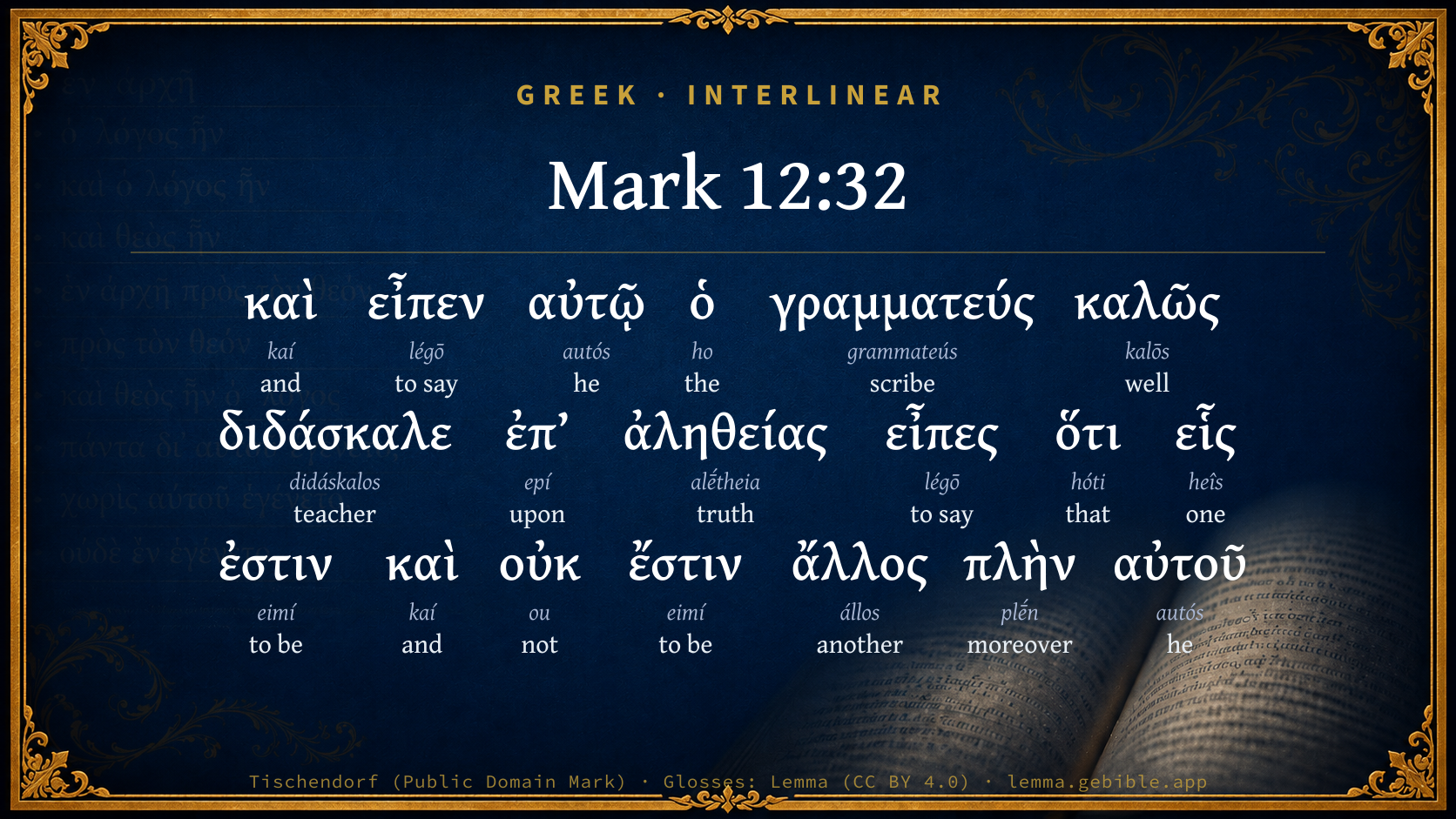
Download image
Cite this verse

Mark 12:32 (World English Bible). Public Domain. Lemma interlinear Bible study tool, https://lemma.gebible.app/v/mark/12/32.

Show BibTeX & RIS
BibTeX
RIS
English Translation
The scribe said to him, "Truly, teacher, you have said well that he is one, and there is none other but he,
World English Bible · Public Domain
Download a study sheet

One document with this verse’s original text, its word-by-word gloss line, the meaning frame, cross-references with their text, attributed commentary, and full source and license credits — printable, and it pastes into notes with its structure intact.

This verse Autodidact and up

Study sheet (.html) Plain text (.txt)

A passage Seminary Student

Up to 50 verses in one chapter. A passage sheet keeps up to 6 commentary sources and 12 cross-references per verse, in the order this page ranks them, and says so on the sheet whenever that leaves anything out. Ask for a single verse and you get the Autodidact verse sheet above.

Everything on this page stays free to read, with no account — the sheet is a download of what is already on screen, not access to it.

Want to remove ads? Support Godless Engineer
Compare translations 3

The same verse in 3 English versions, stacked beneath the original-language interlinear above. Click any original word for its lexicon entry.

Each is an independent rendering of the whole verse — the interlinear is not word-aligned to these translations.

Highlighted words mark where these versions differ — a whole-verse word diff, not a word-by-word alignment.

  • World English Bible Public Domain
    The scribe said to him, "Truly, teacher, you have said well that he is one, and there is none other but he,
  • King James Version Public Domain
    And the scribe said unto him, Well, Master, thou hast said the truth: for there is one God; and there is none other but he:
  • unfoldingWord Literal Text CC BY-SA 4.0
    And the scribe said to him, “Well, Teacher! On the basis of truth you have said that he is one, and there is no other besides him.

unfoldingWord Literal Text — © unfoldingWord, licensed CC BY-SA 4.0. Word-aligned USFM3 via Door43 (git.door43.org/unfoldingWord/en_ult).

Versions to compare (up to 4)

3 of 4 selected

Show all 19 translations

Every available English version of this verse, each an independent rendering of the whole verse.

  • World English Bible Public Domain
    The scribe said to him, "Truly, teacher, you have said well that he is one, and there is none other but he,
  • Berean Standard Bible Public Domain
    “Right, Teacher,” the scribe replied. “You have stated correctly that God is One and there is no other but Him,
  • Majority Standard Bible Public Domain
    “Right, Teacher,” the scribe replied. “You have stated correctly that God is One and there is no other but Him,
  • King James Version Public Domain
    And the scribe said unto him, Well, Master, thou hast said the truth: for there is one God; and there is none other but he:
  • American Standard Version (1901) Public Domain
    And the scribe said unto him, Of a truth, Teacher, thou hast well said that he is one; and there is none other but he:
  • Revised Version (1885) Public Domain
    And the scribe said unto him, Of a truth, Master, thou hast well said that he is one; and there is none other but he:
  • Geneva Bible (1599) Public Domain
    Then that Scribe said vnto him, Well, Master, thou hast saide the trueth, that there is one God, and that there is none but he,
  • Douay-Rheims (1899) Public Domain
    And the scribe said to him: Well, Master, thou hast said in truth, that there is one God, and there is no other besides him.
  • Young's Literal Translation Public Domain
    And the scribe said to him, `Well, Teacher, in truth thou hast spoken that there is one God, and there is none other but He;
  • Literal Standard Version CC BY-SA 4.0
    And the scribe said to Him, “Well, Teacher, in truth You have spoken that there is one God, and there is none other but He;
  • Unlocked Literal Bible CC BY-SA 4.0
    The scribe said, “Good, Teacher! You have truly said that God is one, and that there is no other besides him.
  • unfoldingWord Literal Text CC BY-SA 4.0
    And the scribe said to him, “Well, Teacher! On the basis of truth you have said that he is one, and there is no other besides him.
  • Darby Bible Public Domain
    And the scribe said to him, Right, teacher; thou hast spoken according to [the] truth. For he is one, and there is none other besides him;
  • World Messianic Bible Public Domain
    The scribe said to him, “Truly, Rabbi, you have said well that he is one, and there is none other but he;
  • Webster's Bible Public Domain
    And the scribe said to him, Well, Master, thou hast said the truth: for there is one God; and there is no other but he.
  • Free Bible Version CC BY-SA 4.0
    “That's right, Teacher,” the man replied. “It's true as you said that God is one, and there is no other.
  • Bible in Basic English Public Domain
    And the scribe said to him, Truly, Master, you have well said that he is one, and there is no other but he:
  • Text-Critical English NT CC BY 4.0
    Then the scribe said to him, “Yoʋ are right, Teacher. In truth yoʋ have said that God is one, and that there is no other besides him,
  • Tyndale New Testament (1534) Public Domain
    And the Scribe sayde vnto him: well master thou hast sayd the truthe that ther ys one God and that ther is none but he.

Literal Standard Version (2020), Covenant Press — licensed CC BY-SA 4.0. Text via the HelloAO Bible API (eBible.org). Unlocked Literal Bible (unfoldingWord) — licensed CC BY-SA 4.0. Text via the HelloAO Bible API (eBible.org). unfoldingWord Literal Text — © unfoldingWord, licensed CC BY-SA 4.0. Word-aligned USFM3 via Door43 (git.door43.org/unfoldingWord/en_ult). Free Bible Version, Dr. Jonathan Gallagher — licensed CC BY-SA 4.0. Text via the HelloAO Bible API (eBible.org).

Word by word

More ways to search: Search by grammar → Find every occurrence → Compare this word →

Practice this passage: Drill this verse → Learn its vocabulary →

πλὴν
plḗn
G4133
“moreover”
Adverb
Part of Speech
Adverb
Full Thayer's Definition

Origin: from G4119

TDNT: None

1. moreover, besides, but, nevertheless 2. besides, except, but
  1. καὶ kaí G2532 “and” Conjunction
  2. εἶπεν légō G3004 “to say” Verb, Aorist, Active, Indicative, 3rd person, Singular
  3. αὐτῷ autós G846 “he” Personal pronoun, Dative, Singular, Masculine
  4. ὁ ho G3588 “the” Article, Nominative, Singular, Masculine
  5. γραμματεύς grammateús G1122 “scribe” Noun, Nominative, Singular, Masculine
  6. καλῶς kalōs G2573 “well” Adverb
  7. διδάσκαλε didáskalos G1320 “teacher” Noun, Vocative, Singular, Masculine
  8. ἐπ’ epí G1909 “upon” Preposition
  9. ἀληθείας alḗtheia G225 “truth” Noun, Genitive, Singular, Feminine
  10. εἶπες légō G3004 “to say” Verb, Aorist, Active, Indicative, 2nd person, Singular
  11. ὅτι hóti G3754 “that” Conjunction
  12. εἷς heîs G1520 “one” Adjective, Nominative, Singular, Masculine
  13. ἐστιν eimí G1510 “to be” Verb, Present, Active, Indicative, 3rd person, Singular
  14. καὶ kaí G2532 “and” Conjunction
  15. οὐκ ou G3756 “not” Particle, Negative
  16. ἔστιν eimí G1510 “to be” Verb, Present, Active, Indicative, 3rd person, Singular
  17. ἄλλος állos G243 “another” Adjective, Nominative, Singular, Masculine
  18. αὐτοῦ autós G846 “he” Personal pronoun, Genitive, Singular, Masculine

About this verse

These counts appear in no published source. They are computed here, from the morphology-tagged text and Lemma’s own curated glosses. What Lemma adds →

19
words
15
distinct lemmas
Gospels
section

Shared distinctive vocabulary

πλὴν moreover G4133 occurs in 31 verses of the Greek New Testament. Also found in:
Repetition

Words recur within this verse:

  • εἶπεν to say G3004 ×2
  • ἐστιν to be G1510 ×2
  • καὶ and G2532 ×2
  • αὐτῷ he G846 ×2

Cross-references

12

Topical passages linked to Mark 12:32 in the Treasury of Scripture Knowledge — connected by theme and wording, ordered by reader-vote popularity; previews shown in the World English Bible.

  • Deuteronomy 4:39 Know therefore this day, and lay it to your heart, that Yahweh he is God in heaven above and on the earth beneath; there is none else.
  • Deuteronomy 4:35 To you it was shown, that you might know that Yahweh he is God; there is none else besides him.
  • Isaiah 46:9 Remember the former things of old: for I am God, and there is none else; [I am] God, and there is none like me;
  • Deuteronomy 6:4 Hear, Israel: Yahweh is our God; Yahweh is one:
  • Isaiah 45:5–6 I am Yahweh, and there is none else; besides me there is no God. I will gird you, though you have not known me;
  • Isaiah 45:14 Thus says Yahweh: "The labor of Egypt, and the merchandise of Ethiopia, and the Sabeans, men of stature, shall come over to you, and they shall be yours. They shall go after you. In chains they shall come over; and they shall fall down to you. They shall make supplication to you: 'Surely God is in you; and there is none else, there is no other god.
  • Isaiah 45:18 For thus says Yahweh who created the heavens, the God who formed the earth and made it, who established it and didn't create it a waste, who formed it to be inhabited: I am Yahweh; and there is no one else.
  • Deuteronomy 5:7 You shall have no other gods before me.
  • Isaiah 44:8 Don't fear, neither be afraid: haven't I declared to you of old, and shown it? You are my witnesses. Is there a God besides me? Indeed, there is not. I don't know any Rock.
  • Jeremiah 10:10–12 But Yahweh is the true God; he is the living God, and an everlasting King: at his wrath the earth trembles, and the nations are not able to abide his indignation.
  • Mark 12:29 Jesus answered, "The greatest is, 'Hear, Israel, the Lord our God, the Lord is one:
  • Isaiah 45:21–22 Declare you, and bring [it] forth; yes, let them take counsel together: who has shown this from ancient time? who has declared it of old? Haven't I, Yahweh? and there is no God else besides me, a just God and a Savior; there is no one besides me.

Cross-references courtesy of OpenBible.info (CC BY 4.0).

Where the printed editions differ

1 variant

Places in this verse where the major printed Greek editions disagree on the wording in a way that affects the translation — a comparison of editions, not a manuscript-by-manuscript collation. The editions are the modern critical texts (Nestlé-Aland 28/27, SBL, Westcott-Hort, Tregelles, Tyndale House) and the traditional texts behind the KJV (the Textus Receptus and the Byzantine/Majority text). It is not a claim about which reading is original.

  1. Extra text
    θεὸς

    “God”

    In TR Not in NA28NA27TynSBLWHTregByz

    θεὸς (theos) 'God' is only in traditional manuscripts (TR)

Textual data: Translators Amalgamated Greek New Testament (STEPBible TAGNT) · CC BY 4.0.

Commentary

Notes on Mark 12:32 from classic Christian and Jewish commentators (each source and its license shown beneath its notes). The classic Christian expositions comment on the surrounding passage and are grouped to its opening verse, so a note may address several verses; the Jewish commentaries on the Tanakh (Rashi and others) are per-verse, so they appear only where the commentator wrote on this verse.

Lemma curates 59 commentaries, every one of them public domain or Creative Commons licensed, each selected and text-cleaned for this edition rather than reprinted as found. About our sources →

Adam Clarke's Commentary

Verse 32. And the scribe said] The answer of the scribe, contained in Mr 12:32-34, is not found either in Matthew or Luke. This is another proof against Mark's supposed abridgment.

Adam Clarke's Commentary on the Bible (1810–1826) — public domain. Text from a community e-Sword/MySword module.

The Biblical Illustrator

Joseph S. Exell

Mar_12:32

Well, Master, Thou hast said the truth.

The Divine echo in the human heart

Man needs a Saviour. The heart of man answers, Well, Master, Thou hast said the truth. What are the practical consequences of our having this responsive faculty?

I. Man is made a co-worker with God; not a machine, but a cooperating agent.

II. Man enjoys the restraints of conscience. The Bible appeals to and has the consent of conscience.

III. God bases His judgment upon this responsive faculty. To him that knoweth to do good, etc. The judgment day will be short, because every man will be his own witness. (The Pulpit Analyst.)

The Biblical Illustrator, edited by Joseph S. Exell (c. 1880s–1900s) — public domain. Text from a community e-Sword module.

Joseph Benson's Commentary

Mar 12:32-34. The scribe — Who had proposed the question to try him, being struck with the solidity and spirit of his answer, said, Well, Master — In the original it is, καλως, excellently, finely, or beautifully; a phrase which expresses his high satisfaction in the reply much more strongly than the word well. Thou hast said the truth — Thy declaration is perfectly correct, and unspeakably important; for there is one God, &c., and to love him with all the heart — To love and serve him with all the united powers of the soul, in their utmost vigour; and without a rival; and to love his neighbour as himself — To maintain the same equitable and charitable temper and behaviour toward all men, as we, in like circumstances, would wish from them toward ourselves, is a more necessary and important duty, and a more acceptable service, than the offering the most noble and costly sacrifices; nor could the most exact and pompous ritual observances be acceptable without such graces and virtues as these. When Jesus saw that he answered discreetly — And thereby showed that he had just views of true religion; he said, Thou art not far from the kingdom of God — He applauded the piety and wisdom of the scribe’s reflection, by declaring, that he was not far from embracing the gospel, and becoming a true member of Christ’s Church, possessed of all the blessings belonging to his disciples. Reader, art thou not far from the kingdom of God? Then go on: be a real Christian; else it had been better for thee to have been afar off.

Joseph Benson's Commentary on the Old and New Testaments (1811–1818) — public domain. Text from a community e-Sword module.

Tyndale Open Study Notes

Tyndale Open Resources

12:32-33 The scribe’s affirmation adds emphasis to the importance of these two commands for authentic devotion.

Tyndale Open Study Notes — © Tyndale Open Resources, licensed CC BY-SA 4.0. Text via the HelloAO Bible API.

Bengel's Gnomon

Johann Albrecht Bengel

Mar 12:32. Κακῶς, excellently [well]) Construe with. Thou hast said: for His “saying well” is made to rest on the truth, ἐπʼ ἀληθείας, as in Luk 4:25 [ἐπʼ ἀληθείας λέγω, I say, resting on the truth, “I say of a truth”], εἷς ἐστι καὶ οὐκ ἔστιν ἄλλος πλὴν αὐτοῦ, there is One, and there is none other but He) There is One [or rather He is One], an absolute phraseology, is repeated from Mar 12:29, that is, from Moses’ writings; comp. Zec 14:9. The subject, Θεὸς, God, is left to be supplied, by a striking εὐλάβεια of language [reverent caution is needlessly repeating God’s name], although many have inserted this very word, Θεὸς, after ἐστί. See App. Crit. Ed. ii. on this passage.[6]

[6] AB Vulg. omit Θεὸς. D abc and Rec. Text (which prefixes ὁ) insert Θεὸς.—ED. and TRANSL.

Bengel's Gnomon of the New Testament — English translation (T&T Clark, Edinburgh, 1860) — public domain. Text from a community e-Sword module.

Expositor's Greek Testament

ed. W. Robertson Nicoll

Mar 12:32 . καλῶς , ἐπʼ ἀληθείας : to be taken together = well indeed! εἷς ἐστὶν : He is one (God understood, supplied in T.R.).

The Expositor's Greek Testament, edited by W. Robertson Nicoll (1897–1910) — public domain. Text from a community e-Sword module.

Ellicott's Commentary for English Readers

(32) Well, Master, thou hast said the truth.—Better, Well hast Thou said truly that there is one God. The words seem intentionally repeated from Mar_12:14, but are uttered now, not with the covert sneer of the hypocrite, but in the sincerity of admiration. Note also the real reverence shown in the form of address, “Master,” i.e., “Teacher, Rabbi.” He recognises the speaker as one of his own order. This, and all that follows, is peculiar to St. Mark, and is an addition of singular interest, as showing the existence among the scribes of some who accepted our Lord’s teaching as to the spiritual meaning of the Law, and were able to distinguish between its essence and its accidents.

A Bible Commentary for English Readers, edited by Charles John Ellicott (1878–1897) — public domain. Text from a community e-Sword module.

John Gill's Exposition

And when Jesus saw that he answered discreetly,.... Wisely and prudently, as a man of sense and understanding; by taking in the several parts of our Lord's answer very distinctly, and reasoning upon them, and confirming them:

he said unto him, thou art not far from the kingdom of God: not meaning from heaven, and eternal happiness; for right and distinct notions of the above commandments, and even the performance of the in by a sinful and imperfect creature, can neither give a man a title to, or bring him near, or introduce him into the heavenly glory, which is a pure gift of God's grace; but our Lord's sense is, that he was not far off from the Gospel dispensation, and was in a fair way of entering into it; his sentiments were very near to such, who became followers of Christ, and embraced the doctrines, and submitted to the ordinances of the Gospel state: since he preferred those things, which related to the knowledge of the being and perfections of God, to the love and worship of God, and to the good of his neighbour; before the ceremonies of the law; which were quickly to be abolished, and make way for the setting up of the kingdom of God, or of the Messiah, in a more glorious and visible manner. Indeed there are some persons, who seem not far off from the kingdom of God, in the other sense of the phrase, as it may respect eternal glory and happiness, who will never enter into it: there are some that seem very devout and religions; hear the word, attend on all ordinances, join themselves with a church, submit to baptism, and sit down at the Lord's table, and live a moral life and conversation, and yet are destitute of the grace of God: yea, there are some who have clear notions of the Gospel, and make a bright profession of it, and yet have no experience of the power of it upon their hearts, and have not the oil of grace there: and even hold this profession to the end, and yet come short of the kingdom and glory of our Lord Jesus: such are almost Christians, but not altogether; virgins, but foolish ones; have lamps, but no oil; come as far as the door, but that is shut upon them.

And no man after that durst ask him any question; in any captious matter in order to ensnare him; finding they could get no advantage, or occasion against him that way; he having silenced the Herodians, Sadducees, Scribes, and Pharisees.

John Gill's Exposition of the Whole Bible (1746–1763) — public domain (CC PDM 1.0). Text via the HelloAO Bible API.

The Pulpit Commentary

The first words of this verse should be rendered thus: Of a truth, Master, thou hast well said that he is one. In the remainder of the scribe"s answer we find a different word used in the Greek for" mind," or "understanding," from that just used by our Lord. In our Lord"s answer the word is dianoia . Here it is sunesiv . Both words are well rendered by "understanding." It is an act of understanding. It is the thought associating itself with the object, and "standing under" it so as to support it. (See Dr. Morison on St. Mark.)

The Pulpit Commentary (1880–1919), ed. H.D.M. Spence-Jones & Joseph S. Exell — public domain. Text from a community e-Sword module.

Kretzmann's Popular Commentary

Paul E. Kretzmann

The Pharisee is convinced:

v. 32. And the scribe said unto Him, Well, Master, Thou hast said the truth; for there is one God; and there is none other but He;

v. 33. and to love Him with all the heart, and with all the understanding, and with all the soul, and with all the strength, and to love his neighbor as himself, is more than all whole burnt offerings and sacrifices.

v. 34. And when Jesus saw that he answered discreetly, He said unto him, Thou art not far from the kingdom of God. And no man after that durst ask Him any question.

The clear-cut statement from Scriptures which Jesus gave him in answer to his tempting question made a deep impression upon the scribe. There was not a single point which could be gainsaid, there was not a single flaw, on account of which one might start an argument. It was clear, unmistakable Bible-truth. It is always thus where the Word of God is concerned. If the believer is only sure of his Bible-passages, of his proof-texts! They are the eternal truth of the great God, that will stand in spite of all jeering and all arguments to the contrary. The scribe was obliged to assent absolutely: Good, Master, in truth Thou hast said. When the Word of God has spoken, all argumentation must cease. Almost mechanically the scribe repeated the substance of Christ’s instruction. But that he was fully convinced, appears from the fact that he varies Christ’s words somewhat and demands love of God also with full understanding. The entire intellect and understanding, the entire ability to reason, is not shut off and put out of commission in a Christian, but rather strengthens his position over against God, since it is taken captive under the obedience of Christ. Every effort of the believing Christian is strained toward that end, of demonstrating his love toward God, of penetrating into the mysteries of God’s holy Word by comparing the various sections concerning fundamental doctrines and also by showing the foolishness of the attacks upon the Bible. And if heart, soul, mind, and understanding are thus bound up in the service of God, the entire life of such a Christian will be a continual worshiping, far more valuable in the sight of God than burnt offerings and all offerings; it will be a worshiping in spirit and in truth, Joh 4:24. The assent of the scribe pleased Jesus very much, since He saw that he had given the matter careful thought, that he had really understood the distinction which Jesus wished to present, that he grasped the meaning of the Lord. Joyfully He tells him: Not far art thou from the kingdom of God. The answer of the Lord had brought him to his senses. He had gained confidence in the Master of Israel and in His doctrine; he had come to the conclusion that this man must be the Messiah of Israel. The first faint movements of faith had begun in his heart. The divine Word always has the power to convince even the enemies and gainsayers.

Paul E. Kretzmann, Popular Commentary of the Bible (1921–1924) — public domain. Text from a community e-Sword module.

unfoldingWord translationNotes

Door43 World Missions Community

Good, Teacher

"Good answer, Teacher" or "Well said, Teacher"

God is one

This means that there is only one God. AT: "there is only one God" (See: Idiom)

that there is no other

The word "God" is understood from the previous phrase. AT: "that there is no other God" (See: Ellipsis)

with all the heart ... all the understanding ... all the strength

Here "heart" is a metonym for person's thoughts, feelings, or inner being. These three phrases are used together to mean "completely" or "earnestly." (See: Metonymy)

to love one's neighbor as oneself

This simile compares how people are to love each other with the same love that they love themselves. AT: "to love your neighbor as much as you love yourself" (See: Simile)

is even more than

This idiom means that something is more important than something else. In this case, these two commandments are more pleasing to God that burnt offering and sacrifices. This may be written clearly. AT: "is even more important than" or "is even more pleasing to God than" (See: Idiom)

You are not far from the kingdom of God

This can be stated in positive form. Here Jesus speaks of the man being ready to submit to God as king as being physically close to the kingdom of God, as if it where a physical place. AT: "You are close to submitting to God as king" (See: Litotes and Metaphor)

no one dared

This can be stated in positive form. AT: "everyone was afraid" (See: Litotes)

translationWords

teacher

understand

burnt offering

sacrifice

wise

kingdom of God

unfoldingWord translationNotes — © Distant Shores Media and the Door43 World Missions Community, licensed CC BY-SA 4.0. Source: git.door43.org/Door43/en_tn.

Cambridge Greek Testament for Schools and Colleges

32. εἷς ἐστιν ([2805][2806][2807][2808][2809]) rather than εἷς ἐστιν θεός ([2810][2805] Codex Sinaiticus. 4th cent. Discovered by Tischendorf in 1859 at the Monastery of St Katharine on Mount Sinai. Now at St Petersburg. The whole Gospel, ending at Mar 16:8. Photographic facsimile, 1911.

[2806] Codex Alexandrinus. 5th cent. Brought by Cyril Lucar, Patriarch of Constantinople, from Alexandria, and afterwards presented by him to King Charles I. in 1628. In the British Museum. The whole Gospel. Photographic facsimile, 1879.

[2807] Codex Vaticanus. 4th cent., but perhaps a little later than א. In the Vatican Library almost since its foundation by Pope Nicolas V., and one of its greatest treasures. The whole Gospel, ending at Mar 16:8. Photographic facsimile, 1889.

[2808] Codex Regius. 8th cent. An important witness. At Paris. Contains Mar 1:1 to Mar 10:15; Mar 10:30 to Mar 15:1; Mar 15:20 to Mar 16:20, but the shorter ending is inserted between Mar 16:8 and Mar 16:9, showing that the scribe preferred it to the longer one.

[2809] Codex Sangallensis. 9th or 10th cent. Contains the Gospels nearly complete, with an interlinear Latin translation. The text of Mark is specially good, agreeing often with CL. At St Gall.

[2810] odex Bezae. 6th cent. Has a Latin translation (d) side by side with the Greek text, and the two do not quite always agree. Presented by Beza to the University Library of Cambridge in 1581. Remarkable for its frequent divergences from other texts. Contains Mark, except Mar 16:15-20, which has been added by a later hand. Photographic facsimile, 1899.

32. Καλῶς. The reply of the Scribe is given by Mk alone. Καλῶς is not an interjection. It may be taken either with the preceding εἶπεν, in which case it anticipates νουνεχῶς in Mar 12:34, or with the following εἶπας. In favour of the former is the fact that elsewhere Mk begins addresses with Διδάσκαλε (Mar 4:38, Mar 9:17; Mar 9:38, Mar 10:17; Mar 10:20; Mar 10:35, Mar 12:14; Mar 12:19, Mar 13:1). But the full expression in καλῶς ἐπʼ ἀληθείας is in Mk’s style, where ἐπʼ ἀλ. adds strength to καλῶς, but is otherwise pleonastic; “Verely thou hast sayde right” (Coverdale).

ὅτι Εἷς ἐστιν. That He is one (R.V.), not “for there is one God” (A.V.). The Scribe avoids using the Divine Name, and the insertion of θεός in some texts is a corruption.

Cambridge Greek Testament for Schools and Colleges (Cambridge University Press, 1896; 21 vols, various authors incl. Carr, Maclear, Plummer, Farrar, Lumby, Moule, M. R. James, Simcox) — public domain. Text from a community e-Sword module.

International Critical Commentary

32. καλῶς, διδάσκαλε· ἐπʼ ἀληθείας εἶπες, ὅτι εἷς ἐστί—Well, teacher! you said truly that he is one. AV. Well, Master; thou didst speak the truth; for, etc. This is not wrong, but what follows ὅτι is so nearly what Jesus said, that it seems more natural to make it a repetition of that, than a reason for the scribe’s approval of it. RV. Of a truth, Master, thou hast well said, that, etc. The distribution of the words and of emphasis is against this. It would read ἐπʼ ἀληθείας καλῶς εἶπες.

Omit θεός, God, Tisch. Treg. WH. RV. א ABKLMSUX ΓΔΠ one ms. Lat. Vet. many mss. Vulg. Pesh.

οὐκ ἔστιν ἄλλος πλὴν αὐτοῦ—there is no other but he. This addition to Jesus’ words is taken by the Scribe from Deu 4:35, Deu 4:39. His enumeration of the parts of man entering into the love of God differs again from that of Jesus. The following table shows them all together.

Heb. καρδία, ψυχή, ἰσχύς.

Sept. διανοία, ψυχή, ἰσχύς.

Jesus. καρδία, ψυχή, διανοία, ἰσχύς.

Scribe. καρδία, σύνεσις, ἰσχύς.

But of course, this is a matter of no importance, the two latter representing only the oratio variata of the writer.

International Critical Commentary — older volumes (1896–1929), various authors — public domain. Text from a community e-Sword module.

Vincent's Word Studies in the New Testament

Marvin R. Vincent

Well, Master, thou hast said the truth; for there is one God. All the best texts omit God.

Well [καλως] . Exclamatory, as one says good! on hearing something which he approves.

The truth [επ αληθειας] . Incorrect. The phrase is adverbial; of a truth, in truth, truthfully, and qualifies the succeeding verb, thou hast said. For [οτι] . The A. V. begins a new and explanatory sentence with this word; but it is better with Rev. to translate that, and make the whole sentence continuous : Thou hast truthfully said that he is one.

Marvin R. Vincent, Word Studies in the New Testament (1887–1900) — public domain. Text from a community e-Sword/MySword module.

Lesson kit

Teaching starters — assembled from the data on this page, not authored interpretation. Every prompt links to the verse data it draws on. Edit before teaching.

Mark, in the Gospels, opens this verse with 19 words (15 distinct Greek lemmas). Its most distinctive word is plḗn (“moreover”). A historical commentator’s framing appears above. Read the whole chapter for the surrounding context.

Discussion questions

  1. How does “moreover” (plḗn) shape what this verse is saying?
  2. How does Matthew 11:22, which shares the word «moreover», read alongside this verse?
  3. What does the repetition of “to say” (2× in this one verse) do in this verse?
  4. These translations render this verse differently; the difference is in the English rendering, not the original. What questions does that raise?
  5. Compare how Adam Clarke's Commentary and The Biblical Illustrator read this verse. Where do they agree or differ?

Things to notice

Reading settings

Reading text

Shown beneath each verse's original-language words.

Old Testament
Old Testament edition

Read the OT as the Masoretic Hebrew (MT) or the Greek Septuagint (LXX).

English shown for the Greek Septuagint (in the Hebrew ↔ Greek comparison).

Comparing translations? Open the Compare panel on any verse page to stack up to four side by side.