Mark 14:39

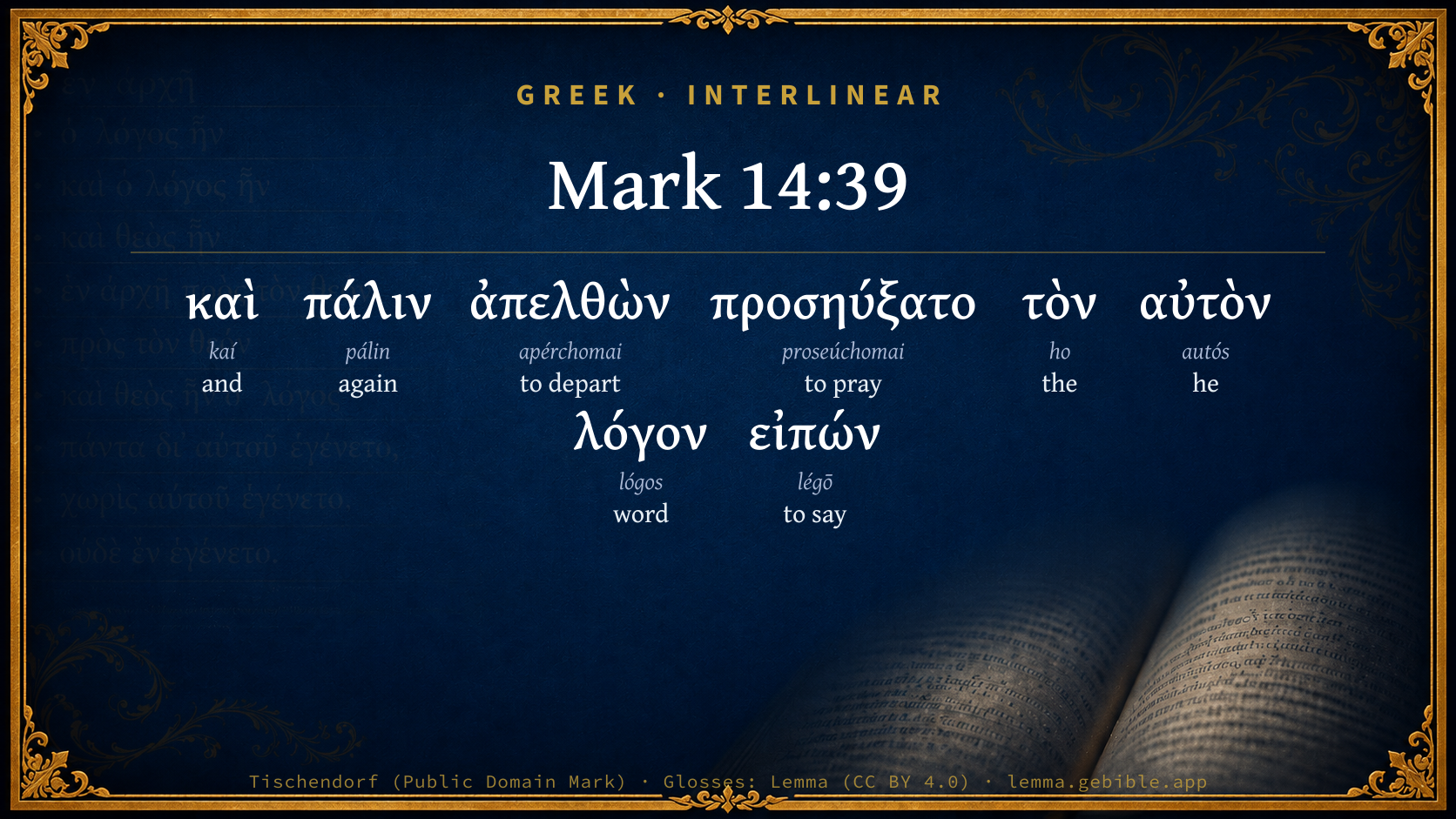
Greek (Tischendorf 8th ed.) Mark 14:39 appears in the Greek New Testament. The text above is from the Tischendorf 8th edition. Each word links to its Strong’s number and a concise gloss. Click any word for its full Thayer’s Greek Lexicon entry.
Download image
Cite this verse

Mark 14:39 (World English Bible). Public Domain. Lemma interlinear Bible study tool, https://lemma.gebible.app/v/mark/14/39.

Show BibTeX & RIS
BibTeX
RIS
English Translation
Again he went away, and prayed, saying the same words.
World English Bible · Public Domain
Download a study sheet

One document with this verse’s original text, its word-by-word gloss line, the meaning frame, cross-references with their text, attributed commentary, and full source and license credits — printable, and it pastes into notes with its structure intact.

This verse Autodidact and up

Study sheet (.html) Plain text (.txt)

A passage Seminary Student

Up to 50 verses in one chapter. A passage sheet keeps up to 6 commentary sources and 12 cross-references per verse, in the order this page ranks them, and says so on the sheet whenever that leaves anything out. Ask for a single verse and you get the Autodidact verse sheet above.

Everything on this page stays free to read, with no account — the sheet is a download of what is already on screen, not access to it.

Want to remove ads? Support Godless Engineer
Compare translations 3

The same verse in 3 English versions, stacked beneath the original-language interlinear above. Click any original word for its lexicon entry.

Each is an independent rendering of the whole verse — the interlinear is not word-aligned to these translations.

Highlighted words mark where these versions differ — a whole-verse word diff, not a word-by-word alignment.

  • World English Bible Public Domain
    Again he went away, and prayed, saying the same words.
  • King James Version Public Domain
    And again he went away, and prayed, and spake the same words.
  • unfoldingWord Literal Text CC BY-SA 4.0
    And again, having gone away, he prayed, having said the same word.

unfoldingWord Literal Text — © unfoldingWord, licensed CC BY-SA 4.0. Word-aligned USFM3 via Door43 (git.door43.org/unfoldingWord/en_ult).

Versions to compare (up to 4)

3 of 4 selected

Show all 19 translations

Every available English version of this verse, each an independent rendering of the whole verse.

  • World English Bible Public Domain
    Again he went away, and prayed, saying the same words.
  • Berean Standard Bible Public Domain
    Again He went away and prayed, saying the same thing.
  • Majority Standard Bible Public Domain
    Again He went away and prayed, saying the same thing.
  • King James Version Public Domain
    And again he went away, and prayed, and spake the same words.
  • American Standard Version (1901) Public Domain
    And again he went away, and prayed, saying the same words.
  • Revised Version (1885) Public Domain
    And again he went away, and prayed, saying the same words.
  • Geneva Bible (1599) Public Domain
    And againe hee went away, and praied, and spake the same wordes.
  • Douay-Rheims (1899) Public Domain
    A going away again, he prayed, saying the same words.
  • Young's Literal Translation Public Domain
    And again having gone away, he prayed, the same word saying;
  • Literal Standard Version CC BY-SA 4.0
    And again having gone away, He prayed, saying the same word;
  • Unlocked Literal Bible CC BY-SA 4.0
    Again he went away and prayed, and he used the same words.
  • unfoldingWord Literal Text CC BY-SA 4.0
    And again, having gone away, he prayed, having said the same word.
  • Darby Bible Public Domain
    And going away, he prayed again, saying the same thing.
  • World Messianic Bible Public Domain
    Again he went away and prayed, saying the same words.
  • Webster's Bible Public Domain
    And again he went away, and prayed, and spoke the same words.
  • Free Bible Version CC BY-SA 4.0
    He left them once more, and prayed, saying the same things.
  • Bible in Basic English Public Domain
    And again he went away, and said a prayer, using the same words.
  • Text-Critical English NT CC BY 4.0
    Once again he went away and prayed the same prayer.
  • Tyndale New Testament (1534) Public Domain
    And agayne he went awaye and prayde and spake the same wordes.

Literal Standard Version (2020), Covenant Press — licensed CC BY-SA 4.0. Text via the HelloAO Bible API (eBible.org). Unlocked Literal Bible (unfoldingWord) — licensed CC BY-SA 4.0. Text via the HelloAO Bible API (eBible.org). unfoldingWord Literal Text — © unfoldingWord, licensed CC BY-SA 4.0. Word-aligned USFM3 via Door43 (git.door43.org/unfoldingWord/en_ult). Free Bible Version, Dr. Jonathan Gallagher — licensed CC BY-SA 4.0. Text via the HelloAO Bible API (eBible.org).

Word by word

More ways to search: Search by grammar → Find every occurrence → Compare this word →

Practice this passage: Drill this verse → Learn its vocabulary →

About this verse

These counts appear in no published source. They are computed here, from the morphology-tagged text and Lemma’s own curated glosses. What Lemma adds →

8
words
8
distinct lemmas
Gospels
section

Cross-references

4

Topical passages linked to Mark 14:39 in the Treasury of Scripture Knowledge — connected by theme and wording, ordered by reader-vote popularity; previews shown in the World English Bible.

  • Matthew 26:42–44 Again, a second time he went away, and prayed, saying, "My Father, if this cup can't pass away from me unless I drink it, your desire be done."
  • Matthew 6:7 In praying, don't use vain repetitions, as the Gentiles do; for they think that they will be heard for their much speaking.
  • 2 Corinthians 12:8 Concerning this thing, I begged the Lord three times that it might depart from me.
  • Luke 18:1 He also spoke a parable to them that they must always pray, and not give up,

Cross-references courtesy of OpenBible.info (CC BY 4.0).

Commentary

Notes on Mark 14:39 from classic Christian and Jewish commentators (each source and its license shown beneath its notes). The classic Christian expositions comment on the surrounding passage and are grouped to its opening verse, so a note may address several verses; the Jewish commentaries on the Tanakh (Rashi and others) are per-verse, so they appear only where the commentator wrote on this verse.

Lemma curates 59 commentaries, every one of them public domain or Creative Commons licensed, each selected and text-cleaned for this edition rather than reprinted as found. About our sources →

The Biblical Illustrator

Joseph S. Exell

Mar_14:39

And prayed, and spake the same words.

Perseverance in prayer

We may learn from this what we are to do in time of distress and affliction; we are not only to go to God by prayer for help, comfort, and deliverance; but we are to go to Him again and again: yea, often to call upon Him, and seek to Him in our distress, to be instant and importunate with Him; and so to continue as long as the affliction presses us.

I. Prayer is a duty and service which we owe to God and which we ought constantly to perform in obedience to His will commanding it, though otherwise we should reap no benefit by it to ourselves, nor even obtain the things we ask. And here the very doing of our duty in uprightness of heart must comfort us (2Co_1:12).

II. Although God does not at once grant our petitions, yet He takes notice of our prayers and is well pleased with them.

III. There are just causes why God does not always hear our prayers at first or speedily; but delays, sometimes for long.

1. To exercise and try our faith, hope, patience, and obedience in waiting upon Him.

2. To make us more fervent in prayer.

3. That the things we have asked, being for a time delayed, may be the more prized by us when we get them.

IV. The reason why God does not hear us at first, or so soon as we desire, may be and often is in ourselves, viz., in the faultiness of our prayers. Either we ask such things as God does not see fit for us to obtain, and then it is a mercy in Him to deny them to us; or else we ask not in due manner, we pray not in faith, or not with such feeling and fervour as we ought; or else we are living in some sin unrepented of, which hinders the fruit of our prayer (Jam_4:2-3; Jam_5:16; Psa_66:18).

V. Though God has promised to hear our prayers, and to grant our petitions, so far as is good for us, and is according to His will; yet He will not have us limit Him a time in which to do so: nor is it fit for us so to do, but we are to wait His leisure, convinced that by so doing we shall lose nothing (Isa_28:16; Psa_40:1).

VI. God hears our prayers in divers ways.

1. By giving us the things we ask. Hannah, a child; Solomon, wisdom etc.

2. By giving us something as good, or better for us than that we ask; e.g. patience in time of trouble, and strength to bear it (2Co_12:7-10).

3. By giving us inward comfort, by and in our prayers, and after them (Psa_35:13).

4. By accepting our prayers as a service pleasing to Him. Now although God often delays to hear us the first way, yet He always hears us one of these ways, and that as soon as we pray to Him, if we pray in due manner, and as we ought; which being so, must encourage us to persevere, and hold out in prayer, when we do not immediately obtain those petitions which we ask of God. (George Petter.)

Lawfulness of set forms of prayer

Hence we may gather, that it is lawful for us to use a set form of prayer: not only to ask the same petitions of God in effect and substance of matter at sundry times, but also in the same form of words, or well near the same: yea, that this may be done even in private prayer alone by ourselves, for such was this prayer now made by our Saviour. And if in private prayer alone by ourselves (where usually more liberty may be taken to vary the form of words in our prayers), then much more when we pray with others, especially in public, it must needs be lawful to use a set form of words, and to ask the same petitions in the same words. Our Saviour taught His disciples a set form of prayer, which is that we call the Lords Prayer, appointing both them and us to use it in the very same form of words in which it is framed (Luk_11:2)…And what are sundry of Davids Psalms, but set forms of prayer, used by the Church in those times?…The Church of God has always used set forms of prayer in public and solemn meetings, nor was the lawfulness of this practice ever questioned till of late times by Anabaptists, Brownists, and such like. (George Petter.)

The Biblical Illustrator, edited by Joseph S. Exell (c. 1880s–1900s) — public domain. Text from a community e-Sword module.

Joseph Benson's Commentary

Mar 14:39-42. And he went away and spake the same words — It is plain, by comparing Mar 14:35-36, with Mat 26:42, that the words were not entirely the same; and it is certain that λογος, here rendered word, often signifies matter. So that no more appears to be intended than that he prayed to the same purpose as before. Sleep on now, &c. — Dr. Waterland and some others read this interrogatively, Do ye sleep on still and take your rest? The passage, however, may be read with propriety agreeably to our own version; (see the note on Mat 26:42-45;) as much as to say, My previous conflict is now over, and you may sleep on, because I have no further occasion for your watching. It is enough, or rather, as Campbell renders απεχει, All is over, or, it is done. the time is expired. The intention of the phrase was manifestly to signify, that the time wherein they might have been of use to him, was now lost; and that he was, in a manner, already in the hands of his enemies. Rise up, let us go — See notes on Mat 26:46-49.

Joseph Benson's Commentary on the Old and New Testaments (1811–1818) — public domain. Text from a community e-Sword module.

Expositor's Greek Testament

ed. W. Robertson Nicoll

Mar 14:39 . Mk., like Mt., divides the agony into three acts, but he reports the words spoken by Jesus in prayer only in the first. Mt. gives the prayer of Jesus in the second act, as well as in the first, generalising in the third, where he repeats the formula here used by Mk.: τὸν αὐτὸν λόγον εἰπών .

The Expositor's Greek Testament, edited by W. Robertson Nicoll (1897–1910) — public domain. Text from a community e-Sword module.

John Gill's Exposition

And when he returned, he found them asleep again,.... Notwithstanding the expostulation he had used with them, the exhortation he had given them, and the danger he had suggested to them:

for their eyes were heavy: with sleep and sorrow:

neither wist they what to answer him; partly through confusion and shame, not knowing how to excuse themselves; and partly, through their being stupefied with sleep and grief.

John Gill's Exposition of the Whole Bible (1746–1763) — public domain (CC PDM 1.0). Text via the HelloAO Bible API.

The Pulpit Commentary

Saying the same words. The repetition of the same words shows his fixed determination to submit to the will of his heavenly Father. Although the human nature at first asserted itself in the prayer that the cup might pass from him; yet ultimately the human will yielded to the Divine. He desired to drink this cup of bitterness appointed for him by the will of God; for his supreme desire was that the will of God might be done.

Vers. 39-43Sorrow, sleep, and sin.

When a dear friend is in trouble our footfall is quiet and our voice hushed. Even children are awed to silence when they see the face they love stained with tears and pale with anguish. How much more does stillness of soul become us when we enter into the Garden o Gethsemane and see the Lord we love in his agony! Christ completed the cycle of human temptations in Gethsemane. In the wilderness he had been tempted to desire what was forbidden, to obtain provision in a wrong way, to manifest Divine power in an act of presumption, to gain the kingdom by force and fraud. Now he was tempted to avoid what was ordained. And to do what we ought not, not to do what we ought, sums up all temptations. He "was in all points tempted like as we are, yet without sin." In this mysterious scene we discern a concentration of human history.

I THE SIN-FORGETTING CHURCH is represented by the disciples who failed their Lord.

1. They did not understand the necessity and dreadfulness of Christ"s struggle with the powers of darkness. They allowed natural weariness to overcome them, so that they had no share in the conflict endured near them and for them. As little does the Church share the purpose of Christ in the redemption of the world from sin; nor does she see the need for being in an "agony" about it. Is there the feeling about sin, even about our own sin, that there should be? Are we not too often like those who, under the shadow of Christ"s sorrow, slept, though he himself had said, "Tarry ye here, and watch"?

2. Nor did these disciples reach the source of power that night. It was impossible to find victory through human passion, as Peter discovered after he had drawn and used his sword. Indiscriminate zeal, which will attack heretics and sceptics with bitter words and penalties, is sure to fail. Power to overcome is found in obedience to the command, "Watch and pray." To watch without praying is presumption; to pray without watching is fanaticism. The difference between our Lord and his disciples was this: they refreshed themselves by natural means, and he by spiritual; they fell back on sleep, and he on prayer just as too often we rely on human agencies, and not on Divine.

3. Their confusion and indecision increased as they diverged from their Lord. He became more calm, and more sure of victory. They became more heavy with sleep, more cowardly and unprepared, till they all forsook him and fled. Only when they assembled again in his Name to pray in the upper room were they endued with power from on high. "Let us not sleep as do others, but let us watch and be sober," lest again he should say, "Sleep on now, and take your rest..... Behold, the Son of man is betrayed.

II THE SIN-COMMITTING WORLD. (Ver. 43)

1. While the disciples slept, the hostile world was alert. This vigilance was a rebuke to their sloth. Still it is so. Frequenters of haunts of pleasure are often more eager than members of Christ"s Church to invite their companions to join them.

2. Those who assail the cause of Christ are animated by different motives. Some are malignant, as the priests were; others join in the popular cry, though it be "Crucify him!" The mob in Jerusalem had little idea what they were doing casting out of the world the Son of God, who had come to be their Savior and Friend. Men"s acts have more in them than appears; and some who are simply careless will be amazed to find themselves reckoned amongst his foes! The world had no power over Christ except through the traitor Judas. The weakness of the Church, the inconsistency or apostasy of Christians, ever lead to the most successful attacks. Judas knew where Jesus resorted, and betrayed him by a kiss. The fall of one sentinel may prove the destruction of the comp.

III THE SIN-BEARING SAVIOR. It is no figment of theological imagination that he himself took our infirmities, that "he was wounded for our transgressions, and bruised for our iniquities." He made atonement for us, as well as learnt sympathy with us. He took the cup of bitterness that we might receive the cup of blessing. A.R.

The Pulpit Commentary (1880–1919), ed. H.D.M. Spence-Jones & Joseph S. Exell — public domain. Text from a community e-Sword module.

Cambridge Greek Testament for Schools and Colleges

39. τὸν αὐτὸν λόγον εἰπών. “Saying the same words” (A.V., R.V.) is a little too definite; it means “speaking to the same effect.” The statement would be quite true if He made the same petition in different words, as reported by Mt.

Cambridge Greek Testament for Schools and Colleges (Cambridge University Press, 1896; 21 vols, various authors incl. Carr, Maclear, Plummer, Farrar, Lumby, Moule, M. R. James, Simcox) — public domain. Text from a community e-Sword module.

Alford’s Greek Testament

Henry Alford

39.] τὸν αὐτὸν λόγον, not verbatim, but in substance: see Matt.

Henry Alford, The Greek Testament (1849–1861) — public domain. Text from a community e-Sword module.

International Critical Commentary

39. τὸν αὐτὸν λόγον—the same word. λόγον is used here collectively of the language used by Jesus in his prayer. Mt. changes the prayer here, making it one of submission. Father, if it is not possible that this cup pass from me, except I drink it, thy will be done.

International Critical Commentary — older volumes (1896–1929), various authors — public domain. Text from a community e-Sword module.

Lesson kit

Teaching starters — assembled from the data on this page, not authored interpretation. Every prompt links to the verse data it draws on. Edit before teaching.

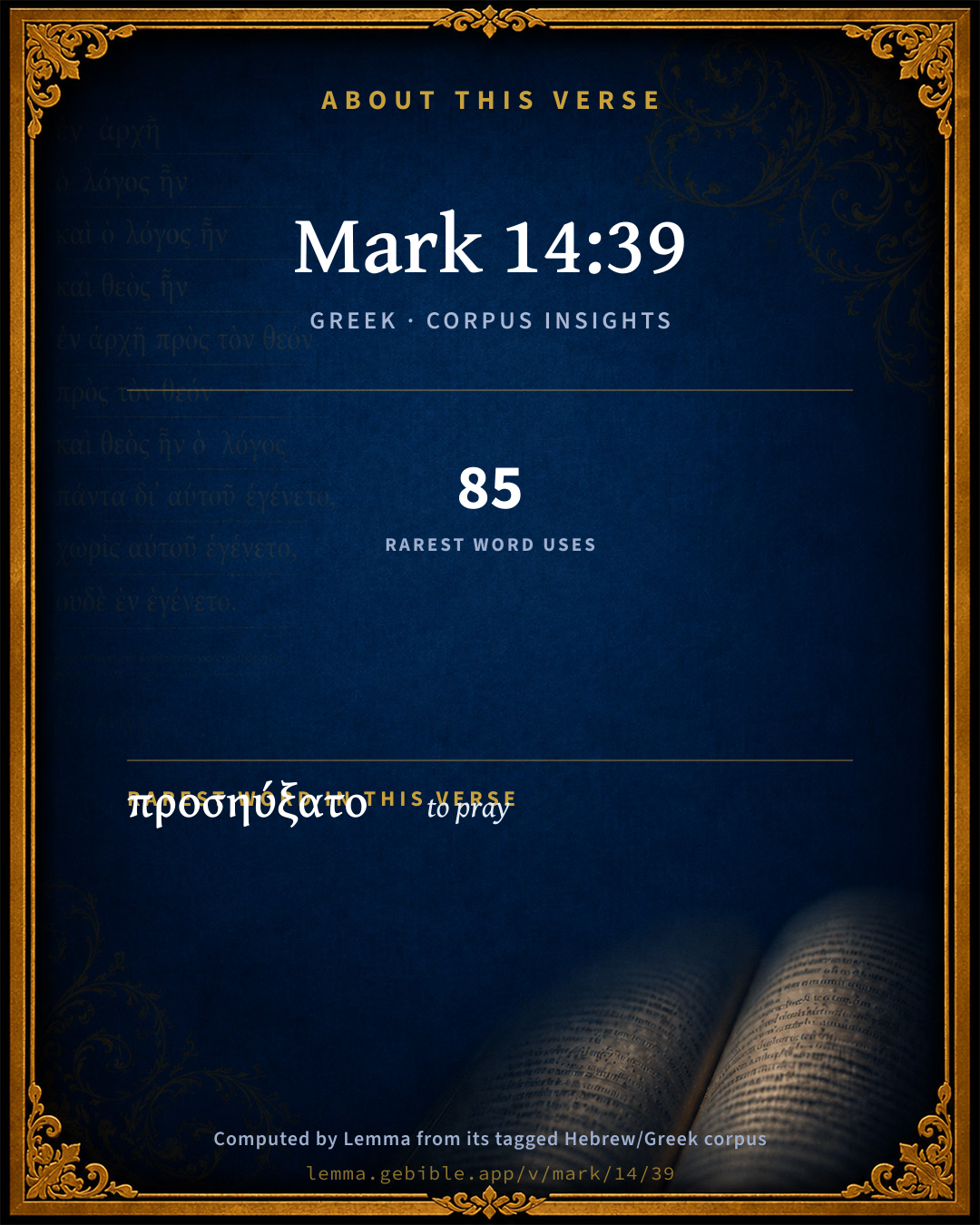
Mark, in the Gospels, opens this verse with 8 words (8 distinct Greek lemmas). Its most distinctive word is proseúchomai (“to pray”). A historical commentator’s framing appears above. Read the whole chapter for the surrounding context.

Discussion questions

  1. How does “to pray” (proseúchomai) shape what this verse is saying?
  2. Matthew 26:42–44 shares this passage’s theme. How do the two illuminate each other?
  3. These translations render this verse differently; the difference is in the English rendering, not the original. What questions does that raise?
  4. Reading how The Biblical Illustrator and Joseph Benson's Commentary read this verse, where do the two commentators agree and where do they part?

Things to notice

Reading settings

Reading text

Shown beneath each verse's original-language words.

Old Testament
Old Testament edition

Read the OT as the Masoretic Hebrew (MT) or the Greek Septuagint (LXX).

English shown for the Greek Septuagint (in the Hebrew ↔ Greek comparison).

Comparing translations? Open the Compare panel on any verse page to stack up to four side by side.