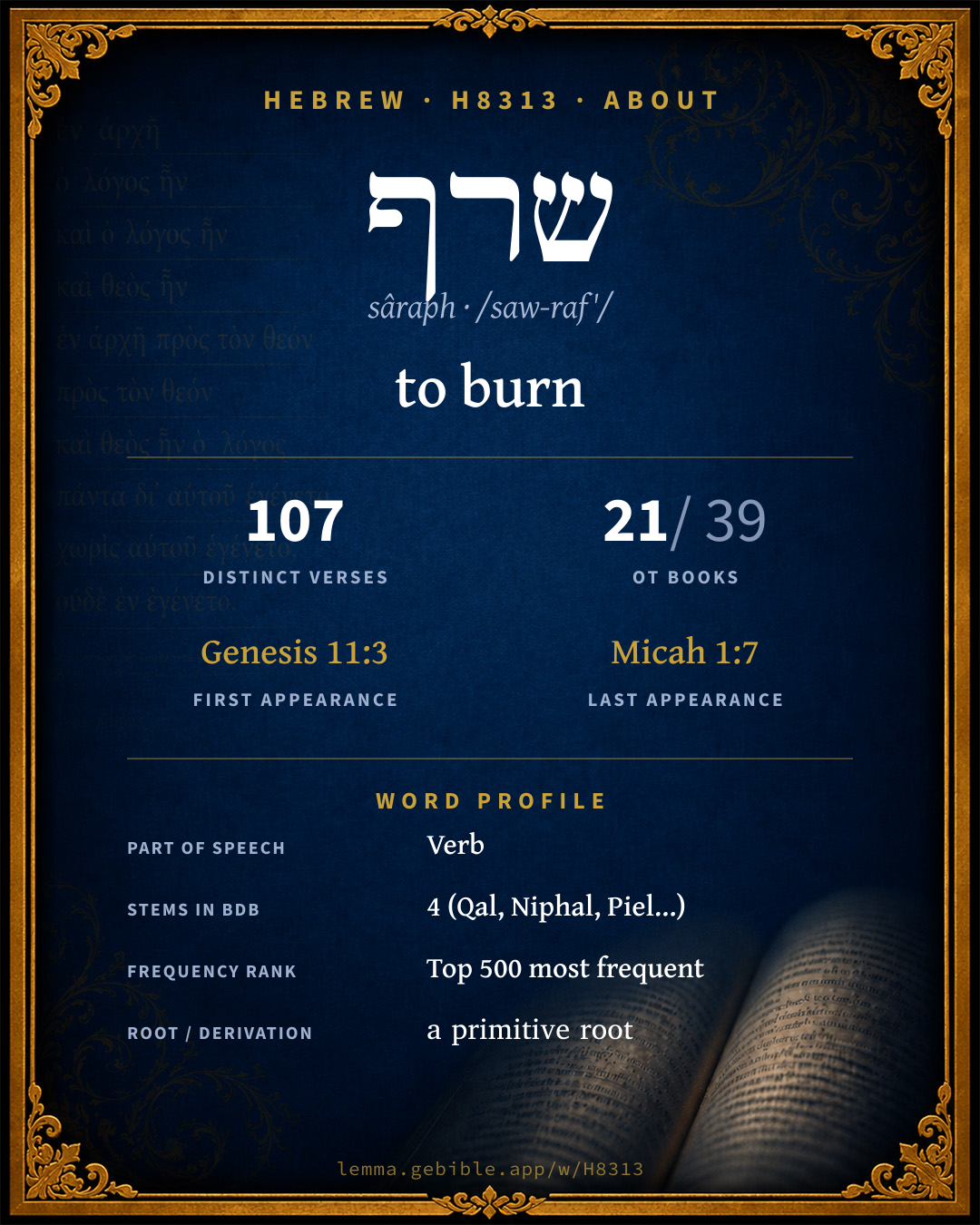
שָׂרַף
to burn
‘to burn’ is one of 5 main senses fuller range ↓
Full lexicon entry — Brown-Driver-Briggs (BDB)
From Brown-Driver-Briggs (BDB)
Where this word appears
See every Qal verb in the Hebrew Bible →
Grammar key — what these labels mean
Part of speech
- Verb
- An action or state-of-being word.
Stem
- Qal
- The basic, simple active stem — the plain form of the verb (“he wrote”). Here: ‘in making bricks’
- Niphal
- Usually the simple passive or reflexive of the Qal (“he was written”).
- Pual
- The passive counterpart of the Piel.
Form
- Perfect
- A completed action or state — Hebrew marks aspect (completeness) more than strict tense (“he wrote”).
- Sequential Imperfect
- An imperfect with prefixed waw — the standard past-narrative form (waw-consecutive imperfect).
- Imperfect
- An incomplete, ongoing, or future action (“he will / would write”).
- Sequential Perfect
- A perfect with prefixed waw continuing a preceding imperfect or command (waw-consecutive perfect).
- Participle Active
- A verbal adjective expressing ongoing or characteristic action (“writing / one who writes”).
- Infinitive Construct
- A bound verbal noun, frequently with prepositions (“to write / in writing”).
- Participle Passive
- A verbal adjective expressing action received (“written”).
- Cohortative
- A first-person volitional form expressing wish or resolve (“let me / let us write”).
- Infinitive Absolute
- An unbound verbal noun, often intensifying or standing in for a finite verb.
State
- Absolute
- The independent form of a noun, not bound to a following word.
Person
- 3rd Person
- The one spoken about (“he / she / it / they”).
- 2nd Person
- The one addressed (“you”).
- 1st Person
- The speaker (“I / we”).
Gender
- Masculine
- Grammatically masculine.
- Common
- Either gender — not distinguished for this form.
- Feminine
- Grammatically feminine.
Number
- Singular
- One.
- Plural
- More than one (in Hebrew, generally three or more).
Grammatical forms 32 distinct
- Verb, Qal, Perfect, 3rd Person, Masculine, Singular 17 times (15%)
- Verb, Qal, Sequential Imperfect, 3rd Person, Masculine, Singular 13 times (11%)
- Verb, Qal, Perfect, 3rd Person, Common, Plural 7 times (6%)
- Verb, Qal, Sequential Imperfect, 3rd Person, Masculine, Plural 7 times (6%)
- Verb, Qal, Sequential Perfect, 3rd Person, Common, Plural 7 times (6%)
- Verb, Qal, Sequential Perfect, 3rd Person, Masculine, Singular 7 times (6%)
- Verb, Qal, Infinitive Construct 6 times (5%)
- Verb, Niphal, Imperfect, 3rd Person, Masculine, Singular 5 times (4%)
+24 more forms (48 occurrences)
Parsed forms decoded from the imported morphology (morphhb / Westminster Leningrad Codex — WLC text public domain, morphhb tagging CC BY 4.0), counted across 117 parsed occurrences — not distinct verses.
Every verse where H8313 appears — 107 distinct verses across 21 books. Click any verse to open its interlinear word-by-word view. Verse text shown in the World English Bible for context — . Each verse’s Hebrew form is shown with its reference; the English is not keyword-highlighted, since the data carries no word-level English alignment. Use “Compare translations” on any verse to read it across multiple English versions. This concordance covers the Hebrew Bible; Septuagint (Greek Old Testament) occurrences are not indexed here.
Genesis 2 verses
- Genesis 11:3 וְ/נִשְׂרְפָ֖ה conj + Qal coh 1cp They said one to another, "Come, let's make brick, and burn them thoroughly." They had brick for stone, and they used tar for mortar.
- Genesis 38:24 וְ/תִשָּׂרֵֽף conj + Niphal impf 3fs It happened about three months later, that it was told Judah, saying, "Tamar, your daughter-in-law, has played the prostitute; and moreover, behold, she is with child by prostitution." Judah said, "Bring her forth, and let her be burnt."
Exodus 4 verses
- Exodus 12:10 תִּשְׂרֹֽפוּ Qal impf 2mp You shall let nothing of it remain until the morning; but that which remains of it until the morning you shall burn with fire.
- Exodus 29:14 תִּשְׂרֹ֣ף Qal impf 2ms But the flesh of the bull, and its skin, and its dung, you shall burn with fire outside of the camp: it is a sin-offering.
- Exodus 29:34 וְ/שָׂרַפְתָּ֤ conj + Qal wpf 2ms If anything of the flesh of the consecration, or of the bread, remains to the morning, then you shall burn the remainder with fire: it shall not be eaten, because it is holy.
- Exodus 32:20 וַ/יִּשְׂרֹ֣ף conj + Qal wimpf 3ms He took the calf which they had made, and burnt it with fire, ground it to powder, and scattered it on the water, and made the children of Israel drink of it.
Leviticus 18 verses
- Leviticus 4:12 וְ/שָׂרַ֥ף יִשָּׂרֵֽף conj + Qal pf 3ms Niphal impf 3ms even the whole bull shall he carry forth outside the camp to a clean place, where the ashes are poured out, and burn it on wood with fire. Where the ashes are poured out it shall be burned.
- Leviticus 4:21 וְ/שָׂרַ֣ף שָׂרַ֔ף conj + Qal wpf 3ms Qal pf 3ms He shall carry forth the bull outside the camp, and burn it as he burned the first bull. It is the sin offering for the assembly.
- Leviticus 6:30 תִּשָּׂרֵֽף Niphal impf 3fs No sin offering, of which any of the blood is brought into the Tent of Meeting to make atonement in the Holy Place, shall be eaten: it shall be burned with fire.
- Leviticus 7:17 יִשָּׂרֵֽף Niphal impf 3ms but what remains of the flesh of the sacrifice on the third day shall be burned with fire.
- Leviticus 7:19 יִשָּׂרֵ֑ף Niphal impf 3ms "'The flesh that touches any unclean thing shall not be eaten. It shall be burned with fire. As for the flesh, everyone who is clean may eat it;
- Leviticus 8:17 שָׂרַ֣ף Qal pf 3ms But the bull, and its skin, and its flesh, and its dung, he burned with fire outside the camp; as Yahweh commanded Moses.
- Leviticus 8:32 תִּשְׂרֹֽפוּ Qal impf 2mp What remains of the flesh and of the bread you shall burn with fire.
- Leviticus 9:11 שָׂרַ֣ף Qal pf 3ms The flesh and the skin he burned with fire outside the camp.
- Leviticus 10:6 שָׂרַ֥ף Qal pf 3ms Moses said to Aaron, and to Eleazar and to Ithamar, his sons, "Don't let the hair of your heads go loose, neither tear your clothes; that you don't die, and that he not be angry with all the congregation: but let your brothers, the whole house of Israel, bewail the burning which Yahweh has kindled.
- Leviticus 10:16 שֹׂרָ֑ף Pual pf 3ms Moses diligently inquired about the goat of the sin offering, and, behold, it was burned: and he was angry with Eleazar and with Ithamar, the sons of Aaron who were left, saying,
- Leviticus 13:52 וְ/שָׂרַ֨ף תִּשָּׂרֵֽף conj + Qal wpf 3ms Niphal impf 3fs He shall burn the garment, whether the warp or the woof, in wool or in linen, or anything of skin, in which the plague is: for it is a destructive mildew. It shall be burned in the fire.
- Leviticus 13:55 תִּשְׂרְפֶ֑/נּוּ Qal impf 2ms + sfx pers 3ms Then the priest shall examine it, after the plague is washed; and, behold, if the plague hasn't changed its color, and the plague hasn't spread, it is unclean; you shall burn it in the fire. It is a mildewed spot, whether the bareness is inside or outside.
- Leviticus 13:57 תִּשְׂרְפֶ֔/נּוּ Qal impf 2ms + sfx pers 3ms and if it appears again in the garment, either in the warp, or in the woof, or in anything of skin, it is spreading. You shall burn with fire that in which the plague is.
- Leviticus 16:27 וְ/שָׂרְפ֣וּ conj + Qal wpf 3cp The bull for the sin offering, and the goat for the sin offering, whose blood was brought in to make atonement in the Holy Place, shall be carried forth outside the camp; and they shall burn their skins, their flesh, and their dung with fire.
- Leviticus 16:28 וְ/הַ/שֹּׂרֵ֣ף conj + ptcl def.art + Qal ptcp.act ms He who burns them shall wash his clothes, and bathe his flesh in water, and afterward he shall come into the camp.
- Leviticus 19:6 יִשָּׂרֵֽף Niphal impf 3ms It shall be eaten the same day you offer it, and on the next day: and if anything remains until the third day, it shall be burned with fire.
- Leviticus 20:14 יִשְׂרְפ֤וּ Qal impf 3mp "'If a man takes a wife and her mother, it is wickedness: they shall be burned with fire, both he and they; that there may be no wickedness among you.
- Leviticus 21:9 תִּשָּׂרֵֽף Niphal impf 3fs "'The daughter of any priest, if she profanes herself by playing the prostitute, she profanes her father: she shall be burned with fire.
Numbers 4 verses
- Numbers 16:39 הַ/שְּׂרֻפִ֑ים ptcl def.art + Qal ptcp.pass mp Eleazar the priest took the brazen censers, which those who were burnt had offered; and they beat them out for a covering of the altar,
- Numbers 19:5 וְ/שָׂרַ֥ף יִשְׂרֹֽף conj + Qal wpf 3ms Qal impf 3ms One shall burn the heifer in his sight; her skin, and her flesh, and her blood, with her dung, shall he burn:
- Numbers 19:8 וְ/הַ/שֹּׂרֵ֣ף conj + ptcl def.art + Qal ptcp.act ms He who burns her shall wash his clothes in water, and bathe his flesh in water, and shall be unclean until the even.
- Numbers 31:10 שָׂרְפ֖וּ Qal pf 3cp All their cities in the places in which they lived, and all their encampments, they burnt with fire.
Deuteronomy 6 verses
- Deuteronomy 7:5 תִּשְׂרְפ֥וּ/ן Qal impf 2mp + sfx n But thus shall you deal with them: you shall break down their altars, and dash in pieces their pillars, and hew down their Asherim, and burn their engraved images with fire.
- Deuteronomy 7:25 תִּשְׂרְפ֣וּ/ן Qal impf 2mp + sfx n The engraved images of their gods shall you burn with fire: you shall not covet the silver or the gold that is on them, nor take it to you, lest you be snared therein; for it is an abomination to Yahweh your God.
- Deuteronomy 9:21 וָ/אֶשְׂרֹ֣ף conj + Qal wimpf 1cs I took your sin, the calf which you had made, and burnt it with fire, and stamped it, grinding it very small, until it was as fine as dust: and I cast the dust of it into the brook that descended out of the mountain.
- Deuteronomy 12:3 תִּשְׂרְפ֣וּ/ן Qal impf 2mp + sfx n and you shall break down their altars, and dash in pieces their pillars, and burn their Asherim with fire; and you shall cut down the engraved images of their gods; and you shall destroy their name out of that place.
- Deuteronomy 12:31 יִשְׂרְפ֥וּ Qal impf 3mp You shall not do so to Yahweh your God: for every abomination to Yahweh, which he hates, have they done to their gods; for even their sons and their daughters do they burn in the fire to their gods.
- Deuteronomy 13:16 וְ/שָׂרַפְתָּ֨ conj + Qal wpf 2ms You shall gather all the spoil of it into the midst of the street of it, and shall burn with fire the city, and all the spoil of it every whit, to Yahweh your God: and it shall be a heap forever; it shall not be built again.
Joshua 8 verses
- Joshua 6:24 שָׂרְפ֥וּ Qal pf 3cp They burnt the city with fire, and all that was therein; only the silver, and the gold, and the vessels of brass and of iron, they put into the treasury of the house of Yahweh.
- Joshua 7:15 יִשָּׂרֵ֣ף Niphal impf 3ms It shall be, that he who is taken with the devoted thing shall be burnt with fire, he and all that he has; because he has transgressed the covenant of Yahweh, and because he has done folly in Israel.
- Joshua 7:25 וַ/יִּשְׂרְפ֤וּ conj + Qal wimpf 3mp Joshua said, Why have you troubled us? Yahweh shall trouble you this day. All Israel stoned him with stones; and they burned them with fire, and stoned them with stones.
- Joshua 8:28 וַ/יִּשְׂרֹ֥ף conj + Qal wimpf 3ms So Joshua burnt Ai, and made it a heap forever, even a desolation, to this day.
- Joshua 11:6 תִּשְׂרֹ֥ף Qal impf 2ms Yahweh said to Joshua, Don't be afraid because of them; for tomorrow at this time will I deliver them up all slain before Israel: you shall hamstring their horses, and burn their chariots with fire.
- Joshua 11:9 שָׂרַ֥ף Qal pf 3ms Joshua did to them as Yahweh bade him: he hamstrung their horses, and burnt their chariots with fire.
- Joshua 11:11 שָׂרַ֥ף Qal pf 3ms They struck all the souls who were therein with the edge of the sword, utterly destroying them; there was none left who breathed: and he burnt Hazor with fire.
- Joshua 11:13 שְׂרָפָ֖/ם שָׂרַ֥ף Qal pf 3ms + sfx pers 3mp Qal pf 3ms But as for the cities that stood on their mounds, Israel burned none of them, save Hazor only; that did Joshua burn.
Judges 5 verses
- Judges 9:52 לְ/שָׂרְפ֥/וֹ prep + Qal inf.cs + sfx pers 3ms Abimelech came to the tower, and fought against it, and drew near to the door of the tower to burn it with fire.
- Judges 12:1 נִשְׂרֹ֥ף Qal impf 1cp The men of Ephraim were gathered together, and passed northward; and they said to Jephthah, Why did you pass over to fight against the children of Ammon, and didn't call us to go with you? we will burn your house on you with fire.
- Judges 14:15 נִשְׂרֹ֥ף Qal impf 1cp It happened on the seventh day, that they said to Samson's wife, Entice your husband, that he may declare to us the riddle, lest we burn you and your father's house with fire: have you called us to impoverish us? is it not [so]?
- Judges 15:6 וַ/יִּשְׂרְפ֥וּ conj + Qal wimpf 3mp Then the Philistines said, Who has done this? They said, Samson, the son-in-law of the Timnite, because he has taken his wife, and given her to his companion. The Philistines came up, and burnt her and her father with fire.
- Judges 18:27 שָׂרְפ֥וּ Qal pf 3cp They took that which Micah had made, and the priest whom he had, and came to Laish, to a people quiet and secure, and struck them with the edge of the sword; and they burnt the city with fire.
1 Samuel 4 verses
- 1 Samuel 30:1 וַ/יִּשְׂרְפ֥וּ conj + Qal wimpf 3mp It happened, when David and his men were come to Ziklag on the third day, that the Amalekites had made a raid on the South, and on Ziklag, and had struck Ziklag, and burned it with fire,
- 1 Samuel 30:3 שְׂרוּפָ֖ה Qal ptcp.pass fs When David and his men came to the city, behold, it was burned with fire; and their wives, and their sons, and their daughters, were taken captive.
- 1 Samuel 30:14 שָׂרַ֥פְנוּ Qal pf 1cp We made a raid on the South of the Cherethites, and on that which belongs to Judah, and on the South of Caleb; and we burned Ziklag with fire.
- 1 Samuel 31:12 וַ/יִּשְׂרְפ֥וּ conj + Qal wimpf 3mp all the valiant men arose, and went all night, and took the body of Saul and the bodies of his sons from the wall of Beth-shan; and they came to Jabesh, and burnt them there.
2 Samuel 1 verse
1 Kings 4 verses
- 1 Kings 9:16 וַ/יִּשְׂרְפָ֣/הּ conj + Qal wimpf 3ms + sfx pers 3fs Pharaoh king of Egypt had gone up, and taken Gezer, and burnt it with fire, and slain the Canaanites who lived in the city, and given it for a portion to his daughter, Solomon's wife.
- 1 Kings 13:2 יִשְׂרְפ֥וּ Qal impf 3mp He cried against the altar by the word of Yahweh, and said, altar, altar, thus says Yahweh: Behold, a son shall be born to the house of David, Josiah by name; and on you shall he sacrifice the priests of the high places who burn incense on you, and men's bones shall they burn on you.
- 1 Kings 15:13 וַ/יִּשְׂרֹ֖ף conj + Qal wimpf 3ms Also Maacah his mother he removed from being queen, because she had made an abominable image for an Asherah; and Asa cut down her image, and burnt it at the brook Kidron.
- 1 Kings 16:18 וַ/יִּשְׂרֹ֨ף conj + Qal wimpf 3ms It happened, when Zimri saw that the city was taken, that he went into the castle of the king's house, and burnt the king's house over him with fire, and died,
2 Kings 9 verses
- 2 Kings 10:26 וַֽ/יִּשְׂרְפֽוּ/הָ conj + Qal wimpf 3mp + sfx pers 3fs They brought forth the pillars that were in the house of Baal, and burned them.
- 2 Kings 17:31 שֹׂרְפִ֤ים Qal ptcp.act mp and the Avvites made Nibhaz and Tartak; and the Sepharvites burnt their children in the fire to Adrammelech and Anammelech, the gods of Sepharvaim.
- 2 Kings 23:4 וַֽ/יִּשְׂרְפֵ֞/ם conj + Qal wimpf 3ms + sfx pers 3mp The king commanded Hilkiah the high priest, and the priests of the second order, and the keepers of the threshold, to bring forth out of the temple of Yahweh all the vessels that were made for Baal, and for the Asherah, and for all the host of the sky, and he burned them outside of Jerusalem in the fields of the Kidron, and carried the ashes of them to Bethel.
- 2 Kings 23:6 וַ/יִּשְׂרֹ֥ף conj + Qal wimpf 3ms He brought out the Asherah from the house of Yahweh, outside of Jerusalem, to the brook Kidron, and burned it at the brook Kidron, and beat it to dust, and cast the dust of it on the graves of the common people.
- 2 Kings 23:11 שָׂרַ֥ף Qal pf 3ms He took away the horses that the kings of Judah had given to the sun, at the entrance of the house of Yahweh, by the chamber of Nathan-melech the chamberlain, which was in the precincts; and he burned the chariots of the sun with fire.
- 2 Kings 23:15 וַ/יִּשְׂרֹ֧ף וְ/שָׂרַ֥ף conj + Qal wimpf 3ms conj + Qal pf 3ms Moreover the altar that was at Bethel, and the high place which Jeroboam the son of Nebat, who made Israel to sin, had made, even that altar and the high place he broke down; and he burned the high place and beat it to dust, and burned the Asherah.
- 2 Kings 23:16 וַ/יִּשְׂרֹ֥ף conj + Qal wimpf 3ms As Josiah turned himself, he spied the tombs that were there in the mountain; and he sent, and took the bones out of the tombs, and burned them on the altar, and defiled it, according to the word of Yahweh which the man of God proclaimed, who proclaimed these things.
- 2 Kings 23:20 וַ/יִּשְׂרֹ֛ף conj + Qal wimpf 3ms He killed all the priests of the high places that were there, on the altars, and burned men's bones on them; and he returned to Jerusalem.
- 2 Kings 25:9 וַ/יִּשְׂרֹ֥ף שָׂרַ֥ף conj + Qal wimpf 3ms Qal pf 3ms He burnt the house of Yahweh, and the king's house; and all the houses of Jerusalem, even every great house, burnt he with fire.
1 Chronicles 1 verse
2 Chronicles 4 verses
- 2 Chronicles 15:16 וַ/יִּשְׂרֹ֖ף conj + Qal wimpf 3ms Also Maacah, the mother of Asa the king, he removed from being queen, because she had made an abominable image for an Asherah; and Asa cut down her image, and made dust of it, and burnt it at the brook Kidron.
- 2 Chronicles 16:14 וַ/יִּשְׂרְפוּ conj + Qal wimpf 3mp They buried him in his own tombs, which he had hewn out for himself in the city of David, and laid him in the bed which was filled with sweet odors and various kinds [of spices] prepared by the perfumers' are: and they made a very great burning for him.
- 2 Chronicles 34:5 שָׂרַ֖ף Qal pf 3ms He burnt the bones of the priests on their altars, and purged Judah and Jerusalem.
- 2 Chronicles 36:19 וַֽ/יִּשְׂרְפוּ֙ שָׂרְפ֣וּ conj + Qal wimpf 3mp Qal pf 3cp They burnt the house of God, and broke down the wall of Jerusalem, and burnt all the palaces of it with fire, and destroyed all the goodly vessels of it.
Nehemiah 1 verse
Psalms 3 verses
- Psalms 46:9 יִשְׂרֹ֥ף Qal impf 3ms He makes wars cease to the end of the earth. He breaks the bow, and shatters the spear. He burns the chariots in the fire.
- Psalms 74:8 שָׂרְפ֖וּ Qal pf 3cp They said in their heart, "We will crush them completely." They have burned up all the places in the land where God was worshiped.
- Psalms 80:16 שְׂרֻפָ֣ה Qal ptcp.pass fs It's burned with fire. It's cut down. They perish at your rebuke.
Proverbs 1 verse
Isaiah 4 verses
- Isaiah 1:7 שְׂרֻפ֣וֹת Qal ptcp.pass fp Your country is desolate. Your cities are burned with fire. Strangers devour your land in your presence, And it is desolate, As overthrown by strangers.
- Isaiah 44:16 שָׂרַ֣ף Qal pf 3ms He burns part of it in the fire; with part of it he eats flesh; he roasts roast, and is satisfied; yes, he warms himself, and says, Aha, I am warm, I have seen the fire.
- Isaiah 44:19 שָׂרַ֣פְתִּי Qal pf 1cs None calls to mind, neither is there knowledge nor understanding to say, I have burned part of it in the fire; yes, also I have baked bread on the coals of it; I have roasted flesh and eaten it: and shall I make the residue of it an abomination? shall I fall down to the stock of a tree?
- Isaiah 47:14 שְׂרָפָ֔תַ/ם Qal pf 3fs + sfx pers 3mp Behold, they shall be as stubble; the fire shall burn them; they shall not deliver themselves from the power of the flame: it shall not be a coal to warm at, nor a fire to sit before.
Jeremiah 22 verses
- Jeremiah 7:31 לִ/שְׂרֹ֛ף prep + Qal inf.cs They have built the high places of Topheth, which is in the valley of the son of Hinnom, to burn their sons and their daughters in the fire; which I didn't command, neither came it into my mind.
- Jeremiah 19:5 לִ/שְׂרֹ֧ף prep + Qal inf.cs and have built the high places of Baal, to burn their sons in the fire for burnt offerings to Baal; which I didn't command, nor spoke it, neither came it into my mind:
- Jeremiah 21:10 וּ/שְׂרָפָ֖/הּ conj + Qal wpf 3ms + sfx pers 3fs For I have set my face on this city for evil, and not for good, says Yahweh: it shall be given into the hand of the king of Babylon, and he shall burn it with fire.
- Jeremiah 32:29 וּ/שְׂרָפ֑וּ/הָ conj + Qal wpf 3cp + sfx pers 3fs and the Chaldeans, who fight against this city, shall come and set this city on fire, and burn it, with the houses, on whose roofs they have offered incense to Baal, and poured out drink-offerings to other gods, to provoke me to anger.
- Jeremiah 34:2 וּ/שְׂרָפָ֖/הּ conj + Qal wpf 3ms + sfx pers 3fs Thus says Yahweh, the God of Israel, Go, and speak to Zedekiah king of Judah, and tell him, Thus says Yahweh, Behold, I will give this city into the hand of the king of Babylon, and he shall burn it with fire:
- Jeremiah 34:5 יִשְׂרְפוּ Qal impf 3mp you shall die in peace; and with the burnings of your fathers, the former kings who were before you, so shall they make a burning for you; and they shall lament you, [saying], Ah Lord! for I have spoken the word, says Yahweh.
- Jeremiah 34:22 וּ/שְׂרָפֻ֣/הָ conj + Qal wpf 3cp + sfx pers 3fs Behold, I will command, says Yahweh, and cause them to return to this city; and they shall fight against it, and take it, and burn it with fire: and I will make the cities of Judah a desolation, without inhabitant.
- Jeremiah 36:25 שְׂרֹ֖ף Qal inf.cs Moreover Elnathan and Delaiah and Gemariah had made intercession to the king that he would not burn the scroll; but he would not hear them.
- Jeremiah 36:27 שְׂרֹ֣ף Qal inf.cs Then the word of Yahweh came to Jeremiah, after that the king had burned the scroll, and the words which Baruch wrote at the mouth of Jeremiah, saying,
- Jeremiah 36:28 שָׂרַ֖ף Qal pf 3ms Take again another scroll, and write in it all the former words that were in the first scroll, which Jehoiakim the king of Judah has burned.
- Jeremiah 36:29 שָׂרַ֜פְתָּ Qal pf 2ms Concerning Jehoiakim king of Judah you shall say, Thus says Yahweh: You have burned this scroll, saying, Why have you written therein, saying, The king of Babylon shall certainly come and destroy this land, and shall cause to cease from there man and animal?
- Jeremiah 36:32 שָׂרַ֛ף Qal pf 3ms Then took Jeremiah another scroll, and gave it to Baruch the scribe, the son of Neriah, who wrote therein from the mouth of Jeremiah all the words of the book which Jehoiakim king of Judah had burned in the fire; and there were added besides to them many like words.
- Jeremiah 37:8 וּ/שְׂרָפֻ֥/הָ conj + Qal wpf 3cp + sfx pers 3fs The Chaldeans shall come again, and fight against this city; and they shall take it, and burn it with fire.
- Jeremiah 37:10 וְ/שָֽׂרְפ֛וּ conj + Qal wpf 3cp For though you had struck the whole army of the Chaldeans who fight against you, and there remained but wounded men among them, yes would they rise up every man in his tent, and burn this city with fire.
- Jeremiah 38:17 תִשָּׂרֵ֖ף Niphal impf 3fs Then said Jeremiah to Zedekiah, Thus says Yahweh, the God of hosts, the God of Israel: If you will go forth to the king of Babylon's princes, then your soul shall live, and this city shall not be burned with fire; and you shall live, and your house.
- Jeremiah 38:18 וּ/שְׂרָפ֖וּ/הָ conj + Qal wpf 3cp + sfx pers 3fs But if you will not go forth to the king of Babylon's princes, then shall this city be given into the hand of the Chaldeans, and they shall burn it with fire, and you shall not escape out of their hand.
- Jeremiah 38:23 תִּשְׂרֹ֥ף Qal impf 3fs They shall bring out all your wives and your children to the Chaldeans; and you shall not escape out of their hand, but shall be taken by the hand of the king of Babylon: and you shall cause this city to be burned with fire.
- Jeremiah 39:8 שָׂרְפ֥וּ Qal pf 3cp The Chaldeans burned the king's house, and the houses of the people, with fire, and broke down the walls of Jerusalem.
- Jeremiah 43:12 וּ/שְׂרָפָ֖/ם conj + Qal wpf 3ms + sfx pers 3mp I will kindle a fire in the houses of the gods of Egypt; and he shall burn them, and carry them away captive: and he shall array himself with the land of Egypt, as a shepherd puts on his garment; and he shall go forth from there in peace.
- Jeremiah 43:13 יִשְׂרֹ֥ף Qal impf 3ms He shall also break the pillars of Beth-shemesh, that is in the land of Egypt; and the houses of the gods of Egypt shall he burn with fire.
- Jeremiah 51:32 שָׂרְפ֣וּ Qal pf 3cp and the passages are seized, and the reeds they have burned with fire, and the men of war are frightened.
- Jeremiah 52:13 וַ/יִּשְׂרֹ֥ף שָׂרַ֥ף conj + Qal wimpf 3ms Qal pf 3ms and he burned the house of Yahweh, and the king's house; and all the houses of Jerusalem, even every great house, burned he with fire.
Ezekiel 4 verses
- Ezekiel 5:4 וְ/שָׂרַפְתָּ֥ conj + Qal wpf 2ms Of these again shall you take, and cast them into the midst of the fire, and burn them in the fire; from it shall a fire come forth into all the house of Israel.
- Ezekiel 16:41 וְ/שָׂרְפ֤וּ conj + Qal wpf 3cp They shall burn your houses with fire, and execute judgments on you in the sight of many women; and I will cause you to cease from playing the prostitute, and you shall also give no hire any more.
- Ezekiel 23:47 יִשְׂרֹֽפוּ Qal impf 3mp The company shall stone them with stones, and dispatch them with their swords; they shall kill their sons and their daughters, and burn up their houses with fire.
- Ezekiel 43:21 וּ/שְׂרָפ/וֹ֙ conj + Qal wpf 3ms + sfx pers 3ms You shall also take the bull of the sin-offering, and it shall be burnt in the appointed place of the house, outside of the sanctuary.
Amos 1 verse
Micah 1 verse
About this entry
At a glance — auto-summarized from this page’s data, not written by a person. Every figure links to its source below. This summary describes the numbers; it doesn’t interpret them.
שרף (sâraph) is a Hebrew verb most often rendered “to burn.” Its English rendering has broadened — “burn” classically, “burned” (Berean Standard Bible) and “he burned” (unfoldingWord Literal Text) in modern versions; see the renderings breakdown. Spanning 107 verses in 21 books, it ranks among the common words of the Hebrew Bible. It first appears in Genesis 11:3. As a verb its force shifts by stem, across 4 stems (Qal, Niphal, and more). The sections below give every sense, occurrence, and version rendering.
Gloss history
Strong's 1890 vs modern scholarship
About this word
Strong's H8313 catalogs a Hebrew word from the Hebrew Old Testament.
These counts are not copied from any lexicon or concordance. They are computed here, from the morphology-tagged Hebrew Old Testament. What Lemma adds →
- 107
- distinct verses
- The word appears in 107 distinct verses.
- 21 / 39
- OT books
- The word appears in 21 of 39 Old Testament books.
- #372
- by frequency
- Top 500 most frequent Hebrew words (rank 372 of 8,640 Hebrew words by occurrence).
View all 107 occurrences in the concordance →
By section of the Old Testament
By traditional corpus
Conventional, traditional groupings — biblical authorship is debated, so this is a traditional corpus grouping, not an authorship claim. Each share is this word’s portion of its verses in that division of the Hebrew canon. Each figure is a share of the word’s 107 distinct verses.
- Prophets (Nevi'im) 63 verses · 59%
- Torah (Pentateuch) 34 verses · 32%
- Writings (Ketuvim) 10 verses · 9%
How translations render this word
Counts come from each version’s own published word-to-Strong’s tagging or interlinear alignment — an approximate guide to how each version renders this word, not a word-level alignment the data otherwise carries. Because each total is that version’s own tagged count, the per-version totals vary from one another and need not match the appearance or distinct-verse counts above. These counts may also differ from a printed concordance because Lemma counts each distinctly tagged rendering and does not collapse phrase taggings into a single head-word total. This is a fixed set of word-tagged versions (KJV, ASV, BSB, ULT) and does not change with the reading translation you choose elsewhere. Each version’s license is shown beside its name below (and on Sources).
- King James Version: Burn 15×, Burnt 14×, Burned 13×
- American Standard Version: Burn 12×, Burnt 11×, Burned 8×
- Berean Standard Bible: Burned 10×, Burn 8×, He burned 7×
- unfoldingWord Literal Text: He burned 15×, Burned 9×, They burned 9×
King James Version Public Domain
Renders H8313 across 117 tagged occurrences — most commonly:
Plus other, less common renderings. Plus 35 renderings that appear only once — usually multi-word phrases or single function words the recovered tagging swept in, not distinct renderings.
American Standard Version Public Domain
Renders H8313 across 116 tagged occurrences — most commonly:
Plus other, less common renderings. Plus 41 renderings that appear only once — usually multi-word phrases or single function words the recovered tagging swept in, not distinct renderings.
Berean Standard Bible Public Domain
Renders H8313 across 109 tagged occurrences — most commonly:
Plus other, less common renderings. Plus 42 renderings that appear only once — usually multi-word phrases or single function words the recovered tagging swept in, not distinct renderings. Not rendered by a distinct English word in 8 further occurrences.
unfoldingWord Literal Text CC BY-SA 4.0
Renders H8313 across 102 tagged occurrences — most commonly:
Plus other, less common renderings. Plus 31 renderings that appear only once — usually multi-word phrases or single function words the recovered tagging swept in, not distinct renderings.
7 senses and sub-senses in the full BDB
Hebrew verbs can shift meaning by stem (binyan): Qal is the basic action, Niphal is often passive or reflexive, Piel often intensifies or makes it factitive, and Hiphil is typically causative. The senses below are grouped under the stem BDB assigns to each. This entry also uses Pual (the passive of Piel).
What do BDB’s symbols mean?
BDB uses these scholarly abbreviations:
| Symbol | Meaning |
|---|---|
| 𝔊 | the Septuagint (the ancient Greek translation, LXX) |
| 𝔙 | the Vulgate (the Latin translation) |
| 𝔖 | the Syriac version (the Peshitta) |
| 𝔗 | the Targum (the Aramaic translation) |
| ψ | the Psalms |
| √ | root (the underlying root or stem) |
| ‖ | parallel passage (a synonymous or contrasted parallel) |
| † | the dagger: every passage where the word occurs is cited |
The 7 senses and sub-senses the full Brown-Driver-Briggs lexicon distinguishes for this word, in lexicon order (not ranked by frequency), with BDB’s own verbatim wording and sub-sense lettering. Shown in Hebrew script with BDB’s own scholarly abbreviations. The condensed entry is in the Lexicon Entry tab. See also the Forms in the corpus table below.
Qal
- Pf. 3 ms. שׂ׳ Jos 11:9 +, 3 fs. sf. שְׂרָפָ֫תַם Is 47:14, etc.; Impf. 3 ms. יִשְׂרֹף Nu 19:5 + 2 times, more often וַיִּשְׂרֹף Ex 32:20 +, 2 mpl. תִּשְׂרְפוּן Dt 7:5 + 2 times; Inf. abs. שָׂרוֹף 2 S 23:7; cstr. שְׂרֹף Je 36:25 +; sf. שָׂרְפוֹ Ju 9:52; Am 2:1; Pt. act. שֹׂרֵף Lv 16:28; Nu 19:8, pl. שֹׂרְפִים 2 K 17:31; pass. mpl. שְׂרֻפִים Nu 17:4; fs. שְׂרוּפָה 1 S 30:3, שְׂרֻפָה ψ 80:17, pl. שְׂרוּפוֹת Ne 3:34, cstr. שְׂרֻפוֹת Is 1:7;—burn (59 times + בָּאֵשׁ, 2 times + בְּמוֹ־אֵשׁ): e.g. Joshua 11:9
- 1. in making bricks, + לִשְׂרֵפָה Gn 11:3 (J; obj. om.). e.g. Genesis 11:3
- 2.
- a. c. acc. rei, usually to destroy, e.g. door Ju 9:52, house Ju 12:1; 1 K 16:18 (both c. עַל pers.), Je 39:8 + 11 times, cf. pt. pass. Ne 3:24, city Jos 6:24 1 S 30:1, 14 + 16 times, cf. pt. pass. 1 S 30:3; Is 1:7, chariots Jos 11:6, 9 2 K 23:11 ψ 46:10 (subj. י׳), idols, etc., Ex 32:20 (acc. om.), Dt 9:21 + 10 times, roll †Je 36:25, 27, 28, 29, 32, wood †Is 44:16, 19 (both + בְּמוֹ־אֵשׁ), cf. ψ 80:17 (fig.), Je 51:32, hair †Ez 5:4; bones, to lime (as outrage) †Am 2:1; upon altars (in desecration) †1 K 13:2; 2 K 23:16, 20 = 2 Ch 34:5; bodies, as funeral rite † 1 S 31:12 (rare custom, RSSem i. 353; 2nd ed. 372; but Klo Bu read יִשְׂפְּדוּ [= יִס׳]; cf. BenzArch. 163; Ency. Bib. Dead NowArch. i. 188); שׂ׳ as funeral rite also (obj. om., prob spices, cf. 2 Ch 16:14), †c. ל pers. mort. Je 34:5, + acc. cogn. שְׂרֵפָה 2 Ch 16:14 (cf. שְׂרֵפָה); in ceremonial of P (never of burning sacrif. on altar, הִקְטִיר, cf. הֶעֱלָה, but) chiefly (14 times) of consuming refuse, especially unused portions of victims, etc. (to prevent use), and infected objects, Ex 29:14, 34 +, sometimes מִחוּץ לַמַּחֲנֶה Lv 4:12 (+ עַל־עֵצִים), v 21(×2) + 4 times, etc., cf. Ez 43:21; also of burning red heifer (to produce ashes for purification) Nu 19:5(×2), 8. e.g. Judges 9:52
- b. burn, c. acc. pers., (1) as penalty Jos 7:25 (JE), Ju 14:15; 15:6 Lv 20:14, cf. Nu 17:4 (pt. pass.), so, אֵשׁ subj., Is 47:14, c. acc. cogn. שְׂרֵפָה Lv 10:6 (P); (2) as sacrifice, Je 7:31; 19:5; + ל dei Dt 12:31; 2 K 17:31. e.g. Joshua 7:25
Niphal
- Impf. 3 ms. יִשָּׂרֵף Jos 7:15 +, 3 fpl. תִּשָּׂרַפְנָה Pr 6:27, etc.;—be burned (11 times + בָּאֵשׁ): of city Je 38:17 + v 23 (read תִּשָּׂרֵף for תִּשְׂרֹף 𝔊 𝔖 𝔗 Hi Ew Gf Gie Du), idols, etc., Mi 1:7; 1 Ch 14:12; ritually (cf. Qal 2 a ad fin.) Lv 4:12; 6:23; 7:17, 19; 13:52; 19:6; of pers., as penalty Gn 38:24 (J), Jos 7:15 (JE), 2 S 23:7 (poet.), Lv 21:9 (H). e.g. Joshua 7:15
Piel
- Pt. sf. מְסָֽרְפוֹ Am 6:10 his burner, usually one burning him, but prob. burning spices for him, v. Dr and cf. Qal supra. e.g. Amos 6:10
Pual
- Pf. 3 ms. שׂרָ֑ף, of goat Lv 10:16 it was burnt up (and gone). e.g. Leviticus 10:16
Senses from the full Brown-Driver-Briggs lexicon (Brown, Driver, Briggs; Oxford 1906 — public domain), digitized via Sefaria, supplemented by the OpenScriptures HebrewLexicon (CC BY 4.0). Full attribution on Sources.
Word origin
vb. burn (70 times + בָּאֵשׁ, 2 times + בְּמוֹ־אֵשׁ) (NH (rare) = BH; Assyrian šarâpu; Aramaic שְׂרַף (rare); ܣܪܰܦ is absorb, consume);—
— Brown-Driver-Briggs (Oxford 1906, public domain), digitized via Sefaria, supplemented by the OpenScriptures HebrewLexicon (CC BY 4.0). See Sources.
Origin: a primitive root
Jastrow Dictionary
A second Hebrew/Aramaic lexicon for comparison, covering Aramaic and post-biblical (Talmudic, Targumic, Midrashic) usage that the biblical-Hebrew BDB does not. Matched by lemma rather than by Strong’s number, so a lemma may carry more than one Jastrow headword (shown separately below), and the entries cover usage well beyond the Bible.
שָׂרַף I
- onomatop.) [to sip, absorb, v. שָׂרַף II,] to consume, burn. Pes. I, 4 ושׂוֹרְפִין … שש and the burning (of leavened matter) must take place at the beginning of the sixth hour. Ab. Zar. 11ᵃ שׂורְפִין על המלכים we do burning at the burial of kings; ומה הן שורפין וכ׳ and what is burnt? Their couch and their objects of service (armor &c.); Tosef. Snh. IV, 3; Tosef. Sabb. VII (VIII), 18; a. fr.—Part. pass. שָׂרוּף; f. שְׂרוּפָה &c. Nidd. 24ᵇ עצמותיו שְׂרוּפִין, v. שְׁתִיָּה I; a. e.
- to be burnt. Num. R. s. 236 ונ׳ על שמעל וכ׳ and he (Achan) was burned (after being stoned), because he had misappropriated devoted things. Pes. 34ᵇ יִשָּׂרֵף מיד must be burned at once. Tosef. ib. V, 8 כשם … אינו נִשְׂרָף וכ׳ as the wooden spit (on which the Passover lamb is roasted) does not burn, so the metal spit does not get hot. Zeb. XII, 5 בזמן שהם נִשְׂרָפִין כמצותן נשרפין וכ׳ when they are burned according to the law concerning them (and not because of a disqualification), they are burned in the ash-house. Ib. a. fr. פרים הנִשְׂרָפִים וכ׳ the bullock sacrifices which the law requires to be burned; a. fr.—[Y. Taan. I, 64ᵇ top תשרף, read תשרה, v. שָׁרָה I.]
שְׂרַף
- Targ. O. Gen. XI, 3 (some ed. ונוקדי׳, v. יְקַד).
- to be burned. Zeb. 16ᵃ שפיר אִישְׂתָּרוּף they would have been burned according to law; Yalk. Lev. 534. Gen. R. s. 38 (ref. to Gen. XI, 3) עתידין … מִשְׂתָּרְפָה מן וכ׳ these people are destined to be burned out of the world; Yalk. ib. 62; a. e.—Y. Sabb. IV, 7ᵃ top [read:] מצדתא הוו פריסן והוון מִשְׂטָרְפָן וכ׳ nets were spread, and they were burned in the sun. e.g. Genesis 11:3
שָׂרַף II
- (v.שָׂרַף I) to absorb, quaff, sip, suck. Ab. Zar. II, 5 (29ᵇ) שׂורְפָהּ חיה (not שורפו) sucks it (the maw) out raw, v. גְּמִי I; Cant. R. to I, 2.
שְׂרַף ²
- Naz. 36ᵇ אי דקא שָׂרֵיף ליה מִישְׂרַף if he quaffed it (swallowed it, instead of striking it on bread); Pes. 44ᵃ אי בעיניה דקשריף וקאכיל ליה (Ms. M. בעיניה קאכיל ליה) if he swallowed it in its natural condition, opp. שטר. Ker. 22ᵃ בשעה … מישרף שריף with the last breath of the animal, it (the heart) absorbs (the blood from the blood vessels). Taan. 24ᵇ ש׳ פינכא וכ׳ (Ms. M. טעים מידי, v. Rabb. D. S. a. l. note) he swallowed a dishful of grist. Ib. אי שְׂרִיף מר וכ׳ (v. Rabb. D. S. a. l. note 300) if you had swallowed &c. Ber. 62ᵃ כדלא ש׳ תבשילא as if he had never sipped a dish (never had had marital intercourse; Ḥag. 5ᵇ כמאן דלא טעים וכ׳).
שָׂרַף III
- Pi. שֵׂירֵף (denom. of שְׂרָף) to cover with resin. Tosef. Mikv. VI (VII), 21 שֵׂירְפָהּ בשרף (not שו׳; Var. סֵירְפָהּ) if he covered it (the handle of a saw) with resin.
שָׂרָף I
- burning, venomous serpent (v. Sm. Dict. s. v. Dipsas). Gen. R. s. 44; Lev. R. s. 13 (ref. to Deut. VIII, 15) ש׳ זו מדי saraf refers to Media; a. e.—Pl. שְׂרָפִים. Num. R. s. 1922 הנחשים הש׳ ששורפים את הנפש they are called burning serpents, because they burn the life out (with thirst); Yalk. ib. 764; Tanḥ. Ḥuck. 19. Num. R. s. 23, beg.; a. e. e.g. Deuteronomy 8:15
שָׂרָף II
- (b. h.) Seraph, an angel.—Pl. שְׂרָפִים. Ḥag. 12ᵇ. Pirké d’R. El. ch. IV. Deut. R. s. 11 בשעה שראו … ושַׂרְפֵי להבה וכ׳ when the wheels of the chariot and the flaming Seraphim saw &c. Pesik. R. s. 20; a. fr.
שָׂרָף
- same, v. סַרְפַיָּא.
שָׂרָף III
- (b. h.) pr. n. m. Saraph. B. Bath. 91ᵇ
שְׂרָף
- (שָׂרַף I) acrid substance, esp. vegetable sap made thick by inspissation; resin, gum (secreted by the heat of the sun). Ber. 44ᵃ כל סעודה שאין בה ש׳ וכ׳ Ms. M. (ed. שָׂרִיף) a meal without an acrid substance (bitter herbs &c.) is no meal. Pes. 39ᵃ, v. מַר II. Tosef. ib. I (II), 33 כל שיש בו ש׳ וכ׳ any plant which contains an acrid sap is fit to be used on the Passover night. Orl. I, 7 שְׂרַף העלים the sap of leaves; ש׳ העקרים of roots; ש׳ הפגים of unripe grapes. Y. ib. I, 61ᵇ bot. למה ש׳ פרי פגין פרי why (this difference in the law between resin and juice of unripe fruits)? resin is fruit and grapes are fruit. Ib. קטף בטל ע"י שִׂרְפּוֹ resin ceases to exist when its sap is pressed out; Y. Shebi. VII, end, 37ᶜ. Ib. אילן אינו בטל ע"ג שרפו the tree does not cease to exist when its sap is tapped. Ker. 6ᵃ; Sabb. 26ᵃ צרי אינו אלא ש׳ וכ׳ balsam is only a gum that drips from the balsam tree. Y. ib. II, 4ᵈ אין … מפני שהוא ש׳ you must not use balsam for the Sabbath light, because it is a gum. Gen. R. s. 94, v. סָפַג; Tanḥ. B’midbar 16 השבט (corr. acc.); a. e.—Trnsf. secretion, matter. Nidd. 10ᵇ זו שִׂירְפָּה מצוי וכ׳ with the one (the newly married virgin) secretion (from a wound caused by first coition) is frequent &c.; [oth. opin.: with the wife of older standing secretion is frequent].—Pl. שְׂרָפִים, שְׂרָפִין. Sabb. 23ᵃ כל הש׳ יפין וכ׳ all gums are good for ink, but the gum of the balsam tree is the best.
שְׂרַף II
- , esp. balsam. Targ. Y. Gen. XXXVII, 25 (h. text צרי). Ib. XLIII, 11 (h. text צרי).
A Dictionary of the Targumim, the Talmud Babli and Yerushalmi, and the Midrashic Literature (Marcus Jastrow; London, Luzac, 1903) — Public Domain. Digitized via Sefaria. Digitized via Sefaria. Full attribution on Sources.
Forms in the corpus
The 83 distinct written forms H8313 takes in the Hebrew Bible, most frequent first — each parse links to that stem’s occurrences in the concordance. Hebrew forms include their vowel points and cantillation, so a single lemma takes many written forms.
The 60 most common forms are shown; 23 rarer forms follow in the full concordance.
Same root — word family
Other BDB entries built from the same root as H8313, grouped by Strong’s listed origin. These share a root / origin per the lexicon — not necessarily a shared meaning. Each links to that word’s own entry.
Derived from this word
- משרפה misrâphâh H4955 burning
- רשף resheph H7565 flame
- שרף sârâph H8314 seraphim
- שרפה sᵉrêphâh H8316 burning
Compare all same-root words → Showing 4 of 5 — not the complete family. They share a root, not necessarily a meaning.
Septuagint verse parallels
This word appears in 99 verses that also exist in the Greek Old Testament (Septuagint), out of the 107 Hebrew verses it occurs in. You can read those verses in Greek by switching the Old Testament edition to the Septuagint.
Read these verses in the Septuagint
- Genesis 11:3
- Exodus 12:10
- Leviticus 4:12
- Numbers 19:5
- Deuteronomy 7:5
- Joshua 6:24
- Judges 9:52
- 1 Samuel 30:1
- 2 Samuel 23:7
- 1 Kings 9:16
- 2 Kings 10:26
- 1 Chronicles 14:12
This is a verse-level parallel only — the same verses exist in both the Hebrew and Greek Old Testaments. No word-level Hebrew↔Greek correspondence is claimed: the data carries no such alignment, so no Greek word is shown as this Hebrew word’s translation. Coverage is not total — the Septuagint omits the deuterocanon and renumbers the Psalms, so some Hebrew verses have no direct Greek parallel.