
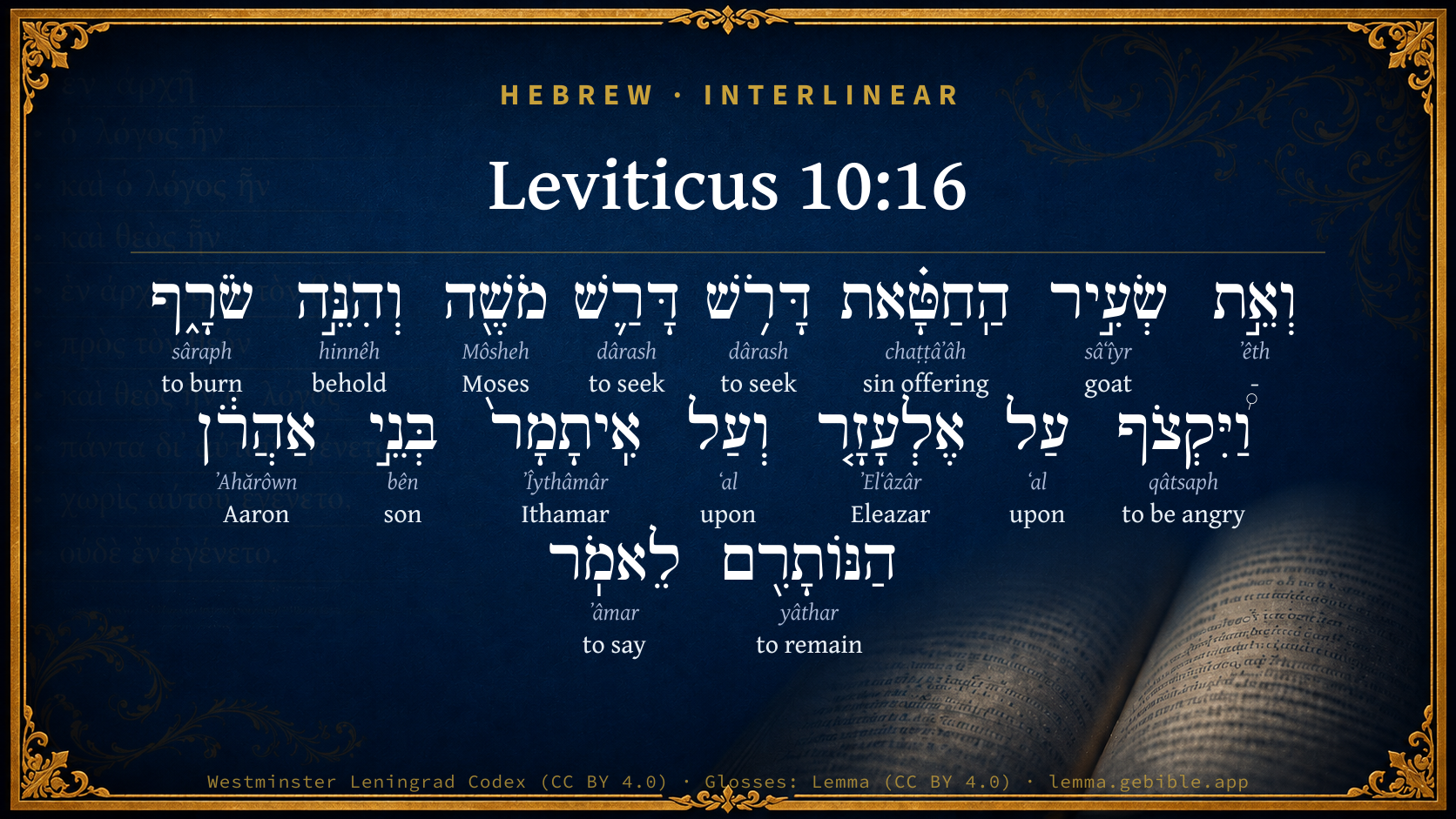
Leviticus 10:16

Hebrew (Westminster Leningrad Codex) Leviticus 10:16 appears in the Hebrew Old Testament. The text above is from the Westminster Leningrad Codex. Each word links to its Strong’s number, a concise gloss, and parsing drawn from the Open Scriptures Hebrew Bible morphology. Click any word for its full Brown-Driver-Briggs (BDB) entry.
Download image
Cite this verse

Leviticus 10:16 (World English Bible). Public Domain. Lemma interlinear Bible study tool, https://lemma.gebible.app/v/leviticus/10/16.

Show BibTeX & RIS
BibTeX
RIS
English Translation
Moses diligently inquired about the goat of the sin offering, and, behold, it was burned: and he was angry with Eleazar and with Ithamar, the sons of Aaron who were left, saying,
World English Bible · Public Domain
Download a study sheet

One document with this verse’s original text, its word-by-word gloss line, the meaning frame, cross-references with their text, attributed commentary, and full source and license credits — printable, and it pastes into notes with its structure intact.

This verse Autodidact and up

Study sheet (.html) Plain text (.txt)

A passage Seminary Student

Up to 50 verses in one chapter. A passage sheet keeps up to 6 commentary sources and 12 cross-references per verse, in the order this page ranks them, and says so on the sheet whenever that leaves anything out. Ask for a single verse and you get the Autodidact verse sheet above.

Everything on this page stays free to read, with no account — the sheet is a download of what is already on screen, not access to it.

Want to remove ads? Support Godless Engineer
Compare translations 3

The same verse in 3 English versions, stacked beneath the original-language interlinear above. Click any original word for its lexicon entry.

Each is an independent rendering of the whole verse — the interlinear is not word-aligned to these translations.

Highlighted words mark where these versions differ — a whole-verse word diff, not a word-by-word alignment.

  • World English Bible Public Domain
    Moses diligently inquired about the goat of the sin offering, and, behold, it was burned: and he was angry with Eleazar and with Ithamar, the sons of Aaron who were left, saying,
  • King James Version Public Domain
    And Moses diligently sought the goat of the sin offering, and, behold, it was burnt: and he was angry with Eleazar and Ithamar, the sons of Aaron which were left alive, saying,
  • unfoldingWord Literal Text CC BY-SA 4.0
    And the goat of the sin offering Moses, searching, searched for. But look! It had been burned up! And he was angry with Eleazar and with Ithamar, the remaining sons of Aaron, saying,

unfoldingWord Literal Text — © unfoldingWord, licensed CC BY-SA 4.0. Word-aligned USFM3 via Door43 (git.door43.org/unfoldingWord/en_ult).

Versions to compare (up to 4)

3 of 4 selected

Show all 18 translations

Every available English version of this verse, each an independent rendering of the whole verse.

  • World English Bible Public Domain
    Moses diligently inquired about the goat of the sin offering, and, behold, it was burned: and he was angry with Eleazar and with Ithamar, the sons of Aaron who were left, saying,
  • Berean Standard Bible Public Domain
    Later, Moses searched carefully for the goat of the sin offering, and behold, it had been burned up. He was angry with Eleazar and Ithamar, Aaron’s remaining sons, and asked,
  • Majority Standard Bible Public Domain
    Later, Moses searched carefully for the goat of the sin offering, and behold, it had been burned up. He was angry with Eleazar and Ithamar, Aaron’s remaining sons, and asked,
  • King James Version Public Domain
    And Moses diligently sought the goat of the sin offering, and, behold, it was burnt: and he was angry with Eleazar and Ithamar, the sons of Aaron which were left alive, saying,
  • American Standard Version (1901) Public Domain
    And Moses diligently sought the goat of the sin-offering, and, behold, it was burnt: and he was angry with Eleazar and with Ithamar, the sons of Aaron that were left, saying,
  • Revised Version (1885) Public Domain
    And Moses diligently sought the goat of the sin offering, and, behold, it was burnt: and he was angry with Eleazar and with Ithamar, the sons of Aaron that were left, saying,
  • Geneva Bible (1599) Public Domain
    And Moses sought the goate that was offred for sinne, and lo, it was burnt: therefore he was angrie with Eleazar and Ithamar the sonnes of Aaron, which were left aliue, saying,
  • Douay-Rheims (1899) Public Domain
    While these things were a doing, when Moses sought for the buck goat, that had been offered for sin, he found it burnt: and being angry with Eleazar and Ithamar, the sons of Aaron that were left, he said:
  • Young's Literal Translation Public Domain
    And the goat of the sin-offering hath Moses diligently sought, and lo, it is burnt, and he is wroth against Eleazar, and against Ithamar, sons of Aaron, who are left, saying,
  • Literal Standard Version CC BY-SA 4.0
    And Moses has diligently sought the goat of the sin-offering, and behold, it is burned, and he is angry against Eleazar and against Ithamar, sons of Aaron, who are left, saying,
  • Unlocked Literal Bible CC BY-SA 4.0
    Then Moses asked about the goat for the sin offering, and found that it was burned up. So he was angry with Eleazar and Ithamar, the remaining sons of Aaron; he said,
  • unfoldingWord Literal Text CC BY-SA 4.0
    And the goat of the sin offering Moses, searching, searched for. But look! It had been burned up! And he was angry with Eleazar and with Ithamar, the remaining sons of Aaron, saying,
  • Darby Bible Public Domain
    And Moses diligently sought the goat of the sin-offering, and behold, it was burnt up: then he was wroth with Eleazar and Ithamar, the sons of Aaron that were left, saying,
  • World Messianic Bible Public Domain
    Moses diligently inquired about the goat of the sin offering, and, behold, it was burned. He was angry with Eleazar and with Ithamar, the sons of Aaron who were left, saying,
  • Webster's Bible Public Domain
    And Moses diligently sought the goat of the sin-offering, and behold, it was burnt: and he was angry with Eleazar and Ithamar, the sons of Aaron who were left alive, saying,
  • Free Bible Version CC BY-SA 4.0
    Moses checked what had happened to the goat of the sin offering, and found out that it had been burned. He got angry with Eleazar and Ithamar, the sons Aaron had left, and asked them,
  • Bible in Basic English Public Domain
    And Moses was looking for the goat of the sin-offering, but it was burned; and he was angry with Eleazar and Ithamar, the sons of Aaron, who were still living, saying,
  • JPS Tanakh (1917) Public Domain
    And Moses diligently inquired for the goat of the sin-offering, and, behold, it was burnt; and he was angry with Eleazar and with Ithamar, the sons of Aaron that were left, saying:

Literal Standard Version (2020), Covenant Press — licensed CC BY-SA 4.0. Text via the HelloAO Bible API (eBible.org). Unlocked Literal Bible (unfoldingWord) — licensed CC BY-SA 4.0. Text via the HelloAO Bible API (eBible.org). unfoldingWord Literal Text — © unfoldingWord, licensed CC BY-SA 4.0. Word-aligned USFM3 via Door43 (git.door43.org/unfoldingWord/en_ult). Free Bible Version, Dr. Jonathan Gallagher — licensed CC BY-SA 4.0. Text via the HelloAO Bible API (eBible.org).

Word by word

More ways to search: Search by grammar → Find every occurrence → Compare this word →

Practice this passage: Drill this verse → Learn its vocabulary →

אִֽיתָמָר֙
ʼÎythâmâr
H385
“Ithamar”
Noun, Proper
Part of Speech
Noun
Type
Proper
Full BDB Definition

Origin: from H339 and H8558

TWOT: None

Ithamar = "coast of palms" - fourth and youngest son of Aaron
  1. וְאֵ֣ת ʼêth H853 “and · -” Conjunction + Particle, Direct Object
  2. שְׂעִ֣יר sâʻîyr H8163 “goat of” Noun, Common, Masculine, Singular, Construct
  3. הַֽחַטָּ֗את chaṭṭâʼâh H2403 “the · sin offering” Particle, Definite Article + Noun, Common, Feminine, Singular, Absolute
  4. דָּרֹ֥שׁ dârash H1875 “to seek” Verb, Qal, Infinitive Absolute
  5. דָּרַ֛שׁ dârash H1875 “to seek” Verb, Qal, Perfect, 3rd Person, Masculine, Singular
  6. מֹשֶׁ֖ה Môsheh H4872 “Moses” Noun, Proper
  7. וְהִנֵּ֣ה hinnêh H2009 “and · behold” Conjunction + Particle, Demonstrative
  8. שֹׂרָ֑ף sâraph H8313 “to burn” Verb, Pual, Perfect, 3rd Person, Masculine, Singular
  9. וַ֠יִּקְצֹף qâtsaph H7107 “and · to be angry” Conjunction + Verb, Qal, Sequential Imperfect, 3rd Person, Masculine, Singular
  10. עַל ʻal H5921 “upon” Preposition
  11. אֶלְעָזָ֤ר ʼElʻâzâr H499 “Eleazar” Noun, Proper
  12. וְעַל ʻal H5921 “and · upon” Conjunction + Preposition
  13. בְּנֵ֣י bên H1121 “sons of” Noun, Common, Masculine, Plural, Construct
  14. אַהֲרֹ֔ן ʼAhărôwn H175 “Aaron” Noun, Proper
  15. הַנּוֹתָרִ֖ם yâthar H3498 “the · remaining” Particle, Definite Article + Verb, Niphal, Participle Active, Masculine, Plural, Absolute
  16. לֵאמֹֽר ʼâmar H559 “to say” Preposition + Verb, Qal, Infinitive Construct

About this verse

These counts appear in no published source. They are computed here, from the morphology-tagged text and Lemma’s own curated glosses. What Lemma adds →

17
words
15
distinct lemmas
Pentateuch
section

Notable vocabulary

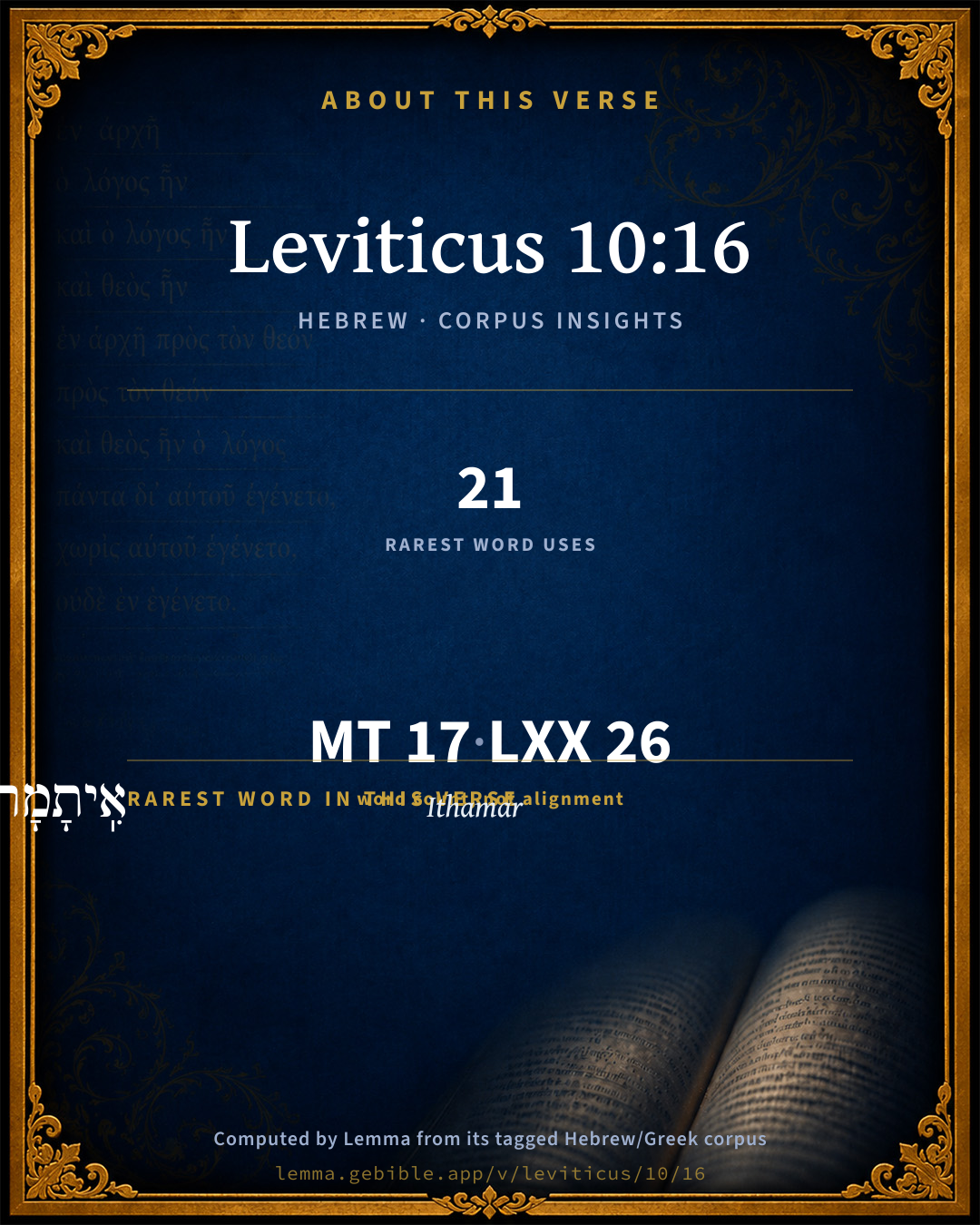
The rarest word here is אִֽיתָמָר֙ Ithamar H385 — appearing just 21 times in the whole Hebrew Bible.

Shared distinctive vocabulary

אִֽיתָמָר֙ Ithamar H385 occurs in 20 verses of the Hebrew Bible. Also found in:

Grammatical profile

  • 6 verbs
  • 7 nouns
  • 2 prepositions
  • 2 particles

Verb forms

  • דָּרֹ֥שׁ Qal · Infinitive Absolute
  • דָּרַ֛שׁ Qal · Perfect
  • שֹׂרָ֑ף Pual · Perfect
  • וַ֠יִּקְצֹף Qal · Sequential Imperfect
  • הַנּוֹתָרִ֖ם Niphal · Participle Active
  • לֵאמֹֽר Qal · Infinitive Construct

Repetition

Words recur within this verse — often emphatic in Hebrew:

  • דָּרֹ֥שׁ to seek H1875 ×2
  • עַל upon H5921 ×2

Hebrew & Septuagint length

In English translation the verse runs 32 words from the Hebrew and 32 from the Septuagint (LXX English) — the same length.

A rough comparison of the two English renderings, which tokenize alike — not a word-level alignment.

Word counts can differ between the Hebrew and the Greek without any difference in meaning — e.g. the Hebrew direct-object marker אֵת has no separate Greek word, and Greek often adds the article ὁ.

In the original languages it is 17 Hebrew tokens and 26 Greek tokens — but the two are counted differently (Hebrew bundles its prefixes and suffixes into one token; the Greek is in lemma form), so that isn’t a like-for-like length.

Cross-references

10

Topical passages linked to Leviticus 10:16 in the Treasury of Scripture Knowledge — connected by theme and wording, ordered by reader-vote popularity; previews shown in the World English Bible.

  • Leviticus 9:3 You shall speak to the children of Israel, saying, 'Take a male goat for a sin offering; and a calf and a lamb, both a year old, without blemish, for a burnt offering;
  • Leviticus 9:15 He presented the people's offering, and took the goat of the sin offering which was for the people, and killed it, and offered it for sin, like the first.
  • Exodus 32:19–22 It happened, as soon as he came near to the camp, that he saw the calf and the dancing: and Moses' anger grew hot, and he threw the tablets out of his hands, and broke them beneath the mountain.
  • Leviticus 6:26 The priest who offers it for sin shall eat it. It shall be eaten in a holy place, in the court of the Tent of Meeting.
  • Leviticus 6:30 No sin offering, of which any of the blood is brought into the Tent of Meeting to make atonement in the Holy Place, shall be eaten: it shall be burned with fire.
  • Numbers 12:3 Now the man Moses was very humble, above all the men who were on the surface of the earth.
  • Matthew 5:22 But I tell you, that everyone who is angry with his brother without a cause shall be in danger of the judgment; and whoever shall say to his brother, 'Raca!' shall be in danger of the council; and whoever shall say, 'You fool!' shall be in danger of the fire of Gehenna.
  • Mark 3:5 When he had looked around at them with anger, being grieved at the hardening of their hearts, he said to the man, "Stretch out your hand." He stretched it out, and his hand was restored as healthy as the other.
  • Mark 10:14 But when Jesus saw it, he was moved with indignation, and said to them, "Allow the little children to come to me! Don't forbid them, for the Kingdom of God belongs to such as these.
  • Ephesians 4:26 "Be angry, and don't sin." Don't let the sun go down on your wrath,

Cross-references courtesy of OpenBible.info (CC BY 4.0).

Hebrew and Greek witnesses Masoretic Hebrew ↔ Greek Septuagint

The same verse in the two great witnesses to the Old Testament, shown verse-for-verse.

These are two independent witnesses, not word-aligned to each other, and the Septuagint is shown in lemma (dictionary) form.

Hebrew Leviticus 10:16 Masoretic · Westminster Leningrad Codex

וְאֵ֣ת שְׂעִ֣יר הַֽחַטָּ֗את דָּרֹ֥שׁ דָּרַ֛שׁ מֹשֶׁ֖ה וְהִנֵּ֣ה שֹׂרָ֑ף וַ֠יִּקְצֹף עַל אֶלְעָזָ֤ר וְעַל אִֽיתָמָר֙ בְּנֵ֣י אַהֲרֹ֔ן הַנּוֹתָרִ֖ם לֵאמֹֽר

Moses diligently inquired about the goat of the sin offering, and, behold, it was burned: and he was angry with Eleazar and with Ithamar, the sons of Aaron who were left, saying,

World English Bible · Public Domain

Greek LXX Leviticus 10:16 Septuagint · lemma form

καί ὁ χίμαρος ὁ περί ὁ ἁμαρτία ζητέω ἐκζητέω μωυσῆς καί ὅδε ἐνπυρίζω καί θυμόω μωυσῆς ἐπί ελεαζαρ καί ιθαμαρ ὁ υἱός ἀαρών ὁ καταλείπω λέγω

And Moses diligently sought the goat of the sin-offering, but it had been consumed by fire; and Moses was angry with Eleazar and Ithamar the sons of Aaron that were left, saying,

LXX2012 (modern English Septuagint) · Public Domain

Hebrew: Westminster Leningrad Codex (CC BY 4.0). Greek: Septuagint (public domain); English from LXX2012 (modern English Septuagint) (Public Domain). How the Septuagint differs from the Hebrew →

Targum (Aramaic paraphrase)

2

The Targum is the ancient Jewish Aramaic paraphrase of the Hebrew Scriptures — an interpretive translation, not the Hebrew text itself. Onkelos (literal) and Pseudo-Jonathan (expansive) render the Torah, and Jonathan the Prophets. Coverage is partial: where no permissively-licensed English translation exists for a verse, only the Aramaic is shown. This is verse-level text, not a word-by-word alignment to the Hebrew.

  1. Targum Onkelos Torah (Genesis–Deuteronomy)
    וְיָת צְפִירָא דְחַטָאתָא מִתְבַּע תָּבְעֵי מֹשֶׁה וְהָא אִתּוֹקָד וּרְגֵז עַל אֶלְעָזָר וְעַל אִיתָמָר בְּנֵי אַהֲרֹן דְאִשְׁתָּאֲרוּ לְמֵימָר

    (no public-domain English translation for this verse)

    Targum Onkelos — Aramaic: “Onkelos Genesis” (public domain); “Onkelos Exodus” (public domain); “Onkelos Leviticus” (public domain); “Onkelos Numbers” (public domain); “Onkelos Deuteronomy” (public domain). English: “Sefaria Community Translation” (CC0 1.0 (public-domain dedication)); “J.W. Etheridge. The Targums of Onkelos and Jonathan Ben Uzziel on the Pentateuch. London: Longmans, Green, 1862” (public domain). Text via Sefaria.

  2. Targum Pseudo-Jonathan Torah (Genesis–Deuteronomy)
    וְיַת תְּלָתָא צְפִירַיָיא דְאִתְקְרִיבוּ בְּיוֹמָא הַהוּא צְפִירָא דְרֵישׁ יַרְחָא וּצְפִירָא דְחַטָאתָא דִלְעַמָא וּצְפִירָא דְחַטָאתָא דְקָרֵיב נַחְשׁוֹן בַּר עֲמִינָדָב לַחֲנוּכַּת מַדְבְּחָא אָזַל אַהֲרן וּבְנוֹי וְאוֹקִידוּ תְּלָתֵיהוֹן אָתָא משֶׁה וְתָבַע יַת צְפִירָא דְחַטָאתָא דִי לְעַמָא וְתַבְעֵיהּ וְהָא אִיתוֹקָד וְרָתַח עַל אֶלְעָזָר וְעַל אִיתָמָר בְּנוֹי דְאַהֲרן דְאִשְׁתְּיָירוּ לְמֵימָר

    And on this day three goats shall be offered; the goat for the beginning of the month, (or, new moon,) the goat of the people's sin offering, and the goat for the sin offering which Nachson bar Aminadab hath brought for the dedication of the altar. And Aharon and his sons went and burned those three. (But) Mosheh came and inquired for the goat of the people's sin offering; he sought it, but, behold, it had been burned, and he was angry with Elasar and Ithamar, the sons of Aharon who were left, and said,

    Targum Pseudo-Jonathan — Aramaic: “Targum Jonathan on Genesis” (public domain); “Targum Jonathan on Exodus” (public domain); “Targum Jonathan on Leviticus” (public domain); “Targum Jonathan on Numbers” (public domain); “Targum Jonathan on Deuteronomy” (public domain). English: “The Targum of Jonathan ben Uzziel, trans. J. W. Etheridge, London, 1862” (public domain). Text via Sefaria.

Commentary

Notes on Leviticus 10:16 from classic Christian and Jewish commentators (each source and its license shown beneath its notes). The classic Christian expositions comment on the surrounding passage and are grouped to its opening verse, so a note may address several verses; the Jewish commentaries on the Tanakh (Rashi and others) are per-verse, so they appear only where the commentator wrote on this verse.

Lemma curates 59 commentaries, every one of them public domain or Creative Commons licensed, each selected and text-cleaned for this edition rather than reprinted as found. About our sources →

Trapp's Complete Commentary

John Trapp

Lev 10:16 And Moses diligently sought the goat of the sin offering, and, behold, it was burnt: and he was angry with Eleazar and Ithamar, the sons of Aaron [which were] left [alive], saying,

Ver. 16. And, behold, it was burnt.] Passion for their dead friends had so transported the priests, that they knew not well what they did. We use to say, Res est ingeniosa dolor: but then it must not be excessive as here, and as 2Sa 18:33.

John Trapp, A Commentary or Exposition upon All the Books of the Old and New Testament (1647–1656) — public domain. Text from a community e-Sword module.

The Biblical Illustrator

Joseph S. Exell

Lev_10:16-20

Wherefore have ye not eaten the sin offering?

Consideration for neglected duty

Part of this goat being a sin offering, should have been eaten--I mean the shoulder and breast allotted to the priest--but it was all burned contrary to the law, for which Moses was justly offended, having seen so lately Gods wrath upon the other fault. The answer of Aaron you have in Lev_10:19, in effect and sense as if he should have said, I confess and acknowledge the ordinance of God is to be kept, and we are to eat with joy of the parts allotted unto us of the sacrifice for sin; the blood was not brought into the Tabernacle of the testimony. But how could I eat with joy in so heavy and woful a case of my children? Compelled, therefore, with the greatness of my grief, I did what I did, &c. At which answer, saith our chapter, Moses was content, so bearing with his infirmity, considering his great sorrow, but not leaving an example to forgive them that maliciously transgress the commandment of God. And as Moses is said to have stayed his anger, so you see the Lord Himself did, not punishing again this fault. It layeth open unto us the great kindness of our gracious God, of whom the psalm saith, He is full of compassion and mercy, long suffering and of great goodness. He will not always be chiding, neither keepeth He His anger for ever. He dealeth not with us after our sins, neither rewardeth us according to our wickedness, &c. Secondly, you may see here how these ceremonial laws gave place to necessity, as David also in necessity did eat the shewbread, which was otherwise unlawful for him to do; and Hezekiah admitted to the Passover those that were not cleansed. But for moral laws there is no dispensation for corporal necessity, but a constant course must be held in obeying them. For it is not necessary that I should live; but it is ever necessary that I should live righteously. Lastly, in that Moses admitted a reasonable excuse, we may learn to abhor pride and to do the like; pride, I say, which scorneth to hear what may be said against the conceit we have once harboured. A modest man or woman doth not thus; but even for his servant or his maid holy Job had an ear, and did not despise their judgment, their complaint, or grief, when they thought themselves evil entreated by him. The example of God Himself is instead of a thousand, who both heard and accepted of Abimelech his excuse for taking away Abrahams wife, I know, saith He, that thou didst it even with an upright mind, and therefore I kept thee also that thou shouldest not sin against Me, &c. Shall the Lord be thus sweet, and we so dogged, so churlish, so stern and sour, that no excuse may serve for a thing done amiss if once we have taken notice of it? Beware, beware, and remember your own frailty well. A stubborn frowardness hath hurt many, sweet gentleness and courtesy never any; but though wicked men were unthankful, yet our gracious God was pleased. (Bp. Babington.)

Such things have befallen me.

The afflictions which befall the servants of God

I. That sore afflictions sometimes befall the servants of God.

1. The death of two sons by one stroke.

2. The distressing character of their death.

3. The prohibition of any expression of grief.

II. That under the pressure of sore afflictions the servants of God are required to attend to religious duties.

1. The obligatoriness of such duties is not annulled by trial. Trust in God, and prayer and praise to him, are binding in sickness as in health, in sorrow as m joy. So are all religious duties.

2. The need of the help which attention to such duties affords is not diminished by trial, but rather increased.

III. That under the pressure of sore afflictions the mind and heart of the servants of God often seem unequal to a proper discharge of religious duties. On the day when this calamity befell them, Aaron and his surviving sons did not accurately discharge their sacred duties. It was expressly commanded that the flesh of those sin offerings, the blood of which was not carried into the Tabernacle of the congregation, should be eaten by the officiating priests (Lev_6:24-30). Instead of doing this, Aaron and his sons burnt the flesh of the sinoffering (Lev_10:16-18). The error may be viewed as--

1. An oversight caused by the things which had befallen them. In great griefs the heart seems dead to every feeling but the predominant one, and the mind seems incapable of sustained attention to anything except what is related to its griefs. Meditation upon the holy Scriptures, prayer, spiritual aspirations, communion with God--these seem impossible to the sorrow-stricken soul. Needing them so urgently, yet the soul seems unable properly to attend to them.

2. Intentional because of felt unfitness to eat of the most holy flesh. This seems to receive most support from the words following the text: Such things have befallen me, and if I had eaten the sin-offering to-day, should it have been accepted in the sight of the Lord? The bereaved father seems to have been not only sorrowful, but deeply awed and humbled by the things which had befallen him, and to have felt that if he had eaten the most holy flesh in such a frame of mind it would not have been acceptable to God. His case reminds us of some who absent themselves from the sacrament of the Lords supper because of a sincere feeling of unworthiness. But let such persons remember that Aarons sense of unworthiness did not disqualify him for eating the flesh of the sin-offering; he rather erred in not doing so.

IV. That when the mind and heart of the suffering servants of god seem thus unfitted for religious duties, God does not account such unfitness as sin. When Moses heard the apology of Aaron he was content; and we are warranted in regarding his content as an evidence that God also was satisfied with the reason assigned by the high priest for his deviation from the line of duty. Surely the Lord knew the intense anguish which His servant was suffering, and regarded him with deepest, tenderest pity. The Lord is very pitiful, and of tender mercy. Here is consolation for the sorrow-stricken soul. If in the day of your sore afflictions you seem to have no heart for worship, your efforts to pray end in what seems to you to be utter failure, and religious thought and emotion seem to have entirely departed from you, remember the touching words of Aaron in his great calamity, Such things have befallen me; remember also those other words, And when Moses heard that, he was content. (W. Jones.)

The vicissitudes of life

Observe here again with yourself the strange and admirable change of these worldly matters in the turn, as we say, of a hand. For but yesterday, as it were, Aaron and these sons of his had a famous and glorious consecration into the greatest and highest dignity upon earth, nothing under the sun being more glorious than that priesthood in those days. And how may you think his heart rejoiced to see, not only himself, but his children (which parents often love more than themselves), so blessed and honoured? But, O change! how sudden and fearful! O fickle, fading comfort, that man taketh hold of in this world, whatsoever it be, if worldly! These sons so lately exalted and honoured to their old fathers sweet and great joy, now lie destroyed before his face, to his extreme and twitching torment. And how? Not by any ordinary and accustomed death, but by fire from heaven, a sore and dreadful judgment. For what also? Even for breach of commanded duty by the Lord, all which doubled and trebled the fathers sorrow. As it did in David when his son Absalom died not a usual death, and in rebellion and disobedience against his king and father. You remember his passion then uttered: 0 my son Absalom, my son, my son Absalom; would God I had died for thee, O Absalom, my son my son. He considered the cause wherein he died, and the manner how he died; to a father so kind as David was, both of them full of woe and sorrow. Let never, therefore, any prosperity in this world puff us; for we little know what to-morrow may bring with it. The glass that glittereth most is soonest broken; the rankest corn is soonest laid; and the fullest bough with pleasant fruit is soonest slit, having more eyes upon it, and more stones east at it, than all the other boughs of the tree. Pleasant wine maketh wise men fools, and fools often stark mad. Milos strong arm overthrew him, and Caesar his ambition. The one trusted too much to nature, and the other to fortune. As a spiders web, so is a mans greatness in this world soon wiped away with a little whisk. (Bp. Babington.)

When Moses heard that, he was content.--

A contented law

Some explanations carry their own conviction. We know the voice of honesty when we hear it; there is a frankness about it that can hardly be mistaken. But the meaning lies deeper; there can be no contentment in the presence of violated law. Where a law is violated wantonly, nature can have no rest; she says, I cannot sleep to-night. Thank God she cannot! When she can forget her Maker, the end will have come in darkness, and there will in very deed, in spirit and effect, be no more any God. Law must be satisfied in one of two ways. Law can rest upon the ashes of Sodom and Gomorrah, saying, Judgment has been inflicted, righteousness has been vindicated, and the seal of condemnation has been attached to the testimony of evil; and mighty, imperial, inexorable law sits on the desolated cities--content. That is not the way in which the Lord would bring about His own contentment; still, there is the law: fall upon this stone and be broken, or the stone will fall upon you and you will be ground to powder. The gospel is a savour of life unto life, or of death unto death. God would have law obeyed: all His ordinances carried out in simple obedience, every statute turned into conduct, every appointment represented in obedience and praise. Then the universe, faithful to her Creator, the stars never disloyal to their Creator-King--the whole creation will say--Content. (J. Parker, D. D.)

.

The Biblical Illustrator, edited by Joseph S. Exell (c. 1880s–1900s) — public domain. Text from a community e-Sword module.

Joseph Benson's Commentary

Lev 10:16. Behold, it was burnt — This justified Moses’s suspicion that some mistake might be committed in the holy things; for upon inquiry he found that the priests had burned upon the altar those parts of the people’s sin-offering which they ought to have eaten, Lev 6:26; Lev 6:29. He was angry with Eleazar and Ithamar — Moses, not willing to aggravate the sorrows of his brother Aaron, says nothing to him, but expostulates with his sons for their neglect. He knew, however, that the reproof, though directed to them, would concern him too.

Joseph Benson's Commentary on the Old and New Testaments (1811–1818) — public domain. Text from a community e-Sword module.

Tyndale Open Study Notes

Tyndale Open Resources

10:16-17 The goat of the sin offering was the offering for the people (9:3, 15-17; cp. 9:2, 8-11). On this special occasion, its blood was not carried into the Holy Place as required. The remaining portion, after the portions allocated to God had been offered, should have been eaten by the priests (see 6:29). But the goat was entirely burned, even though its blood had not been taken into the sanctuary (10:18; see 6:30).

Tyndale Open Study Notes — © Tyndale Open Resources, licensed CC BY-SA 4.0. Text via the HelloAO Bible API.

Geneva Bible (1599)

Geneva Bible translators

And not consumed as Nadab and Abihu.

Geneva Bible (1599) marginal notes — public domain. Text via Bolls.life.

Jamieson, Fausset & Brown

Robert Jamieson, A. R. Fausset & David Brown

Moses diligently sought the goat of the sin offering, and, behold, it was burnt--In a sacrifice presented, as that had been, on behalf of the people, it was the duty of the priests, as typically representing them and bearing their sins, to have eaten the flesh after the blood had been sprinkled upon the altar. Instead of using it, however, for a sacred feast, they had burnt it without the camp; and Moses, who discovered this departure from the prescribed ritual, probably from a dread of some further chastisements, challenged, not Aaron, whose heart was too much lacerated to bear a new cause of distress but his two surviving sons in the priesthood for the great irregularity. Their father, however, who heard the charge and by whose directions the error had been committed, hastened to give the explanation. The import of his apology is, that all the duty pertaining to the presentation of the offering had been duly and sacredly performed, except the festive part of the observance, which privately devolved upon the priest and his family. And that this had been omitted, either because his heart was too dejected to join in the celebration of a cheerful feast, or that he supposed, from the appalling judgments that had been inflicted, that all the services of that occasion were so vitiated that he did not complete them. Aaron was decidedly in the wrong. By the express command of God, the sin offering was to be eaten in the holy place; and no fanciful view of expediency or propriety ought to have led him to dispense at discretion with a positive statute. The law of God was clear and, where that is the case, it is sin to deviate a hair's breadth from the path of duty. But Moses sympathized with his deeply afflicted brother and, having pointed out the error, said no more.

Next: Leviticus Chapter 11

Jamieson, Fausset & Brown — Commentary Critical and Explanatory on the Whole Bible (1871) — public domain (CC PDM 1.0). Text via the HelloAO Bible API.

Adam Clarke's Commentary

Verse 16. Moses diligently sought the goat] The goat which was offered the same day for the sins of the priests and the people, (see Le 9:15-16), and which, through the confusion that happened on account of the death of Nadab and Abihu, was burnt instead of being eaten. See Le 10:18.

Adam Clarke's Commentary on the Bible (1810–1826) — public domain. Text from a community e-Sword/MySword module.

Ellicott's Commentary for English Readers

(16) And Moses diligently sought the goat.—That is, the flesh of the goat of the sin offering which was offered by the nation on the eighth day. (See Lev_9:15.)

And, behold, it was burnt.—Being overwhelmed with grief at the loss of their brothers, Eleazar and Ithamar could not eat, and as none but priests were allowed to partake of the flesh of the sin offering, they burnt it on the altar, to prevent its corruption. They did this all the more readily since the flesh of Aaron’s sin offering was just before burnt without the camp. (See Lev_9:11.)

And he was angry with Eleazar and Ithamar.—As it was Aaron’s duty quite as much as his two sons to eat of the flesh, Moses probably omitted to mention his name, because he wished to spare the honour of the pontiff in the sight of the people.

A Bible Commentary for English Readers, edited by Charles John Ellicott (1878–1897) — public domain. Text from a community e-Sword module.

John Gill's Exposition

Wherefore have ye not eaten of the sin offering in the holy place, seeing it is most holy,.... The sin offering was one of the most holy things, and therefore to be eaten only in the sanctuary; though this was not the fault they are here charged with that they had eat it, but not in the holy place; for they had not eaten it at all, but burnt it, as appears from the preceding verse; this is what they are blamed for particularly, though they are reminded of the whole law concerning it, that it was to he eaten by them, that it was to be eaten in the holy place, the reason of which is given; but they had not eaten it any where:

and God hath given it to you, to bear the iniquity of the congregation, to make atonement for them before the Lord? for by eating the sin offering, or sin itself, as it is in the original text, see Hos 4:8 they made the sins of the people, for whom the offering was, in some sense their own; and they bore them, and made a typical atonement for them; in which they were types of Christ, who was made sin for his people, took their sins upon him, and by imputation they were made his own, and he bore them in his own body on the tree, and made full satisfaction and atonement for them. Now since the eating of the sin offering of the people was of so great importance and consequence, the neglect of it by the priests was very blameworthy.

John Gill's Exposition of the Whole Bible (1746–1763) — public domain (CC PDM 1.0). Text via the HelloAO Bible API.

Albert Barnes' Notes on the Bible

The Law on the point in question was clear. See Lev 2:3, note; Lev 4:5, note; Lev 4:15 note. But on this occasion, though the sin-offering which had been offered by Aaron was for the people Lev 9:15, its blood was not carried into the tabernacle. The priests might therefore have too readily supposed that their eating the flesh, or burning it, was a matter of indifference. Hence, Moses explains that the appropriation of the flesh by the priests is an essential part of the act of atonement Lev 10:17.

It was burnt - It was consumed by fire in an ordinary way, not; in the fire of the altar. See Lev 1:9.

Albert Barnes' Notes on the Bible (1834–1885) — public domain. Text from a community e-Sword/MySword module.

Haydock's Catholic Bible Commentary

While, &c. Hebrew, "and Moses sought diligently for," &c. This goat had been offered the same day, for the sins of the priest and of the people, chap. ix. 15. Aaron had not taken the parts allotted to his family, being too much grieved, and perhaps thinking that they could not eat all. (Calmet) --- Therefore, he judged it conformable to God’s command to consume the whole, chap vii. 17. Moses fearing lest the thing had been done through negligence, finds fault with this two sons; but on hearing the remonstrance of Aaron, is satisfied. (Haydock)

George Leo Haydock (1774–1849), Haydock's Catholic Family Bible and Commentary, 1859 edition — public domain. Excludes Psalms (Douay-Rheims chapter numbering differs from Protestant) and Deuterocanonical books (Catholic canon only).

Matthew Poole's English Annotations

The goat of the sin-offering, to wit, for the people, mentioned Lev 9:15, to know what was done with that part of it which was the priest’s; which he inquired into more than into the other sacrifices, because a mistake there was easy and probable, because that matter might seem something doubtful, by reason of two laws concerning it seemingly contrary, the one Lev 4:21, where it is to be burned, the other Lev 6:26, where it was to be eaten. But they are thus reconciled: It was to be burnt when the blood of this sacrifice was brought into the holy place, Lev 4:16,17; and when that was not done, which Aaron this first time could not do, for the reason expressed in Lev 10:18, it was to be eaten, and here lay their mistake.

He was angry with Eleazar and Ithamar: he spares Aaron at this time, as overwhelmed with sorrow, and because the rebuking of him before his sons might have exposed him to some contempt; but he knew that the reproof, though directed to them, would concern him too, as he also apprehended it.

Which were left alive, preserved from death when their brethren were destroyed, which is here mentioned as an aggravation of their sin.

Matthew Poole's English Annotations on the Holy Bible (1683–1685) — public domain. Text from a community e-Sword/MySword module.

Whedon's Commentary on the Bible

Daniel D. Whedon

16. The goat of the sin offering — This was the people’s sin offering which had been slain and offered by Moses, (Lev_9:15,) or by the two younger sons of Aaron, to whom this part of the ritual had been intrusted by Moses.

And he was angry — No softer word will import into English the strength of the Hebrew katzaph — to snort, to storm. Anger is not a sin when it arises not from personal feeling, but purely in the interest of justice, truth, order, and humanity. The soul which cannot be angry at great wrongs Plato compares to an arm with the chief sinew cut asunder. We do not accept that weak defence of the imprecatory Psalms which explains them as simply declaratory of future judgments upon David’s enemies. They are the proper expression of a righteous indignation breathed out in behalf of God and his righteousness. Hence, the sinless Jesus on one occasion looked around with anger upon his foes lurking in ambush for his life. Mar_3:5. It remains for us to inquire whether Moses had sufficient provocation to just anger. We reply that stupidity and gross carelessness in handling interests of vast importance are such a provocation. The sins of the whole Hebrew nation were to be taken away by virtue of their incorporation into the priests by eating the people’s sin offering. Such was the sanctifying power of the priests’ office that by this act they were enabled to bear away the iniquity of the congregation. By the blunder of these young priests the people’s sins were still resting upon them. See chap. Lev_6:26, note. Heedlessness in respect to our own interests is culpable, but in respect to the well-being of others it is criminal.

Daniel D. Whedon (gen. ed.), Commentary on the Old and New Testaments (1874–1909) — public domain. Text from a community e-Sword module.

The Pulpit Commentary

Vers. 16-20. Moses and Aaron an allegory.

Moses may be taken as the impersonation of the Law which was given by his hand. (see Luk_16:29 Act_15:21) Hence the "body of Moses," about which Michael disputed with Satan, is by some supposed to denote the substance of the Law. (Jud_1:9) In this view he appeared upon the mount of transfiguration, surrendering to Christ, who, in like manner, impersonated his gospel. (Mat_17:3-5) So the vail over Moses" face represented the shadows in which the Law invested the glory of the Lord until the death of Christ, when the darkness passed away and the true light shined forth. Hence, when the vail, that is to say, the flesh of Christ, was tom in death, the vail of the temple was rent from the top throughout. (Mat_27:50, 51 2Co_3:7 Heb_9:3, 8 10:19, 20) Aaron"s function was to bring out the spiritual meaning of the Law; and so he was a type of Christ, who came not to destroy but to fulfill it. Bearing these things in mind, light may be let in upon the remarkable passage before us. We have here

I THE ANGER OF MOSES.

1. Look at the history in the letter.

(1) Moses had given instructions to Aaron and his sons respecting the goat which was to be offered for the sin of the people. (see Lev_9:15, Lev_9:16)

(2) These instructions were not fully carried out. The goat was killed and its fat burnt upon the altar; but the flesh was not eaten in the holy place.

(3) Moses made search, and behold the goat was burnt, probably without the comp. (Lev_4:12 Lev_6:11) This angered him, and led him to question the "sons of Aaron who were left, or had escaped the fire that consumed their brethren, as to why they had deviated from his directions.

2. Now look at the moral.

(1) It should have been eaten in the holy place, because it was "most holy," that is to say, the "bread of God"; (Lev_6:16, 17 21:22) that which wrath was to feed upon. This significantly pointed to Christ. After declaring himself to be the "bread of God which cometh down from heaven," he explains, "the bread that I will give is my flesh, which I will give for the life of the world". (Joh_6:51) How remarkably the mysteries of the bread offering and the "flesh" of the sin offering, associated on the Levitical altar, are again associated in this gospel explanation!

(2) By the fire of God feeding upon the sin offering, it bore "the iniquity of the congregation, to make atonement for them before the Lord" (verse 17). But this is said of the eating of the flesh by Aaron and his sons. By eating the flesh of the sin offering, then, Aaron was to appear as in the place of it. (comp. 1Co_10:7) This significantly indicated that the true sin offering was not to be an animal, but a man.

(3) The rule is laid down that if the blood was not brought in within the holy place, the flesh should be eaten in the holy place (verse 18). That rule showed that the Law priests were typically to bear the iniquity of the people, until that High Priest should come who would carry his own blood into the holy place not made with hands. In that event their functions were destined to cease.

II THE EXPLANATION OF AARON.

1. The anger of Moses was with the sons of Aaron.

(1) We are not told that he felt any anger towards Aaron. We see a propriety in this when we consider that Aaron was a type of Christ. Moses directed Aaron all through the ceremonials of his consecration, and so Christ in this world, in which he was consecrated to his priesthood, was "made under the Law." But the Law could have no anger against Christ, "who fulfilled all its righteousness," and in every way "magnified and made it honourable.

(2) But against the sons of Jesus, who are far from being as perfect as their Head, the Law may have occasion for anger.

2. But Aaron speaks in his own person for his sons.

(1) (See verse 19) So Jesus takes the faults of his children upon himself. (see Mat_8:16, 17 1Pe_2:24)

(2) And speaking for them thus, Aaron was able to appease Moses. Not only was Moses "satisfied," as in the text, but what Aaron urged was "well pleasing in his eyes," as in the Hebrew. So triumphantly is Jesus able to deliver us from the anger of the Law. (Rom_5:9, Rom_5:20, Rom_5:21)

3. But what is the import of Aaron"s words (verse 19)?

(1) Here he concedes that the sin offering had been offered, and that, under usual conditions, to have complied with all the directions of Moses would have been proper. But he explains, "such things have befallen me," referring to his parental sorrow in the loss of his sons under most distressing circumstances. He was, therefore, a mourner, not outwardly (see verses 4-7), but in spirit, so, had he eaten the sin offering, would it have been accepted by the Lord, viz. who looketh upon the heart? Moses had nothing to reply to this. (comp. Deu_12:7 1Sa_1:7, 8 Hos_9:4)

(2) But was there not a prophetic meaning in these words of Aaron? As Caiaphas "spake not of himself, but being high priest that year, he prophesied that Jesus should die for that nation", (Joh 10) does not Aaron as truly in the spirit of prophecy here say that the death of the priest sets aside the type? (see Col_2:14)

(3) The consent of Moses shows how the Law bears testimony to Christ, and is itself to vanish as a shadow when the substance takes its place.

(4) It also shows that it is proper to break the Law in the letter, when to do so is necessary to its observance in the spirit. The spirit of the Law is the gospel. J.A.M.

The Pulpit Commentary (1880–1919), ed. H.D.M. Spence-Jones & Joseph S. Exell — public domain. Text from a community e-Sword module.

John Wesley's Explanatory Notes

He was angry with Eleazar - He spares Aaron at this time, as overwhelmed with sorrow, and because the rebuking him before his sons might have exposed him to some contempt; but he knew that the reproof though directed to them, would concern him too. Who were left alive - And therefore ought to have taken warning.

John Wesley, Explanatory Notes Upon the Whole Bible (1754–1765) — public domain. Text via the GEBible commentary corpus.

unfoldingWord translationNotes

Door43 World Missions Community

it was burned up

This can be translated in active form. AT: "the priests had burned it all" (See: Active or Passive)

Eleazar and Ithamar

See how you translated these names in Leviticus 10:6.

Why have you not eaten ... before him?

Moses uses a question to rebuke Eleazar and Ithamar. This rhetorical question can be translated as a statement. AT: "You should have eaten ... before him." (See: Rhetorical Question)

since it is most holy

"since the sin offering is most holy"

to take away the iniquity of the assembly

Causing Yahweh to forgive the people of Israel is spoken of as if iniquity were an object that Yahweh takes from the people. (See: Metaphor)

before him

"in his presence"

its blood was not brought

This can be translated in active form. AT: "you did not bring its blood" (See: Active or Passive)

translationWords

Moses

goat

sin offering

son

Aaron

tabernacle

holy

Yahweh

iniquity

assembly

atonement

blood

command

unfoldingWord translationNotes — © Distant Shores Media and the Door43 World Missions Community, licensed CC BY-SA 4.0. Source: git.door43.org/Door43/en_tn.

Rashi

Rabbi Shlomo Yitzchaki (Rashi)

שעיר החטאת THE GOAT OF THE SIN OFFERING — This was the goat of the additonal offerings of the New Moon. Three goats for sin-offerings had been sacrificed that day: a goat of the kids prescribed for the installation ceremony (see Leviticus 9:3), and the goat brought by Nachshon as a free-will offering, and the goat for the New Moon. Of all these, this last alone had been burnt, and the Sages of Israel differ in their opinions regarding the matter. Some say that it was on account of some uncleanness (unclean thing) which had touched it that it was burnt, whilst others say that it had been burnt on account of the state of mourning in which Aaron’s sons were, for it was a holy sacrifice ordained for all generations and was not of an exceptional character whilst in the case of the occasional holy sacrifices (the two other goats) they relied on Moses’ statement when he said in respect to the occasional meal-offering (v. 12), “and eat it as unleavened cakes”, although you are Onanim, and they took this to apply also to those goats which were also of an occasional character (Sifra, Shemini, Chapter 2 8-10; Zevachim 101a).

דרש דרש [MOSES] DILIGENTLY ENQUIRED ABOUT — The repetition of the word implies that he made two enquiries: why has this (the goat for the New Moon) been burnt and why have these other goats been eaten? — Thus it is stated in Torath Cohanim (Sifra, Shemini, Chapter 2 2).

על אלעזר ועל איתמר [HE WAS ANGRY] WITH ELEAZAR AND ITHAMAR — Out of the respect due to Aaron he turned towards his sons and showed himself angry with them instead of with Aaron (Sifra, Shemini, Chapter 2 3).

לאמר SAYING (i. e. that they should say or speak) — He said to them, “Give me replies to my questions” (Sifra, Shemini, Chapter 2).

Rashi on the Tanakh — English translations: “The Judaica Press complete Tanach with Rashi, translated by A. J. Rosenberg” (CC BY 4.0); “Pentateuch with Rashi's commentary by M. Rosenbaum and A.M. Silbermann, 1929-1934” (public domain); “The Metsudah Tanach series, Lakewood, N.J” (CC BY 4.0); and “The Book of Joshua, Metsudah Publications, 1997” (CC BY 4.0). Text via Sefaria.

Ramban (Nachmanides)

Rabbi Moshe ben Nachman (Ramban / Nachmanides)

AND MOSES DILIGENTLY INQUIRED FOR THE GOAT OF THE SIN-OFFERING, AND BEHOLD, IT WAS BURNT. “This was the he-goat of the Additional Offerings of the New Moon. Three he-goats for sin-offerings were offered up that day: [the people’s sin-offering brought especially on that day, as it is said], Take ye a he-goat for a sin-offering, and the he-goat brought by Nachshon [in honor of the dedication of the altar], and the he-goat for the New Moon. Of all these, it was only the he-goat for the New Moon that was burnt [although ordinarily it would have been eaten by the priests]. The Sages of Israel differed regarding the reason why it was burnt. Some say that it was burnt on account of some impure object that touched it, and some say it was burnt on account of the mourning [of Aaron’s sons].” All this is the language of Rashi.It is in accordance with the opinion of those who say that it was burnt on account of some impure object that touched it, that the Rabbi [Rashi] wrote on the verse, “and if I had eaten of the sin-offering ‘today’? Now it is on the word “today” that Rashi comments: “by day etc.” — by ‘day’ it was forbidden to eat thereof, but in the case of an onen by law of the Torah is a mourner on the day of death of his relative whether before or after burial on that day. [On the night following he is an onen by law of the Rabbis. If burial has not taken place on the day of death he continues to be an onen by law of the Rabbis. When burial finally takes place he is an onen by law of the Rabbis even after burial, but at night he is no longer considered an onen at all.] An onen is to be distinguished from an avel who is a mourner for a period of seven or thirty days. The laws of mourning as affecting the Divine Service in the Tabernacle and its holy offerings relate to the priest when he is an onen. on the night [following the death and burial] it is permitted [to eat the offering], since the [Scriptural] law of the onen applies only to the day of burial.” Accordingly, if it was burnt on account of mourning, they should have [left it to be] eaten at night! We must perforce say that those Rabbis [who say that it was burnt on account of mourning] are of the opinion that the [Scriptural] law of an onen [forbidding him to eat an offering] applies even on the night following the burial! [Therefore Aaron’s defense of his sons’ action in burning the sin-offering was correct, since they could not have eaten of it even at night. But Rashi, who is of the opinion that an onen may eat the offering at night, must hold that the reason why they burnt it, was on account of some impure object which touched the offering, as a result of which it could never be eaten, and hence Aaron’s defense of them was completely correct.]

Ramban (Nachmanides) on the Tanakh — English translation: “Commentary on the Torah by Ramban (Nachmanides). Translated and annotated by Charles B. Chavel. New York, Shilo Pub. House, 1971-1976” (CC BY 4.0). Text via Sefaria.

Lesson kit

Teaching starters — assembled from the data on this page, not authored interpretation. Every prompt links to the verse data it draws on. Edit before teaching.

Leviticus, in the Pentateuch, opens this verse with 17 words (15 distinct Hebrew lemmas). Its most distinctive word is ʼÎythâmâr (“Ithamar”). A historical commentator’s framing appears above. Read the whole chapter for the surrounding context.

Discussion questions

  1. What does “Ithamar” (ʼÎythâmâr) contribute to the verse as a whole?
  2. Exodus 6:23 shares the word «Ithamar» with this verse. How do the two illuminate each other?
  3. “to seek” occurs 2× in this one verse. What is the effect of the repetition?
  4. The translations on this page render this verse differently — a whole-verse word diff, not a word-by-word alignment. What might account for the different wordings?
  5. The verb «דָּרֹ֥שׁ» is Qal Infinitive Absolute. How does its form color the action?
  6. Reading how Trapp's Complete Commentary and The Biblical Illustrator read this verse, where do the two commentators agree and where do they part?

Things to notice

Reading settings

Reading text

Shown beneath each verse's original-language words.

Old Testament
Old Testament edition

Read the OT as the Masoretic Hebrew (MT) or the Greek Septuagint (LXX).

English shown for the Greek Septuagint (in the Hebrew ↔ Greek comparison).

Comparing translations? Open the Compare panel on any verse page to stack up to four side by side.