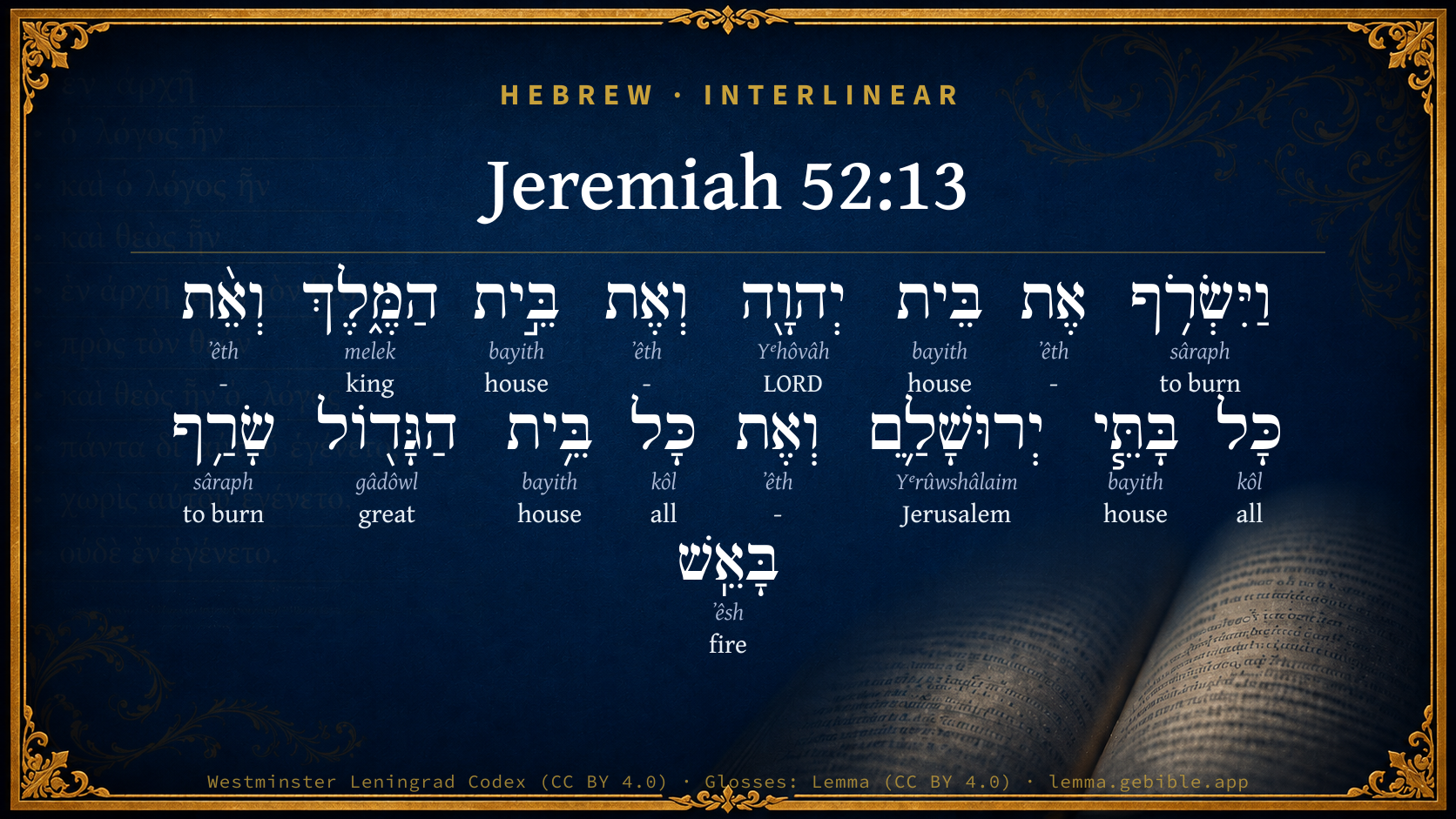
Jeremiah 52:13

Hebrew (Westminster Leningrad Codex) Jeremiah 52:13 appears in the Hebrew Old Testament. The text above is from the Westminster Leningrad Codex. Each word links to its Strong’s number, a concise gloss, and parsing drawn from the Open Scriptures Hebrew Bible morphology. Click any word for its full Brown-Driver-Briggs (BDB) entry.
Download image
Cite this verse

Jeremiah 52:13 (World English Bible). Public Domain. Lemma interlinear Bible study tool, https://lemma.gebible.app/v/jeremiah/52/13.

Show BibTeX & RIS
BibTeX
RIS
English Translation
and he burned the house of Yahweh, and the king's house; and all the houses of Jerusalem, even every great house, burned he with fire.
World English Bible · Public Domain
Download a study sheet

One document with this verse’s original text, its word-by-word gloss line, the meaning frame, cross-references with their text, attributed commentary, and full source and license credits — printable, and it pastes into notes with its structure intact.

This verse Autodidact and up

Study sheet (.html) Plain text (.txt)

A passage Seminary Student

Up to 50 verses in one chapter. A passage sheet keeps up to 6 commentary sources and 12 cross-references per verse, in the order this page ranks them, and says so on the sheet whenever that leaves anything out. Ask for a single verse and you get the Autodidact verse sheet above.

Everything on this page stays free to read, with no account — the sheet is a download of what is already on screen, not access to it.

Want to remove ads? Support Godless Engineer
Compare translations 3

The same verse in 3 English versions, stacked beneath the original-language interlinear above. Click any original word for its lexicon entry.

Each is an independent rendering of the whole verse — the interlinear is not word-aligned to these translations.

Highlighted words mark where these versions differ — a whole-verse word diff, not a word-by-word alignment.

  • World English Bible Public Domain
    and he burned the house of Yahweh, and the king's house; and all the houses of Jerusalem, even every great house, burned he with fire.
  • King James Version Public Domain
    And burned the house of the LORD, and the king's house; and all the houses of Jerusalem, and all the houses of the great men, burned he with fire:
  • unfoldingWord Literal Text CC BY-SA 4.0
    He burned the house of Yahweh, the king’s palace, and all the houses of Jerusalem; also every important building in the city he burned.

unfoldingWord Literal Text — © unfoldingWord, licensed CC BY-SA 4.0. Word-aligned USFM3 via Door43 (git.door43.org/unfoldingWord/en_ult).

Versions to compare (up to 4)

3 of 4 selected

Show all 18 translations

Every available English version of this verse, each an independent rendering of the whole verse.

  • World English Bible Public Domain
    and he burned the house of Yahweh, and the king's house; and all the houses of Jerusalem, even every great house, burned he with fire.
  • Berean Standard Bible Public Domain
    He burned down the house of the LORD, the royal palace, and all the houses of Jerusalem—every significant building.
  • Majority Standard Bible Public Domain
    He burned down the house of the LORD, the royal palace, and all the houses of Jerusalem—every significant building.
  • King James Version Public Domain
    And burned the house of the LORD, and the king's house; and all the houses of Jerusalem, and all the houses of the great men, burned he with fire:
  • American Standard Version (1901) Public Domain
    and he burned the house of Jehovah, and the king's house; and all the houses of Jerusalem, even every great house, burned he with fire.
  • Revised Version (1885) Public Domain
    and he burned the house of the LORD, and the king’s house; and all the houses of Jerusalem, even every great house, burned he with fire.
  • Geneva Bible (1599) Public Domain
    And burnt the House of the Lord, and the Kings house, and all the houses of Ierusalem, and all the great houses burnt he with fire.
  • Douay-Rheims (1899) Public Domain
    And he burnt the house of the Lord, and the king's house, and all the houses of Jerusalem, and every great house he burnt with fire.
  • Young's Literal Translation Public Domain
    and he burneth the house of Jehovah, and the house of the king, and all the houses of Jerusalem, even every great house he hath burned with fire,
  • Literal Standard Version CC BY-SA 4.0
    and he burns the house of YHWH, and the house of the king, and all the houses of Jerusalem—even every great house he has burned with fire,
  • Unlocked Literal Bible CC BY-SA 4.0
    He burned the house of Yahweh, the king's palace, and all the houses of Jerusalem; also every important building in the city he burned.
  • unfoldingWord Literal Text CC BY-SA 4.0
    He burned the house of Yahweh, the king’s palace, and all the houses of Jerusalem; also every important building in the city he burned.
  • Darby Bible Public Domain
    and he burned the house of Jehovah, and the king's house, and all the houses of Jerusalem; and every great [man's] house he burned with fire.
  • World Messianic Bible Public Domain
    He burned the LORD’s house, and the king’s house; and all the houses of Jerusalem, even every great house, he burned with fire.
  • Webster's Bible Public Domain
    And burned the house of the LORD, and the king's house; and all the houses of Jerusalem, and all the houses of the great men he burned with fire:
  • Free Bible Version CC BY-SA 4.0
    He burned down the Lord's Temple, the royal palace, and all the large buildings of Jerusalem.
  • Bible in Basic English Public Domain
    And he had the house of the Lord and the king's house and all the houses of Jerusalem, even every great house, burned with fire:
  • JPS Tanakh (1917) Public Domain
    and he burned the house of the LORD, and the king's house; and all the houses of Jerusalem, even every great man's house, burned he with fire.

Literal Standard Version (2020), Covenant Press — licensed CC BY-SA 4.0. Text via the HelloAO Bible API (eBible.org). Unlocked Literal Bible (unfoldingWord) — licensed CC BY-SA 4.0. Text via the HelloAO Bible API (eBible.org). unfoldingWord Literal Text — © unfoldingWord, licensed CC BY-SA 4.0. Word-aligned USFM3 via Door43 (git.door43.org/unfoldingWord/en_ult). Free Bible Version, Dr. Jonathan Gallagher — licensed CC BY-SA 4.0. Text via the HelloAO Bible API (eBible.org).

Word by word

More ways to search: Search by grammar → Find every occurrence → Compare this word →

Practice this passage: Drill this verse → Learn its vocabulary →

וַיִּשְׂרֹ֥ף
sâraph
H8313
“and · to burn”
Conjunction + Verb, Qal, Sequential Imperfect, 3rd Person, Masculine, Singular
Part of Speech
Conjunction + Verb
Stem
Qal
Form
Sequential Imperfect
Person
3rd Person
Gender
Masculine
Number
Singular
Full BDB Definition

Origin: a primitive root

TWOT: 2292

to burn - (Qal) to burn - (Niphal) to be burned - (Piel) burner, burning (participle) - (Pual) to be burnt up, be burned
  1. אֶת ʼêth H853 “-” Particle, Direct Object
  2. בֵּית bayith H1004 “house of” Noun, Common, Masculine, Singular, Construct
  3. יְהוָ֖ה Yᵉhôvâh H3068 “LORD” Noun, Proper
  4. וְאֶת ʼêth H853 “and · -” Conjunction + Particle, Direct Object
  5. בֵּ֣ית bayith H1004 “house of” Noun, Common, Masculine, Singular, Construct
  6. הַמֶּ֑לֶךְ melek H4428 “the · king” Particle, Definite Article + Noun, Common, Masculine, Singular, Absolute
  7. וְאֵ֨ת ʼêth H853 “and · -” Conjunction + Particle, Direct Object
  8. כָּל kôl H3605 “all of” Noun, Common, Masculine, Singular, Construct
  9. בָּתֵּ֧י bayith H1004 “houses of” Noun, Common, Masculine, Plural, Construct
  10. יְרוּשָׁלִַ֛ם Yᵉrûwshâlaim H3389 “Jerusalem” Noun, Proper
  11. וְאֶת ʼêth H853 “and · -” Conjunction + Particle, Direct Object
  12. כָּל kôl H3605 “all of” Noun, Common, Masculine, Singular, Construct
  13. בֵּ֥ית bayith H1004 “house of” Noun, Common, Masculine, Singular, Construct
  14. הַגָּד֖וֹל gâdôwl H1419 “the · great” Particle, Definite Article + Adjective, Adjective, Masculine, Singular, Absolute
  15. שָׂרַ֥ף sâraph H8313 “to burn” Verb, Qal, Perfect, 3rd Person, Masculine, Singular
  16. בָּאֵֽשׁ ʼêsh H784 “in/at the · fire” Preposition, Determined + Noun, Common, Both, Singular, Absolute

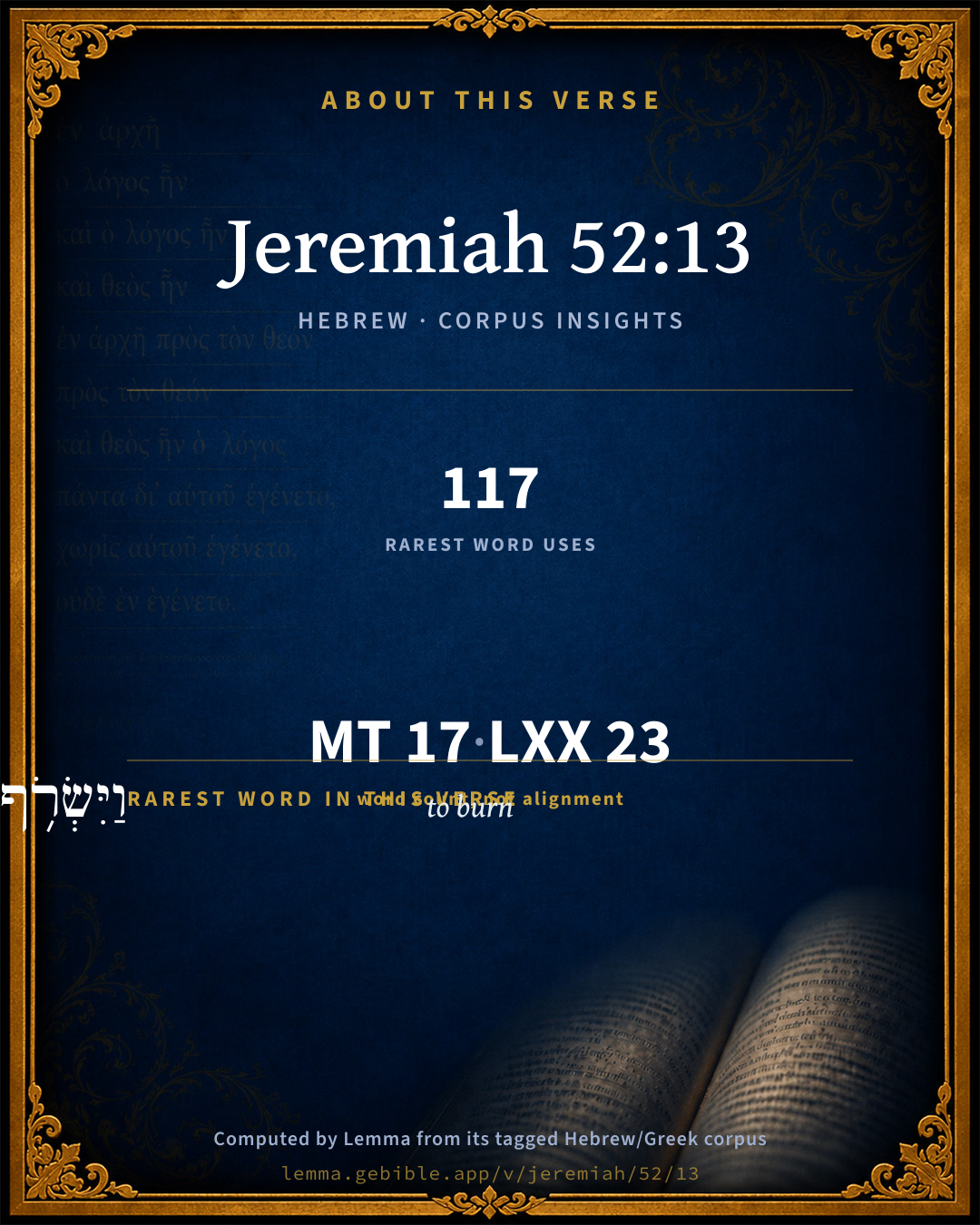
About this verse

These counts appear in no published source. They are computed here, from the morphology-tagged text and Lemma’s own curated glosses. What Lemma adds →

17
words
9
distinct lemmas
Prophets
section

Grammatical profile

  • 2 verbs
  • 10 nouns
  • 1 adjective
  • 4 particles

Verb forms

  • וַיִּשְׂרֹ֥ף Qal · Sequential Imperfect
  • שָׂרַ֥ף Qal · Perfect

Repetition

Words recur within this verse — often emphatic in Hebrew:

  • בֵּית house H1004 ×4
  • וַיִּשְׂרֹ֥ף to burn H8313 ×2
  • כָּל all H3605 ×2

Hebrew & Septuagint length

In the original languages it is 17 Hebrew tokens and 23 Greek tokens — but the two are counted differently (Hebrew bundles its prefixes and suffixes into one token; the Greek is in lemma form), so that isn’t a like-for-like length.

Cross-references

22

Topical passages linked to Jeremiah 52:13 in the Treasury of Scripture Knowledge — connected by theme and wording, ordered by reader-vote popularity; previews shown in the World English Bible.

  • 2 Chronicles 36:19 They burnt the house of God, and broke down the wall of Jerusalem, and burnt all the palaces of it with fire, and destroyed all the goodly vessels of it.
  • Psalms 79:1 God, the nations have come into your inheritance. They have defiled your holy temple. They have laid Jerusalem in heaps.
  • Micah 3:12 Therefore Zion for your sake will be plowed like a field, And Jerusalem will become heaps of rubble, And the mountain of the temple like the high places of a forest.
  • 2 Kings 25:9 He burnt the house of Yahweh, and the king's house; and all the houses of Jerusalem, even every great house, burnt he with fire.
  • Psalms 74:6–8 Now all its carved work They break down with hatchet and hammers.
  • Isaiah 64:10–11 Your holy cities are become a wilderness, Zion is become a wilderness, Jerusalem a desolation.
  • Lamentations 2:7 The Lord has cast off his altar, he has abhorred his sanctuary; He has given up into the hand of the enemy the walls of her palaces: They have made a noise in the house of Yahweh, as in the day of a solemn assembly.
  • Amos 2:5 But I will send a fire on Judah, And it will devour the palaces of Jerusalem."
  • Amos 3:10–11 "Indeed they don't know to do right," says Yahweh, "Who hoard plunder and loot in their palaces."
  • Amos 6:11 "For, behold, Yahweh commands, and the great house will be smashed to pieces, And the little house into bits.
  • Jeremiah 7:14 therefore will I do to the house which is called by my name, in which you trust, and to the place which I gave to you and to your fathers, as I did to Shiloh.
  • Jeremiah 22:14 who says, I will build me a wide house and spacious chambers, and cuts him out windows; and it is ceiling with cedar, and painted with vermilion.
  • Jeremiah 34:22 Behold, I will command, says Yahweh, and cause them to return to this city; and they shall fight against it, and take it, and burn it with fire: and I will make the cities of Judah a desolation, without inhabitant.
  • Jeremiah 37:8–10 The Chaldeans shall come again, and fight against this city; and they shall take it, and burn it with fire.
  • Jeremiah 38:23 They shall bring out all your wives and your children to the Chaldeans; and you shall not escape out of their hand, but shall be taken by the hand of the king of Babylon: and you shall cause this city to be burned with fire.
  • Jeremiah 39:8–9 The Chaldeans burned the king's house, and the houses of the people, with fire, and broke down the walls of Jerusalem.
  • Ezekiel 7:20–22 As for the beauty of his ornament, he set it in majesty; but they made the images of their abominations [and] their detestable things therein: therefore have I made it to them as an unclean thing.
  • Ezekiel 24:1–14 Again, in the ninth year, in the tenth month, in the tenth [day] of the month, the word of Yahweh came to me, saying,
  • Ezekiel 24:21 Speak to the house of Israel, Thus says the Lord Yahweh: Behold, I will profane my sanctuary, the pride of your power, the desire of your eyes, and that which your soul pities; and your sons and your daughters whom you have left behind shall fall by the sword.
  • Zechariah 11:1 Open your doors, Lebanon, That the fire may devour your cedars.
  • Matthew 24:2 But he answered them, "Don't you see all of these things? Most assuredly I tell you, there will not be left here one stone on another, that will not be thrown down."
  • Acts 6:13–14 and set up false witnesses who said, "This man never stops speaking blasphemous words against this holy place and the law.

Cross-references courtesy of OpenBible.info (CC BY 4.0).

Hebrew and Greek witnesses Masoretic Hebrew ↔ Greek Septuagint

The same verse in the two great witnesses to the Old Testament, shown verse-for-verse.

These are two independent witnesses, not word-aligned to each other, and the Septuagint is shown in lemma (dictionary) form.

Hebrew Jeremiah 52:13 Masoretic · Westminster Leningrad Codex

וַיִּשְׂרֹ֥ף אֶת בֵּית יְהוָ֖ה וְאֶת בֵּ֣ית הַמֶּ֑לֶךְ וְאֵ֨ת כָּל בָּתֵּ֧י יְרוּשָׁלִַ֛ם וְאֶת כָּל בֵּ֥ית הַגָּד֖וֹל שָׂרַ֥ף בָּאֵֽשׁ

and he burned the house of Yahweh, and the king's house; and all the houses of Jerusalem, even every great house, burned he with fire.

World English Bible · Public Domain

Greek LXX Structure differs

In the Septuagint, Jeremiah is about an eighth shorter than the Hebrew and arranges its material differently — the Oracles Against the Nations (Hebrew chapters 46–51) appear in the middle of the Greek book, after 25:13. Because the chapter and verse boundaries do not line up, a verse-for-verse comparison with the Hebrew is not shown.

A verse-for-verse comparison isn’t shown here because the chapters and verses don’t line up. Switch to the LXX edition with the MT / LXX toggle above to read the Greek directly.

Hebrew: Westminster Leningrad Codex (CC BY 4.0). Greek: Septuagint (public domain); English from a public-domain English Septuagint. How the Septuagint differs from the Hebrew →

Targum (Aramaic paraphrase)

1

The Targum is the ancient Jewish Aramaic paraphrase of the Hebrew Scriptures — an interpretive translation, not the Hebrew text itself. Onkelos (literal) and Pseudo-Jonathan (expansive) render the Torah, and Jonathan the Prophets. Coverage is partial: where no permissively-licensed English translation exists for a verse, only the Aramaic is shown. This is verse-level text, not a word-by-word alignment to the Hebrew.

  1. Targum Jonathan Prophets (Joshua–Malachi)
    וְאוֹקֵיד יַת בֵּית מַקְדְשָׁא דַייָ וְיַת בֵּית מַלְכָּא וְיַת כָּל בָּתֵּי יְרוּשְׁלֵם וְיַת כָּל בָּתֵּי רַבְרְבַיָא אוֹקִיד בְּנוּרָא:

    (no public-domain English translation for this verse)

    Targum Jonathan — Aramaic: “Mikraot Gedolot” (public domain). English: “Sefaria Community Translation” (CC0 1.0 (public-domain dedication)); “London "Chaldee Paraphrase," 1871” (public domain). Text via Sefaria.

Commentary

Notes on Jeremiah 52:13 from classic Christian and Jewish commentators (each source and its license shown beneath its notes). The classic Christian expositions comment on the surrounding passage and are grouped to its opening verse, so a note may address several verses; the Jewish commentaries on the Tanakh (Rashi and others) are per-verse, so they appear only where the commentator wrote on this verse.

Lemma curates 59 commentaries, every one of them public domain or Creative Commons licensed, each selected and text-cleaned for this edition rather than reprinted as found. About our sources →

Tyndale Open Study Notes

Tyndale Open Resources

52:13 He burned down the Temple: Although the Temple was constructed mostly of stone, beams of cedar were laid among the stones. Cedar panels covered the walls, and cypress planks were used for the floors. Wood was also used for window frames and for doors (see 1 Kgs 6). All of this wood burned.

Tyndale Open Study Notes — © Tyndale Open Resources, licensed CC BY-SA 4.0. Text via the HelloAO Bible API.

Jamieson, Fausset & Brown

Robert Jamieson, A. R. Fausset & David Brown

all the houses . . . and all the houses of the great--the "and" defines what houses especially are meant, namely, the houses of the great men.

Jamieson, Fausset & Brown — Commentary Critical and Explanatory on the Whole Bible (1871) — public domain (CC PDM 1.0). Text via the HelloAO Bible API.

Adam Clarke's Commentary

Verse 13. And burned the house of the Lord] Thus perished this magnificent structure, after it had stood four hundred and twenty-four years three months and eight days. It was built A.M. 2992, and destroyed A.M. 3416.

Adam Clarke's Commentary on the Bible (1810–1826) — public domain. Text from a community e-Sword/MySword module.

Ellicott's Commentary for English Readers

(13) All the houses of the great men.—More accurately, all the great houses.

A Bible Commentary for English Readers, edited by Charles John Ellicott (1878–1897) — public domain. Text from a community e-Sword module.

The Cambridge Bible for Schools and Colleges

gen. ed. J. J. S. Perowne

13. every great house] We must render as mg. every great man’s house, but the Heb. expression is a strange one.

The Cambridge Bible for Schools and Colleges (gen. ed. J. J. S. Perowne; Cambridge University Press, 1878–1918) — public domain. Text from a community e-Sword module.

John Gill's Exposition

And all the army of the Chaldeans, that were with the captain of the guard,.... Which he brought with him from Riblah, or were left at Jerusalem by those that pursued after Zedekiah when the city was taken, which the captain of the guard now had the command of:

broke down all the walls of Jerusalem round about: See Gill on Jer 39:8.

John Gill's Exposition of the Whole Bible (1746–1763) — public domain (CC PDM 1.0). Text via the HelloAO Bible API.

Albert Barnes' Notes on the Bible

Houses of the great - Rather, every great house; i. e., the larger houses only.

Albert Barnes' Notes on the Bible (1834–1885) — public domain. Text from a community e-Sword/MySword module.

Whedon's Commentary on the Bible

Daniel D. Whedon

13. All the houses of the great — Literally, every house the great. “The meaning is, that only the larger houses were burned; and as the article here is intensive, it should be rendered all the largest houses.” — Speaker’s Commentary.

Daniel D. Whedon (gen. ed.), Commentary on the Old and New Testaments (1874–1909) — public domain. Text from a community e-Sword module.

The Pulpit Commentary

The destruction of the temple.

I THE GREATEST EARTHLY SPLENDOUR IS DESTRUCTIBLE. Solomon"s temple was the pride of the Jews. For centuries it had stood mellowing with age. But when the brutal Chaldeans flung their torches at it the magnificent pile of buildings was soon reduced to a mass of smouldering ruins. Sic transit gloria mundi. An invasion, a revolution, a conflagration, may destroy the work of years in a night. Splendid possessions are poor refuges. A palace is not necessarily a castle.

II THERE IS NO SAFETY IN HOLY PLACES AND CONSECRATED THINGS. The temple was burnt, and its treasures and sacred vessels were carried to Babylon. The flames that leaped up on the private houses of Jerusalem found no charmed circle to keep them off from the temple. The building was holy only in so far as it was put to holy uses. But when it was desecrated by sin no magical influence could prevent it from complete destruction. And if the temple could not preserve itself, much less could it protect its superstitious devotees. It was vain indeed for them to cry, "The temple of the Lord," as though the words were a spell to ward off trouble. Thus all who trust in holy sites, ceremonial services, etc., apart from spiritual devotion, will find their faith wrecked, even if the idol of their superstition is not destroyed.

III WHEN THE SPIRIT OF DEVOTION HAS FORSAKEN A TEMPLE THE DESTRUCTION OF THE BUILDING MAY BE A GOOD RATHER THAN AN EVIL. The temple is then worse than useless; it is a snare, tempting men to believe that all is well so long as it stands. So the ordinances of religion delude men into false confidence. While these are duly administered with imposing solemnity, it is difficult to believe that the spirit of religion has fled. Let these go too and men have their eyes open to their true condition. The temple without true worship is a mockery to God. When the soul has gone the body had better be put away as soon as possible. If the Christian has ceased to offer spiritual sacrifices in his body as in a temple of the Holy Ghost, his life is no longer of any true value. When this temple is destroyed the fate is striking and alarming, yet it is but little after its sad desecration through sin.

IV THE ONLY DURABLE WORK IS SPIRITUAL AND HOLY WORK, "Each man"s work shall be made manifest: for the day shall declare it, because it is revealed in fire". (1Co_3:13) There will be a test to the work of life. This may be splendid as a temple, but if it is unholy and earthly in character it must pass away ultimately. How many temples, and cities, and kingdoms, "cloud-capped towers, and gorgeous palaces" have left "not a rack behind"! It is the spiritual work of a man that endures. Even this fails, fruitless, unless it is good in character.

The Pulpit Commentary (1880–1919), ed. H.D.M. Spence-Jones & Joseph S. Exell — public domain. Text from a community e-Sword module.

Lesson kit

Teaching starters — assembled from the data on this page, not authored interpretation. Every prompt links to the verse data it draws on. Edit before teaching.

Jeremiah, in the Prophets, opens this verse with 17 words (9 distinct Hebrew lemmas). Its most distinctive word is sâraph (“to burn”). A historical commentator’s framing appears above. Read the whole chapter for the surrounding context.

Discussion questions

  1. The word sâraph carries the sense “to burn.” How does it shape the verse?
  2. 2 Chronicles 36:19 shares this passage’s theme. How do the two illuminate each other?
  3. “house” occurs 4× in this one verse. What is the effect of the repetition?
  4. The translations on this page render this verse differently — a whole-verse word diff, not a word-by-word alignment. What might account for the different wordings?
  5. The verb «וַיִּשְׂרֹ֥ף» is Qal Sequential Imperfect. How does its form color the action?
  6. Reading how Tyndale Open Study Notes and Jamieson, Fausset & Brown read this verse, where do the two commentators agree and where do they part?

Things to notice

Reading settings

Reading text

Shown beneath each verse's original-language words.

Old Testament
Old Testament edition

Read the OT as the Masoretic Hebrew (MT) or the Greek Septuagint (LXX).

English shown for the Greek Septuagint (in the Hebrew ↔ Greek comparison).

Comparing translations? Open the Compare panel on any verse page to stack up to four side by side.