
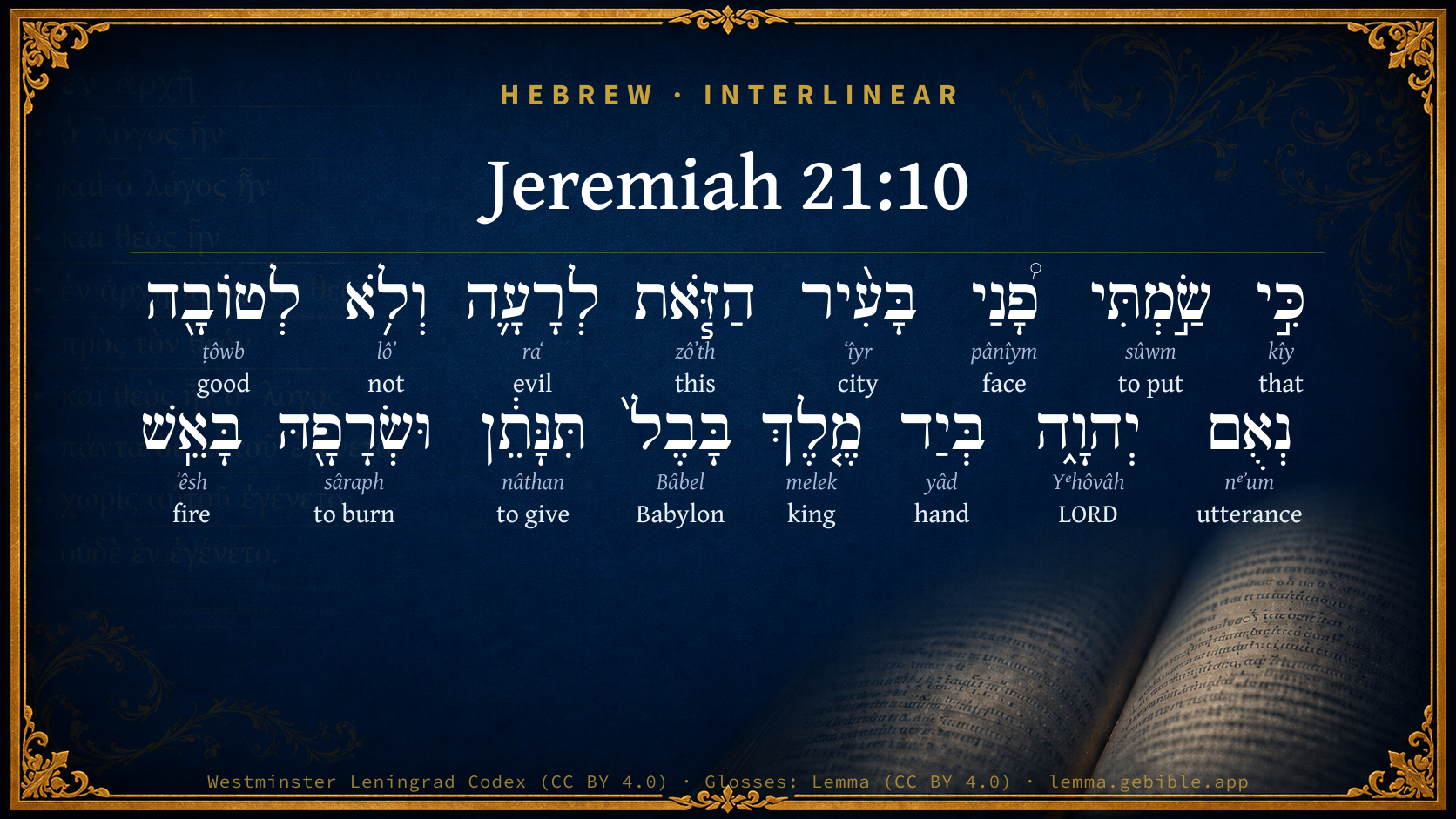
Jeremiah 21:10

Hebrew (Westminster Leningrad Codex) Jeremiah 21:10 appears in the Hebrew Old Testament. The text above is from the Westminster Leningrad Codex. Each word links to its Strong’s number, a concise gloss, and parsing drawn from the Open Scriptures Hebrew Bible morphology. Click any word for its full Brown-Driver-Briggs (BDB) entry.
Download image
Cite this verse

Jeremiah 21:10 (World English Bible). Public Domain. Lemma interlinear Bible study tool, https://lemma.gebible.app/v/jeremiah/21/10.

Show BibTeX & RIS
BibTeX
RIS
English Translation
For I have set my face on this city for evil, and not for good, says Yahweh: it shall be given into the hand of the king of Babylon, and he shall burn it with fire.
World English Bible · Public Domain
Download a study sheet

One document with this verse’s original text, its word-by-word gloss line, the meaning frame, cross-references with their text, attributed commentary, and full source and license credits — printable, and it pastes into notes with its structure intact.

This verse Autodidact and up

Study sheet (.html) Plain text (.txt)

A passage Seminary Student

Up to 50 verses in one chapter. A passage sheet keeps up to 6 commentary sources and 12 cross-references per verse, in the order this page ranks them, and says so on the sheet whenever that leaves anything out. Ask for a single verse and you get the Autodidact verse sheet above.

Everything on this page stays free to read, with no account — the sheet is a download of what is already on screen, not access to it.

Want to remove ads? Support Godless Engineer
Compare translations 3

The same verse in 3 English versions, stacked beneath the original-language interlinear above. Click any original word for its lexicon entry.

Each is an independent rendering of the whole verse — the interlinear is not word-aligned to these translations.

Highlighted words mark where these versions differ — a whole-verse word diff, not a word-by-word alignment.

  • World English Bible Public Domain
    For I have set my face on this city for evil, and not for good, says Yahweh: it shall be given into the hand of the king of Babylon, and he shall burn it with fire.
  • King James Version Public Domain
    For I have set my face against this city for evil, and not for good, saith the LORD: it shall be given into the hand of the king of Babylon, and he shall burn it with fire.
  • unfoldingWord Literal Text CC BY-SA 4.0
    For I have set my face against this city for evil and not for good’—the declaration of Yahweh—‘into the hand of the king of Babylon it will be given, and he will burn it with fire.’”

unfoldingWord Literal Text — © unfoldingWord, licensed CC BY-SA 4.0. Word-aligned USFM3 via Door43 (git.door43.org/unfoldingWord/en_ult).

Versions to compare (up to 4)

3 of 4 selected

Show all 18 translations

Every available English version of this verse, each an independent rendering of the whole verse.

  • World English Bible Public Domain
    For I have set my face on this city for evil, and not for good, says Yahweh: it shall be given into the hand of the king of Babylon, and he shall burn it with fire.
  • Berean Standard Bible Public Domain
    For I have set My face against this city to bring disaster and not good, declares the LORD. It will be delivered into the hand of the king of Babylon, who will destroy it with fire.’
  • Majority Standard Bible Public Domain
    For I have set My face against this city to bring disaster and not good, declares the LORD. It will be delivered into the hand of the king of Babylon, who will destroy it with fire.’
  • King James Version Public Domain
    For I have set my face against this city for evil, and not for good, saith the LORD: it shall be given into the hand of the king of Babylon, and he shall burn it with fire.
  • American Standard Version (1901) Public Domain
    For I have set my face upon this city for evil, and not for good, saith Jehovah: it shall be given into the hand of the king of Babylon, and he shall burn it with fire.
  • Revised Version (1885) Public Domain
    For I have set my face upon this city for evil, and not for good, saith the LORD: it shall be given into the hand of the king of Babylon, and he shall burn it with fire.
  • Geneva Bible (1599) Public Domain
    For I haue set my face against this citie, for euill and not for good, saith the Lord: it shalbe giuen into the hande of the King of Babel, and he shall burne it with fire.
  • Douay-Rheims (1899) Public Domain
    For I have set my face against this city for evil, and not for good, saith the Lord: it shall be given into the hand of the king of Babylon, and he shall burn it with fire.
  • Young's Literal Translation Public Domain
    For I have set My face against this city for evil, And not for good -- an affirmation of Jehovah. Into the hand of the king of Babylon it is given, And he hath burned it with fire.
  • Literal Standard Version CC BY-SA 4.0
    For I have set My face against this city for calamity, || And not for good,” || A declaration of YHWH. “It is given into the hand of the king of Babylon, || And he has burned it with fire.
  • Unlocked Literal Bible CC BY-SA 4.0
    For I have set my face against this city in order to bring disaster and not to bring good—this is Yahweh's declaration. It has been given into the hand of the king of Babylon and he will burn it.'
  • unfoldingWord Literal Text CC BY-SA 4.0
    For I have set my face against this city for evil and not for good’—the declaration of Yahweh—‘into the hand of the king of Babylon it will be given, and he will burn it with fire.’”
  • Darby Bible Public Domain
    For I have set my face against this city for evil, and not for good, saith Jehovah: it shall be given into the hand of the king of Babylon, and he shall burn it with fire.
  • World Messianic Bible Public Domain
    For I have set my face on this city for evil, and not for good,” says the LORD. “It will be given into the hand of the king of Babylon, and he will burn it with fire.”’
  • Webster's Bible Public Domain
    For I have set my face against this city for evil, and not for good, saith the LORD: it shall be given into the hand of the king of Babylon, and he shall burn it with fire.
  • Free Bible Version CC BY-SA 4.0
    For I am determined to bring disaster on this city, and not blessings, declares the Lord. It will be handed over to the king of Babylon, who will destroy it with fire.
  • Bible in Basic English Public Domain
    For my face is turned to this town for evil and not for good, says the Lord: it will be given into the hands of the king of Babylon, and he will have it burned with fire.
  • JPS Tanakh (1917) Public Domain
    For I have set My face against this city for evil, and not for good, saith the LORD; it shall be given into the hand of the king of Babylon, and he shall burn it with fire.

Literal Standard Version (2020), Covenant Press — licensed CC BY-SA 4.0. Text via the HelloAO Bible API (eBible.org). Unlocked Literal Bible (unfoldingWord) — licensed CC BY-SA 4.0. Text via the HelloAO Bible API (eBible.org). unfoldingWord Literal Text — © unfoldingWord, licensed CC BY-SA 4.0. Word-aligned USFM3 via Door43 (git.door43.org/unfoldingWord/en_ult). Free Bible Version, Dr. Jonathan Gallagher — licensed CC BY-SA 4.0. Text via the HelloAO Bible API (eBible.org).

Word by word

More ways to search: Search by grammar → Find every occurrence → Compare this word →

Practice this passage: Drill this verse → Learn its vocabulary →

וּשְׂרָפָ֖הּ
sâraph
H8313
“and · to burn · her”
Conjunction + Verb, Qal, Sequential Perfect, 3rd Person, Masculine, Singular + Suffix, Personal, 3rd Person, Feminine, Singular
Part of Speech
Conjunction + Verb
Stem
Qal
Form
Sequential Perfect
Person
3rd Person
Gender
Masculine
Number
Singular
Full BDB Definition

Origin: a primitive root

TWOT: 2292

to burn - (Qal) to burn - (Niphal) to be burned - (Piel) burner, burning (participle) - (Pual) to be burnt up, be burned
  1. כִּ֣י kîy H3588 “that” Conjunction
  2. שַׂ֣מְתִּי sûwm H7760 “to put” Verb, Qal, Perfect, 1st Person, Common, Singular
  3. פָ֠נַי pânîym H6440 “face(s) · my” Noun, Common, Both, Plural, Construct + Suffix, Personal, 1st Person, Common, Singular
  4. בָּעִ֨יר ʻîyr H5892 “in/at the · city” Preposition, Determined + Noun, Common, Feminine, Singular, Absolute
  5. הַזֹּ֧את zôʼth H2063 “the · this” Particle, Definite Article + Pronoun, Demonstrative, Feminine, Singular
  6. לְרָעָ֛ה raʻ H7451 “to/for · evil” Preposition + Noun, Common, Feminine, Singular, Absolute
  7. וְלֹ֥א lôʼ H3808 “and · not” Conjunction + Particle, Negative
  8. לְטוֹבָ֖ה ṭôwb H2896 “to/for · good” Preposition + Adjective, Adjective, Feminine, Singular, Absolute
  9. נְאֻם nᵉʼum H5002 “utterance of” Noun, Common, Masculine, Singular, Construct
  10. יְהוָ֑ה Yᵉhôvâh H3068 “LORD” Noun, Proper
  11. בְּיַד yâd H3027 “in/at · hand of” Preposition + Noun, Common, Both, Singular, Construct
  12. מֶ֤לֶךְ melek H4428 “king of” Noun, Common, Masculine, Singular, Construct
  13. בָּבֶל֙ Bâbel H894 “Babylon” Noun, Proper
  14. תִּנָּתֵ֔ן nâthan H5414 “to give” Verb, Niphal, Imperfect, 3rd Person, Feminine, Singular
  15. בָּאֵֽשׁ ʼêsh H784 “in/at the · fire” Preposition, Determined + Noun, Common, Both, Singular, Absolute

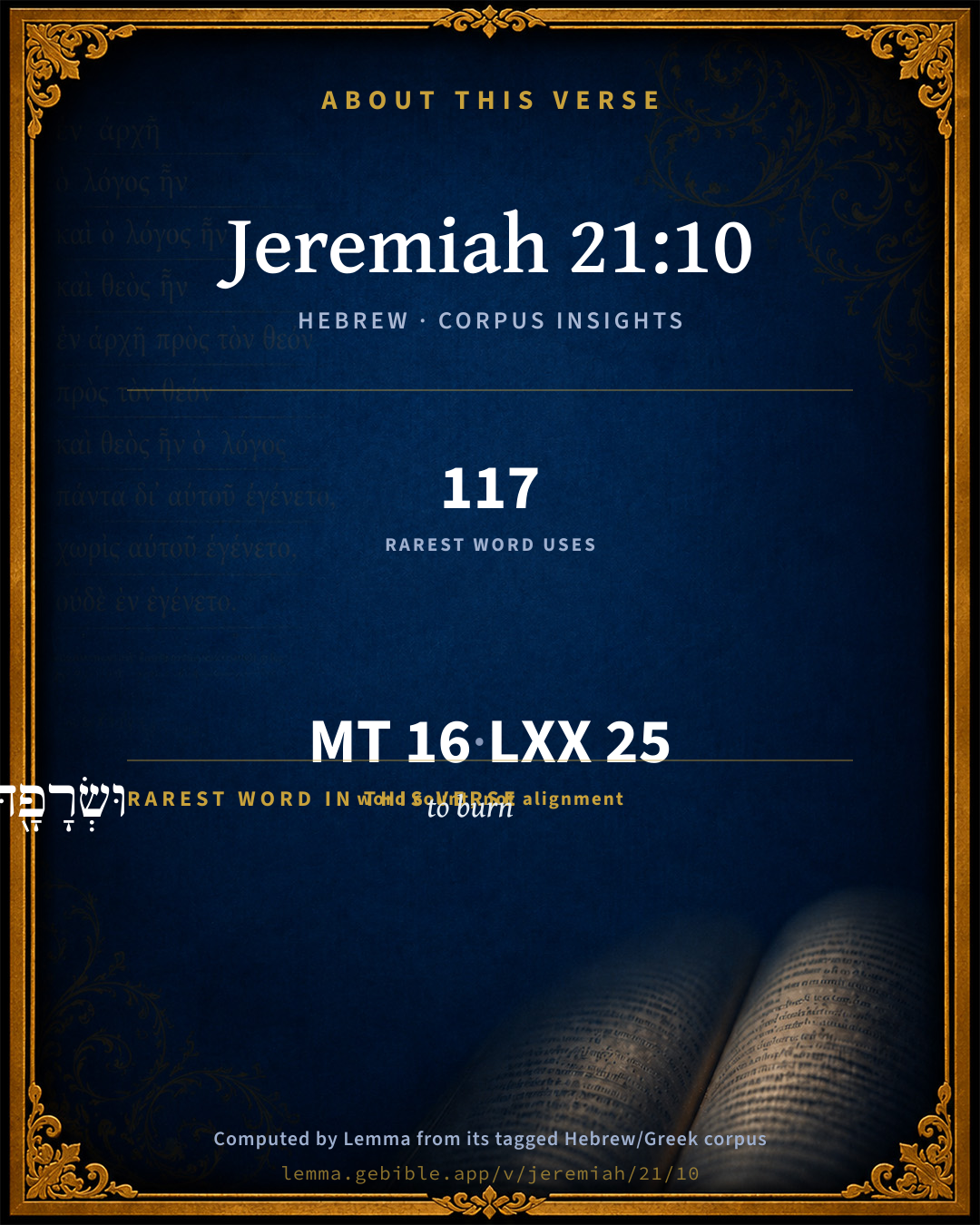
About this verse

These counts appear in no published source. They are computed here, from the morphology-tagged text and Lemma’s own curated glosses. What Lemma adds →

16
words
16
distinct lemmas
Prophets
section

Grammatical profile

  • 3 verbs
  • 9 nouns
  • 1 adjective
  • 1 pronoun
  • 1 conjunction
  • 1 particle

Verb forms

  • שַׂ֣מְתִּי Qal · Perfect
  • תִּנָּתֵ֔ן Niphal · Imperfect
  • וּשְׂרָפָ֖הּ Qal · Sequential Perfect

Hebrew & Septuagint length

In the original languages it is 16 Hebrew tokens and 25 Greek tokens — but the two are counted differently (Hebrew bundles its prefixes and suffixes into one token; the Greek is in lemma form), so that isn’t a like-for-like length.

Cross-references

21

Topical passages linked to Jeremiah 21:10 in the Treasury of Scripture Knowledge — connected by theme and wording, ordered by reader-vote popularity; previews shown in the World English Bible.

  • Jeremiah 44:11 Therefore thus says Yahweh of Hosts, the God of Israel: Behold, I will set my face against you for evil, even to cut off all Judah.
  • Jeremiah 44:27 Behold, I watch over them for evil, and not for good; and all the men of Judah who are in the land of Egypt shall be consumed by the sword and by the famine, until there be an end of them.
  • Amos 9:4 Though they go into captivity before their enemies, there I will command the sword, and it will kill them. I will set my eyes on them for evil, and not for good.
  • Jeremiah 52:13 and he burned the house of Yahweh, and the king's house; and all the houses of Jerusalem, even every great house, burned he with fire.
  • Ezekiel 15:7 I will set my face against them; they shall go forth from the fire, but the fire shall devour them; and you shall know that I am Yahweh, when I set my face against them.
  • 2 Chronicles 36:19 They burnt the house of God, and broke down the wall of Jerusalem, and burnt all the palaces of it with fire, and destroyed all the goodly vessels of it.
  • Jeremiah 34:2 Thus says Yahweh, the God of Israel, Go, and speak to Zedekiah king of Judah, and tell him, Thus says Yahweh, Behold, I will give this city into the hand of the king of Babylon, and he shall burn it with fire:
  • Jeremiah 38:3 Thus says Yahweh, This city shall surely be given into the hand of the army of the king of Babylon, and he shall take it.
  • Jeremiah 38:18 But if you will not go forth to the king of Babylon's princes, then shall this city be given into the hand of the Chaldeans, and they shall burn it with fire, and you shall not escape out of their hand.
  • Jeremiah 39:8 The Chaldeans burned the king's house, and the houses of the people, with fire, and broke down the walls of Jerusalem.
  • Leviticus 17:10 "'Any man of the house of Israel, or of the strangers who live as foreigners among them, who eats any kind of blood, I will set my face against that soul who eats blood, and will cut him off from among his people.
  • Leviticus 26:17 I will set my face against you, and you will be struck before your enemies. Those who hate you will rule over you; and you will flee when no one pursues you.
  • Psalms 34:16 Yahweh's face is against those who do evil, To cut off the memory of them from the earth.
  • Jeremiah 38:23 They shall bring out all your wives and your children to the Chaldeans; and you shall not escape out of their hand, but shall be taken by the hand of the king of Babylon: and you shall cause this city to be burned with fire.
  • Leviticus 20:3–5 I also will set my face against that person, and will cut him off from among his people because he has given of his seed to Molech, to defile my sanctuary, and to profane my holy name.
  • Jeremiah 17:27 But if you will not listen to me to make the Sabbath day holy, and not to bear a burden and enter in at the gates of Jerusalem on the Sabbath day; then will I kindle a fire in the gates of it, and it shall devour the palaces of Jerusalem, and it shall not be quenched.
  • Jeremiah 26:6 then will I make this house like Shiloh, and will make this city a curse to all the nations of the earth.
  • Jeremiah 32:28–31 Therefore thus says Yahweh: Behold, I will give this city into the hand of the Chaldeans, and into the hand of Nebuchadrezzar king of Babylon, and he shall take it:
  • Jeremiah 34:22 Behold, I will command, says Yahweh, and cause them to return to this city; and they shall fight against it, and take it, and burn it with fire: and I will make the cities of Judah a desolation, without inhabitant.
  • Jeremiah 37:8–10 The Chaldeans shall come again, and fight against this city; and they shall take it, and burn it with fire.
  • Zechariah 1:6 But my words and my decrees, which I commanded my servants the prophets, didn't they overtake your fathers? "Then they repented and said, 'Just as Yahweh of Hosts determined to do to us, according to our ways, and according to our practices, so he has dealt with us.'"

Cross-references courtesy of OpenBible.info (CC BY 4.0).

Hebrew and Greek witnesses Masoretic Hebrew ↔ Greek Septuagint

The same verse in the two great witnesses to the Old Testament, shown verse-for-verse.

These are two independent witnesses, not word-aligned to each other, and the Septuagint is shown in lemma (dictionary) form.

Hebrew Jeremiah 21:10 Masoretic · Westminster Leningrad Codex

כִּ֣י שַׂ֣מְתִּי פָ֠נַי בָּעִ֨יר הַזֹּ֧את לְרָעָ֛ה וְלֹ֥א לְטוֹבָ֖ה נְאֻם יְהוָ֑ה בְּיַד מֶ֤לֶךְ בָּבֶל֙ תִּנָּתֵ֔ן וּשְׂרָפָ֖הּ בָּאֵֽשׁ

For I have set my face on this city for evil, and not for good, says Yahweh: it shall be given into the hand of the king of Babylon, and he shall burn it with fire.

World English Bible · Public Domain

Greek LXX Structure differs

In the Septuagint, Jeremiah is about an eighth shorter than the Hebrew and arranges its material differently — the Oracles Against the Nations (Hebrew chapters 46–51) appear in the middle of the Greek book, after 25:13. Because the chapter and verse boundaries do not line up, a verse-for-verse comparison with the Hebrew is not shown.

A verse-for-verse comparison isn’t shown here because the chapters and verses don’t line up. Switch to the LXX edition with the MT / LXX toggle above to read the Greek directly.

Hebrew: Westminster Leningrad Codex (CC BY 4.0). Greek: Septuagint (public domain); English from a public-domain English Septuagint. How the Septuagint differs from the Hebrew →

Targum (Aramaic paraphrase)

1

The Targum is the ancient Jewish Aramaic paraphrase of the Hebrew Scriptures — an interpretive translation, not the Hebrew text itself. Onkelos (literal) and Pseudo-Jonathan (expansive) render the Torah, and Jonathan the Prophets. Coverage is partial: where no permissively-licensed English translation exists for a verse, only the Aramaic is shown. This is verse-level text, not a word-by-word alignment to the Hebrew.

  1. Targum Jonathan Prophets (Joshua–Malachi)
    אֲרֵי חַל רוּגְזִי בְּקַרְתָּא הָדָא לְבִישָׁא וְלָא לְטָבָא אֲמַר יְיָ בִּידָא דְמַלְכָּא דְבָבֶל תִּתְמְסַר וְיוֹקִדִינָהּ בְּנוּרָא:

    (no public-domain English translation for this verse)

    Targum Jonathan — Aramaic: “Mikraot Gedolot” (public domain). English: “Sefaria Community Translation” (CC0 1.0 (public-domain dedication)); “London "Chaldee Paraphrase," 1871” (public domain). Text via Sefaria.

Commentary

Notes on Jeremiah 21:10 from classic Christian and Jewish commentators (each source and its license shown beneath its notes). The classic Christian expositions comment on the surrounding passage and are grouped to its opening verse, so a note may address several verses; the Jewish commentaries on the Tanakh (Rashi and others) are per-verse, so they appear only where the commentator wrote on this verse.

Lemma curates 59 commentaries, every one of them public domain or Creative Commons licensed, each selected and text-cleaned for this edition rather than reprinted as found. About our sources →

Trapp's Complete Commentary

John Trapp

Jer 21:10 For I have set my face against this city for evil, and not for good, saith the LORD: it shall be given into the hand of the king of Babylon, and he shall burn it with fire.

Ver. 10. For I have set my face against this city.] I have looked this city to destruction. I have decreed it, and will do it. When our Saviour set his face to go towards this city, {Luk 9:51} he was fully resolved on it, and nothing should hinder him. See Lev 17:10; Lev 20:5.

John Trapp, A Commentary or Exposition upon All the Books of the Old and New Testament (1647–1656) — public domain. Text from a community e-Sword module.

Jamieson, Fausset & Brown

Robert Jamieson, A. R. Fausset & David Brown

set . . . face against--determined to punish (See on Lev 17:10).

Jamieson, Fausset & Brown — Commentary Critical and Explanatory on the Whole Bible (1871) — public domain (CC PDM 1.0). Text via the HelloAO Bible API.

Adam Clarke's Commentary

Verse 10. He shall burn it with fire.] What a heavy message to all; and especially to them who had any fear of God, or reverence for the temple and its sacred services!

Adam Clarke's Commentary on the Bible (1810–1826) — public domain. Text from a community e-Sword/MySword module.

John Calvin's Commentaries

He again confirms what he had said, that it would be the way of death if the Jews remained fixed in the city, for this would be to struggle against God; for God is said to set his face for evil, since he had fully determined to punish that nation. To set the face is the same as to be resolute. Then God says that what he had resolved respecting the destruction of Jerusalem could not be changed. Now, what must at length be the issue when any one thinks that he can, against the will of God, escape death? As they who violently stumble against a stone break their legs, and arms, and head, too; so they who furiously stumble against God attain for themselves final ruin.

We hence see why the Prophet added this verse: it was, that the Jews might not in their usual manner foster vain hopes; for to hope for any good was to contend with God himself. Delivered, he says, shall be this city into the hand of the king of Babylon, and he shall burn it with fire He intimates that Nebuchadnezzar would not only conquer the people and triumph over a taken city, but that the city itself was doomed to destruction. It is, indeed, a most grievous thing when a city is wholly demolished: cities are often taken, and the conqueror removes the inhabitants here and there, while it remains still a habitable place; but God declares here that he would act more severely towards the city of Jerusalem, for it was to perish by fire. It follows, —

John Calvin's Commentaries (1540-1563) — public domain. Text from the Calvin Translation Society English edition (1840s-50s) via the Christian Classics Ethereal Library (ccel.org). Calvin's coverage is partial (roughly two-thirds of the Bible); uncommented books and verses are honest gaps, never fabricated. The 19th-century editor's footnotes and remarks are omitted so the notes are faithfully Calvin's own voice.

Ellicott's Commentary for English Readers

(10) He shall burn it with fire.—Another detail of prediction fulfilled literally in Jer_52:13. Such a destruction was, of course, common enough as an incident of the capture of besieged cities, but it was not universal. Often, indeed, the conquerors sought to preserve the city and to occupy its palaces. The actual answer to Zedekiah’s messengers possibly ended with this verse.

A Bible Commentary for English Readers, edited by Charles John Ellicott (1878–1897) — public domain. Text from a community e-Sword module.

The Cambridge Bible for Schools and Colleges

gen. ed. J. J. S. Perowne

10. I have set my face upon this city] Cp. Jer_44:11; Amo_9:4. The phrase occurs in a good sense in Jer_26:6.

The Cambridge Bible for Schools and Colleges (gen. ed. J. J. S. Perowne; Cambridge University Press, 1878–1918) — public domain. Text from a community e-Sword module.

John Gill's Exposition

For I have set my face against this city,.... Or "my fury", as the Targum; their sins had provoked the eyes of his glory; he was wroth with them, and determined to cut them off; his mind was set against them, and upon their ruin; and there was no turning him from it:

for evil, and not for good, saith the Lord; to bring the evil of punishment upon them for the evil of their sins, and not do any good unto them, they were so ill deserving of:

it shall be given into the hand of the king of Babylon; come under his power and dominion, by the will of the Lord; for it was he that gave it into his hands, because of the sins of the inhabitants of it:

and he shall burn it with fire; as he did, both the house of the Lord in it, the temple, the king's house or palace, the stately houses of the princes and nobles, and even the houses of all the people; see Jer 52:13.

John Gill's Exposition of the Whole Bible (1746–1763) — public domain (CC PDM 1.0). Text via the HelloAO Bible API.

Matthew Poole's English Annotations

I have set my face against this city for evil, and not for good; that is, I will set myself against it, I will be an enemy to it. See the like phrase Lev 17:10; 20:5. It is a phrase signifying not only God’s aversion from them, and the taking his affection off them, but his determination to bring ruin upon them, and choosing methods of providence tending and conducive thereunto; and so it is opened in the following words, which are rather to be understood of the structure of the city than of the inhabitants, for that not the people were burnt with fire, though probably many of the people perished in so great burnings.

Matthew Poole's English Annotations on the Holy Bible (1683–1685) — public domain. Text from a community e-Sword/MySword module.

Rashi

Rabbi Shlomo Yitzchaki (Rashi)

My anger as the Targum, רוּגְזִי My anger.

Rashi on the Tanakh — English translations: “The Judaica Press complete Tanach with Rashi, translated by A. J. Rosenberg” (CC BY 4.0); “Pentateuch with Rashi's commentary by M. Rosenbaum and A.M. Silbermann, 1929-1934” (public domain); “The Metsudah Tanach series, Lakewood, N.J” (CC BY 4.0); and “The Book of Joshua, Metsudah Publications, 1997” (CC BY 4.0). Text via Sefaria.

Lesson kit

Teaching starters — assembled from the data on this page, not authored interpretation. Every prompt links to the verse data it draws on. Edit before teaching.

Jeremiah, in the Prophets, opens this verse with 16 words (16 distinct Hebrew lemmas). Its most distinctive word is sâraph (“to burn”). A historical commentator’s framing appears above. Read the whole chapter for the surrounding context.

Discussion questions

  1. The word sâraph carries the sense “to burn.” How does it shape the verse?
  2. How does Jeremiah 44:11, which shares this passage’s theme, read alongside this verse?
  3. The translations on this page render this verse differently — a whole-verse word diff, not a word-by-word alignment. What might account for the different wordings?
  4. «שַׂ֣מְתִּי» is a Qal Perfect verb. How does that grammatical form shape the action described?
  5. Compare how Trapp's Complete Commentary and Jamieson, Fausset & Brown read this verse. Where do they agree or differ?

Things to notice

Reading settings

Reading text

Shown beneath each verse's original-language words.

Old Testament
Old Testament edition

Read the OT as the Masoretic Hebrew (MT) or the Greek Septuagint (LXX).

English shown for the Greek Septuagint (in the Hebrew ↔ Greek comparison).

Comparing translations? Open the Compare panel on any verse page to stack up to four side by side.