
Jeremiah 19:5

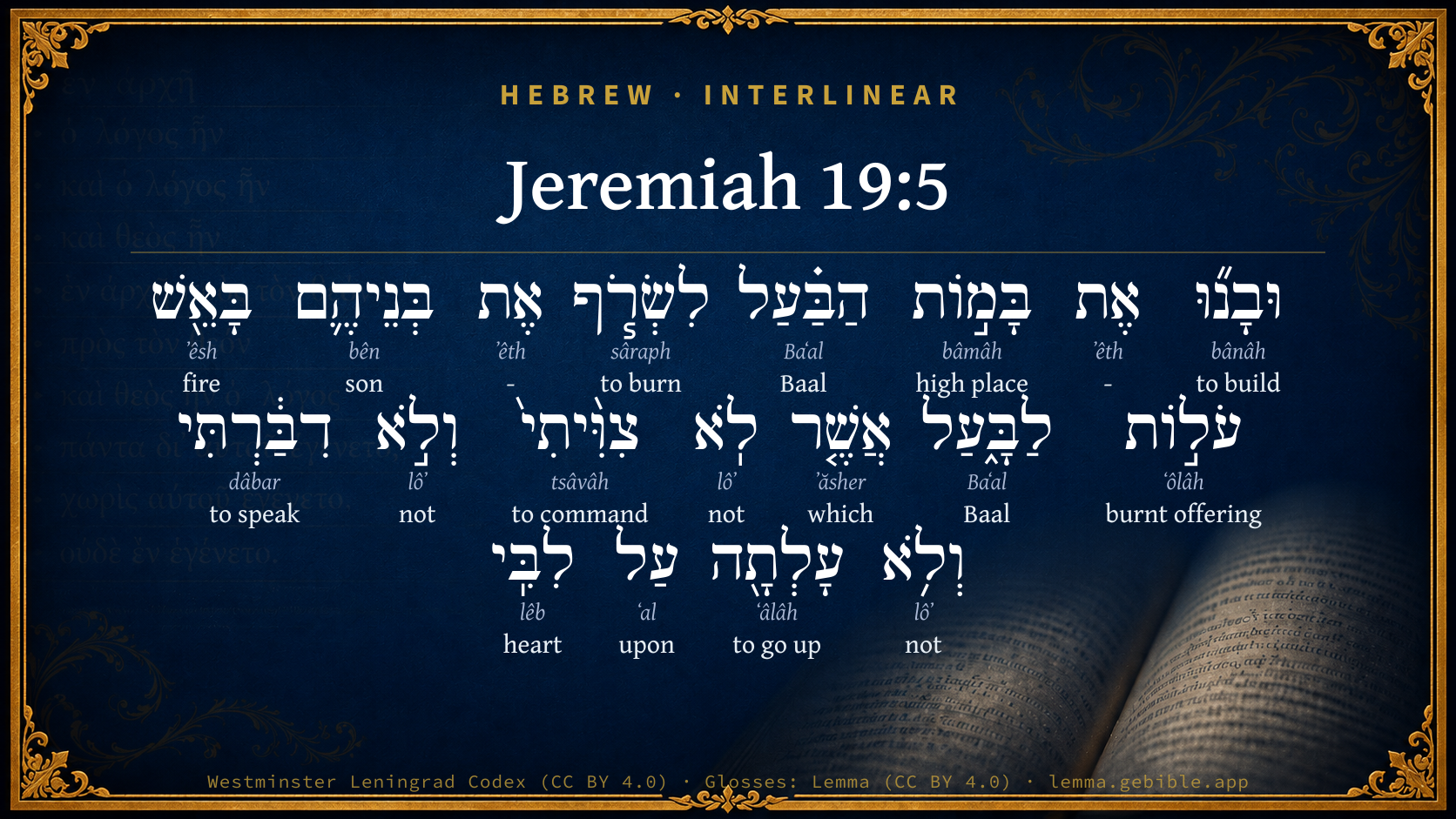
Hebrew (Westminster Leningrad Codex) Jeremiah 19:5 appears in the Hebrew Old Testament. The text above is from the Westminster Leningrad Codex. Each word links to its Strong’s number, a concise gloss, and parsing drawn from the Open Scriptures Hebrew Bible morphology. Click any word for its full Brown-Driver-Briggs (BDB) entry.
Download image
Cite this verse

Jeremiah 19:5 (World English Bible). Public Domain. Lemma interlinear Bible study tool, https://lemma.gebible.app/v/jeremiah/19/5.

Show BibTeX & RIS
BibTeX
RIS
English Translation
and have built the high places of Baal, to burn their sons in the fire for burnt offerings to Baal; which I didn't command, nor spoke it, neither came it into my mind:
World English Bible · Public Domain
Download a study sheet

One document with this verse’s original text, its word-by-word gloss line, the meaning frame, cross-references with their text, attributed commentary, and full source and license credits — printable, and it pastes into notes with its structure intact.

This verse Autodidact and up

Study sheet (.html) Plain text (.txt)

A passage Seminary Student

Up to 50 verses in one chapter. A passage sheet keeps up to 6 commentary sources and 12 cross-references per verse, in the order this page ranks them, and says so on the sheet whenever that leaves anything out. Ask for a single verse and you get the Autodidact verse sheet above.

Everything on this page stays free to read, with no account — the sheet is a download of what is already on screen, not access to it.

Want to remove ads? Support Godless Engineer
Compare translations 3

The same verse in 3 English versions, stacked beneath the original-language interlinear above. Click any original word for its lexicon entry.

Each is an independent rendering of the whole verse — the interlinear is not word-aligned to these translations.

Highlighted words mark where these versions differ — a whole-verse word diff, not a word-by-word alignment.

  • World English Bible Public Domain
    and have built the high places of Baal, to burn their sons in the fire for burnt offerings to Baal; which I didn't command, nor spoke it, neither came it into my mind:
  • King James Version Public Domain
    They have built also the high places of Baal, to burn their sons with fire for burnt offerings unto Baal, which I commanded not, nor spake it, neither came it into my mind:
  • unfoldingWord Literal Text CC BY-SA 4.0
    And they have built the high places of Baal to burn their sons in the fire burnt offerings to Baal, which I did not command, and I did not speak, and it did not come up into my heart.

unfoldingWord Literal Text — © unfoldingWord, licensed CC BY-SA 4.0. Word-aligned USFM3 via Door43 (git.door43.org/unfoldingWord/en_ult).

Versions to compare (up to 4)

3 of 4 selected

Show all 18 translations

Every available English version of this verse, each an independent rendering of the whole verse.

  • World English Bible Public Domain
    and have built the high places of Baal, to burn their sons in the fire for burnt offerings to Baal; which I didn't command, nor spoke it, neither came it into my mind:
  • Berean Standard Bible Public Domain
    They have built high places to Baal on which to burn their children in the fire as offerings to Baal—something I never commanded or mentioned, nor did it even enter My mind.
  • Majority Standard Bible Public Domain
    They have built high places to Baal on which to burn their children in the fire as offerings to Baal—something I never commanded or mentioned, nor did it even enter My mind.
  • King James Version Public Domain
    They have built also the high places of Baal, to burn their sons with fire for burnt offerings unto Baal, which I commanded not, nor spake it, neither came it into my mind:
  • American Standard Version (1901) Public Domain
    and have built the high places of Baal, to burn their sons in the fire for burnt-offerings unto Baal; which I commanded not, nor spake it, neither came it into my mind:
  • Revised Version (1885) Public Domain
    and have built the high places of Baal, to burn their sons in the fire for burnt offerings unto Baal; which I commanded not, nor spake it, neither came it into my mind:
  • Geneva Bible (1599) Public Domain
    And they haue built the hie places of Baal, to burne their sonnes with fire for burnt offrings vnto Baal, which I commanded not, nor spake it, neither came it into my minde)
  • Douay-Rheims (1899) Public Domain
    And they have built the high places of Baalim, to burn their children with fire for a holocaust to Baalim: which I did not command, nor speak of, neither did it once come into my mind.
  • Young's Literal Translation Public Domain
    and have built the high places of Baal to burn their sons with fire, burnt-offerings to Baal, that I commanded not, nor spake of, nor did it come up on My heart.
  • Literal Standard Version CC BY-SA 4.0
    and have built the high places of Ba‘al to burn their sons with fire, burnt-offerings to Ba‘al, that I did not command, nor spoke of, nor did it come up on My heart.
  • Unlocked Literal Bible CC BY-SA 4.0
    They built the high places of Baal to burn their sons in the fire as burnt offerings to him—something that I did not command or mention, nor did it enter my mind.
  • unfoldingWord Literal Text CC BY-SA 4.0
    And they have built the high places of Baal to burn their sons in the fire burnt offerings to Baal, which I did not command, and I did not speak, and it did not come up into my heart.
  • Darby Bible Public Domain
    and they have built the high places of Baal, to burn their sons in the fire as burnt-offerings unto Baal, which I commanded not, nor spake it, neither came it up into my mind:
  • World Messianic Bible Public Domain
    and have built the high places of Baal to burn their children in the fire for burnt offerings to Baal, which I didn’t command, nor speak, which didn’t even enter into my mind.
  • Webster's Bible Public Domain
    They have built also the high places of Baal, to burn their sons with fire for burnt-offerings to Baal, which I commanded not, nor spoke it, neither came it into my mind:
  • Free Bible Version CC BY-SA 4.0
    They have built pagan shrines to Baal where they burn their children in the fire as offerings to Baal. This is something I never commanded or even mentioned. I never even thought of such a thing!
  • Bible in Basic English Public Domain
    And they have put up the high places of the Baal, burning their sons in the fire; a thing which was not ordered by me, and it was never in my mind:
  • JPS Tanakh (1917) Public Domain
    and have built the high places of Baal, to burn their sons in the fire for burnt-offerings unto Baal; which I commanded not, nor spoke it, neither came it into My mind.

Literal Standard Version (2020), Covenant Press — licensed CC BY-SA 4.0. Text via the HelloAO Bible API (eBible.org). Unlocked Literal Bible (unfoldingWord) — licensed CC BY-SA 4.0. Text via the HelloAO Bible API (eBible.org). unfoldingWord Literal Text — © unfoldingWord, licensed CC BY-SA 4.0. Word-aligned USFM3 via Door43 (git.door43.org/unfoldingWord/en_ult). Free Bible Version, Dr. Jonathan Gallagher — licensed CC BY-SA 4.0. Text via the HelloAO Bible API (eBible.org).

Word by word

More ways to search: Search by grammar → Find every occurrence → Compare this word →

Practice this passage: Drill this verse → Learn its vocabulary →

הַבַּ֗עַל
Baʻal
H1168
“the · Baal”
Particle, Definite Article + Noun, Proper
Part of Speech
Particle + Noun
Type
Proper
Full BDB Definition

Origin: the same as H1167

TWOT: 262a

Baal = "lord" - supreme male divinity of the Phoenicians or Canaanites (noun proper masculine) - a Reubenite (noun proper masculine) - the son of Jehiel and grandfather of Saul (noun proper masculine) - a town of Simeon, probably identical to Baalath-beer (noun proper locative)
  1. וּבָנ֞וּ bânâh H1129 “and · to build” Conjunction + Verb, Qal, Sequential Perfect, 3rd Person, Common, Plural
  2. אֶת ʼêth H853 “-” Particle, Direct Object
  3. בָּמ֣וֹת bâmâh H1116 “high places of” Noun, Common, Feminine, Plural, Construct
  4. לִשְׂרֹ֧ף sâraph H8313 “to burn” Preposition + Verb, Qal, Infinitive Construct
  5. אֶת ʼêth H853 “-” Particle, Direct Object
  6. בְּנֵיהֶ֛ם bên H1121 “sons · their” Noun, Common, Masculine, Plural, Construct + Suffix, Personal, 3rd Person, Masculine, Plural
  7. בָּאֵ֖שׁ ʼêsh H784 “in/at the · fire” Preposition, Determined + Noun, Common, Both, Singular, Absolute
  8. עֹל֣וֹת ʻôlâh H5930 “burnt offerings” Noun, Common, Feminine, Plural, Absolute
  9. לַבָּ֑עַל Baʻal H1168 “to/for the · Baal” Preposition, Determined + Noun, Proper
  10. אֲשֶׁ֤ר ʼăsher H834 “which” Particle, Relative
  11. לֹֽא lôʼ H3808 “not” Particle, Negative
  12. צִוִּ֨יתִי֙ tsâvâh H6680 “to command” Verb, Piel, Perfect, 1st Person, Common, Singular
  13. וְלֹ֣א lôʼ H3808 “and · not” Conjunction + Particle, Negative
  14. דִבַּ֔רְתִּי dâbar H1696 “to speak” Verb, Piel, Perfect, 1st Person, Common, Singular
  15. וְלֹ֥א lôʼ H3808 “and · not” Conjunction + Particle, Negative
  16. עָלְתָ֖ה ʻâlâh H5927 “to go up” Verb, Qal, Perfect, 3rd Person, Feminine, Singular
  17. עַל ʻal H5921 “upon” Preposition
  18. לִבִּֽי lêb H3820 “heart · my” Noun, Common, Masculine, Singular, Construct + Suffix, Personal, 1st Person, Common, Singular

About this verse

These counts appear in no published source. They are computed here, from the morphology-tagged text and Lemma’s own curated glosses. What Lemma adds →

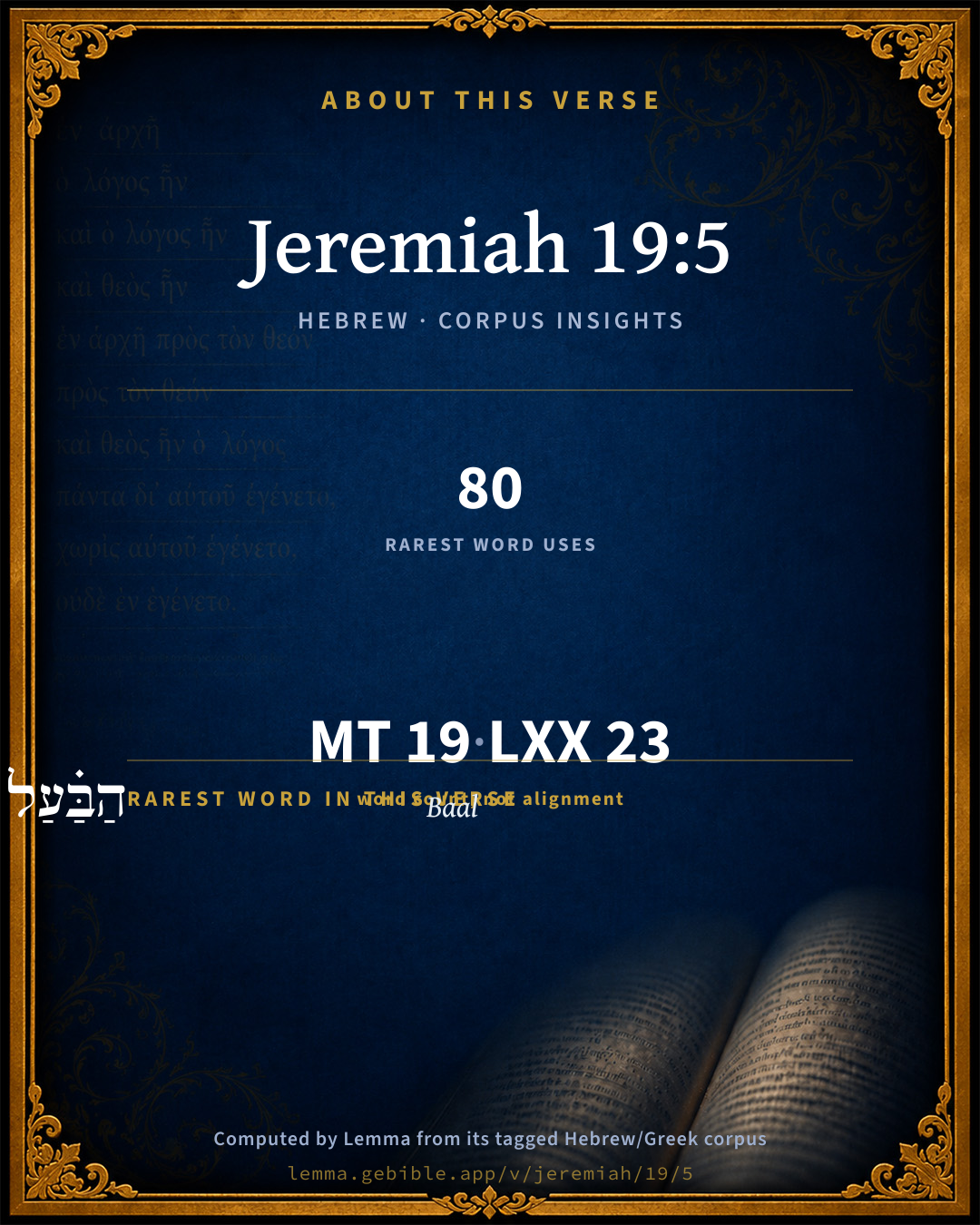
19
words
15
distinct lemmas
Prophets
section

Grammatical profile

  • 5 verbs
  • 7 nouns
  • 1 preposition
  • 6 particles

Verb forms

  • וּבָנ֞וּ Qal · Sequential Perfect
  • לִשְׂרֹ֧ף Qal · Infinitive Construct
  • צִוִּ֨יתִי֙ Piel · Perfect
  • דִבַּ֔רְתִּי Piel · Perfect
  • עָלְתָ֖ה Qal · Perfect

Repetition

Words recur within this verse — often emphatic in Hebrew:

  • הַבַּ֗עַל Baal H1168 ×2
  • לֹֽא not H3808 ×3

Hebrew & Septuagint length

In the original languages it is 19 Hebrew tokens and 23 Greek tokens — but the two are counted differently (Hebrew bundles its prefixes and suffixes into one token; the Greek is in lemma form), so that isn’t a like-for-like length.

Cross-references

12

Topical passages linked to Jeremiah 19:5 in the Treasury of Scripture Knowledge — connected by theme and wording, ordered by reader-vote popularity; previews shown in the World English Bible.

  • Jeremiah 32:35 They built the high places of Baal, which are in the valley of the son of Hinnom, to cause their sons and their daughters to pass through [the fire] to Molech; which I didn't command them, neither did it come into my mind, that they should do this abomination, to cause Judah to sin.
  • Deuteronomy 12:31 You shall not do so to Yahweh your God: for every abomination to Yahweh, which he hates, have they done to their gods; for even their sons and their daughters do they burn in the fire to their gods.
  • Leviticus 18:21 "'You shall not give any of your children to sacrifice to Molech; neither shall you profane the name of your God: I am Yahweh.
  • Psalms 106:37–38 Yes, they sacrificed their sons and their daughters to demons.
  • Jeremiah 7:31–32 They have built the high places of Topheth, which is in the valley of the son of Hinnom, to burn their sons and their daughters in the fire; which I didn't command, neither came it into my mind.
  • Ezekiel 16:20–21 Moreover you have taken your sons and your daughters, whom you have borne to me, and these have you sacrificed to them to be devoured. Were your prostitution a small matter,
  • 2 Kings 17:17 They caused their sons and their daughters to pass through the fire, and used divination and enchantments, and sold themselves to do that which was evil in the sight of Yahweh, to provoke him to anger.
  • Numbers 22:41 It happened in the morning, that Balak took Balaam, and brought him up into the high places of Baal; and he saw from there the utmost part of the people.
  • 2 Chronicles 28:3 Moreover he burnt incense in the valley of the son of Hinnom, and burnt his children in the fire, according to the abominations of the nations whom Yahweh cast out before the children of Israel.
  • Ezekiel 20:26 and I polluted them in their own gifts, in that they caused to pass through [the fire] all that opens the womb, that I might make them desolate, to the end that they might know that I am Yahweh.
  • Ezekiel 38:10 Thus says the Lord Yahweh: It shall happen in that day, that things shall come into your mind, and you shall devise an evil device:
  • Daniel 2:29 as for you, O king, your thoughts came [into your mind] on your bed, what should happen hereafter; and he who reveals secrets has made known to you what shall happen.

Cross-references courtesy of OpenBible.info (CC BY 4.0).

Hebrew and Greek witnesses Masoretic Hebrew ↔ Greek Septuagint

The same verse in the two great witnesses to the Old Testament, shown verse-for-verse.

These are two independent witnesses, not word-aligned to each other, and the Septuagint is shown in lemma (dictionary) form.

Hebrew Jeremiah 19:5 Masoretic · Westminster Leningrad Codex

וּבָנ֞וּ אֶת בָּמ֣וֹת הַבַּ֗עַל לִשְׂרֹ֧ף אֶת בְּנֵיהֶ֛ם בָּאֵ֖שׁ עֹל֣וֹת לַבָּ֑עַל אֲשֶׁ֤ר לֹֽא צִוִּ֨יתִי֙ וְלֹ֣א דִבַּ֔רְתִּי וְלֹ֥א עָלְתָ֖ה עַל לִבִּֽי

and have built the high places of Baal, to burn their sons in the fire for burnt offerings to Baal; which I didn't command, nor spoke it, neither came it into my mind:

World English Bible · Public Domain

Greek LXX Structure differs

In the Septuagint, Jeremiah is about an eighth shorter than the Hebrew and arranges its material differently — the Oracles Against the Nations (Hebrew chapters 46–51) appear in the middle of the Greek book, after 25:13. Because the chapter and verse boundaries do not line up, a verse-for-verse comparison with the Hebrew is not shown.

A verse-for-verse comparison isn’t shown here because the chapters and verses don’t line up. Switch to the LXX edition with the MT / LXX toggle above to read the Greek directly.

Hebrew: Westminster Leningrad Codex (CC BY 4.0). Greek: Septuagint (public domain); English from a public-domain English Septuagint. How the Septuagint differs from the Hebrew →

Targum (Aramaic paraphrase)

1

The Targum is the ancient Jewish Aramaic paraphrase of the Hebrew Scriptures — an interpretive translation, not the Hebrew text itself. Onkelos (literal) and Pseudo-Jonathan (expansive) render the Torah, and Jonathan the Prophets. Coverage is partial: where no permissively-licensed English translation exists for a verse, only the Aramaic is shown. This is verse-level text, not a word-by-word alignment to the Hebrew.

  1. Targum Jonathan Prophets (Joshua–Malachi)
    וּבְנוֹ יַת בָּמַת בַּעֲלָא לְאוֹקָדָא יַת בְּנֵיהוֹן בְּנוּרָא עֲלַוָן לְבַעֲלָא דְלָא פַקְדֵית בְּאוֹרַיְתִי וּדְלָא שְׁלָחֵית בְּיַד עַבְדֵי נְבִיַיָא וְלָא רַעֲוָא קָדָמָי:

    (no public-domain English translation for this verse)

    Targum Jonathan — Aramaic: “Mikraot Gedolot” (public domain). English: “Sefaria Community Translation” (CC0 1.0 (public-domain dedication)); “London "Chaldee Paraphrase," 1871” (public domain). Text via Sefaria.

Commentary

Notes on Jeremiah 19:5 from classic Christian and Jewish commentators (each source and its license shown beneath its notes). The classic Christian expositions comment on the surrounding passage and are grouped to its opening verse, so a note may address several verses; the Jewish commentaries on the Tanakh (Rashi and others) are per-verse, so they appear only where the commentator wrote on this verse.

Lemma curates 59 commentaries, every one of them public domain or Creative Commons licensed, each selected and text-cleaned for this edition rather than reprinted as found. About our sources →

Trapp's Complete Commentary

John Trapp

Jer 19:5 They have built also the high places of Baal, to burn their sons with fire [for] burnt offerings unto Baal, which I commanded not, nor spake [it], neither came [it] into my mind:

Ver. 5. Which I commanded not.] Reprobatur voluntarius cultus, et factitiae religiones. See Jer 7:31; Jer 32:35 2Ki 23:10.

John Trapp, A Commentary or Exposition upon All the Books of the Old and New Testament (1647–1656) — public domain. Text from a community e-Sword module.

Geneva Bible (1599)

Geneva Bible translators

Whereby is declared, that whatsoever is not commanded by God’s word touching his service, is against his word.

Geneva Bible (1599) marginal notes — public domain. Text via Bolls.life.

Jamieson, Fausset & Brown

Robert Jamieson, A. R. Fausset & David Brown

commanded not--nay, more, I commanded the opposite (Lev 18:21; see Jer 7:31-32).

Jamieson, Fausset & Brown — Commentary Critical and Explanatory on the Whole Bible (1871) — public domain (CC PDM 1.0). Text via the HelloAO Bible API.

Adam Clarke's Commentary

Verse 5. Offerings unto Baal] A general name for all the popular idols; Baal, Moloch, Ashtaroth, &c.

Adam Clarke's Commentary on the Bible (1810–1826) — public domain. Text from a community e-Sword/MySword module.

John Calvin's Commentaries

He at last adds, that that place was filled with the blood of innocents; for there they killed their children. And by this circumstance Jeremiah again amplifies the wickedness of the people; for they had not only despised God and his law, but also cruelly destroyed their innocent infants; and thus he proved them guilty not only of impiety and profaneness in vitiating the worship of God, but also of brutal and barbarous savageness in not sparing innocent blood.

John Calvin's Commentaries (1540-1563) — public domain. Text from the Calvin Translation Society English edition (1840s-50s) via the Christian Classics Ethereal Library (ccel.org). Calvin's coverage is partial (roughly two-thirds of the Bible); uncommented books and verses are honest gaps, never fabricated. The 19th-century editor's footnotes and remarks are omitted so the notes are faithfully Calvin's own voice.

Ellicott's Commentary for English Readers

(5) The high places of Baal.—Baal, as in Jer_2:23, is identified with Molech, and the terms in which the guilt of the people and its punishment are described are all but identical with those of Jer_7:31-32. The fact that such sacrifices were offered is indicated in Psa_106:37-38.

A Bible Commentary for English Readers, edited by Charles John Ellicott (1878–1897) — public domain. Text from a community e-Sword module.

The Cambridge Bible for Schools and Colleges

gen. ed. J. J. S. Perowne

5. of Baal] See on Jer_2:8. Topheth is the corresponding word in Jer_7:31.

5, 6. Substantially identical with ch. Jer_7:31-32. See notes there and on Jer_2:23.

The Cambridge Bible for Schools and Colleges (gen. ed. J. J. S. Perowne; Cambridge University Press, 1878–1918) — public domain. Text from a community e-Sword module.

John Gill's Exposition

They have also built the high places of Baal,.... Or, they have even built, &c. and so the words explain what is before suggested of their idolatry; these were the temples in which they placed his image, and the altars on which they sacrificed to him; as follows:

to burn their sons with fire, for burnt offerings unto Baal; the same idol that is sometimes called Moloch, the names being much of the same signification; the one signifying a "lord" or "master"; the other a king; and to the idol under each name they burned their children with fire, and offered them as burnt offerings unto it; which was a most cruel and barbarous way of sacrificing. Some think they only caused them to pass through two fires; but the text is express for it, that they burnt them with fire, and made burnt offerings of them, as they did with slain beasts. It seems very likely that they did both:

which I commanded not; in my law, as the Targum adds; and which was intimation enough to avoid it; though this was not all, he expressly forbad it, Lev 20:2;

nor spake it, neither came it into my mind; and it is marvellous it should ever enter into the heart of man; none but Satan himself could ever have devised such a way of worship.

John Gill's Exposition of the Whole Bible (1746–1763) — public domain (CC PDM 1.0). Text via the HelloAO Bible API.

Haydock's Catholic Bible Commentary

Mind. Perhaps the people stupidly thought thus to honour him; but God pointedly condemns such sacrifices.

George Leo Haydock (1774–1849), Haydock's Catholic Family Bible and Commentary, 1859 edition — public domain. Excludes Psalms (Douay-Rheims chapter numbering differs from Protestant) and Deuterocanonical books (Catholic canon only).

Matthew Poole's English Annotations

This and the following verse contain another great sin of this people, with the punishment which God proportioneth to it. The sin in the general was idolatry, but a most barbarous species of it, mentioned also Jer 7:31; 32:35, where it is said they made their sons and their daughters pass through the fire to Molech; the place where they did it is called Tophet, Jer 19:6, of which also mention is made Isa 30:33; Jer 7:31-33. For the opening of this text, as also of those other texts that mention this idolatry, we must open what is meant by Baal, Moloch, Tophet, and the valley of the son of Hinnom. There is no doubt but Baal and Molech, or Moloch, signify the same thing; Baal signifieth a lord, Molech a king. They ordinarily called their idols by these names; as also Malcham, Zep 1:5; upon which account God would not be called Baal, Hos 2:16, though he was called Jehovah, Elohim, and Adonai, all which signified lord, as Baal did. Both Baal and Molech seem common names to all idols. There was more than one idol in the house of Baal, 2Ki 10:26. The Ammonites called their principal idol Milcom and Molech, as appears from 1Ki 11:5; 2Ki 23:13. To this idol they sacrificed their children. It was a very ancient idolatry, as appeareth by the very early law of God against it, Lev 20:3-5. Some say it was derived from Saturn, whom they make contemporary with Deborah and Barak, who, to appease the gods in an imminent danger, sacrificed his son. Others say it began in the time of Serug, the father of Nahor, of whom we read Gen 11:20, and that it had its original from the devil, speaking out of the belly of some dead persons, commanding this homage, possibly in imitation of God, who, Gen 22:2, to try Abraham’s obedience, commanded him to offer up Isaac upon the Mount Moriah. We must know there were other sacrifices they offered to Baal: they burnt incense to Baal, 2Ki 23:5; they offered sacrifices and burnt-offerings of beasts, 1Ki 18:26; 2Ki 10:24; only in some extraordinary straits, to show their great obedience to the devil, they offered their children. What creature they worshipped under this name is not certain, but very probably it was the sun, from 2Ki 23:5, or some superior being, which they owned as their supreme lord and king, which they, some of them, mistook the sun, moon, and stars to be; they being glorious beings removed out of men’s knowledge, so as they had not sufficient means to understand their natures, might, considering their motions, and vast influence they had upon all other creatures, mistake them for animate and supreme beings, to which as they paid other homages, (such as swearing by them, Zep 1:5, burning incense, offering beasts, praying to them,) so in imitation of the heathens, and in a pretence of high devotion and homage in some special cases and straits, they offered their children. Some think they only made them go through the fire, but did not burn them; and indeed so most of the scriptures express this abominable idolatry; but some scriptures speak it plain enough, that they actually burnt them: the psalmist, Psa 106:37, saith, They shed innocent blood, even the blood of their sons and daughters, whom they sacrificed to the idols of Canaan, and the land was polluted with blood, which it could not have been by their children’s merely passing through the fire; and it is laid to their charge, Eze 16:20,21, Thou hast taken thy sons and thy daughters, whom thou hast borne unto me, and those hast thou sacrificed to them to be devoured. That thou hast slain my children, and delivered them to cause them to pass through the fire for them. We read of the idolatry of Jeroboam, who worshipped the true God, but by calves set up at Dan and Beth-el. Ahab exceeded this, bringing in the terminative worship of the creatures, worshipping the sun, moon, and stars, under the name of Baal. But, the first in Judah, of whom we read that he made his son to pass through the fire, was Ahaz, the father of Hezekiah, 2Ki 16:3. He was followed by his grandchild Manasseh, 2Ki 21:6. Josiah, the good son of a bad father, defiled the place where this abominable idolatry was committed, 2Ki 23:10. The place where they committed this horrible abomination was the valley of the son of Hinnom, very near the city, and the particular place was called Tophet. There was a high place built for the idol, and many think that the name Tophet ariseth from their use of a drum or tabret, with which, while the poor children were burning, they made great noises to drown the sound of the children’s yellings; though others think the word Tophet originally signifies hell, or the place of the damned, of which this place, both for the torments and roarings in it, was a lively representation. Now of this barbarous and horrible idolatry God saith, he commanded them not, neither came it into his mind. It was so far from it, that God had most severely forbid it, Lev 20:2-5, making it a capital crime for any to do it, and for any to conceal others that they knew did it; so that here is a meiosis, less spoken than was true fit the case; but possibly God’s expressing a thing of this nature, being an error in his worship, under these soft terms,

I commanded them not, neither did it come into my mind, giveth no small ground to considerate men to judge that we must have a command from God, though not for every individual act of our worship, nor for every circumstance of human action which we do in his worship, yet for every specifical religious act, and for any thing whereby we pay a homage to God; it being indeed the most reasonable thing imaginable, that God should have the same privilege which every prince or great man amongst men claimeth as his right, to prescribe the acts, modes, and methods for his own homage.

Matthew Poole's English Annotations on the Holy Bible (1683–1685) — public domain. Text from a community e-Sword/MySword module.

Whedon's Commentary on the Bible

Daniel D. Whedon

5, 6. Compare Jer_7:31-32.

Daniel D. Whedon (gen. ed.), Commentary on the Old and New Testaments (1874–1909) — public domain. Text from a community e-Sword module.

The Pulpit Commentary

Baal. This seems to be used loosely for Moloch. (comp. on Jer_2:8)

The Pulpit Commentary (1880–1919), ed. H.D.M. Spence-Jones & Joseph S. Exell — public domain. Text from a community e-Sword module.

John Wesley's Explanatory Notes

To burn - This and the following verse, contain another great sin of this people, with the punishment which God proportions to it. The sin in the general was idolatry, but a most barbarous species of it, mentioned also chap. vii, 31; xxxii, 35, where it is said, they made their sons and their daughters pass thro' the fire to Molech; the place where they did it is called Tophet, ver. xix, 6, of which also mention is made, Isaiah xxx, 33. Baal and Molech, signify the same thing; Baal signifies a Lord, Molech a King. Both Baal and Molech seem common names to all idols.

John Wesley, Explanatory Notes Upon the Whole Bible (1754–1765) — public domain. Text via the GEBible commentary corpus.

Lesson kit

Teaching starters — assembled from the data on this page, not authored interpretation. Every prompt links to the verse data it draws on. Edit before teaching.

Jeremiah, in the Prophets, opens this verse with 19 words (15 distinct Hebrew lemmas). Its most distinctive word is Baʻal (“Baal”). A historical commentator’s framing appears above. Read the whole chapter for the surrounding context.

Discussion questions

  1. How does “Baal” (Baʻal) shape what this verse is saying?
  2. Jeremiah 32:35 shares this passage’s theme. How do the two illuminate each other?
  3. “Baal” occurs 2× in this one verse. What is the effect of the repetition?
  4. These translations render this verse differently. What is at stake in choosing one wording over another?
  5. The verb «וּבָנ֞וּ» is Qal Sequential Perfect. How does its form color the action?
  6. Reading how Trapp's Complete Commentary and Geneva Bible (1599) read this verse, where do the two commentators agree and where do they part?

Things to notice

Reading settings

Reading text

Shown beneath each verse's original-language words.

Old Testament
Old Testament edition

Read the OT as the Masoretic Hebrew (MT) or the Greek Septuagint (LXX).

English shown for the Greek Septuagint (in the Hebrew ↔ Greek comparison).

Comparing translations? Open the Compare panel on any verse page to stack up to four side by side.