Jeremiah 36:25

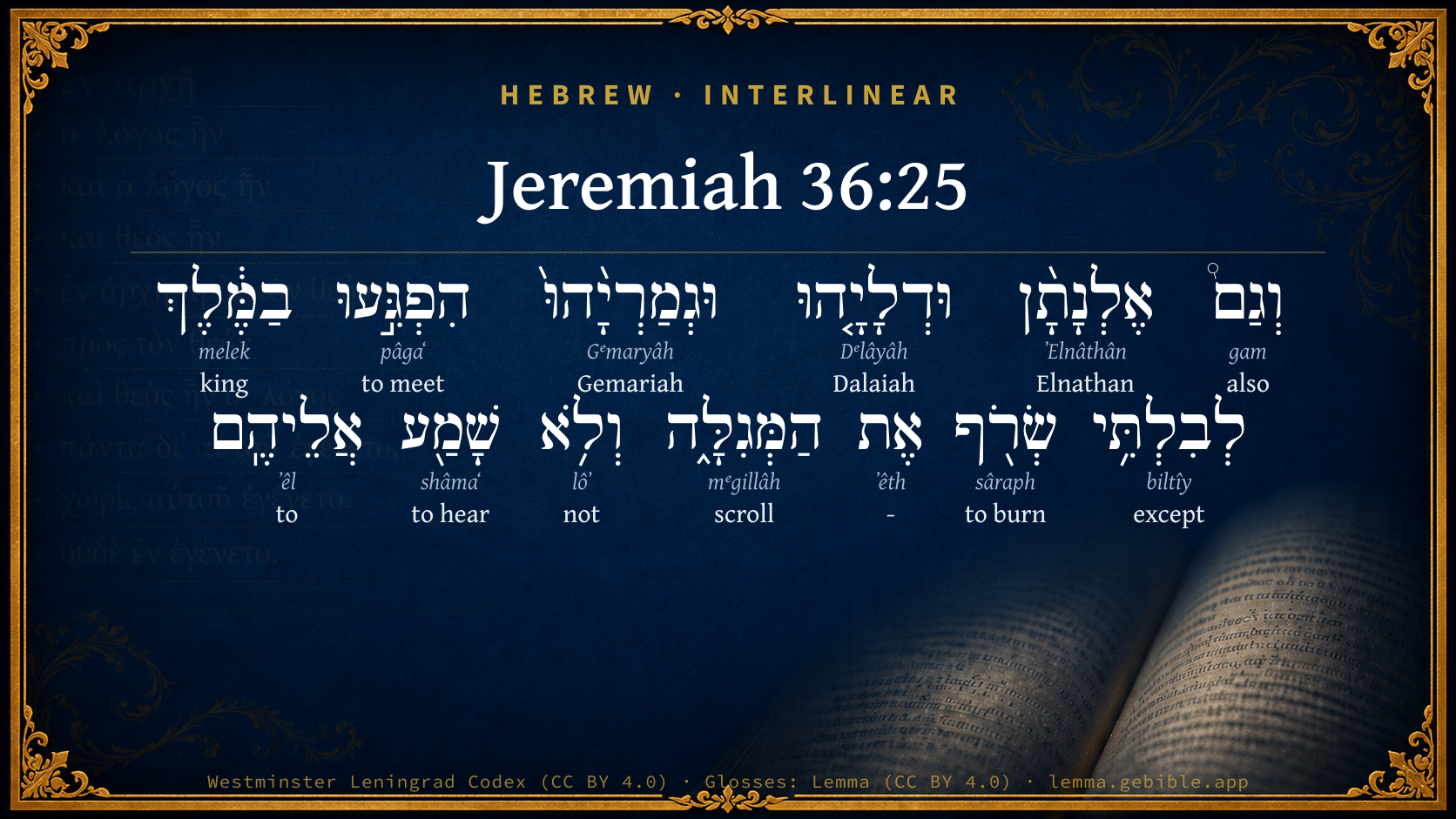
Hebrew (Westminster Leningrad Codex) Jeremiah 36:25 appears in the Hebrew Old Testament. The text above is from the Westminster Leningrad Codex. Each word links to its Strong’s number, a concise gloss, and parsing drawn from the Open Scriptures Hebrew Bible morphology. Click any word for its full Brown-Driver-Briggs (BDB) entry.
Download image
Cite this verse

Jeremiah 36:25 (World English Bible). Public Domain. Lemma interlinear Bible study tool, https://lemma.gebible.app/v/jeremiah/36/25.

Show BibTeX & RIS
BibTeX
RIS
English Translation
Moreover Elnathan and Delaiah and Gemariah had made intercession to the king that he would not burn the scroll; but he would not hear them.
World English Bible · Public Domain
Download a study sheet

One document with this verse’s original text, its word-by-word gloss line, the meaning frame, cross-references with their text, attributed commentary, and full source and license credits — printable, and it pastes into notes with its structure intact.

This verse Autodidact and up

Study sheet (.html) Plain text (.txt)

A passage Seminary Student

Up to 50 verses in one chapter. A passage sheet keeps up to 6 commentary sources and 12 cross-references per verse, in the order this page ranks them, and says so on the sheet whenever that leaves anything out. Ask for a single verse and you get the Autodidact verse sheet above.

Everything on this page stays free to read, with no account — the sheet is a download of what is already on screen, not access to it.

Want to remove ads? Support Godless Engineer
Compare translations 3

The same verse in 3 English versions, stacked beneath the original-language interlinear above. Click any original word for its lexicon entry.

Each is an independent rendering of the whole verse — the interlinear is not word-aligned to these translations.

Highlighted words mark where these versions differ — a whole-verse word diff, not a word-by-word alignment.

  • World English Bible Public Domain
    Moreover Elnathan and Delaiah and Gemariah had made intercession to the king that he would not burn the scroll; but he would not hear them.
  • King James Version Public Domain
    Nevertheless Elnathan and Delaiah and Gemariah had made intercession to the king that he would not burn the roll: but he would not hear them.
  • unfoldingWord Literal Text CC BY-SA 4.0
    Elnathan, Delaiah, and Gemariah had even urged the king not to burn the scroll, but he did not listen to them.

unfoldingWord Literal Text — © unfoldingWord, licensed CC BY-SA 4.0. Word-aligned USFM3 via Door43 (git.door43.org/unfoldingWord/en_ult).

Versions to compare (up to 4)

3 of 4 selected

Show all 18 translations

Every available English version of this verse, each an independent rendering of the whole verse.

  • World English Bible Public Domain
    Moreover Elnathan and Delaiah and Gemariah had made intercession to the king that he would not burn the scroll; but he would not hear them.
  • Berean Standard Bible Public Domain
    Even though Elnathan, Delaiah, and Gemariah urged the king not to burn the scroll, he would not listen to them.
  • Majority Standard Bible Public Domain
    Even though Elnathan, Delaiah, and Gemariah urged the king not to burn the scroll, he would not listen to them.
  • King James Version Public Domain
    Nevertheless Elnathan and Delaiah and Gemariah had made intercession to the king that he would not burn the roll: but he would not hear them.
  • American Standard Version (1901) Public Domain
    Moreover Elnathan and Delaiah and Gemariah had made intercession to the king that he would not burn the roll; but he would not hear them.
  • Revised Version (1885) Public Domain
    Moreover Elnathan and Delaiah and Gemariah had made intercession to the king that he would not burn the roll: but he would not hear them.
  • Geneva Bible (1599) Public Domain
    Neuerthelesse, Elnathan, and Delaiah, and Gemariah had besought the King, that he would not burne ye roule: but he would not heare them.
  • Douay-Rheims (1899) Public Domain
    But yet Elnathan, and Dalaias, and Gamarias spoke to the king, not to burn. the book: and he heard them not.
  • Young's Literal Translation Public Domain
    And also Elnathan, and Delaiah, and Gemariah have interceded with the king not to burn the roll, and he hath not hearkened unto them.
  • Literal Standard Version CC BY-SA 4.0
    And also Elnathan, and Delaiah, and Gemariah have interceded with the king not to burn the scroll, and he has not listened to them.
  • Unlocked Literal Bible CC BY-SA 4.0
    Elnathan, Delaiah, and Gemariah had even urged the king not to burn the scroll, but he did not listen to them.
  • unfoldingWord Literal Text CC BY-SA 4.0
    Elnathan, Delaiah, and Gemariah had even urged the king not to burn the scroll, but he did not listen to them.
  • Darby Bible Public Domain
    Moreover, Elnathan and Delaiah and Gemariah had made intercession to the king that he would not burn the roll; but he would not hear them.
  • World Messianic Bible Public Domain
    Moreover Elnathan and Delaiah and Gemariah had made intercession to the king that he would not burn the scroll; but he would not listen to them.
  • Webster's Bible Public Domain
    Nevertheless Elnathan and Delaiah and Gemariah had made intercession to the king that he would not burn the roll: but he would not hear them.
  • Free Bible Version CC BY-SA 4.0
    Even when Elnathan, Delaiah, and Gemariah pleaded with the king not to burn the scroll, he refused to listen to them.
  • Bible in Basic English Public Domain
    And Elnathan and Delaiah and Gemariah had made a strong request to the king not to let the book be burned, but he would not give ear to them.
  • JPS Tanakh (1917) Public Domain
    Moreover Elnathan and Delaiah and Gemariah had entreated the king not to burn the roll; but he would not hear them.

Literal Standard Version (2020), Covenant Press — licensed CC BY-SA 4.0. Text via the HelloAO Bible API (eBible.org). Unlocked Literal Bible (unfoldingWord) — licensed CC BY-SA 4.0. Text via the HelloAO Bible API (eBible.org). unfoldingWord Literal Text — © unfoldingWord, licensed CC BY-SA 4.0. Word-aligned USFM3 via Door43 (git.door43.org/unfoldingWord/en_ult). Free Bible Version, Dr. Jonathan Gallagher — licensed CC BY-SA 4.0. Text via the HelloAO Bible API (eBible.org).

Word by word

More ways to search: Search by grammar → Find every occurrence → Compare this word →

Practice this passage: Drill this verse → Learn its vocabulary →

וּגְמַרְיָ֨הוּ֙
Gᵉmaryâh
H1587
“and · Gemariah”
Conjunction + Noun, Proper
Part of Speech
Conjunction + Noun
Type
Proper
Full BDB Definition

Origin: from H1584 and H3050

TWOT: None

Gemariah = "Jehovah has accomplished" - the son of Shaphan the scribe and father of Michaiah; one of the nobles of Judah who had a chamber in the temple from which Baruch read Jeremiah's alarming prophecy to all the people - the son of Hilkiah who bore Jeremiah's letter to the captive Jews
  1. וְגַם֩ gam H1571 “and · also” Conjunction + Particle, Accusative
  2. אֶלְנָתָ֨ן ʼElnâthân H494 “Elnathan” Noun, Proper
  3. וּדְלָיָ֤הוּ Dᵉlâyâh H1806 “and · Dalaiah” Conjunction + Noun, Proper
  4. הִפְגִּ֣עוּ pâgaʻ H6293 “to meet” Verb, Hiphil, Perfect, 3rd Person, Common, Plural
  5. בַמֶּ֔לֶךְ melek H4428 “in/at the · king” Preposition, Determined + Noun, Common, Masculine, Singular, Absolute
  6. לְבִלְתִּ֥י biltîy H1115 “to/for · except” Preposition + Conjunction
  7. שְׂרֹ֖ף sâraph H8313 “to burn” Verb, Qal, Infinitive Construct
  8. אֶת ʼêth H853 “-” Particle, Direct Object
  9. הַמְּגִלָּ֑ה mᵉgillâh H4039 “the · scroll” Particle, Definite Article + Noun, Common, Feminine, Singular, Absolute
  10. וְלֹ֥א lôʼ H3808 “and · not” Conjunction + Particle, Negative
  11. שָׁמַ֖ע shâmaʻ H8085 “to hear” Verb, Qal, Perfect, 3rd Person, Masculine, Singular
  12. אֲלֵיהֶֽם ʼêl H413 “to · them” Preposition + Suffix, Personal, 3rd Person, Masculine, Plural

About this verse

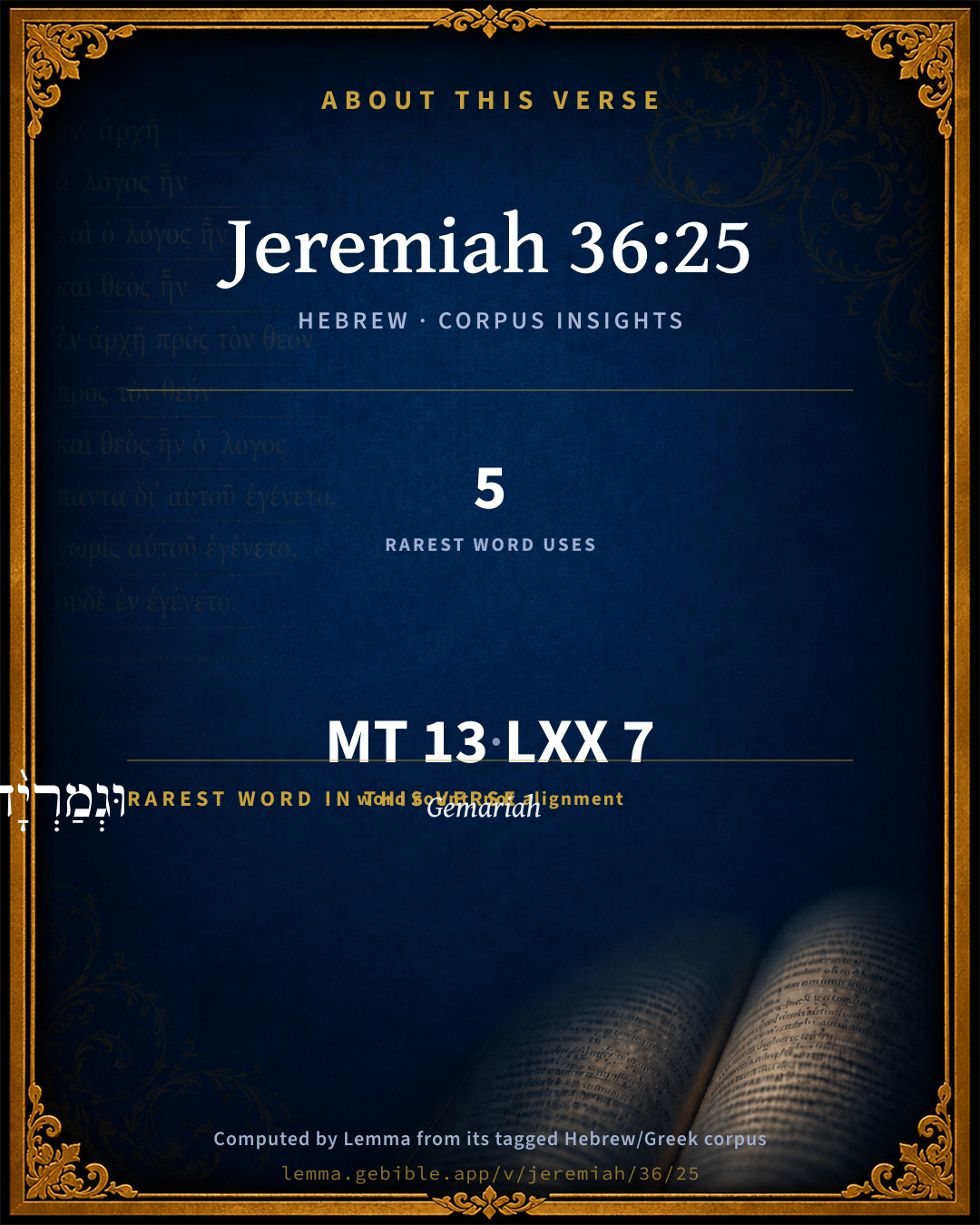
These counts appear in no published source. They are computed here, from the morphology-tagged text and Lemma’s own curated glosses. What Lemma adds →

13
words
13
distinct lemmas
Prophets
section

Notable vocabulary

The rarest word here is וּגְמַרְיָ֨הוּ֙ Gemariah H1587 — appearing just 5 times in the whole Hebrew Bible.

Shared distinctive vocabulary

וּגְמַרְיָ֨הוּ֙ Gemariah H1587 occurs in 5 verses of the Hebrew Bible. Also found in:

Grammatical profile

  • 3 verbs
  • 5 nouns
  • 1 preposition
  • 1 conjunction
  • 3 particles

Verb forms

  • הִפְגִּ֣עוּ Hiphil · Perfect
  • שְׂרֹ֖ף Qal · Infinitive Construct
  • שָׁמַ֖ע Qal · Perfect

Hebrew & Septuagint length

In the original languages it is 13 Hebrew tokens and 7 Greek tokens — but the two are counted differently (Hebrew bundles its prefixes and suffixes into one token; the Greek is in lemma form), so that isn’t a like-for-like length.

Cross-references

9

Topical passages linked to Jeremiah 36:25 in the Treasury of Scripture Knowledge — connected by theme and wording, ordered by reader-vote popularity; previews shown in the World English Bible.

  • Genesis 37:22 Reuben said to them, "Shed no blood. Throw him into this pit that is in the wilderness, but lay no hand on him"-- that he might deliver him out of their hand, to restore him to his father.
  • Jeremiah 36:12 he went down into the king's house, into the scribe's chamber: and, behold, all the princes were sitting there, [to wit], Elishama the scribe, and Delaiah the son of Shemaiah, and Elnathan the son of Achbor, and Gemariah the son of Shaphan, and Zedekiah the son of Hananiah, and all the princes.
  • Acts 5:34–39 But one stood up in the council, a Pharisee named Gamaliel, a teacher of the law, honored by all the people, and commanded to put the apostles out for a little while.
  • Genesis 37:26–28 Judah said to his brothers, "What profit is it if we kill our brother and conceal his blood?
  • Proverbs 21:29 A wicked man hardens his face; But as for the upright, he establishes his ways.
  • Jeremiah 13:15–17 Hear you, and give ear; don't be proud; for Yahweh has spoken.
  • Jeremiah 26:22 and Jehoiakim the king sent men into Egypt, [namely], Elnathan the son of Achbor, and certain men with him, into Egypt;
  • Matthew 27:4 saying, "I have sinned in that I betrayed innocent blood." But they said, "What is that to us? You see to it."
  • Matthew 27:24–25 So when Pilate saw that nothing was being gained, but rather that a disturbance was starting, he took water, and washed his hands before the multitude, saying, "I am innocent of the blood of this righteous person. You see to it."

Cross-references courtesy of OpenBible.info (CC BY 4.0).

Hebrew and Greek witnesses Masoretic Hebrew ↔ Greek Septuagint

The same verse in the two great witnesses to the Old Testament, shown verse-for-verse.

These are two independent witnesses, not word-aligned to each other, and the Septuagint is shown in lemma (dictionary) form.

Hebrew Jeremiah 36:25 Masoretic · Westminster Leningrad Codex

וְגַם֩ אֶלְנָתָ֨ן וּדְלָיָ֤הוּ וּגְמַרְיָ֨הוּ֙ הִפְגִּ֣עוּ בַמֶּ֔לֶךְ לְבִלְתִּ֥י שְׂרֹ֖ף אֶת הַמְּגִלָּ֑ה וְלֹ֥א שָׁמַ֖ע אֲלֵיהֶֽם

Moreover Elnathan and Delaiah and Gemariah had made intercession to the king that he would not burn the scroll; but he would not hear them.

World English Bible · Public Domain

Greek LXX Structure differs

In the Septuagint, Jeremiah is about an eighth shorter than the Hebrew and arranges its material differently — the Oracles Against the Nations (Hebrew chapters 46–51) appear in the middle of the Greek book, after 25:13. Because the chapter and verse boundaries do not line up, a verse-for-verse comparison with the Hebrew is not shown.

A verse-for-verse comparison isn’t shown here because the chapters and verses don’t line up. Switch to the LXX edition with the MT / LXX toggle above to read the Greek directly.

Hebrew: Westminster Leningrad Codex (CC BY 4.0). Greek: Septuagint (public domain); English from a public-domain English Septuagint. How the Septuagint differs from the Hebrew →

Targum (Aramaic paraphrase)

1

The Targum is the ancient Jewish Aramaic paraphrase of the Hebrew Scriptures — an interpretive translation, not the Hebrew text itself. Onkelos (literal) and Pseudo-Jonathan (expansive) render the Torah, and Jonathan the Prophets. Coverage is partial: where no permissively-licensed English translation exists for a verse, only the Aramaic is shown. This is verse-level text, not a word-by-word alignment to the Hebrew.

  1. Targum Jonathan Prophets (Joshua–Malachi)
    וְאַף אֶלְנָתָן וּדְלָיָה וּגְמַרְיָה בְעוֹ מִן מַלְכָּא בְּדִיל דְלָא לְאוֹקָדָא יַת מְגִלְתָא וְלָא קַבֵּיל מִנְהוֹן:

    (no public-domain English translation for this verse)

    Targum Jonathan — Aramaic: “Mikraot Gedolot” (public domain). English: “Sefaria Community Translation” (CC0 1.0 (public-domain dedication)); “London "Chaldee Paraphrase," 1871” (public domain). Text via Sefaria.

Commentary

Notes on Jeremiah 36:25 from classic Christian and Jewish commentators (each source and its license shown beneath its notes). The classic Christian expositions comment on the surrounding passage and are grouped to its opening verse, so a note may address several verses; the Jewish commentaries on the Tanakh (Rashi and others) are per-verse, so they appear only where the commentator wrote on this verse.

Lemma curates 59 commentaries, every one of them public domain or Creative Commons licensed, each selected and text-cleaned for this edition rather than reprinted as found. About our sources →

Trapp's Complete Commentary

John Trapp

Jer 36:25 Nevertheless Elnathan and Delaiah and Gemariah had made intercession to the king that he would not burn the roll: but he would not hear them.

Ver. 25. Nevertheless Elnathan.] Who had before been active for the king in apprehending and slaughtering the prophet Uriah, {Jer 26:22} but now haply touched with some remorse for having any hand in so bloody an act.

Had made intercession to the king.] Verum frigide admodum, but very coldly; and such cold friends the truth hath still not a few, at kings’ courts especially.

John Trapp, A Commentary or Exposition upon All the Books of the Old and New Testament (1647–1656) — public domain. Text from a community e-Sword module.

Joseph Benson's Commentary

Jer 36:25-26. Nevertheless, Elnathan, Delaiah, and Gemariah had made intercession, &c. — These three princes appear to have had a greater dread of God upon their hearts than the rest, for, so far as they durst, they interposed and besought the king not to burn the roll; but he would not hearken to their advice; so far from it that he gives orders to apprehend both Jeremiah and Baruch. But the Lord bid them — God by his providence kept them both out of their hands, directing them to such a place of recess as the king’s messengers could not find out.

Joseph Benson's Commentary on the Old and New Testaments (1811–1818) — public domain. Text from a community e-Sword module.

Tyndale Open Study Notes

Tyndale Open Resources

36:25 The three officials who begged the king not to destroy the scroll probably held positions of great power, because Jehoiakim did not punish them for trying to preserve Jeremiah’s scroll.

Tyndale Open Study Notes — © Tyndale Open Resources, licensed CC BY-SA 4.0. Text via the HelloAO Bible API.

Jamieson, Fausset & Brown

Robert Jamieson, A. R. Fausset & David Brown

(See on Jer 36:16). The "nevertheless" aggravates the king's sin; though God would have drawn him back through their intercession, he persisted: judicial blindness and reprobation!

Jamieson, Fausset & Brown — Commentary Critical and Explanatory on the Whole Bible (1871) — public domain (CC PDM 1.0). Text via the HelloAO Bible API.

Adam Clarke's Commentary

Verse 25. Elnathan and Delaiah and Gemariah] Three of the princes wished to save the roll, and entreated the king that it might not be burnt. They would have saved it out of the fire, but the king would not permit it to be done.

Adam Clarke's Commentary on the Bible (1810–1826) — public domain. Text from a community e-Sword/MySword module.

John Calvin's Commentaries

The Prophet aggravates the wickedness of the king by this circumstance, that three men opposed him, though they thereby subjected themselves to great danger. They saw that the king was carried away by the violence of his temper; and when he resisted God in a manner so insolent, what would he not have dared to do to them? That they notwithstanding hesitated not to intercede with him, was an instance of great courage. But it hence appears, that as the king did not attend to their counsel, his impiety was extreme.

The particle וגם ugam, is to be rendered nevertheless Many interpreters have not attended here to what is emphatical, and have therefore perverted the meaning of the Prophet, or at least have extenuated it so as not to represent faithfully the object of the Prophet; for there is, as I have said, a very emphatic exaggeration in the word Nevertheless And let us learn from this passage, that when God draws us back from wicked designs, we are less excusable if we persevere in executing what he clearly shews ought not to be done. Conscience will indeed always be to us in the place of thousand witnesses; and though no one be present as a witness or an adviser or a monitor, yet we shall in vain try to escape before God by pretending ignorance or mistake or want of thought: but when the Lord by the instrumentality of men calls us back, so that we may not go on in evil ways, if we are not persuaded to desist, then discovered more fully is our incorrigible perverseness, according to what the Prophet intimates here. In short, let us know that any one sins the more grievously, the more means God employs to draw him back from his evil course.

Since, then, we see how obstinate Jehoiakim was, there is no reason for us to wonder, that many at this day go on presumptuously in their course, though God as it were checks them, or at least sends men to restrain them. Let us, then, know that it is an old evil, so that we may not be disturbed by such a presumptuous contempt of the ungodly.

Let us also notice the example given here of a bold admonition: for it is something like a miracle to find those at this day in the courts of princes, who are bold enough to remonstrate when there is much danger; for, as it has been before stated, every one is ingenious in devising means to flatter; and as this is the best and shortest way to elevation, all apply themselves assiduously to this art. The Prophet had indeed said that the king and his counsellors did not rend their garments, and yet he tells us now of three who openly professed that they feared God: but when he spoke before of all the princes, we must understand him as speaking of them as a body. Then the three, mentioned now, must be excepted; nor is there a doubt but that they incurred the displeasure of all the courtiers, as they had them opposed to them, since they must have been ashamed of their own negligence; but they dared to draw on themselves the displeasure both of the king and of all the rest, for they saw that it was God’s cause. It follows —

John Calvin's Commentaries (1540-1563) — public domain. Text from the Calvin Translation Society English edition (1840s-50s) via the Christian Classics Ethereal Library (ccel.org). Calvin's coverage is partial (roughly two-thirds of the Bible); uncommented books and verses are honest gaps, never fabricated. The 19th-century editor's footnotes and remarks are omitted so the notes are faithfully Calvin's own voice.

The Cambridge Bible for Schools and Colleges

gen. ed. J. J. S. Perowne

25. Elnathan … had made intercession] See note on Jer_26:22.

The Cambridge Bible for Schools and Colleges (gen. ed. J. J. S. Perowne; Cambridge University Press, 1878–1918) — public domain. Text from a community e-Sword module.

John Gill's Exposition

Nevertheless, Elnathan, and Delaiah, and Gemariah,.... Three of the five princes mentioned in Jer 36:12;

had made intercession to the king, that he would not burn the roll; or suffer it to be burnt; this they did either at first, as soon as the roll was brought, that if the king should not like it, yet they besought him that he would not destroy it; or rather when they saw what Jehudi was going to do with it, either by the express order, or at the connivance of the king; then they humbly entreated that such an action might not be done, which gave them a secret horror, though they might endeavour to hide it as much as possible:

but he would not hear them; or he would not receive it of them, as the Targum; that is, their supplication and intercession; but either east the roll into the fire himself, or permitted Jehudi to do it; nor would he suffer it to be taken out till it was all consumed.

John Gill's Exposition of the Whole Bible (1746–1763) — public domain (CC PDM 1.0). Text via the HelloAO Bible API.

Albert Barnes' Notes on the Bible

It is remarkable to find Elnathan interceding for Jeremiah after the office he had discharged toward Urijah Jer 26:22.

Albert Barnes' Notes on the Bible (1834–1885) — public domain. Text from a community e-Sword/MySword module.

Matthew Poole's English Annotations

These three princes seemed to have had a greater dread of God upon their hearts than the rest, for so far as they durst, they interposed, and besought the king not to burn the roll; but he would not hearken to their advice.

Matthew Poole's English Annotations on the Holy Bible (1683–1685) — public domain. Text from a community e-Sword/MySword module.

Whedon's Commentary on the Bible

Daniel D. Whedon

25. Made intercession… not burn the roll — The insane rage of the king is brought out into a stronger light by the counter requests of the scribes.

Daniel D. Whedon (gen. ed.), Commentary on the Old and New Testaments (1874–1909) — public domain. Text from a community e-Sword module.

John Wesley's Explanatory Notes

Elnathan - These princes seemed to have had a greater dread of God upon their hearts than the rest.

John Wesley, Explanatory Notes Upon the Whole Bible (1754–1765) — public domain. Text via the GEBible commentary corpus.

unfoldingWord translationNotes

Door43 World Missions Community

Elnathan, Delaiah, and Gemariah

See how you translated these names in Jeremiah 36:12.

urged the king

"pleaded with the king"

Jerahmeel ... Seraiah ... Azriel ... Shelemiah ... Abdeel

These are the names of men. (See: How to Translate Names)

a relative

"a relative of the king"

Jeremiah the prophet ... hidden them

It is not clear why Jeremiah is referring to himself by name here. You may translate using first person, as the UDB does. (See: First, Second, or Third Person)

translationWords

plea

king

scroll

command

Baruch

scribe

Jeremiah

prophet

Yahweh

unfoldingWord translationNotes — © Distant Shores Media and the Door43 World Missions Community, licensed CC BY-SA 4.0. Source: git.door43.org/Door43/en_tn.

Rashi

Rabbi Shlomo Yitzchaki (Rashi)

entreated Heb. הפגעו, supplicated.

Rashi on the Tanakh — English translations: “The Judaica Press complete Tanach with Rashi, translated by A. J. Rosenberg” (CC BY 4.0); “Pentateuch with Rashi's commentary by M. Rosenbaum and A.M. Silbermann, 1929-1934” (public domain); “The Metsudah Tanach series, Lakewood, N.J” (CC BY 4.0); and “The Book of Joshua, Metsudah Publications, 1997” (CC BY 4.0). Text via Sefaria.

Lesson kit

Teaching starters — assembled from the data on this page, not authored interpretation. Every prompt links to the verse data it draws on. Edit before teaching.

Jeremiah, in the Prophets, opens this verse with 13 words (13 distinct Hebrew lemmas). Its most distinctive word is Gᵉmaryâh (“Gemariah”). A historical commentator’s framing appears above. Read the whole chapter for the surrounding context.

Discussion questions

  1. What does “Gemariah” (Gᵉmaryâh) contribute to the verse as a whole?
  2. How does Jeremiah 29:3, which shares the word «Gemariah», read alongside this verse?
  3. These translations render this verse differently; the difference is in the English rendering, not the original. What questions does that raise?
  4. «הִפְגִּ֣עוּ» is a Hiphil Perfect verb. How does that grammatical form shape the action described?
  5. Compare how Trapp's Complete Commentary and Joseph Benson's Commentary read this verse. Where do they agree or differ?

Things to notice

Reading settings

Reading text

Shown beneath each verse's original-language words.

Old Testament
Old Testament edition

Read the OT as the Masoretic Hebrew (MT) or the Greek Septuagint (LXX).

English shown for the Greek Septuagint (in the Hebrew ↔ Greek comparison).

Comparing translations? Open the Compare panel on any verse page to stack up to four side by side.