
Jeremiah 38:18

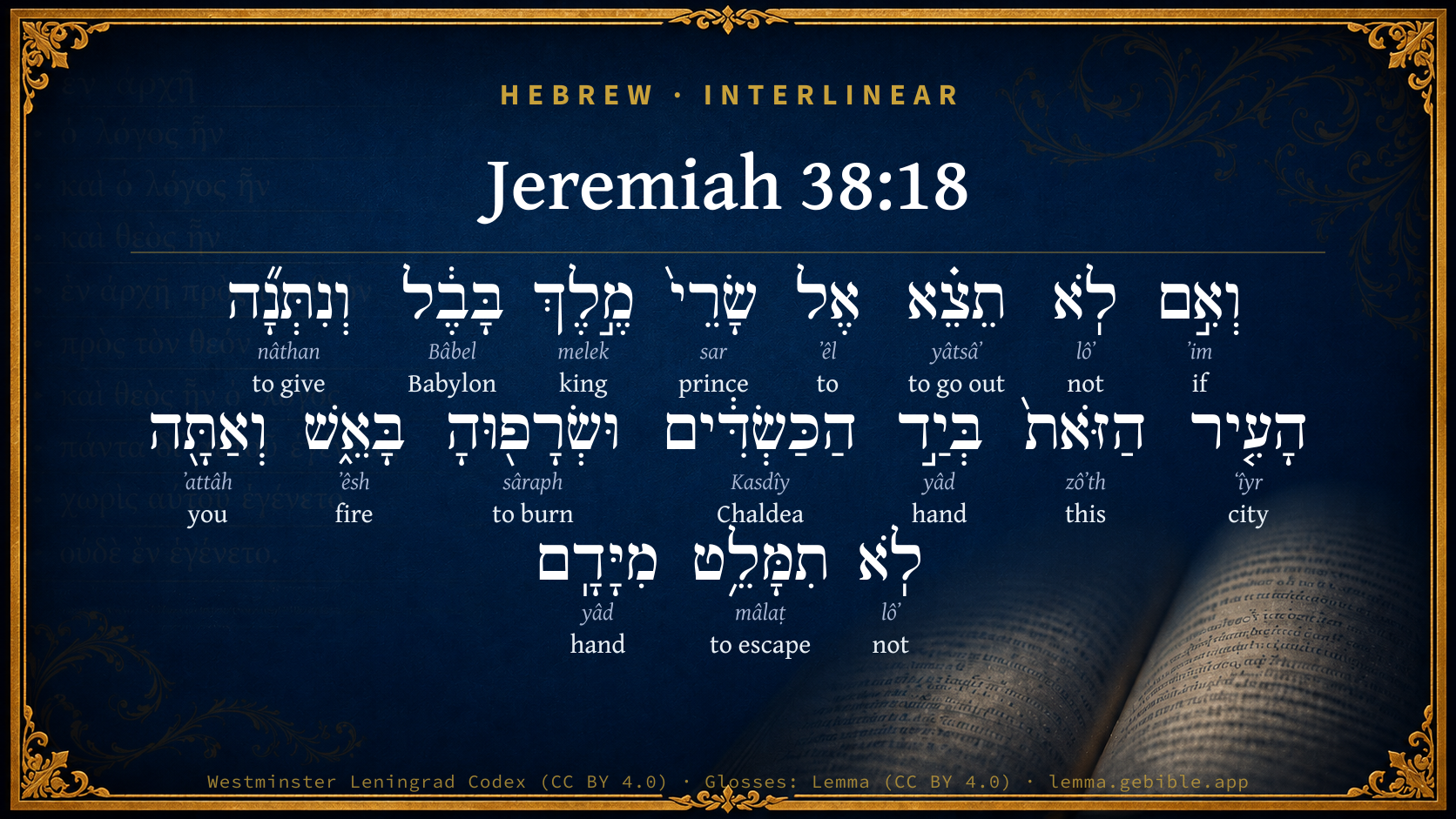
Hebrew (Westminster Leningrad Codex) Jeremiah 38:18 appears in the Hebrew Old Testament. The text above is from the Westminster Leningrad Codex. Each word links to its Strong’s number, a concise gloss, and parsing drawn from the Open Scriptures Hebrew Bible morphology. Click any word for its full Brown-Driver-Briggs (BDB) entry.
Download image
Cite this verse

Jeremiah 38:18 (World English Bible). Public Domain. Lemma interlinear Bible study tool, https://lemma.gebible.app/v/jeremiah/38/18.

Show BibTeX & RIS
BibTeX
RIS
English Translation
But if you will not go forth to the king of Babylon's princes, then shall this city be given into the hand of the Chaldeans, and they shall burn it with fire, and you shall not escape out of their hand.
World English Bible · Public Domain
Download a study sheet

One document with this verse’s original text, its word-by-word gloss line, the meaning frame, cross-references with their text, attributed commentary, and full source and license credits — printable, and it pastes into notes with its structure intact.

This verse Autodidact and up

Study sheet (.html) Plain text (.txt)

A passage Seminary Student

Up to 50 verses in one chapter. A passage sheet keeps up to 6 commentary sources and 12 cross-references per verse, in the order this page ranks them, and says so on the sheet whenever that leaves anything out. Ask for a single verse and you get the Autodidact verse sheet above.

Everything on this page stays free to read, with no account — the sheet is a download of what is already on screen, not access to it.

Want to remove ads? Support Godless Engineer
Compare translations 3

The same verse in 3 English versions, stacked beneath the original-language interlinear above. Click any original word for its lexicon entry.

Each is an independent rendering of the whole verse — the interlinear is not word-aligned to these translations.

Highlighted words mark where these versions differ — a whole-verse word diff, not a word-by-word alignment.

  • World English Bible Public Domain
    But if you will not go forth to the king of Babylon's princes, then shall this city be given into the hand of the Chaldeans, and they shall burn it with fire, and you shall not escape out of their hand.
  • King James Version Public Domain
    But if thou wilt not go forth to the king of Babylon's princes, then shall this city be given into the hand of the Chaldeans, and they shall burn it with fire, and thou shalt not escape out of their hand.
  • unfoldingWord Literal Text CC BY-SA 4.0
    But if you do not go out to the officials of the king of Babylon, then this city will be given into the hand of the Chaldeans. They will burn it, and you will not escape from their hand.”

unfoldingWord Literal Text — © unfoldingWord, licensed CC BY-SA 4.0. Word-aligned USFM3 via Door43 (git.door43.org/unfoldingWord/en_ult).

Versions to compare (up to 4)

3 of 4 selected

Show all 18 translations

Every available English version of this verse, each an independent rendering of the whole verse.

  • World English Bible Public Domain
    But if you will not go forth to the king of Babylon's princes, then shall this city be given into the hand of the Chaldeans, and they shall burn it with fire, and you shall not escape out of their hand.
  • Berean Standard Bible Public Domain
    But if you do not surrender to the officers of the king of Babylon, then this city will be delivered into the hands of the Chaldeans. They will burn it down, and you yourself will not escape their grasp.’”
  • Majority Standard Bible Public Domain
    But if you do not surrender to the officers of the king of Babylon, then this city will be delivered into the hands of the Chaldeans. They will burn it down, and you yourself will not escape their grasp.’”
  • King James Version Public Domain
    But if thou wilt not go forth to the king of Babylon's princes, then shall this city be given into the hand of the Chaldeans, and they shall burn it with fire, and thou shalt not escape out of their hand.
  • American Standard Version (1901) Public Domain
    But if thou wilt not go forth to the king of Babylon's princes, then shall this city be given into the hand of the Chaldeans, and they shall burn it with fire, and thou shalt not escape out of their hand.
  • Revised Version (1885) Public Domain
    But if thou wilt not go forth to the king of Babylon’s princes, then shall this city be given into the hand of the Chaldeans, and they shall burn it with fire, and thou shalt not escape out of their hand.
  • Geneva Bible (1599) Public Domain
    But if thou wilt not go forth to the King of Babels princes, then shall this citie be giuen into the hand of ye Caldeans, and they shall burne it with fire, and thou shalt not escape out of their hands.
  • Douay-Rheims (1899) Public Domain
    But if thou wilt not go out to the princes of the king of Babylon, this city shall be delivered into the hands of the Chaldeans, and they shall burn it with fire: and thou shalt not escape out of their hands.
  • Young's Literal Translation Public Domain
    And if thou dost not go forth unto the heads of the king of Babylon, then hath this city been given into the hand of the Chaldeans, and they have burnt it with fire, and thou dost not escape from their hand.'
  • Literal Standard Version CC BY-SA 4.0
    And if you do not go forth to the heads of the king of Babylon, then this city has been given into the hand of the Chaldeans, and they have burned it with fire, and you do not escape from their hand.”
  • Unlocked Literal Bible CC BY-SA 4.0
    But if you do not go out to the officials of the king of Babylon, then this city will be given into the hand of the Chaldeans. They will burn it, and you will not escape from their hand.”
  • unfoldingWord Literal Text CC BY-SA 4.0
    But if you do not go out to the officials of the king of Babylon, then this city will be given into the hand of the Chaldeans. They will burn it, and you will not escape from their hand.”
  • Darby Bible Public Domain
    But if thou wilt not go forth to the king of Babylon's princes, then shall this city be given into the hand of the Chaldeans, and they shall burn it with fire, and thou shalt not escape out of their hand.
  • World Messianic Bible Public Domain
    But if you will not go out to the king of Babylon’s princes, then this city will be given into the hand of the Kasdim, and they will burn it with fire, and you won’t escape out of their hand.’”
  • Webster's Bible Public Domain
    But if thou wilt not go forth to the king of Babylon's princes, then shall this city be given into the hand of the Chaldeans, and they shall burn it with fire, and thou shalt not escape from their hand.
  • Free Bible Version CC BY-SA 4.0
    But if you don't hand yourself over to the officers of the king of Babylon, then this city will be given to the Babylonians. They will burn it down, and you yourself won't escape being captured.’”
  • Bible in Basic English Public Domain
    But if you do not go out to the king of Babylon's captains, then this town will be given into the hands of the Chaldaeans and they will put it on fire, and you will not get away from them.
  • JPS Tanakh (1917) Public Domain
    but if thou wilt not go forth to the king of Babylon's princes, then shall this city be given into the hand of the Chaldeans, and they shall burn it with fire, and thou shalt not escape out of their hand.'

Literal Standard Version (2020), Covenant Press — licensed CC BY-SA 4.0. Text via the HelloAO Bible API (eBible.org). Unlocked Literal Bible (unfoldingWord) — licensed CC BY-SA 4.0. Text via the HelloAO Bible API (eBible.org). unfoldingWord Literal Text — © unfoldingWord, licensed CC BY-SA 4.0. Word-aligned USFM3 via Door43 (git.door43.org/unfoldingWord/en_ult). Free Bible Version, Dr. Jonathan Gallagher — licensed CC BY-SA 4.0. Text via the HelloAO Bible API (eBible.org).

Word by word

More ways to search: Search by grammar → Find every occurrence → Compare this word →

Practice this passage: Drill this verse → Learn its vocabulary →

הַכַּשְׂדִּ֔ים
Kasdîy
H3778
“the · Chaldea”
Particle, Definite Article + Noun, Proper
Part of Speech
Particle + Noun
Type
Proper
Full BDB Definition

Origin: (occasionally with enclitic) Kasdiymah kas-dee'- maw

TWOT: None

Chaldea or Chaldeans = "clod-breakers" - a territory in lower Mesopotamia bordering on the Persian Gulf (noun proper locative) - the inhabitants of Chaldea, living on the lower Euphrates and Tigris (noun proper masculine) - those persons considered the wisest in the land (by extension) (noun proper masculine)
  1. וְאִ֣ם ʼim H518 “and · if” Conjunction + Conjunction
  2. לֹֽא lôʼ H3808 “not” Particle, Negative
  3. תֵצֵ֗א yâtsâʼ H3318 “to go out” Verb, Qal, Imperfect, 2nd Person, Masculine, Singular
  4. אֶל ʼêl H413 “to” Preposition
  5. שָׂרֵי֙ sar H8269 “princes of” Noun, Common, Masculine, Plural, Construct
  6. מֶ֣לֶךְ melek H4428 “king of” Noun, Common, Masculine, Singular, Construct
  7. בָּבֶ֔ל Bâbel H894 “Babylon” Noun, Proper
  8. וְנִתְּנָ֞ה nâthan H5414 “and · to give” Conjunction + Verb, Niphal, Sequential Perfect, 3rd Person, Feminine, Singular
  9. הָעִ֤יר ʻîyr H5892 “the · city” Particle, Definite Article + Noun, Common, Feminine, Singular, Absolute
  10. הַזֹּאת֙ zôʼth H2063 “the · this” Particle, Definite Article + Pronoun, Demonstrative, Feminine, Singular
  11. בְּיַ֣ד yâd H3027 “in/at · hand of” Preposition + Noun, Common, Both, Singular, Construct
  12. וּשְׂרָפ֖וּהָ sâraph H8313 “and · to burn · her” Conjunction + Verb, Qal, Sequential Perfect, 3rd Person, Common, Plural + Suffix, Personal, 3rd Person, Feminine, Singular
  13. בָּאֵ֑שׁ ʼêsh H784 “in/at the · fire” Preposition, Determined + Noun, Common, Both, Singular, Absolute
  14. וְאַתָּ֖ה ʼattâh H859 “and · you” Conjunction + Pronoun, Personal, 2nd Person, Masculine, Singular
  15. לֹֽא lôʼ H3808 “not” Particle, Negative
  16. תִמָּלֵ֥ט mâlaṭ H4422 “to escape” Verb, Niphal, Imperfect, 2nd Person, Masculine, Singular
  17. מִיָּדָֽם yâd H3027 “from · hand · their” Preposition + Noun, Common, Both, Singular, Construct + Suffix, Personal, 3rd Person, Masculine, Plural

About this verse

These counts appear in no published source. They are computed here, from the morphology-tagged text and Lemma’s own curated glosses. What Lemma adds →

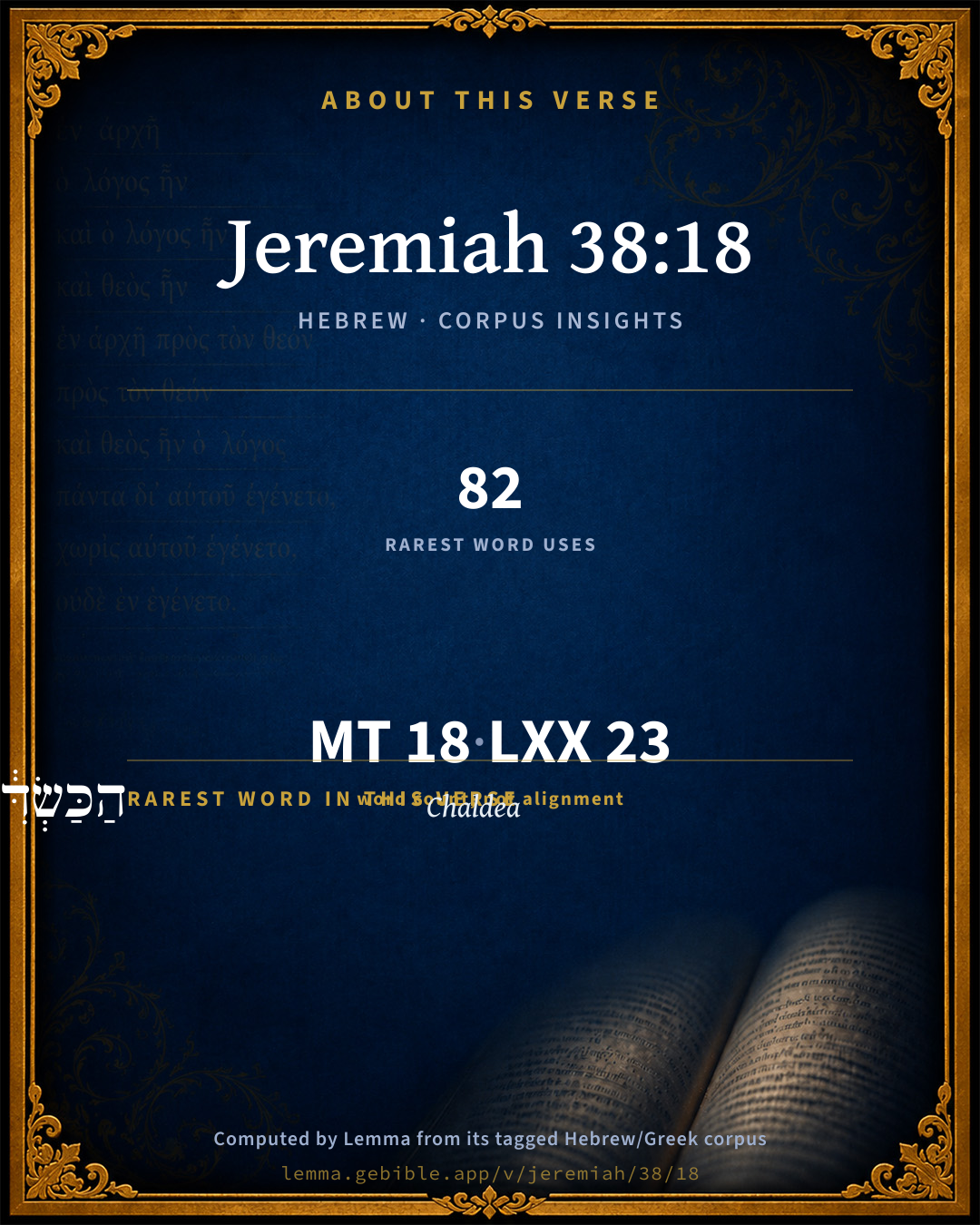
18
words
16
distinct lemmas
Prophets
section

Grammatical profile

  • 4 verbs
  • 8 nouns
  • 2 pronouns
  • 1 preposition
  • 1 conjunction
  • 2 particles

Verb forms

  • תֵצֵ֗א Qal · Imperfect
  • וְנִתְּנָ֞ה Niphal · Sequential Perfect
  • וּשְׂרָפ֖וּהָ Qal · Sequential Perfect
  • תִמָּלֵ֥ט Niphal · Imperfect

Repetition

Words recur within this verse — often emphatic in Hebrew:

  • בְּיַ֣ד hand H3027 ×2
  • לֹֽא not H3808 ×2

Hebrew & Septuagint length

In the original languages it is 18 Hebrew tokens and 23 Greek tokens — but the two are counted differently (Hebrew bundles its prefixes and suffixes into one token; the Greek is in lemma form), so that isn’t a like-for-like length.

Cross-references

16

Topical passages linked to Jeremiah 38:18 in the Treasury of Scripture Knowledge — connected by theme and wording, ordered by reader-vote popularity; previews shown in the World English Bible.

  • 2 Kings 25:4–10 Then a breach was made in the city, and all the men of war [fled] by night by the way of the gate between the two walls, which was by the king's garden (now the Chaldeans were against the city round about); and [the king] went by the way of the Arabah.
  • Jeremiah 24:8–10 As the bad figs, which can't be eaten, they are so bad, surely thus says Yahweh, So will I give up Zedekiah the king of Judah, and his princes, and the residue of Jerusalem, who remain in this land, and those who dwell in the land of Egypt,
  • Jeremiah 32:3–5 For Zedekiah king of Judah had shut him up, saying, Why do you prophesy, and say, Thus says Yahweh, Behold, I will give this city into the hand of the king of Babylon, and he shall take it;
  • Jeremiah 38:3 Thus says Yahweh, This city shall surely be given into the hand of the army of the king of Babylon, and he shall take it.
  • 2 Kings 24:12 and Jehoiachin the king of Judah went out to the king of Babylon, he, and his mother, and his servants, and his princes, and his officers: and the king of Babylon took him in the eighth year of his reign.
  • 2 Kings 25:27–30 It happened in the seven and thirtieth year of the captivity of Jehoiachin king of Judah, in the twelfth month, on the seven and twentieth day of the month, that Evilmerodach king of Babylon, in the year that he began to reign, did lift up the head of Jehoiachin king of Judah out of prison;
  • Jeremiah 34:2–3 Thus says Yahweh, the God of Israel, Go, and speak to Zedekiah king of Judah, and tell him, Thus says Yahweh, Behold, I will give this city into the hand of the king of Babylon, and he shall burn it with fire:
  • Jeremiah 34:19–22 the princes of Judah, and the princes of Jerusalem, the eunuchs, and the priests, and all the people of the land, who passed between the parts of the calf;
  • Jeremiah 37:8 The Chaldeans shall come again, and fight against this city; and they shall take it, and burn it with fire.
  • Jeremiah 38:23 They shall bring out all your wives and your children to the Chaldeans; and you shall not escape out of their hand, but shall be taken by the hand of the king of Babylon: and you shall cause this city to be burned with fire.
  • Jeremiah 39:3 that all the princes of the king of Babylon came in, and sat in the middle gate, [to wit], Nergal Sharezer, Samgar-nebo, Sarsechim, Rabsaris, Nergal Sharezer, Rabmag, with all the rest of the princes of the king of Babylon.
  • Jeremiah 39:5–7 But the army of the Chaldeans pursued after them, and overtook Zedekiah in the plains of Jericho: and when they had taken him, they brought him up to Nebuchadrezzar king of Babylon to Riblah in the land of Hamath; and he gave judgment on him.
  • Jeremiah 52:7–11 Then a breach was made in the city, and all the men of war fled, and went forth out of the city by night by the way of the gate between the two walls, which was by the king's garden; (now the Chaldeans were against the city round about;) and they went toward the Arabah.
  • Ezekiel 12:13 My net also will I spread on him, and he shall be taken in my snare; and I will bring him to Babylon to the land of the Chaldeans; yet shall he not see it, though he shall die there.
  • Ezekiel 17:20–21 I will spread my net on him, and he shall be taken in my snare, and I will bring him to Babylon, and will enter into judgment with him there for his trespass that he has trespassed against me.
  • Ezekiel 21:25–27 You, deadly wounded wicked one, the prince of Israel, whose day is come, in the time of the iniquity of the end,

Cross-references courtesy of OpenBible.info (CC BY 4.0).

Hebrew and Greek witnesses Masoretic Hebrew ↔ Greek Septuagint

The same verse in the two great witnesses to the Old Testament, shown verse-for-verse.

These are two independent witnesses, not word-aligned to each other, and the Septuagint is shown in lemma (dictionary) form.

Hebrew Jeremiah 38:18 Masoretic · Westminster Leningrad Codex

וְאִ֣ם לֹֽא תֵצֵ֗א אֶל שָׂרֵי֙ מֶ֣לֶךְ בָּבֶ֔ל וְנִתְּנָ֞ה הָעִ֤יר הַזֹּאת֙ בְּיַ֣ד הַכַּשְׂדִּ֔ים וּשְׂרָפ֖וּהָ בָּאֵ֑שׁ וְאַתָּ֖ה לֹֽא תִמָּלֵ֥ט מִיָּדָֽם

But if you will not go forth to the king of Babylon's princes, then shall this city be given into the hand of the Chaldeans, and they shall burn it with fire, and you shall not escape out of their hand.

World English Bible · Public Domain

Greek LXX Structure differs

In the Septuagint, Jeremiah is about an eighth shorter than the Hebrew and arranges its material differently — the Oracles Against the Nations (Hebrew chapters 46–51) appear in the middle of the Greek book, after 25:13. Because the chapter and verse boundaries do not line up, a verse-for-verse comparison with the Hebrew is not shown.

A verse-for-verse comparison isn’t shown here because the chapters and verses don’t line up. Switch to the LXX edition with the MT / LXX toggle above to read the Greek directly.

Hebrew: Westminster Leningrad Codex (CC BY 4.0). Greek: Septuagint (public domain); English from a public-domain English Septuagint. How the Septuagint differs from the Hebrew →

Targum (Aramaic paraphrase)

1

The Targum is the ancient Jewish Aramaic paraphrase of the Hebrew Scriptures — an interpretive translation, not the Hebrew text itself. Onkelos (literal) and Pseudo-Jonathan (expansive) render the Torah, and Jonathan the Prophets. Coverage is partial: where no permissively-licensed English translation exists for a verse, only the Aramaic is shown. This is verse-level text, not a word-by-word alignment to the Hebrew.

  1. Targum Jonathan Prophets (Joshua–Malachi)
    וְאִם לָא תִפּוֹק לְוַת רַבְרְבֵי מַלְכָּא דְבָבֶל וְתִתְמְסַר קַרְתָּא הָדָא בִּידָא דְכַסְדָאֵי וְיוֹקְדִינָהּ בְּנוּרָא וְאַתְּ לָא תִשְׁתֵּיזֵיב מִידֵיהוֹן:

    (no public-domain English translation for this verse)

    Targum Jonathan — Aramaic: “Mikraot Gedolot” (public domain). English: “Sefaria Community Translation” (CC0 1.0 (public-domain dedication)); “London "Chaldee Paraphrase," 1871” (public domain). Text via Sefaria.

Commentary

Notes on Jeremiah 38:18 from classic Christian and Jewish commentators (each source and its license shown beneath its notes). The classic Christian expositions comment on the surrounding passage and are grouped to its opening verse, so a note may address several verses; the Jewish commentaries on the Tanakh (Rashi and others) are per-verse, so they appear only where the commentator wrote on this verse.

Lemma curates 59 commentaries, every one of them public domain or Creative Commons licensed, each selected and text-cleaned for this edition rather than reprinted as found. About our sources →

Trapp's Complete Commentary

John Trapp

Jer 38:18 But if thou wilt not go forth to the king of Babylon’s princes, then shall this city be given into the hand of the Chaldeans, and they shall burn it with fire, and thou shalt not escape out of their hand.

Ver. 18. But if thou wilt not go forth.] See Jer 32:39. Thus Zedekiah hath it both ways, that it may abide by him; but he was uncounselable and irreclaimable.

John Trapp, A Commentary or Exposition upon All the Books of the Old and New Testament (1647–1656) — public domain. Text from a community e-Sword module.

John Calvin's Commentaries

The Prophet gave to the king the hope of pardon; not that he promised impunity, but that the king might at least hope that God would be merciful to him, if he anticipated his extreme vengeance. But as hypocrites are not easily moved when God allures them by the sweetness of his promises, hence a threatening is added, “Except thou deliverest thyself up,” says the Prophet, “to the. Chaldeans, thou shalt not escape, and the city shall be taken and burnt by the Chaldeans.”

Zedekiah might have had hope in part, and thus have found the mercy which God offered to him. As he had profited nothing in this respect, it was necessary, in another way, to arouse him, by setting before him the destruction of the city, and his own death. But he was not prevailed upon either by fear or by hope, to obey the advice of the Prophet. We hence see, that though he did not avowedly despise God, he was yet neither cold nor hot, but wished to be wholly spared. Hence then it was, that he rejected the favor offered to him by the Prophet. However his excuse follows —

John Calvin's Commentaries (1540-1563) — public domain. Text from the Calvin Translation Society English edition (1840s-50s) via the Christian Classics Ethereal Library (ccel.org). Calvin's coverage is partial (roughly two-thirds of the Bible); uncommented books and verses are honest gaps, never fabricated. The 19th-century editor's footnotes and remarks are omitted so the notes are faithfully Calvin's own voice.

John Gill's Exposition

But if thou wilt not go forth to the king of Babylon's princes,.... And surrender to them:

then shall this city be given into the hands of the Chaldeans; if not willingly delivered up by the king of Judah, it shall be forcibly taken by the king of Babylon's army, through the permission of God; with respect to whom it is said to be given unto them, even by him who has the disposing of cities and kingdoms:

and they shall burn it with fire; as it had been often foretold it should, and as it accordingly was, Jer 39:8;

and thou shalt not escape out of their hand; though he might hope he should, and would attempt to do it, yet should be taken; and though he should not be slain, yet should never regain his liberty, or get out of their hands, when once in them; see Jer 52:7.

John Gill's Exposition of the Whole Bible (1746–1763) — public domain (CC PDM 1.0). Text via the HelloAO Bible API.

Matthew Poole's English Annotations

As he before had used exhortations and promises, so here he useth threatenings, to persuade him to that which indeed was in his power to do, but God infallibly knew that he would not do; the end of God in which could be no other than to leave him without excuse, in not obeying what God commanded.

Matthew Poole's English Annotations on the Holy Bible (1683–1685) — public domain. Text from a community e-Sword/MySword module.

Lesson kit

Teaching starters — assembled from the data on this page, not authored interpretation. Every prompt links to the verse data it draws on. Edit before teaching.

Jeremiah, in the Prophets, opens this verse with 18 words (16 distinct Hebrew lemmas). Its most distinctive word is Kasdîy (“Chaldea”). A historical commentator’s framing appears above. Read the whole chapter for the surrounding context.

Discussion questions

  1. How does “Chaldea” (Kasdîy) shape what this verse is saying?
  2. How does 2 Kings 25:4–10, which shares this passage’s theme, read alongside this verse?
  3. What does the repetition of “hand” (2× in this one verse) do in this verse?
  4. The translations on this page render this verse differently — a whole-verse word diff, not a word-by-word alignment. What might account for the different wordings?
  5. «תֵצֵ֗א» is a Qal Imperfect verb. How does that grammatical form shape the action described?
  6. Compare how Trapp's Complete Commentary and John Calvin's Commentaries read this verse. Where do they agree or differ?

Things to notice

Reading settings

Reading text

Shown beneath each verse's original-language words.

Old Testament
Old Testament edition

Read the OT as the Masoretic Hebrew (MT) or the Greek Septuagint (LXX).

English shown for the Greek Septuagint (in the Hebrew ↔ Greek comparison).

Comparing translations? Open the Compare panel on any verse page to stack up to four side by side.