
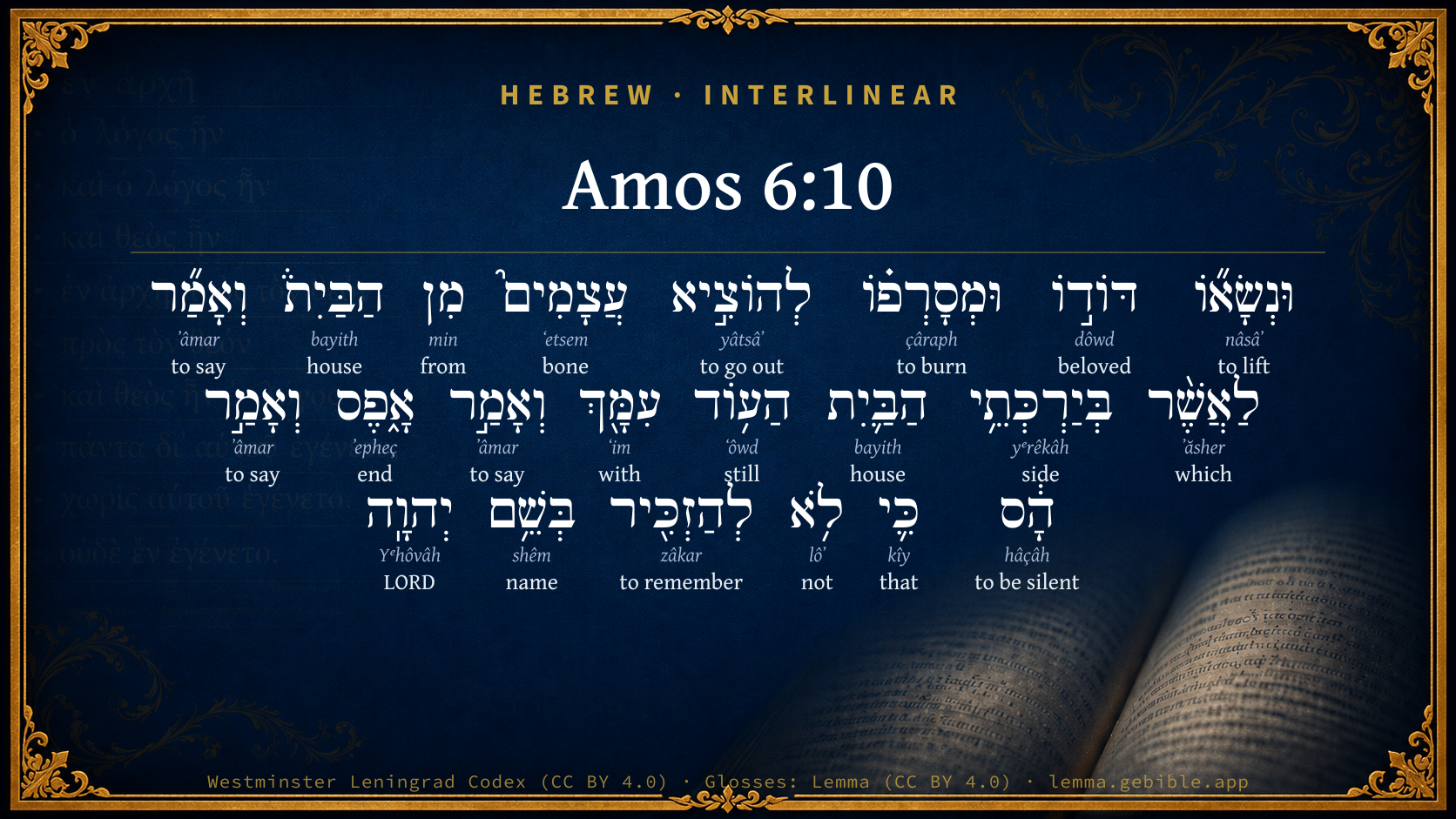
Amos 6:10

Hebrew (Westminster Leningrad Codex) Amos 6:10 appears in the Hebrew Old Testament. The text above is from the Westminster Leningrad Codex. Each word links to its Strong’s number, a concise gloss, and parsing drawn from the Open Scriptures Hebrew Bible morphology. Click any word for its full Brown-Driver-Briggs (BDB) entry.
Download image
Cite this verse

Amos 6:10 (World English Bible). Public Domain. Lemma interlinear Bible study tool, https://lemma.gebible.app/v/amos/6/10.

Show BibTeX & RIS
BibTeX
RIS
English Translation
"When a man's relative carries him, even he who burns him, to bring bodies out of the house, and asks him who is in the innermost parts of the house, 'Is there yet any with you?' And he says, 'No;' then he will say, 'Hush! Indeed we must not mention the name of Yahweh.'
World English Bible · Public Domain
Highlights
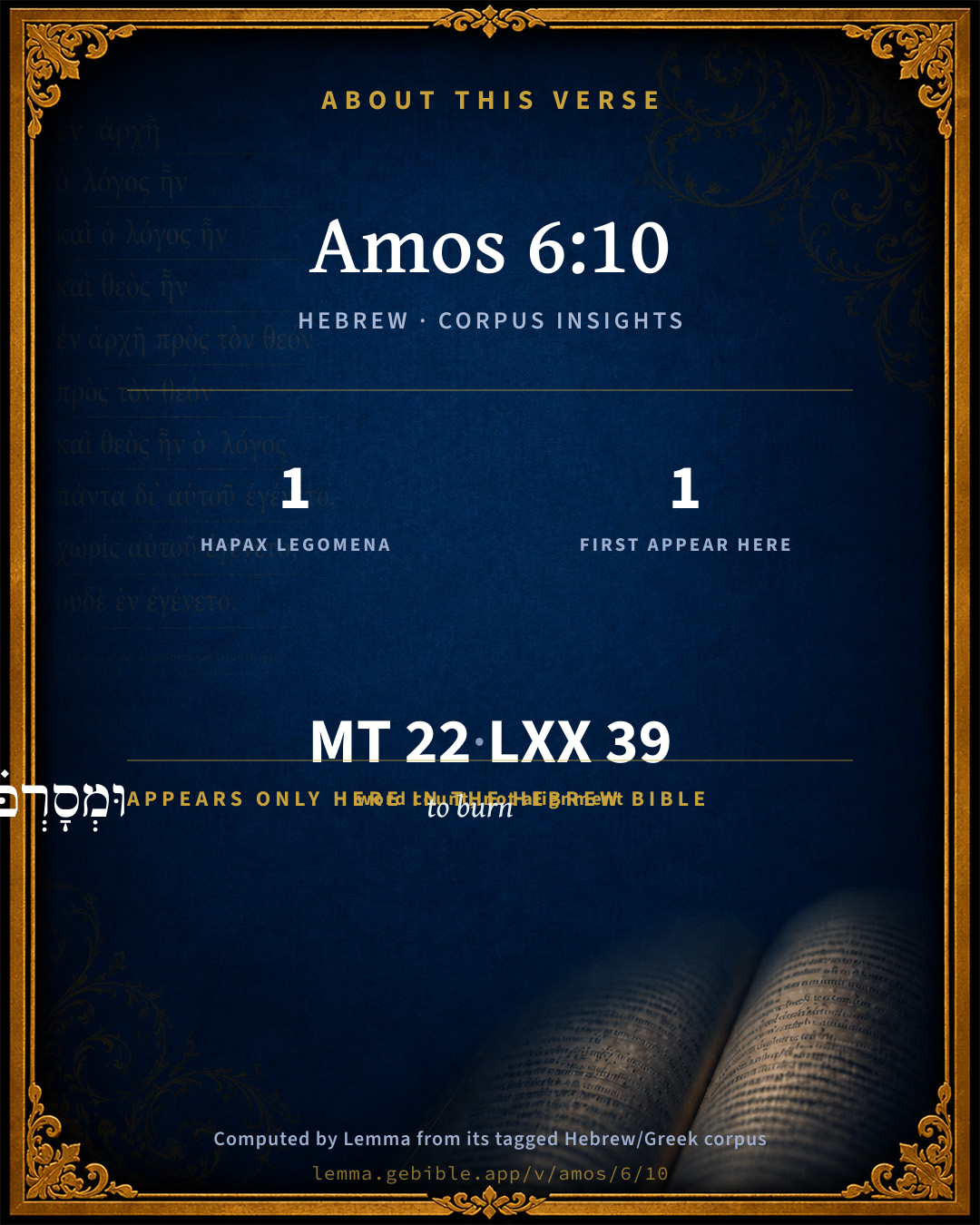
  • 1 hapax legomenon — only here in the Hebrew Bible
  • 1 first appearance in the Hebrew Bible
Full analysis ↓
Download a study sheet

One document with this verse’s original text, its word-by-word gloss line, the meaning frame, cross-references with their text, attributed commentary, and full source and license credits — printable, and it pastes into notes with its structure intact.

This verse Autodidact and up

Study sheet (.html) Plain text (.txt)

A passage Seminary Student

Up to 50 verses in one chapter. A passage sheet keeps up to 6 commentary sources and 12 cross-references per verse, in the order this page ranks them, and says so on the sheet whenever that leaves anything out. Ask for a single verse and you get the Autodidact verse sheet above.

Everything on this page stays free to read, with no account — the sheet is a download of what is already on screen, not access to it.

Want to remove ads? Support Godless Engineer
Compare translations 3

The same verse in 3 English versions, stacked beneath the original-language interlinear above. Click any original word for its lexicon entry.

Each is an independent rendering of the whole verse — the interlinear is not word-aligned to these translations.

Highlighted words mark where these versions differ — a whole-verse word diff, not a word-by-word alignment.

  • World English Bible Public Domain
    "When a man's relative carries him, even he who burns him, to bring bodies out of the house, and asks him who is in the innermost parts of the house, 'Is there yet any with you?' And he says, 'No;' then he will say, 'Hush! Indeed we must not mention the name of Yahweh.'
  • King James Version Public Domain
    And a man's uncle shall take him up, and he that burneth him, to bring out the bones out of the house, and shall say unto him that is by the sides of the house, Is there yet any with thee? and he shall say, No. Then shall he say, Hold thy tongue: for we may not make mention of the name of the LORD.
  • unfoldingWord Literal Text CC BY-SA 4.0
    When a man’s relative comes to take their bodies up—the one who is to cremate them after bringing the corpses out of the house—if he says to the person in the house, “Is there anyone with you?” What if that person says, “No.” Then he will say, “Be quiet, for we must not mention Yahweh’s name.”

unfoldingWord Literal Text — © unfoldingWord, licensed CC BY-SA 4.0. Word-aligned USFM3 via Door43 (git.door43.org/unfoldingWord/en_ult).

Versions to compare (up to 4)

3 of 4 selected

Show all 18 translations

Every available English version of this verse, each an independent rendering of the whole verse.

  • World English Bible Public Domain
    "When a man's relative carries him, even he who burns him, to bring bodies out of the house, and asks him who is in the innermost parts of the house, 'Is there yet any with you?' And he says, 'No;' then he will say, 'Hush! Indeed we must not mention the name of Yahweh.'
  • Berean Standard Bible Public Domain
    And when the relative who is to burn the bodies picks them up to remove them from the house, he will call to one inside, “Is anyone else with you?” “None,” that person will answer. “Silence,” the relative will retort, “for the name of the LORD must not be invoked.”
  • Majority Standard Bible Public Domain
    And when the relative who is to burn the bodies picks them up to remove them from the house, he will call to one inside, “Is anyone else with you?” “None,” that person will answer. “Silence,” the relative will retort, “for the name of the LORD must not be invoked.”
  • King James Version Public Domain
    And a man's uncle shall take him up, and he that burneth him, to bring out the bones out of the house, and shall say unto him that is by the sides of the house, Is there yet any with thee? and he shall say, No. Then shall he say, Hold thy tongue: for we may not make mention of the name of the LORD.
  • American Standard Version (1901) Public Domain
    And when a man's uncle shall take him up, even he that burneth him, to bring out the bones out of the house, and shall say unto him that is in the innermost parts of the house, Is there yet any with thee? and he shall say, No; then shall he say, Hold thy peace; for we may not make mention of the name of Jehovah.
  • Revised Version (1885) Public Domain
    And when a man’s uncle shall take him up, even he that burneth him, to bring out the bones out of the house, and shall say unto him that is in the innermost parts of the house, Is there yet any with thee? and he shall say, No; then shall he say, Hold thy peace; for we may not make mention of the name of the LORD.
  • Geneva Bible (1599) Public Domain
    And his vncle shall take him vp and burne him to cary out the bones out of the house, and shall say vnto him, that is by ye sides of the house, Is there yet any with thee? And he shall say, None. Then shall he say, Holde thy tongue: for we may not remember the Name of the Lord.
  • Douay-Rheims (1899) Public Domain
    And a man's kinsman shall take him up, and shall burn him, that he may carry the bones out of the house; and he shall say to him that is in the inner rooms of the house: Is there yet any with thee?
  • Young's Literal Translation Public Domain
    And lifted him up hath his loved one, even his burner, To bring forth the bones from the house, And he said to him who `is' in the sides of the house, `Is there yet with thee?' And he said, `None,' then he said, `Hush! Save to make mention of the name of Jehovah.'
  • Literal Standard Version CC BY-SA 4.0
    And his loved one has lifted him up, even his burner, || To bring forth the bones from the house, || And he said to him who [is] in the sides of the house, || “Is there [any] yet with you?” And he said, “None,” || Then he said, “Hush! We must not make mention of the Name of YHWH.”
  • Unlocked Literal Bible CC BY-SA 4.0
    When a man's relative comes to take their bodies up—the one who is to cremate them after bringing the corpses out of the house—if he says to the person in the house, “Is there anyone with you?” What if that person says, “No.” Then he will say, “Be quiet, for we must not mention Yahweh's name.”
  • unfoldingWord Literal Text CC BY-SA 4.0
    When a man’s relative comes to take their bodies up—the one who is to cremate them after bringing the corpses out of the house—if he says to the person in the house, “Is there anyone with you?” What if that person says, “No.” Then he will say, “Be quiet, for we must not mention Yahweh’s name.”
  • Darby Bible Public Domain
    And a man's uncle, and he that should burn him, shall take him up to bring out the bones from the house, and shall say unto him that is in the inner parts of the house, Is there yet [any] with thee? and he shall say, None. And he will say, Silence! for we may not make mention of Jehovah's name.
  • World Messianic Bible Public Domain
    “When a man’s relative carries him, even he who burns him, to bring bodies out of the house, and asks him who is in the innermost parts of the house, ‘Is there yet any with you?’ And he says, ‘No;’ then he will say, ‘Hush! Indeed we must not mention the LORD’s name.’
  • Webster's Bible Public Domain
    And a man's uncle shall take him up, and he that burneth him, to bring the bones out of the house, and shall say to him that is by the sides of the house, Is there yet any with thee? and he shall say, No. Then shall he say, Hold thy tongue: for we may not make mention of the name of the LORD.
  • Free Bible Version CC BY-SA 4.0
    And when a relative comes to take away the bodies from the house, he will ask someone inside, “Is there anyone else with you?” The person will reply, “No...” Then the other will say, “Quiet! Don't even mention the Lord's name.”
  • Bible in Basic English Public Domain
    And when a man's relation, even the one who is responsible for burning his body, lifting him up to take his bones out of the house, says to him who is in the inmost part of the house, Is there still anyone with you? and he says, No; then he will say, Keep quiet, for the name of the Lord may not be named.
  • JPS Tanakh (1917) Public Domain
    And when a man's uncle shall take him up, even he that burneth him, to bring out the bones out of the house, and shall say unto him that is in the innermost parts of the house: 'Is there yet any with thee?' and he shall say: 'No'; then shall he say: 'Hold thy peace; for we must not make mention of the name of the LORD.'

Literal Standard Version (2020), Covenant Press — licensed CC BY-SA 4.0. Text via the HelloAO Bible API (eBible.org). Unlocked Literal Bible (unfoldingWord) — licensed CC BY-SA 4.0. Text via the HelloAO Bible API (eBible.org). unfoldingWord Literal Text — © unfoldingWord, licensed CC BY-SA 4.0. Word-aligned USFM3 via Door43 (git.door43.org/unfoldingWord/en_ult). Free Bible Version, Dr. Jonathan Gallagher — licensed CC BY-SA 4.0. Text via the HelloAO Bible API (eBible.org).

Word by word

More ways to search: Search by grammar → Find every occurrence → Compare this word →

Practice this passage: Drill this verse → Learn its vocabulary →

וּמְסָרְפ֗וֹ
çâraph
H5635
“and · burning · him”
Conjunction + Verb, Piel, Participle Active, Masculine, Singular, Construct + Suffix, Personal, 3rd Person, Masculine, Singular
Part of Speech
Conjunction + Verb
Stem
Piel
Form
Participle Active
Gender
Masculine
Number
Singular
State
Construct
Full BDB Definition

Origin: a primitive root

TWOT: 2292

(Piel) to burn
  1. וּנְשָׂא֞וֹ nâsâʼ H5375 “and · to lift · him” Conjunction + Verb, Qal, Sequential Perfect, 3rd Person, Masculine, Singular + Suffix, Personal, 3rd Person, Masculine, Singular
  2. דּוֹד֣וֹ dôwd H1730 “beloved · his” Noun, Common, Masculine, Singular, Construct + Suffix, Personal, 3rd Person, Masculine, Singular
  3. לְהוֹצִ֣יא yâtsâʼ H3318 “to go out” Preposition + Verb, Hiphil, Infinitive Construct
  4. עֲצָמִים֮ ʻetsem H6106 “bones” Noun, Common, Feminine, Plural, Absolute
  5. מִן min H4480 “from” Preposition
  6. הַבַּיִת֒ bayith H1004 “the · house” Particle, Definite Article + Noun, Common, Masculine, Singular, Absolute
  7. וְאָמַ֞ר ʼâmar H559 “and · to say” Conjunction + Verb, Qal, Sequential Perfect, 3rd Person, Masculine, Singular
  8. לַאֲשֶׁ֨ר ʼăsher H834 “to/for · which” Preposition + Particle, Relative
  9. בְּיַרְכְּתֵ֥י yᵉrêkâh H3411 “in/at · sides of” Preposition + Noun, Common, Feminine, Dual, Construct
  10. הַבַּ֛יִת bayith H1004 “the · house” Particle, Definite Article + Noun, Common, Masculine, Singular, Absolute
  11. הַע֥וֹד ʻôwd H5750 “still” Particle, Interrogative + Adverb
  12. עִמָּ֖ךְ ʻim H5973 “with · you” Preposition + Suffix, Personal, 2nd Person, Feminine, Singular
  13. וְאָמַ֣ר ʼâmar H559 “and · to say” Conjunction + Verb, Qal, Sequential Perfect, 3rd Person, Masculine, Singular
  14. אָ֑פֶס ʼepheç H657 “end” Noun, Common, Masculine, Singular, Absolute
  15. וְאָמַ֣ר ʼâmar H559 “and · to say” Conjunction + Verb, Qal, Sequential Perfect, 3rd Person, Masculine, Singular
  16. הָ֔ס hâçâh H2013 “be silent” Verb, Piel, Imperative, 2nd Person, Masculine, Singular
  17. כִּ֛י kîy H3588 “that” Conjunction
  18. לֹ֥א lôʼ H3808 “not” Particle, Negative
  19. לְהַזְכִּ֖יר zâkar H2142 “to remember” Preposition + Verb, Hiphil, Infinitive Construct
  20. בְּשֵׁ֥ם shêm H8034 “in/at · name of” Preposition + Noun, Common, Masculine, Singular, Construct
  21. יְהוָֽה Yᵉhôvâh H3068 “LORD” Noun, Proper

About this verse

These counts appear in no published source. They are computed here, from the morphology-tagged text and Lemma’s own curated glosses. What Lemma adds →

22
words
19
distinct lemmas
Prophets
section

Notable vocabulary

1 hapax legomenon — a word that appears only here in the entire Hebrew Bible:

  • וּמְסָרְפ֗וֹ to burn H5635

First appearance in Scripture

This word makes its first canonical appearance in the Hebrew Bible here:

  • וּמְסָרְפ֗וֹ to burn H5635

Shared distinctive vocabulary

הָ֔ס to be silent H2013 occurs in 8 verses of the Hebrew Bible. Also found in:

Grammatical profile

  • 8 verbs
  • 8 nouns
  • 2 prepositions
  • 1 conjunction
  • 1 adverb
  • 2 particles

Verb forms

  • וּנְשָׂא֞וֹ Qal · Sequential Perfect
  • וּמְסָרְפ֗וֹ Piel · Participle Active
  • לְהוֹצִ֣יא Hiphil · Infinitive Construct
  • וְאָמַ֞ר Qal · Sequential Perfect
  • וְאָמַ֣ר Qal · Sequential Perfect
  • וְאָמַ֣ר Qal · Sequential Perfect
  • הָ֔ס Piel · Imperative
  • לְהַזְכִּ֖יר Hiphil · Infinitive Construct

Repetition

Words recur within this verse — often emphatic in Hebrew:

  • וְאָמַ֞ר to say H559 ×3
  • הַבַּיִת֒ house H1004 ×2

Hebrew & Septuagint length

In English translation the verse runs 54 words from the Hebrew and 43 from the Septuagint (LXX English) — closely comparable.

A rough comparison of the two English renderings, which tokenize alike — not a word-level alignment.

Word counts can differ between the Hebrew and the Greek without any difference in meaning — e.g. the Hebrew direct-object marker אֵת has no separate Greek word, and Greek often adds the article ὁ.

In the original languages it is 22 Hebrew tokens and 39 Greek tokens — but the two are counted differently (Hebrew bundles its prefixes and suffixes into one token; the Greek is in lemma form), so that isn’t a like-for-like length.

Cross-references

10

Topical passages linked to Amos 6:10 in the Treasury of Scripture Knowledge — connected by theme and wording, ordered by reader-vote popularity; previews shown in the World English Bible.

  • 1 Samuel 31:12 all the valiant men arose, and went all night, and took the body of Saul and the bodies of his sons from the wall of Beth-shan; and they came to Jabesh, and burnt them there.
  • Amos 8:3 The songs of the temple will be wailings in that day," says the Lord Yahweh. "The dead bodies will be many. In every place they will throw them out with silence.
  • Ezekiel 20:39 As for you, house of Israel, thus says the Lord Yahweh: Go you, serve everyone his idols, and hereafter also, if you will not listen to me; but my holy name shall you no more profane with your gifts, and with your idols.
  • Amos 5:13 Therefore he who is prudent shall keep silence in such a time; For it is an evil time.
  • Numbers 17:12 The children of Israel spoke to Moses, saying, Behold, we perish, we are undone, we are all undone.
  • Jeremiah 16:6 Both great and small shall die in this land; they shall not be buried, neither shall men lament for them, nor cut themselves, nor make themselves bald for them;
  • Jeremiah 44:26 Therefore hear the word of Yahweh, all Judah who dwell in the land of Egypt: Behold, I have sworn by my great name, says Yahweh, that my name shall no more be named in the mouth of any man of Judah in all the land of Egypt, saying, As the Lord Yahweh lives.
  • Ezekiel 24:21 Speak to the house of Israel, Thus says the Lord Yahweh: Behold, I will profane my sanctuary, the pride of your power, the desire of your eyes, and that which your soul pities; and your sons and your daughters whom you have left behind shall fall by the sword.
  • 2 Kings 6:33 While he was yet talking with them, behold, the messenger came down to him: and he said, Behold, this evil is of Yahweh; why should I wait for Yahweh any longer?
  • 2 Kings 23:16 As Josiah turned himself, he spied the tombs that were there in the mountain; and he sent, and took the bones out of the tombs, and burned them on the altar, and defiled it, according to the word of Yahweh which the man of God proclaimed, who proclaimed these things.

Cross-references courtesy of OpenBible.info (CC BY 4.0).

Hebrew and Greek witnesses Masoretic Hebrew ↔ Greek Septuagint

The same verse in the two great witnesses to the Old Testament, shown verse-for-verse.

These are two independent witnesses, not word-aligned to each other, and the Septuagint is shown in lemma (dictionary) form.

Hebrew Amos 6:10 Masoretic · Westminster Leningrad Codex

וּנְשָׂא֞וֹ דּוֹד֣וֹ וּמְסָרְפ֗וֹ לְהוֹצִ֣יא עֲצָמִים֮ מִן הַבַּיִת֒ וְאָמַ֞ר לַאֲשֶׁ֨ר בְּיַרְכְּתֵ֥י הַבַּ֛יִת הַע֥וֹד עִמָּ֖ךְ וְאָמַ֣ר אָ֑פֶס וְאָמַ֣ר הָ֔ס כִּ֛י לֹ֥א לְהַזְכִּ֖יר בְּשֵׁ֥ם יְהוָֽה

"When a man's relative carries him, even he who burns him, to bring bodies out of the house, and asks him who is in the innermost parts of the house, 'Is there yet any with you?' And he says, 'No;' then he will say, 'Hush! Indeed we must not mention the name of Yahweh.'

World English Bible · Public Domain

Greek LXX Amos 6:10 Septuagint · lemma form

καί λαμβάνω ὁ οἰκεῖος αὐτός καί παραβιόω ὁ ἐκφέρω ὁ ὀστέον αὐτός ἐκ ὁ οἶκος καί εἶπον ὁ προἵστημι ὁ οἰκία εἰ ἔτι ὑποἄρχω παρά σύ καί εἶπον οὐκέτι καί εἶπον σιγάω ἕνεκα ὁ μή ὀνομάζω ὁ ὄνομα κύριος

But a remnant shall be left behind, and their relations shall take them, and shall strenuously endeavor to carry forth their bones from the house: and one shall say to the heads of the house, Is there yet any one else with you?

LXX2012 (modern English Septuagint) · Public Domain

On this verse, The Pulpit Commentary discusses the Septuagint’s reading. Read the note in Commentary ↓

Hebrew: Westminster Leningrad Codex (CC BY 4.0). Greek: Septuagint (public domain); English from LXX2012 (modern English Septuagint) (Public Domain). How the Septuagint differs from the Hebrew →

Targum (Aramaic paraphrase)

1

The Targum is the ancient Jewish Aramaic paraphrase of the Hebrew Scriptures — an interpretive translation, not the Hebrew text itself. Onkelos (literal) and Pseudo-Jonathan (expansive) render the Torah, and Jonathan the Prophets. Coverage is partial: where no permissively-licensed English translation exists for a verse, only the Aramaic is shown. This is verse-level text, not a word-by-word alignment to the Hebrew.

  1. Targum Jonathan Prophets (Joshua–Malachi)
    וְיִטְלִנֵיהּ קְרִיבֵיהּ מִיְקֵידָא לְאַפָּקָא גַרְמַיָא מִן בֵּיתָא וְיֵימַר לְדִי בְשִׁדָא דְבֵיתָא הַעוֹד כְּעַן עִמָךְ וְיֵימַר סָפוּ וְיֵימַר סַלֵק אֲרֵי כַּד הֲווֹ קַיָמִין לָא הֲווֹ מְצַלָן בִּשְׁמָא דַיָי:

    (no public-domain English translation for this verse)

    Targum Jonathan — Aramaic: “Mikraot Gedolot” (public domain). English: “Sefaria Community Translation” (CC0 1.0 (public-domain dedication)); “London "Chaldee Paraphrase," 1871” (public domain). Text via Sefaria.

Commentary

Notes on Amos 6:10 from classic Christian and Jewish commentators (each source and its license shown beneath its notes). The classic Christian expositions comment on the surrounding passage and are grouped to its opening verse, so a note may address several verses; the Jewish commentaries on the Tanakh (Rashi and others) are per-verse, so they appear only where the commentator wrote on this verse.

Lemma curates 59 commentaries, every one of them public domain or Creative Commons licensed, each selected and text-cleaned for this edition rather than reprinted as found. About our sources →

Trapp's Complete Commentary

John Trapp

Amo 6:10 And a man’s uncle shall take him up, and he that burneth him, to bring out the bones out of the house, and shall say unto him that [is] by the sides of the house, [Is there] yet [any] with thee? and he shall say, No. Then shall he say, Hold thy tongue: for we may not make mention of the name of the LORD.

Ver. 10. And a man’s uncle shall take him up] Him, that is, every one of the ten before mentioned, being now dead of the plague, shall his uncle or dearest friend take up on his own shoulders, for want of the ordinary mercenary officers (called by the Latins Vespillones, Libitinarii, Pollinctores), their best friends shall be forced to bury or burn their dead corpses. So Seneca in Oedipo.

“ portat hunc aeger parens

Supremum ad ignem, mater hunc amens gerit,

Properatque ut alium regerat in eundem rogum. ”

To bring out the bones out of the house] For burial, as 1Sa 31:13, the flesh being first burnt. Bones are a part of a man’s body; and therefore to be committed to the earth, or laid up in a safe place, as Joseph’s were, Exo 13:19 Jos 24:32, and with his, the rest of the patriarchs doubtless, Act 7:16. This is one of the dues of the dead, τα νομιζομενα: 1. In honour of God, who made man’s body with admirable art, Psa 139:5, and as it were by the book, Psa 139:14-16. 2. Next because the dead body was sometime a temple of the Holy Ghost, and an instrument of many holy actions, 1Co 3:16-17 2Co 6:16. 3. Because it shall be raised one day and conformed to Christ’s glorious body, the standard, Php 2:21. "We know," saith the same apostle, "that when Christ, our life, shall appear, we shall appear with him in glory"; like as in the transfiguration, that body of Moses which was hidden in the valley of Moab appeared with Christ in the hill of Tabor.

And shall say unto him that is by the sides of the house] To him that burneth the dead, as before, that assisteth a man’s uncle to inter him. The Jews did not usually burn, but bury; yet sometimes they did, Jer 34:5 1Ki 13:2; and at this time they were forced by the raging pestilence to do it (as Jerome here noteth), for the preventing of stench and further infection.

Is there yet any with thee] sc. left alive; or hath death made a clean riddance? Or thus: Are there yet any more dead corpses which I may carry forth for the burial?

And he shall say, No] Or, And he shall say an end, a total consumption; they are all dead and gone. A sad verdict.

Then shall he say, Hold thy tongue] sc. bear it patiently, fret not, murmur not, it is God’s doing, Psa 39:9. Hold thy peace at the presence of the Lord God, Zep 1:7.

For we may not make mention of the name of the Lord] This is vox desperantis, the voice of despair and despondency; and it is as if he had said, it is bootless to pray; for God is set to plague us, and will not be pacified: Surely there is no hope; but we are all "free among the dead, like the slain that lie in the grave, whom God remembereth no more," Psa 88:5, neither helpeth it us to remember or mention him any more. Men under sharp afflictions are apt to think that there is left them neither hope of better nor place of worse, as the Church in the Lamentations. Others sense it otherwise; but to me this seemeth the likeliest.

John Trapp, A Commentary or Exposition upon All the Books of the Old and New Testament (1647–1656) — public domain. Text from a community e-Sword module.

Tyndale Open Study Notes

Tyndale Open Resources

6:10 to dispose of the dead: Or to burn the dead. Cremation was very uncommon in the ancient Near East (see study note on 2:1), so some interpret this phrase to mean burn a memorial fire (see Jer 34:5). Others take it to mean dispose of the remains, rather than perform a cremation. Yet the context—the need to dispose of multiple bodies to avoid putrefaction and disease (Amos 6:9; see 8:3)—supports the idea that it means cremation.

Tyndale Open Study Notes — © Tyndale Open Resources, licensed CC BY-SA 4.0. Text via the HelloAO Bible API.

Geneva Bible (1599)

Geneva Bible translators

That is, to some neighbor that dwelleth round about.

The destruction shall be so great, that none shall almost be left to bury the dead: and therefore they shall burn them at home, to carry out the burnt ashes with more ease.

They shall be so astonished at this destruction, that they shall boast no more of the Name of God, and that they are his people: but they shall be dumb when they hear God’s Name, and abhor it, as they that are desperate, or reprobate.

Geneva Bible (1599) marginal notes — public domain. Text via Bolls.life.

Jamieson, Fausset & Brown

Robert Jamieson, A. R. Fausset & David Brown

a man's uncle--The nearest relatives had the duty of burying the dead (Gen 25:9; Gen 35:29; Jdg 16:31). No nearer relative was left of this man than an uncle.

and he that burneth him--the uncle, who is also at the same time the one that burneth him (one of the "ten," Amo 6:9). Burial was the usual Hebrew mode of disposing of their dead. But in cases of necessity, as when the men of Jabesh-gilead took the bodies of Saul and his three sons from the walls of Beth-shan and burned them to save them from being insulted by the Philistines, burning was practised. So in this case, to prevent contagion.

the bones--that is, the dead body (Gen 50:25). Perhaps here there is an allusion in the phrase to the emaciated condition of the body, which was little else but skin and bones.

say unto him that is by the sides of the house--that is, to the only one left of the ten in the interior of the house [MAURER] (compare Note, see on Isa 14:13).

Hold thy tongue . . . we may not . . . mention . . . the Lord--After receiving the reply, that none is left besides the one addressed, when the man outside fancies the man still surviving inside to be on the point, as was customary, of expressing devout gratitude to God who spared him, the man outside interrupts him, "Hold thy tongue! for there is not now cause for mentioning with praise (Jos 23:7) the name of Jehovah"; for thou also must die; as all the ten are to die to the last man (Amo 6:9; compare Amo 8:3). Formerly ye boasted in the name of Jehovah, as if ye were His peculiar people; now ye shall be silent and shudder at His name, as hostile to you, and as one from whom ye wish to be hidden (Rev 6:16), [CALVIN].

Jamieson, Fausset & Brown — Commentary Critical and Explanatory on the Whole Bible (1871) — public domain (CC PDM 1.0). Text via the HelloAO Bible API.

Adam Clarke's Commentary

Verse 10. A man's uncle shall take him up] Bp. Newcome says, this obscure verse seems to describe the effects of famine and pestilence during the siege of Samaria. The carcass shall be burnt, and the bones removed with no ceremony of funeral rites, and without the assistance of the nearest kinsman. Solitude shall reign in the house; and if one is left, he must be silent, (see Am 8:3,) and retired, lest he be plundered of his scanty provision! Burning the body, and then collecting the ashes, and putting them into an urn, was deemed the most honourable mode of burial.

Adam Clarke's Commentary on the Bible (1810–1826) — public domain. Text from a community e-Sword/MySword module.

John Calvin's Commentaries

In the beginning of the verse the Prophet expresses more clearly what he had just said, — that the pestilence would be so severe as to consume the whole family: for when he speaks of an uncle coming to bury the dead, he shows, that unless neighbors performed their duty, bodies would remain without the honor of a burial: but this never happened, except during extreme devastation; for though the pestilence destroyed many in the same city, there were yet always some who buried the dead. When therefore it was necessary for uncles to perform this office, it was evident how great the calamity would be. This the Prophet meant to express in these words, His uncle shall take him away; that is, his uncle shall take away each of the dead. But this office, being servile, as I have said, was wont to be committed to mercenaries; and when a father or an uncle was constrained to do this, it was a proof of great confusion.

An uncle then shall come and take him away שרף, shireph, means to burn; it is written here with ס, but the change of ש into ס is well known. Hence, many render the words, and shall burn him in order to take away his bones; and this interpretation seems to suit the place. Then it is, “he will burn him, that he may carry his bones out of the house”. Dead bodies, as it is well known, were usually carried forth and burnt publicly. But as one man could not carry out a dead body especially an old man, and Amos mentions an uncle, he says, that another plan would be necessary, that the uncle would burn his nephews at home, that he might have the bones only to carry out, as he could not carry forth their dead bodies. This seems to me to be the real meaning of the Prophet. For they who explain this of a maternal uncle, have no reason on their side: it was enough to mention one only when men were so few. If indeed a maternal uncle be added to the paternal one, a great number of men would seem to have been still remaining. But when mention is made only of one uncle, this circumstance agrees best with what I have stated. An uncle shall come, he shall take him; and then, he will burn him that he may carry forth his bones. The bones could be easier carried out when the body was burnt, for the burden was not so heavy. We now then perceive the meaning of the words.

It follows, And he will say to him who shall be at the sides of the house. By the sides of the house, understand the next dwellings. He will then inquire, Is there yet any one with thee? that is, Is any one of thy neighbors alive? We cannot indeed explain the sides of the house as meaning the inner parts of the house, except one understands a reference to be made to strangers or lodgers, as though the Prophet said, “If there will be any lodger, he will seek retreat in some corner of the house.” Then the uncle, when the whole house had become desolate, should he by chance meet a guest, says, “Is there any one with thee? And he shall say, There is an end”, or a decay. Though there be some ambiguity in the words, we yet see what the Prophet meant, and what he had in view. He indeed confirms what he had previously declared in the person of God, which was, — that though ten remained alive in one house, yet all of them would die together, so that there would not be, no not one survivor; for the uncle, on inquiring respecting his nephews, whether any remained, would hear, that there was an end, that all had perished together. Now, the design of these words was to strike men with terror; for we know how great their stupidity is, as long as God spares them: but when they feel his hand, they then dread, though they are not moved by any threatenings. This, then, is the reason why the Prophet denounces here at large on the Israelites the dreadful judgment, which they would not dread, being, as we have seen, extremely secure and thoughtless.

It follows, And he will say; Be silent; for it is not meet to mention the name of Jehovah This place is differently explained. Some think that their extreme wickedness is here noticed, that those who died, even in their last moments, would not mention the name of God. They thus then expound the words, — “Be silent,” as though it were the expression of one indignant or of one who denied God. Be silent, then; for they remembered not the name of God, that is, those whom God would have humbled, repented not of their perverseness; even death itself could not bring them to the right way. Others give this exposition: Be silent, for it is not meet to mention the name of God; that is, “What can God’s name do to us? for we abhor it as a bad and an unhappy omen; for God brings us no joy”. The wicked dread the name of God, and wish it to be wholly obliterated. But it seems to me that the Prophet’s design is another, which interpreters have not sufficiently weighed. We first find that the hypocrites, whom he reproves, boasted of God’s name; for they said in adversity that it was the day of the Lord, as though they expected a change for the better. The Prophet now says, that the time would come when this boasting would cease, for they would perceive that God was offended with them, and they would no longer falsely pretend his name, as they had been wont to do. There is then a contrast to be understood between what is here said, and what is said in a former verse. The Prophet had previously inveighed against their rash vaunting, when they pretended the name of God without any shame, “O! we are God’s people, we are a holy nation, we are God’s heritage”. As, then, they were become thus arrogant, and yet had cast away God far from them, the Prophet now says, “These delusions shall then cease, by which ye now deceive yourselves; God will not suffer you wickedly to abuse his name, as we have ever hitherto done; and ye still go on in this iniquity. Ye shall at that time,” he says, “be silent respecting God’s name; yea, it will be a dread to you.”

We now apprehend the Prophet’s object: he means that such would be the grievousness of this last calamity, that the Israelites would really find that God was an enemy incensed against them, so that they would cast aside the false glorying which filled them with pride; yea, that they would dread the very name of God, for they would know that nothing would be better for them than to be hid from his presence. As it is said of the reprobate,

‘They will say to the mountains, Cover us; and to the hills, Bury us,’ (Revelation 6:16)

so also in this place, the Prophet says, that when hypocrites shall be struck and seriously frightened by God’s judgments, their false vauntings will continue no longer; for they would find that to be near God is to be near destruction. Be silent, then, for there is no reason for us to remember the name of Jehovah. It follows —

John Calvin's Commentaries (1540-1563) — public domain. Text from the Calvin Translation Society English edition (1840s-50s) via the Christian Classics Ethereal Library (ccel.org). Calvin's coverage is partial (roughly two-thirds of the Bible); uncommented books and verses are honest gaps, never fabricated. The 19th-century editor's footnotes and remarks are omitted so the notes are faithfully Calvin's own voice.

The Cambridge Bible for Schools and Colleges

gen. ed. J. J. S. Perowne

10. A grim episode imagined by the prophet (cf. Isa_3:6 f.) for the purpose of illustrating vividly the terrors of the time: the relative of a deceased man enters his house to perform the last duties to his corpse: he finds no living person in it except one, secreted in a far corner, who tells him he is the solitary survivor of the household, all the others having perished (cf. Amo_5:9): so desperate is the outlook that men dread even to mention Jehovah’s name, for fear lest it should call down a fresh judgement upon them.

a man’s uncle] His father and brother are supposed to be dead: so his uncle is his next-of-kin, and, as such, has the care of his interment.

and he that burneth him] As a rule, the Hebrews did not burn their dead, but buried them, the only exceptions noted in the O.T. being the cases of criminals (Lev_20:14; Lev_21:9; Jos_7:15; Jos_7:25; cf. Gen_38:24), and of Saul and his son, whose bodies were burnt by the men of Jabesh-Gilead, after they had rescued them from the wall of Beth-shean. If the rendering given be correct, it must be supposed that Amos pictured burial as being impossible, either on account of the limited space available, in a besieged city, or because of the virulence of the plague. The Heb. is however, literally, not he that burneth him, but his burner; and as the terms used seem to imply that some recognised custom is alluded to, it is quite possible that the reference is to the practice of burning fragrant spices in honour of the dead: see Jer_34:5; and esp. 2Ch_16:14 (“and they laid him [Asa] in the bed [bier], which was filled with sweet odours, and divers kinds of spices, prepared by the perfumer, and they burnt for him a very great burning”); 2Ch_21:19 b.

by the sides] in the innermost parts (R.V.),—the same word which is used of the furthest or innermost parts of a cave (1Sa_24:3), of Sheol (Isa_14:15), and, as here, of a house, Psa_128:3.

Is there yet any with thee?] viz. alive.

Then shall he say] And he shall say: the subject is still the survivor, speaking from the corner of the house, the words ‘and he shall say’ being inserted merely for the purpose of separating two parts of the answer which have no immediate connexion with each other (Hitzig compares 2Ki_6:27 f.; see also Gen_16:10-11; Gen_21:7).

Hold thy tongue] Hush!—the exclamation found also in Amo_8:3; Jdg_3:19; Hab_2:20; Zep_1:7; Zec_2:13; and in the plural, treated as a verb, Neh_8:11.

for we must not mention, &c.] lest, namely—such, at least, appears to be the meaning—by an injudicious utterance some fresh judgement should be invoked upon the panic-stricken survivors. It may have been the custom, upon occasion of a death, to offer some prayer or invocation to Jehovah; and the speaker, unmanned by the terrible mortality about him, feels a superstitious dread of mentioning Jehovah’s name, lest He should be moved by it to manifest some fresh token of His displeasure (comp. partly Isa_19:17).

The Cambridge Bible for Schools and Colleges (gen. ed. J. J. S. Perowne; Cambridge University Press, 1878–1918) — public domain. Text from a community e-Sword module.

John Gill's Exposition

And a man's uncle shall take him up,.... That is, his father's brother, as Kimchi; or his near kinsman, as the Targum; to whom the right of inheritance belongs, and also the care of his funeral; he shall take up the dead man himself, in order to inter him, there being none to employ in such service; the mortality being so universal, either through the pestilence raging everywhere, or through the earthquake, men being killed by the fall of houses upon them; which Aben Ezra takes to be the case here; see Amo 6:11;

and he that burneth him; which may be read disjunctively, "or he that burneth him" (e); his mother's brother, according to Judah ben Karis in Aben Ezra; for which there seems to be no foundation. The Targum renders it in connection with the preceding clause,

"shall take him up from burning;''

and so Jarchi interprets of a man's being found, and taken up in a house, burnt by the enemy at the taking of the city: but it is best to understand it of one whose business it was to burn the dead; which, though not commonly used among the Jews, sometimes was, Sa1 31:12; and so should be at this time, partly because of the infection, and to stop the contagion; and chiefly because a single man could not well carry whole bodies to the grave, to bury them; and therefore first burnt their flesh, and then buried their bones, as follows:

to bring out the bones out of the house; in order to bury them:

and shall say unto him that is by the sides of the house; or "in the corner of it" (f), as the Targum; either the uncle shall say to the burner, that is searching the house for the dead; or the uncle and burner, being one and the same person, shall say to the only surviving one of the ten, that is got into some corner of the house through fear or melancholy, under such a sad calamity,

is there yet any with thee? any dead corpse to be brought out and burned and buried?

and he shall say, no; there are no more: or "there is an end" of them all (g); the last has been brought out: or, as the Targum,

"they are perished;''

they are all dead, and carried out:

then shall he say, hold thy tongue; lest the neighbours should hear, and be discouraged at the number of the dead in one house; or say not one word against the providence of God, nor murmur and repine at his hand, since it is just and righteous:

for we may not make mention of the name of the Lord; being forbid by their superiors; or it is not right to do it by way of complaint, since our sins have deserved such judgments to come upon us; or it will be to no purpose to make mention of the name of the Lord, and pray unto him to turn away his hand, since destruction is determined, the decree is gone forth. The Targum is,

"he shall say, remove (that is, the dead), since while they lived they did not pray in the name of the Lord.''

And so the Syriac and Arabic versions make this to be the reason of the mortality, "because they remembered not the name of the Lord"; or, "called not upon" it.

(e) "aut vespillo", Tigurine version; "aut ustor ejus", Junius & Tremellius. (f) "in penitissimis domus", Cocceius. (g) "finis est", V. L. Pagninus, Montanus, Vatablus, Calvin, Drusius.

John Gill's Exposition of the Whole Bible (1746–1763) — public domain (CC PDM 1.0). Text via the HelloAO Bible API.

Albert Barnes' Notes on the Bible

And a man’s uncle ... and he that burneth him - Literally, “and there shall take him up his uncle and his burner,” that is, his uncle who, as his next of kin, had the care of his interment, was himself the burner. Burial is the natural following out of the words, “dust thou art and unto dust thou shalt return.” The common burying-places (such as we find in the history of the patriarchs) were the natural expression of the belief in the Resurrection. The bodies rested together, to be raised together. The pagan burned the bodies of Christian martyrs, and scattered their ashes in mockery of the Resurrection . The pagan noticed that it was matter of piety with the Jews “to bury rather than to burn bodies.” The only exceptions are the history of Saul, and this place. Both were cases of emergency. The men of Jabesh-Gilead doubtless burned the bodies of Saul and his sons , for fear the Philistines might disinter them, if buried, and renew their insults upon them. The Israelites still buried what would not be disturbed or could be concealed - the bones. David solemnly buried their remains in the sepulchre of Kish, Saul’s father 2Sa 21:12-14. So probably here also, it is mentioned as an aggravation, that one who loved them, had to burn their bodies. He does not say, why: but mentions it, as one feature of the common suffering. Parents, brothers - all gone; a man’s uncle was his “burner.” There was no other interment than this, the most alien from their affections and religion. It may have been on account of the extreme infection (the opening of a forgotten burying place of those who died of the plague of London produced a virulent disease, though 1 12 century had elapsed), or from the delay of burial, when, death reigning all round, there had been none to bury the dead.

He who is “by the sides,” that is, the furthest part “of the house.” He was the one survivor of the ten, and he too, sick. The question, Is there “yet” any “with thee?” inquires whether there was anyone, alive, to succor, or dead, to burn? There was none. All, even the bodies, had now been removed; one only remained, of all the hum, din, and throng, in that abode of luxury, one only “in the extremity” of its untenanted chambers. Probably the sick man was going to speak of God. The uncle breaks in upon his “No!” with “Hush! for we may not make mention of the Name of the Lord.” Times of plague are, with the most, times of religious despair. They who had not feared God in their prosperity, do nothing but fear Him then. Fear, without love, turns man more away from God. He feels then the presence and power of God whom he had forgotten. He owns Him as the Author of his miseries; but, not having known Him before, he knows Him now in no other relation.

The words then, “for not to be mentioned is the Name of the Lord,” are very probably the voice of despair. “It is useless to name Him now. We did not name His Name in life. It is not for “us” to name it now, in death.” It might be the voice of impatient aversion, which would not bear to hear of God, the Author of its woe; or it might be the voice of superstition, which would not name God’s Name, for fear of bringing fresh evil upon itself. All these grounds for not naming the Name of God and others yet worse, recur, again and again, under the pressure of a general sudden destruction. Such times being out the soul to light, as it is. Souls, which have sinned away the grace of God and are beyond its reach, pass unobserved amid the thronging activity of ordinary life. They are arrested then. They must choose then or never. Their unchanged aversion from God, then, unveils what they had been before. They choose once more, deliberately, in the face of God’s judgments, what they had habitually chosen before, and, by the dreadful nakedness of their choice of evil, become now unmitigatedly evil. The prophet gives one instance of this utter misery of body and soul, because detail of misery sets the whole calamity more before people’s eyes. In one picture, they see all. The words, or what the words imply, that, in extreme calamity, people do not mention the Name of God, come true in different minds out of different characters of irreligion.

It has also been thought, that the brief answer, “Hush!” closes the dialogue. The uncle asks, “is there yet with thee?” He answers, “None.” The other rejoins “Hush!” and the prophet assigns the ground; “for the Name of the Lord is not to be named.” If people have not sought God earlier, they have, when his hand is heavy upon them, no heart, nor time, nor thought, nor faith to seek Him.

Albert Barnes' Notes on the Bible (1834–1885) — public domain. Text from a community e-Sword/MySword module.

Haydock's Catholic Bible Commentary

Burn. After the captivity, it was more common to bury or to embalm the dead. (Calmet)

George Leo Haydock (1774–1849), Haydock's Catholic Family Bible and Commentary, 1859 edition — public domain. Excludes Psalms (Douay-Rheims chapter numbering differs from Protestant) and Deuterocanonical books (Catholic canon only).

Matthew Poole's English Annotations

A man’s uncle, or some near kinsman, shall take him up, instead of those mercenaries who were wont to do this, and were paid for it; but now none of these to be had, the next to the dead must, as well as he is able, take him up on his shoulders, and carry him, i.e. the last of the ten, the other nine being dead.

He that burneth him: though the Jews mostly buried, yet in some cases they burned the dead bodies, as in this of wasting pestilence, when they could not carry them out, either for fear of infecting others, or for want of help.

To bring out the bones out of the house; all that remained: the flesh of the dead being consumed to ashes, the bones are reserved to be buried, and laid up in some sepulchre of their ancestors.

Shall say; he that doth this office for the last of his dead friends shall inquire of one he seeth either dwelling near, and by the sides of the house out of which the bones are carried, or else of some that lay undiscerned in the corner of the house where so many died,

Is there yet any with thee? is any one living in this your house, hath any one escaped?

He shall say, No; the man of whom the uncle, or whoever carried out the bones, inquireth.

Then shall he say, then shall the inquirer say,

Hold thy tongue; either, Murmur not against God, or mourn not, for so sad is the time that the dead are happier than the living; or, Say nothing, lest all be rifled from thee; for such inhumanity was among them, that there were those who would dare to rifle infected houses. Or else, which suits the next words, Be silent under God’s just displeasure.

We may not make mention of the name of the Lord; now it is too late to seek God, who its executing his immutable decree and sentence, which we were advised to prevent, but did not in season.

Matthew Poole's English Annotations on the Holy Bible (1683–1685) — public domain. Text from a community e-Sword/MySword module.

The Pulpit Commentary

The prophet gives an instance of the terror and misery in that common calamity. He depicts a scene where the nearest surviving kinsman comes into the house to perform the funeral rites for a dead man. And a man"s uncle; better, and when a mans kinsman; the apodosis being at the end of the verse, "Then shall he say." Dod is sometimes rendered "beloved," but usually "father"s brother," but it may mean any near relation upon whom, in default of father and brethren, would devolve the duty of burying the corpse. Septuagint, el oijkeioi aujtwn: propinquus suus (Vulgate). And he that burneth him; literally, and his burner. This is the same person as the kinsman. the butler; but tot some reason, either from the number of deaths, or from the pestilence, or from the distance of the burying place, which would be out of the city and inaccessible in the blockade, he cannot lay the body in the brave, and is forced to take and burn it. Though the Jews generally buried dead bodies, cremation was sometimes used, both in honour or emergency (1Sa_31:12) and in punishment. (Lev_20:14 Lev_21:9) The bones; i.e. the corpse, as in Exo_13:19; Jos_24:32; and 2Ki_13:21; Keil. The kinsman takes it up to bring it out of the house to burn it. Him that is by the sides of the house; him that is in the innermost parts of the house; qui in penetralibus domus est (Vulgate) This is the last living person, who had hidden himself in the most remote chambers; or it may be a messenger whom the kinsman had sent to search the house. He asks him Is there yet any with thee? Is there any one left alive to succour, or dead to bury? And he shall say, No; Vulgate, et respondebit, Finis est. Then he (the kinsman) shall say, Hold thy tongue (Has!); Hush! He stays the man in the inner chamber from speaking; and why? For we may not make mention of the name of the Lord; Vulgate, et non recorderis nominis Domini. Some, as Pussy, Schegg, and Gandell, see here the voice of despair. It is too late to call upon God now; it is the time of vengeance. We rejected him in life; we may not cry to him in death. St. Jerome refers the prohibition to the hardness of heart and unbelief of the people, who even in all this misery will not confess the name of the Lord. Keil says, "It indicates a fear lest, by the invocation of the name of God, his eye should be drawn towards this last remaining one, and he also should fall a victim to the judgment of death." Others again think that the notion in the mind of the impious speaker is that Jehovah is the Author of all their calamities, and that he is impatient at the very mention of his name. The simplest explanation is the first, or a modification of it The person addressed is about to pray or to call on God in his distress. "Be silent," says the speaker; "we can no longer appeal to Jehovah as the covenant God; by naming him we call to his remembrance how we have broken the covenant, violated our relation to him; therefore provoke him not further by making mention of his name."

The Pulpit Commentary (1880–1919), ed. H.D.M. Spence-Jones & Joseph S. Exell — public domain. Text from a community e-Sword module.

John Wesley's Explanatory Notes

Uncle - Or near kinsman, instead of those who were wont to do this, and were paid for it; but now none of these remaining, the next to the dead must, as well as he is able, take him up on his shoulders, and carry him. That burneth - Though the Jews mostly buried, yet in some cases they burned the dead bodies, as in this of pestilence. The bones - The flesh being consumed, the bones are reserved to be buried. Unto him - Any one he sees near the house out of which the bones are carried. Is there yet any - Is any one living in your house. Hold thy tongue - Do not complain, lest thou thyself be killed, lest all be rifled. For - It is too late to seek God, who is executing his immutable decree.

John Wesley, Explanatory Notes Upon the Whole Bible (1754–1765) — public domain. Text via the GEBible commentary corpus.

Rashi

Rabbi Shlomo Yitzchaki (Rashi)

And his kinsman and the one who saved him from burning shall carry him—His kinsman and his friend who saved his bones from the fire. In this manner, Jonathan rendered it: And his kinsman shall carry him out of the fire.

and he shall say I.e, the one who takes [the bodies] out of the fire. to [the one] who is in the end of the house—I.e, to his friend who went to search within the house.

“Are there any more with you?”—Is there any living person besides you who escaped among the hidden ones?

and he shall say, “There is none.”—There is no living one, only dead. And this one says to him, “Take out the corpses.” הָס, Cast out and eliminate everything. For this comes to them because they did not want to mention the Name of the Lord. In this manner, Jonathan rendered it.

Rashi on the Tanakh — English translations: “The Judaica Press complete Tanach with Rashi, translated by A. J. Rosenberg” (CC BY 4.0); “Pentateuch with Rashi's commentary by M. Rosenbaum and A.M. Silbermann, 1929-1934” (public domain); “The Metsudah Tanach series, Lakewood, N.J” (CC BY 4.0); and “The Book of Joshua, Metsudah Publications, 1997” (CC BY 4.0). Text via Sefaria.

Lesson kit

Teaching starters — assembled from the data on this page, not authored interpretation. Every prompt links to the verse data it draws on. Edit before teaching.

Amos, in the Prophets, opens this verse with 22 words (19 distinct Hebrew lemmas). Its most distinctive word is çâraph (“to burn”). A historical commentator’s framing appears above. Read the whole chapter for the surrounding context.

Discussion questions

  1. What does “to burn” (çâraph) contribute to the verse as a whole?
  2. 1 word here appears nowhere else in the Hebrew Bible. Why might the author reach for such rare wording?
  3. This is the first place “to burn” appears in Scripture (first appears here). What does its debut here establish?
  4. How does Numbers 13:30, which shares the word «to be silent», read alongside this verse?
  5. What does the repetition of “to say” (3× in this one verse) do in this verse?
  6. The translations on this page render this verse differently — a whole-verse word diff, not a word-by-word alignment. What might account for the different wordings?
  7. «וּנְשָׂא֞וֹ» is a Qal Sequential Perfect verb. How does that grammatical form shape the action described?
  8. Compare how Trapp's Complete Commentary and Tyndale Open Study Notes read this verse. Where do they agree or differ?

Things to notice

  • 1 word in this verse appears nowhere else in the Hebrew Bible.
  • 1 word makes its first canonical appearance in Scripture here.
  • This verse counts 22 Hebrew ↔ 39 Greek words.
  • These translations choose different wording for 47 words in this verse.
  • “to say” occurs 3× in this single verse.

Reading settings

Reading text

Shown beneath each verse's original-language words.

Old Testament
Old Testament edition

Read the OT as the Masoretic Hebrew (MT) or the Greek Septuagint (LXX).

English shown for the Greek Septuagint (in the Hebrew ↔ Greek comparison).

Comparing translations? Open the Compare panel on any verse page to stack up to four side by side.