
1 Kings 13:2

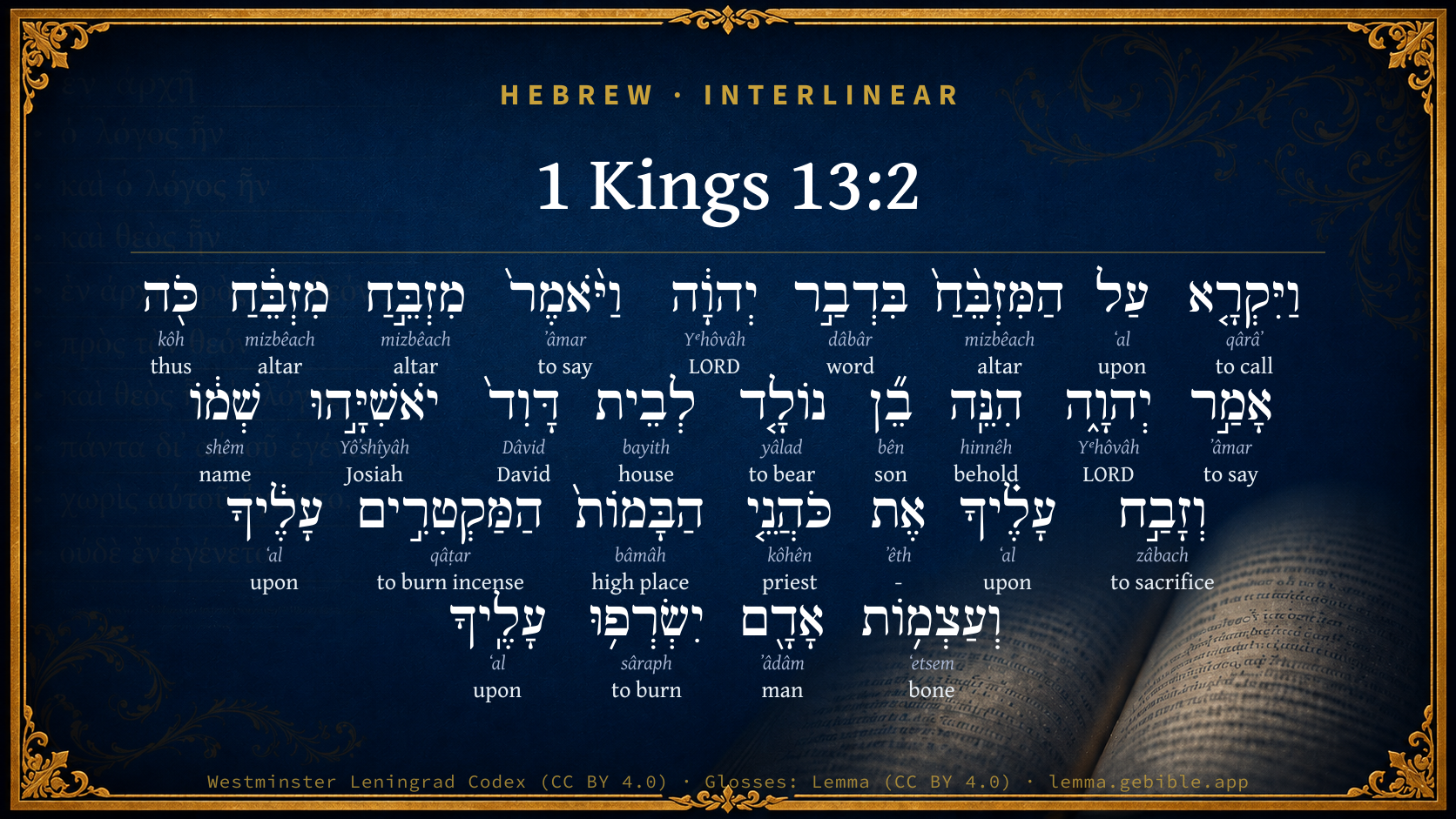
Hebrew (Westminster Leningrad Codex) 1 Kings 13:2 appears in the Hebrew Old Testament. The text above is from the Westminster Leningrad Codex. Each word links to its Strong’s number, a concise gloss, and parsing drawn from the Open Scriptures Hebrew Bible morphology. Click any word for its full Brown-Driver-Briggs (BDB) entry.
Download image
Cite this verse

1 Kings 13:2 (World English Bible). Public Domain. Lemma interlinear Bible study tool, https://lemma.gebible.app/v/1-kings/13/2.

Show BibTeX & RIS
BibTeX
RIS
English Translation
He cried against the altar by the word of Yahweh, and said, altar, altar, thus says Yahweh: Behold, a son shall be born to the house of David, Josiah by name; and on you shall he sacrifice the priests of the high places who burn incense on you, and men's bones shall they burn on you.
World English Bible · Public Domain
Highlights
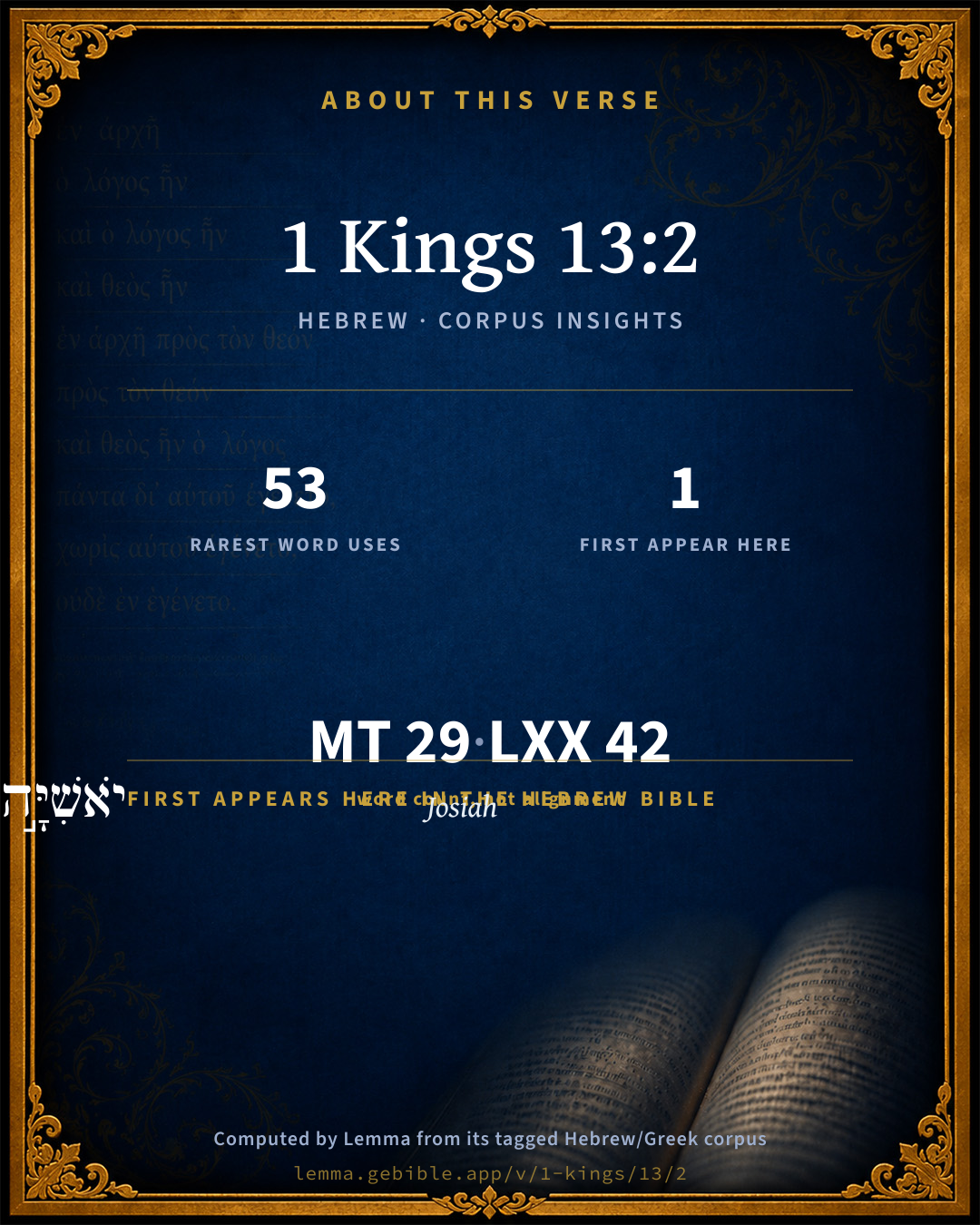
  • 1 first appearance in the Hebrew Bible
Full analysis ↓
Download a study sheet

One document with this verse’s original text, its word-by-word gloss line, the meaning frame, cross-references with their text, attributed commentary, and full source and license credits — printable, and it pastes into notes with its structure intact.

This verse Autodidact and up

Study sheet (.html) Plain text (.txt)

A passage Seminary Student

Up to 50 verses in one chapter. A passage sheet keeps up to 6 commentary sources and 12 cross-references per verse, in the order this page ranks them, and says so on the sheet whenever that leaves anything out. Ask for a single verse and you get the Autodidact verse sheet above.

Everything on this page stays free to read, with no account — the sheet is a download of what is already on screen, not access to it.

Want to remove ads? Support Godless Engineer
Compare translations 3

The same verse in 3 English versions, stacked beneath the original-language interlinear above. Click any original word for its lexicon entry.

Each is an independent rendering of the whole verse — the interlinear is not word-aligned to these translations.

Highlighted words mark where these versions differ — a whole-verse word diff, not a word-by-word alignment.

  • World English Bible Public Domain
    He cried against the altar by the word of Yahweh, and said, altar, altar, thus says Yahweh: Behold, a son shall be born to the house of David, Josiah by name; and on you shall he sacrifice the priests of the high places who burn incense on you, and men's bones shall they burn on you.
  • King James Version Public Domain
    And he cried against the altar in the word of the LORD, and said, O altar, altar, thus saith the LORD; Behold, a child shall be born unto the house of David, Josiah by name; and upon thee shall he offer the priests of the high places that burn incense upon thee, and men's bones shall be burnt upon thee.
  • unfoldingWord Literal Text CC BY-SA 4.0
    And he cried out against the altar by the word of Yahweh and said: “Altar! Altar! Thus says Yahweh, ‘Behold, a son will be born to the house of David, Josiah his name. And he will sacrifice on you the priests of the high places, the ones burning incense on you. And they will burn the bones of a human on you.’”

unfoldingWord Literal Text — © unfoldingWord, licensed CC BY-SA 4.0. Word-aligned USFM3 via Door43 (git.door43.org/unfoldingWord/en_ult).

Versions to compare (up to 4)

3 of 4 selected

Show all 18 translations

Every available English version of this verse, each an independent rendering of the whole verse.

  • World English Bible Public Domain
    He cried against the altar by the word of Yahweh, and said, altar, altar, thus says Yahweh: Behold, a son shall be born to the house of David, Josiah by name; and on you shall he sacrifice the priests of the high places who burn incense on you, and men's bones shall they burn on you.
  • Berean Standard Bible Public Domain
    And he cried out against the altar by the word of the LORD, “O altar, O altar, this is what the LORD says: ‘A son named Josiah will be born to the house of David, and upon you he will sacrifice the priests of the high places who burn incense upon you, and human bones will be burned upon you.’”
  • Majority Standard Bible Public Domain
    And he cried out against the altar by the word of the LORD, “O altar, O altar, this is what the LORD says: ‘A son named Josiah will be born to the house of David, and upon you he will sacrifice the priests of the high places who burn incense upon you, and human bones will be burned upon you.’”
  • King James Version Public Domain
    And he cried against the altar in the word of the LORD, and said, O altar, altar, thus saith the LORD; Behold, a child shall be born unto the house of David, Josiah by name; and upon thee shall he offer the priests of the high places that burn incense upon thee, and men's bones shall be burnt upon thee.
  • American Standard Version (1901) Public Domain
    And he cried against the altar by the word of Jehovah, and said, O altar, altar, thus saith Jehovah: Behold, a son shall be born unto the house of David, Josiah by name; and upon thee shall he sacrifice the priests of the high places that burn incense upon thee, and men's bones shall they burn upon thee.
  • Revised Version (1885) Public Domain
    And he cried against the altar by the word of the LORD, and said, O altar, altar, thus saith the LORD: Behold, a child shall be born unto the house of David, Josiah by name; and upon thee shall he sacrifice the priests of the high places that burn incense upon thee, and men’s bones shall they burn upon thee.
  • Geneva Bible (1599) Public Domain
    And he cryed against the altar by the comandement of the Lord, and said, O altar, altar, thus saith the Lord, Beholde, a child shalbe borne vnto the house of Dauid, Iosiah by name, and vpon thee shall he sacrifice the Priestes of the hie places that burne incense vpon thee, and they shall burne mens bones vpon thee.
  • Douay-Rheims (1899) Public Domain
    And he cried out against the altar in the word of the Lord, and said: O altar, altar, thus saith the Lord: Behold a child shall be born to the house of David, Josias by name, and he shall immolate upon thee the priests of the high places, who now burn incense upon thee, and he shall burn men's bones upon thee.
  • Young's Literal Translation Public Domain
    and he calleth against the altar, by the word of Jehovah, and saith, `Altar! altar! thus said Jehovah, Lo, a son is born to the house of David -- Josiah his name -- and he hath sacrificed on thee the priests of the high places who are making perfume on thee, and bones of man are burnt on thee.'
  • Literal Standard Version CC BY-SA 4.0
    and he calls against the altar, by the word of YHWH, and says, “Altar! Altar! Thus said YHWH: Behold, a son is born to the house of David—Josiah [is] his name—and he has sacrificed on you the priests of the high places who are making incense on you, and bones of man are burned on you.”
  • Unlocked Literal Bible CC BY-SA 4.0
    He cried against the altar by the word of Yahweh: “Altar, altar! This is what Yahweh says, 'See, a son named Josiah will be born to the family of David, and on you he will sacrifice the priests of the high places who now burn incense on you. On you they will burn human bones.'”
  • unfoldingWord Literal Text CC BY-SA 4.0
    And he cried out against the altar by the word of Yahweh and said: “Altar! Altar! Thus says Yahweh, ‘Behold, a son will be born to the house of David, Josiah his name. And he will sacrifice on you the priests of the high places, the ones burning incense on you. And they will burn the bones of a human on you.’”
  • Darby Bible Public Domain
    And he cried against the altar by the word of Jehovah, and said, O altar, altar! thus saith Jehovah: Behold, a child shall be born unto the house of David, Josiah by name; and upon thee shall he sacrifice the priests of the high places that burn incense upon thee, and men's bones shall be burned upon thee.
  • World Messianic Bible Public Domain
    He cried against the altar by the LORD’s word, and said, “Altar! Altar! The LORD says: ‘Behold, a son will be born to David’s house, Josiah by name. On you he will sacrifice the priests of the high places who burn incense on you, and they will burn men’s bones on you.’”
  • Webster's Bible Public Domain
    And he cried against the altar in the word of the LORD, and said, O altar, altar, thus saith the LORD; Behold, a child shall be born to the house of David, Josiah by name; and upon thee shall he offer the priests of the high places that burn incense upon thee, and men's bones shall be burnt upon thee.
  • Free Bible Version CC BY-SA 4.0
    He shouted out the Lord's condemnation of the altar: “Altar, altar, this is what the Lord says. A son will be born to the house of David. His name will be Josiah, and on you he will sacrifice the priests of the high places who burn offerings on you, and human bones will be burned on you.”
  • Bible in Basic English Public Domain
    And by the order of the Lord he made an outcry against the altar, saying, O altar, altar, the Lord has said, From the seed of David will come a child, named Josiah, and on you he will put to death the priests of the high places, who are burning offerings on you, and men's bones will be burned on you.
  • JPS Tanakh (1917) Public Domain
    And he cried against the altar by the word of the LORD, and said: 'O altar, altar, thus saith the LORD: Behold, a son shall be born unto the house of David, Josiah by name; and upon thee shall he sacrifice the priests of the high places that offer upon thee, and men's bones shall they burn upon thee.'

Literal Standard Version (2020), Covenant Press — licensed CC BY-SA 4.0. Text via the HelloAO Bible API (eBible.org). Unlocked Literal Bible (unfoldingWord) — licensed CC BY-SA 4.0. Text via the HelloAO Bible API (eBible.org). unfoldingWord Literal Text — © unfoldingWord, licensed CC BY-SA 4.0. Word-aligned USFM3 via Door43 (git.door43.org/unfoldingWord/en_ult). Free Bible Version, Dr. Jonathan Gallagher — licensed CC BY-SA 4.0. Text via the HelloAO Bible API (eBible.org).

Word by word

More ways to search: Search by grammar → Find every occurrence → Compare this word →

Practice this passage: Drill this verse → Learn its vocabulary →

יֹאשִׁיָּ֣הוּ
Yôʼshîyâh
H2977
“Josiah”
Noun, Proper
Part of Speech
Noun
Type
Proper
Full BDB Definition

Origin: from the same root as H803 and H3050

TWOT: None

Josiah = "whom Jehovah heals" - son of Amon by Jedidah who succeeded his father to the throne of Judah and reigned for 31 years; his reign is noteworthy for the great revivals back to the worship of Jehovah which he led - a returned exile and son of Zephaniah at whose house took place the solemn and symbolical crowning of Joshua the high priest in the time of Zechariah the prophet
  1. וַיִּקְרָ֤א qârâʼ H7121 “and · to call” Conjunction + Verb, Qal, Sequential Imperfect, 3rd Person, Masculine, Singular
  2. עַל ʻal H5921 “upon” Preposition
  3. הַמִּזְבֵּ֨חַ֙ mizbêach H4196 “the · altar” Particle, Definite Article + Noun, Common, Masculine, Singular, Absolute
  4. בִּדְבַ֣ר dâbâr H1697 “in/at · word of” Preposition + Noun, Common, Masculine, Singular, Construct
  5. יְהוָ֔ה Yᵉhôvâh H3068 “LORD” Noun, Proper
  6. וַיֹּ֨אמֶר֙ ʼâmar H559 “and · to say” Conjunction + Verb, Qal, Sequential Imperfect, 3rd Person, Masculine, Singular
  7. מִזְבֵּ֣חַ mizbêach H4196 “altar” Noun, Common, Masculine, Singular, Absolute
  8. מִזְבֵּ֔חַ mizbêach H4196 “altar” Noun, Common, Masculine, Singular, Absolute
  9. כֹּ֖ה kôh H3541 “thus” Adverb
  10. אָמַ֣ר ʼâmar H559 “to say” Verb, Qal, Perfect, 3rd Person, Masculine, Singular
  11. יְהוָ֑ה Yᵉhôvâh H3068 “LORD” Noun, Proper
  12. הִנֵּֽה hinnêh H2009 “behold” Particle, Demonstrative
  13. בֵ֞ן bên H1121 “son” Noun, Common, Masculine, Singular, Absolute
  14. נוֹלָ֤ד yâlad H3205 “bearing” Verb, Niphal, Participle Active, Masculine, Singular, Absolute
  15. לְבֵית bayith H1004 “to/for · house of” Preposition + Noun, Common, Masculine, Singular, Construct
  16. דָּוִד֙ Dâvid H1732 “David” Noun, Proper
  17. שְׁמ֔וֹ shêm H8034 “name · his” Noun, Common, Masculine, Singular, Construct + Suffix, Personal, 3rd Person, Masculine, Singular
  18. וְזָבַ֣ח zâbach H2076 “and · to sacrifice” Conjunction + Verb, Qal, Perfect, 3rd Person, Masculine, Singular
  19. עָלֶ֗יךָ ʻal H5921 “upon · you” Preposition + Suffix, Personal, 2nd Person, Masculine, Singular
  20. אֶת ʼêth H853 “-” Particle, Direct Object
  21. כֹּהֲנֵ֤י kôhên H3548 “priests of” Noun, Common, Masculine, Plural, Construct
  22. הַבָּמוֹת֙ bâmâh H1116 “the · high places” Particle, Definite Article + Noun, Common, Feminine, Plural, Absolute
  23. הַמַּקְטִרִ֣ים qâṭar H6999 “the · burning incense” Particle, Definite Article + Verb, Hiphil, Participle Active, Masculine, Plural, Absolute
  24. עָלֶ֔יךָ ʻal H5921 “upon · you” Preposition + Suffix, Personal, 2nd Person, Masculine, Singular
  25. וְעַצְמ֥וֹת ʻetsem H6106 “and · bones of” Conjunction + Noun, Common, Feminine, Plural, Construct
  26. אָדָ֖ם ʼâdâm H120 “man” Noun, Common, Masculine, Singular, Absolute
  27. יִשְׂרְפ֥וּ sâraph H8313 “to burn” Verb, Qal, Imperfect, 3rd Person, Masculine, Plural
  28. עָלֶֽיךָ ʻal H5921 “upon · you” Preposition + Suffix, Personal, 2nd Person, Masculine, Singular

About this verse

These counts appear in no published source. They are computed here, from the morphology-tagged text and Lemma’s own curated glosses. What Lemma adds →

29
words
22
distinct lemmas
Historical
section

First appearance in Scripture

This word makes its first canonical appearance in the Hebrew Bible here:

  • יֹאשִׁיָּ֣הוּ Josiah H2977

Shared distinctive vocabulary

יֹאשִׁיָּ֣הוּ Josiah H2977 occurs in 48 verses of the Hebrew Bible. Also found in:

Grammatical profile

  • 7 verbs
  • 15 nouns
  • 4 prepositions
  • 1 adverb
  • 2 particles

Verb forms

  • וַיִּקְרָ֤א Qal · Sequential Imperfect
  • וַיֹּ֨אמֶר֙ Qal · Sequential Imperfect
  • אָמַ֣ר Qal · Perfect
  • נוֹלָ֤ד Niphal · Participle Active
  • וְזָבַ֣ח Qal · Perfect
  • הַמַּקְטִרִ֣ים Hiphil · Participle Active
  • יִשְׂרְפ֥וּ Qal · Imperfect

Repetition

Words recur within this verse — often emphatic in Hebrew:

  • עַל upon H5921 ×4
  • הַמִּזְבֵּ֨חַ֙ altar H4196 ×3
  • יְהוָ֔ה LORD H3068 ×2
  • וַיֹּ֨אמֶר֙ to say H559 ×2

Hebrew & Septuagint length

In English translation the verse runs 56 words from the Hebrew and 63 from the Septuagint (LXX English) — closely comparable.

A rough comparison of the two English renderings, which tokenize alike — not a word-level alignment.

Word counts can differ between the Hebrew and the Greek without any difference in meaning — e.g. the Hebrew direct-object marker אֵת has no separate Greek word, and Greek often adds the article ὁ.

In the original languages it is 29 Hebrew tokens and 42 Greek tokens — but the two are counted differently (Hebrew bundles its prefixes and suffixes into one token; the Greek is in lemma form), so that isn’t a like-for-like length.

Cross-references

17

Topical passages linked to 1 Kings 13:2 in the Treasury of Scripture Knowledge — connected by theme and wording, ordered by reader-vote popularity; previews shown in the World English Bible.

  • 2 Kings 23:15–18 Moreover the altar that was at Bethel, and the high place which Jeroboam the son of Nebat, who made Israel to sin, had made, even that altar and the high place he broke down; and he burned the high place and beat it to dust, and burned the Asherah.
  • Ezekiel 36:1 You, son of man, prophesy to the mountains of Israel, and say, You mountains of Israel, hear the word of Yahweh.
  • 2 Kings 22:1–2 Josiah was eight years old when he began to reign; and he reigned thirty-one years in Jerusalem: and his mother's name was Jedidah the daughter of Adaiah of Bozkath.
  • Deuteronomy 32:1 Give ear, you heavens, and I will speak; Let the earth hear the words of my mouth.
  • 1 Kings 13:32 For the saying which he cried by the word of Yahweh against the altar in Bethel, and against all the houses of the high places which are in the cities of Samaria, shall surely happen.
  • 2 Chronicles 34:1 Josiah was eight years old when he began to reign; and he reigned thirty-one years in Jerusalem.
  • 2 Chronicles 34:4–7 They broke down the altars of the Baals in his presence; and the sun-images that were on high above them he hewed down; and the Asherim, and the engraved images, and the molten images, he broke in pieces, and made dust of them, and strewed it on the graves [of those] who had sacrificed to them.
  • Isaiah 1:2 Hear, heavens, And listen, earth; for Yahweh has spoken: I have nourished and brought up children, And they have rebelled against me.
  • Isaiah 42:9 Behold, the former things have happened, and new things do I declare. Before they spring forth I tell you of them.
  • Isaiah 44:26–28 who confirms the word of his servant, and performs the counsel of his messengers; who says of Jerusalem, She shall be inhabited; and of the cities of Judah, They shall be built, and I will raise up the waste places of it;
  • Isaiah 46:10 declaring the end from the beginning, and from ancient times things that are not [yet] done; saying, My counsel shall stand, and I will do all my pleasure;
  • Isaiah 48:5–7 therefore I have declared it to you from of old; before it came to pass I shown it you; lest you should say, My idol has done them, and my engraved image, and my molten image, has commanded them.
  • Isaiah 58:1 Cry aloud, don't spare, lift up your voice like a trumpet, and declare to my people their disobedience, and to the house of Jacob their sins.
  • Jeremiah 22:29 O earth, earth, earth, hear the word of Yahweh.
  • Ezekiel 36:4 therefore, you mountains of Israel, hear the word of the Lord Yahweh: Thus says the Lord Yahweh to the mountains and to the hills, to the watercourses and to the valleys, to the desolate wastes and to the cities that are forsaken, which are become a prey and derision to the residue of the nations that are round about;
  • Ezekiel 38:4 and I will turn you about, and put hooks into your jaws, and I will bring you forth, and all your army, horses and horsemen, all of them clothed in full armor, a great company with buckler and shield, all of them handling swords;
  • Luke 19:40 He answered them, "I tell you that if these were silent, the stones would cry out."

Cross-references courtesy of OpenBible.info (CC BY 4.0).

Hebrew and Greek witnesses Masoretic Hebrew ↔ Greek Septuagint

The same verse in the two great witnesses to the Old Testament, shown verse-for-verse.

These are two independent witnesses, not word-aligned to each other, and the Septuagint is shown in lemma (dictionary) form.

Hebrew 1 Kings 13:2 Masoretic · Westminster Leningrad Codex

וַיִּקְרָ֤א עַל הַמִּזְבֵּ֨חַ֙ בִּדְבַ֣ר יְהוָ֔ה וַיֹּ֨אמֶר֙ מִזְבֵּ֣חַ מִזְבֵּ֔חַ כֹּ֖ה אָמַ֣ר יְהוָ֑ה הִנֵּֽה בֵ֞ן נוֹלָ֤ד לְבֵית דָּוִד֙ יֹאשִׁיָּ֣הוּ שְׁמ֔וֹ וְזָבַ֣ח עָלֶ֗יךָ אֶת כֹּהֲנֵ֤י הַבָּמוֹת֙ הַמַּקְטִרִ֣ים עָלֶ֔יךָ וְעַצְמ֥וֹת אָדָ֖ם יִשְׂרְפ֥וּ עָלֶֽיךָ

He cried against the altar by the word of Yahweh, and said, altar, altar, thus says Yahweh: Behold, a son shall be born to the house of David, Josiah by name; and on you shall he sacrifice the priests of the high places who burn incense on you, and men's bones shall they burn on you.

World English Bible · Public Domain

Greek LXX 1 Kings 13:2 Septuagint · lemma form

καί ἐπικαλέω πρός ὁ θυσιαστήριον ἐν λόγος κύριος καί εἶπον θυσιαστήριον θυσιαστήριον ὅδε λέγω κύριος ἰδού υἱός τίκτω ὁ οἶκος δαυίδ ιωσιας ὄνομα αὐτός καί θύω ἐπί σύ ὁ ἱερεύς ὁ ὑψηλός ὁ ἐπιθύω ἐπί σύ καί ὀστέον ἄνθρωπος καίω ἐπί σύ

And he cried against the altar by the word of the Lord, and said, O altar, altar, thus says the Lord, Behold, a son is to be born to the house of David, Josias by name; and he shall offer upon you the priests of the high places, even of them that sacrifice upon you, and he shall burn men's bones upon you.

LXX2012 (modern English Septuagint) · Public Domain

Hebrew: Westminster Leningrad Codex (CC BY 4.0). Greek: Septuagint (public domain); English from LXX2012 (modern English Septuagint) (Public Domain). How the Septuagint differs from the Hebrew →

Targum (Aramaic paraphrase)

1

The Targum is the ancient Jewish Aramaic paraphrase of the Hebrew Scriptures — an interpretive translation, not the Hebrew text itself. Onkelos (literal) and Pseudo-Jonathan (expansive) render the Torah, and Jonathan the Prophets. Coverage is partial: where no permissively-licensed English translation exists for a verse, only the Aramaic is shown. This is verse-level text, not a word-by-word alignment to the Hebrew.

  1. Targum Jonathan Prophets (Joshua–Malachi)
    וְאִתְנַבֵי עַל אֱגוֹרָא בְּפִתְגָמָא דַייָ וַאֲמַר מַדְבְּחָא מַדְבְּחָא כִּדְנַן אֲמַר יְיָ הָא בְּרָא מִתְיְלִיד לְבֵית דָוִד יֹאשִׁיָהוּ שְׁמֵיהּ וְיִנְכֵיס עֲלָךְ יַת כוּמָרֵי בָּמָתָא דְאַסִיקוּ בּוּסְמִין עֲלָךְ וְגַרְמֵי אֱנָשָׁא יוֹקְדוּן עֲלָךְ:

    (no public-domain English translation for this verse)

    Targum Jonathan — Aramaic: “Mikraot Gedolot” (public domain). English: “Sefaria Community Translation” (CC0 1.0 (public-domain dedication)); “London "Chaldee Paraphrase," 1871” (public domain). Text via Sefaria.

Commentary

Notes on 1 Kings 13:2 from classic Christian and Jewish commentators (each source and its license shown beneath its notes). The classic Christian expositions comment on the surrounding passage and are grouped to its opening verse, so a note may address several verses; the Jewish commentaries on the Tanakh (Rashi and others) are per-verse, so they appear only where the commentator wrote on this verse.

Lemma curates 59 commentaries, every one of them public domain or Creative Commons licensed, each selected and text-cleaned for this edition rather than reprinted as found. About our sources →

Trapp's Complete Commentary

John Trapp

1Ki 13:2 And he cried against the altar in the word of the LORD, and said, O altar, altar, thus saith the LORD; Behold, a child shall be born unto the house of David, Josiah by name; and upon thee shall he offer the priests of the high places that burn incense upon thee, and men’s bones shall be burnt upon thee.

Ver. 2. And he cried against the altar.] Directing his speech to it out of detestation of such an abomination: and as having no hope to prevail with Jeroboam, who stood by it, and was more insensible than that altar, or than the heap of stones that Bede once preached unto.

Behold, a child shall be born.] Above three hundred years hence. Future events - such as are contingent - are known to God only. For prophecies this rule is given; when the prophets foretold things ut futura in seipsis, then they always fell out; but when they foretold them only as in their causes, they might fall out, or not, as Isa 38:1 1Ki 21:20 Joh 3:4.

And men’s bones shall be burnt upon thee.] Other men’s bones beside priests’. Jeroboam’s likely, who upon this prophecy should have made all "the stones of his altars as chalkstones that are beaten in sunder: this is all the fruit, to take away his sin,." {Isa 27:9}

John Trapp, A Commentary or Exposition upon All the Books of the Old and New Testament (1647–1656) — public domain. Text from a community e-Sword module.

Joseph Benson's Commentary

1Ki 13:2. He cried against the altar — And consequently against all the worship performed at it. O altar, altar — He directs his speech against the altar, because the following signs were to be wrought upon it. Behold, a child shall be born, &c. — This prophecy is the more wonderful, because it foretels of what family the child should spring, and what should be his name; and in the accomplishment of it we see the absolute certainty of God’s providence and foreknowledge, even in the most contingent things. For the particulars here mentioned, namely, the having a child, and the giving it this name, were in themselves things as uncertain, dependent on man’s will, and contingent as any events can be: and yet God exactly foretold them, and they came to pass accordingly. God therefore can foresee how the will of man, and of numbers of men, whose wills are dependant on each other, will be influenced in all possible circumstances, and that for ages to come; or, he can certainly and effectually, and yet without infringing or violating man’s liberty, overrule his will which way he pleaseth; otherwise it was possible this prediction might have been false, which it would be blasphemy to assert. Upon it shall he offer the priests — The meaning is not that he should offer or burn the priests alive, but that he should slay the priests of the high places, and then burn their bones, as he did the bones of those that had been buried, and thereby should defile this altar. How bold was the man that durst thus attack the king in his pride, and interrupt the solemnity in which he gloried! Those who are sent on God’s errand, must not fear the faces of men. Although it was so many ages ere this prophecy was to be fulfilled, the time is spoken of as sure and nigh at hand. For a thousand years are with God as one day.

Joseph Benson's Commentary on the Old and New Testaments (1811–1818) — public domain. Text from a community e-Sword module.

Jamieson, Fausset & Brown

Robert Jamieson, A. R. Fausset & David Brown

he cried against the altar--which is put for the whole system of worship organized in Israel.

Behold, a child shall be born . . . Josiah by name--This is one of the most remarkable prophecies recorded in the Scriptures; and, in its clearness, circumstantial minuteness, and exact prediction of an event that took place three hundred sixty years later, it stands in striking contrast to the obscure and ambiguous oracles of the heathen. Being publicly uttered, it must have been well known to the people; and every Jew who lived at the accomplishment of the event must have been convinced of the truth of a religion connected with such a prophecy as this. A present sign was given of the remote event predicted, in a visible fissure being miraculously made on the altar. Incensed at the man's license of speech, Jeroboam stretched out his hand and ordered his attendants to seize the bold intruder. That moment the king's arm became stiff and motionless, and the altar split asunder, so that the fire and ashes fell on the floor. Overawed by the effects of his impiety, Jeroboam besought the prophet's prayer. His request was acceded to, and the hand was restored to its healthy state. Jeroboam was artful, and invited the prophet to the royal table, not to do him honor or show his gratitude for the restoration of his hand, but to win, by his courtesy and liberal hospitality, a person whom he could not crush by his power. But the prophet informed him of a divine injunction expressly prohibiting him from all social intercourse with any in the place, as well as from returning the same way. The prohibition not to eat or drink in Beth-el was because all the people had become apostates from the true religion, and the reason he was not allowed to return the same way was lest he should be recognized by any whom he had seen in going.

Jamieson, Fausset & Brown — Commentary Critical and Explanatory on the Whole Bible (1871) — public domain (CC PDM 1.0). Text via the HelloAO Bible API.

Adam Clarke's Commentary

Verse 2. He cried against the altar] He denounced the destruction of this idolatrous system.

A child shall be born - Josiah by name] This is one of the most remarkable and most singular prophecies in the Old Testament. It here most circumstantially foretells a fact which took place three hundred and forty years after the prediction; a fact which was attested by the two nations. The Jews, in whose behalf this prophecy was delivered, would guard it most sacredly; and it was the interest of the Israelites, against whom it was levelled, to impugn its authenticity and expose its falsehood, had this been possible. This prediction not only showed the knowledge of God, but his power. He gave, as it were, this warning to idolatry, that it might be on its guard, and defend itself against this Josiah whenever a person of that name should be found sitting on the throne of David; and no doubt it was on the alert, and took all prudent measures for its own defence; but all in vain, for Josiah, in the eighteenth year of his reign, literally accomplished this prophecy, as we may read, 2Kg 23:15-20. And from this latter place we find that the prophecy had three permanent testimonials of its truth.

1. The house of Israel;

2. The house of Judah; and,

3. The tomb of the prophet who delivered this prophecy, who, being slain by a lion, was brought back and buried at Beth-el, the superscription on whose tomb remained till the day on which Josiah destroyed that altar, and burnt dead men's bones upon it.

See above, verses 16-18. 2Kg 23:16-18

Adam Clarke's Commentary on the Bible (1810–1826) — public domain. Text from a community e-Sword/MySword module.

Ellicott's Commentary for English Readers

(2) Thus saith the Lord.—This is one of those rather unfrequent prophecies found in Holy Scripture, which, not content to foreshadow the future in general outline, descend to striking particularity of detail. It has been indeed suggested that the words. “Josiah by name” are a marginal gloss which has crept into the text, or the insertion of the chronicler writing after the event, and not a part of the original prophetic utterance. The latter supposition is in itself not unlikely. But the mention of the name in prediction is exemplified in the well-known reference to Cyrus in Isa_44:28; and in this instance, as perhaps also in that, the name is significant (for Josiah means “one healed” or “helped by Jehovah”), and is not, therefore, a mere artificial detail. The particularity of prediction, which is on all hands recognised as exceptional, will be credible or incredible to us, according to the view which we take of the nature of prophetic prediction. If we resolve it into the intuitive sagacity of an inspired mind forecasting the future, because it sees more clearly than ordinary minds the germs of that future in the present, the particularity must seem incredible. If, on the other hand, we believe it to be the supernatural gift of a power to enter, in some measure, into “the mind of God,” in whose fore- knowledge all the future is already seen and ordained, then it will be to us simply unusual, but in no sense incredible, that from time to time foreknowledge of details, as well as generalities, should be granted. It is beyond controversy that the latter view is the one put forward in Holy Scripture, both in the Old Testament and in the New. Prophecy is, indeed, something higher and greater than supernatural prediction; but it claims to include such prediction, both as a test of mission from God, and as a necessary part of its revelation of the dispensations of God. On the fulfilment of this prediction, see 2Ki_23:15-20.

A Bible Commentary for English Readers, edited by Charles John Ellicott (1878–1897) — public domain. Text from a community e-Sword module.

The Cambridge Bible for Schools and Colleges

gen. ed. J. J. S. Perowne

2. he cried against the altar in the word of the Lord] The Hebrew is the same as in the preceding verse. Render therefore (with R.V.) ‘by the word.’ The meaning is that both the journey from Judah and the prophecy were in consequence of divine instruction.

Josiah by name] The history of the fulfilment of this prophecy is in 2Ki_23:15-16. Between the accession of Jeroboam and the accession of Josiah was an interval of about 330 years. Hence as the name of the king who should execute the threatened vengeance is mentioned, this prophecy is remarkable among the predictions of the Old Testament. There is nothing with which it can be compared except the prophecy concerning Cyrus in Isa_44:28; Isa_45:1, nor is it according to the manner of scriptural prophecies to be precise about details such as this. Hence some have thought that this verse and also other parts of the story of this chapter were brought into their present form at a later date than Jeroboam. The story of the appearance of the prophet and of his prediction were known from the first, but the details here given were inserted when the prediction was accomplished. There is certainly in 1Ki_13:32 a notice of the ‘cities of Samaria’ which confirms this opinion. Jeroboam’s capital was Shechem, and Samaria was not built, nor any district so called, till the reign of Omri the father of Ahab (1Ki_16:24). Again, it is unlike the rest of the narrative of the Books of Kings that no name should be given to either of the prophets who play such a part in the story. It seems therefore probable that the chapter is taken from some other source than that which supplied what has gone before and what follows it. If this be so, we need not be surprised at what was noticed on the previous verse, that Jeroboam’s action in approaching the altar seems noted as impious while Solomon’s sacrifices are accepted. The compiler of the Books of Kings gathered his material from various sources, and did his work after Josiah was dead. There is no difficulty in understanding how by that time the story as he has given it had been put on record, and as he wished to place Jeroboam’s sin in a strong light all through his history, the events here recorded were exceedingly appropriate for incorporation in his narrative.

upon thee shall he offer the priests] The verb is that which is usually rendered sacrifice, and it is better (with R.V.) so to translate it. Josephus states specifically ‘upon thee shall he sacrifice the false priests which shall be at that time’. Not only was the king to defile the altar by casting upon it the bones of the dead, but his righteous vengeance was to fall also upon the idolatrous priests then living, and they were to be slain by him before the altars at which they ministered.

men’s bones shall be burnt] R.V. shall they burn. There is no gain apparent in departing from the literal rendering of the original.

The Cambridge Bible for Schools and Colleges (gen. ed. J. J. S. Perowne; Cambridge University Press, 1878–1918) — public domain. Text from a community e-Sword module.

John Gill's Exposition

And he cried against the altar in the word of the Lord,.... By his order and command:

and said, O altar, altar; addressing himself not to Jeroboam, but the altar, thereby reproving his stupidity, the altar being as ready to hear as he; and because that was what moved the indignation of the Lord; and the word is repeated, to show the vehemency of the prophet's spirit, and his zeal against it; though the Jews commonly say it respects both altars, that at Dan, as well as this at Bethel:

thus saith the Lord, a child shall be born unto the house of David, Josiah by name; who was not born until three hundred years after this, according to the Jewish writers (a): but it is generally reckoned to be more, even three hundred and fifty or three hundred and sixty years; this is a clear proof of the prescience, predetermination, and providence of God with respect to future events, contingent ones, such as depend upon the will of men; for what more so than giving a name to a child?

upon thee shall he offer the priests of the high places that burn incense upon thee, and men's bones shall be burnt upon thee; all which was fulfilled by Josiah, Kg2 23:15, it may be read, "the bones of a man", which the Jews understand of Jeroboam; but may only signify that, instead of the bones of beasts, which were burnt on it, the bones of men should be burnt, and even of the priests themselves; a glaring proof this of the truth of prophecy, and of divine revelation.

(a) Pirke Eliezer, c. 17.

John Gill's Exposition of the Whole Bible (1746–1763) — public domain (CC PDM 1.0). Text via the HelloAO Bible API.

Albert Barnes' Notes on the Bible

A child shall be born ... Josiah by name - Divine predictions so seldom descend to such particularity as this, that doubts are entertained, even by orthodox theologians, with respect to the actual mention of Josiah’s name by a prophet living in the time of Jeroboam. Only one other instance that can be considered parallel occurs in the whole of Scripture - the mention of Cyrus by Isaiah. Of course no one who believes in the divine foreknowledge can doubt that God could, if He chose, cause events to be foretold minutely by his prophets; but certainly the general law of his Providence is, that He does not do so. If this law is to be at any time broken through, it will not be capriciously. Here it certainly does not appear what great effect was to be produced by the mention of Josiah’s name so long before his birth; and hence, a doubt arises whether we have in our present copies the true original text. The sense is complete without the words “Josiah by name;” and these words, if originally a marginal note, may easily have crept into the text by the mistake of a copyist. It is remarkable that, where this narrative is again referred to in Kings (marginal reference), there is no allusion to the fact that the man of God had prophesied of Josiah “by name.”

Albert Barnes' Notes on the Bible (1834–1885) — public domain. Text from a community e-Sword/MySword module.

Haydock's Catholic Bible Commentary

Altar, in which the prodigy was to take place, for the instruction of all. (Menochius) --- Name: 340 (Calmet) or 350 years after. (Salien) --- This prediction proves the truth of the religion; for, though the author of this book might have seen it verified, yet he would undoubtedly insert the very words of the prophet, which were known to all the people, 4 Kings xxiii. 15. In this passage we do not read that Josias destroyed the priests. But ver. 19., and 20., it is clearly insinuated. (Calmet) --- Who now. He will reduce their bones to ashes upon this altar; or, those who shall imitate these priests, shall be there burnt alive. (Haydock)

George Leo Haydock (1774–1849), Haydock's Catholic Family Bible and Commentary, 1859 edition — public domain. Excludes Psalms (Douay-Rheims chapter numbering differs from Protestant) and Deuterocanonical books (Catholic canon only).

Matthew Poole's English Annotations

He cried against the altar; and consequently, against all that worship, which is oft signified by the name of the altar. See Isa 19:19; 1Co 9:13; Heb 7:13; 13:10. O altar, altar; he directs his speech to the altar, partly because the following signs were wrought upon it, and partly to signify that Jeroboam would no more regard his words than the altar did, and yet they should take effect.

A child shall be born unto the house of David, Josiah by name; which being done above three hundred years after this prophecy, plainly shows the absolute certainty of God’s providence and foreknowledge, even in the most contingent things. For this was in itself uncertain, and wholly depended upon man’s will, both as to the having of a child, and as to the giving it this name. Therefore God can certainly and effectually overrule man’s will which way he pleaseth; or else it was possible that this prediction should have been false, which is blasphemous to imagine.

Upon thee shall he offer the priests; synecdoehically, the bones of the priests, 2Ki 23:15,16, whereby the altar should be defiled.

Matthew Poole's English Annotations on the Holy Bible (1683–1685) — public domain. Text from a community e-Sword/MySword module.

Whedon's Commentary on the Bible

Daniel D. Whedon

2. Josiah by name — This precise description of a future event, and naming of the chief person, is, of course, with the rationalists, ample proof that the whole thing was written after the events had occurred. But all their reasoning proceeds from the gratuitous assumption that such predictions could never have thus occurred, and that all such records of the supernatural are mythical or legendary. The devout believer sees in this accurate portrayal of a future event only one instance out of many in the chain of Old Testament history and revelation. Isaac, (Gen_17:19,) Solomon, (1Ch_22:9,) and Cyrus, (Isa_45:1,) were also named before their birth. For the literal fulfilment of this prophecy, see 2Ki_23:15-20.

Daniel D. Whedon (gen. ed.), Commentary on the Old and New Testaments (1874–1909) — public domain. Text from a community e-Sword module.

The Pulpit Commentary

And he cried against the altar in the word of the Lord, and said, O altar, altar, thus saith the Lord This apostrophe of the altar is very striking and significant. It is as if the prophet disdained to notice the royal but self-constituted priest; as if it were useless to appeal to him; as if his person was of little consequence compared with the religious system he was inaugurating, the system of which the altar was the centre and embodiment; Behold a child shall be born unto the house of David, Josiah by name This particular mention of the Reformer by name was formerly regarded, as by many it is still, as a remarkable instance of prophetic foresight. But the tendency of late, even amongst orthodox theologians, has been to doubt the authenticity of these two words, on the ground that it is unlike Scripture prophecy in general to descend to such details, which rather belong to soothsaying than prediction. Prophecy concerns itself not with names, times, and similar particulars, but with the "progressive development of the kingdom of God in its general features" (Keil). It is not for a moment denied that the prophet could just as easily, speaking "in the word of the Lord," have mentioned the name of Josiah, as the circumstance that a son of the house of David would utterly destroy the worship of calves. But it is alleged that the latter prediction is quite in accordance with Scripture usage, and the former altogether contrarient thereto. The case of Cyrus, (Isa_44:28 Isa_45:1) it is true, is anexception to the rule, unless vrko (which means the sun) is, like Pharaoh and Hadad, a name of office, a title of the Persian kings. The instances of (Gen_17:19) and Solomon (1Ch_22:9) are not parallels, as in both these cases the name was highly significant, and each was mentioned, not by way of prophecy, but as a direction to bestow that name on a child shortly about to be born. And it is certainly noticeable though the argument e silentio is necessarily a precarious one where this narrative is again referred to (2Ki_23:15-18) there is no allusion to the fact that the man of God had prophesied of Josiah by name" (Rawlinson). On the whole, therefore, it seems probable that the two words wOmv WhY; vayO were no part of the original prophecy, but a marginal note which in course of time found its way accidentally into the text. The idea of Keil, that "Josiah" is mentioned here not as a proper name, but as an appellation, "he whom Jehovah sustains," is hardly worthy of serious consideration. It may be allowed, however, that the meaning of the name affords some slender reason for its mention; and upon thee shall he offer lit., sacrifice the priests of the high places (see on 1Ki_12:32) that burn incense upon thee, and men"s bones Heb. bones of man, i.e., human bones. Nothing could more completely foreshadow the future desecration of the altar. The presence in the congregation of a living man who had merely touched a dead body and had not been purified, defiled the tabernacle, (Num_19:13) how much more the dead body itself, burnt on the very altar. The Samaritan who once strewed the temple with human ashes (Jos., Ant. 18:2. 2) knew that he took the most effectual way to pollute it shall be burnt Heb. shall they burn upon thee. For the fulfilment, see. 2Ki_23:20, "At the ground of this judgment, as of the whole theocratic law, lies the jus talionis". (Keil, 1846)

It is worthy of note how completely this brief protest proclaimed to Jeroboam the utter and shameful overthrow, both of his political and religious systems. A child of the rival house of David should stand where he then stood, his successors extinct or powerless to prevent him, and should cover this new cultus with disgrace and contempt. The man of God, he must have felt, has proclaimed in few words the fall of his dynasty, the triumph of his rival, and the failure of all his schemes.

Vers. 2, 3, 8.

Protest and Excommunication.

The sin of Jeroboam, the schism which he inaugurated in person at the first feast of tabernacles held in Bethel, was not consummated without protest. When the king, possibly in the "golden garments" of the priesthood, mounted the altar platform and stood before the vast multitude assembled to witness this first great function of the new regime, a messenger of God, sent from Judah, the seat of the true religion, lifted up his voice and witnessed against these irregular and impious proceedings, against the unsanctified altar, the unhallowed sacrifice, and the intrusive priesthood. It must have been pretty clear beforehand that any protest addressed to Jeroboam, who had devised and elaborated this corruption of Mosaic worship, would be unavailing, but nevertheless it must be made. It was probably in part because Jeroboam was beyond the reach of remonstrance that the warning was addressed to the altar itself In other words, it was made for the sake of the people rather than of their king. They should be mercifully, and therefore distinctly, taught that this calf worship had not and could not have the sanction of the Most High. Whether they would hear, or whether they would forbear, they should see that God had not left Himself without witness; they should know that at this crisis there had been a prophet amongst them. The breach should not be made without due warning of its sinfulness and its consequences. "For a testimony unto them" the man of God addresses the dumb altar, the sign and centre of the new system, and proclaims not only its overthrow but the destruction of Jeroboam"s house and the defeat of all his schemes.

And as, under such circumstances, mere threats, of whatsoever character and by whomsoever spoken, would have had but little weight without "signs following," the message straightway receives the confirmation of a miracle. That the man of God "came from Judah" was in itself reason enough why the men of Israel should not listen to him, unless he compelled their attention by prodigies. "A partizan," they would say, "perhaps a hireling of Rehoboam, it was natural such a one would prophecy evil of the Northern Church and kingdom," and so his words would have been unheeded, even if his life had been spared. Besides, one who professed to come as he did, "in the word of the Lord," they had a right to ask for his credentials, and those credentials could only be miraculous. Had not Moses and Aaron "wrought signs and wonders in the land of Egypt, before Pharaoh and all his servants?" Had not Samuel, too, supported his message by a portent? (1Sa_12:18) If the denunciation of the schism, consequently, was not to be inoperative, he must "give a sign" the same day.

And to these "two witnesses "sure word of prophecy" and the "sign following the rashness and impiety of Jeroboam procured the addition of a third, or rather of two more silent, but eloquent attestations, each of them, that the prophet had not spoken in his own name. For, enraged at this bold, this most unwelcome and sinister interruption of his ritual, and fearing the effect of this brave protest on his audience and the thousands of Israel to whom the news would ultimately come, and forgetting at the moment the sacred character of the speaker and the unseen panoply which protected him, he stretches forth his hand intuitively, as if to detain the prophet, and thunders his commands to the attendant soldiery to arrest him. But that hand, really raised against the Most High, suddenly becomes rigid and powerless, and he must needs stoop to beg the prophet"s prayers that it may be restored to him again. And so it came to pass that the heretic king furnished in his own person, much against his will, two powerful proofs that the "man of God" did indeed speak the word of God and was supported by the power of God. It is thus that God makes the wrath of man to praise Him.

Such, then, was the PROTEST, in word and deed, which marked the first great service of the schismatic Church. But that was not all. The protest was to be followed by an INTERDICT. The man of God was commissioned at the same time to put the city and inhabitants of Bethel under a ban. He was to treat them as lepers, as so tainted with heresy, so polluted and unclean in the sight of God, that he could neither eat of their bread nor drink of their cup. For this was clearly the object of the injunction, "Eat no bread nor drink water there;" it was to show that all who participated in this unhallowed worship were thenceforward to be treated by Divine command as heathens and publicans. And to the children of the East this public disclaimer of fellowship, this practical excommunication, would have a significance such as with our altered conditions of society we can hardly conceive, though the "Boycotting" of our own time may help us to understand its operation. Every citizen of Bethel, every worshipper of the calves, would feel himself branded as unclean. The "scarlet letter" which the Puritans of New England printed on the bosom of the adulteress hardly involved a greater stigma. It was for this reason, therefore, that when the king bade the man of God to his palace and promised him a royal recompense for the service he had rendered him, the latter flung back his invitation in his face, and swore that half the king"s house would not tempt him to eat of his dainties. Jeroboam, and his people through him, should learn that if they would persist in their wanton defiance of Divine law; if they would have two churches and three sanctuaries where God had decreed there should in either case be but one; if they would sacrifice before the works of their own hands, and by ministers of man"s ordaining, and at times of man"s devising, then the pious Hebrews who preserved inviolate the ancient faith should wipe their hands of them, and treat them as renegades and aliens from the commonwealth of Israel.

The lessons of this history are manifold. Two, however, occupy a position of pre-eminence above the rest.

1. That corruptions of religion are not to be consummated without PROTEST on the part of the Church. That Christianity, as well as Judaism, should have its heresies and schisms was distinctly foretold by St. Paul himself (1Co_11:19; Act_20:29, Act_20:30) But if they are inevitable, because of the frailty of our nature and the hardnesss of our hearts, they are none the less sinful, and it is none the less our duty to strive and to witness against them. If God did not suffer that first great schism to pass unreproved, can we do better, or do less, than follow His example? It may be said that we cannot always distinguish between heresy and orthodoxy that we "call our doxy orthodoxy, and other people"s doxy heterodoxy," and this is quite true. But individual opinion is one thing and the teaching of the Church another. Has the Church, then, no teaching office? Is she or is she not "the pillar and ground of the truth"? Has she or has she not the promise of our Lord"s guidance and illumination? (Mat_18:17, 18 28:20) Or can the Church universal err? (Mat_16:18) Is her Quod semper, quod ubique," etc., no test of truth? It is not for the private Christian to claim any infallibility, but it is for the Church to say what is in and what is against her depositum fidei. And furthermore it is her duty, in her synods and by her officers, to protest against all corruptions of the faith. "A man that is a heretic reject," Tit_3:10; cf. ch. 1:9-11; 1Ti_6:3-5 ("From such withdraw thyself Rom_16:17; Mat_18:17 8 Joh 9, 10; Gal_1:8 Gal_2:11. The Christian verity is not less dear to God than was the teaching of Hoses. The preacher is as much bound to preserve the faith whole and undefiled as was the prophet. And it is idle to say, as it sometimes is said, that mere protests are worse than useless. They may not avert a schism this protest did not but they may have their use nevertheless, as this had. Or if they are entirely futile as regards others, they are not forgotten of God. Besides, who shall say that success or non success is to alter the standard of Christian duty? It is surely something to be able to say, whatever the issue, Liberavi animam meam. It is to be remembered that God knew beforehand that this His protest, though enforced by signs and wonders, would be comparatively unavailing.

2. That certain crimes against morality and religion are still to be visited by EXCOMMUNICATION. Not the excommunication of bell and book and candlethat finds no place in Holy Scripture but social excommunication such as that described to us in this history. Indeed, there is also an ecclesiastical excommunication which must sometimes be wielded. There are persons with whom we have no right to eat and to drink at the Table of our Blessed Lord persons who must be repelled at any cost from Holy Communion, lest we should indirectly make ourselves "partakers of other men"s sins". (1Ti_5:22) When John Wesley once proposed to give a note of admission to the Lord"s Table to a man of dubious character, Henry Moore, one of his preachers, bluntly said that if that man were admitted he should refuse to attend. "Sir," said Wesley, "I should attend even if the devil came to Holy Communion." "So should I," was the answer; "but not if John Wesley gave him a note of admission." For it is obvious that the Eucharist, the closest rite of fellowship the rite which makes and proclaims us members one of another (Rom_12:4, Rom_12:5) if knowingly administered to the "notorious evil liver" is a virtual condoning of his sin; it is equivalent to bidding him God speed, (2Jn_1:10, 2Jn_1:11) and so it makes the Church "partaker of his evil deeds." "Therefore put away from among yourselves that wicked person". (1Co 5:15) But our history points rather to social than ecclesiastical interdict. And it must be distinctly understood that the refusal to eat and drink with notorious and incorrigible evil livers is a part of Christian duty (1Co_5:9-11; 2Th_3:14, 2Th_3:15; Mat_18:17) We are not permitted to know them and to treat them like other men. The story of St. John"s hurriedly leaving the bath because of the presence there of the heretic Cerinthus, is one for which the so called tolerance of the age can only afford a contemptuous smile; but the age is often wiser in its own conceit than Christ and His apostles. Only let us remember, if we must treat any as heathens and publicans, how Christ treated the penitent publicans; (cf. Luk_15:1, Luk_15:2) and then let us not shrink from discharging this painful duty both to our country, our Church, and our God. Among the secondary lessons of our story are these:

1. That right shall triumph in the long run. The schism throve for 250 years, but the altar was ultimately dishonoured and overthrown. The Reformer who should desecrate it with bones of men was already appointed in the counsels of God. Even so, sooner or later, "every plant which my heavenly Father hath not planted shall be rooted up". (Mat_15:18) "If this work be of men, it will come to nought". (Act_5:38)

Our little systems have their day, They have their day and cease to be.

Magma est veritas, etc. The Babel of sects cannot last forever.

2. The ministers of God are secure so long as they do their duty. Jeroboam, with the ten tribes at his back, was powerless against the unprotected missionary. "He reproved kings for their sakes, saying Do my prophets no harm". (Psa_105:14, Psa_105:15) The stars shall fall from their courses before a hair of their heads shall be injured. Cf. Dan_3:27 Dan_6:22; 2Ki_1:10, etc. But it may be objected, "The saints and messengers of God have often been brutally outraged and murdered". (Heb_11:35-37) True, but who shall say that they were not then most secure? "Through much tribulation we must enter into the kingdom of God". (Act_14:22) It was when Stephen was martyred that he saw "Jesus standingi.e. , to help the right hand of God." It has been suggested that it was when St. Paul was stoned and taken up for dead (Act_14:19) that he was caught up into Paradise. (2Co_12:4) Sic iter ad astra.

3. The wicked cannot dispense with the prayers of the saints. "Entreat the face of the Lord thy God and pray for me" (cf. Exo_9:28; Num_12:2, Num_12:13; Act_8:24) How often has this history repeated itself; and what a foreshadowing of the world to come! Here was one of the synagogue of Satan worshipping at the prophet"s feet, etc. (Rev_3:9) Observe, too, it is the part of a man of God to answer threats with prayers. "They are mine adversaries, but I, prayer" (Psa_109:4, Hebrews; cf. Psa_35:13 sqq.) It is the very best way of overcoming evil with good.

4. Men are often more concerned about their sufferings than about their sins. Jeroboam"s entreaty is, not that his sin may be forgiven, but that his hand may be restored. How many pray, "Heal my body;" how few, "Heal my soul, for I have sinned against thee". (Psa_41:4) The plague of head or hand extorts more cries for mercy than the plague of the heart. (1Ki_8:38)

1. Law and order cannot be violated with impunity by any ruler under any religious pretext" (Maurice). The rent altar teaches the lesson of. Psa_2:2-5: "Those betray themselves that think by any sin to support themselves." "He promised himself that the calves would secure the crown to his family, but it proved they lost it" (M. Henry)

2. Let the ministers of God beware of bribery. "Come home with me and I will give," etc. The device of Jeroboam for silencing and conciliating the prophet has often been tried since, and with fatal success. How many men"s mouths have been stopped by a sop by place or pension, nay, by an insignificant present. Men know well the enemy of man knows well that the preacher finds it hard to reprove a benefactor. The writer onceheard an influential person boasting that he had silenced his clergyman"s remonstrances and appeals by a present of game! The world has a shrewd suspicion that the clergy are not incorruptible; that they, like others, have their price. Let us be on our guard against social corruption. How sinister the influence of some homes on the younger clergy. The cordial "Come home with me" was to them a snare of Satan. With the State clergy how strong the temptation to sacrifice independence for a benefice; with Nonconformists, to speak smooth words lest the congregation should "stop the supplies." The man of God thus speaks to all ministers of God.

The Pulpit Commentary (1880–1919), ed. H.D.M. Spence-Jones & Joseph S. Exell — public domain. Text from a community e-Sword module.

John Wesley's Explanatory Notes

The altar - And consequently, against all that worship. O altar - He directs his speech to the altar, because the following signs were wrought upon it. Josiah - Which being done above three hundred years after this prophecy, plainly shews the absolute certainty of God's providence; and fore-knowledge even in the most contingent things. For this was in itself uncertain, and wholly depended upon man's will, both as to the having of a child, and as to the giving it this name. Therefore God can certainly and effectually over-rule man's will which way he pleaseth; or else it was possible, that this prediction should have been false; which is blasphemous to imagine. The priests - The bones of the priests, 2 Kings xxiii, 15, 16, whereby the altar should be defiled. How bold was the man, that durst attack the king in his pride, and interrupt the solemnity he was proud of? Whoever is sent on God's errand, must not fear the faces of men. It was above three hundred and fifty years ere this prophecy was fulfilled. Yet it is spoken of as sure and nigh at hand. For a thousand years are with God as one day.

John Wesley, Explanatory Notes Upon the Whole Bible (1754–1765) — public domain. Text via the GEBible commentary corpus.

Rashi

Rabbi Shlomo Yitzchaki (Rashi)

Altar, altar. [The one] in Beis Eil and [the one] in Dan.

And the bones of human beings. This refers to Yerovom’s [bones], but he [the prophet] treated him with respect.

Rashi on the Tanakh — English translations: “The Judaica Press complete Tanach with Rashi, translated by A. J. Rosenberg” (CC BY 4.0); “Pentateuch with Rashi's commentary by M. Rosenbaum and A.M. Silbermann, 1929-1934” (public domain); “The Metsudah Tanach series, Lakewood, N.J” (CC BY 4.0); and “The Book of Joshua, Metsudah Publications, 1997” (CC BY 4.0). Text via Sefaria.

Lesson kit

Teaching starters — assembled from the data on this page, not authored interpretation. Every prompt links to the verse data it draws on. Edit before teaching.

1 Kings, in the Historical, opens this verse with 29 words (22 distinct Hebrew lemmas). Its most distinctive word is Yôʼshîyâh (“Josiah”). A historical commentator’s framing appears above. Read the whole chapter for the surrounding context.

Discussion questions

  1. How does “Josiah” (Yôʼshîyâh) shape what this verse is saying?
  2. This is the first place “Josiah” appears in Scripture (first appears here). What does its debut here establish?
  3. How does 2 Kings 21:24, which shares the word «Josiah», read alongside this verse?
  4. What does the repetition of “upon” (4× in this one verse) do in this verse?
  5. These translations render this verse differently. What is at stake in choosing one wording over another?
  6. «וַיִּקְרָ֤א» is a Qal Sequential Imperfect verb. How does that grammatical form shape the action described?
  7. Compare how Trapp's Complete Commentary and Joseph Benson's Commentary read this verse. Where do they agree or differ?

Things to notice

Reading settings

Reading text

Shown beneath each verse's original-language words.

Old Testament
Old Testament edition

Read the OT as the Masoretic Hebrew (MT) or the Greek Septuagint (LXX).

English shown for the Greek Septuagint (in the Hebrew ↔ Greek comparison).

Comparing translations? Open the Compare panel on any verse page to stack up to four side by side.