Jeremiah 51:32

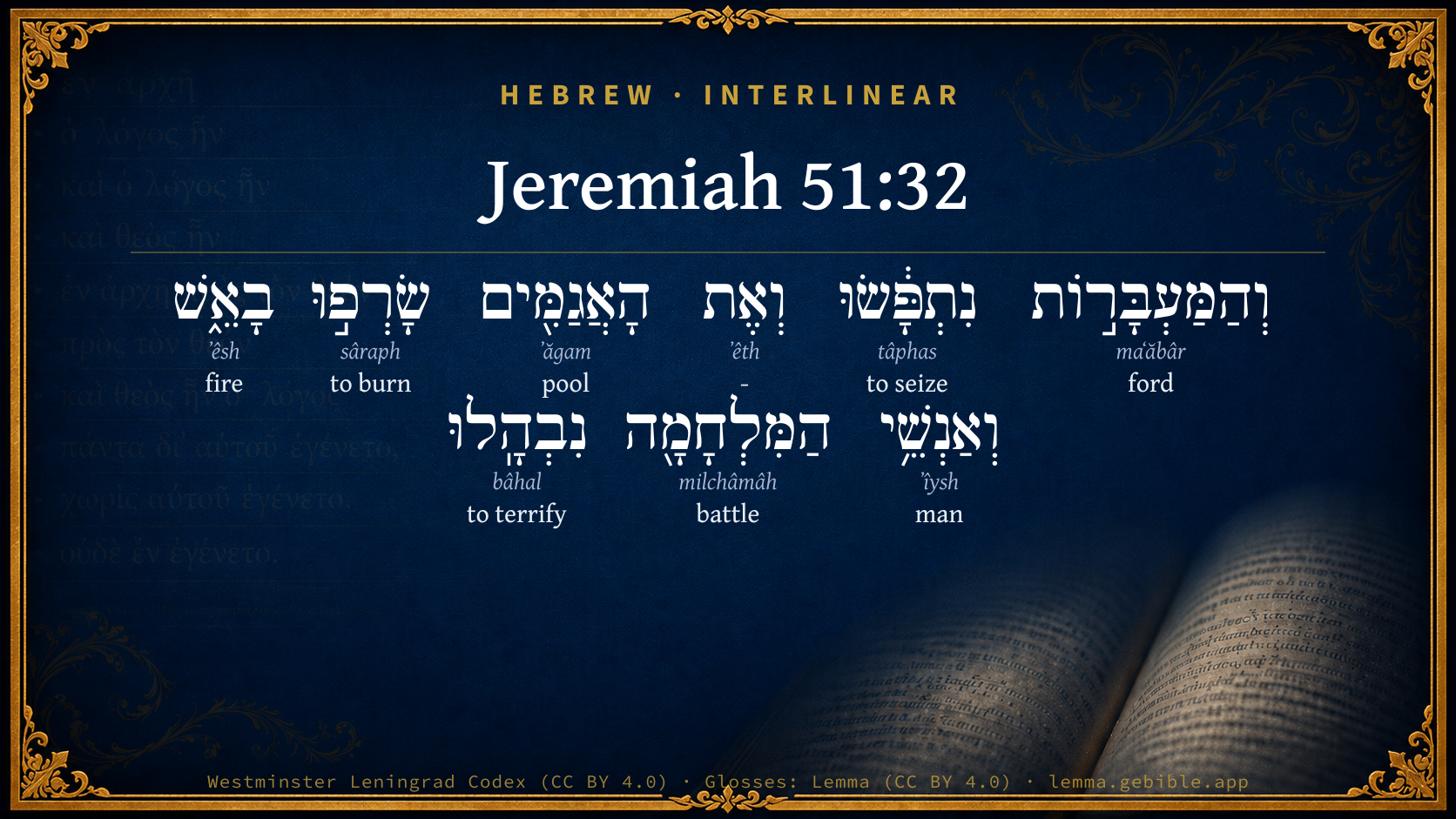
Hebrew (Westminster Leningrad Codex) Jeremiah 51:32 appears in the Hebrew Old Testament. The text above is from the Westminster Leningrad Codex. Each word links to its Strong’s number, a concise gloss, and parsing drawn from the Open Scriptures Hebrew Bible morphology. Click any word for its full Brown-Driver-Briggs (BDB) entry.
Download image
Cite this verse

Jeremiah 51:32 (World English Bible). Public Domain. Lemma interlinear Bible study tool, https://lemma.gebible.app/v/jeremiah/51/32.

Show BibTeX & RIS
BibTeX
RIS
English Translation
and the passages are seized, and the reeds they have burned with fire, and the men of war are frightened.
World English Bible · Public Domain
Download a study sheet

One document with this verse’s original text, its word-by-word gloss line, the meaning frame, cross-references with their text, attributed commentary, and full source and license credits — printable, and it pastes into notes with its structure intact.

This verse Autodidact and up

Study sheet (.html) Plain text (.txt)

A passage Seminary Student

Up to 50 verses in one chapter. A passage sheet keeps up to 6 commentary sources and 12 cross-references per verse, in the order this page ranks them, and says so on the sheet whenever that leaves anything out. Ask for a single verse and you get the Autodidact verse sheet above.

Everything on this page stays free to read, with no account — the sheet is a download of what is already on screen, not access to it.

Want to remove ads? Support Godless Engineer
Compare translations 3

The same verse in 3 English versions, stacked beneath the original-language interlinear above. Click any original word for its lexicon entry.

Each is an independent rendering of the whole verse — the interlinear is not word-aligned to these translations.

Highlighted words mark where these versions differ — a whole-verse word diff, not a word-by-word alignment.

  • World English Bible Public Domain
    and the passages are seized, and the reeds they have burned with fire, and the men of war are frightened.
  • King James Version Public Domain
    And that the passages are stopped, and the reeds they have burned with fire, and the men of war are affrighted.
  • unfoldingWord Literal Text CC BY-SA 4.0
    So the fords over the river are seized; the enemy is burning the reed marshes, and Babylon’s fighting men are confused.

unfoldingWord Literal Text — © unfoldingWord, licensed CC BY-SA 4.0. Word-aligned USFM3 via Door43 (git.door43.org/unfoldingWord/en_ult).

Versions to compare (up to 4)

3 of 4 selected

Show all 18 translations

Every available English version of this verse, each an independent rendering of the whole verse.

  • World English Bible Public Domain
    and the passages are seized, and the reeds they have burned with fire, and the men of war are frightened.
  • Berean Standard Bible Public Domain
    The fords have been seized, the marshes set on fire, and the soldiers are terrified.”
  • Majority Standard Bible Public Domain
    The fords have been seized, the marshes set on fire, and the soldiers are terrified.”
  • King James Version Public Domain
    And that the passages are stopped, and the reeds they have burned with fire, and the men of war are affrighted.
  • American Standard Version (1901) Public Domain
    and the passages are seized, and the reeds they have burned with fire, and the men of war are affrighted.
  • Revised Version (1885) Public Domain
    and the passages are surprised, and the reeds they have burned with fire, and the men of war are affrighted.
  • Geneva Bible (1599) Public Domain
    And that the passages are stopped, and the reedes burnt with fire, and the me of war troubled.
  • Douay-Rheims (1899) Public Domain
    And that the fords are taken, and the marshes are burnt with fire, and the men of war are affrighted.
  • Young's Literal Translation Public Domain
    And the passages have been captured, And the reeds they have burnt with fire, And the men of war have been troubled.
  • Literal Standard Version CC BY-SA 4.0
    And the passages have been captured, || And they have burned the reeds with fire, || And the men of war have been troubled.
  • Unlocked Literal Bible CC BY-SA 4.0
    So the fords over the river are seized; the enemy is burning the reed marshes, and Babylon's fighting men are confused.
  • unfoldingWord Literal Text CC BY-SA 4.0
    So the fords over the river are seized; the enemy is burning the reed marshes, and Babylon’s fighting men are confused.
  • Darby Bible Public Domain
    and the passages are seized, and the reedy places are burnt with fire, and the men of war are affrighted.
  • World Messianic Bible Public Domain
    So the passages are seized. They have burned the reeds with fire. The men of war are frightened.”
  • Webster's Bible Public Domain
    And that the passages are stopped, and the reeds they have burned with fire, and the men of war are affrighted.
  • Free Bible Version CC BY-SA 4.0
    the river crossings have been captured, the marshlands set on fire and his soldiers are panicking.
  • Bible in Basic English Public Domain
    And the ways across the river have been taken, and the water-holes... burned with fire, and the men of war are in the grip of fear.
  • JPS Tanakh (1917) Public Domain
    And the fords are seized, and the castles they have burned with fire, and the men of war are affrighted.

Literal Standard Version (2020), Covenant Press — licensed CC BY-SA 4.0. Text via the HelloAO Bible API (eBible.org). Unlocked Literal Bible (unfoldingWord) — licensed CC BY-SA 4.0. Text via the HelloAO Bible API (eBible.org). unfoldingWord Literal Text — © unfoldingWord, licensed CC BY-SA 4.0. Word-aligned USFM3 via Door43 (git.door43.org/unfoldingWord/en_ult). Free Bible Version, Dr. Jonathan Gallagher — licensed CC BY-SA 4.0. Text via the HelloAO Bible API (eBible.org).

Word by word

More ways to search: Search by grammar → Find every occurrence → Compare this word →

Practice this passage: Drill this verse → Learn its vocabulary →

הָאֲגַמִּ֖ים
ʼăgam
H98
“the · pools”
Particle, Definite Article + Noun, Common, Masculine, Plural, Absolute
Part of Speech
Particle + Noun
Type
Common
Gender
Masculine
Number
Plural
State
Absolute
Full BDB Definition

Origin: from an unused root (meaning to collect as water)

TWOT: 18a

pool, troubled pool - troubled or muddy (gloomy) pools, marshes - any pool, pond - swamp reeds, reeds, rush(es)
  1. וְהַמַּעְבָּר֣וֹת maʻăbâr H4569 “and · the · fords” Conjunction + Particle, Definite Article + Noun, Common, Feminine, Plural, Absolute
  2. נִתְפָּ֔שׂוּ tâphas H8610 “to seize” Verb, Niphal, Perfect, 3rd Person, Common, Plural
  3. וְאֶת ʼêth H853 “and · -” Conjunction + Particle, Direct Object
  4. שָׂרְפ֣וּ sâraph H8313 “to burn” Verb, Qal, Perfect, 3rd Person, Common, Plural
  5. בָאֵ֑שׁ ʼêsh H784 “in/at the · fire” Preposition, Determined + Noun, Common, Both, Singular, Absolute
  6. וְאַנְשֵׁ֥י ʼîysh H376 “and · men of” Conjunction + Noun, Common, Masculine, Plural, Construct
  7. הַמִּלְחָמָ֖ה milchâmâh H4421 “the · battle” Particle, Definite Article + Noun, Common, Feminine, Singular, Absolute
  8. נִבְהָֽלוּ bâhal H926 “to terrify” Verb, Niphal, Perfect, 3rd Person, Common, Plural

About this verse

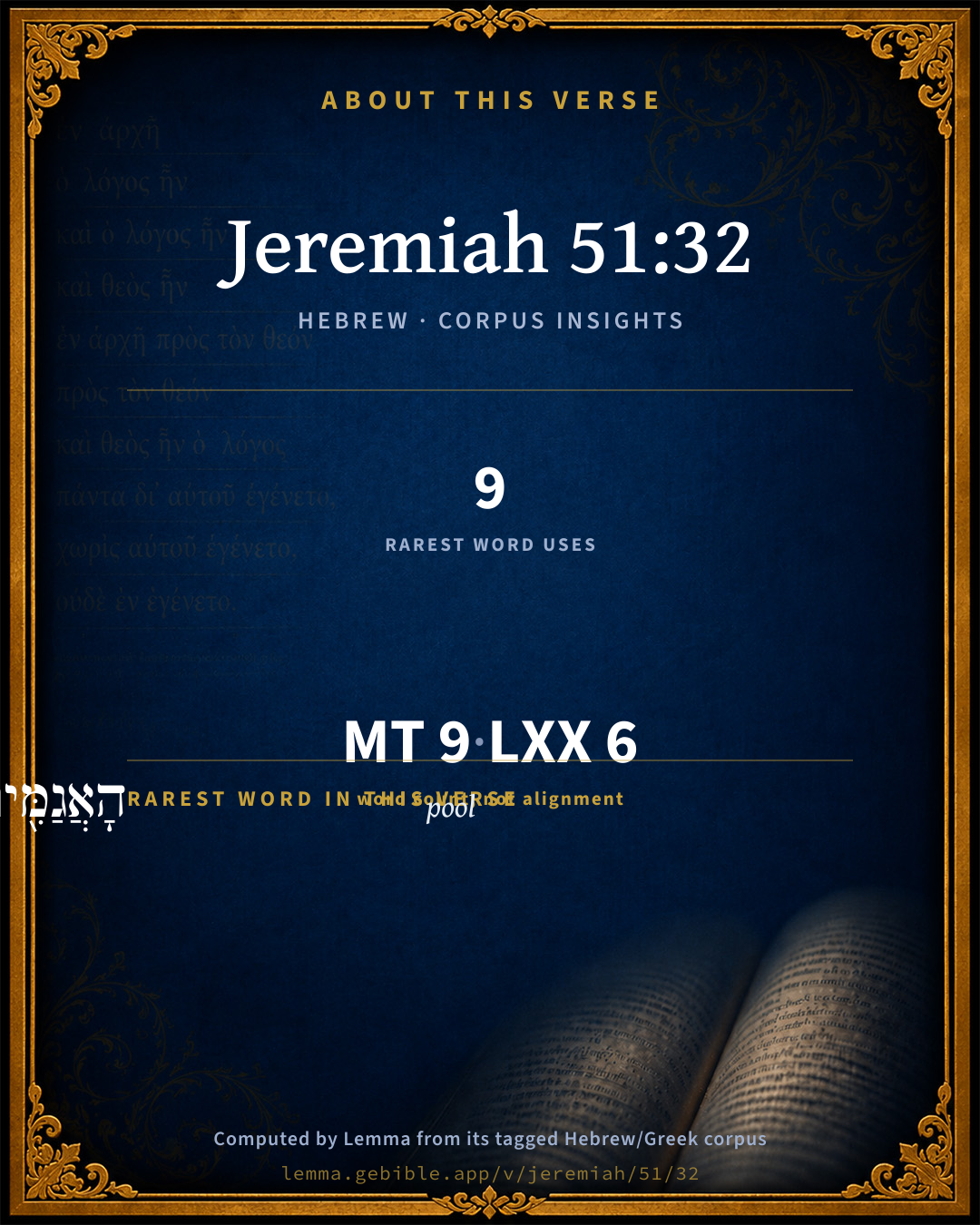
These counts appear in no published source. They are computed here, from the morphology-tagged text and Lemma’s own curated glosses. What Lemma adds →

9
words
9
distinct lemmas
Prophets
section

Notable vocabulary

The rarest word here is הָאֲגַמִּ֖ים pool H98 — appearing just 9 times in the whole Hebrew Bible.

Shared distinctive vocabulary

הָאֲגַמִּ֖ים pool H98 occurs in 9 verses of the Hebrew Bible. Also found in:

Grammatical profile

  • 3 verbs
  • 5 nouns
  • 1 particle

Verb forms

  • נִתְפָּ֔שׂוּ Niphal · Perfect
  • שָׂרְפ֣וּ Qal · Perfect
  • נִבְהָֽלוּ Niphal · Perfect

Hebrew & Septuagint length

In the original languages it is 9 Hebrew tokens and 6 Greek tokens — but the two are counted differently (Hebrew bundles its prefixes and suffixes into one token; the Greek is in lemma form), so that isn’t a like-for-like length.

Cross-references

3

Topical passages linked to Jeremiah 51:32 in the Treasury of Scripture Knowledge — connected by theme and wording, ordered by reader-vote popularity; previews shown in the World English Bible.

  • Isaiah 44:27 who says to the deep, Be dry, and I will dry up your rivers;
  • Jeremiah 50:37–38 A sword is on their horses, and on their chariots, and on all the mixed people who are in the midst of her; and they shall become as women: a sword is on her treasures, and they shall be robbed.
  • Jeremiah 51:30 The mighty men of Babylon have forborne to fight, they remain in their strongholds; their might has failed; they are become as women: her dwelling-places are set on fire; her bars are broken.

Cross-references courtesy of OpenBible.info (CC BY 4.0).

Hebrew and Greek witnesses Masoretic Hebrew ↔ Greek Septuagint

The same verse in the two great witnesses to the Old Testament, shown verse-for-verse.

These are two independent witnesses, not word-aligned to each other, and the Septuagint is shown in lemma (dictionary) form.

Hebrew Jeremiah 51:32 Masoretic · Westminster Leningrad Codex

וְהַמַּעְבָּר֣וֹת נִתְפָּ֔שׂוּ וְאֶת הָאֲגַמִּ֖ים שָׂרְפ֣וּ בָאֵ֑שׁ וְאַנְשֵׁ֥י הַמִּלְחָמָ֖ה נִבְהָֽלוּ

and the passages are seized, and the reeds they have burned with fire, and the men of war are frightened.

World English Bible · Public Domain

Greek LXX Structure differs

In the Septuagint, Jeremiah is about an eighth shorter than the Hebrew and arranges its material differently — the Oracles Against the Nations (Hebrew chapters 46–51) appear in the middle of the Greek book, after 25:13. Because the chapter and verse boundaries do not line up, a verse-for-verse comparison with the Hebrew is not shown.

A verse-for-verse comparison isn’t shown here because the chapters and verses don’t line up. Switch to the LXX edition with the MT / LXX toggle above to read the Greek directly.

Hebrew: Westminster Leningrad Codex (CC BY 4.0). Greek: Septuagint (public domain); English from a public-domain English Septuagint. How the Septuagint differs from the Hebrew →

Targum (Aramaic paraphrase)

1

The Targum is the ancient Jewish Aramaic paraphrase of the Hebrew Scriptures — an interpretive translation, not the Hebrew text itself. Onkelos (literal) and Pseudo-Jonathan (expansive) render the Torah, and Jonathan the Prophets. Coverage is partial: where no permissively-licensed English translation exists for a verse, only the Aramaic is shown. This is verse-level text, not a word-by-word alignment to the Hebrew.

  1. Targum Jonathan Prophets (Joshua–Malachi)
    וּמְגִיזָתָא אִתְאֲחָדָא וְיַת אֲגַמַיָא אוֹקִידוּ בְנוּרָא וְגַבְרֵי עָבְדֵי קְרָבָא אִתְבְּהִילוּ:

    (no public-domain English translation for this verse)

    Targum Jonathan — Aramaic: “Mikraot Gedolot” (public domain). English: “Sefaria Community Translation” (CC0 1.0 (public-domain dedication)); “London "Chaldee Paraphrase," 1871” (public domain). Text via Sefaria.

Commentary

Notes on Jeremiah 51:32 from classic Christian and Jewish commentators (each source and its license shown beneath its notes). The classic Christian expositions comment on the surrounding passage and are grouped to its opening verse, so a note may address several verses; the Jewish commentaries on the Tanakh (Rashi and others) are per-verse, so they appear only where the commentator wrote on this verse.

Lemma curates 59 commentaries, every one of them public domain or Creative Commons licensed, each selected and text-cleaned for this edition rather than reprinted as found. About our sources →

Trapp's Complete Commentary

John Trapp

Jer 51:32 And that the passages are stopped, and the reeds they have burned with fire, and the men of war are affrighted.

Ver. 32. And that the passages are stopped.] Or, Taken, seized, surprised. {as Jer 48:41}

And the reeds.] Or, Marshes, made by Euphrates overflowing. It is well observed that the Babylonians might by this prophecy have been forewarned and forearmed against Cyrus’s stratagem; but they slighted it, and never inquired after it likely.

John Trapp, A Commentary or Exposition upon All the Books of the Old and New Testament (1647–1656) — public domain. Text from a community e-Sword module.

Jamieson, Fausset & Brown

Robert Jamieson, A. R. Fausset & David Brown

passages are stopped--The guarded fords of the Euphrates are occupied by the enemy (see on Jer 50:38).

reeds . . . burned--literally, "the marsh." After draining off the river, Cyrus "burned" the stockade of dense tree-like "reeds" on its banks, forming the outworks of the city's fortifications. The burning of these would give the appearance of the marsh or river itself being on "fire."

Jamieson, Fausset & Brown — Commentary Critical and Explanatory on the Whole Bible (1871) — public domain (CC PDM 1.0). Text via the HelloAO Bible API.

Adam Clarke's Commentary

Verse 32. That the passages are stopped] Either the bridges or slips for boats, by which the inhabitants passed from one side to the other, and may mean the principal gates or passes in the city, which the victorious army would immediately seize, that they might prevent all communication between the inhabitants.

The reeds they have burned with fire] What this means I cannot tell, unless it refer to something done after the taking of the city. Setting fire to the reeds in the marshy ground, in order the better to clear the places, and give a freer passage to the water, that it may neither stagnate nor turn the solid ground into a marsh. Dr. Blayney thinks it refers to the firing of the houses, in order to throw the inhabitants into the greater confusion; but no historian makes any mention of burning the city, except what is said Jer 51:30, "They have burned her dwelling places;" and this may be a poetical expression. That they burnt nothing before they took the city must be evident from the circumstance of their taking the city by surprise, in the night time, with the greatest secrecy. Still there might have been some gates, barricadoes, or wooden works, serving for barracks or such like, which obstructed some of the great passages, which, when they had entered, they were obliged to burn, in order to get themselves a ready passage through the city. This is the more likely because this burning of reeds is connected with the stopping of the passages, burning the dwelling places, and breaking the bars.

Adam Clarke's Commentary on the Bible (1810–1826) — public domain. Text from a community e-Sword/MySword module.

John Calvin's Commentaries

This verse most clearly proves that Jeremiah was God’s herald, and that his language was under the guidance of the celestial Spirit; for he sets forth the manner in which Babylon was taken, as though he had witnessed it with his own eyes.

He says that the fords were taken, and that the pools were burnt with fire. We do not read that Cyrus had made use of fire; and some render pools, reeds, but there is no reason to constrain us so to render the word; for the Prophet speaks metaphorically. Their object was to give a literal rendering, by saying that reeds were burnt; but the Prophet shows, speaking hyperbolically, that the fords of the Euphrates were dried up, as though one burned wood by applying fire to it. This, indeed, is not suitable to water; but he, by a hyperbole, expresses more fully the miracle which might have otherwise exceeded human comprehension. He then says, that the fords were dried up, and then adds, that the pools were burnt. The same thing is expressed twice, but in a different way; and as I have already said, he states hyperbolically, that such was the skill of Cyrus and his army, that he made dry the fords and the pools, as though one collected a large heap of wood and consumed it with fire. We now perceive the design of the Prophet.

He afterwards adds, that the men of war were broken in pieces For though the fords were made dry, that is, the streams which were drawn from the Euphrates, vet. the guards of the city might have still kept possession of a part of it, and have manfully resisted, so as to prevent the soldiers of Cyrus from advancing farther; but the city was so craftily taken, that the Babylonians were so terrified as not to dare to raise up a finger, when yet they might have defended a part of the city, though one part of it was taken.

John Calvin's Commentaries (1540-1563) — public domain. Text from the Calvin Translation Society English edition (1840s-50s) via the Christian Classics Ethereal Library (ccel.org). Calvin's coverage is partial (roughly two-thirds of the Bible); uncommented books and verses are honest gaps, never fabricated. The 19th-century editor's footnotes and remarks are omitted so the notes are faithfully Calvin's own voice.

Ellicott's Commentary for English Readers

(32) That the passages are stopped.—These were probably the ferries across the Euphrates, by which one part of the city was in communication with the other. These were at the ends of the streets that ran at right angles to the river, and gates—left open in the panic of surprise—led down to them. Besides these there was one bridge over the Euphrates in the middle and a tunnel under it (Herod. i. 186). The word is elsewhere used for fords, as in Gen_32:22; Jdg_3:28, but cannot have that meaning here, as the Euphrates was not fordable at Babylon.

The reeds they have burned with fire.—The word for “reeds” is elsewhere (Isa_14:23; Isa_41:18; Exo_7:19; Exo_8:5) translated “pool.” Here it probably refers to the great pool constructed by Nitocris as a reservoir or dock. This was probably left dry by the diversion of the river into another channel, and the reeds which grew in it, perhaps also the flood-gates of the canals, and the ships that were in dock, were burnt by the Persians. The very pools were the scene of a conflagration.

A Bible Commentary for English Readers, edited by Charles John Ellicott (1878–1897) — public domain. Text from a community e-Sword module.

The Cambridge Bible for Schools and Colleges

gen. ed. J. J. S. Perowne

32. passages] mg. fords, but perhaps we should take it as meaning here ferries over the Euphrates.

reeds] mg. marshes, Heb. pools. The sense is either that the great reed beds which served as defences are burned, or (by a violent hyperbole) that the pools which protected the city are dried up. Perhaps the text is corrupt. If so, “palaces,” “defences,” “barricades” are suggested as emendations.

The Cambridge Bible for Schools and Colleges (gen. ed. J. J. S. Perowne; Cambridge University Press, 1878–1918) — public domain. Text from a community e-Sword module.

John Gill's Exposition

Nebuchadrezzar the king of Babylon hath devoured me,.... Or "us" (w); everyone of us: these are the words of Zion and Jerusalem, as appears from Jer 51:35; complaining of the injuries done them by the king of Babylon, who had eaten them up; spoiled their substance, as the Targum; took their cities, plundered them of their riches, and carried them away captive:

he hath crushed me; to the earth; or "bruised" or "broken", even all her bones; see Jer 50:17;

he hath made me an empty vessel; emptied the land of its inhabitants and riches, and left nothing valuable in it:

he hath swallowed me up like a dragon; or "whale", or any large fish, which swallow the lesser ones whole. The allusion is to the large swallow of dragons, which is sometimes represented as almost beyond all belief; for not only Pliny (x) from Megasthenes reports, that, in India, serpents, that is, dragons, grow to such a bulk, that they will swallow whole deer, and even bulls; but Posidonius (y) relates, that in Coelesyria was one, whose gaping jaws would admit of a horse and his rider: and Onesicritus (z) speaks of two dragons in the country of Abisarus in India; the one was fourscore and the other a hundred and forty cubits long;

he hath filled his belly with my delicates; with the treasures of the king and his nobles; with the vessels of the temple, and the riches of the people, which he loaded himself with to his full satisfaction. So the Targum,

"he filled his treasury with the good of my land;''

he hath cast me out; out of my land, and carried me captive; so the Targum.

(w) The "Cetib", or textual reading, is "us"; but the "Keri", or marginal reading, is "me", which our version follows, and so the same in the four following words, in the text. (x) Nat. Hist. l. 8. c. 14. col. 436. (y) Apud Bochart. Hierozoic. par. 2. l. 3. c. 14. col. 436. (z) Apud Strabo. Geograph. l. 15. p. 480.

John Gill's Exposition of the Whole Bible (1746–1763) — public domain (CC PDM 1.0). Text via the HelloAO Bible API.

Albert Barnes' Notes on the Bible

The passages are stopped - The ferries are seized, occupied. The historians state that when Cyrus captured the city his troops moved down the bed of the river and occupied all these ferries, finding at each of them the gates negligently left open. See the Dan 5:1 note.

The reeds - literally, the marshes or pools, which formed an important part of the defenses of Babylon, were dried up as completely as a piece of wood would be consumed by fire.

Albert Barnes' Notes on the Bible (1834–1885) — public domain. Text from a community e-Sword/MySword module.

Haydock's Catholic Bible Commentary

Fords. Thus the enemy entered. --- Marches. Hebrew, "sedges," which grew to the size of trees, and were burnt when the waters of the river and lakes were drained. Herodotus (i. 185, 178.) specifies a lake four hundred and twenty stadia square, and says the ditches round the city were full of water.

George Leo Haydock (1774–1849), Haydock's Catholic Family Bible and Commentary, 1859 edition — public domain. Excludes Psalms (Douay-Rheims chapter numbering differs from Protestant) and Deuterocanonical books (Catholic canon only).

Matthew Poole's English Annotations

This was part of the message which the prophet saith the messenger should carry to the king of Babylon, that was in the other part of the city, that the passages over the river Euphrates, or any other passages by which the Babylonians might, upon the enemies’ entrance, make their escape, were all stopped, and guarded with soldiers, or otherwise, so as there was no hope of any making an escape. The word translated

reeds signifies also standing pools of water, and that some judge the sense, the water is drained out of the pits or pools, so as it could not hinder the entrance of the enemies: those that adhere to the translation of it reeds, say that upon the borders of the river Euphrates were vast quantities of great and tall reeds, which, with the mud in which they stood, were as another wall to the city, but the Medes had burnt up them, so as the way was open to the walls; and the men of war, seeing these reeds burnt up, and the water drained from them, were affrighted, so as their hearts through fear failed them.

Matthew Poole's English Annotations on the Holy Bible (1683–1685) — public domain. Text from a community e-Sword/MySword module.

Whedon's Commentary on the Bible

Daniel D. Whedon

32. Passages — Literally, crossing-places, either bridges or fords, or more probably both.

Are stopped — Rather, seized, occupied.

Reeds… burned — Better, marshes or ponds, alluding to the artificial lakes which, according to Herodotus, formed an important part of the defences of Babylon. As these could not be literally burned, the translation “reeds” has been adopted, but utterly without authority. The language is poetic and hyperbolic, and should not be forced.

Daniel D. Whedon (gen. ed.), Commentary on the Old and New Testaments (1874–1909) — public domain. Text from a community e-Sword module.

The Pulpit Commentary

And that the passages are stopped; rather, are seized. (as Jer_48:41) Babylon, it should be remembered, was divided nearly in half by the Euphrates. It was guarded, says Professor Rawlinson, "by two walls of brick, which skirted them along their whole length. In each of these walls were twenty-five gates, corresponding to the number of the streets which gave upon the river; and outside each gate was a sloped landing place, by which you could descend to the water"s edge, if you had occasion to cross the river. Boats were kept ready at these landing places to convey passengers from side to side; while for those who disliked this method of conveyance, a bridge was provided of a somewhat peculiar construction" ("Ancient Monarchies," 2:514). The reeds they have burned with fire. This rendering is no doubt tenable, though it gives an unusual meaning to the first noun. The "reeds" would be those of the marshes in the neighbourhood of Babylon; and Kimchi suggests that these would be cut down to facilitate the entrance of the army into the city, Surely a very forced explanation. The natural meaning of the first noun is "pools" or "lakes," and, considering that Herodotus (1:185) speaks of a lake in connection with the defences of Babylon, it has been thought (e.g. by Vitringa) that the prophet may refer to something which was to happen to this and similar lakes; "burned with fire" is then regarded as a hyperbolical expression equivalent to "dried up" (comp. ver. 36). This, however, is hardly less forced than the first interpretation; and we seem almost compelled to assume s corruption of the text, and to read (for agammin) armonim, palaces. If "palaces" (i.e. lofty houses, for such is the etymological meaning) were not uncommon at Jerusalem, (Isa_32:14) much more frequent must they have been at Babylon, Or perhaps the prophet refers to the two magnificent royal palaces, which, together with the temple of Bel, constituted the wonders of Babylon. They were on opposite sides of the river, and were guarded with triple enclosures, the circumference in the one case amounting to sixty stadia (nearly seven miles), and in the other to thirty (Rawlinson, "Ancient Monarchies," 2:514, etc.).

The Pulpit Commentary (1880–1919), ed. H.D.M. Spence-Jones & Joseph S. Exell — public domain. Text from a community e-Sword module.

John Wesley's Explanatory Notes

The passages - The passages over the river Euphrates, and all the other passages by which the Babylonians might make their escape, were guarded with soldiers. Reeds - On the border of the river Euphrates were vast quantities of great and tall reeds, which with the mud in which they stood, were as another wall to the city; but the Medes had burnt them so as the way was open.

John Wesley, Explanatory Notes Upon the Whole Bible (1754–1765) — public domain. Text via the GEBible commentary corpus.

Keil & Delitzsch

C. F. Keil & F. Delitzsch

Permits of being taken as a continuation of the message brought to the king. מעבּרות, "crossing-places," do not here mean "fords" (Jdg 3:28); for such shallow places, where one could go through the river, are not to be found in the Euphrates. at Babylon: they mean bridges and ferries, because, in addition to the stone bridge built by Nebuchadnezzar (Herodotus, i. 186; see Duncker's Geschichte, i. S. 859), there must also have been at Babylon, throughout its large extent, other means of crossing, either by bridges of boats or ferries. נתפּשׁוּ, "they have been taken," seized by the enemy; cf. Jer 48:41. אגמּים are ponds and artificial lakes which had been formed for the protection of the city, of the waters of the Euphrates (Herodotus, i. 185; Arrian. Jer 7:17); these "they have burned with fire." Inasmuch as a burning of ponds is an impossibility, many, with Kimchi, would understand אגמים of the reeds of the marshes. But the word has no such meaning; moreover, even if it had, the burning of the reeds would have no significance for the taking of the city. Others think of the sluices and the enclosures of the artificial waters, which enclosures were constructed of wood-work; but apart from the basin of water at Sepharvaim, which could be opened by sluices, the enclosure of the ponds with wood-work is a matter of much doubt, and a burning of the wood-work is not a burning of the ponds. The expression, as Calvin long ago remarked, is hyperbolic, and not to be pressed: Propheta hyperbolice ostendit, siccata fuisse vada Euphratis ac si quis lignum exureret igni supposito; hoc quidem aquis non convenit, sed hyperbolice melius exprimit miraculum. On the whole, the picture is not to be taken as a description of the historical circumstances connected with the taking of Babylon by Cyrus; neither, therefore, is the burning of the ponds to be referred to the fact that the bed of the Euphrates was made dry through diversion of the stream (Herodotus, i. 191); but we have here a poetic colouring given to the thought that all Babylon's means of offence and defence will fall into the power of the enemy and be destroyed by them. For (according to the reason assigned in Jer 51:33 for what has been described) the Almighty God of Israel has decreed the destruction of Babylon. "The daughter of Babylon (i.e., not merely the city, but the kingdom of Babylon) is like a threshing-floor at the time when they tread it," i.e., stamp on it, make the ground into a threshing-floor by treading it hard.

(Note: "The threshing-floor is an open spot in the field, carefully levelled and cleared from stones, etc., that the grain may be spread out on it for threshing." - Paulsen, Ackerbau der Morgenl. S. 123. "A level spot is selected for the threshing-floors, which are then constructed near each other, of a circular form, perhaps fifty feet in diameter, merely by beating the earth hard." - Robinson's Pal. ii. 227.)

הדריכהּ might be the infinitive (Ewald, 238, d): it is simpler, however, to take it as a perfect, and supply the relative אשׁר. The meaning is, that Babylon is ripe for judgment. עוד מעט, "yet a little while" (i.e., soon), comes the time of harvest, so that the grain will be threshed, i.e., the judgment will be executed. The figure reminds us of Isa 21:10, cf. Joe 3:13, Mic 4:13, etc.

Keil & Delitzsch — Biblical Commentary on the Old Testament (1861–1891) — public domain (CC PDM 1.0). Text via the HelloAO Bible API. (Old Testament only.)

Lesson kit

Teaching starters — assembled from the data on this page, not authored interpretation. Every prompt links to the verse data it draws on. Edit before teaching.

Jeremiah, in the Prophets, opens this verse with 9 words (9 distinct Hebrew lemmas). Its most distinctive word is ʼăgam (“pool”). A historical commentator’s framing appears above. Read the whole chapter for the surrounding context.

Discussion questions

  1. The word ʼăgam carries the sense “pool.” How does it shape the verse?
  2. Exodus 7:19 shares the word «pool» with this verse. How do the two illuminate each other?
  3. The translations on this page render this verse differently — a whole-verse word diff, not a word-by-word alignment. What might account for the different wordings?
  4. The verb «נִתְפָּ֔שׂוּ» is Niphal Perfect. How does its form color the action?
  5. Reading how Trapp's Complete Commentary and Jamieson, Fausset & Brown read this verse, where do the two commentators agree and where do they part?

Things to notice

Reading settings

Reading text

Shown beneath each verse's original-language words.

Old Testament
Old Testament edition

Read the OT as the Masoretic Hebrew (MT) or the Greek Septuagint (LXX).

English shown for the Greek Septuagint (in the Hebrew ↔ Greek comparison).

Comparing translations? Open the Compare panel on any verse page to stack up to four side by side.