
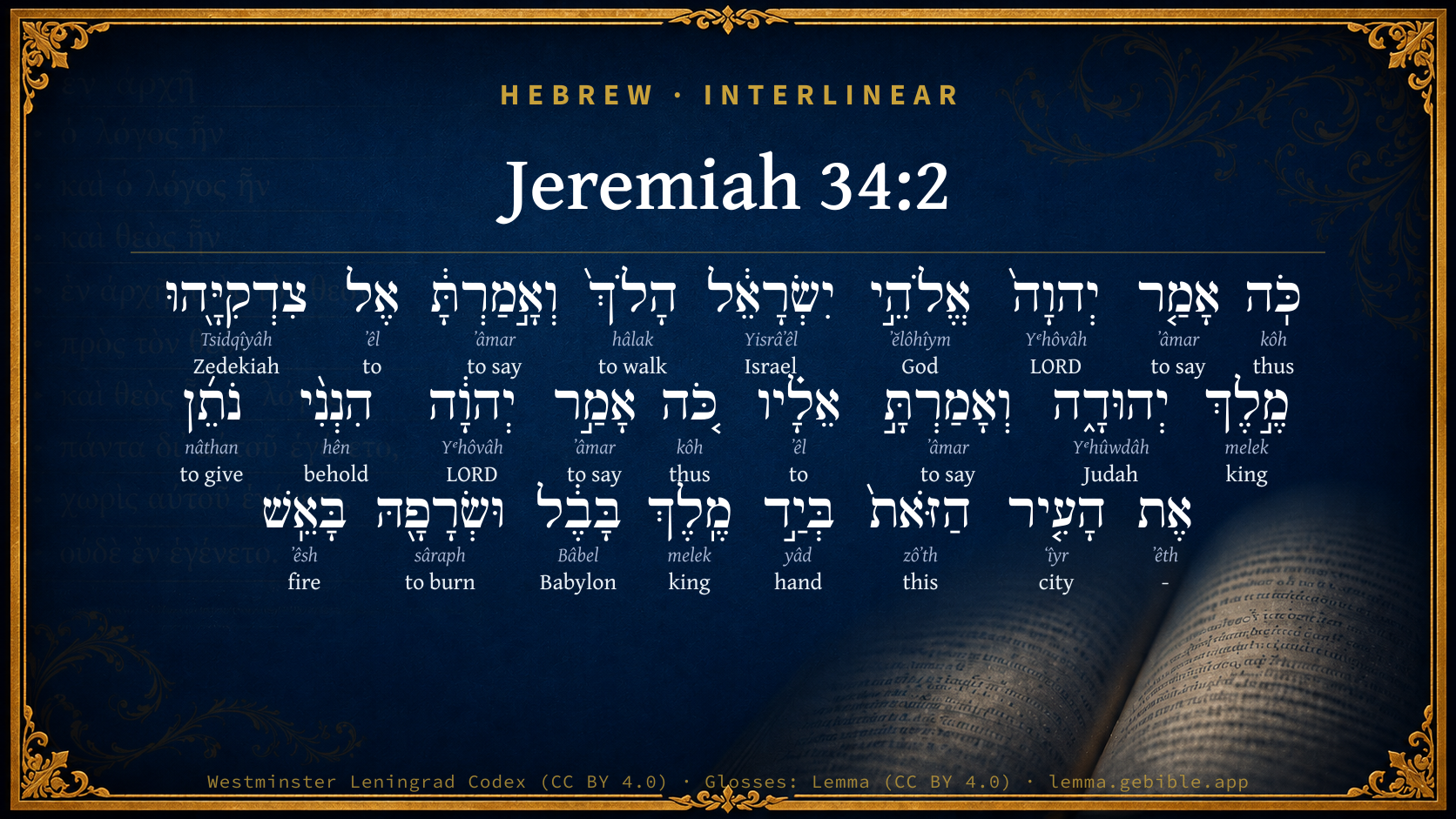
Jeremiah 34:2

Hebrew (Westminster Leningrad Codex) Jeremiah 34:2 appears in the Hebrew Old Testament. The text above is from the Westminster Leningrad Codex. Each word links to its Strong’s number, a concise gloss, and parsing drawn from the Open Scriptures Hebrew Bible morphology. Click any word for its full Brown-Driver-Briggs (BDB) entry.
Download image
Cite this verse

Jeremiah 34:2 (World English Bible). Public Domain. Lemma interlinear Bible study tool, https://lemma.gebible.app/v/jeremiah/34/2.

Show BibTeX & RIS
BibTeX
RIS
English Translation
Thus says Yahweh, the God of Israel, Go, and speak to Zedekiah king of Judah, and tell him, Thus says Yahweh, Behold, I will give this city into the hand of the king of Babylon, and he shall burn it with fire:
World English Bible · Public Domain
Download a study sheet

One document with this verse’s original text, its word-by-word gloss line, the meaning frame, cross-references with their text, attributed commentary, and full source and license credits — printable, and it pastes into notes with its structure intact.

This verse Autodidact and up

Study sheet (.html) Plain text (.txt)

A passage Seminary Student

Up to 50 verses in one chapter. A passage sheet keeps up to 6 commentary sources and 12 cross-references per verse, in the order this page ranks them, and says so on the sheet whenever that leaves anything out. Ask for a single verse and you get the Autodidact verse sheet above.

Everything on this page stays free to read, with no account — the sheet is a download of what is already on screen, not access to it.

Want to remove ads? Support Godless Engineer
Compare translations 3

The same verse in 3 English versions, stacked beneath the original-language interlinear above. Click any original word for its lexicon entry.

Each is an independent rendering of the whole verse — the interlinear is not word-aligned to these translations.

Highlighted words mark where these versions differ — a whole-verse word diff, not a word-by-word alignment.

  • World English Bible Public Domain
    Thus says Yahweh, the God of Israel, Go, and speak to Zedekiah king of Judah, and tell him, Thus says Yahweh, Behold, I will give this city into the hand of the king of Babylon, and he shall burn it with fire:
  • King James Version Public Domain
    Thus saith the LORD, the God of Israel; Go and speak to Zedekiah king of Judah, and tell him, Thus saith the LORD; Behold, I will give this city into the hand of the king of Babylon, and he shall burn it with fire:
  • unfoldingWord Literal Text CC BY-SA 4.0
    “Yahweh, God of Israel, says this: Go and speak to Zedekiah king of Judah and say to him, ‘Yahweh says this: Look, I am about to give this city into the hand of the king of Babylon. He will burn it.

unfoldingWord Literal Text — © unfoldingWord, licensed CC BY-SA 4.0. Word-aligned USFM3 via Door43 (git.door43.org/unfoldingWord/en_ult).

Versions to compare (up to 4)

3 of 4 selected

Show all 18 translations

Every available English version of this verse, each an independent rendering of the whole verse.

  • World English Bible Public Domain
    Thus says Yahweh, the God of Israel, Go, and speak to Zedekiah king of Judah, and tell him, Thus says Yahweh, Behold, I will give this city into the hand of the king of Babylon, and he shall burn it with fire:
  • Berean Standard Bible Public Domain
    The LORD, the God of Israel, told Jeremiah to go and speak to Zedekiah king of Judah and tell him that this is what the LORD says: “Behold, I am about to deliver this city into the hand of the king of Babylon, and he will burn it down.
  • Majority Standard Bible Public Domain
    The LORD, the God of Israel, told Jeremiah to go and speak to Zedekiah king of Judah and tell him that this is what the LORD says: “Behold, I am about to deliver this city into the hand of the king of Babylon, and he will burn it down.
  • King James Version Public Domain
    Thus saith the LORD, the God of Israel; Go and speak to Zedekiah king of Judah, and tell him, Thus saith the LORD; Behold, I will give this city into the hand of the king of Babylon, and he shall burn it with fire:
  • American Standard Version (1901) Public Domain
    Thus saith Jehovah, the God of Israel, Go, and speak to Zedekiah king of Judah, and tell him, Thus saith Jehovah, Behold, I will give this city into the hand of the king of Babylon, and he shall burn it with fire:
  • Revised Version (1885) Public Domain
    Thus saith the LORD, the God of Israel, Go, and speak to Zedekiah king of Judah, and tell him, Thus saith the LORD, Behold, I will give this city into the hand of the king of Babylon, and he shall burn it with fire:
  • Geneva Bible (1599) Public Domain
    Thus sayth the Lord God of Israel, Goe, and speake to Zedekiah King of Iudah, and tell him, Thus sayth the Lord, Beholde, I will giue this citie into the hand of the King of Babel, and he shall burne it with fire,
  • Douay-Rheims (1899) Public Domain
    Thus saith the Lord, the God of Israel: Go, and speak to Sedecias king of Juda, and say to him: Thus saith the Lord: Behold I will deliver this city into the hands of the king of Babylon, and he shall burn it with fire.
  • Young's Literal Translation Public Domain
    `Thus said Jehovah, God of Israel: Go, and thou hast spoken unto Zedekiah king of Judah, and hast said unto him, Thus said Jehovah: Lo, I am giving this city into the hand of the king of Babylon, and he hath burned it with fire,
  • Literal Standard Version CC BY-SA 4.0
    “Thus said YHWH, God of Israel: Go, and you have spoken to Zedekiah king of Judah, and have said to him, Thus said YHWH: Behold, I am giving this city into the hand of the king of Babylon, and he has burned it with fire,
  • Unlocked Literal Bible CC BY-SA 4.0
    “Yahweh, God of Israel, says this: Go and speak to Zedekiah king of Judah and say to him, 'Yahweh says this: Look, I am about to give this city into the hand of the king of Babylon. He will burn it.
  • unfoldingWord Literal Text CC BY-SA 4.0
    “Yahweh, God of Israel, says this: Go and speak to Zedekiah king of Judah and say to him, ‘Yahweh says this: Look, I am about to give this city into the hand of the king of Babylon. He will burn it.
  • Darby Bible Public Domain
    Thus saith Jehovah, the God of Israel: Go and speak to Zedekiah king of Judah, and tell him, Thus saith Jehovah: Behold, I give this city into the hand of the king of Babylon, and he shall burn it with fire.
  • World Messianic Bible Public Domain
    “The LORD, the God of Israel, says, ‘Go, and speak to Zedekiah king of Judah, and tell him, the LORD says, “Behold, I will give this city into the hand of the king of Babylon and he will burn it with fire.
  • Webster's Bible Public Domain
    Thus saith the LORD, the God of Israel; Go and speak to Zedekiah king of Judah, and tell him, Thus saith the LORD; Behold, I will give this city into the hand of the king of Babylon, and he shall burn it with fire:
  • Free Bible Version CC BY-SA 4.0
    This is what the Lord, the God of Israel, says: Go and talk to Zedekiah king of Judah and tell him that this is what the Lord says: Listen! I am about to hand this city over to the king of Babylon, and he is going to burn it down.
  • Bible in Basic English Public Domain
    The Lord, the God of Israel, has said, Go and say to Zedekiah, king of Judah, This is what the Lord has said: See, I will give this town into the hands of the king of Babylon, and he will have it burned with fire:
  • JPS Tanakh (1917) Public Domain
    Thus saith the LORD, the God of Israel: Go, and speak to Zedekiah king of Judah, and tell him: Thus saith the LORD: Behold, I will give this city into the hand of the king of Babylon, and he shall burn it with fire;

Literal Standard Version (2020), Covenant Press — licensed CC BY-SA 4.0. Text via the HelloAO Bible API (eBible.org). Unlocked Literal Bible (unfoldingWord) — licensed CC BY-SA 4.0. Text via the HelloAO Bible API (eBible.org). unfoldingWord Literal Text — © unfoldingWord, licensed CC BY-SA 4.0. Word-aligned USFM3 via Door43 (git.door43.org/unfoldingWord/en_ult). Free Bible Version, Dr. Jonathan Gallagher — licensed CC BY-SA 4.0. Text via the HelloAO Bible API (eBible.org).

Word by word

More ways to search: Search by grammar → Find every occurrence → Compare this word →

Practice this passage: Drill this verse → Learn its vocabulary →

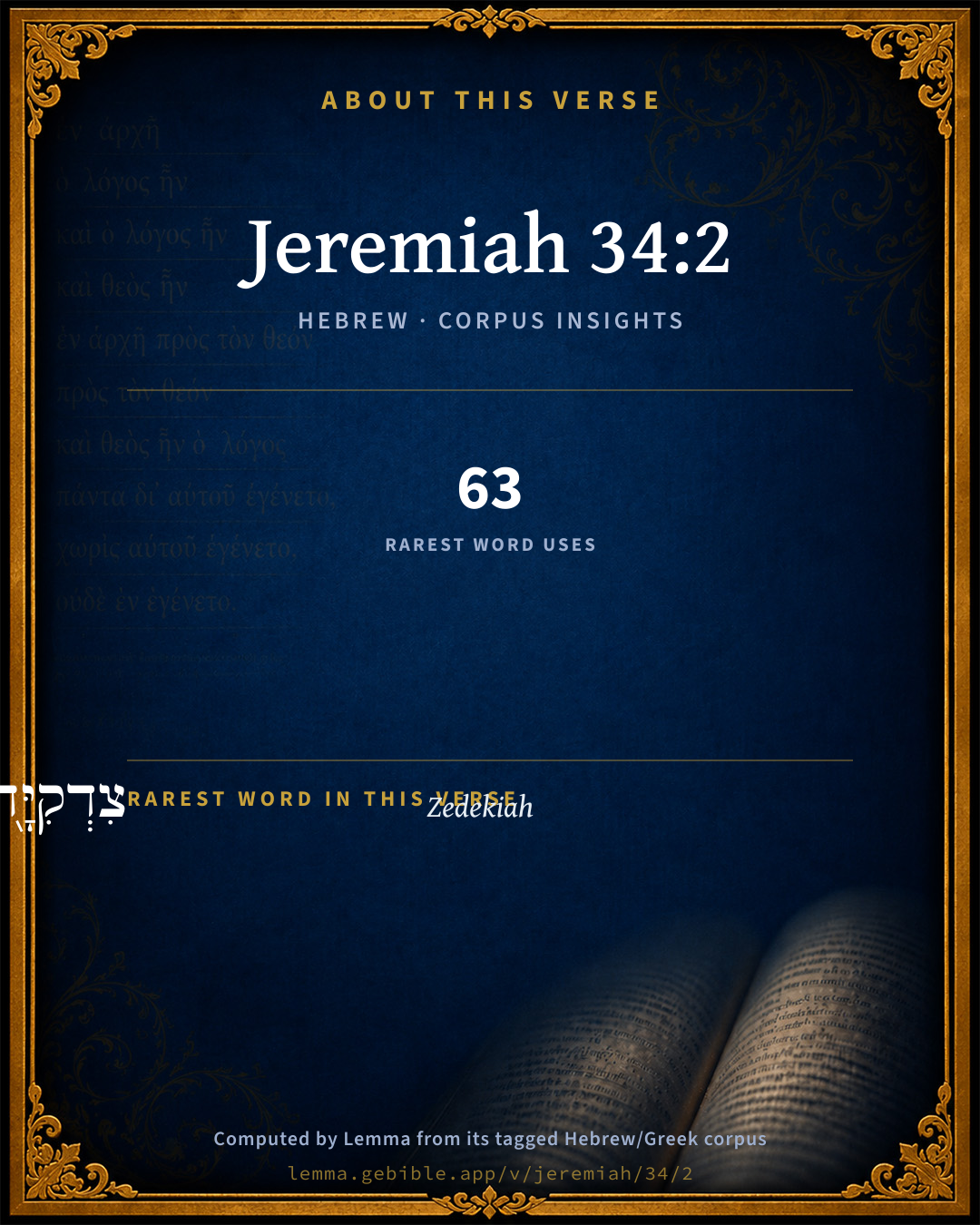
צִדְקִיָּ֖הוּ
Tsidqîyâh
H6667
“Zedekiah”
Noun, Proper
Part of Speech
Noun
Type
Proper
Full BDB Definition

Origin: from H6664 and H3050

TWOT: None

Zedekiah = "Jehovah is righteous" - the last king of Judah renamed from 'Mattaniah' by Nebuchadnezzar; son of Josiah by wife Hamutal; placed on the throne by Nebuchadnezzar when he carried his nephew Jehoiakim in captivity - false prophet at the court of king Ahab of the northern kingdom of Israel - son of Maaseiah, a false prophet in Babylon - son of Hananiah, one of the princes of Judah in the time of Jeremiah - a priest who sealed the covenant with Nehemiah - son of king Jehoiakim of Judah
  1. כֹּֽה kôh H3541 “thus” Adverb
  2. אָמַ֤ר ʼâmar H559 “to say” Verb, Qal, Perfect, 3rd Person, Masculine, Singular
  3. יְהוָה֙ Yᵉhôvâh H3068 “LORD” Noun, Proper
  4. אֱלֹהֵ֣י ʼĕlôhîym H430 “God(s) of” Noun, Common, Masculine, Plural, Construct
  5. יִשְׂרָאֵ֔ל Yisrâʼêl H3478 “Israel” Noun, Proper
  6. הָלֹךְ֙ hâlak H1980 “to walk” Verb, Qal, Infinitive Absolute
  7. וְאָ֣מַרְתָּ֔ ʼâmar H559 “and · to say” Conjunction + Verb, Qal, Sequential Perfect, 2nd Person, Masculine, Singular
  8. אֶל ʼêl H413 “to” Preposition
  9. מֶ֣לֶךְ melek H4428 “king of” Noun, Common, Masculine, Singular, Construct
  10. יְהוּדָ֑ה Yᵉhûwdâh H3063 “Judah” Noun, Proper
  11. וְאָמַרְתָּ֣ ʼâmar H559 “and · to say” Conjunction + Verb, Qal, Sequential Perfect, 2nd Person, Masculine, Singular
  12. אֵלָ֗יו ʼêl H413 “to · him” Preposition + Suffix, Personal, 3rd Person, Masculine, Singular
  13. כֹּ֚ה kôh H3541 “thus” Adverb
  14. אָמַ֣ר ʼâmar H559 “to say” Verb, Qal, Perfect, 3rd Person, Masculine, Singular
  15. יְהוָ֔ה Yᵉhôvâh H3068 “LORD” Noun, Proper
  16. הִנְנִ֨י hên H2005 “behold · me” Particle, Demonstrative + Suffix, Personal, 1st Person, Common, Singular
  17. נֹתֵ֜ן nâthan H5414 “giving” Verb, Qal, Participle Active, Masculine, Singular, Absolute
  18. אֶת ʼêth H853 “-” Particle, Direct Object
  19. הָעִ֤יר ʻîyr H5892 “the · city” Particle, Definite Article + Noun, Common, Feminine, Singular, Absolute
  20. הַזֹּאת֙ zôʼth H2063 “the · this” Particle, Definite Article + Pronoun, Demonstrative, Feminine, Singular
  21. בְּיַ֣ד yâd H3027 “in/at · hand of” Preposition + Noun, Common, Both, Singular, Construct
  22. מֶֽלֶךְ melek H4428 “king of” Noun, Common, Masculine, Singular, Construct
  23. בָּבֶ֔ל Bâbel H894 “Babylon” Noun, Proper
  24. וּשְׂרָפָ֖הּ sâraph H8313 “and · to burn · her” Conjunction + Verb, Qal, Sequential Perfect, 3rd Person, Masculine, Singular + Suffix, Personal, 3rd Person, Feminine, Singular
  25. בָּאֵֽשׁ ʼêsh H784 “in/at the · fire” Preposition, Determined + Noun, Common, Both, Singular, Absolute

About this verse

These counts appear in no published source. They are computed here, from the morphology-tagged text and Lemma’s own curated glosses. What Lemma adds →

26
words
19
distinct lemmas
Prophets
section

Grammatical profile

  • 7 verbs
  • 12 nouns
  • 1 pronoun
  • 2 prepositions
  • 2 adverbs
  • 2 particles

Verb forms

  • אָמַ֤ר Qal · Perfect
  • הָלֹךְ֙ Qal · Infinitive Absolute
  • וְאָ֣מַרְתָּ֔ Qal · Sequential Perfect
  • וְאָמַרְתָּ֣ Qal · Sequential Perfect
  • אָמַ֣ר Qal · Perfect
  • נֹתֵ֜ן Qal · Participle Active
  • וּשְׂרָפָ֖הּ Qal · Sequential Perfect

Repetition

Words recur within this verse — often emphatic in Hebrew:

  • אָמַ֤ר to say H559 ×4
  • כֹּֽה thus H3541 ×2
  • יְהוָה֙ LORD H3068 ×2
  • מֶ֣לֶךְ king H4428 ×2
  • אֶל to H413 ×2

Cross-references

11

Topical passages linked to Jeremiah 34:2 in the Treasury of Scripture Knowledge — connected by theme and wording, ordered by reader-vote popularity; previews shown in the World English Bible.

  • Jeremiah 21:10 For I have set my face on this city for evil, and not for good, says Yahweh: it shall be given into the hand of the king of Babylon, and he shall burn it with fire.
  • Jeremiah 34:22 Behold, I will command, says Yahweh, and cause them to return to this city; and they shall fight against it, and take it, and burn it with fire: and I will make the cities of Judah a desolation, without inhabitant.
  • 2 Chronicles 36:11–12 Zedekiah was twenty-one years old when he began to reign; and he reigned eleven years in Jerusalem:
  • Jeremiah 22:1–2 Thus said Yahweh: Go down to the house of the king of Judah, and speak there this word,
  • Jeremiah 32:3 For Zedekiah king of Judah had shut him up, saying, Why do you prophesy, and say, Thus says Yahweh, Behold, I will give this city into the hand of the king of Babylon, and he shall take it;
  • Jeremiah 37:8–10 The Chaldeans shall come again, and fight against this city; and they shall take it, and burn it with fire.
  • Jeremiah 21:4 Thus says Yahweh, the God of Israel, Behold, I will turn back the weapons of war that are in your hands, with which you fight against the king of Babylon, and against the Chaldeans who besiege you, without the walls; and I will gather them into the midst of this city.
  • Jeremiah 32:28–29 Therefore thus says Yahweh: Behold, I will give this city into the hand of the Chaldeans, and into the hand of Nebuchadrezzar king of Babylon, and he shall take it:
  • Jeremiah 37:1–4 Zedekiah the son of Josiah reigned as king, instead of Coniah the son of Jehoiakim, whom Nebuchadrezzar king of Babylon made king in the land of Judah.
  • Jeremiah 38:23 They shall bring out all your wives and your children to the Chaldeans; and you shall not escape out of their hand, but shall be taken by the hand of the king of Babylon: and you shall cause this city to be burned with fire.
  • Jeremiah 39:8 The Chaldeans burned the king's house, and the houses of the people, with fire, and broke down the walls of Jerusalem.

Cross-references courtesy of OpenBible.info (CC BY 4.0).

Hebrew and Greek witnesses Masoretic Hebrew ↔ Greek Septuagint

The same verse in the two great witnesses to the Old Testament, shown verse-for-verse.

These are two independent witnesses, not word-aligned to each other, and the Septuagint is shown in lemma (dictionary) form.

Hebrew Jeremiah 34:2 Masoretic · Westminster Leningrad Codex

כֹּֽה אָמַ֤ר יְהוָה֙ אֱלֹהֵ֣י יִשְׂרָאֵ֔ל הָלֹךְ֙ וְאָ֣מַרְתָּ֔ אֶל צִדְקִיָּ֖הוּ מֶ֣לֶךְ יְהוּדָ֑ה וְאָמַרְתָּ֣ אֵלָ֗יו כֹּ֚ה אָמַ֣ר יְהוָ֔ה הִנְנִ֨י נֹתֵ֜ן אֶת הָעִ֤יר הַזֹּאת֙ בְּיַ֣ד מֶֽלֶךְ בָּבֶ֔ל וּשְׂרָפָ֖הּ בָּאֵֽשׁ

Thus says Yahweh, the God of Israel, Go, and speak to Zedekiah king of Judah, and tell him, Thus says Yahweh, Behold, I will give this city into the hand of the king of Babylon, and he shall burn it with fire:

World English Bible · Public Domain

Greek LXX Structure differs

In the Septuagint, Jeremiah is about an eighth shorter than the Hebrew and arranges its material differently — the Oracles Against the Nations (Hebrew chapters 46–51) appear in the middle of the Greek book, after 25:13. Because the chapter and verse boundaries do not line up, a verse-for-verse comparison with the Hebrew is not shown.

A verse-for-verse comparison isn’t shown here because the chapters and verses don’t line up. Switch to the LXX edition with the MT / LXX toggle above to read the Greek directly.

Hebrew: Westminster Leningrad Codex (CC BY 4.0). Greek: Septuagint (public domain); English from a public-domain English Septuagint. How the Septuagint differs from the Hebrew →

Targum (Aramaic paraphrase)

1

The Targum is the ancient Jewish Aramaic paraphrase of the Hebrew Scriptures — an interpretive translation, not the Hebrew text itself. Onkelos (literal) and Pseudo-Jonathan (expansive) render the Torah, and Jonathan the Prophets. Coverage is partial: where no permissively-licensed English translation exists for a verse, only the Aramaic is shown. This is verse-level text, not a word-by-word alignment to the Hebrew.

  1. Targum Jonathan Prophets (Joshua–Malachi)
    כִּדְנַן אֲמַר יְיָ אֱלָהָא דְיִשְׂרָאֵל אֱזֵיל וְתֵימַר לְצִדְקִיָה מְלַךְ שִׁבְטָא דְבֵית יְהוּדָה וְתֵימַר לֵיהּ כִּדְנַן אֲמַר יְיָ הָא אֲנָא מָסַר יַת קַרְתָּא הָדָא בְּיַד מַלְכָּא דְבָבֶל וְיוֹקְדִנָהּ בְּנוּרָא:

    (no public-domain English translation for this verse)

    Targum Jonathan — Aramaic: “Mikraot Gedolot” (public domain). English: “Sefaria Community Translation” (CC0 1.0 (public-domain dedication)); “London "Chaldee Paraphrase," 1871” (public domain). Text via Sefaria.

Commentary

Notes on Jeremiah 34:2 from classic Christian and Jewish commentators (each source and its license shown beneath its notes). The classic Christian expositions comment on the surrounding passage and are grouped to its opening verse, so a note may address several verses; the Jewish commentaries on the Tanakh (Rashi and others) are per-verse, so they appear only where the commentator wrote on this verse.

Lemma curates 59 commentaries, every one of them public domain or Creative Commons licensed, each selected and text-cleaned for this edition rather than reprinted as found. About our sources →

Trapp's Complete Commentary

John Trapp

Jer 34:2 Thus saith the LORD, the God of Israel; Go and speak to Zedekiah king of Judah, and tell him, Thus saith the LORD; Behold, I will give this city into the hand of the king of Babylon, and he shall burn it with fire:

Ver. 2. Go and speak unto Zedekiah.] Tell him plainly what shall become of him and his, though thou be sent to prison for thy plain dealing.

John Trapp, A Commentary or Exposition upon All the Books of the Old and New Testament (1647–1656) — public domain. Text from a community e-Sword module.

Joseph Benson's Commentary

Jer 34:2-5. Behold, I will give this city into the hand of the king of Babylon, and thou shalt not escape, &c. — This prophecy, which threatened the king in particular, as well as the city and nation in general, so much displeased Zedekiah that he shut up Jeremiah in prison. See notes on Jer 32:2-5, where the same things are related that occur here. But thou shalt die in peace — Namely, by a natural death. The king of Babylon took him, killed his sons before his eyes, then put out his eyes, and bound him with chains, (Jer 39:7,) but did not put him to death, as we here learn. With the burning of thy fathers, &c., so shall they burn odours for thee — It was customary among the Jews, at the funerals of their kings, especially of those whose memories they honoured, to prepare a bed of spices, of which they made a perfume by burning them, and therein to deposite the body of the deceased prince: see 2Ch 16:14; 2Ch 21:19. And they will lament thee, saying, Ah lord! — In these, and the foregoing words, God promises Zedekiah an honourable interment, and suitable to his quality; a favour he did not vouchsafe to Jehoiakim, Jer 22:18.

Joseph Benson's Commentary on the Old and New Testaments (1811–1818) — public domain. Text from a community e-Sword module.

Tyndale Open Study Notes

Tyndale Open Resources

34:2 No matter what King Zedekiah did, Jerusalem would fall. The Lord would not rescue the city.

Tyndale Open Study Notes — © Tyndale Open Resources, licensed CC BY-SA 4.0. Text via the HelloAO Bible API.

Adam Clarke's Commentary

Verse 2. He shall burn it with fire] This was a newly-added circumstance. Among many ancient nations they burned the bodies of the more illustrious dead. Odours were used in the burning: they then gathered the ashes, and put them into an urn or pitcher, sometimes into a strong vessel, and buried them. Many of these have been digged up in different parts of England, where the Romans had stations.

Adam Clarke's Commentary on the Bible (1810–1826) — public domain. Text from a community e-Sword/MySword module.

John Calvin's Commentaries

Now the Prophet says, Behold, I will deliver this city into the hand of the king of Babylon Had he simply said that the city would in a short time be taken, it would have been a general truth, not effectual but frigid. It was therefore necessary to add this, — that the ruin of the city was a just punishment inflicted by God. And Zedekiah was also thus reminded, that though he were stronger than his enemy, yet he could not effectually resist him, for the war was carrid on under the authority of God, as though he had said, “Thou thinkest that thou contendest with men; it would be difficult enough for thee and more than enough, to contend with the eastern monarchy and so many nations and kingdoms; farther than this, God himself is thine enemy; have regard to him, that thou mayest learn to dread his judgment.” And that the words might be more forcible, God himself speaks in his own person, Behold, he says, I will deliver this city into the hand of the king of Babylon, and he will burn it with fire This last sentence was a dreadful aggravation; for it often happens that cities are taken, and the conquerors are satisfied with the spoils. When, therefore, Nebuchadnezzar came against the city of Jerusalem with so much rage that he burnt it, it was a proof of the dreadful vengeance of God. It now follows —

John Calvin's Commentaries (1540-1563) — public domain. Text from the Calvin Translation Society English edition (1840s-50s) via the Christian Classics Ethereal Library (ccel.org). Calvin's coverage is partial (roughly two-thirds of the Bible); uncommented books and verses are honest gaps, never fabricated. The 19th-century editor's footnotes and remarks are omitted so the notes are faithfully Calvin's own voice.

Ellicott's Commentary for English Readers

(2, 3) Go and speak to Zedekiah . . .—See Notes on Jer_32:3-4.

A Bible Commentary for English Readers, edited by Charles John Ellicott (1878–1897) — public domain. Text from a community e-Sword module.

John Gill's Exposition

Thus saith the Lord, the God of Israel,.... Who, though the covenant God of Israel, yet provoked by their sins, sends the following message to their king:

go and speak to Zedekiah king of Judah, and tell him: alone; and tell it to no other but him, at least at present; the message being more peculiar to him, and must, had it been told to the people, been very disheartening to them:

behold, I will give this city into the hand of the king of Babylon,

and he shall burn it with fire; see Jer 32:3; which was exactly accomplished, Jer 52:13.

John Gill's Exposition of the Whole Bible (1746–1763) — public domain (CC PDM 1.0). Text via the HelloAO Bible API.

Whedon's Commentary on the Bible

Daniel D. Whedon

2. Burn it with fire — Suggesting the fierceness and fury of the king of Babylon and the cruelty of oriental warfare.

Daniel D. Whedon (gen. ed.), Commentary on the Old and New Testaments (1874–1909) — public domain. Text from a community e-Sword module.

The Pulpit Commentary

Vers. 2, 3. comp. these verses with Jer_32:3-5.

The woe of weakness.

"Zedekiah, King of Judah." The life of this unhappy monarch is a piteous but powerful illustration of the misery of instability of character, the sorrows that dog the footsteps of the infirm will. What men need, in order to be happier and better than they are, is not more knowledge of what is right they are amply supplied with that; or the presence of plentiful good purpose and desire to do the right hell itself is paved with good intentions; but what is needed is strength of will, firmness and stability of character. It is for lack of that that men go so wrong and make such a miserable confusion of their own life and that of others. The history of Zedekiah illustrates all this. Therefore note

I HIS CHARACTER AS SHOWN BY HIS HISTORY. He was son of the good King Josiah, and may have been one of the "princes" carried off to Babylon in the days of Jehoiakim. He appears to have attracted the favourable notice of Nebuchadnezzar, probably on the ground of the hope that Jeremiah the prophet cherished concerning him. That hope was expressed in the name given him Zedekiah, "the Lord our Righteousness," a name fulfilled only in One, but telling of the hopes that gathered round this young king. At twenty-one years of age he was placed on the throne of Judah by Nebuchadnezzar, and then the extreme difficulties of his position became evident. In his own country and in those adjoining, a smouldering rebellion prevailed. This the great enemy of Babylon, Egypt, did not fail to fan and further to the utmost of her power. Only a leader was wanting, and the rebellion would at once break forth. The chief of Zedekiah"s own people were eager for him to head the revolt. For a time he refused, and seems (cf. Jer_51:59) to have taken a solemn oath of allegiance to Nebuchadnezzar. But keeping this oath was not easy. It was a cruel position for him, and he had not the strength which so critical a time and emergency demanded. The influence of Jeremiah and Ms fear of the Babylonian power drew him one way; the clamour of his princes, priests, and people, and the promised aid of Egypt drew him another. And so at length he yielded, and treated his oath as so many idle words. Loud and stern were the protests of the prophet of God against such shameless and senseless falsehood. (cf. Eze_17:14 Jer 28) But the princes of his court, as he himself pathetically admits (Jer 38), had him completely under their influence: "Against them," he complains, "it is not the king that can do anything." He was thus driven to disregard the counsels of the prophet, which, as the event proved, were perfectly sound; and "he who might have kept the fragments of the kingdom together, and maintained for some generations longer the worship of Jehovah, brought its final ruin on his country, destruction on the temple, death to his family, and a cruel torment and a miserable captivity on himself." And there are other recorded instances of his lack of moral strength. His allowing the rich men and all those who, contrary to the Law, had held their, brethren as bondslaves, to enslave them once more, notwithstanding that in the most solemn way they had covenanted with God not to do so; then his treatment of the Prophet Jeremiah, all showed, not so much that he was wicked, as that he was weak. Cruelly imprisoned by his enemies, the king sent for the prophet and placed him in gentler captivity in the court of his own palace. But there assailed by the angry accusations of the prophet"s foes, the king yielded, and let them cast him into a horrible pit, where, had he been long left, he must have miserably perished. Conscience, stirred up by the remonstrance of a faithful servant, led the king to interpose again for his relief, and to have him remitted to his prison in the king"s court. There Zedekiah treated him kindly; when the famine was raging in the city, he procured bread for him; he asked his prayers, and held long and frequent converse with him, but was all the while in abject fear lest the nobles should discover what their conversation had been about, and ha prevailed upon the prophet to condescend to an evasion of the truth in order not to betray him, poor weak king that he was (Jer 38). Altogether wise was the counsel the prophet gave, but the king would and he would not. He did not know his own mind. But events moved on. The city was captured. The king and his household endeavoured to escape, were caught, carried before Nebuchadnezzar; his children were crucified in his presence; then his eyes were put out; and, loaded with fetters, he was dragged across the weary desert to Babylon, where he lived in misery until the Lord visited him (Jer_32:5) that is, until the Lord mercifully sent death to put an end to all his woe. It is a pitiful story, but one that teaches much concerning this instability of character which was this poor monarch"s ruin.

II WHAT THIS HISTORY SUGGESTS AS TO SUCH CHARACTER. It suggests:

1. Its nature. That it is a halting perpetually between two opinions a condition of perpetual indecision! You never know where to find such men, or can be sure as to what they will do. They promise so well; they turn out so ill. Like a chip on a stream, driven, tossed, turned hither and thither, entangled, engulfed at last so is such a man. In secular matters it is ruin, in spiritual it is more disastrous still.

2. Its results. What a miserable man this Zedekiah must have been! And so are all such. The debtor"s pillow is proverbially a restless one, because of its wretchedness. Yet more so is that of the man who has no will of his own. And what Sorrow he brings upon others! He drags them down into the same vortex in which he is himself swallowed up. What ruin is wrought by such men in all the circles to which they belong!

3. Its cause. Want of a guiding principle in life. Without this, having no fixed rules, secular life is ruined. But in things spiritual this endeavour to serve God and mammon, this divided heart, is absolutely fatal. In such men the surrender to Christ has never been thorough and complete. They are as the seed on the stony ground.

4. Its cure. Living under the abiding realization of the presence of Christ. In armies that have begun to waver, the approach, the word, the eye of their leader has rallied them again and won them victory. So if, when tempted to waver, we feel the eye of Christ on us, we shall be firm. Therefore let him be the Lord of your souls. C.

The Pulpit Commentary (1880–1919), ed. H.D.M. Spence-Jones & Joseph S. Exell — public domain. Text from a community e-Sword module.

Lesson kit

Teaching starters — assembled from the data on this page, not authored interpretation. Every prompt links to the verse data it draws on. Edit before teaching.

Jeremiah, in the Prophets, opens this verse with 26 words (19 distinct Hebrew lemmas). Its most distinctive word is Tsidqîyâh (“Zedekiah”). A historical commentator’s framing appears above. Read the whole chapter for the surrounding context.

Discussion questions

  1. How does “Zedekiah” (Tsidqîyâh) shape what this verse is saying?
  2. Jeremiah 21:10 shares this passage’s theme. How do the two illuminate each other?
  3. “to say” occurs 4× in this one verse. What is the effect of the repetition?
  4. These translations render this verse differently; the difference is in the English rendering, not the original. What questions does that raise?
  5. The verb «אָמַ֤ר» is Qal Perfect. How does its form color the action?
  6. Reading how Trapp's Complete Commentary and Joseph Benson's Commentary read this verse, where do the two commentators agree and where do they part?

Things to notice

Reading settings

Reading text

Shown beneath each verse's original-language words.

Old Testament
Old Testament edition

Read the OT as the Masoretic Hebrew (MT) or the Greek Septuagint (LXX).

English shown for the Greek Septuagint (in the Hebrew ↔ Greek comparison).

Comparing translations? Open the Compare panel on any verse page to stack up to four side by side.