
Jeremiah 38:23

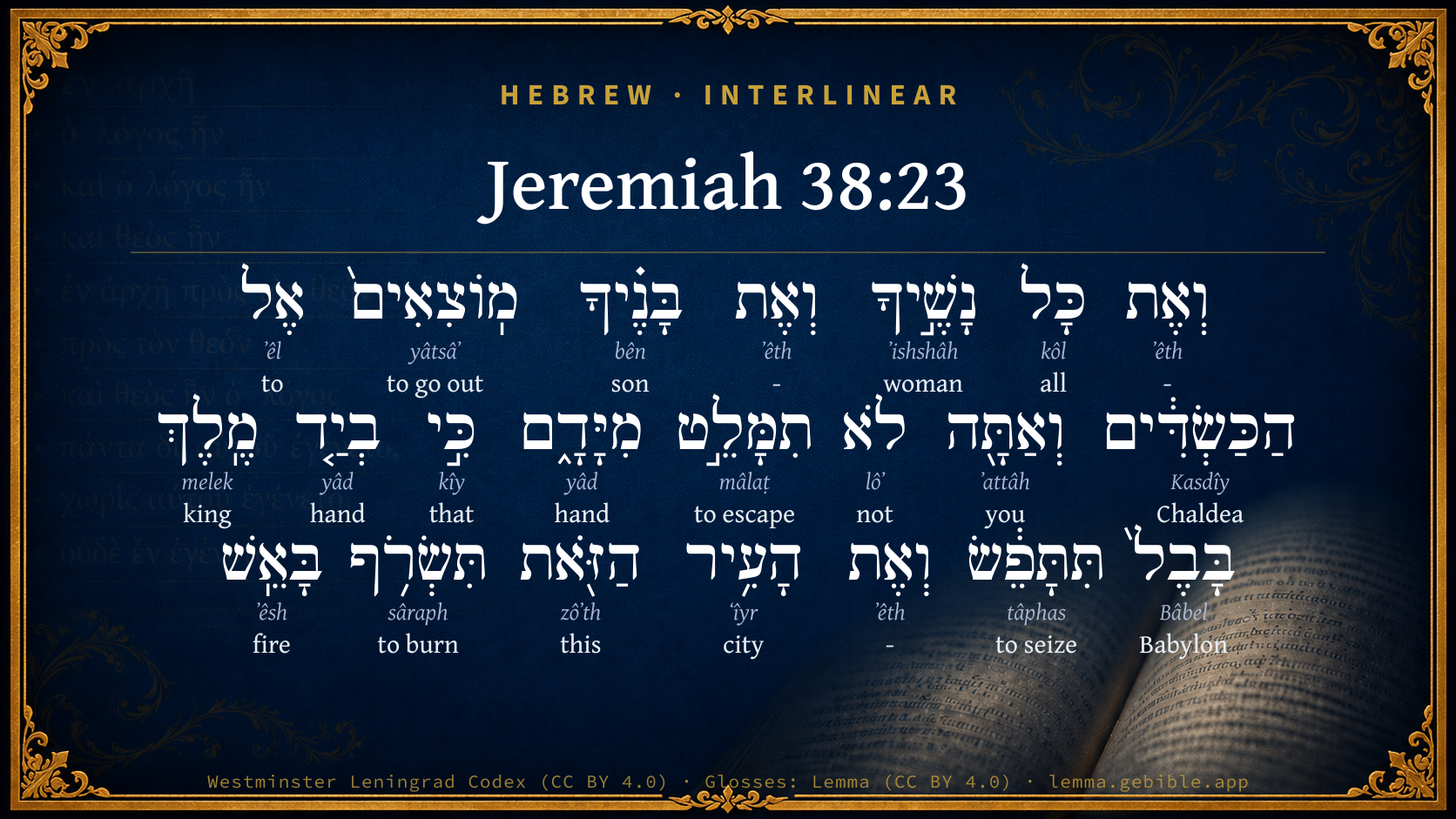
Hebrew (Westminster Leningrad Codex) Jeremiah 38:23 appears in the Hebrew Old Testament. The text above is from the Westminster Leningrad Codex. Each word links to its Strong’s number, a concise gloss, and parsing drawn from the Open Scriptures Hebrew Bible morphology. Click any word for its full Brown-Driver-Briggs (BDB) entry.
Download image
Cite this verse

Jeremiah 38:23 (World English Bible). Public Domain. Lemma interlinear Bible study tool, https://lemma.gebible.app/v/jeremiah/38/23.

Show BibTeX & RIS
BibTeX
RIS
English Translation
They shall bring out all your wives and your children to the Chaldeans; and you shall not escape out of their hand, but shall be taken by the hand of the king of Babylon: and you shall cause this city to be burned with fire.
World English Bible · Public Domain
Download a study sheet

One document with this verse’s original text, its word-by-word gloss line, the meaning frame, cross-references with their text, attributed commentary, and full source and license credits — printable, and it pastes into notes with its structure intact.

This verse Autodidact and up

Study sheet (.html) Plain text (.txt)

A passage Seminary Student

Up to 50 verses in one chapter. A passage sheet keeps up to 6 commentary sources and 12 cross-references per verse, in the order this page ranks them, and says so on the sheet whenever that leaves anything out. Ask for a single verse and you get the Autodidact verse sheet above.

Everything on this page stays free to read, with no account — the sheet is a download of what is already on screen, not access to it.

Want to remove ads? Support Godless Engineer
Compare translations 3

The same verse in 3 English versions, stacked beneath the original-language interlinear above. Click any original word for its lexicon entry.

Each is an independent rendering of the whole verse — the interlinear is not word-aligned to these translations.

Highlighted words mark where these versions differ — a whole-verse word diff, not a word-by-word alignment.

  • World English Bible Public Domain
    They shall bring out all your wives and your children to the Chaldeans; and you shall not escape out of their hand, but shall be taken by the hand of the king of Babylon: and you shall cause this city to be burned with fire.
  • King James Version Public Domain
    So they shall bring out all thy wives and thy children to the Chaldeans: and thou shalt not escape out of their hand, but shalt be taken by the hand of the king of Babylon: and thou shalt cause this city to be burned with fire.
  • unfoldingWord Literal Text CC BY-SA 4.0
    For all of your wives and children will be brought out to the Chaldeans, and you yourself will not escape from their hand. You will be captured by the hand of the king of Babylon, and this city will be burned.”

unfoldingWord Literal Text — © unfoldingWord, licensed CC BY-SA 4.0. Word-aligned USFM3 via Door43 (git.door43.org/unfoldingWord/en_ult).

Versions to compare (up to 4)

3 of 4 selected

Show all 18 translations

Every available English version of this verse, each an independent rendering of the whole verse.

  • World English Bible Public Domain
    They shall bring out all your wives and your children to the Chaldeans; and you shall not escape out of their hand, but shall be taken by the hand of the king of Babylon: and you shall cause this city to be burned with fire.
  • Berean Standard Bible Public Domain
    All your wives and children will be brought out to the Chaldeans. And you yourself will not escape their grasp, for you will be seized by the king of Babylon, and this city will be burned down.”
  • Majority Standard Bible Public Domain
    All your wives and children will be brought out to the Chaldeans. And you yourself will not escape their grasp, for you will be seized by the king of Babylon, and this city will be burned down.”
  • King James Version Public Domain
    So they shall bring out all thy wives and thy children to the Chaldeans: and thou shalt not escape out of their hand, but shalt be taken by the hand of the king of Babylon: and thou shalt cause this city to be burned with fire.
  • American Standard Version (1901) Public Domain
    And they shall bring out all thy wives and thy children to the Chaldeans; and thou shalt not escape out of their hand, but shalt be taken by the hand of the king of Babylon: and thou shalt cause this city to be burned with fire.
  • Revised Version (1885) Public Domain
    And they shall bring out all thy wives and thy children to the Chaldeans: and thou shalt not escape out of their hand, but shalt be taken by the hand of the king of Babylon: and thou shalt cause this city to be burned with fire.
  • Geneva Bible (1599) Public Domain
    So they shall bring out all thy wiues, and thy children to the Caldeans, and thou shalt not escape out of their hands, but shalt be taken by the hand of the King of Babel: and this citie shalt thou cause to be burnt with fire.
  • Douay-Rheims (1899) Public Domain
    And all thy wives, and thy children shall be brought out to the Chaldeans, and thou shalt not escape their hands, but thou shalt be taken by the hand of the king of Babylon: and he shall burn this city with fire.
  • Young's Literal Translation Public Domain
    `And all thy wives, and thy sons, are brought forth unto the Chaldeans, and thou dost not escape from their hand, for by the hand of the king of Babylon thou art caught, and this city is burnt with fire.'
  • Literal Standard Version CC BY-SA 4.0
    And all your wives and your sons are brought forth to the Chaldeans, and you do not escape from their hand, for you are caught by the hand of the king of Babylon, and this city is burned with fire.”
  • Unlocked Literal Bible CC BY-SA 4.0
    For all of your wives and children will be brought out to the Chaldeans, and you yourself will not escape from their hand. You will be captured by the hand of the king of Babylon, and this city will be burned.”
  • unfoldingWord Literal Text CC BY-SA 4.0
    For all of your wives and children will be brought out to the Chaldeans, and you yourself will not escape from their hand. You will be captured by the hand of the king of Babylon, and this city will be burned.”
  • Darby Bible Public Domain
    And they shall bring out all thy wives and thy children to the Chaldeans, and thou shalt not escape out of their hand; for thou shalt be taken by the hand of the king of Babylon, and thou shalt cause this city to be burned with fire.
  • World Messianic Bible Public Domain
    They will bring out all your wives and your children to the Kasdim. You won’t escape out of their hand, but will be taken by the hand of the king of Babylon. You will cause this city to be burned with fire.’”
  • Webster's Bible Public Domain
    So they shall bring out all thy wives and thy children to the Chaldeans: and thou shalt not escape out of their hand, but shalt be taken by the hand of the king of Babylon: and thou shalt cause this city to be burned with fire.
  • Free Bible Version CC BY-SA 4.0
    All your wives and children will be handed over to the Chaldeans. And you yourself will not escape, for you will be captured by the king of Babylon, and Jerusalem will be burned down.”
  • Bible in Basic English Public Domain
    And they will take all your wives and your children out to the Chaldaeans: and you will not get away out of their hands, but will be taken by the hands of the king of Babylon: and this town will be burned with fire.
  • JPS Tanakh (1917) Public Domain
    And they shall bring out all thy wives and thy children to the Chaldeans; and thou shalt not escape out of their hand, but shalt be taken by the hand of the king of Babylon; and thou shalt cause this city to be burned with fire.'

Literal Standard Version (2020), Covenant Press — licensed CC BY-SA 4.0. Text via the HelloAO Bible API (eBible.org). Unlocked Literal Bible (unfoldingWord) — licensed CC BY-SA 4.0. Text via the HelloAO Bible API (eBible.org). unfoldingWord Literal Text — © unfoldingWord, licensed CC BY-SA 4.0. Word-aligned USFM3 via Door43 (git.door43.org/unfoldingWord/en_ult). Free Bible Version, Dr. Jonathan Gallagher — licensed CC BY-SA 4.0. Text via the HelloAO Bible API (eBible.org).

Word by word

More ways to search: Search by grammar → Find every occurrence → Compare this word →

Practice this passage: Drill this verse → Learn its vocabulary →

תִּתָּפֵ֔שׂ
tâphas
H8610
“to seize”
Verb, Niphal, Imperfect, 2nd Person, Masculine, Singular
Part of Speech
Verb
Stem
Niphal
Form
Imperfect
Person
2nd Person
Gender
Masculine
Number
Singular
Full BDB Definition

Origin: a primitive root

TWOT: 2538

to catch, handle, lay hold, take hold of, seize, wield - (Qal) - to lay hold of, seize, arrest, catch - to grasp (in order to) wield, wield, use skilfully - (Niphal) to be seized, be arrested, be caught, be taken, captured - (Piel) to catch, grasp (with the hands)
  1. וְאֶת ʼêth H853 “and · -” Conjunction + Particle, Direct Object
  2. כָּל kôl H3605 “all of” Noun, Common, Masculine, Singular, Construct
  3. נָשֶׁ֣יךָ ʼishshâh H802 “women · your” Noun, Common, Feminine, Plural, Construct + Suffix, Personal, 2nd Person, Masculine, Singular
  4. וְאֶת ʼêth H853 “and · -” Conjunction + Particle, Direct Object
  5. בָּנֶ֗יךָ bên H1121 “sons · your” Noun, Common, Masculine, Plural, Construct + Suffix, Personal, 2nd Person, Masculine, Singular
  6. מֽוֹצִאִים֙ yâtsâʼ H3318 “going out” Verb, Hiphil, Participle Active, Masculine, Plural, Absolute
  7. אֶל ʼêl H413 “to” Preposition
  8. הַכַּשְׂדִּ֔ים Kasdîy H3778 “the · Chaldea” Particle, Definite Article + Noun, Proper
  9. וְאַתָּ֖ה ʼattâh H859 “and · you” Conjunction + Pronoun, Personal, 2nd Person, Masculine, Singular
  10. לֹא lôʼ H3808 “not” Particle, Negative
  11. תִמָּלֵ֣ט mâlaṭ H4422 “to escape” Verb, Niphal, Imperfect, 2nd Person, Masculine, Singular
  12. מִיָּדָ֑ם yâd H3027 “from · hand · their” Preposition + Noun, Common, Both, Singular, Construct + Suffix, Personal, 3rd Person, Masculine, Plural
  13. כִּ֣י kîy H3588 “that” Conjunction
  14. בְיַ֤ד yâd H3027 “in/at · hand of” Preposition + Noun, Common, Both, Singular, Construct
  15. מֶֽלֶךְ melek H4428 “king of” Noun, Common, Masculine, Singular, Construct
  16. בָּבֶל֙ Bâbel H894 “Babylon” Noun, Proper
  17. וְאֶת ʼêth H853 “and · -” Conjunction + Particle, Direct Object
  18. הָעִ֥יר ʻîyr H5892 “the · city” Particle, Definite Article + Noun, Common, Feminine, Singular, Absolute
  19. הַזֹּ֖את zôʼth H2063 “the · this” Particle, Definite Article + Pronoun, Demonstrative, Feminine, Singular
  20. תִּשְׂרֹ֥ף sâraph H8313 “to burn” Verb, Qal, Imperfect, 3rd Person, Feminine, Singular
  21. בָּאֵֽשׁ ʼêsh H784 “in/at the · fire” Preposition, Determined + Noun, Common, Both, Singular, Absolute

About this verse

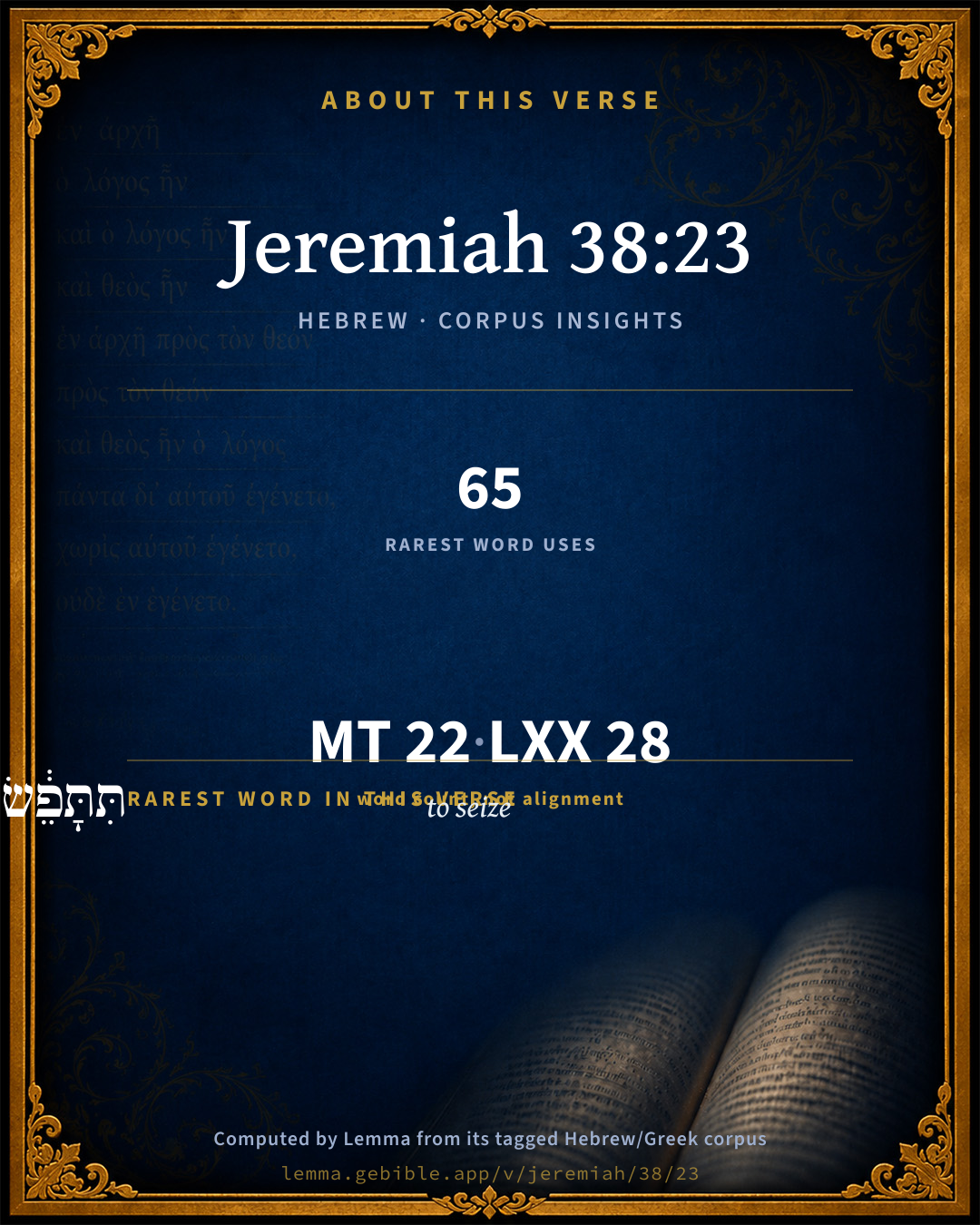
These counts appear in no published source. They are computed here, from the morphology-tagged text and Lemma’s own curated glosses. What Lemma adds →

22
words
19
distinct lemmas
Prophets
section

Grammatical profile

  • 4 verbs
  • 10 nouns
  • 2 pronouns
  • 1 preposition
  • 1 conjunction
  • 4 particles

Verb forms

  • מֽוֹצִאִים֙ Hiphil · Participle Active
  • תִמָּלֵ֣ט Niphal · Imperfect
  • תִּתָּפֵ֔שׂ Niphal · Imperfect
  • תִּשְׂרֹ֥ף Qal · Imperfect

Repetition

A word recurs within this verse — often emphatic in Hebrew:

  • מִיָּדָ֑ם hand H3027 ×2

Hebrew & Septuagint length

In the original languages it is 22 Hebrew tokens and 28 Greek tokens — but the two are counted differently (Hebrew bundles its prefixes and suffixes into one token; the Greek is in lemma form), so that isn’t a like-for-like length.

Cross-references

9

Topical passages linked to Jeremiah 38:23 in the Treasury of Scripture Knowledge — connected by theme and wording, ordered by reader-vote popularity; previews shown in the World English Bible.

  • Jeremiah 41:10 Then Ishmael carried away captive all the residue of the people who were in Mizpah, even the king's daughters, and all the people who remained in Mizpah, whom Nebuzaradan the captain of the guard had committed to Gedaliah the son of Ahikam; Ishmael the son of Nethaniah carried them away captive, and departed to go over to the children of Ammon.
  • Jeremiah 38:18 But if you will not go forth to the king of Babylon's princes, then shall this city be given into the hand of the Chaldeans, and they shall burn it with fire, and you shall not escape out of their hand.
  • Jeremiah 39:6 Then the king of Babylon killed the sons of Zedekiah in Riblah before his eyes: also the king of Babylon killed all the nobles of Judah.
  • 2 Kings 25:7 They killed the sons of Zedekiah before his eyes, and put out the eyes of Zedekiah, and bound him in fetters, and carried him to Babylon.
  • 2 Chronicles 36:20–21 Those who had escaped from the sword carried he away to Babylon; and they were servants to him and his sons until the reign of the kingdom of Persia:
  • Jeremiah 27:12–13 I spoke to Zedekiah king of Judah according to all these words, saying, Bring your necks under the yoke of the king of Babylon, and serve him and his people, and live.
  • Jeremiah 52:8–13 But the army of the Chaldeans pursued after the king, and overtook Zedekiah in the plains of Jericho; and all his army was scattered from him.
  • Ezekiel 14:9 If the prophet be deceived and speak a word, I, Yahweh, have deceived that prophet, and I will stretch out my hand on him, and will destroy him from the midst of my people Israel.
  • Ezekiel 43:3 It was according to the appearance of the vision which I saw, even according to the vision that I saw when I came to destroy the city; and the visions were like the vision that I saw by the river Chebar; and I fell on my face.

Cross-references courtesy of OpenBible.info (CC BY 4.0).

Hebrew and Greek witnesses Masoretic Hebrew ↔ Greek Septuagint

The same verse in the two great witnesses to the Old Testament, shown verse-for-verse.

These are two independent witnesses, not word-aligned to each other, and the Septuagint is shown in lemma (dictionary) form.

Hebrew Jeremiah 38:23 Masoretic · Westminster Leningrad Codex

וְאֶת כָּל נָשֶׁ֣יךָ וְאֶת בָּנֶ֗יךָ מֽוֹצִאִים֙ אֶל הַכַּשְׂדִּ֔ים וְאַתָּ֖ה לֹא תִמָּלֵ֣ט מִיָּדָ֑ם כִּ֣י בְיַ֤ד מֶֽלֶךְ בָּבֶל֙ תִּתָּפֵ֔שׂ וְאֶת הָעִ֥יר הַזֹּ֖את תִּשְׂרֹ֥ף בָּאֵֽשׁ

They shall bring out all your wives and your children to the Chaldeans; and you shall not escape out of their hand, but shall be taken by the hand of the king of Babylon: and you shall cause this city to be burned with fire.

World English Bible · Public Domain

Greek LXX Structure differs

In the Septuagint, Jeremiah is about an eighth shorter than the Hebrew and arranges its material differently — the Oracles Against the Nations (Hebrew chapters 46–51) appear in the middle of the Greek book, after 25:13. Because the chapter and verse boundaries do not line up, a verse-for-verse comparison with the Hebrew is not shown.

A verse-for-verse comparison isn’t shown here because the chapters and verses don’t line up. Switch to the LXX edition with the MT / LXX toggle above to read the Greek directly.

On this verse, The Pulpit Commentary discusses the Septuagint’s reading. Read the note in Commentary ↓

Hebrew: Westminster Leningrad Codex (CC BY 4.0). Greek: Septuagint (public domain); English from a public-domain English Septuagint. How the Septuagint differs from the Hebrew →

Targum (Aramaic paraphrase)

1

The Targum is the ancient Jewish Aramaic paraphrase of the Hebrew Scriptures — an interpretive translation, not the Hebrew text itself. Onkelos (literal) and Pseudo-Jonathan (expansive) render the Torah, and Jonathan the Prophets. Coverage is partial: where no permissively-licensed English translation exists for a verse, only the Aramaic is shown. This is verse-level text, not a word-by-word alignment to the Hebrew.

  1. Targum Jonathan Prophets (Joshua–Malachi)
    וְיַת כָּל נְשָׁךְ וְיַת בְּנָךְ מִתַּפְקִין לְוַת כַּסְדָאֵי וְאַתְּ לָא תִשְׁתֵּיזֵיב מִיָדְהוֹן אֲרֵי בְיַד מַלְכָּא דְבָבֶל תִּתְמַסֵר וְיַת קַרְתָּא הָדָא תִּתּוֹקָד בְּנוּרָא:

    (no public-domain English translation for this verse)

    Targum Jonathan — Aramaic: “Mikraot Gedolot” (public domain). English: “Sefaria Community Translation” (CC0 1.0 (public-domain dedication)); “London "Chaldee Paraphrase," 1871” (public domain). Text via Sefaria.

Commentary

Notes on Jeremiah 38:23 from classic Christian and Jewish commentators (each source and its license shown beneath its notes). The classic Christian expositions comment on the surrounding passage and are grouped to its opening verse, so a note may address several verses; the Jewish commentaries on the Tanakh (Rashi and others) are per-verse, so they appear only where the commentator wrote on this verse.

Lemma curates 59 commentaries, every one of them public domain or Creative Commons licensed, each selected and text-cleaned for this edition rather than reprinted as found. About our sources →

Trapp's Complete Commentary

John Trapp

Jer 38:23 So they shall bring out all thy wives and thy children to the Chaldeans: and thou shalt not escape out of their hand, but shalt be taken by the hand of the king of Babylon: and thou shalt cause this city to be burned with fire.

Ver. 23. So shall they bring out all thy wives and thy children.] Or, Thy women (whether wives or concubines, that crew of wanton creatures) and thy sons; for his daughters were left behind. {Jer 41:10; Jer 43:6} If, therefore, thou hast any care of those that are, or ought to be, most dear unto thee, be ruled by me.

And thou shalt cause this city to be burnt with fire.] Heb., Thou shalt burn this city:

“ Quicquid delirant reges, plectuntur Achivi. ”

John Trapp, A Commentary or Exposition upon All the Books of the Old and New Testament (1647–1656) — public domain. Text from a community e-Sword module.

Jamieson, Fausset & Brown

Robert Jamieson, A. R. Fausset & David Brown

children-- (Jer 39:6; Jer 41:10). "wives . . . children . . . thou"; an ascending climax.

Jamieson, Fausset & Brown — Commentary Critical and Explanatory on the Whole Bible (1871) — public domain (CC PDM 1.0). Text via the HelloAO Bible API.

Adam Clarke's Commentary

Verse 23. They shall bring out all thy wives and thy children] These were the women of the first rank, by whom the king had children. These had no temptation to go out to the Chaldeans, nor would they have been made welcome; but the others being young, and without children, would be well received by the Chaldean princes.

Adam Clarke's Commentary on the Bible (1810–1826) — public domain. Text from a community e-Sword/MySword module.

John Calvin's Commentaries

Jeremiah pursues the same subject; but he sets forth at large the calamity, that the king being at least frightened with horror, might submit to a right counsel; for when we hear that death is at hand, this indeed fills us with horror; and when many evils are mentioned, we must necessarily be roused; and this, no doubt, was what the Prophet looked for. Then he says that Zedekiah would come into the hands of his enemies, hut he adds other indignities, which would bring greater bitterness, They shall draw out, he says, all thy wives and thy children, etc. Had Zedekiah been right-minded, he would have preferred to die a hundred times, and thus to have died for them all, than to have been the cause of so many evils. For we know that many have boldly exposed themselves to danger in defending the chastity of their wives; and doubtless such a reproach is far harder to be endured by ingenuous minds than a hundred deaths. We hence see what was the design of the Prophet; for he saw that Zedekiah could not be sufficiently roused by merely setting his own death before him, hence he added other circumstances, calculated to affect him still more, They shall draw out, he says, thy wives and thy children

We hence learn how conjugal fidelity was then with impunity violated. It was, we know, an ancient evil, but it had now passed into general practice, so that it was, as it were, the common law: and yet what God had once established continued unchanged, even that every man should have only his own wife. As, then, polygamy had so prevailed and had become so licentious among the Jews, we see that the fear of God was in fact extinguished and all regard to purity. More liberty was indeed allowed to kings, but they were not on that account to be excused, because their life ought to have been an example to others, a mirror of uprightness and chastity. When, therefore, they married a number of wives, it became an intolerable evil. And now when mention is made of all the wives, we conclude that the king had not only three or four wives or concubines, but a large number, that he might gratify his lust. hence then we learn how great was the corruption of that age. It is also a wonder that the king was thus given to his lusts, and not brought back to some degree of moderation when necessity itself constrained him. We hence see that he must have been extremely insensible in retaining so many concubines, when his only city was hardly safe, and the whole country in the possession of enemies. But thus perverse men despise God and his scourges. For though all confess, according to the common proverb, that necessity is a mistress whom all are forced to obey, yet the greater part struggle with necessity itself, as we see was the case with Zedekiah, who refused to bend or turn, though very poor and miserable, and who suffered nothing of his royal pomp and splendor to be diminished. Hence it was that he had a large number of wives or concubines, as mentioned here.

It then follows, This city shalt thou burn with fire It is certain that the torch was not applied by Zedekiah, nor was he the agent in the burning. But the Prophet reminded him that the cause of all the evils might justly be attributed to his obstinacy; as though he had said, that the Chaldeans would indeed be the authors of the burning, as they would with their own hands set the houses on fire, and yet that the first and the chief fault would be in Zedekiah himself, because he obstinately resisted God.

But as to the women, this brief notice must be added: other kings, indeed, had been very dissolute; but God now applied the remedy when the court was purged from all its old filth. For with Jeconiah, we know, the royal dignity ceased; and the city was exposed to plunder; and yet some concubines remained; and these passed as by hereditary right to other kings, as they succeeded to the wives as to the kingdom. But when wickedness became incorrigible, all the concubines were taken away also. It was then a sign of final destruction. It follows —

John Calvin's Commentaries (1540-1563) — public domain. Text from the Calvin Translation Society English edition (1840s-50s) via the Christian Classics Ethereal Library (ccel.org). Calvin's coverage is partial (roughly two-thirds of the Bible); uncommented books and verses are honest gaps, never fabricated. The 19th-century editor's footnotes and remarks are omitted so the notes are faithfully Calvin's own voice.

Ellicott's Commentary for English Readers

(23) So they shall bring out . . .—The picture of defeat and destruction is once more repeated from Jer_38:18. Probably, the last clause should be read with a different punctuation of the Hebrew, “This city shall be burnt with fire.” As the text now stands, the marginal rendering, Thou shalt burn, gives the true force of the word. The king himself would have that destruction to answer for. It would be his own act and deed.

(24–26) Let no man know . . .—The weak king vacillated to the last moment. He feared the prophet, he feared the princes yet more. To hush up all that had passed in the interview, to urge the prophet to baffle the eager suspicions of the princes by a prevaricating statement, as if it had been he who had sought the meeting, and had petitioned the king, as before (Jer_37:20), to protect him from the cruelties which he had suffered in the house of Jonathan: this was the only course he could bring himself to follow. The plan so far succeeded that the prophet returned and gave the evasive answer which the king suggested. The nature of the interview was concealed, and events took their course; and Jeremiah remained in the court of the prison till the city was taken. The king’s suggestion as to the house of Jonathan implies either that he believed that the princes would urge that Jeremiah should be sent there after his rescue from the dungeon of Malchiah, or else a wish to slur over that transaction altogether.

A Bible Commentary for English Readers, edited by Charles John Ellicott (1878–1897) — public domain. Text from a community e-Sword module.

The Cambridge Bible for Schools and Colleges

gen. ed. J. J. S. Perowne

23. And they] Du. considers this v. an insertion, as adding nothing to what has been said already.

thou shalt cause, etc.] Heb. more forcibly, thou shalt burn, etc. This suits the parallelism better. Zedekiah through his obstinacy shall be as much the cause, as if he had set fire to Jerusalem with his own hands.

The Cambridge Bible for Schools and Colleges (gen. ed. J. J. S. Perowne; Cambridge University Press, 1878–1918) — public domain. Text from a community e-Sword module.

John Gill's Exposition

So they shall bring out all thy wives and thy children to the Chaldeans,.... Not the citizens of Jerusalem; but, as Kimchi observes, the Chaldeans that should enter the city shall bring them out to the Chaldeans without: or it may be rendered impersonally, "they shall be brought out": not only the ladies at court, that waited on him and his queen, as before; but all his wives and concubines, and his children, or his sons rather; for at the taking of the city no mention is made of daughters, only of sons, who were slain before his eyes, Jer 39:6;

and thou shalt not escape out of their hand, but shalt be taken by the hand of the king of Babylon; not by him personally, for he was not present at the taking of him, but by his army, who having taken him, brought him to him, and delivered him into his hand, Jer 39:5;

and thou shalt cause this city to be burnt with fire; or, "thou shall burn this city with fire" (b); be the moral cause of it; through his sin and obstinacy, impenitence and unbelief, the burning of the city might be laid to his charge; his sin was the cause of it; and it was all one as if he had burnt it with his own hands. All this is said to work upon him to hearken to the advice given; but all was in vain.

(b) "combures igne", Vatablus, Schmidt; "cremabis in igne", Montanus.

John Gill's Exposition of the Whole Bible (1746–1763) — public domain (CC PDM 1.0). Text via the HelloAO Bible API.

Albert Barnes' Notes on the Bible

So - And. In addition to the ridicule there shall be the miseries of the capture.

Thou shalt cause this city to be burned - literally, as margin. It shall be thy own act as completely as if done with thine own hand.

Albert Barnes' Notes on the Bible (1834–1885) — public domain. Text from a community e-Sword/MySword module.

Matthew Poole's English Annotations

This is no more than what was said before, only here repeated, as an argument to persuade his obedience in surrendering himself, if not for the city’s sake, yet for his own sake, and for his children’s sake; for he assures the king that not himself only, but his wives and children also, would otherwise fall into the hands of the Babylonians, and their reflections upon him for the misery he had brought upon them would be no small aggravation of his affliction.

Matthew Poole's English Annotations on the Holy Bible (1683–1685) — public domain. Text from a community e-Sword/MySword module.

The Pulpit Commentary

So they, etc.; rather, and they, etc. The women spoken of are different from those in ver. 22. Thou shalt cause this city to be burned. The literal rendering (see margin) is, Thou shalt burn this city; but the Septuagint, Peshito, and Targum have "As for this city it shall be burned," which suits the parallelism better.

The end of Zedekiah"s irresolution.

Irresolution it may be called rather than disobedience. There is nothing to show that he had definitely made up his mind not to obey the voice of the Lord. In spite of the clear announcement made to him, he seems to have gone on, hoping against hope that some decisive disaster would overtake the Chaldeans. Yet Jeremiah closes his address by this sentence, so well calculated to bring even an irresolute man to decision: "Thou shalt cause this city to be burned with fire.

I A DECLARATION OF PERSONAL RESPONSIBILITY. Already in ver. 18 there is the declaration that the Chaldeans will burn the city with fire, and Zedekiah is well able to infer, if he likes, that this is a calamity he may prevent. But he is not left to inference. The prophet"s exhortation goes on, maintaining its cogency and directness, and then in the last word he individually is made responsible. The sting of the address is emphatically in the tail. Zedekiah is now brought face to face with his obligations as a king. Jeremiah could not have said to any one else," Thou shalt cause this city to be burned with fire," because no one else could have set in train the course of events which would avert such a calamity. Here is an example to teach those who are tempted to envy the grandeur of kings and the fame of such as are ruling men in a state. Zedekiah"s decision affected not himself only, or a few people, but a whole city. The responsibility was further increased by his having sent for the prophet who said this very thing. It is not every ruler who at a critical moment has his way made so clear as was the way of Zedekiah here. How much in the way of preventing evil may depend on one single man!

II MATTER IS FURNISHED TO EMBITTER THE REFLECTIONS OF THE FUTURE. Whether Zedekiah saw the blazing city we cannot be sure. If he did, what a pang for his heart to think that the city where he was king, in which he and his ancestors had taken such pride, was burning, through his want of decision at a critical time! He feared to do what looked unpatriotic, and in the end he virtually destroyed the city he might have saved.

III THERE WAS A LIMIT TO ZEDEKIAH"S POWER OVER THE SITUATION. Truly it was a great deal for one man to be able to do either to save a city from the flames or hand it over to them. But this power only looks great according to the standard given by temporal and superficial relations. An almost boundless area for human powers and opportunities lay altogether outside of Zedekiah"s reach. As man is unable purely by his own effort to confer the highest benefits on his fellow man, so he is also unable to inflict the worst evil. The worst evils are ever self-originated. Zedekiah did far more to hurt himself than any one else. Jeremiah had been charged to make it quite clear to every one that he who went forth to the Chaldeans should live. Y.

The Pulpit Commentary (1880–1919), ed. H.D.M. Spence-Jones & Joseph S. Exell — public domain. Text from a community e-Sword module.

Rashi

Rabbi Shlomo Yitzchaki (Rashi)

and this city you shall burn with fire It is as though you are burning it with your hands for you are causing it.

Rashi on the Tanakh — English translations: “The Judaica Press complete Tanach with Rashi, translated by A. J. Rosenberg” (CC BY 4.0); “Pentateuch with Rashi's commentary by M. Rosenbaum and A.M. Silbermann, 1929-1934” (public domain); “The Metsudah Tanach series, Lakewood, N.J” (CC BY 4.0); and “The Book of Joshua, Metsudah Publications, 1997” (CC BY 4.0). Text via Sefaria.

Lesson kit

Teaching starters — assembled from the data on this page, not authored interpretation. Every prompt links to the verse data it draws on. Edit before teaching.

Jeremiah, in the Prophets, opens this verse with 22 words (19 distinct Hebrew lemmas). Its most distinctive word is tâphas (“to seize”). A historical commentator’s framing appears above. Read the whole chapter for the surrounding context.

Discussion questions

  1. What does “to seize” (tâphas) contribute to the verse as a whole?
  2. How does Jeremiah 41:10, which shares this passage’s theme, read alongside this verse?
  3. What does the repetition of “hand” (2× in this one verse) do in this verse?
  4. These translations render this verse differently; the difference is in the English rendering, not the original. What questions does that raise?
  5. «מֽוֹצִאִים֙» is a Hiphil Participle Active verb. How does that grammatical form shape the action described?
  6. Compare how Trapp's Complete Commentary and Jamieson, Fausset & Brown read this verse. Where do they agree or differ?

Things to notice

Reading settings

Reading text

Shown beneath each verse's original-language words.

Old Testament
Old Testament edition

Read the OT as the Masoretic Hebrew (MT) or the Greek Septuagint (LXX).

English shown for the Greek Septuagint (in the Hebrew ↔ Greek comparison).

Comparing translations? Open the Compare panel on any verse page to stack up to four side by side.