
Ezekiel 16:41

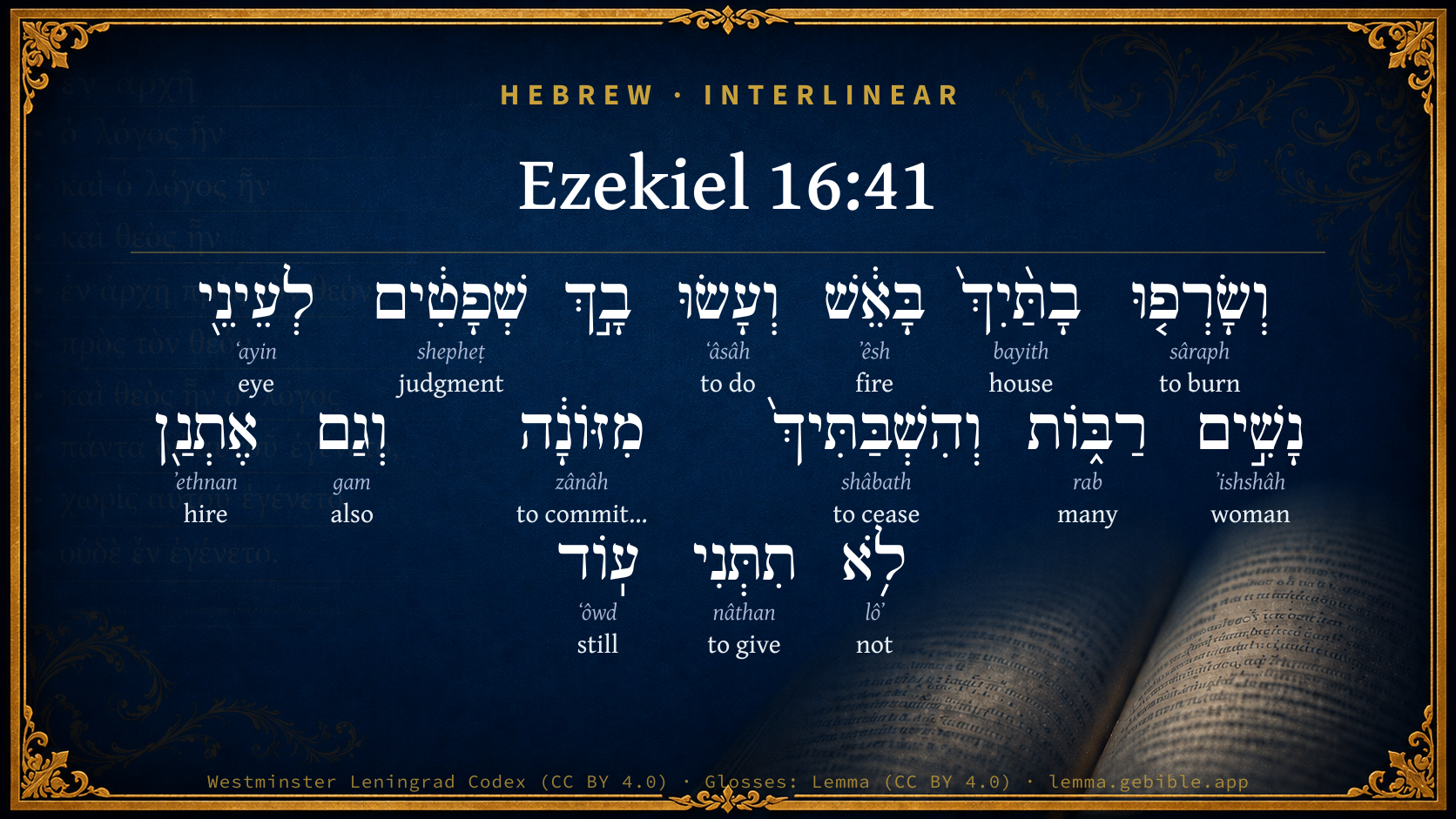
Hebrew (Westminster Leningrad Codex) Ezekiel 16:41 appears in the Hebrew Old Testament. The text above is from the Westminster Leningrad Codex. Each word links to its Strong’s number, a concise gloss, and parsing drawn from the Open Scriptures Hebrew Bible morphology. Click any word for its full Brown-Driver-Briggs (BDB) entry.
Download image
Cite this verse

Ezekiel 16:41 (World English Bible). Public Domain. Lemma interlinear Bible study tool, https://lemma.gebible.app/v/ezekiel/16/41.

Show BibTeX & RIS
BibTeX
RIS
English Translation
They shall burn your houses with fire, and execute judgments on you in the sight of many women; and I will cause you to cease from playing the prostitute, and you shall also give no hire any more.
World English Bible · Public Domain
Download a study sheet

One document with this verse’s original text, its word-by-word gloss line, the meaning frame, cross-references with their text, attributed commentary, and full source and license credits — printable, and it pastes into notes with its structure intact.

This verse Autodidact and up

Study sheet (.html) Plain text (.txt)

A passage Seminary Student

Up to 50 verses in one chapter. A passage sheet keeps up to 6 commentary sources and 12 cross-references per verse, in the order this page ranks them, and says so on the sheet whenever that leaves anything out. Ask for a single verse and you get the Autodidact verse sheet above.

Everything on this page stays free to read, with no account — the sheet is a download of what is already on screen, not access to it.

Want to remove ads? Support Godless Engineer
Compare translations 3

The same verse in 3 English versions, stacked beneath the original-language interlinear above. Click any original word for its lexicon entry.

Each is an independent rendering of the whole verse — the interlinear is not word-aligned to these translations.

Highlighted words mark where these versions differ — a whole-verse word diff, not a word-by-word alignment.

  • World English Bible Public Domain
    They shall burn your houses with fire, and execute judgments on you in the sight of many women; and I will cause you to cease from playing the prostitute, and you shall also give no hire any more.
  • King James Version Public Domain
    And they shall burn thine houses with fire, and execute judgments upon thee in the sight of many women: and I will cause thee to cease from playing the harlot, and thou also shalt give no hire any more.
  • unfoldingWord Literal Text CC BY-SA 4.0
    They will burn your houses and will perform many acts of punishment on you in the sight of many women, for I will put a stop to your prostitution, and you will no longer pay your lovers.

unfoldingWord Literal Text — © unfoldingWord, licensed CC BY-SA 4.0. Word-aligned USFM3 via Door43 (git.door43.org/unfoldingWord/en_ult).

Versions to compare (up to 4)

3 of 4 selected

Show all 18 translations

Every available English version of this verse, each an independent rendering of the whole verse.

  • World English Bible Public Domain
    They shall burn your houses with fire, and execute judgments on you in the sight of many women; and I will cause you to cease from playing the prostitute, and you shall also give no hire any more.
  • Berean Standard Bible Public Domain
    Then they will burn down your houses and execute judgment against you in the sight of many women. I will put an end to your prostitution, and you will never again pay your lovers.
  • Majority Standard Bible Public Domain
    Then they will burn down your houses and execute judgment against you in the sight of many women. I will put an end to your prostitution, and you will never again pay your lovers.
  • King James Version Public Domain
    And they shall burn thine houses with fire, and execute judgments upon thee in the sight of many women: and I will cause thee to cease from playing the harlot, and thou also shalt give no hire any more.
  • American Standard Version (1901) Public Domain
    And they shall burn thy houses with fire, and execute judgments upon thee in the sight of many women; and I will cause thee to cease from playing the harlot, and thou shalt also give no hire any more.
  • Revised Version (1885) Public Domain
    And they shall burn thine houses with fire, and execute judgments upon thee in the sight of many women; and I will cause thee to cease from playing the harlot, and thou shalt also give no hire any more.
  • Geneva Bible (1599) Public Domain
    And they shall burne vp thine houses with fire, and execute iudgements vpon thee in the sight of many women: and I will cause thee to cease from playing the harlot, and thou shalt giue no reward any more.
  • Douay-Rheims (1899) Public Domain
    ,41And they shall burn thy houses with fire, and shall execute judgments upon thee in the sight of many women: and thou shalt cease from fornication, and shalt give no hire any more.
  • Young's Literal Translation Public Domain
    And burnt thy houses with fire, And done in thee judgments before the eyes of many women, And I have caused thee to cease from going a-whoring, And also a gift thou givest no more.
  • Literal Standard Version CC BY-SA 4.0
    And burned your houses with fire, || And done judgments in you before the eyes of many women, || And I have caused you to cease from going whoring, || And also, you no longer give a wage.
  • Unlocked Literal Bible CC BY-SA 4.0
    They will burn your houses and will perform many acts of punishment on you in the sight of many women, for I will put a stop to your prostitution, and you will no longer pay your lovers.
  • unfoldingWord Literal Text CC BY-SA 4.0
    They will burn your houses and will perform many acts of punishment on you in the sight of many women, for I will put a stop to your prostitution, and you will no longer pay your lovers.
  • Darby Bible Public Domain
    And they shall burn thy houses with fire, and execute judgments upon thee in the sight of many women; and I will cause thee to cease from being a harlot, and thou also shalt give no more any reward.
  • World Messianic Bible Public Domain
    They will burn your houses with fire, and execute judgments on you in the sight of many women. I will cause you to cease from playing the prostitute, and you will also give no hire any more.
  • Webster's Bible Public Domain
    And they shall burn thy houses with fire, and execute judgments upon thee in the sight of many women: and I will cause thee to cease from playing the harlot, and thou also shalt give no hire any more.
  • Free Bible Version CC BY-SA 4.0
    They will burn down your houses and punish you while many women watch. I will stop your prostitution, and you won't ever pay your lovers again.
  • Bible in Basic English Public Domain
    And they will have you burned with fire, sending punishments on you before the eyes of great numbers of women; and I will put an end to your loose ways, and you will no longer give payment.
  • JPS Tanakh (1917) Public Domain
    And they shall burn thy houses with fire, and execute judgments upon thee in the sight of many women; and I will cause thee to cease from playing the harlot, and thou shalt also give no hire any more.

Literal Standard Version (2020), Covenant Press — licensed CC BY-SA 4.0. Text via the HelloAO Bible API (eBible.org). Unlocked Literal Bible (unfoldingWord) — licensed CC BY-SA 4.0. Text via the HelloAO Bible API (eBible.org). unfoldingWord Literal Text — © unfoldingWord, licensed CC BY-SA 4.0. Word-aligned USFM3 via Door43 (git.door43.org/unfoldingWord/en_ult). Free Bible Version, Dr. Jonathan Gallagher — licensed CC BY-SA 4.0. Text via the HelloAO Bible API (eBible.org).

Word by word

More ways to search: Search by grammar → Find every occurrence → Compare this word →

Practice this passage: Drill this verse → Learn its vocabulary →

אֶתְנַ֖ן
ʼethnan
H868
“hire”
Noun, Common, Masculine, Singular, Absolute
Part of Speech
Noun
Type
Common
Gender
Masculine
Number
Singular
State
Absolute
Full BDB Definition

Origin: the same as H866

TWOT: 2529a

hire of prostitute, price - hire (of harlot) - of idolatrous Israel, Jerusalem, Tyre (figuratively)
  1. וְשָׂרְפ֤וּ sâraph H8313 “and · to burn” Conjunction + Verb, Qal, Sequential Perfect, 3rd Person, Common, Plural
  2. בָתַּ֨יִךְ֙ bayith H1004 “houses · your” Noun, Common, Masculine, Plural, Construct + Suffix, Personal, 2nd Person, Feminine, Singular
  3. בָּאֵ֔שׁ ʼêsh H784 “in/at the · fire” Preposition, Determined + Noun, Common, Both, Singular, Absolute
  4. וְעָשׂוּ ʻâsâh H6213 “and · to do” Conjunction + Verb, Qal, Sequential Perfect, 3rd Person, Common, Plural
  5. שְׁפָטִ֔ים shepheṭ H8201 “judgments” Noun, Common, Masculine, Plural, Absolute
  6. לְעֵינֵ֖י ʻayin H5869 “to/for · eyes of” Preposition + Noun, Common, Both, Dual, Construct
  7. נָשִׁ֣ים ʼishshâh H802 “women” Noun, Common, Feminine, Plural, Absolute
  8. רַבּ֑וֹת rab H7227 “many” Adjective, Adjective, Feminine, Plural, Absolute
  9. וְהִשְׁבַּתִּיךְ֙ shâbath H7673 “and · to cease · you” Conjunction + Verb, Hiphil, Sequential Perfect, 1st Person, Common, Singular + Suffix, Personal, 2nd Person, Feminine, Singular
  10. מִזּוֹנָ֔ה zânâh H2181 “from · committing fornication” Preposition + Verb, Qal, Participle Active, Feminine, Singular, Absolute
  11. וְגַם gam H1571 “and · also” Conjunction + Particle, Accusative
  12. לֹ֥א lôʼ H3808 “not” Particle, Negative
  13. תִתְּנִי nâthan H5414 “to give” Verb, Qal, Imperfect, 2nd Person, Feminine, Singular
  14. עֽוֹד ʻôwd H5750 “still” Adverb

About this verse

These counts appear in no published source. They are computed here, from the morphology-tagged text and Lemma’s own curated glosses. What Lemma adds →

16
words
15
distinct lemmas
Prophets
section

Notable vocabulary

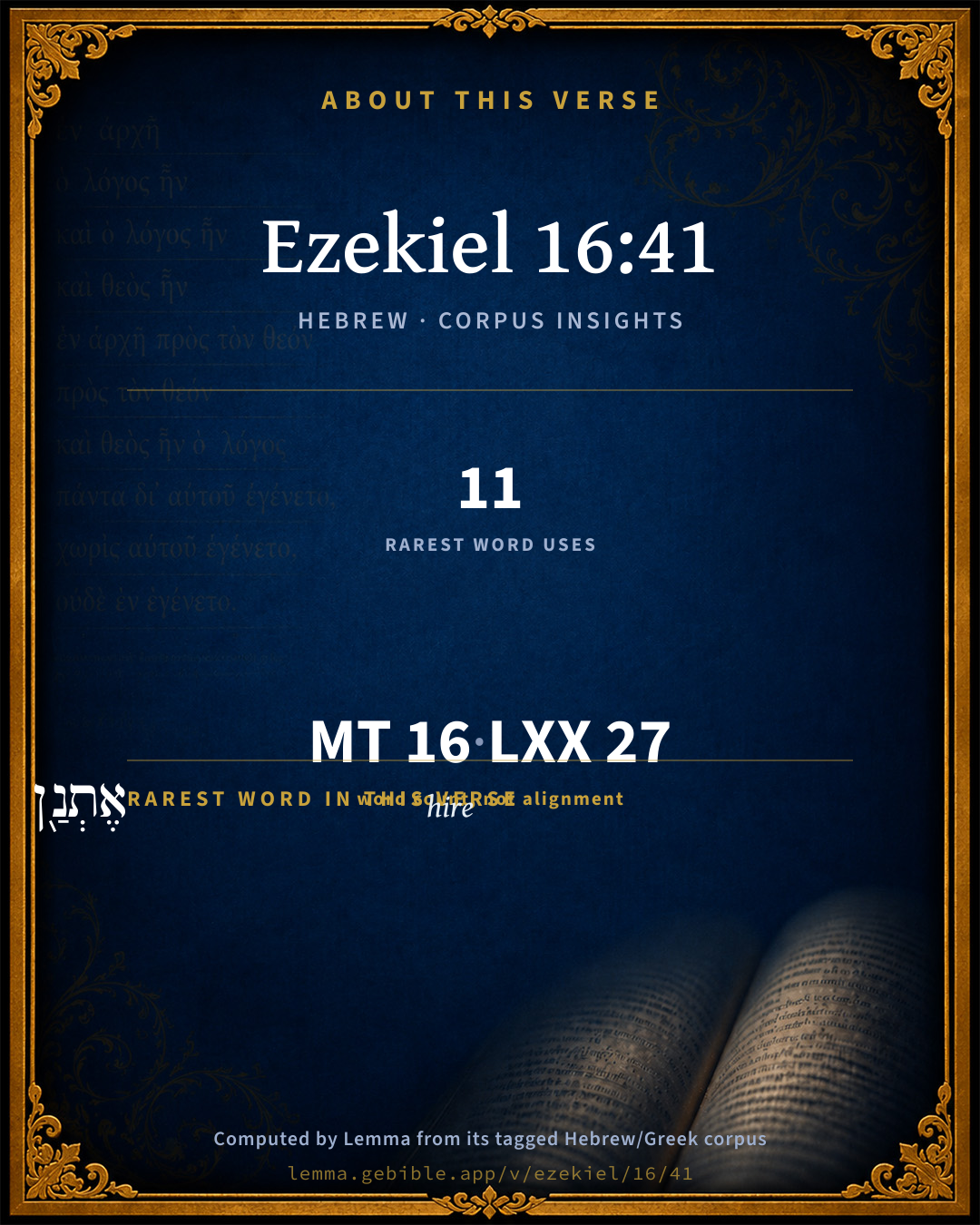
The rarest word here is אֶתְנַ֖ן hire H868 — appearing just 11 times in the whole Hebrew Bible.

Shared distinctive vocabulary

אֶתְנַ֖ן hire H868 occurs in 8 verses of the Hebrew Bible. Also found in:

Grammatical profile

  • 5 verbs
  • 6 nouns
  • 1 adjective
  • 1 preposition
  • 1 adverb
  • 2 particles

Verb forms

  • וְשָׂרְפ֤וּ Qal · Sequential Perfect
  • וְעָשׂוּ Qal · Sequential Perfect
  • וְהִשְׁבַּתִּיךְ֙ Hiphil · Sequential Perfect
  • מִזּוֹנָ֔ה Qal · Participle Active
  • תִתְּנִי Qal · Imperfect

Hebrew & Septuagint length

In English translation the verse runs 38 words from the Hebrew and 36 from the Septuagint (LXX English) — closely comparable.

A rough comparison of the two English renderings, which tokenize alike — not a word-level alignment.

Word counts can differ between the Hebrew and the Greek without any difference in meaning — e.g. the Hebrew direct-object marker אֵת has no separate Greek word, and Greek often adds the article ὁ.

In the original languages it is 16 Hebrew tokens and 27 Greek tokens — but the two are counted differently (Hebrew bundles its prefixes and suffixes into one token; the Greek is in lemma form), so that isn’t a like-for-like length.

Cross-references

21

Topical passages linked to Ezekiel 16:41 in the Treasury of Scripture Knowledge — connected by theme and wording, ordered by reader-vote popularity; previews shown in the World English Bible.

  • Ezekiel 23:48 Thus will I cause lewdness to cease out of the land, that all women may be taught not to do after your lewdness.
  • 2 Kings 25:9 He burnt the house of Yahweh, and the king's house; and all the houses of Jerusalem, even every great house, burnt he with fire.
  • Jeremiah 39:8 The Chaldeans burned the king's house, and the houses of the people, with fire, and broke down the walls of Jerusalem.
  • Jeremiah 52:13 and he burned the house of Yahweh, and the king's house; and all the houses of Jerusalem, even every great house, burned he with fire.
  • Ezekiel 23:27 Thus will I make your lewdness to cease from you, and your prostitution [brought] from the land of Egypt; so that you shall not lift up your eyes to them, nor remember Egypt any more.
  • Deuteronomy 13:16 You shall gather all the spoil of it into the midst of the street of it, and shall burn with fire the city, and all the spoil of it every whit, to Yahweh your God: and it shall be a heap forever; it shall not be built again.
  • Ezekiel 5:8 therefore thus says the Lord Yahweh: Behold, I, even I, am against you; and I will execute judgments in the midst of you in the sight of the nations.
  • Ezekiel 23:10 These uncovered her nakedness; they took her sons and her daughters; and her they killed with the sword: and she became a byword among women; for they executed judgments on her.
  • Deuteronomy 13:11 All Israel shall hear, and fear, and shall not do any more such wickedness as this is in the midst of you.
  • Deuteronomy 22:21 then they shall bring out the young lady to the door of her father's house, and the men of her city shall stone her to death with stones, because she has done folly in Israel, to play the prostitute in her father's house: so shall you put away the evil from the midst of you.
  • Deuteronomy 22:24 then you shall bring them both out to the gate of that city, and you shall stone them to death with stones; the lady, because she didn't cry, being in the city; and the man, because he has humbled his neighbor's wife: so you shall put away the evil from the midst of you.
  • Job 34:26 He strikes them as wicked men In the open sight of others;
  • Isaiah 1:25–26 And I will turn my hand on you, Thoroughly purge away your dross, And will take away all your tin.
  • Isaiah 2:18 The idols shall utterly pass away.
  • Isaiah 27:9 Therefore by this shall the iniquity of Jacob be forgiven, and this is all the fruit of taking away his sin: that he makes all the stones of the altar as chalk stones that are beaten in sunder, [so that] the Asherim and the sun-images shall rise no more.
  • Ezekiel 37:23 neither shall they defile themselves any more with their idols, nor with their detestable things, nor with any of their transgressions; but I will save them out of all their dwelling-places, in which they have sinned, and will cleanse them: so shall they be my people, and I will be their God.
  • Hosea 2:6–17 Therefore, behold, I will hedge up your way with thorns, And I will build a wall against her, That she can't find her way.
  • Micah 3:12 Therefore Zion for your sake will be plowed like a field, And Jerusalem will become heaps of rubble, And the mountain of the temple like the high places of a forest.
  • Micah 5:10–14 "It will happen in that day," says Yahweh, "That I will cut off your horses out of the midst of you, And will destroy your chariots.
  • Zechariah 13:2 It will come to pass in that day, says Yahweh of Hosts, that I will cut off the names of the idols out of the land, and they will no more be remembered; and also I will cause the prophets and the spirit of impurity to pass out of the land.
  • 1 Timothy 5:20 Those who sin, reprove in the sight of all, that the rest also may be in fear.

Cross-references courtesy of OpenBible.info (CC BY 4.0).

Hebrew and Greek witnesses Masoretic Hebrew ↔ Greek Septuagint

The same verse in the two great witnesses to the Old Testament, shown verse-for-verse.

These are two independent witnesses, not word-aligned to each other, and the Septuagint is shown in lemma (dictionary) form.

Hebrew Ezekiel 16:41 Masoretic · Westminster Leningrad Codex

וְשָׂרְפ֤וּ בָתַּ֨יִךְ֙ בָּאֵ֔שׁ וְעָשׂוּ בָ֣ךְ שְׁפָטִ֔ים לְעֵינֵ֖י נָשִׁ֣ים רַבּ֑וֹת וְהִשְׁבַּתִּיךְ֙ מִזּוֹנָ֔ה וְגַם אֶתְנַ֖ן לֹ֥א תִתְּנִי עֽוֹד

They shall burn your houses with fire, and execute judgments on you in the sight of many women; and I will cause you to cease from playing the prostitute, and you shall also give no hire any more.

World English Bible · Public Domain

Greek LXX Ezekiel 16:41 Septuagint · lemma form

καί ἐνπίμπρημι ὁ οἶκος σύ πῦρ καί ποιέω ἐν σύ ἐκδίκησις ἐνώπιον γυνή πολύς καί ἀποστρέφω σύ ἐκ ὁ πορνεία σύ καί μίσθωμα οὐ μή δίδωμι οὐκέτι

And they shall burn your houses with fire, and shall execute vengeance on you in the sight of many women: and I will turn you back from harlotry, and I will no more give you rewards.

LXX2012 (modern English Septuagint) · Public Domain

Hebrew: Westminster Leningrad Codex (CC BY 4.0). Greek: Septuagint (public domain); English from LXX2012 (modern English Septuagint) (Public Domain). How the Septuagint differs from the Hebrew →

Targum (Aramaic paraphrase)

1

The Targum is the ancient Jewish Aramaic paraphrase of the Hebrew Scriptures — an interpretive translation, not the Hebrew text itself. Onkelos (literal) and Pseudo-Jonathan (expansive) render the Torah, and Jonathan the Prophets. Coverage is partial: where no permissively-licensed English translation exists for a verse, only the Aramaic is shown. This is verse-level text, not a word-by-word alignment to the Hebrew.

  1. Targum Jonathan Prophets (Joshua–Malachi)
    וְיוֹקְדוּן בָּתָּךְ בְּנוּרָא וְיַעְבְּדוּן בִּיךְ פּוּרְעֲנוּת דִינִין לְעֵינֵי מְדִינָן סַגִיאָן וְאֶבְטְלִינִיךְ מִלְמֶהֱוֵי כְּנַפְקַת בָּרָא וְאַף אֲגַר לָא תִתְּנִין עוֹד:

    (no public-domain English translation for this verse)

    Targum Jonathan — Aramaic: “Mikraot Gedolot” (public domain). English: “Sefaria Community Translation” (CC0 1.0 (public-domain dedication)); “London "Chaldee Paraphrase," 1871” (public domain). Text via Sefaria.

Commentary

Notes on Ezekiel 16:41 from classic Christian and Jewish commentators (each source and its license shown beneath its notes). The classic Christian expositions comment on the surrounding passage and are grouped to its opening verse, so a note may address several verses; the Jewish commentaries on the Tanakh (Rashi and others) are per-verse, so they appear only where the commentator wrote on this verse.

Lemma curates 59 commentaries, every one of them public domain or Creative Commons licensed, each selected and text-cleaned for this edition rather than reprinted as found. About our sources →

Trapp's Complete Commentary

John Trapp

Eze 16:41 And they shall burn thine houses with fire, and execute judgments upon thee in the sight of many women: and I will cause thee to cease from playing the harlot, and thou also shalt give no hire any more.

Ver. 41. In the sight of many women.] Those matrons whom thou hast misused; and many others who may well be warned, by thy just punishment, to keep their faith to God and man.

John Trapp, A Commentary or Exposition upon All the Books of the Old and New Testament (1647–1656) — public domain. Text from a community e-Sword module.

Jamieson, Fausset & Brown

Robert Jamieson, A. R. Fausset & David Brown

The result of the awful judgment shall be, when divine vengeance has run its course, it shall cease.

burn-- (Deu 13:16; Kg2 25:9).

women--the surrounding Gentile nations to whom thou shalt be an object of mocking (Psa 137:7).

I will cause thee to cease . . . harlot-- (Eze 23:27). Thou shalt no longer be able to play the harlot through My judgments.

thou . . . shall give . . . no hire . . . any more--Thou shalt have none to give.

Jamieson, Fausset & Brown — Commentary Critical and Explanatory on the Whole Bible (1871) — public domain (CC PDM 1.0). Text via the HelloAO Bible API.

John Calvin's Commentaries

After he had spoken of the slaughter of men, he adds the burning of their dwellings. This was sad indeed, that the whole land should be deprived of inhabitants: but the deformity of this last slaughter was heaped upon them when the houses were burnt up; for the country was laid waste for the future, and for a length of time. For when men are slain others may succeed, if they find houses prepared, and fields not uncultivated. But when all these things are consumed by fire, and by other means of ruin, all hope for the future is taken away. The Prophet now means this when he says, that the houses were burnt up. He adds, they shall execute judgment against thee in the sight of many women. As he had used the simile of a harlot for the Jewish people, that the clauses of the sentence may correspond, he understands the neighboring people under the name of women. He confirms what we formerly saw, that the penalty which should be exacted of the Jews should be joined with the greatest disgrace. But this is very bitter, when not only we must perish, but the cruelty of enemies must be satiated while many behold us; and doubtless it was much more severe for the Jews to sustain the ridicule of their foes than to perish at once. If they had perished at once, death had not been such a torture to them as those mockeries by which they were harassed by their enemies. For we said that they were hated by almost all; and in the 137th Psalm (Psalm 137:7) it is shown that the Edomites, and others like them, said, by way of congratulation, Hail! hail! when Jerusalem was destroyed: Remember, O Lord, the sons of Edom, who said in the day of Jerusalem, Down with it, down with it, even to the ground. The Prophet, therefore, announces this, that the punishment which he formerly mentioned should be an example to all nations. He speaks improperly of the Chaldaeans, when he says that they should be executors of God’s judgments, for there was not a duty assigned to them; but God often transfers to man as the instrument of his wrath what peculiarly belongs to himself alone. And in this way he wounds the Jews more severely when he makes the Chaldaeans their judges. God, properly speaking, was the sole judge who avenged the people’s wickedness; but meanwhile he substitutes the Chaldaeans for himself, that the punishment might be the more disgraceful. He adds, and I will make thee cease from fornication, nor shall you offer gifts any more God does not mean that the Jews would be better when in exile, but simply reminds them that the opportunity for their sinning would be wanting, as when an immodest person is ashamed through being despised by every one, not through any improvement in her disposition, since her licentious feelings are the same as before. So also the Jews were always obstinate in their wickedness, though deprived of the opportunity of sinning. It follows —

John Calvin's Commentaries (1540-1563) — public domain. Text from the Calvin Translation Society English edition (1840s-50s) via the Christian Classics Ethereal Library (ccel.org). Calvin's coverage is partial (roughly two-thirds of the Bible); uncommented books and verses are honest gaps, never fabricated. The 19th-century editor's footnotes and remarks are omitted so the notes are faithfully Calvin's own voice.

Ellicott's Commentary for English Readers

(41) Shall burn thine house.—Comp. Deu_13:16. The figurative and the literal sense here blend together; the house of the unfaithful wife shall be destroyed, and the houses of Jerusalem shall be burned.

A Bible Commentary for English Readers, edited by Charles John Ellicott (1878–1897) — public domain. Text from a community e-Sword module.

The Cambridge Bible for Schools and Colleges

gen. ed. J. J. S. Perowne

41. thine houses with fire] A summary method of punishment often adopted, as by the Philistines on Samson’s father-in-law (Jdg_15:6); threatened by Ephraim on Jephthah (Jdg_12:1). Comp. also the summary act of Absalom against Joab for his inattention to the prince’s messages (2Sa_14:30), cf. Jos_7:25.

sight of many women] The neighbouring states. There may be reference to a custom of making women witness the fate of the adulteress, that they might take warning.

The Cambridge Bible for Schools and Colleges (gen. ed. J. J. S. Perowne; Cambridge University Press, 1878–1918) — public domain. Text from a community e-Sword module.

John Gill's Exposition

So will I make my fury towards thee to rest,.... When the Jews should cease from their idolatries, and no more worship the gods of the nations, then the fury of the Lord, and the effects of it, should cease: God no longer contends with a people than while they are sinning; when a reformation is brought about, by afflictions or judgments, his end is answered, and he puts a stop to the spread of his wrath and fury; or if is made to rest, because there is nothing left for it to work upon, a total consumption of people and substance being made by it: or it may be rendered, "I will make my fury to rest upon thee" (t); and the sense be, that his wrath should abide upon them, and not remove until an utter end was made of them; though the first sense seems best to agree with what goes before, and follows after:

and my jealousy shall depart from thee; as it does from a man when he has utterly rejected his wife because of whoredom, and is divorced from her; and his burning jealousy has satisfied itself, and there is no other way to operate and show itself in; or when a woman returns to her husband and gives him satisfaction, keeps close unto him, and lives chastely with him, having relinquished her former lewd ways and practices:

and I will be quiet, and will be no more angry: the effects of his anger cease, his judgments averted, and he at peace with them, and they with him; for he retains not his anger for ever: though some understand this of his being quiet and at ease in the destruction of the Jews; there being no more to wreak his vengeance upon.

(t) "et requiescere faciam iram meam in te", Pagninus, Montanus, Vatsblus, Cocceius.

John Gill's Exposition of the Whole Bible (1746–1763) — public domain (CC PDM 1.0). Text via the HelloAO Bible API.

Haydock's Catholic Bible Commentary

Women: nations assembled against Jerusalem.

George Leo Haydock (1774–1849), Haydock's Catholic Family Bible and Commentary, 1859 edition — public domain. Excludes Psalms (Douay-Rheims chapter numbering differs from Protestant) and Deuterocanonical books (Catholic canon only).

Matthew Poole's English Annotations

They; that company mentioned Eze 16:40.

Shall burn thine houses; as harlots and idolaters were to be punished; intimating also the burning Jerusalem, the temple and houses in it, as 2Ki 25:9; 2Ch 36:19.

Execute, as God’s instruments to do his will, and also as men that satisfy their own rage, judgments, all kind of cruelty,

upon thee, O Jerusalem, and thine inhabitants, in the sight of many women; the people that were gathered to besiege, take, and spoil Jerusalem, and the daughters thereof. I

will cause thee: it is not said how this shall be done, whether by changing their minds, or by utterly ruining them; but this shall be done: this is the effect of the Divine judgments.

From playing the harlot; from idolatry, and adulteries, which attend it.

Thou also, who hast been so lavish and inclined to this course, shalt give no hire any more; so poor, thou canst not, or so changed, that thou wilt no more, hire paramours to come in to thee.

Matthew Poole's English Annotations on the Holy Bible (1683–1685) — public domain. Text from a community e-Sword/MySword module.

Whedon's Commentary on the Bible

Daniel D. Whedon

41. Burn thine houses — The use of the sword and of fire was not a part of the ordinary punishment of the adulteress. It shows special indignation and rage against the culprit. (Compare Jdg_15:6.) Historically all these threatened judgments against Jerusalem did take place, and it was indeed her “lovers,” the Assyrians and Egyptians, who inflicted the punishment.

In the sight of many women — Surrounding nations, who needed to take warning from Jerusalem’s fate.

Daniel D. Whedon (gen. ed.), Commentary on the Old and New Testaments (1874–1909) — public domain. Text from a community e-Sword module.

The Pulpit Commentary

They shall burn thine houris with fire, etc.. (comp. 2Ki_25:9 and Jer_52:13, for the fulfilment of the prediction) The women stand for the "cities" which looked on, with awe or exultation, at the destruction of the guilty. Possibly, however, the words may include a literal sense, as in Lam_2:10.

The Pulpit Commentary (1880–1919), ed. H.D.M. Spence-Jones & Joseph S. Exell — public domain. Text from a community e-Sword module.

Rashi

Rabbi Shlomo Yitzchaki (Rashi)

and I shall stop you from a harlot From being a harlot.

Rashi on the Tanakh — English translations: “The Judaica Press complete Tanach with Rashi, translated by A. J. Rosenberg” (CC BY 4.0); “Pentateuch with Rashi's commentary by M. Rosenbaum and A.M. Silbermann, 1929-1934” (public domain); “The Metsudah Tanach series, Lakewood, N.J” (CC BY 4.0); and “The Book of Joshua, Metsudah Publications, 1997” (CC BY 4.0). Text via Sefaria.

Lesson kit

Teaching starters — assembled from the data on this page, not authored interpretation. Every prompt links to the verse data it draws on. Edit before teaching.

Ezekiel, in the Prophets, opens this verse with 16 words (15 distinct Hebrew lemmas). Its most distinctive word is ʼethnan (“hire”). A historical commentator’s framing appears above. Read the whole chapter for the surrounding context.

Discussion questions

  1. What does “hire” (ʼethnan) contribute to the verse as a whole?
  2. How does Deuteronomy 23:18, which shares the word «hire», read alongside this verse?
  3. The translations on this page render this verse differently — a whole-verse word diff, not a word-by-word alignment. What might account for the different wordings?
  4. «וְשָׂרְפ֤וּ» is a Qal Sequential Perfect verb. How does that grammatical form shape the action described?
  5. Compare how Trapp's Complete Commentary and Jamieson, Fausset & Brown read this verse. Where do they agree or differ?

Things to notice

Reading settings

Reading text

Shown beneath each verse's original-language words.

Old Testament
Old Testament edition

Read the OT as the Masoretic Hebrew (MT) or the Greek Septuagint (LXX).

English shown for the Greek Septuagint (in the Hebrew ↔ Greek comparison).

Comparing translations? Open the Compare panel on any verse page to stack up to four side by side.