
Jeremiah 32:29

Hebrew (Westminster Leningrad Codex) Jeremiah 32:29 appears in the Hebrew Old Testament. The text above is from the Westminster Leningrad Codex. Each word links to its Strong’s number, a concise gloss, and parsing drawn from the Open Scriptures Hebrew Bible morphology. Click any word for its full Brown-Driver-Briggs (BDB) entry.
Download image
Cite this verse

Jeremiah 32:29 (World English Bible). Public Domain. Lemma interlinear Bible study tool, https://lemma.gebible.app/v/jeremiah/32/29.

Show BibTeX & RIS
BibTeX
RIS
English Translation
and the Chaldeans, who fight against this city, shall come and set this city on fire, and burn it, with the houses, on whose roofs they have offered incense to Baal, and poured out drink-offerings to other gods, to provoke me to anger.
World English Bible · Public Domain
Download a study sheet

One document with this verse’s original text, its word-by-word gloss line, the meaning frame, cross-references with their text, attributed commentary, and full source and license credits — printable, and it pastes into notes with its structure intact.

This verse Autodidact and up

Study sheet (.html) Plain text (.txt)

A passage Seminary Student

Up to 50 verses in one chapter. A passage sheet keeps up to 6 commentary sources and 12 cross-references per verse, in the order this page ranks them, and says so on the sheet whenever that leaves anything out. Ask for a single verse and you get the Autodidact verse sheet above.

Everything on this page stays free to read, with no account — the sheet is a download of what is already on screen, not access to it.

Want to remove ads? Support Godless Engineer
Compare translations 3

The same verse in 3 English versions, stacked beneath the original-language interlinear above. Click any original word for its lexicon entry.

Each is an independent rendering of the whole verse — the interlinear is not word-aligned to these translations.

Highlighted words mark where these versions differ — a whole-verse word diff, not a word-by-word alignment.

  • World English Bible Public Domain
    and the Chaldeans, who fight against this city, shall come and set this city on fire, and burn it, with the houses, on whose roofs they have offered incense to Baal, and poured out drink-offerings to other gods, to provoke me to anger.
  • King James Version Public Domain
    And the Chaldeans, that fight against this city, shall come and set fire on this city, and burn it with the houses, upon whose roofs they have offered incense unto Baal, and poured out drink offerings unto other gods, to provoke me to anger.
  • unfoldingWord Literal Text CC BY-SA 4.0
    The Chaldeans who are fighting against this city will come and set fire to this city and burn it, along with the houses on the roofs of which the people worshiped Baal and poured out drink offerings to other gods in order to provoke me.

unfoldingWord Literal Text — © unfoldingWord, licensed CC BY-SA 4.0. Word-aligned USFM3 via Door43 (git.door43.org/unfoldingWord/en_ult).

Versions to compare (up to 4)

3 of 4 selected

Show all 18 translations

Every available English version of this verse, each an independent rendering of the whole verse.

  • World English Bible Public Domain
    and the Chaldeans, who fight against this city, shall come and set this city on fire, and burn it, with the houses, on whose roofs they have offered incense to Baal, and poured out drink-offerings to other gods, to provoke me to anger.
  • Berean Standard Bible Public Domain
    And the Chaldeans who are fighting against this city will come in, set it on fire, and burn it, along with the houses of those who provoked Me to anger by burning incense to Baal on their rooftops and by pouring out drink offerings to other gods.
  • Majority Standard Bible Public Domain
    And the Chaldeans who are fighting against this city will come in, set it on fire, and burn it, along with the houses of those who provoked Me to anger by burning incense to Baal on their rooftops and by pouring out drink offerings to other gods.
  • King James Version Public Domain
    And the Chaldeans, that fight against this city, shall come and set fire on this city, and burn it with the houses, upon whose roofs they have offered incense unto Baal, and poured out drink offerings unto other gods, to provoke me to anger.
  • American Standard Version (1901) Public Domain
    and the Chaldeans, that fight against this city, shall come and set this city on fire, and burn it, with the houses, upon whose roofs they have offered incense unto Baal, and poured out drink-offerings unto other gods, to provoke me to anger.
  • Revised Version (1885) Public Domain
    and the Chaldeans, that fight against this city, shall come and set this city on fire, and burn it, with the houses, upon whose roofs they have offered incense unto Baal, and poured out drink offerings unto other gods, to provoke me to anger.
  • Geneva Bible (1599) Public Domain
    And the Caldeans shall come and fight against this citie, and set fire on this citie and burne it, with the houses, vpon whose rouses they haue offred incense vnto Baal, and powred drinke offrings vnto other gods, to prouoke me vnto anger.
  • Douay-Rheims (1899) Public Domain
    And the Chaldeans that fight against this city, shall come and set it on fire, and burn it, with the houses upon whose roofs they offered sacrifice to Baal, and poured out drink offerings to strange gods, to provoke me to wrath.
  • Young's Literal Translation Public Domain
    And come in have the Chaldeans who are fighting against this city, and they have set this city on fire, and have burned it, and the houses on whose roofs they made perfume to Baal, and poured out libations to other gods, so as to provoke Me to anger.
  • Literal Standard Version CC BY-SA 4.0
    And the Chaldeans who are fighting against this city have come in, and they have set this city on fire, and have burned it—and the houses on whose roofs they made incense to Ba‘al, and poured out drink-offerings to other gods, so as to provoke Me to anger.
  • Unlocked Literal Bible CC BY-SA 4.0
    The Chaldeans who are fighting against this city will come and set fire to this city and burn it, along with the houses on the roofs of which the people worshiped Baal and poured out drink offerings to other gods in order to provoke me.
  • unfoldingWord Literal Text CC BY-SA 4.0
    The Chaldeans who are fighting against this city will come and set fire to this city and burn it, along with the houses on the roofs of which the people worshiped Baal and poured out drink offerings to other gods in order to provoke me.
  • Darby Bible Public Domain
    And the Chaldeans, that fight against this city, shall come in and set fire to this city, and shall burn it, and the houses upon whose roofs they have offered incense unto Baal, and poured out drink-offerings unto other gods, to provoke me to anger.
  • World Messianic Bible Public Domain
    The Kasdim, who fight against this city, will come and set this city on fire, and burn it with the houses on whose roofs they have offered incense to Baal, and poured out drink offerings to other gods, to provoke me to anger.
  • Webster's Bible Public Domain
    And the Chaldeans, that fight against this city, shall come and set fire on this city, and burn it with the houses, upon whose roofs they have offered incense to Baal, and poured out drink-offerings to other gods, to provoke me to anger.
  • Free Bible Version CC BY-SA 4.0
    The Babylonians who are attacking the city are going to come and set fire to it. They will burn it down, including the houses belonging to the people who made me angry by burning incense to Baal on their rooftops, and by pouring out drink offerings in worship of other gods.
  • Bible in Basic English Public Domain
    And the Chaldaeans, who are fighting against this town, will come and put the town on fire, burning it together with the houses, on the roofs of which perfumes have been burned to the Baal, and drink offerings have been drained out to other gods, moving me to wrath.
  • JPS Tanakh (1917) Public Domain
    and the Chaldeans, that fight against this city, shall come and set this city on fire, and burn it, with the houses, upon whose roofs they have offered unto Baal, and poured out drink-offerings unto other gods, to provoke Me.

Literal Standard Version (2020), Covenant Press — licensed CC BY-SA 4.0. Text via the HelloAO Bible API (eBible.org). Unlocked Literal Bible (unfoldingWord) — licensed CC BY-SA 4.0. Text via the HelloAO Bible API (eBible.org). unfoldingWord Literal Text — © unfoldingWord, licensed CC BY-SA 4.0. Word-aligned USFM3 via Door43 (git.door43.org/unfoldingWord/en_ult). Free Bible Version, Dr. Jonathan Gallagher — licensed CC BY-SA 4.0. Text via the HelloAO Bible API (eBible.org).

Word by word

More ways to search: Search by grammar → Find every occurrence → Compare this word →

Practice this passage: Drill this verse → Learn its vocabulary →

וְהִסִּ֤כוּ
nâçak
H5258
“and · to pour out”
Conjunction + Verb, Hiphil, Perfect, 3rd Person, Common, Plural
Part of Speech
Conjunction + Verb
Stem
Hiphil
Form
Perfect
Person
3rd Person
Gender
Common
Number
Plural
Full BDB Definition

Origin: a primitive root

TWOT: 1375 , 1377

to pour out, pour, offer, cast - (Qal) - to pour out - to cast metal images - to anoint (a king) - (Niphal) to be anointed - (Piel) to pour out (as a libation) - (Hiphil) to pour out libations - (Hophal) to be poured out - to set, install - (Qal) to install - (Niphal) to be installed
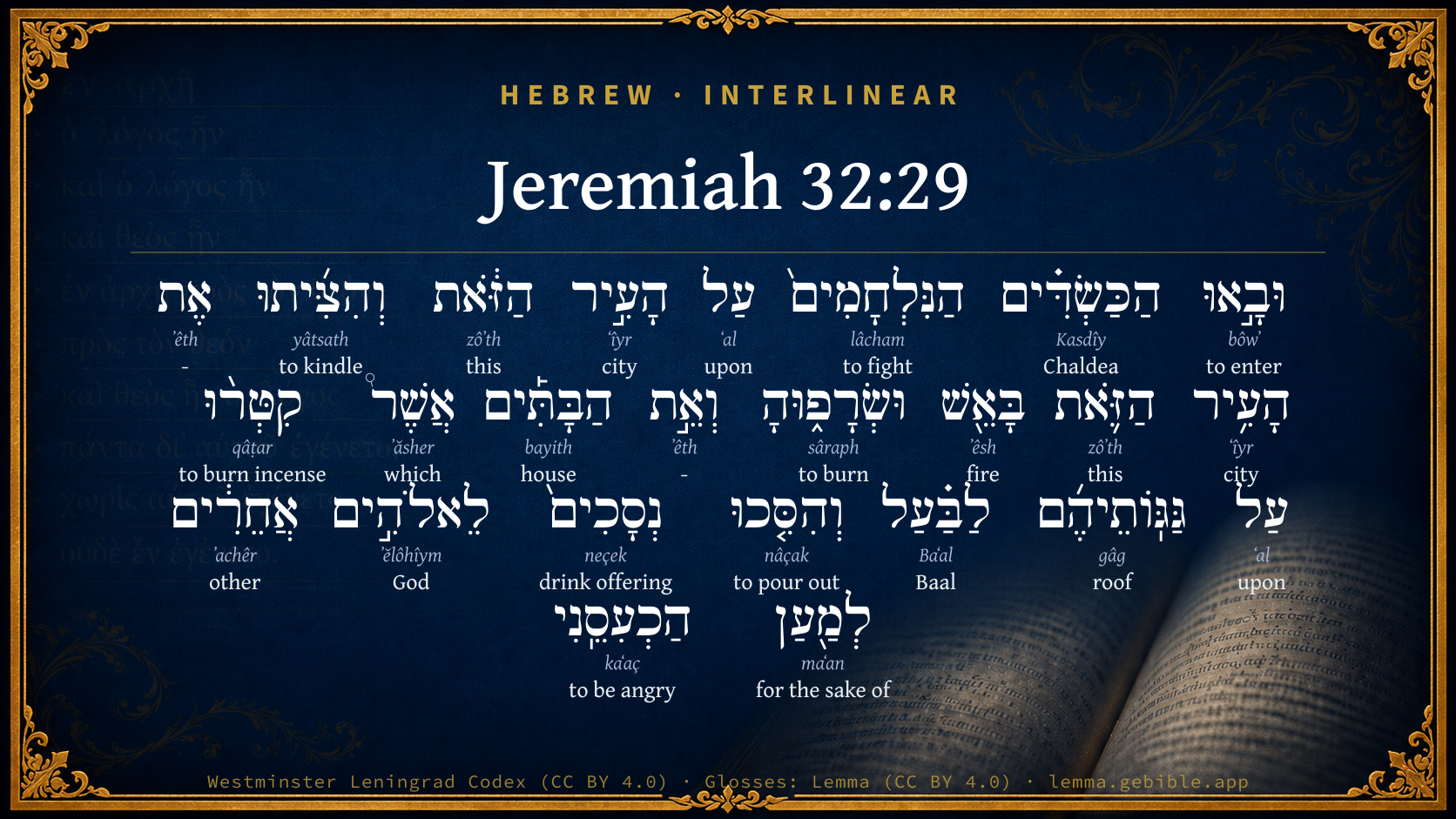
  1. וּבָ֣אוּ bôwʼ H935 “and · to enter” Conjunction + Verb, Qal, Sequential Perfect, 3rd Person, Common, Plural
  2. הַכַּשְׂדִּ֗ים Kasdîy H3778 “the · Chaldea” Particle, Definite Article + Noun, Proper
  3. הַנִּלְחָמִים֙ lâcham H3898 “the · fighting” Particle, Definite Article + Verb, Niphal, Participle Active, Masculine, Plural, Absolute
  4. עַל ʻal H5921 “upon” Preposition
  5. הָעִ֣יר ʻîyr H5892 “the · city” Particle, Definite Article + Noun, Common, Feminine, Singular, Absolute
  6. הַזֹּ֔את zôʼth H2063 “the · this” Particle, Definite Article + Pronoun, Demonstrative, Feminine, Singular
  7. וְהִצִּ֜יתוּ yâtsath H3341 “and · to kindle” Conjunction + Verb, Hiphil, Perfect, 3rd Person, Common, Plural
  8. אֶת ʼêth H853 “-” Particle, Direct Object
  9. הָעִ֥יר ʻîyr H5892 “the · city” Particle, Definite Article + Noun, Common, Feminine, Singular, Absolute
  10. הַזֹּ֛את zôʼth H2063 “the · this” Particle, Definite Article + Pronoun, Demonstrative, Feminine, Singular
  11. בָּאֵ֖שׁ ʼêsh H784 “in/at the · fire” Preposition, Determined + Noun, Common, Both, Singular, Absolute
  12. וּשְׂרָפ֑וּהָ sâraph H8313 “and · to burn · her” Conjunction + Verb, Qal, Sequential Perfect, 3rd Person, Common, Plural + Suffix, Personal, 3rd Person, Feminine, Singular
  13. וְאֵ֣ת ʼêth H853 “and · -” Conjunction + Particle, Direct Object
  14. הַבָּתִּ֡ים bayith H1004 “the · houses” Particle, Definite Article + Noun, Common, Masculine, Plural, Absolute
  15. אֲשֶׁר֩ ʼăsher H834 “which” Particle, Relative
  16. קִטְּר֨וּ qâṭar H6999 “to burn incense” Verb, Piel, Perfect, 3rd Person, Common, Plural
  17. עַל ʻal H5921 “upon” Preposition
  18. גַּגּֽוֹתֵיהֶ֜ם gâg H1406 “roofs · their” Noun, Common, Masculine, Plural, Construct + Suffix, Personal, 3rd Person, Masculine, Plural
  19. לַבַּ֗עַל Baʻal H1168 “to/for the · Baal” Preposition, Determined + Noun, Proper
  20. נְסָכִים֙ neçek H5262 “drink offerings” Noun, Common, Masculine, Plural, Absolute
  21. לֵאלֹהִ֣ים ʼĕlôhîym H430 “to/for · God(s)” Preposition + Noun, Common, Masculine, Plural, Absolute
  22. אֲחֵרִ֔ים ʼachêr H312 “other” Adjective, Adjective, Masculine, Plural, Absolute
  23. לְמַ֖עַן maʻan H4616 “for the sake of” Preposition
  24. הַכְעִסֵֽנִי kaʻaç H3707 “to be angry · me” Verb, Hiphil, Infinitive Construct + Suffix, Personal, 1st Person, Common, Singular

About this verse

These counts appear in no published source. They are computed here, from the morphology-tagged text and Lemma’s own curated glosses. What Lemma adds →

25
words
21
distinct lemmas
Prophets
section

Notable vocabulary

The rarest word here is וְהִסִּ֤כוּ to pour out H5258 — appearing just 25 times in the whole Hebrew Bible.

Shared distinctive vocabulary

וְהִסִּ֤כוּ to pour out H5258 occurs in 24 verses of the Hebrew Bible. Also found in:

Grammatical profile

  • 7 verbs
  • 9 nouns
  • 1 adjective
  • 2 pronouns
  • 3 prepositions
  • 3 particles

Verb forms

  • וּבָ֣אוּ Qal · Sequential Perfect
  • הַנִּלְחָמִים֙ Niphal · Participle Active
  • וְהִצִּ֜יתוּ Hiphil · Perfect
  • וּשְׂרָפ֑וּהָ Qal · Sequential Perfect
  • קִטְּר֨וּ Piel · Perfect
  • וְהִסִּ֤כוּ Hiphil · Perfect
  • הַכְעִסֵֽנִי Hiphil · Infinitive Construct

Repetition

Words recur within this verse — often emphatic in Hebrew:

  • עַל upon H5921 ×2
  • הָעִ֣יר city H5892 ×2
  • הַזֹּ֔את this H2063 ×2

Cross-references

15

Topical passages linked to Jeremiah 32:29 in the Treasury of Scripture Knowledge — connected by theme and wording, ordered by reader-vote popularity; previews shown in the World English Bible.

  • Jeremiah 19:13 and the houses of Jerusalem, and the houses of the kings of Judah, which are defiled, shall be as the place of Topheth, even all the houses on whose roofs they have burned incense to all the host of the sky, and have poured out drink-offerings to other gods.
  • Jeremiah 21:10 For I have set my face on this city for evil, and not for good, says Yahweh: it shall be given into the hand of the king of Babylon, and he shall burn it with fire.
  • 2 Chronicles 36:19 They burnt the house of God, and broke down the wall of Jerusalem, and burnt all the palaces of it with fire, and destroyed all the goodly vessels of it.
  • Jeremiah 52:13 and he burned the house of Yahweh, and the king's house; and all the houses of Jerusalem, even every great house, burned he with fire.
  • Jeremiah 7:18 The children gather wood, and the fathers kindle the fire, and the women knead the dough, to make cakes to the queen of the sky, and to pour out drink-offerings to other gods, that they may provoke me to anger.
  • Jeremiah 39:8 The Chaldeans burned the king's house, and the houses of the people, with fire, and broke down the walls of Jerusalem.
  • Jeremiah 44:17–19 But we will certainly perform every word that is gone forth out of our mouth, to burn incense to the queen of the sky, and to pour out drink-offerings to her, as we have done, we and our fathers, our kings and our princes, in the cities of Judah, and in the streets of Jerusalem; for then had we plenty of food, and were well, and saw no evil.
  • Jeremiah 44:25 Thus says Yahweh of Hosts, the God of Israel, saying, You and your wives have both spoken with your mouths, and with your hands have fulfilled it, saying, We will surely perform our vows that we have vowed, to burn incense to the queen of the sky, and to pour out drink-offerings to her: establish then your vows, and perform your vows.
  • 2 Kings 25:9 He burnt the house of Yahweh, and the king's house; and all the houses of Jerusalem, even every great house, burnt he with fire.
  • Isaiah 64:10–11 Your holy cities are become a wilderness, Zion is become a wilderness, Jerusalem a desolation.
  • Jeremiah 17:27 But if you will not listen to me to make the Sabbath day holy, and not to bear a burden and enter in at the gates of Jerusalem on the Sabbath day; then will I kindle a fire in the gates of it, and it shall devour the palaces of Jerusalem, and it shall not be quenched.
  • Jeremiah 27:8–10 It shall happen, that the nation and the kingdom which will not serve the same Nebuchadnezzar king of Babylon, and that will not put their neck under the yoke of the king of Babylon, that nation will I punish, says Yahweh, with the sword, and with the famine, and with the pestilence, until I have consumed them by his hand.
  • Jeremiah 37:7–10 Thus says Yahweh, the God of Israel, Thus shall you tell the king of Judah, who sent you to me to inquire of me: Behold, Pharaoh's army, which is come forth to help you, shall return to Egypt into their own land.
  • Lamentations 4:11 Yahweh has accomplished his wrath, he has poured out his fierce anger; He has kindled a fire in Zion, which has devoured the foundations of it.
  • Matthew 22:7 When the king heard that, he was angry, and he sent his armies, destroyed those murderers, and burned their city.

Cross-references courtesy of OpenBible.info (CC BY 4.0).

Hebrew and Greek witnesses Masoretic Hebrew ↔ Greek Septuagint

The same verse in the two great witnesses to the Old Testament, shown verse-for-verse.

These are two independent witnesses, not word-aligned to each other, and the Septuagint is shown in lemma (dictionary) form.

Hebrew Jeremiah 32:29 Masoretic · Westminster Leningrad Codex

וּבָ֣אוּ הַכַּשְׂדִּ֗ים הַנִּלְחָמִים֙ עַל הָעִ֣יר הַזֹּ֔את וְהִצִּ֜יתוּ אֶת הָעִ֥יר הַזֹּ֛את בָּאֵ֖שׁ וּשְׂרָפ֑וּהָ וְאֵ֣ת הַבָּתִּ֡ים אֲשֶׁר֩ קִטְּר֨וּ עַל גַּגּֽוֹתֵיהֶ֜ם לַבַּ֗עַל וְהִסִּ֤כוּ נְסָכִים֙ לֵאלֹהִ֣ים אֲחֵרִ֔ים לְמַ֖עַן הַכְעִסֵֽנִי

and the Chaldeans, who fight against this city, shall come and set this city on fire, and burn it, with the houses, on whose roofs they have offered incense to Baal, and poured out drink-offerings to other gods, to provoke me to anger.

World English Bible · Public Domain

Greek LXX Structure differs

In the Septuagint, Jeremiah is about an eighth shorter than the Hebrew and arranges its material differently — the Oracles Against the Nations (Hebrew chapters 46–51) appear in the middle of the Greek book, after 25:13. Because the chapter and verse boundaries do not line up, a verse-for-verse comparison with the Hebrew is not shown.

A verse-for-verse comparison isn’t shown here because the chapters and verses don’t line up. Switch to the LXX edition with the MT / LXX toggle above to read the Greek directly.

Hebrew: Westminster Leningrad Codex (CC BY 4.0). Greek: Septuagint (public domain); English from a public-domain English Septuagint. How the Septuagint differs from the Hebrew →

Targum (Aramaic paraphrase)

1

The Targum is the ancient Jewish Aramaic paraphrase of the Hebrew Scriptures — an interpretive translation, not the Hebrew text itself. Onkelos (literal) and Pseudo-Jonathan (expansive) render the Torah, and Jonathan the Prophets. Coverage is partial: where no permissively-licensed English translation exists for a verse, only the Aramaic is shown. This is verse-level text, not a word-by-word alignment to the Hebrew.

  1. Targum Jonathan Prophets (Joshua–Malachi)
    וְיֵעֲלוּן כַּסְדָאֵי דְמַגִיחִין קְרָבָא עַל קַרְתָּא הָדָא וְיִדְלְקוּן יַת קַרְתָּא הָדָא בְּנוּרָא וְיוֹקְדוּנָהּ וְיַת בָּתַּיָא דְאַסִיקוּ בּוּסְמִין עַל אֱגוֹרֵיהוֹן לְבַעֲלָא וּנְסִיכוּ נִסְכִין לְטַעֲוַת פַּלְחֵי כּוֹכְבַיָא בְּדִיל לְאַרְגָזָא קָדָמַי:

    (no public-domain English translation for this verse)

    Targum Jonathan — Aramaic: “Mikraot Gedolot” (public domain). English: “Sefaria Community Translation” (CC0 1.0 (public-domain dedication)); “London "Chaldee Paraphrase," 1871” (public domain). Text via Sefaria.

Commentary

Notes on Jeremiah 32:29 from classic Christian and Jewish commentators (each source and its license shown beneath its notes). The classic Christian expositions comment on the surrounding passage and are grouped to its opening verse, so a note may address several verses; the Jewish commentaries on the Tanakh (Rashi and others) are per-verse, so they appear only where the commentator wrote on this verse.

Lemma curates 59 commentaries, every one of them public domain or Creative Commons licensed, each selected and text-cleaned for this edition rather than reprinted as found. About our sources →

Trapp's Complete Commentary

John Trapp

Jer 32:29 And the Chaldeans, that fight against this city, shall come and set fire on this city, and burn it with the houses, upon whose roofs they have offered incense unto Baal, and poured out drink offerings unto other gods, to provoke me to anger.

Ver. 29. With the houses, upon whose roofs.] Such was their impudence, and so far was this now from being, as once, the holy city. It was become a very Poneropolis, excessively superstitious, as was afterwards Athens. {Act 17:22}

John Trapp, A Commentary or Exposition upon All the Books of the Old and New Testament (1647–1656) — public domain. Text from a community e-Sword module.

Jamieson, Fausset & Brown

Robert Jamieson, A. R. Fausset & David Brown

burn . . . houses upon whose roofs . . . incense unto Baal--retribution in kind. They burnt incense to Baal, on the houses, so the houses shall be burnt (Jer 19:13). The god of fire was the object of their worship; so fire shall be the instrument of their punishment.

to provoke me--indicating the design, not merely the event. They seemed to court God's "anger," and purposely to "provoke" Him.

Jamieson, Fausset & Brown — Commentary Critical and Explanatory on the Whole Bible (1871) — public domain (CC PDM 1.0). Text via the HelloAO Bible API.

Adam Clarke's Commentary

Verse 29. With the houses, upon whose roofs] As it is most probable that Baal was the sun, they might have chosen the tops of the houses, which were always flat, with battlements around, to offer incense and sacrifice to him at his rising, and while he was in sight above the horizon.

Adam Clarke's Commentary on the Bible (1810–1826) — public domain. Text from a community e-Sword/MySword module.

John Calvin's Commentaries

And therefore he adds, enter in shall the Chaldeans who assail the city; for he does not say that they would come, but he confirms in other words what he had said; Break then into the city shall the Chaldeans, though it was closed up and fortified; and shall set on fire this city It was not without purpose that he mentioned the word city so often; for as it was the sanctuary of God, and the royal seat, the Jews thought that it was impregnable, and that the sun could be sooner cast down from heaven than that; enemies could take possession of it: in order then to subvert this false confidence, God often mentioned the word city. He at last adds, that the Chaldeans would burn it, as though he had said, that whatever Jeremiah had predicted would certainly be fulfilled, not only respecting the attack on the city, but also its destruction, so that not a stone would be left on a stone, but that there would be a dreadful desolation until the time of its restoration. The rest to-morrow.

John Calvin's Commentaries (1540-1563) — public domain. Text from the Calvin Translation Society English edition (1840s-50s) via the Christian Classics Ethereal Library (ccel.org). Calvin's coverage is partial (roughly two-thirds of the Bible); uncommented books and verses are honest gaps, never fabricated. The 19th-century editor's footnotes and remarks are omitted so the notes are faithfully Calvin's own voice.

Ellicott's Commentary for English Readers

(29) Upon whose roofs they have offered incense unto Baal . . .—On the mode of worship to which the words refer, see Note on Jer_19:13. Here the leading thought is that of the righteous judgment which is to fall on the very spots that had thus been turned from the worship of Jehovah to that of the false gods whom men had worshipped in His stead. The incense-smoke of their false worship had, as its end, the smoke of burning roof and timbers.

A Bible Commentary for English Readers, edited by Charles John Ellicott (1878–1897) — public domain. Text from a community e-Sword module.

John Gill's Exposition

For the children of Israel and the children of Judah,.... The former are mentioned, as well as the latter, though they had been carried captive some years ago, to justify the dealings of God with them; and besides, there were some of the ten tribes that remained, and were mingled with the tribes of Judah and Benjamin: of all which it is said, that they

have only done evil before me from their youth; from their infancy, being conceived in sin, and shapen in iniquity; and so being destitute of the grace of God, did nothing else but sin all their days, as is said of the men of the old world, Gen 6:5. Some understand this, from the time of their becoming a people, a body politic; or from the time of their coming out of Egypt, and being in the wilderness, when their idolatry began, they brought out of Egypt; or from the time of the judges:

for the children of Israel have only provoked me to anger with the work of their hands, saith the Lord; with their idols, made by their own hands; these they worshipped instead of their Creator and Benefactor; which must be very provoking indeed!

John Gill's Exposition of the Whole Bible (1746–1763) — public domain (CC PDM 1.0). Text via the HelloAO Bible API.

Haydock's Catholic Bible Commentary

Baal, the sun, &c., chap. xix. 13., Sophonias i. 5., and 4 Kings xxiii. 12. (Calmet)

George Leo Haydock (1774–1849), Haydock's Catholic Family Bible and Commentary, 1859 edition — public domain. Excludes Psalms (Douay-Rheims chapter numbering differs from Protestant) and Deuterocanonical books (Catholic canon only).

Matthew Poole's English Annotations

Thou judgest right, this city shall be taken, and that by this very army of Chaldeans which now besiegeth it, they shall set fire on it, and burn the houses; I have made all flesh, and I have power to dispose of it, I will give this city into their hands. But in this execution of my vengeance I shall not act by prerogative, but as a just and righteous judge, vindicating the violation of my laws: they have polluted their houses by idolatry upon the roofs of them, they have offered incense, paid a divine homage, to the idol Baal; and in them they have worshipped other gods; therefore I will watch over and protect them no longer, but send the Chaldeans by their fires to purge them.

Matthew Poole's English Annotations on the Holy Bible (1683–1685) — public domain. Text from a community e-Sword/MySword module.

The Pulpit Commentary

And burn it. A still more significant prediction to Jewish hearers than to us, for it implies that Jerusalem had become utterly rebellious, and deserved the punishment of the old Canaanitish cities. It was to be made a cherem . (Deu_3:6)

The Pulpit Commentary (1880–1919), ed. H.D.M. Spence-Jones & Joseph S. Exell — public domain. Text from a community e-Sword module.

unfoldingWord translationNotes

Door43 World Missions Community

General Information:

Yahweh continues speaking to Jeremiah.

in order to provoke me

"so that I would become very angry"

doing evil before my eyes

Here the metonym "eyes" represents what God sees. Possible meanings are 1) "doing what I consider evil" or 2) "doing evil knowing that I am watching" (See: Metonymy)

since their youth

A person being young is a metaphor for the people of Israel first becoming a nation. AT: "from the time they were young" or "from the time that they became a nation" (See: Metaphor)

the practices of their hands

The word "hands" is a metonym for the things the person does with his hands. AT: "the evil things they have done" (See: Metonymy)

this is Yahweh's declaration

Yahweh speaks of himself by name to express the certainty of what he is declaring. See how you translated this in Jeremiah 1:8. AT: "this is what Yahweh has declared" or "this is what I, Yahweh, have declared" (See: First, Second, or Third Person)

translationWords

Chaldea

worship

Baal

drink offering

false god

kingdom of Israel

kingdom of Judah

evil

declare

unfoldingWord translationNotes — © Distant Shores Media and the Door43 World Missions Community, licensed CC BY-SA 4.0. Source: git.door43.org/Door43/en_tn.

Lesson kit

Teaching starters — assembled from the data on this page, not authored interpretation. Every prompt links to the verse data it draws on. Edit before teaching.

Jeremiah, in the Prophets, opens this verse with 25 words (21 distinct Hebrew lemmas). Its most distinctive word is nâçak (“to pour out”). A historical commentator’s framing appears above. Read the whole chapter for the surrounding context.

Discussion questions

  1. What does “to pour out” (nâçak) contribute to the verse as a whole?
  2. How does Genesis 35:14, which shares the word «to pour out», read alongside this verse?
  3. What does the repetition of “upon” (2× in this one verse) do in this verse?
  4. These translations render this verse differently; the difference is in the English rendering, not the original. What questions does that raise?
  5. «וּבָ֣אוּ» is a Qal Sequential Perfect verb. How does that grammatical form shape the action described?
  6. Compare how Trapp's Complete Commentary and Jamieson, Fausset & Brown read this verse. Where do they agree or differ?

Things to notice

Reading settings

Reading text

Shown beneath each verse's original-language words.

Old Testament
Old Testament edition

Read the OT as the Masoretic Hebrew (MT) or the Greek Septuagint (LXX).

English shown for the Greek Septuagint (in the Hebrew ↔ Greek comparison).

Comparing translations? Open the Compare panel on any verse page to stack up to four side by side.