Psalms 74:8

Hebrew (Westminster Leningrad Codex) Psalms 74:8 appears in the Hebrew Old Testament. The text above is from the Westminster Leningrad Codex. Each word links to its Strong’s number, a concise gloss, and parsing drawn from the Open Scriptures Hebrew Bible morphology. Click any word for its full Brown-Driver-Briggs (BDB) entry.
Download image
Cite this verse

Psalms 74:8 (World English Bible). Public Domain. Lemma interlinear Bible study tool, https://lemma.gebible.app/v/psalms/74/8.

Show BibTeX & RIS
BibTeX
RIS
English Translation
They said in their heart, "We will crush them completely." They have burned up all the places in the land where God was worshiped.
World English Bible · Public Domain
Download a study sheet

One document with this verse’s original text, its word-by-word gloss line, the meaning frame, cross-references with their text, attributed commentary, and full source and license credits — printable, and it pastes into notes with its structure intact.

This verse Autodidact and up

Study sheet (.html) Plain text (.txt)

A passage Seminary Student

Up to 50 verses in one chapter. A passage sheet keeps up to 6 commentary sources and 12 cross-references per verse, in the order this page ranks them, and says so on the sheet whenever that leaves anything out. Ask for a single verse and you get the Autodidact verse sheet above.

Everything on this page stays free to read, with no account — the sheet is a download of what is already on screen, not access to it.

Want to remove ads? Support Godless Engineer
Compare translations 3

The same verse in 3 English versions, stacked beneath the original-language interlinear above. Click any original word for its lexicon entry.

Each is an independent rendering of the whole verse — the interlinear is not word-aligned to these translations.

Highlighted words mark where these versions differ — a whole-verse word diff, not a word-by-word alignment.

  • World English Bible Public Domain
    They said in their heart, "We will crush them completely." They have burned up all the places in the land where God was worshiped.
  • King James Version Public Domain
    They said in their hearts, Let us destroy them together: they have burned up all the synagogues of God in the land.
  • unfoldingWord Literal Text CC BY-SA 4.0
    They said in their heart, “Let us oppress them altogether.” They burned all of the meeting places of God in the land.

unfoldingWord Literal Text — © unfoldingWord, licensed CC BY-SA 4.0. Word-aligned USFM3 via Door43 (git.door43.org/unfoldingWord/en_ult).

Versions to compare (up to 4)

3 of 4 selected

Show all 18 translations

Every available English version of this verse, each an independent rendering of the whole verse.

  • World English Bible Public Domain
    They said in their heart, "We will crush them completely." They have burned up all the places in the land where God was worshiped.
  • Berean Standard Bible Public Domain
    They said in their hearts, “We will crush them completely.” They burned down every place where God met us in the land.
  • Majority Standard Bible Public Domain
    They said in their hearts, “We will crush them completely.” They burned down every place where God met us in the land.
  • King James Version Public Domain
    They said in their hearts, Let us destroy them together: they have burned up all the synagogues of God in the land.
  • American Standard Version (1901) Public Domain
    They said in their heart, Let us make havoc of them altogether: They have burned up all the synagogues of God in the land.
  • Revised Version (1885) Public Domain
    They said in their heart, Let us make havoc of them altogether: they have burned up all the synagogues of God in the land.
  • Geneva Bible (1599) Public Domain
    They saide in their hearts, Let vs destroy them altogether: they haue burnt all the Synagogues of God in the land.
  • Douay-Rheims (1899) Public Domain
    They said in their heart, the whole kindred of them together: Let us abolish all the festival days of God from the land.
  • Young's Literal Translation Public Domain
    They said in their hearts, `Let us oppress them together,' They did burn all the meeting-places of God in the land.
  • Literal Standard Version CC BY-SA 4.0
    They said in their hearts, “Let us oppress them together,” || They burned all the meeting-places of God in the land.
  • Unlocked Literal Bible CC BY-SA 4.0
    They said in their hearts, “We will destroy them all.” They burned up all of your meeting places in the land.
  • unfoldingWord Literal Text CC BY-SA 4.0
    They said in their heart, “Let us oppress them altogether.” They burned all of the meeting places of God in the land.
  • Darby Bible Public Domain
    They said in their heart, Let us destroy them together: they have burned up all ùGod's places of assembly in the land.
  • World Messianic Bible Public Domain
    They said in their heart, “We will crush them completely.” They have burned up all the places in the land where God was worshiped.
  • Webster's Bible Public Domain
    They said in their hearts, Let us destroy them together: they have burned up all the synagogues of God in the land.
  • Free Bible Version CC BY-SA 4.0
    They said to themselves, “Let's destroy it all!” So they burned down every place where God was worshiped throughout the land.
  • Bible in Basic English Public Domain
    They have said in their hearts, Let us put an end to them all together; they have given over to the fire all God's places of worship in the land.
  • JPS Tanakh (1917) Public Domain
    They said in their heart: 'Let us make havoc of them altogether'; they have burned up all the meeting-places of God in the land.

Literal Standard Version (2020), Covenant Press — licensed CC BY-SA 4.0. Text via the HelloAO Bible API (eBible.org). Unlocked Literal Bible (unfoldingWord) — licensed CC BY-SA 4.0. Text via the HelloAO Bible API (eBible.org). unfoldingWord Literal Text — © unfoldingWord, licensed CC BY-SA 4.0. Word-aligned USFM3 via Door43 (git.door43.org/unfoldingWord/en_ult). Free Bible Version, Dr. Jonathan Gallagher — licensed CC BY-SA 4.0. Text via the HelloAO Bible API (eBible.org).

Word by word

More ways to search: Search by grammar → Find every occurrence → Compare this word →

Practice this passage: Drill this verse → Learn its vocabulary →

נִינָ֣ם
yânâh
H3238
“to oppress · their”
Noun, Common, Masculine, Singular, Construct + Suffix, Personal, 3rd Person, Masculine, Plural
Part of Speech
Noun
Type
Common
Gender
Masculine
Number
Singular
State
Construct
Full BDB Definition

Origin: a primitive root

TWOT: 873

to oppress, suppress, treat violently, maltreat, vex, do wrong - (Qal) to oppress, suppress - (Hiphil) to treat violently, maltreat
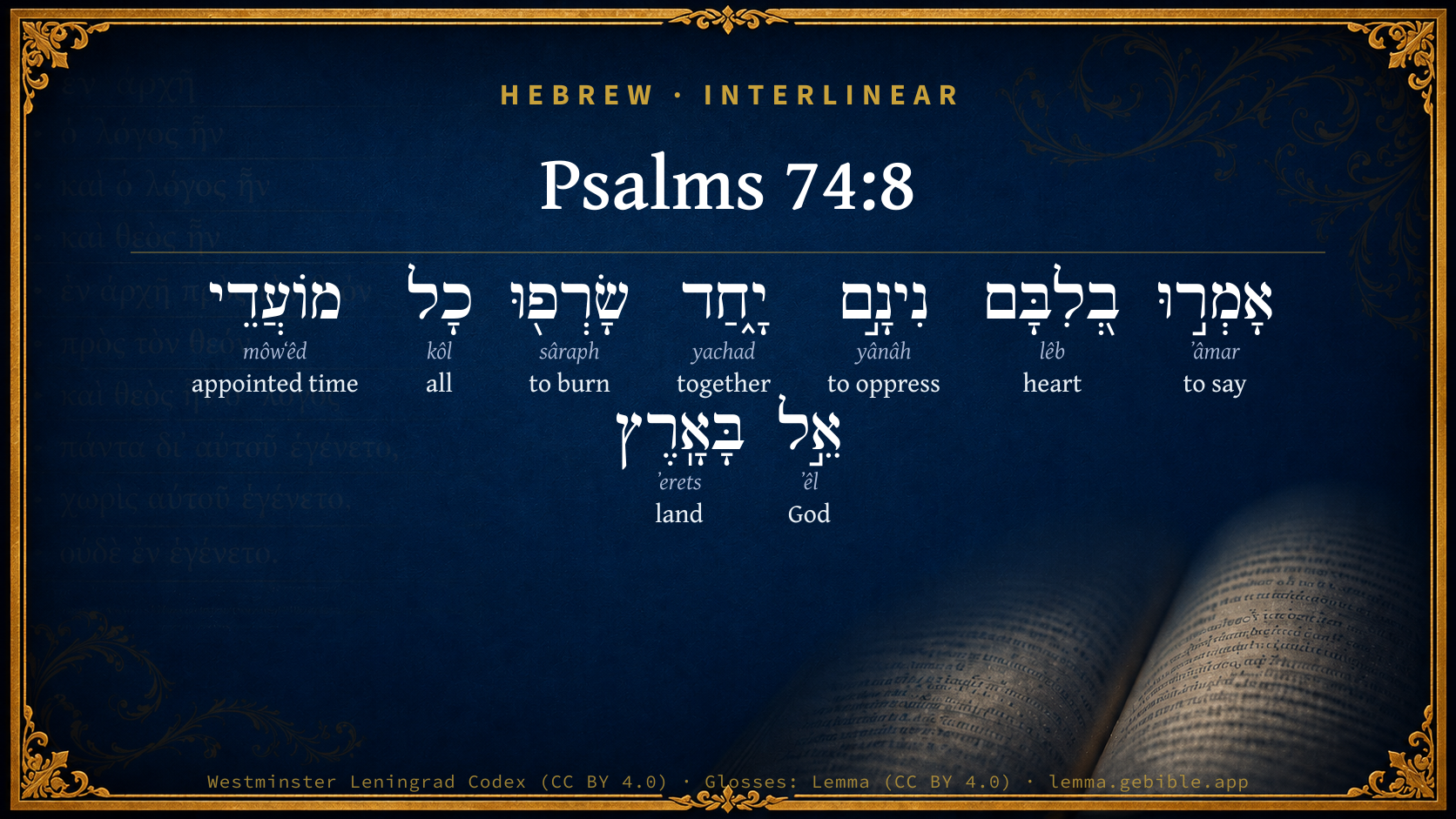
  1. אָמְר֣וּ ʼâmar H559 “to say” Verb, Qal, Perfect, 3rd Person, Common, Plural
  2. בְ֭לִבָּם lêb H3820 “in/at · heart · their” Preposition + Noun, Common, Masculine, Singular, Construct + Suffix, Personal, 3rd Person, Masculine, Plural
  3. יָ֑חַד yachad H3162 “together” Noun, Common, Masculine, Singular, Absolute
  4. שָׂרְפ֖וּ sâraph H8313 “to burn” Verb, Qal, Perfect, 3rd Person, Common, Plural
  5. כָל kôl H3605 “all of” Noun, Common, Masculine, Singular, Construct
  6. מוֹעֲדֵי môwʻêd H4150 “appointed times of” Noun, Common, Masculine, Plural, Construct
  7. אֵ֣ל ʼêl H410 “God” Noun, Common, Masculine, Singular, Absolute
  8. בָּאָֽרֶץ ʼerets H776 “in/at the · land” Preposition, Determined + Noun, Common, Both, Singular, Absolute

About this verse

These counts appear in no published source. They are computed here, from the morphology-tagged text and Lemma’s own curated glosses. What Lemma adds →

9
words
9
distinct lemmas
Wisdom
section

Notable vocabulary

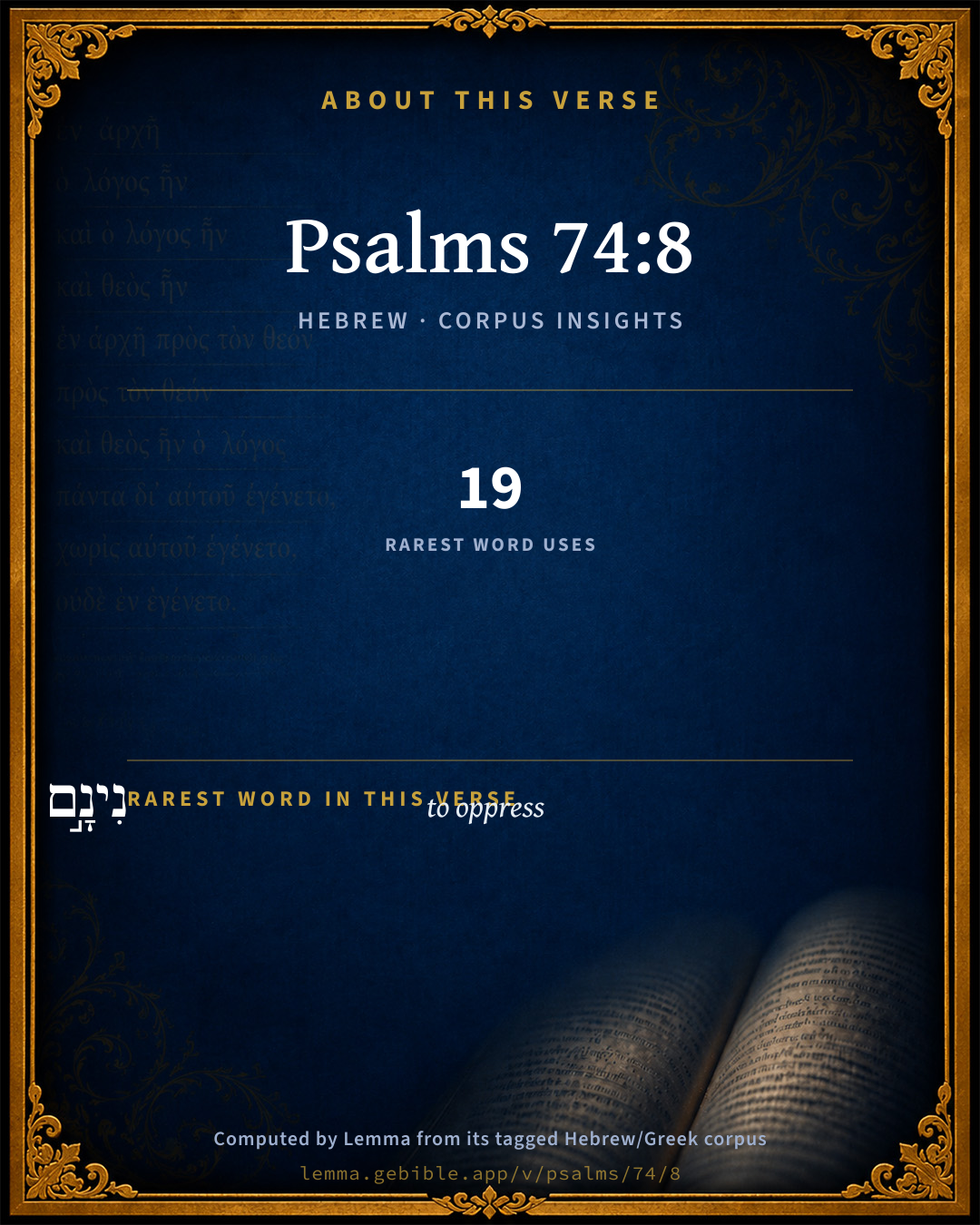
The rarest word here is נִינָ֣ם to oppress H3238 — appearing just 19 times in the whole Hebrew Bible.

Shared distinctive vocabulary

נִינָ֣ם to oppress H3238 occurs in 19 verses of the Hebrew Bible. Also found in:

Grammatical profile

  • 2 verbs
  • 7 nouns

Verb forms

  • אָמְר֣וּ Qal · Perfect
  • שָׂרְפ֖וּ Qal · Perfect

Hebrew & Septuagint length

In English translation the verse runs 24 words from the Hebrew and 23 from the Septuagint (LXX English) — closely comparable.

A rough comparison of the two English renderings, which tokenize alike — not a word-level alignment.

Word counts can differ between the Hebrew and the Greek without any difference in meaning — e.g. the Hebrew direct-object marker אֵת has no separate Greek word, and Greek often adds the article ὁ.

Cross-references

8

Topical passages linked to Psalms 74:8 in the Treasury of Scripture Knowledge — connected by theme and wording, ordered by reader-vote popularity; previews shown in the World English Bible.

  • Psalms 83:4 "Come," they say, "and let's destroy them as a nation, That the name of Israel may be remembered no more."
  • 2 Kings 2:3 The sons of the prophets who were at Bethel came forth to Elisha, and said to him, "Do you know that Yahweh will take away your master from your head today?" He said, "Yes, I know it; hold your peace."
  • 2 Kings 2:5 The sons of the prophets who were at Jericho came near to Elisha, and said to him, "Do you know that Yahweh will take away your master from your head today?" He answered, "Yes, I know it. Hold your peace."
  • 2 Kings 4:23 He said, Why will you go to him today? it is neither new moon nor Sabbath. She said, It shall be well.
  • Esther 3:8–9 Haman said to king Ahasuerus, There is a certain people scattered abroad and dispersed among the peoples in all the provinces of your kingdom; and their laws are diverse from [those of] every people; neither keep they the king's laws: therefore it is not for the king's profit to allow them.
  • Psalms 137:7 Remember, Yahweh, against the children of Edom, The day of Jerusalem; Who said, "Raze it! Raze it even to its foundation!"
  • Matthew 4:23 Jesus went about in all Galilee, teaching in their synagogues, preaching the Gospel of the Kingdom, and healing every disease and every sickness among the people.
  • 2 Chronicles 17:9 They taught in Judah, having the book of the law of Yahweh with them; and they went about throughout all the cities of Judah, and taught among the people.

Cross-references courtesy of OpenBible.info (CC BY 4.0).

Hebrew and Greek witnesses Masoretic Hebrew ↔ Greek Septuagint

The same verse in the two great witnesses to the Old Testament, shown verse-for-verse.

You’re reading Greek Psalm 73 (Hebrew Psalm 74). The Septuagint counts the superscription, so verse numbers can differ from the Hebrew — chapter-level alignment, not verse-by-verse. Numbering follows Rahlfs.

These are two independent witnesses, not word-aligned to each other, and the Septuagint is shown in lemma (dictionary) form.

Hebrew Psalms 74:8 Masoretic · Westminster Leningrad Codex

אָמְר֣וּ בְ֭לִבָּם נִינָ֣ם יָ֑חַד שָׂרְפ֖וּ כָל מוֹעֲדֵי אֵ֣ל בָּאָֽרֶץ

They said in their heart, "We will crush them completely." They have burned up all the places in the land where God was worshiped.

World English Bible · Public Domain

Greek LXX Greek Psalm 73:8 Septuagint · lemma form

εἶπον ἐν ὁ καρδία αὐτός ὁ συγγένεια αὐτός ἐπί ὁ αὐτός δεῦτε καί κατακαίω πᾶς ὁ ἑορτή ὁ θεός ἀπό ὁ γῆ

They have said in their heart, even all their kindred together, Come, let us abolish the feasts of the Lord from the earth.

LXX2012 (modern English Septuagint) · Public Domain

On this verse, J. A. Alexander on Psalms discusses the Septuagint’s reading. Read the note in Commentary ↓

Hebrew: Westminster Leningrad Codex (CC BY 4.0). Greek: Septuagint (public domain); English from LXX2012 (modern English Septuagint) (Public Domain). How the Septuagint differs from the Hebrew →

Commentary

Notes on Psalms 74:8 from classic Christian and Jewish commentators (each source and its license shown beneath its notes). The classic Christian expositions comment on the surrounding passage and are grouped to its opening verse, so a note may address several verses; the Jewish commentaries on the Tanakh (Rashi and others) are per-verse, so they appear only where the commentator wrote on this verse.

Lemma curates 59 commentaries, every one of them public domain or Creative Commons licensed, each selected and text-cleaned for this edition rather than reprinted as found. About our sources →

Trapp's Complete Commentary

John Trapp

Psa 74:8 They said in their hearts, Let us destroy them together: they have burned up all the synagogues of God in the land.

Ver. 8. Let us destroy them together] "Them," that is, the saints; let us prey upon them, as hawks do upon doves: or "them," that is, the temples and schools; these the devil ever sought to destroy, as contrary to his kingdom; and so he doth still by the Turks and Papists and other heretics.

They have burnt up all the synayoyues] These were a kind of chapels of ease to the temple at Jerusalem, and in these the people met frequently, on the sabbath especially, for holy exercises, as we do in our churches. The good centurion built one of these, Luk 7:5. See Jas 2:2.

John Trapp, A Commentary or Exposition upon All the Books of the Old and New Testament (1647–1656) — public domain. Text from a community e-Sword module.

The Biblical Illustrator

Joseph S. Exell

Psa_74:8

They have burned up all the synagogues of God in the land.

The synagogues of God

We do not know the precise circumstances under which this psalm was written. But we thank God our synagogues are not destroyed as were those of the Jews.

I. Let us glance at the synagogues of Judaea and in the ancient world. And we note--

1. That they express one of the greatest marvels of Providence. They were to be the places where, and by means of which, the message of the Gospel was to be delivered. The Jews had synagogues everywhere, and thus God by His providence had prepared the field in which first the Gospel seed was sown.

2. They were intimately connected with our Lords work.

3. And with the ministry of the apostles.

II. At the synagogues of God to-day. The word means a coming together, and it expresses an essential idea of Christian worship. And they are synagogues of God. This the main thing. There God works and blesses souls. And think of them all, and of those especially in our own land. May Gods power be manifested in them more and more. (J. Aldis.)

The synagogue a post-exilian institution

Dr. Prideux affirms that the Jews had no synagogues before the Babylonish captivity; for the main service of the synagogue being the reading of the law unto the people, where there was no book of the law to be read, there certainly would be no synagogue. How rare the book of the law was through all Judaea before the captivity, many texts of Scripture tell us. Dr. Fairbairn, in support of the same view, says, There is every reason to think that this psalm was composed during the Babylonish captivity, and was intended to describe the desolation which had been brought by the Chaldeans upon all the sacred spots of Palestine. The word for synagogue in the original, however, properly expresses the places of the revelation of God, and can refer only to the temple, that one place on which God had chosen to put His name.

The Biblical Illustrator, edited by Joseph S. Exell (c. 1880s–1900s) — public domain. Text from a community e-Sword module.

J. A. Alexander on Psalms

Joseph Addison Alexander

Psa 74:8. They have said in their heart, let us destroy them together (or at once); they have burned all the assemblies of God in, the land, by burning the only place where such assemblies could be held (Deu 12:5; Deu 12:11). Others, with less probability, suppose that the Hebrew word itself denotes the place of assembly, and that all such places means the only such place. The translation synagogues has no authority from Hebrew usage, or the ancient versions (LXX.; Vulg. dies festos. Jer. solennitates), and has been abused to prove that the psalm was written after the Babylonish exile, before which synagogues are commonly supposed to have had no existence.

Joseph Addison Alexander, The Psalms Translated and Explained (1850) — public domain. Text from a community e-Sword module.

Geneva Bible (1599)

Geneva Bible translators

They encouraged one another to cruelty, that not only God’s people might be destroyed, but also his religion utterly in all places suppressed.

Geneva Bible (1599) marginal notes — public domain. Text via Bolls.life.

Adam Clarke's Commentary

Verse 8. Let us destroy them] Their object was totally to annihilate the political existence of the Jewish people.

They have burned up all the synagogues of God in the land.] It is supposed that there were no synagogues in the land till after the Babylonish captivity. How then could the Chaldeans burn up any in Judea? The word מועדי moadey, which we translate synagogues, may be taken in a more general sense, and mean any places where religious assemblies were held: and that such places and assemblies did exist long before the Babylonish captivity, is pretty evident from different parts of Scripture. It appears that Elisha kept such at his house on the sabbaths and new moons. See 2Kg 4:23. And perhaps to such St. James may refer, Ac 15:23, a species of synagogues, where the law was read of old, in every city of the land. And it appears that such religious meetings were held at the house of the Prophet Ezekiel, Eze 33:31. And perhaps every prophet's house was such. This is the only place in the Old Testament where we have the word synagogue. Indeed, wherever there was a place in which God met with patriarch or prophet, and any memorial of it was preserved, there was a מועד moed, or place of religious meeting; and all such places the Chaldeans would destroy, pursuant to their design to extinguish the Jewish religion, and blot out all its memorials from the earth. And this was certainly the most likely means to effect their purpose. How soon would Christianity be destroyed in England if all the churches, chapels, and places of worship were destroyed, and only the poor of the people left in the land; who, from their circumstances, could not build a place for the worship of God! After such desolation, what a miracle was the restoration of the Jews!

Adam Clarke's Commentary on the Bible (1810–1826) — public domain. Text from a community e-Sword/MySword module.

John Calvin's Commentaries

8. They have said in their heart, Let us destroy them all together. To express the more forcibly the atrocious cruelty of the enemies of the Church, the prophet introduces them speaking together, and exciting one another to commit devastation without limit or measure. His language implies, that each of them, as if they had not possessed enough of courage to do mischief, stirred up and stimulated his fellow to waste and destroy the whole of God’s people, without leaving so much as one of them. In the close of the verse he asserts that all the synagogues were burned. I readily take the Hebrew word מועדים, moadim, in the sense of synagogues, because he says ALL the sanctuaries, and speaks expressly of the whole land. It is a frigid explanation which is given by some, that these enemies, upon finding that they could not hurt or do violence to the sanctuary of God in heaven, turned their rage against the material temple or synagogues. The prophet simply complains that they were so intent upon blotting out the name of God, that they left not a single corner on which there was not the mark of the hand of violence. The Hebrew word מועדים, moadim, is commonly taken for the sanctuary; but when we consider its etymology, it is not inappropriately applied to those places where the holy assemblies were wont to be held, not only for reading and expounding the prophets, but also for calling upon the name of God. The wicked, as if the prophet had said, have done all in their power to extinguish and annihilate the worship of God in Judea.

John Calvin's Commentaries (1540-1563) — public domain. Text from the Calvin Translation Society English edition (1840s-50s) via the Christian Classics Ethereal Library (ccel.org). Calvin's coverage is partial (roughly two-thirds of the Bible); uncommented books and verses are honest gaps, never fabricated. The 19th-century editor's footnotes and remarks are omitted so the notes are faithfully Calvin's own voice.

Ellicott's Commentary for English Readers

(8) All the synagogues of God in the land.—This expression excludes from moed either of the meanings possible for it in Psa_74:4, “the Temple” or “the assembly.” Buildings, and these places of worship, must be meant, and it is implied that they are scattered over the land, and can therefore mean nothing but synagogues. The “high places” would’ not be called God’s, nor would Bethel and Dan have been so called, being connected with irregular and unorthodox worship. Thus we have a clear note of time, indicating a period not only later than the rise of the synagogue in Ezra’s time, but much later, since it takes time for a new institution to spread over a country. Aquila and Symmachus actually render “synagogues.” Possibly the LXX. are right in putting the latter clause into the mouth of the enemies, “let us burn,” &c

A Bible Commentary for English Readers, edited by Charles John Ellicott (1878–1897) — public domain. Text from a community e-Sword module.

The Cambridge Bible for Schools and Colleges

gen. ed. J. J. S. Perowne

8. They said in their heart, Let us crush them altogether:

They burned up all the meeting places of God in the land.

For the form of expression cp. Psa_83:4.

The interpretation of this verse is specially important in its bearing on the date of the Psalm. It would be a strong argument for the late date if it really contained an allusion to synagogues. Though the origin of these buildings for purposes of worship and instruction is hidden in obscurity, it can hardly have been earlier than the post-exilic period. (See Schürer, Hist. of the Jewish People, Div. ii. § 27, E.T. ii. ii. 54.) But it is doubtful whether there is any such allusion. The word translated synagogues is the same as that used in Psa_74:4, meaning either place or time of meeting. In the plural it always has the latter meaning. Now if the Psalm were Maccabaean and the passage referred to synagogues, it might be expected that the LXX translators, working no long time afterwards, would have so understood it. But they do not; and apparently they had a different text before them, for they render: Come, let us cause the feasts of the Lord to cease out of the land. Similarly the Syriac. These versions then understand the words to refer to the festivals or solemn assemblies. Now the cessation of the festivals is one of the points mentioned in the Lamentations (Psa_1:4; Psa_2:6) as a special calamity; and in Hos_2:11. the Heb. word presumed by the LXX here is used in the prediction of the cessation of religious festivals in the Captivity. This reading and interpretation suit the context. The stated festivals were among the ‘signs,’ the symbols of God’s presence and favour, of which Psa_74:9 speaks.

The Cambridge Bible for Schools and Colleges (gen. ed. J. J. S. Perowne; Cambridge University Press, 1878–1918) — public domain. Text from a community e-Sword module.

John Gill's Exposition

We see not our signs,.... Either such miracles as were formerly wrought to support the faith of God's people in distress, and for their deliverance out of it, as when they were in Egypt, and brought forth from thence; see Psa 78:43 or rather their sabbaths and sacrifices, the passover and circumcision, and other ordinances and institutions of divine worship; which were signs of the presence of God with them, and of Christ, and blessings of grace, and good things to come by him; which ceased, or were interrupted in their captivity, and which the godly lament: or the signs of redemption, as Kimchi; and may be interpreted of the blindness and stupidity of the greater part of them, who could not discern the signs of the times, as before the destruction of the city and temple, Mat 16:3 so after it, when these being destroyed, and they in the hands of the Romans, might easily have perceived that the sceptre was departed from Judah, and therefore Shiloh must be come, or the Messiah; who also must have been in his temple, and Daniel's weeks be up; but these signs they saw not, nor do they yet: and so though the signs of the latter day are upon us, we see them not, or at least very few take notice of them, and lament them; such as a very great departure from the faith of the Gospel, a neglect of Gospel worship and ordinances, coldness and lukewarmness in matters of religion, want of love to Christ and his people, a general sleepiness and security, a form of religion without the power of it, a name to live and be dead, and iniquity abounding even among professors of religion; besides the frequent signs in heaven and in earth; see Mat 24:12,

there is no more any prophet; there were but few in the Babylonish captivity, and after Malachi there were none; there were none in the times of Antiochus; there were none till John the forerunner of Christ came; and in the latter day the two prophets that prophesy in sackcloth will be slain, and there will be no prophesying for a while, Rev 11:7. Kimchi explains it, there is no prophet yet, and interprets it thus, Elijah the prophet is not yet come:

neither is there among us any that knoweth how long; the calamity will endure, and ere deliverance will come; how long the Babylonish captivity would continue was known, that it would be seventy years, and no longer; the prophets that searched after the time of salvation and redemption by Christ knew how long it would be to it; Daniel fixed the exact time of it; but how long the present times will last we know not, or how long it is to the end of wonders; or when will end the 1260 days of the reign of antichrist, of the church's being in the wilderness, of the holy city being trodden under foot by the Gentiles, and of the witnesses prophesying in sackcloth.

John Gill's Exposition of the Whole Bible (1746–1763) — public domain (CC PDM 1.0). Text via the HelloAO Bible API.

Albert Barnes' Notes on the Bible

They said in their hearts - They purposed; they designed it.

Let us destroy them together - Let us destroy all these buildings, temples, towers, and walls at the same time; let us make an entire destruction of them all.

They have burned up all the synagogues of God in the land - The phrase “they have burned up” must refer to the places or edifices where assemblies for public worship were held, since it cannot be supposed that the idea is that they had burned up the assemblies of worshippers themselves. The word rendered “synagogues” is the same in the Hebrew that is used in Psa 74:4, and is there rendered “congregations.” It means “assemblies,” persons collected together for public worship. See the notes at that verse. It is not used in the Bible to denote “places” for the meetings of such assemblies, nor is it elsewhere rendered “synagogues.” It is translated by the word “seasons,” Gen 1:14; Exo 13:10, “et al.; set time,” Gen 17:21; Exo 9:5, “et al.; time appointed,” Exo 23:15; 2Sa 24:15, “et al.; congregation,” Lev 1:1, Lev 1:3,Lev 1:5; Lev 3:2, Lev 3:8,Lev 3:13, “and very often; feasts,” Lev 23:2, Lev 23:4,Lev 23:37, “et al.; - solemnity,” Deu 31:10; Isa 33:20; - and so also, set feasts, solemn feasts, appointed feasts, etc.

But in no instance does it necessarily refer to an edifice, unless it is in the place before us. There is no reason, however, for doubting that, from the necessity of the case, in the course of events, there would be other places for assembling for the worship of God than the temple, and that in different cities, villages, towns, and neighborhoods, persons would be collected together for some form of social religious service. Buildings or tents would be necessary for the accommodation of such assemblages; and this, in time, might be developed into a system, until in this way the whole arrangement for “synagogues” might have grown up in the land. The exact origin of synagogues is not indeed known. Jahn (‘Biblical Archaeology,’ Section 344) supposes that they sprang up during the Babylonian captivity, and that they had their origin in the fact that the people, when deprived of their customary religious privileges, would collect around some prophet, or other pious man, who would teach them and their children the duties of religion, exhort them to good conduct, and read to them out of the sacred books.

Compare Eze 14:1; Eze 20:1; Dan 6:11; Neh 8:18. There seems, however, no good reason for doubting that synagogues may have existed before the time of the captivity, and may have sprung up in the manner suggested above from the necessities of the people, probably at first without any fixed rule or law on the subject, but as convenience suggested, and that they may at last, by custom and law, have grown into the regular form which they assumed as a part of the national worship. Compare Kitto’s Encyc. Art. ‘synagogue.’ I see no improbability, therefore, in supposing that the word here may refer to such edifices at the time when this psalm was composed. These, if they existed, would naturally be destroyed by the Chaldeans, as well as the temple itself.

Albert Barnes' Notes on the Bible (1834–1885) — public domain. Text from a community e-Sword/MySword module.

Matthew Poole's English Annotations

Destroy them together, root and branch, one as well as another, or all at once. So they desired, and many of them intended, although afterwards, it seems, they changed their counsel, and carried some away captives, and left others to manage the land.

All the synagogues of God in the land, i.e. all the public places wherein the Jews used to meet together to worship God every sabbath day, as is noted, Act 13:27, and upon other occasions. That the Jews had such synagogues is manifest, both from these and other places of Scripture; and from the testimony of the Hebrew doctors, and other ancient and learned writers, who affirm it, and particularly of Jerusalem, in which they say there were above four hundred synagogues; and from the nature and necessity of the thing; for seeing it is undeniable that they did worship God publicly, in every sabbath, and other holy times, even then when they neither did nor could go up to Jerusalem, both conscience and prudence must needs direct them to appoint convenient places for that purpose.

Matthew Poole's English Annotations on the Holy Bible (1683–1685) — public domain. Text from a community e-Sword/MySword module.

The Treasury of David

Charles H. Spurgeon

Ver. 8. They said in their hearts, Let us destroy them together. It was no idle wish, their cruelty was sincere, deep seated, a matter of their inmost heart. Extirpation was the desire of Haman, and the aim of many another tyrant; not a remnant of the people of God would have been left if oppressors could have had their way. Pharaoh's policy to stamp out the nation has been a precedent for others, yet the Jews survive, and will: the bush though burning has not been consumed. Even thus the church of Christ has gone through baptism of blood and fire, but it is all the brighter for them.

They have burned up all the synagogues of God in the land. Here is no allusion to places called synagogues, but to assemblies; and as no assemblies for worship here held in but one place, the ruin of the temple was the destruction of all the holy gatherings, and so in effect all the meeting places were destroyed. One object of persecutors has always been to put an end to all conventicles, as they have called them. Keep them from meeting and you will scatter them, so have the enemy said; but, glory be to God, saints are independent of walls, and have met on the hill side, by the moss, or in the catacombs, or in a boat at sea. Yet has the attempt been almost successful, and the hunt so hot, that the faithful have wandered in solitude, and their solemn congregations have been, under such circumstances, few and far between. What sighs and cries have in such times gone up to the ears of the Lord God of Sabaoth. How happy are we that we can meet for worship in any place we choose, and none dare molest us.

Ver. 8. The synagogues of God. It is the opinion of Spencer, Vitringa, and of the learned in general, that the institution of synagogues for worship originated in the reading of the law publicly after the collection of its volumes by Ezra, and that, consequently, there were no such places of solemn assembly previous to the Babylonish captivity. Some of the Jews themselves have expressed a conviction that this is the fact, and the Scriptures give no intimation of their existence antecedently to that time. We are aware, however, that one of the first Hebraists of the present day, the Rev. Dr. Macaul, inclines to the opinion of an earlier origin than that generally adopted. We quote his words: "The existence of such places before the Babylonish captivity has been much disputed"; and most writers, arguing from the silence of the Old Testament, incline to the opinion that they originated in Babylon, and that after the restoration similar oratories were opened in the land of Israel; and hence some infer that the Seventy-fourth Psalm, which says in the eighth verse, They have burned up all the synagogues in the land, was written in the post Babylonian times. The argument from silence is, however, far from conclusive. The translation of yrewm as synagogues, in the verse just cited, might fairly lead to a similar translation in some other passages which were confessedly written before the captivity; and the circumstances, character, and necessities of the Israelites, the great body of whom were far removed from the temple, prove indisputably that in their towns and villages they must have had some locality where they assembled on their sabbaths, new moons, and other solemn days, for the purpose of receiving instruction in the law, and for public prayer. That locality, however different from subsequent arrangements, was the origin of the synagogue. How such assemblies were conducted before the captivity it is now impossible to say. F. A. Cox.

Ver. 8. Synagogues. Dr. Prideaux affirms that they had no synagogues before the Babylonish captivity; for the main service of the synagogue, says he, being the reading of the law unto the people, where there was no book of the law to be read, there certainly could be no synagogues. But how rare the book of the law was through all Judaea, before the Babylonish captivity, many texts of Scripture tell us. When Jehoshaphat sent teachers through all Judaea, to instruct the people in the law of God, they carried a book of the law with them (2Ch 17:9), which they needed not have done if there had been any copies of the law in those cities to which they went; which certainly there would have been had there been any synagogues in them. And when Hilkiah found the law in the temple (2Ki 22:8), neither he nor king Josiah needed to have been so surprised at it, had books of the law been common on those times. Their behaviour on that occasion sufficiently proves they had never seen it before, which could not be the case had there then been any other copies of it to be found among the people; and if there were no copies of the law at that time among them, there could then be most certainly no synagogues for them to resort to for the hearing of it read unto them. From whence he concludes there could be no synagogues among the Jews, till after the Babylonish captivity. Cruden's Concordance.

Ver. 8. Synagogues. The assertion of those who are in favour of the Maccabean origin of the Psalm, that these words describe the destruction of the synagogues, is met by the remark, that in all the copious accounts which we have of the transactions of these times, there is nothing said of any such work of destruction. E. W. Hengstenberg.

Ver. 8. Synagogues. In the Old Testament we find no traces of meetings for worship in synagogues. Temporary altars, groves, and high places were used alike by the Jewish saints and sinners for the worship of God and idols. The only pre-exile instance which seems to indicate that the devout in Israel were in the habit of resorting to pious leaders for blessings and instruction on stated occasions, is to be found in 2Ki 4:23, where the Shunammite's husband asks, "Wherefore wilt thou go to him (Elisha) today? It is neither new moon nor Sabbath." Yet 2Ki 22:8, etc.; 2Ch 34:14, etc., testify undoubtedly against the existence of places of worship under the monarchy. It is during the exile, whilst the temple worship was in abeyance, that we find indubitable proof of the systematic meetings on fasts for devotion and instruction (Zec 7:3-5 8:19). Religious meetings were also held on Sabbaths and fasts, to instruct the exiles in the divine law, and to admonish them to obey the divine precepts, (Ezr 10:1-9 Ne 8:1-3 9: 1-3 13: 1-3). These meetings, held near the temple and in other localities, were the origin of the synagogue, and the place in which the people assembled was denominated the house of assembly. Hence, also, the synagogue in the temple itself... These synagogues soon became very popular, so that the psalmist in depicting worship in the time of the Maccabees declares that the many meeting places of God--or the Synagogues of God as the A.V. rightly renders it--have been laid waste. Christian D. Ginsburg, in Cyclopaedia of Biblical Literature.

Ver. 8. (second clause). The sense seems to be, they (the Chaldaean invaders) have abolished all the solemnities in the land. They have taken away the daily sacrifice; they have put an end to the festivals and feasts of our holy ritual. Compare La 2:6: "He hath violently taken away his tabernacle; he hath destroyed his places of the assembly, "(or rather, his assembly, his moed). "The Lord hath caused the solemn feasts and sabbaths to be forgotten in Zion." Christopher Wordsworth.

Ver. 8. The destruction of rural churches, the aim of our enemies: the injury they would so do, and our duty to prevent it: the means the destroyers use: bribery, oppression, etc. Our proper method for sustaining such churches.

Psalms 74:9*

Charles H. Spurgeon's The Treasury of David (1869–1885) — public domain. Psalms only. Text from a community e-Sword/MySword module.

Whedon's Commentary on the Bible

Daniel D. Whedon

8. They said… Let us destroy them together—We will destroy them at once: or utterly; that is, all the sacred places of Jehovah.

They have burned up all the synagogues of God in the land—The synagogue proper dates during and after the captivity, and the word is not to be taken here in the restricted sense which it afterward received, but in the general sense of sacred places of meeting, or assembly, perhaps like the proseuchae—places of prayer—mostly in the open field, or by the river side. Thus, Act_16:16 : “As we went to prayer,” προσευχην, to the place of prayer. Such oratories they might have had before the exile. Germs of them appear in the time of Samuel. 1Sa_9:12; 1Sa_10:5. Later, the “schools of the prophets” were gatherings for instruction and devotion, open, it would seem, to all who would come. Such gatherings also seem implied in 2Ki_4:23, and other places. But “synagogues of God” certainly is not a happy rendering of מועדי אל, which simply means, meetingplaces of God. In Lam_2:6, it is rendered “places of the assembly.” The root of the verb means simply to gather, particularly at set times and for religious purposes; though in Psa_75:2, it applies to a judicial assembly, or court. The object of the enemy was, as alluded to in the text, to destroy all places of religious worship or resort, and break up and annihilate all vestiges of the Hebrew system of religion.

Daniel D. Whedon (gen. ed.), Commentary on the Old and New Testaments (1874–1909) — public domain. Text from a community e-Sword module.

The Pulpit Commentary

They said in their hearts, Let us destroy them altogether. It was, no doubt, the intention of Nebuchadnezzar to destroy Israel as a nation. Hence the complete destruction of the city and temple; (2Ki_25:9, 10 2Ch_36:19 Lam_2:1-9, etc.) hence the deportation of all the strength of the nation, (2Ki_24:14-16 2Ki_25:11) and their settlement in the far off region of Babylonia; hence the desolation, not only of Jerusalem, but of "all the habitations of Jacob", (Lam_2:2) all the "strongholds of the daughter of Judah". (Lam_2:2, Lam_2:5) They have burnt up all the synagogues of God in the land. The synagogue system was first introduced by Ezra, according to Jewish tradition; and it has been argued that the mention of "synagogues" here literally, "sacred meeting places proves the psalm to be Maccabean. But meeting places for worship, other than the temple, always existed in Palestine, both before and after its erection. Mesha speaks of having plundered a "house of Jehovah" in his war with Ahab ("Records of the Past," vol. 11:p. 167); and it is plain from 2Ki_4:23 that religious meetings were held by the prophets, probably in houses devoted to the purpose, during the period of the divided monarchy. Hezekiah"s destruction of the high places (2Ki_18:4) is not likely to have interfered with the use of these buildings, to which no savour of idolatry can have attached in the mind of the most violent iconoclast. I should therefore believe, with Leopold Low, that buildings existed before the Exile, in which religious instruction was given by authorized teachers.

The Pulpit Commentary (1880–1919), ed. H.D.M. Spence-Jones & Joseph S. Exell — public domain. Text from a community e-Sword module.

John Wesley's Explanatory Notes

Destroy them - All at once. So they intended, although afterwards they changed their council, and carried some away captive. Burnt up - All the public places wherein the Jews used to meet together to worship God every sabbath-day.

John Wesley, Explanatory Notes Upon the Whole Bible (1754–1765) — public domain. Text via the GEBible commentary corpus.

Rashi

Rabbi Shlomo Yitzchaki (Rashi)

They said in their heart, their rulers together Heb. נינם, their rulers, and similarly (above 72: 17): “his name will be magnified (ינון); (Prov. 29:21), “he will ultimately be a ruler (מנון).” All their rulers devise one plot, the first as the last: namely, to get at the protector of Israel first and afterwards they would get at them [Israel], You should know this by the fact that they burned all the meeting places of God in the land, all His meeting houses. The Philistines destroyed Shiloh; Nebuchadnezzar destroyed the First Temple; Titus destroyed the Second Temple.

Rashi on the Tanakh — English translations: “The Judaica Press complete Tanach with Rashi, translated by A. J. Rosenberg” (CC BY 4.0); “Pentateuch with Rashi's commentary by M. Rosenbaum and A.M. Silbermann, 1929-1934” (public domain); “The Metsudah Tanach series, Lakewood, N.J” (CC BY 4.0); and “The Book of Joshua, Metsudah Publications, 1997” (CC BY 4.0). Text via Sefaria.

Lesson kit

Teaching starters — assembled from the data on this page, not authored interpretation. Every prompt links to the verse data it draws on. Edit before teaching.

Psalms, in the Wisdom, opens this verse with 9 words (9 distinct Hebrew lemmas). Its most distinctive word is yânâh (“to oppress”). A historical commentator’s framing appears above. Read the whole chapter for the surrounding context.

Discussion questions

  1. What does “to oppress” (yânâh) contribute to the verse as a whole?
  2. How does Exodus 22:21, which shares the word «to oppress», read alongside this verse?
  3. These translations render this verse differently. What is at stake in choosing one wording over another?
  4. «אָמְר֣וּ» is a Qal Perfect verb. How does that grammatical form shape the action described?
  5. Compare how Trapp's Complete Commentary and The Biblical Illustrator read this verse. Where do they agree or differ?

Things to notice

Reading settings

Reading text

Shown beneath each verse's original-language words.

Old Testament
Old Testament edition

Read the OT as the Masoretic Hebrew (MT) or the Greek Septuagint (LXX).

English shown for the Greek Septuagint (in the Hebrew ↔ Greek comparison).

Comparing translations? Open the Compare panel on any verse page to stack up to four side by side.