
Jeremiah 34:22

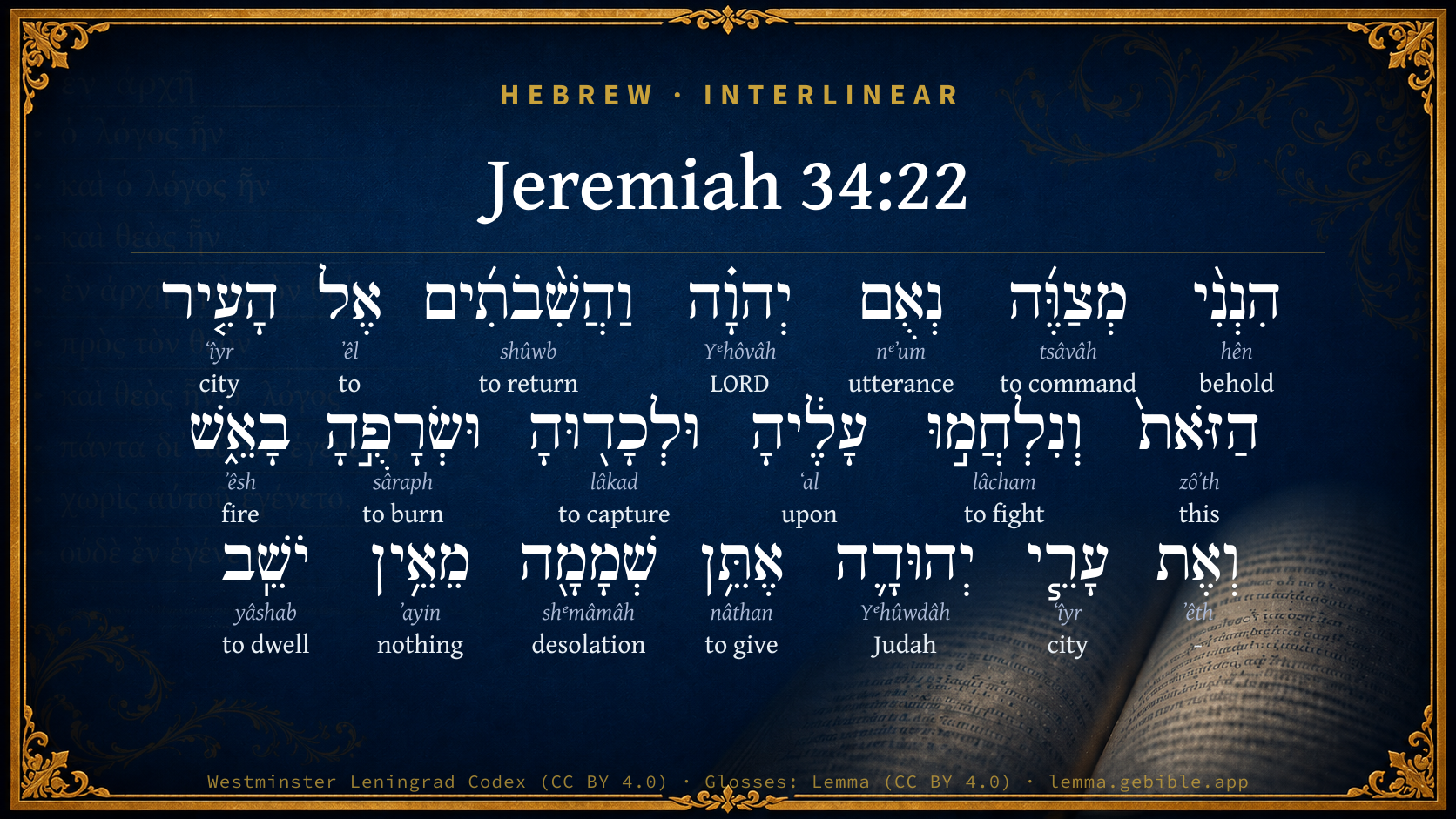
Hebrew (Westminster Leningrad Codex) Jeremiah 34:22 appears in the Hebrew Old Testament. The text above is from the Westminster Leningrad Codex. Each word links to its Strong’s number, a concise gloss, and parsing drawn from the Open Scriptures Hebrew Bible morphology. Click any word for its full Brown-Driver-Briggs (BDB) entry.
Download image
Cite this verse

Jeremiah 34:22 (World English Bible). Public Domain. Lemma interlinear Bible study tool, https://lemma.gebible.app/v/jeremiah/34/22.

Show BibTeX & RIS
BibTeX
RIS
English Translation
Behold, I will command, says Yahweh, and cause them to return to this city; and they shall fight against it, and take it, and burn it with fire: and I will make the cities of Judah a desolation, without inhabitant.
World English Bible · Public Domain
Download a study sheet

One document with this verse’s original text, its word-by-word gloss line, the meaning frame, cross-references with their text, attributed commentary, and full source and license credits — printable, and it pastes into notes with its structure intact.

This verse Autodidact and up

Study sheet (.html) Plain text (.txt)

A passage Seminary Student

Up to 50 verses in one chapter. A passage sheet keeps up to 6 commentary sources and 12 cross-references per verse, in the order this page ranks them, and says so on the sheet whenever that leaves anything out. Ask for a single verse and you get the Autodidact verse sheet above.

Everything on this page stays free to read, with no account — the sheet is a download of what is already on screen, not access to it.

Want to remove ads? Support Godless Engineer
Compare translations 3

The same verse in 3 English versions, stacked beneath the original-language interlinear above. Click any original word for its lexicon entry.

Each is an independent rendering of the whole verse — the interlinear is not word-aligned to these translations.

Highlighted words mark where these versions differ — a whole-verse word diff, not a word-by-word alignment.

  • World English Bible Public Domain
    Behold, I will command, says Yahweh, and cause them to return to this city; and they shall fight against it, and take it, and burn it with fire: and I will make the cities of Judah a desolation, without inhabitant.
  • King James Version Public Domain
    Behold, I will command, saith the LORD, and cause them to return to this city; and they shall fight against it, and take it, and burn it with fire: and I will make the cities of Judah a desolation without an inhabitant.
  • unfoldingWord Literal Text CC BY-SA 4.0
    Look, I am about to give a command—this is Yahweh’s declaration—and will bring them back to this city to wage war against it and take it, and to burn it. For I will turn the cities of Judah into ruined places in which there will be no inhabitants.’”

unfoldingWord Literal Text — © unfoldingWord, licensed CC BY-SA 4.0. Word-aligned USFM3 via Door43 (git.door43.org/unfoldingWord/en_ult).

Versions to compare (up to 4)

3 of 4 selected

Show all 18 translations

Every available English version of this verse, each an independent rendering of the whole verse.

  • World English Bible Public Domain
    Behold, I will command, says Yahweh, and cause them to return to this city; and they shall fight against it, and take it, and burn it with fire: and I will make the cities of Judah a desolation, without inhabitant.
  • Berean Standard Bible Public Domain
    Behold, I am going to give the command, declares the LORD, and I will bring them back to this city. They will fight against it, capture it, and burn it down. And I will make the cities of Judah a desolation, without inhabitant.”
  • Majority Standard Bible Public Domain
    Behold, I am going to give the command, declares the LORD, and I will bring them back to this city. They will fight against it, capture it, and burn it down. And I will make the cities of Judah a desolation, without inhabitant.”
  • King James Version Public Domain
    Behold, I will command, saith the LORD, and cause them to return to this city; and they shall fight against it, and take it, and burn it with fire: and I will make the cities of Judah a desolation without an inhabitant.
  • American Standard Version (1901) Public Domain
    Behold, I will command, saith Jehovah, and cause them to return to this city; and they shall fight against it, and take it, and burn it with fire: and I will make the cities of Judah a desolation, without inhabitant.
  • Revised Version (1885) Public Domain
    Behold, I will command, saith the LORD, and cause them to return to this city; and they shall fight against it, and take it, and burn it with fire: and I will make the cities of Judah a desolation, without inhabitant.
  • Geneva Bible (1599) Public Domain
    Beholde, I will commande, saith the Lord, and cause them to returne to this citie, and they shall fight against it, and take it, and burne it with fire: and I will make the cities of Iudah desolate without an inhabitant.
  • Douay-Rheims (1899) Public Domain
    Behold I will command, saith the Lord, and I will bring them again to this city, and they shall fight against it, and take it, and burn it with fire: and I will make the cities of Juda a desolation, without an inhabitant.
  • Young's Literal Translation Public Domain
    Lo, I am commanding -- an affirmation of Jehovah -- and have brought them back unto this city, and they have fought against it, and captured it, and burned it with fire, and the cities of Judah I do make a desolation -- without inhabitant.'
  • Literal Standard Version CC BY-SA 4.0
    Behold, I am commanding,” a declaration of YHWH, “and have brought them back to this city, and they have fought against it, and captured it, and burned it with fire, and I make the cities of Judah a desolation—without inhabitant.”
  • Unlocked Literal Bible CC BY-SA 4.0
    Look, I am about to give a command—this is Yahweh's declaration—and will bring them back to this city to wage war against it and take it, and to burn it. For I will turn the cities of Judah into ruined places in which there will be no inhabitants.'”
  • unfoldingWord Literal Text CC BY-SA 4.0
    Look, I am about to give a command—this is Yahweh’s declaration—and will bring them back to this city to wage war against it and take it, and to burn it. For I will turn the cities of Judah into ruined places in which there will be no inhabitants.’”
  • Darby Bible Public Domain
    Behold, I command, saith Jehovah, and I will cause them to return to this city; and they shall fight against it, and take it, and burn it with fire; and I will make the cities of Judah a desolation, without inhabitant.
  • World Messianic Bible Public Domain
    Behold, I will command,” says the LORD, “and cause them to return to this city. They will fight against it, take it, and burn it with fire. I will make the cities of Judah a desolation, without inhabitant.”
  • Webster's Bible Public Domain
    Behold, I will command, saith the LORD, and cause them to return to this city; and they shall fight against it, and take it, and burn it with fire: and I will make the cities of Judah a desolation without an inhabitant.
  • Free Bible Version CC BY-SA 4.0
    Listen! I will give the order, declares the Lord, and bring them back to Jerusalem. They will attack it, capture it, and burn it. I'm going to destroy the towns of Judah so nobody will live there.
  • Bible in Basic English Public Domain
    See, I will give orders, says the Lord, and make them come back to this town; and they will make war on it and take it and have it burned with fire: and I will make the towns of Judah waste and unpeopled.
  • JPS Tanakh (1917) Public Domain
    Behold, I will command, saith the LORD, and cause them to return to this city; and they shall fight against it, and take it, and burn it with fire; and I will make the cities of Judah a desolation, without inhabitant.

Literal Standard Version (2020), Covenant Press — licensed CC BY-SA 4.0. Text via the HelloAO Bible API (eBible.org). Unlocked Literal Bible (unfoldingWord) — licensed CC BY-SA 4.0. Text via the HelloAO Bible API (eBible.org). unfoldingWord Literal Text — © unfoldingWord, licensed CC BY-SA 4.0. Word-aligned USFM3 via Door43 (git.door43.org/unfoldingWord/en_ult). Free Bible Version, Dr. Jonathan Gallagher — licensed CC BY-SA 4.0. Text via the HelloAO Bible API (eBible.org).

Word by word

More ways to search: Search by grammar → Find every occurrence → Compare this word →

Practice this passage: Drill this verse → Learn its vocabulary →

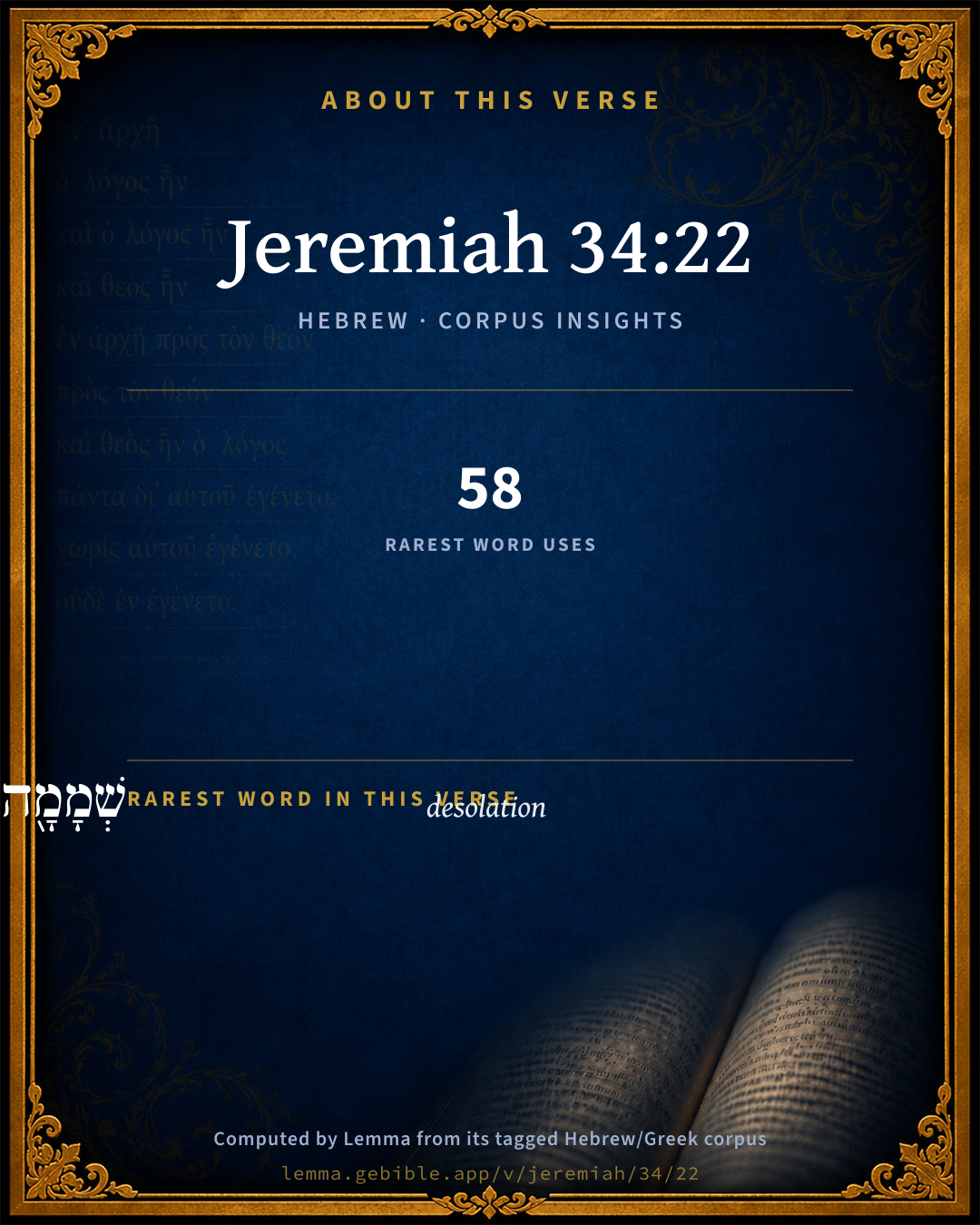
שְׁמָמָ֖ה
shᵉmâmâh
H8077
“desolation”
Noun, Common, Feminine, Singular, Absolute
Part of Speech
Noun
Type
Common
Gender
Feminine
Number
Singular
State
Absolute
Full BDB Definition

Origin: from H8076

TWOT: 2409b , 2409c

devastation, waste, desolation
  1. הִנְנִ֨י hên H2005 “behold · me” Particle, Demonstrative + Suffix, Personal, 1st Person, Common, Singular
  2. מְצַוֶּ֜ה tsâvâh H6680 “commanding” Verb, Piel, Participle Active, Masculine, Singular, Absolute
  3. נְאֻם nᵉʼum H5002 “utterance of” Noun, Common, Masculine, Singular, Construct
  4. יְהוָ֗ה Yᵉhôvâh H3068 “LORD” Noun, Proper
  5. וַהֲשִׁ֨בֹתִ֜ים shûwb H7725 “and · to return · them” Conjunction + Verb, Hiphil, Sequential Perfect, 1st Person, Common, Singular + Suffix, Personal, 3rd Person, Masculine, Plural
  6. אֶל ʼêl H413 “to” Preposition
  7. הָעִ֤יר ʻîyr H5892 “the · city” Particle, Definite Article + Noun, Common, Feminine, Singular, Absolute
  8. הַזֹּאת֙ zôʼth H2063 “the · this” Particle, Definite Article + Pronoun, Demonstrative, Feminine, Singular
  9. וְנִלְחֲמ֣וּ lâcham H3898 “and · to fight” Conjunction + Verb, Niphal, Sequential Perfect, 3rd Person, Common, Plural
  10. עָלֶ֔יהָ ʻal H5921 “upon · her” Preposition + Suffix, Personal, 3rd Person, Feminine, Singular
  11. וּלְכָד֖וּהָ lâkad H3920 “and · to capture · her” Conjunction + Verb, Qal, Sequential Perfect, 3rd Person, Common, Plural + Suffix, Personal, 3rd Person, Feminine, Singular
  12. וּשְׂרָפֻ֣הָ sâraph H8313 “and · to burn · her” Conjunction + Verb, Qal, Sequential Perfect, 3rd Person, Common, Plural + Suffix, Personal, 3rd Person, Feminine, Singular
  13. בָאֵ֑שׁ ʼêsh H784 “in/at the · fire” Preposition, Determined + Noun, Common, Both, Singular, Absolute
  14. וְאֶת ʼêth H853 “and · -” Conjunction + Particle, Direct Object
  15. עָרֵ֧י ʻîyr H5892 “cities of” Noun, Common, Feminine, Plural, Construct
  16. יְהוּדָ֛ה Yᵉhûwdâh H3063 “Judah” Noun, Proper
  17. אֶתֵּ֥ן nâthan H5414 “to give” Verb, Qal, Imperfect, 1st Person, Common, Singular
  18. מֵאֵ֥ין ʼayin H369 “from · nothing” Preposition + Particle, Negative
  19. יֹשֵֽׁב yâshab H3427 “dwelling” Verb, Qal, Participle Active, Masculine, Singular, Absolute

About this verse

These counts appear in no published source. They are computed here, from the morphology-tagged text and Lemma’s own curated glosses. What Lemma adds →

20
words
19
distinct lemmas
Prophets
section

Shared distinctive vocabulary

שְׁמָמָ֖ה desolation H8077 occurs in 54 verses of the Hebrew Bible. Also found in:

Grammatical profile

  • 7 verbs
  • 7 nouns
  • 1 pronoun
  • 2 prepositions
  • 3 particles

Verb forms

  • מְצַוֶּ֜ה Piel · Participle Active
  • וַהֲשִׁ֨בֹתִ֜ים Hiphil · Sequential Perfect
  • וְנִלְחֲמ֣וּ Niphal · Sequential Perfect
  • וּלְכָד֖וּהָ Qal · Sequential Perfect
  • וּשְׂרָפֻ֣הָ Qal · Sequential Perfect
  • אֶתֵּ֥ן Qal · Imperfect
  • יֹשֵֽׁב Qal · Participle Active

Repetition

A word recurs within this verse — often emphatic in Hebrew:

  • הָעִ֤יר city H5892 ×2

Cross-references

30

Topical passages linked to Jeremiah 34:22 in the Treasury of Scripture Knowledge — connected by theme and wording, ordered by reader-vote popularity; previews shown in the World English Bible.

  • Jeremiah 9:11 I will make Jerusalem heaps, a dwelling-place of jackals; and I will make the cities of Judah a desolation, without inhabitant.
  • Jeremiah 39:1–2 It happened when Jerusalem was taken, (in the ninth year of Zedekiah king of Judah, in the tenth month, came Nebuchadrezzar king of Babylon and all his army against Jerusalem, and besieged it;
  • Jeremiah 39:8 The Chaldeans burned the king's house, and the houses of the people, with fire, and broke down the walls of Jerusalem.
  • Jeremiah 33:10 Thus says Yahweh: Yet again there shall be heard in this place, about which you say, It is waste, without man and without animal, even in the cities of Judah, and in the streets of Jerusalem, that are desolate, without man and without inhabitant and without animal,
  • Jeremiah 44:22 so that Yahweh could no longer bear, because of the evil of your doings, and because of the abominations which you have committed; therefore is your land become a desolation, and an astonishment, and a curse, without inhabitant, as it is this day.
  • Jeremiah 52:7 Then a breach was made in the city, and all the men of war fled, and went forth out of the city by night by the way of the gate between the two walls, which was by the king's garden; (now the Chaldeans were against the city round about;) and they went toward the Arabah.
  • Jeremiah 52:13 and he burned the house of Yahweh, and the king's house; and all the houses of Jerusalem, even every great house, burned he with fire.
  • 2 Samuel 16:11 David said to Abishai, and to all his servants, Behold, my son, who came forth from my bowels, seeks my life: how much more [may] this Benjamite now [do it]? let him alone, and let him curse; for Yahweh has invited him.
  • 2 Kings 24:2–3 Yahweh sent against him bands of the Chaldeans, and bands of the Syrians, and bands of the Moabites, and bands of the children of Ammon, and sent them against Judah to destroy it, according to the word of Yahweh, which he spoke by his servants the prophets.
  • 2 Chronicles 36:17 Therefore he brought on them the king of the Chaldeans, who killed their young men with the sword in the house of their sanctuary, and had no compassion on young man or virgin, old man or gray-headed: he gave them all into his hand.
  • Isaiah 6:11 Then I said, "Lord, how long?" He answered, "Until cities are waste without inhabitant, And houses without man, And the land becomes utterly waste,
  • Isaiah 10:5–7 Ho Assyrian, the rod of my anger, the staff in whose hand is my indignation!
  • Isaiah 13:3 I have commanded my consecrated ones, yes, I have called my mighty men for my anger, even my proudly exulting ones.
  • Isaiah 24:12 In the city is left desolation, and the gate is struck with destruction.
  • Isaiah 37:26 Have you not heard how I have done it long ago, and formed it of ancient times? now have I brought it to pass, that it should be your to lay waste fortified cities into ruinous heaps.
  • Isaiah 45:1–3 Thus says Yahweh to his anointed, to Cyrus, whose right hand I have held, to subdue nations before him, and I will loose the loins of kings; to open the doors before him, and the gates shall not be shut:
  • Isaiah 64:10 Your holy cities are become a wilderness, Zion is become a wilderness, Jerusalem a desolation.
  • Jeremiah 4:7 A lion is gone up from his thicket, and a destroyer of nations; he is on his way, he is gone forth from his place, to make your land desolate, that your cities be laid waste, without inhabitant.
  • Jeremiah 21:4–10 Thus says Yahweh, the God of Israel, Behold, I will turn back the weapons of war that are in your hands, with which you fight against the king of Babylon, and against the Chaldeans who besiege you, without the walls; and I will gather them into the midst of this city.
  • Jeremiah 32:29 and the Chaldeans, who fight against this city, shall come and set this city on fire, and burn it, with the houses, on whose roofs they have offered incense to Baal, and poured out drink-offerings to other gods, to provoke me to anger.
  • Jeremiah 37:8–10 The Chaldeans shall come again, and fight against this city; and they shall take it, and burn it with fire.
  • Jeremiah 38:23 They shall bring out all your wives and your children to the Chaldeans; and you shall not escape out of their hand, but shall be taken by the hand of the king of Babylon: and you shall cause this city to be burned with fire.
  • Jeremiah 44:2–6 Thus says Yahweh of Hosts, the God of Israel: You have seen all the evil that I have brought on Jerusalem, and on all the cities of Judah; and, behold, this day they are a desolation, and no man dwells therein,
  • Lamentations 1:1 How does the city sit solitary, that was full of people! She has become as a widow, who was great among the nations! She who was a princess among the provinces is become tributary!
  • Ezekiel 33:27–28 Thus shall you tell them, Thus says the Lord Yahweh: As I live, surely those who are in the waste places shall fall by the sword; and him who is in the open field will I give to the animals to be devoured; and those who are in the strongholds and in the caves shall die of the pestilence.
  • Amos 3:6 Does the trumpet alarm sound in a city, Without the people being afraid? Does evil happen to a city, And Yahweh hasn't done it?
  • Micah 7:13 Yet the land will be desolate because of those who dwell therein, For the fruit of their doings.
  • Zechariah 1:12 Then the angel of Yahweh replied, "O Yahweh of Hosts, how long will you not have mercy on Jerusalem and on the cities of Judah, against which you have had indignation these seventy years?"
  • Zechariah 7:14 "but I will scatter them with a whirlwind among all the nations which they have not known. Thus the land was desolate after them, so that no man passed through nor returned: for they made the pleasant land desolate."
  • Matthew 22:7 When the king heard that, he was angry, and he sent his armies, destroyed those murderers, and burned their city.

Cross-references courtesy of OpenBible.info (CC BY 4.0).

Hebrew and Greek witnesses Masoretic Hebrew ↔ Greek Septuagint

The same verse in the two great witnesses to the Old Testament, shown verse-for-verse.

These are two independent witnesses, not word-aligned to each other, and the Septuagint is shown in lemma (dictionary) form.

Hebrew Jeremiah 34:22 Masoretic · Westminster Leningrad Codex

הִנְנִ֨י מְצַוֶּ֜ה נְאֻם יְהוָ֗ה וַהֲשִׁ֨בֹתִ֜ים אֶל הָעִ֤יר הַזֹּאת֙ וְנִלְחֲמ֣וּ עָלֶ֔יהָ וּלְכָד֖וּהָ וּשְׂרָפֻ֣הָ בָאֵ֑שׁ וְאֶת עָרֵ֧י יְהוּדָ֛ה אֶתֵּ֥ן שְׁמָמָ֖ה מֵאֵ֥ין יֹשֵֽׁב

Behold, I will command, says Yahweh, and cause them to return to this city; and they shall fight against it, and take it, and burn it with fire: and I will make the cities of Judah a desolation, without inhabitant.

World English Bible · Public Domain

Greek LXX Structure differs

In the Septuagint, Jeremiah is about an eighth shorter than the Hebrew and arranges its material differently — the Oracles Against the Nations (Hebrew chapters 46–51) appear in the middle of the Greek book, after 25:13. Because the chapter and verse boundaries do not line up, a verse-for-verse comparison with the Hebrew is not shown.

A verse-for-verse comparison isn’t shown here because the chapters and verses don’t line up. Switch to the LXX edition with the MT / LXX toggle above to read the Greek directly.

Hebrew: Westminster Leningrad Codex (CC BY 4.0). Greek: Septuagint (public domain); English from a public-domain English Septuagint. How the Septuagint differs from the Hebrew →

Targum (Aramaic paraphrase)

1

The Targum is the ancient Jewish Aramaic paraphrase of the Hebrew Scriptures — an interpretive translation, not the Hebrew text itself. Onkelos (literal) and Pseudo-Jonathan (expansive) render the Torah, and Jonathan the Prophets. Coverage is partial: where no permissively-licensed English translation exists for a verse, only the Aramaic is shown. This is verse-level text, not a word-by-word alignment to the Hebrew.

  1. Targum Jonathan Prophets (Joshua–Malachi)
    הָא אֲנָא מְפַקֵיד אֲמַר יְיָ וַאֲתִיבִינוּן עַל קַרְתָּא הָדָא וִיגִיחוּן קְרָבָא עֲלָהּ וְיִכְבְּשׁוּנָהּ וְיוֹקְדוּנָה בְּנוּרָא וְיַת קִרְוַיָא דְבֵית יְהוּדָה אֶתֵּן לְצָדוּ מִבְּלִי יָתֵיב:

    (no public-domain English translation for this verse)

    Targum Jonathan — Aramaic: “Mikraot Gedolot” (public domain). English: “Sefaria Community Translation” (CC0 1.0 (public-domain dedication)); “London "Chaldee Paraphrase," 1871” (public domain). Text via Sefaria.

Commentary

Notes on Jeremiah 34:22 from classic Christian and Jewish commentators (each source and its license shown beneath its notes). The classic Christian expositions comment on the surrounding passage and are grouped to its opening verse, so a note may address several verses; the Jewish commentaries on the Tanakh (Rashi and others) are per-verse, so they appear only where the commentator wrote on this verse.

Lemma curates 59 commentaries, every one of them public domain or Creative Commons licensed, each selected and text-cleaned for this edition rather than reprinted as found. About our sources →

Trapp's Complete Commentary

John Trapp

Jer 34:22 Behold, I will command, saith the LORD, and cause them to return to this city; and they shall fight against it, and take it, and burn it with fire: and I will make the cities of Judah a desolation without an inhabitant.

Ver. 22. Behold, I will command] i.e., By a secret instinct I will move.

John Trapp, A Commentary or Exposition upon All the Books of the Old and New Testament (1647–1656) — public domain. Text from a community e-Sword module.

Jamieson, Fausset & Brown

Robert Jamieson, A. R. Fausset & David Brown

I will command--Nebuchadnezzar, impelled unconsciously by a divine instigation, returned on the withdrawal of the Egyptians.

By the obedience of the Rechabites to their father, Jeremiah condemns the disobedience of the Jews to God their Father. The Holy Spirit has arranged Jeremiah's prophecies by the moral rather than the chronological connection. From the history of an event fifteen years before, the Jews, who had brought back their manumitted servants into bondage, are taught how much God loves and rewards obedience, and hates and punishes disobedience.

Next: Jeremiah Chapter 35

Jamieson, Fausset & Brown — Commentary Critical and Explanatory on the Whole Bible (1871) — public domain (CC PDM 1.0). Text via the HelloAO Bible API.

Adam Clarke's Commentary

Verse 22. I will - cause them to return] They did return; re-invested the city; and, after an obstinate defence, took it, plundered it, and burned it to the ground, taking Zedekiah and his princes captive.

Adam Clarke's Commentary on the Bible (1810–1826) — public domain. Text from a community e-Sword/MySword module.

John Calvin's Commentaries

He shews the same thing in other words, but the repetition was not in vain, for what we read here seemed incredible to the Jews. For they raised up their horns when they saw the King Nebuchadnezzar departing from the city. Lest then this vain confidence should deceive them, he again declared to them that God conducted the war, as though he had said, that the Chaldeans had not thoughtlessly taken up arms, but as God had determined, and as he had commanded them. He does not indeed speak of an open command, for it was not the purpose of the Chaldeans to obey God, or to render service to him; but he speaks of his hidden providence. God is said to command, when the ungodly are guided by his secret impulse, for he can tuae them as he pleases, according to what is said in other places, “I will hiss for the Egyptians,” or for the Assyrians, or for the Chaldeans. The same is the meaning here, when he says, Behold, I will command, etc. In short, God commands the wicked, he commands diseases, he commands the sword, he commands the famine and the pestilence; and yet there is no reason or understanding in the sword, in the pestilence, or in the famine: but Scripture thus teaches us that all things are under his control, so that nothing can touch us, except as far as God intends by these to chastise or humble us.

And for the same purpose are these words, Behold, I, הנני, enni, etc. God shews that he was present, though the Chaldeans were not now seen in the land of Judah. The manner of his presence he sets forth by saying, I will bring them back to this city, and they shall attack it, and take it, and burn it with fire These things have been elsewhere explained, I shall therefore now pass them by.

John Calvin's Commentaries (1540-1563) — public domain. Text from the Calvin Translation Society English edition (1840s-50s) via the Christian Classics Ethereal Library (ccel.org). Calvin's coverage is partial (roughly two-thirds of the Bible); uncommented books and verses are honest gaps, never fabricated. The 19th-century editor's footnotes and remarks are omitted so the notes are faithfully Calvin's own voice.

John Gill's Exposition

Behold, I will command, saith the Lord, and cause them to return to this city,.... The Lord of hosts, or armies, was "Generalissimo" of Nebuchadnezzar's army, had it at his command, and could direct if as he pleased, and order it to march and countermarch as he thought fit: it was under the direction of his providence that it departed from Jerusalem, to try the inhabitants of it; and now, by a secret instinct, he would so powerfully work upon it, and by the ordering of external causes so manage it, that it should return to Jerusalem again, and carry on the siege with redoubled rigour:

and they shall fight against it, and take it, and burn it with fire; they fought against it by shooting arrows from their bows, casting stones from their engines, and by beating down the walls with their battering rams; with which making breaches, they entered in and took the city; and burnt the temple, palaces, and other houses, with fire; of all which see the accomplishment in Jer 52:4;

and I will make the cities of Judah a desolation without an inhabitant: many of them were already; the king of Babylon having taken, ravaged, and plundered them before he came to Jerusalem; and whither the inhabitants of them, that escaped the sword, fled for security; and others of them, that were not, now should be made desolate upon the taking of Jerusalem, as Lachish and Azekah, Jer 34:7; which should fall into the hands of the enemy, and the inhabitants thereof be forced to flee into other countries, or would be carried captive; so that they would be without any, or have but few to dwell in them.

Next: Jeremiah Chapter 35

John Gill's Exposition of the Whole Bible (1746–1763) — public domain (CC PDM 1.0). Text via the HelloAO Bible API.

Haydock's Catholic Bible Commentary

Command. He did not approve of their cruelty, but used them as scourges. (Worthington)

George Leo Haydock (1774–1849), Haydock's Catholic Family Bible and Commentary, 1859 edition — public domain. Excludes Psalms (Douay-Rheims chapter numbering differs from Protestant) and Deuterocanonical books (Catholic canon only).

Matthew Poole's English Annotations

I will put it into their hearts to return, saith the Lord, and they shall come back again to the siege, and shall rise up no more till they have taken the city, and burned it with fire, and made the whole country desolate. The motions of armies are under the government of Divine Providence, they are at God’s command; when he bids them come they come, what he bids them do they do, and shall certainly effect what God hath determined. When we come to Jer 39, we shall read of the fulfilling of this prophecy.

Matthew Poole's English Annotations on the Holy Bible (1683–1685) — public domain. Text from a community e-Sword/MySword module.

John Wesley's Explanatory Notes

Behold - I will put into their hearts to return.

John Wesley, Explanatory Notes Upon the Whole Bible (1754–1765) — public domain. Text via the GEBible commentary corpus.

Rashi

Rabbi Shlomo Yitzchaki (Rashi)

Behold I command that Pharaoh’s army return to his land, and the Chaldeans return upon you.

Rashi on the Tanakh — English translations: “The Judaica Press complete Tanach with Rashi, translated by A. J. Rosenberg” (CC BY 4.0); “Pentateuch with Rashi's commentary by M. Rosenbaum and A.M. Silbermann, 1929-1934” (public domain); “The Metsudah Tanach series, Lakewood, N.J” (CC BY 4.0); and “The Book of Joshua, Metsudah Publications, 1997” (CC BY 4.0). Text via Sefaria.

Lesson kit

Teaching starters — assembled from the data on this page, not authored interpretation. Every prompt links to the verse data it draws on. Edit before teaching.

Jeremiah, in the Prophets, opens this verse with 20 words (19 distinct Hebrew lemmas). Its most distinctive word is shᵉmâmâh (“desolation”). A historical commentator’s framing appears above. Read the whole chapter for the surrounding context.

Discussion questions

  1. The word shᵉmâmâh carries the sense “desolation.” How does it shape the verse?
  2. Exodus 23:29 shares the word «desolation» with this verse. How do the two illuminate each other?
  3. “city” occurs 2× in this one verse. What is the effect of the repetition?
  4. These translations render this verse differently; the difference is in the English rendering, not the original. What questions does that raise?
  5. The verb «מְצַוֶּ֜ה» is Piel Participle Active. How does its form color the action?
  6. Reading how Trapp's Complete Commentary and Jamieson, Fausset & Brown read this verse, where do the two commentators agree and where do they part?

Things to notice

Reading settings

Reading text

Shown beneath each verse's original-language words.

Old Testament
Old Testament edition

Read the OT as the Masoretic Hebrew (MT) or the Greek Septuagint (LXX).

English shown for the Greek Septuagint (in the Hebrew ↔ Greek comparison).

Comparing translations? Open the Compare panel on any verse page to stack up to four side by side.