
Jeremiah 7:31

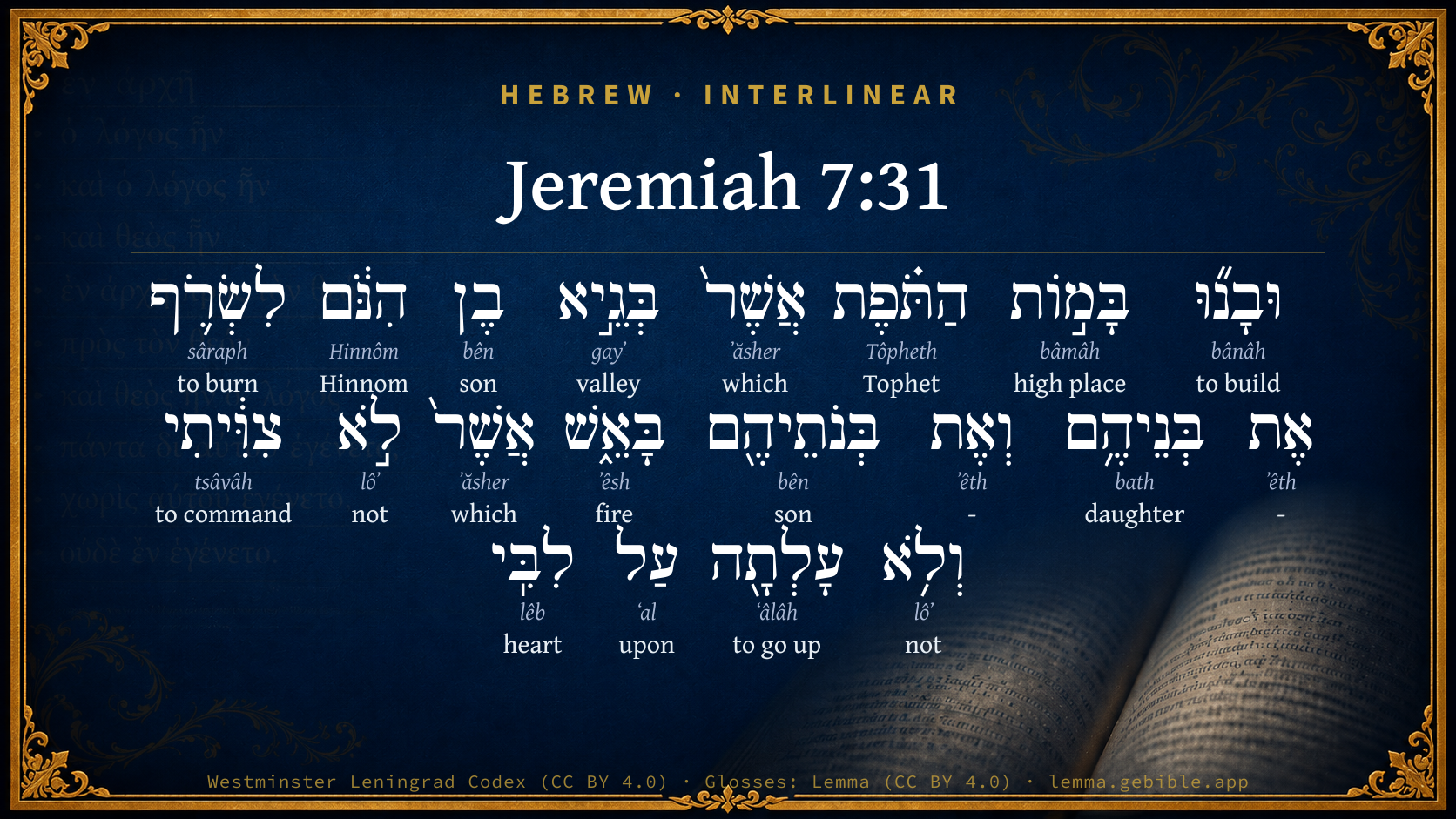
Hebrew (Westminster Leningrad Codex) Jeremiah 7:31 appears in the Hebrew Old Testament. The text above is from the Westminster Leningrad Codex. Each word links to its Strong’s number, a concise gloss, and parsing drawn from the Open Scriptures Hebrew Bible morphology. Click any word for its full Brown-Driver-Briggs (BDB) entry.
Download image
Cite this verse

Jeremiah 7:31 (World English Bible). Public Domain. Lemma interlinear Bible study tool, https://lemma.gebible.app/v/jeremiah/7/31.

Show BibTeX & RIS
BibTeX
RIS
English Translation
They have built the high places of Topheth, which is in the valley of the son of Hinnom, to burn their sons and their daughters in the fire; which I didn't command, neither came it into my mind.
World English Bible · Public Domain
Download a study sheet

One document with this verse’s original text, its word-by-word gloss line, the meaning frame, cross-references with their text, attributed commentary, and full source and license credits — printable, and it pastes into notes with its structure intact.

This verse Autodidact and up

Study sheet (.html) Plain text (.txt)

A passage Seminary Student

Up to 50 verses in one chapter. A passage sheet keeps up to 6 commentary sources and 12 cross-references per verse, in the order this page ranks them, and says so on the sheet whenever that leaves anything out. Ask for a single verse and you get the Autodidact verse sheet above.

Everything on this page stays free to read, with no account — the sheet is a download of what is already on screen, not access to it.

Want to remove ads? Support Godless Engineer
Compare translations 3

The same verse in 3 English versions, stacked beneath the original-language interlinear above. Click any original word for its lexicon entry.

Each is an independent rendering of the whole verse — the interlinear is not word-aligned to these translations.

Highlighted words mark where these versions differ — a whole-verse word diff, not a word-by-word alignment.

  • World English Bible Public Domain
    They have built the high places of Topheth, which is in the valley of the son of Hinnom, to burn their sons and their daughters in the fire; which I didn't command, neither came it into my mind.
  • King James Version Public Domain
    And they have built the high places of Tophet, which is in the valley of the son of Hinnom, to burn their sons and their daughters in the fire; which I commanded them not, neither came it into my heart.
  • unfoldingWord Literal Text CC BY-SA 4.0
    And they have built the high places of Topheth which in the Valley of the Son of Hinnom, to burn their sons and their daughters in the fire—which I did not command, and it did not come into my heart.

unfoldingWord Literal Text — © unfoldingWord, licensed CC BY-SA 4.0. Word-aligned USFM3 via Door43 (git.door43.org/unfoldingWord/en_ult).

Versions to compare (up to 4)

3 of 4 selected

Show all 18 translations

Every available English version of this verse, each an independent rendering of the whole verse.

  • World English Bible Public Domain
    They have built the high places of Topheth, which is in the valley of the son of Hinnom, to burn their sons and their daughters in the fire; which I didn't command, neither came it into my mind.
  • Berean Standard Bible Public Domain
    They have built the high places of Topheth in the Valley of Hinnom so they could burn their sons and daughters in the fire—something I never commanded, nor did it even enter My mind.
  • Majority Standard Bible Public Domain
    They have built the high places of Topheth in the Valley of Ben-hinnom so they could burn their sons and daughters in the fire—something I never commanded, nor did it even enter My mind.
  • King James Version Public Domain
    And they have built the high places of Tophet, which is in the valley of the son of Hinnom, to burn their sons and their daughters in the fire; which I commanded them not, neither came it into my heart.
  • American Standard Version (1901) Public Domain
    And they have built the high places of Topheth, which is in the valley of the son of Hinnom, to burn their sons and their daughters in the fire; which I commanded not, neither came it into my mind.
  • Revised Version (1885) Public Domain
    And they have built the high places of Topheth, which is in the valley of the son of Hinnom, to burn their sons and their daughters in the fire; which I commanded not, neither came it into my mind.
  • Geneva Bible (1599) Public Domain
    And they haue built the hie place of Topheth, which is in the valley of Ben-Hinnom to burne their sonnes and their daughters in the fire, which I commanded them not, neither came it in mine heart.
  • Douay-Rheims (1899) Public Domain
    And they have built the high places of Topeth, which is in the valley of the son of Ennom, to burn their sons, and their daughters in the fire: which I commanded not, nor thought on in my heart.
  • Young's Literal Translation Public Domain
    And have built the high places of Tophet, That `are' in the valley of the son of Hinnom, To burn their sons and their daughters with fire, Which I did not command, Nor did it come up on My heart.
  • Literal Standard Version CC BY-SA 4.0
    And have built the high places of Tophet, || That [are] in the Valley of the Son of Hinnom, || To burn their sons and their daughters with fire, || Which I did not command, || Nor did it come up on My heart.
  • Unlocked Literal Bible CC BY-SA 4.0
    Then they built the high place of Topheth that is in the Valley of Ben Hinnom. They did this to burn their sons and daughters in fire—something that I did not command, nor did it enter my mind.
  • unfoldingWord Literal Text CC BY-SA 4.0
    And they have built the high places of Topheth which in the Valley of the Son of Hinnom, to burn their sons and their daughters in the fire—which I did not command, and it did not come into my heart.
  • Darby Bible Public Domain
    And they have built the high places of Topheth, which is in the valley of the son of Hinnom, to burn their sons and their daughters in the fire; which I commanded not, neither did it come up into my mind.
  • World Messianic Bible Public Domain
    They have built the high places of Topheth, which is in the valley of the son of Hinnom, to burn their sons and their daughters in the fire, which I didn’t command, nor did it come into my mind.
  • Webster's Bible Public Domain
    And they have built the high places of Tophet, which is in the valley of the son of Hinnom, to burn their sons and their daughters in the fire; which I commanded them not, neither came it into my heart.
  • Free Bible Version CC BY-SA 4.0
    They have built pagan shrines at Topheth in the Valley of Hinnom so they could sacrifice their sons and daughters by burning them in the fire. This is something I never commanded. I never even thought of such a thing!
  • Bible in Basic English Public Domain
    And they have put up the high place of Topheth in the valley of the son of Hinnom, burning their sons and their daughters there in the fire; a thing which was not ordered by me and never came into my mind.
  • JPS Tanakh (1917) Public Domain
    And they have built the high places of Topheth, which is in the valley of the son of Hinnom, to burn their sons and their daughters in the fire; which I commanded not, neither came it into My mind.

Literal Standard Version (2020), Covenant Press — licensed CC BY-SA 4.0. Text via the HelloAO Bible API (eBible.org). Unlocked Literal Bible (unfoldingWord) — licensed CC BY-SA 4.0. Text via the HelloAO Bible API (eBible.org). unfoldingWord Literal Text — © unfoldingWord, licensed CC BY-SA 4.0. Word-aligned USFM3 via Door43 (git.door43.org/unfoldingWord/en_ult). Free Bible Version, Dr. Jonathan Gallagher — licensed CC BY-SA 4.0. Text via the HelloAO Bible API (eBible.org).

Word by word

More ways to search: Search by grammar → Find every occurrence → Compare this word →

Practice this passage: Drill this verse → Learn its vocabulary →

הַתֹּ֗פֶת
Tôpheth
H8612
“the · Tophet”
Particle, Definite Article + Noun, Proper
Part of Speech
Particle + Noun
Type
Proper
Full BDB Definition

Origin: the same as H8611

TWOT: 2539

Tophet or Topheth = "place of fire"
  1. וּבָנ֞וּ bânâh H1129 “and · to build” Conjunction + Verb, Qal, Perfect, 3rd Person, Common, Plural
  2. בָּמ֣וֹת bâmâh H1116 “high places of” Noun, Common, Feminine, Plural, Construct
  3. אֲשֶׁר֙ ʼăsher H834 “which” Particle, Relative
  4. בְּגֵ֣יא gayʼ H1516 “in/at · valley of” Preposition + Noun, Common, Both, Singular, Construct
  5. בֶן bên H1121 “son” Noun, Proper
  6. הִנֹּ֔ם Hinnôm H2011 “Hinnom” Noun, Proper
  7. לִשְׂרֹ֛ף sâraph H8313 “to burn” Preposition + Verb, Qal, Infinitive Construct
  8. אֶת ʼêth H853 “-” Particle, Direct Object
  9. בְּנֵיהֶ֥ם bath H1323 “daughters · their” Noun, Common, Feminine, Plural, Construct + Suffix, Personal, 3rd Person, Masculine, Plural
  10. וְאֶת ʼêth H853 “and · -” Conjunction + Particle, Direct Object
  11. בְּנֹתֵיהֶ֖ם bên H1121 “sons · their” Noun, Common, Masculine, Plural, Construct + Suffix, Personal, 3rd Person, Masculine, Plural
  12. בָּאֵ֑שׁ ʼêsh H784 “in/at the · fire” Preposition, Determined + Noun, Common, Both, Singular, Absolute
  13. אֲשֶׁר֙ ʼăsher H834 “which” Particle, Relative
  14. לֹ֣א lôʼ H3808 “not” Particle, Negative
  15. צִוִּ֔יתִי tsâvâh H6680 “to command” Verb, Piel, Perfect, 1st Person, Common, Singular
  16. וְלֹ֥א lôʼ H3808 “and · not” Conjunction + Particle, Negative
  17. עָלְתָ֖ה ʻâlâh H5927 “to go up” Verb, Qal, Perfect, 3rd Person, Feminine, Singular
  18. עַל ʻal H5921 “upon” Preposition
  19. לִבִּֽי lêb H3820 “heart · my” Noun, Common, Masculine, Singular, Construct + Suffix, Personal, 1st Person, Common, Singular

About this verse

These counts appear in no published source. They are computed here, from the morphology-tagged text and Lemma’s own curated glosses. What Lemma adds →

20
words
16
distinct lemmas
Prophets
section

Notable vocabulary

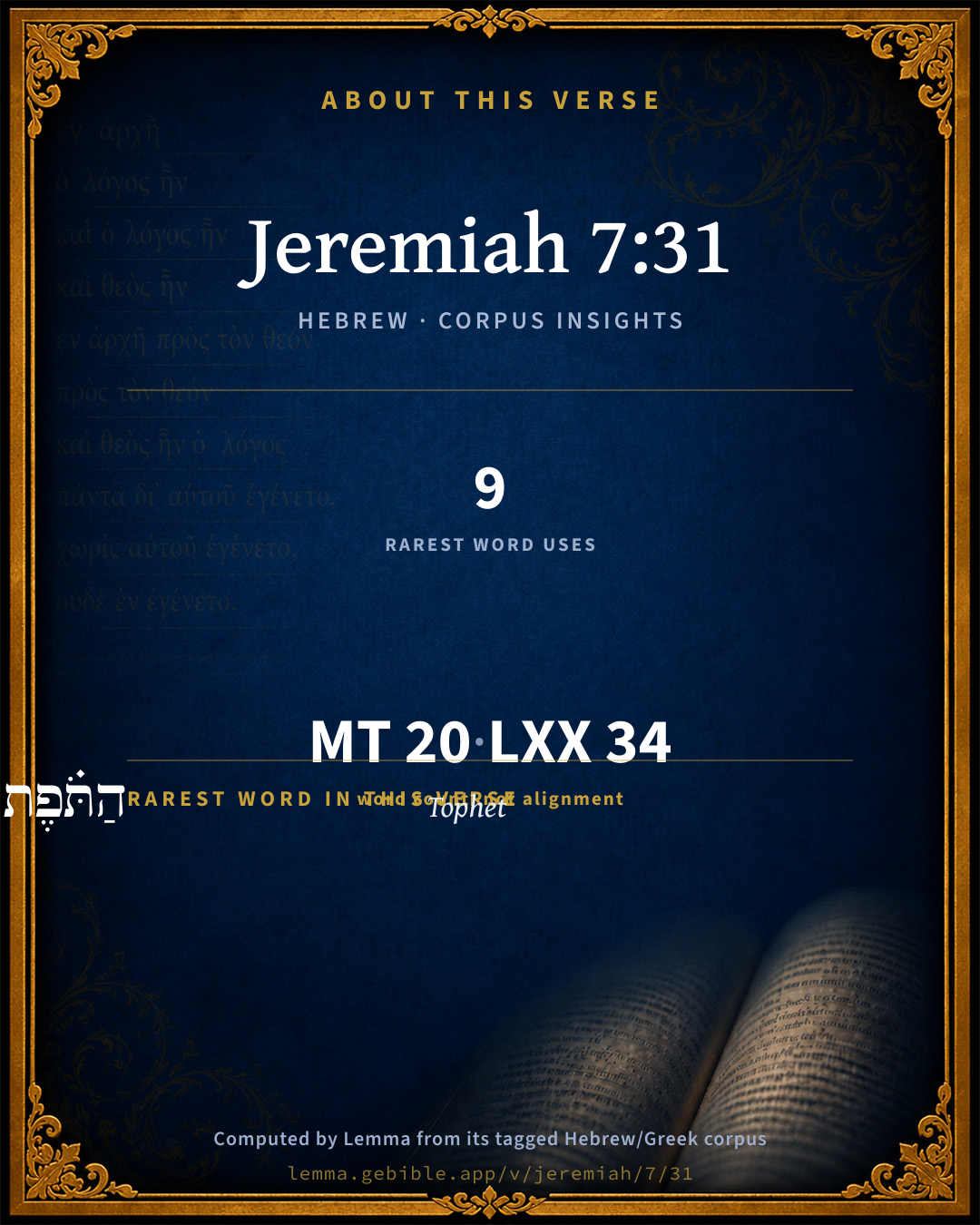
The rarest word here is הַתֹּ֗פֶת Tophet H8612 — appearing just 9 times in the whole Hebrew Bible.

Shared distinctive vocabulary

הַתֹּ֗פֶת Tophet H8612 occurs in 8 verses of the Hebrew Bible. Also found in:

Grammatical profile

  • 4 verbs
  • 9 nouns
  • 1 preposition
  • 6 particles

Verb forms

  • וּבָנ֞וּ Qal · Perfect
  • לִשְׂרֹ֛ף Qal · Infinitive Construct
  • צִוִּ֔יתִי Piel · Perfect
  • עָלְתָ֖ה Qal · Perfect

Repetition

Words recur within this verse — often emphatic in Hebrew:

  • בֶן son H1121 ×2
  • אֲשֶׁר֙ which H834 ×2
  • לֹ֣א not H3808 ×2

Hebrew & Septuagint length

In the original languages it is 20 Hebrew tokens and 34 Greek tokens — but the two are counted differently (Hebrew bundles its prefixes and suffixes into one token; the Greek is in lemma form), so that isn’t a like-for-like length.

Cross-references

15

Topical passages linked to Jeremiah 7:31 in the Treasury of Scripture Knowledge — connected by theme and wording, ordered by reader-vote popularity; previews shown in the World English Bible.

  • 2 Kings 23:10 He defiled Topheth, which is in the valley of the children of Hinnom, that no man might make his son or his daughter to pass through the fire to Molech.
  • Leviticus 18:21 "'You shall not give any of your children to sacrifice to Molech; neither shall you profane the name of your God: I am Yahweh.
  • 2 Kings 17:17 They caused their sons and their daughters to pass through the fire, and used divination and enchantments, and sold themselves to do that which was evil in the sight of Yahweh, to provoke him to anger.
  • Jeremiah 32:35 They built the high places of Baal, which are in the valley of the son of Hinnom, to cause their sons and their daughters to pass through [the fire] to Molech; which I didn't command them, neither did it come into my mind, that they should do this abomination, to cause Judah to sin.
  • Leviticus 20:1–5 Yahweh spoke to Moses, saying,
  • Deuteronomy 12:31 You shall not do so to Yahweh your God: for every abomination to Yahweh, which he hates, have they done to their gods; for even their sons and their daughters do they burn in the fire to their gods.
  • 2 Chronicles 28:3 Moreover he burnt incense in the valley of the son of Hinnom, and burnt his children in the fire, according to the abominations of the nations whom Yahweh cast out before the children of Israel.
  • Psalms 106:37–38 Yes, they sacrificed their sons and their daughters to demons.
  • Jeremiah 19:5–6 and have built the high places of Baal, to burn their sons in the fire for burnt offerings to Baal; which I didn't command, nor spoke it, neither came it into my mind:
  • Ezekiel 16:20 Moreover you have taken your sons and your daughters, whom you have borne to me, and these have you sacrificed to them to be devoured. Were your prostitution a small matter,
  • 2 Chronicles 33:6 He also made his children to pass through the fire in the valley of the son of Hinnom; and he practiced sorcery, and used enchantments, and practiced sorcery, and dealt with those who had familiar spirits, and with wizards: he worked much evil in the sight of Yahweh, to provoke him to anger.
  • Deuteronomy 17:3 and has gone and served other gods, and worshiped them, or the sun, or the moon, or any of the host of the sky, which I have not commanded;
  • 2 Kings 23:20 He killed all the priests of the high places that were there, on the altars, and burned men's bones on them; and he returned to Jerusalem.
  • Jeremiah 19:2 and go forth to the valley of the son of Hinnom, which is by the entry of the gate Harsith, and proclaim there the words that I shall tell you;
  • Joshua 15:8 and the border went up by the valley of the son of Hinnom to the side of the Jebusite southward (the same is Jerusalem); and the border went up to the top of the mountain that lies before the valley of Hinnom westward, which is at the uttermost part of the valley of Rephaim northward;

Cross-references courtesy of OpenBible.info (CC BY 4.0).

Hebrew and Greek witnesses Masoretic Hebrew ↔ Greek Septuagint

The same verse in the two great witnesses to the Old Testament, shown verse-for-verse.

These are two independent witnesses, not word-aligned to each other, and the Septuagint is shown in lemma (dictionary) form.

Hebrew Jeremiah 7:31 Masoretic · Westminster Leningrad Codex

וּבָנ֞וּ בָּמ֣וֹת הַתֹּ֗פֶת אֲשֶׁר֙ בְּגֵ֣יא בֶן הִנֹּ֔ם לִשְׂרֹ֛ף אֶת בְּנֵיהֶ֥ם וְאֶת בְּנֹתֵיהֶ֖ם בָּאֵ֑שׁ אֲשֶׁר֙ לֹ֣א צִוִּ֔יתִי וְלֹ֥א עָלְתָ֖ה עַל לִבִּֽי

They have built the high places of Topheth, which is in the valley of the son of Hinnom, to burn their sons and their daughters in the fire; which I didn't command, neither came it into my mind.

World English Bible · Public Domain

Greek LXX Structure differs

In the Septuagint, Jeremiah is about an eighth shorter than the Hebrew and arranges its material differently — the Oracles Against the Nations (Hebrew chapters 46–51) appear in the middle of the Greek book, after 25:13. Because the chapter and verse boundaries do not line up, a verse-for-verse comparison with the Hebrew is not shown.

A verse-for-verse comparison isn’t shown here because the chapters and verses don’t line up. Switch to the LXX edition with the MT / LXX toggle above to read the Greek directly.

On this verse, The Cambridge Bible for Schools and Colleges discusses the Septuagint’s reading. Read the note in Commentary ↓

Hebrew: Westminster Leningrad Codex (CC BY 4.0). Greek: Septuagint (public domain); English from a public-domain English Septuagint. How the Septuagint differs from the Hebrew →

Targum (Aramaic paraphrase)

1

The Targum is the ancient Jewish Aramaic paraphrase of the Hebrew Scriptures — an interpretive translation, not the Hebrew text itself. Onkelos (literal) and Pseudo-Jonathan (expansive) render the Torah, and Jonathan the Prophets. Coverage is partial: where no permissively-licensed English translation exists for a verse, only the Aramaic is shown. This is verse-level text, not a word-by-word alignment to the Hebrew.

  1. Targum Jonathan Prophets (Joshua–Malachi)
    וּבְנוֹ בָּמַת תּוֹפֶת דִי בְחֵילַת בַּר הִנוֹם לְאוֹקָדָא יַת בְּנֵיהוֹן וְיַת בְּנָתֵיהוֹן בְּנוּרָא דְלָא פַקְדֵית בְּאוֹרַיְתִי וְלָא רַעֲוָא קָדְמַי:

    (no public-domain English translation for this verse)

    Targum Jonathan — Aramaic: “Mikraot Gedolot” (public domain). English: “Sefaria Community Translation” (CC0 1.0 (public-domain dedication)); “London "Chaldee Paraphrase," 1871” (public domain). Text via Sefaria.

Commentary

Notes on Jeremiah 7:31 from classic Christian and Jewish commentators (each source and its license shown beneath its notes). The classic Christian expositions comment on the surrounding passage and are grouped to its opening verse, so a note may address several verses; the Jewish commentaries on the Tanakh (Rashi and others) are per-verse, so they appear only where the commentator wrote on this verse.

Lemma curates 59 commentaries, every one of them public domain or Creative Commons licensed, each selected and text-cleaned for this edition rather than reprinted as found. About our sources →

Trapp's Complete Commentary

John Trapp

Jer 7:31 And they have built the high places of Tophet, which [is] in the valley of the son of Hinnom, to burn their sons and their daughters in the fire; which I commanded [them] not, neither came it into my heart.

Ver. 31. To burn their sons and their daughters.] Haply in a sinful imitation of Abraham or Jephthah; or else after the example of the Canaanites {Deu 12:31} and other heathens, who thus sacrificed to the devil, commanding them so to do by his oracles, though Hercules taught the Italians to offer unto him rather men made of wax. {a}

{a} Macrob. Saturn., lib. vii.

John Trapp, A Commentary or Exposition upon All the Books of the Old and New Testament (1647–1656) — public domain. Text from a community e-Sword module.

Geneva Bible (1599)

Geneva Bible translators

Of Tophet, read 2 Kings 23:10.

But commanded the contrary, as Lev. 18:21 and 20:3; Deut. 18:10.

Geneva Bible (1599) marginal notes — public domain. Text via Bolls.life.

Jamieson, Fausset & Brown

Robert Jamieson, A. R. Fausset & David Brown

high places of Tophet--the altars [HORSLEY] of Tophet; erected to Moloch, on the heights along the south of the valley facing Zion.

burn . . . sons-- (Psa 106:38).

commanded . . . not--put for, "I forbade expressly" (Deu 17:3; Deu 12:31). See on Jer 2:23; Isa 30:33.

Jamieson, Fausset & Brown — Commentary Critical and Explanatory on the Whole Bible (1871) — public domain (CC PDM 1.0). Text via the HelloAO Bible API.

Adam Clarke's Commentary

Verse 31. Tophet - in the valley of the son of Hinnom] Tophet was the place in that valley where the continual fires were kept up, in and through which they consecrated their children to Moloch.

Adam Clarke's Commentary on the Bible (1810–1826) — public domain. Text from a community e-Sword/MySword module.

John Calvin's Commentaries

Jeremiah in this verse also inveighs against those superstitions by which the Jews had corrupted the true and pure worship of God. He says, that they had builded high places, which was prohibited in the law. (Leviticus 26:30.) Now God, as it has been before said, prefers obedience to all sacrifices, (1 Samuel 15:22:) hence the Prophet justly condemned them, that they forsook the Temple and built for themselves high places or groves, and also altars.

He then mentions one particular place, even Tophet in the valley of Hinnom The prophets, in order to render the place detestable, no doubt designated the infernal regions by תפת, Tophet, and גיא הנם, gia enom. For when Isaiah speaks, in the thirtieth chapter, of the eternal punishment of the wicked, he mentions Tophet, which is the same word as we find here. As to the valley of Hinnom, it is called in Greek Gehenna, and is taken to designate eternal death, or the torments which await all the wicked. In a similar manner the word Paradise is metaphorically taken for the blessed state and for the eternal inheritance; for God so placed man at first in that eastern garden, that he might in a manner protect him under his own wings. As then the blessing and favor of God shone on that place where Adam first dwelt, that it might be a certain image of celestial life and of true happiness, so they called the glory, prepared for all God’s children in heaven, Paradise. So also on the other hand the prophets called hell גיא הנם, gia enom, in order that the Jews might detest those impious and sacrilegious modes of worship by which their fathers had polluted themselves. And for the same reason they call hell, Tophet. The ancients also say, that it was a place in the suburbs of the city. They were not wont then to assemble afar off for the sake of these abominations, since the place was within sight of the Temple, and they knew that there was the only true altar approved by God, and that it was not lawful to offer sacrifices anywhere else. Since they knew this, and God had set such a place before their eyes, the greater was their madness, when they preferred a filthy spot in which to worship God according to their own will, or rather according to their own wantonness.

Of this so great an audacity Jeremiah now complains: They builded for themselves high places, in Tophet, even in the valley He introduces the word son; but it is called הנם גיא, gia enom, the valley of Hinnom; whence comes the word Gehenna, as we have already said.

He adds, that they might burn their sons and their daughters It was a horrible and prodigious madness for parents not to spare their own children, but to cast them into the fire; for they must have been so seized with a diabolic fury as to divest themselves of all human feelings: and yet they had a plausible reason, as they supposed; for it was a zeal worthy of all praise to prefer God to their own children. When therefore they cast their children into the fire, this kind of zeal might have deceived the simple; and to this was added a pretext derived from example, for Abraham was prepared to sacrifice his own son. But it hence appears what men will do when they are led away by an inconsiderate zeal; for from the beginning of the world the source of all superstitions has been this, — that men have devised for themselves various modes of worship, and have given themselves the liberty to seek a way of their own to pacify God.

As to the pretended example, they were so blind as not to distinguish between themselves and Abraham; for he was commanded to offer his son, (Genesis 22:2;) but they, without any command, attempted to do the same thing; this was extreme presumption. As to Abraham, he obeyed God; and he could not have been led astray, when he knew that such a sacrifice was approved by God. But when the Jews emulated his zeal, it was an extreme folly; and they were especially culpable, because they neglected God’s command and wholly disregarded it. They were, however, so far carried away by their own wantonness as to cast their own children into the fire, and under the pretense of piety: so great and so savage a cruelty prevailed among them. We hence perceive that there is no end of sinning, when men give themselves up to their own inventions; for God surrenders those to Satan, that they may be led by the spirit of giddiness and of madness and of stupidity. Let us therefore learn ever to regard what God approves: and let this be the very beginning of our inquiry, whenever we undertake anything, whether God commands it; and this course ought especially to be observed with regard to his worship; for, as it has been already stated, religion is especially founded on faith, and faith is based on the word of God: and hence it is here added —

Which I commanded them not, and which never came to my mind This reason ought to be carefully noticed, for God here cuts off from men every occasion for making evasions, since he condemns by this one phrase, “I have not commanded them,” whatever the Jews devised. There is then no other argument needed to condemn superstitions, than that they are not commanded by God: for when men allow themselves to worship God according to their own fancies, and attend not to his commands, they pervert true religion. And if this principle was adopted by the Papists, all those fictitious modes of worship, in which they absurdly exercise themselves, would fall to the ground. It is indeed a horrible thing for the Papists to seek to discharge their duties towards God by performing their own superstitions. There is an immense number of them, as it is well known, and as it manifestly appears. Were they to admit this principle, that we cannot rightly worship God except by obeying his word, they would be delivered from their deep abyss of error. The Prophet’s words then are very important, when he says, that God had commanded no such thing, and that it never came to his mind; as though he had said, that men assume too much wisdom, when they devise what he never required, nay, what he never knew. It is indeed certain, that there was nothing hid from God, even before it was done: but God here assumes the character of man, as though he had said, that what the Jews devised was unknown to him, as his own law was sufficient.

Now, as the words Tophet and Gehenna were so stigmatized by the prophets, we may hence learn how displeasing to God is every idolatry and profanation of his true and pure worship: for he compares these notorious places in which the Jews performed so sedulously their devotions, to the infernal regions. And hence at this day, when the Papists boast of what they call their devotions, we may justly say, that there are as many gates, through which they throw themselves headlong into hell, as there are modes of worship devised by them for the purpose of conciliating God. It follows —

John Calvin's Commentaries (1540-1563) — public domain. Text from the Calvin Translation Society English edition (1840s-50s) via the Christian Classics Ethereal Library (ccel.org). Calvin's coverage is partial (roughly two-thirds of the Bible); uncommented books and verses are honest gaps, never fabricated. The 19th-century editor's footnotes and remarks are omitted so the notes are faithfully Calvin's own voice.

Ellicott's Commentary for English Readers

(31) High places.—Not the same word as in Jer_7:29, but bamoth, as in the “high places” of Baal, in Num_22:41; Num_23:3, the Bamoth-baal of Jos_13:17. The word had become almost technical for the mounds, natural or (as in this passage) artificial, on which altars to Jehovah or to other gods were erected, and appears in 1Sa_9:12; 1Ki_3:4; Eze_20:29; Amo_7:9.

Tophet.—This appears to have been originally, not a local name, but a descriptive epithet. The word appears in Job_17:6 (“by-word” in the Authorised version) as a thing spat upon and loathed. Its use is probably therefore analogous to the scorn with which the prophets substituted bosheth, the “shameful thing,” for Baal (e.g., Jer_3:24; Jer_11:13). When the prediction is repeated in Jer_19:5; Jer_32:35, we have the “high places of Baal,” and “Tophet” here is obviously substituted for that name in indignant contempt. The word in Isa_30:33, though not identical in form (Tophteh, not Tophet), had probably the same meaning. Other etymologies give as the meaning of the word “a garden,” “a place of burning,” or “a place of drums,” i.e., a music grove, and so connect it more closely with the Molech ritual. Possibly the last was the original meaning of the name, for which, as said above, the prophets used the term of opprobrium.

The son of Hinnom.—Possibly the first recorded owner, or a local hero. The name is perpetuated in later Jewish language in Ge-henna = Ge-Hinnom = the vale of Hinnom. It was older than the Molech worship with which it became identified, and appears in the “Doomsday Book” of Israel (Jos_15:8; Jos_18:16).

To burn their sons and their daughters.—The words are important as determining the character of the act more vaguely described in Jer_32:35, as “making to pass through the fire.” The children were, in some cases at least, actually burnt, though often, perhaps (see Eze_16:21), slain first. Horrible as the practice seems to us, it was part of the Canaanite or Phœnician worship of Molech or Malcom (Lev_18:21; Lev_20:2-5), and had been practised by Ahaz (2Ki_16:3; 2Ch_28:3) and Manasseh (2Ki_21:6; 2Ch_33:6).

A Bible Commentary for English Readers, edited by Charles John Ellicott (1878–1897) — public domain. Text from a community e-Sword module.

The Cambridge Bible for Schools and Colleges

gen. ed. J. J. S. Perowne

31. high places] read high place. There would not be more than one altar in Topheth. So LXX and Targ.

Topheth] This probably is not the original vocalisation (LXX Ταφέθ), though the latter cannot be determined with certainty. As Bosheth was a frequent substitute for Baal (see on Jer_3:24), and as the vowels of the former word were for a similar reason given to the consonants MLK (Melech, king), in order that offerings which the more enlightened felt it shameful to connect with Israel’s Divine King (Melech) might be represented as really made to a heathen god (Molech); so here the original form of the word Topheth is thought to have been disguised for the same purpose of discredit. The etymology of the word is doubtful. Perhaps it comes from a root appearing in Aramaic in the sense of fire-place. So Rob. Sm. Rel. of the Semites, p. 377 (1894), who points out that when the term “first appears in Hebrew, the chief foreign influence was that of Damascus” (2 Kings 16). A great pit constituted the “fire-place,” where the victims were consumed. See C. B. on Isa_30:33, where the word is from the same root, though in a slightly different form. As to the position of Topheth see next note. It was defiled by Josiah (2Ki_23:10) as the scene of idolatrous and cruel rites.

valley of the son of Hinnom] The majority of scholars identify it with the Wady er-Rubâbeh, running W. and S. of Jerusalem, rather than with the Tyropoeon or the Kidron valleys. The derivation and meaning of Hinnom are unknown. Possibly it was the name of a former owner. See further on Jer_2:23. As to the position of Topheth in connexion with it, all that we can say with tolerable certainty is that it was near the junction of the three valleys which encompass Jerusalem, and below Siloam. See HDB. Hinnom, Valley of, and Topheth.

to burn, etc.] The law laid down that firstborn alike of men and of cattle were dedicated to Jehovah. The firstborn of men and of unclean animals were to be redeemed, those of clean animals to be offered in sacrifice (Exo_13:2; Exo_13:12 f., Jer_22:29, Jer_34:19 f.; cp. Num_3:46 f., Jer_18:15 f.). The fact that neighbouring nations, Arabs, Phoenicians, Moabites, actually sacrificed their firstborn, together with a misinterpretation of the above passages, may have led to a belief that Jehovah meant that this should be done, and possibly Jeremiah in Jer_8:8 refers to a written perversion of the law in this direction. See note there. According to Ezek. (Eze_20:25) the people were left by God in this belief as a judicial punishment. (Cp. for a parallel case Eze_14:9.) Ezekiel there traces the custom to wilderness days. As human sacrifices came under the category of the burnt offering, and as animals were slain before they were consumed, we may presume that the same was done in these cases. (Milton, P.L. I. 394 ff. takes the other view.)

which I, etc.] Mic_6:7 shews that in his day the question of the efficacy of such sacrifices was a practical one.

mind] mg. heart. See on ch. Jer_5:21.

31, 32. For a recurrence of the substance of this passage see ch. Jer_19:5 f., 11.

The Cambridge Bible for Schools and Colleges (gen. ed. J. J. S. Perowne; Cambridge University Press, 1878–1918) — public domain. Text from a community e-Sword module.

John Gill's Exposition

And they have built the high places of Tophet,.... Where was the idol Moloch; and which place had its name, as Jarchi thinks, from the beating of drums, that the parents of the children that were burnt might not hear the cry of them: which is in the valley of the son of Hinnom; a valley near Jerusalem, and lay to the south of it, Jos 15:8,

to burn their sons and their daughters in the fire: which was done, as Jarchi says, by putting them into the arms of the brasen image Moloch, heated hot. The account he gives of Tophet is this,

"Tophet is Moloch, which was made of brass; and they heated him from his lower parts; and his hands being stretched out, and made hot, they put the child between his hands, and it was burnt; when it vehemently cried out; but the priests beat a drum, that the father might not hear the voice of his son, and his heart might not be moved:''

but in this he is mistaken; for "Tophet" was not the name of an idol, but of a place, as is clear from this and the following verse. There is some agreement between this account of Jarchi, and that which Diodorus Siculus (z) gives of Saturn, to whom children were sacrificed by the Carthaginians; who had, he says, a brasen image of Saturn, which stretched out his hands, inclining to the earth; so that a child put upon them rolled down, and fell into a chasm full of fire:

which I commanded them not: not in my law, as the Targum; nor by any of the prophets, as Jarchi paraphrases it; he commanded them, as Kimchi observes, to burn their beasts, but not their sons and daughters. The instance of Abraham offering up Isaac will not justify it. The case of Jephthah's daughter, if sacrificed, was not by divine command. The giving of seed to Moloch, and letting any pass through the fire to him, is expressly forbidden, Lev 18:21,

neither came it into my heart; it was not so much as thought of by him, still less desired, and much less commanded by him. Jarchi's note is,

"though I spoke to Abraham to slay his son, it did not enter into my heart that he should slay him, but to make known his righteousness.''

(z) Bibliothec. Par. 2. l. 20. p. 756.

John Gill's Exposition of the Whole Bible (1746–1763) — public domain (CC PDM 1.0). Text via the HelloAO Bible API.

Haydock's Catholic Bible Commentary

Valley, to the south of the city. Here Moloc was adored, and Josias therefore contaminated the place, 4 Kings xxiii. 10. (Calmet) --- It was very delightful. (St. Jerome)

George Leo Haydock (1774–1849), Haydock's Catholic Family Bible and Commentary, 1859 edition — public domain. Excludes Psalms (Douay-Rheims chapter numbering differs from Protestant) and Deuterocanonical books (Catholic canon only).

Matthew Poole's English Annotations

High places of Tophet; See Poole "Isa 30:33". It comes from Toph, that signifies a drum, because they did beat drums to hinder the noise of their children’s screeches, when they burnt them in sacrifice upon the altars, called here, high places, to Moloch, which is also called Melchom.

Which is in the valley of the son on Hinnom: Tophet was situate in a pleasant valley near Jerusalem, a place in the possession of the children of one Hinnom, Jos 15:8, watered by the river of Siloe.

To burn their sons and their daughters in the fire: this most inhuman practice of burning their children, even their own bowels, to Moloch, not their sons only, but their daughters, who were most tender, the did expressly against the command and caution of God; See Poole "Deu 18:10"; having learned it of the heathen, Deu 12:30,31, the devil commanding them so to do by his oracles. They took pattern from the Samaritans where those of every nation make gods of their own, 2Ki 17:29-31.

Neither came it into my heart; which was always so far from my approving, that I never let it come into my thought or debate, whether I should or not; or which I abhorred from my heart: he speaks herein after the manner of men: see Jer 3:16; 32:35

Matthew Poole's English Annotations on the Holy Bible (1683–1685) — public domain. Text from a community e-Sword/MySword module.

Whedon's Commentary on the Bible

Daniel D. Whedon

31. High places of Tophet — The word for “high places” is not the same which has been repeatedly so translated in this book, as in Jer_7:29, but rather high altars. It applies to those artificial shrines raised for Baal worship at Jerusalem. Some have thought that the word “Tophet” is to be used here not as a proper noun, but an epithet — abomination. But the reasons given are not conclusive. It is better to regard it here, as elsewhere, as simply the name for a definite locality. For the genesis of the word, see the dictionaries.

Valley of the son of Hinnom — The origin of this designation is not known. Probably it came from some ancient hero of whose exploits this name is the only memorial. It is first used in the book of Joshua.

To burn their sons and their daughters — See Jer_19:6; Jer_32:35; Lev_18:21; Lev_20:2-5; and Eze_16:20-21. This burning was literal, though, as would appear from Ezekiel, the victims were slain before being burned. They “caused their children to pass through the fire” in order to purify them and fit them for eternal bliss.

Daniel D. Whedon (gen. ed.), Commentary on the Old and New Testaments (1874–1909) — public domain. Text from a community e-Sword module.

The Pulpit Commentary

The high places of Tophet; rather, the high places of the Topheth (on the "high places" (Hebrew bamoth)hero probably artificial mounds to erect the altars upon, and on "the Topheth," (see Commentary on 1 Kings). In the valley of the son of Hinnom. Hitzig and others would take Hinnom as a noun meaning "groaning" (Rashi, the great Jewish commentator. had already proposed this view), which is at first sight very plausible. But this name of the valley is already found in the description of the boundaries of Judah and Benin-rain in Jos_15:8 Jos_18:16. To burn their sons, etc. (On the worship of Moloch (Saturn), see Lev_18:21, and comp. Eze_16:20, Eze_16:21, from which it appears that the children were first slain before being "caused to pass through the fire.")

Vers. 31-33. The desecration of Tophet.

This valley was the scene of Solomon"s Moloch-worship, of the child-sacrifices of Ahaz and Manasseh, and of the varying idolatrous rites of succeeding times. If the temple still maintained externally its consecration to Jehovah and its position as the center of the theocracy, the valley of Ben-Hinnom was the acknowledged center and high place of Moloch. Its vicinity to Jerusalem brought it into prominent opposition to the temple. Some signal exhibition of the Divine wrath is, therefore, called for. This is furnished by the iconoclastic zeal of Josiah, the great slaughter of Israel in war, and the gradual use of it as a receptacle for filth, sewage, unburied dead, etc. The prophecy, repeated in Jer_19:11, is speedily translated into history. We have here an instance of the Divine laws

I THAT THAT WHICH IS MORALLY CORRUPT SHALL ENTAIL DESTRUCTION. Where there is filth in God"s universe there will be fire. Corruption is the beginning of death, in this world and that which is to come.

II THE INWARD, MORAL CHARACTER OF THINGS AND PERSONS SHALL HAVE EXTERNAL PHYSICAL EXPRESSION. It will not always be concealed. That which is whispered in the ear shall be spoken from the house-top. The trap will be labeled and the pitfall plainly shown. The externalizing processes of history and development in nations, individuals, etc., tend to declare by outward and unmistakable signs the real character. Of this Tophet is an illustration. The judgment its revolting practices bring upon its votaries is the occasion of its permanent defilement. It gradually is transformed into a scene of physical abomination, and, to the spiritual imagination, the type and symbol of eternal perdition. Gehenna fires how different their first and last senses, and yet how related! The same law will operate in holy and spiritual men. The inward nature will cast the slough of corruption, and shall be clothed upon with a "body," which shall express, further, and fulfill it. When that which is really and spiritually filthy is sentenced to be " filthy still," the saints shall find embodiment and circumstances corresponding to their inward condition, and constituting the elements of their reward. M.

The Pulpit Commentary (1880–1919), ed. H.D.M. Spence-Jones & Joseph S. Exell — public domain. Text from a community e-Sword module.

John Wesley's Explanatory Notes

Tophet - It comes from Toph, a drum, because they beat drums to drown the children's screeches, when they burnt them in sacrifice upon the altars, called here high places, to Moloch. Tophet was situate in a pleasant valley near Jerusalem, a place in the possession of the children of one Hinnom, Josh. xv, 8.

John Wesley, Explanatory Notes Upon the Whole Bible (1754–1765) — public domain. Text via the GEBible commentary corpus.

unfoldingWord translationNotes

Door43 World Missions Community

Connecting Statement:

Yahweh continues to describe the evil things that the people of Judah had done.

General Information:

The words "they" and "their" in these verses refer to the people of Judah.

the high place of Topheth

This is the name of a place where the people of Israel sacrificed their children to a false god by burning them with fire. (See: How to Translate Names)

the Valley of Ben Hinnom

This is the name of a valley south of the city of Jerusalem, where people sacrificed to false gods. (See: How to Translate Names)

in fire

The implied information is that they were burned as sacrifices to a false god. AT: "as sacrifices" (See: Assumed Knowledge and Implicit Information)

nor did it enter my mind

Here the word "mind" refers to Yahweh's thoughts. AT: "nor did I ever think about it" (See: Metonymy)

So see

The word "see" here adds emphasis to what follows. AT: "Indeed"

days are coming ... when it

Future time is spoken of as if the "days are coming." AT: "in the future ... it" or "there will be a time ... when it" (See: Metaphor)

this is Yahweh's declaration

Yahweh speaks of himself by name to express the certainty of what he is declaring. See how you translated this in Jeremiah 1:8. AT: "this is what Yahweh has declared" or "this is what I, Yahweh, have declared" (See: First, Second, or Third Person)

it will no longer be called

This can be stated in active form. AT: "people will no longer call it" (See: Active or Passive)

they will bury bodies

"they will bury dead people"

no room left

"no place remaining"

translationWords

high place

fire

command

mind

day

call

slaughter

bury

body

unfoldingWord translationNotes — © Distant Shores Media and the Door43 World Missions Community, licensed CC BY-SA 4.0. Source: git.door43.org/Door43/en_tn.

Rashi

Rabbi Shlomo Yitzchaki (Rashi)

the high places of Topheth That is Molech, which was of copper, and they would heat it up from underneath it with its hands spread out and heated. And they would place the child on his hands, and he would be burnt and moan, and the priests would beat drums so that the father should not hear his son’s voice and take pity. It is called Topheth because of the drum (תּוף), Hinnom because of the child’s moaning (נהמת).

Hinnom Because of the child’s moaning.

which I did not ordain with commandments that they offer up their children as sacrifices, and I did not speak to any of the prophets, and when I did speak to Abraham to slaughter his son, it did not enter My mind that he slaughter, but only to make his righteousness known.

Rashi on the Tanakh — English translations: “The Judaica Press complete Tanach with Rashi, translated by A. J. Rosenberg” (CC BY 4.0); “Pentateuch with Rashi's commentary by M. Rosenbaum and A.M. Silbermann, 1929-1934” (public domain); “The Metsudah Tanach series, Lakewood, N.J” (CC BY 4.0); and “The Book of Joshua, Metsudah Publications, 1997” (CC BY 4.0). Text via Sefaria.

Lesson kit

Teaching starters — assembled from the data on this page, not authored interpretation. Every prompt links to the verse data it draws on. Edit before teaching.

Jeremiah, in the Prophets, opens this verse with 20 words (16 distinct Hebrew lemmas). Its most distinctive word is Tôpheth (“Tophet”). A historical commentator’s framing appears above. Read the whole chapter for the surrounding context.

Discussion questions

  1. How does “Tophet” (Tôpheth) shape what this verse is saying?
  2. 2 Kings 23:10 shares the word «Tophet» with this verse. How do the two illuminate each other?
  3. “son” occurs 2× in this one verse. What is the effect of the repetition?
  4. The translations on this page render this verse differently — a whole-verse word diff, not a word-by-word alignment. What might account for the different wordings?
  5. The verb «וּבָנ֞וּ» is Qal Perfect. How does its form color the action?
  6. Reading how Trapp's Complete Commentary and Geneva Bible (1599) read this verse, where do the two commentators agree and where do they part?

Things to notice

Reading settings

Reading text

Shown beneath each verse's original-language words.

Old Testament
Old Testament edition

Read the OT as the Masoretic Hebrew (MT) or the Greek Septuagint (LXX).

English shown for the Greek Septuagint (in the Hebrew ↔ Greek comparison).

Comparing translations? Open the Compare panel on any verse page to stack up to four side by side.