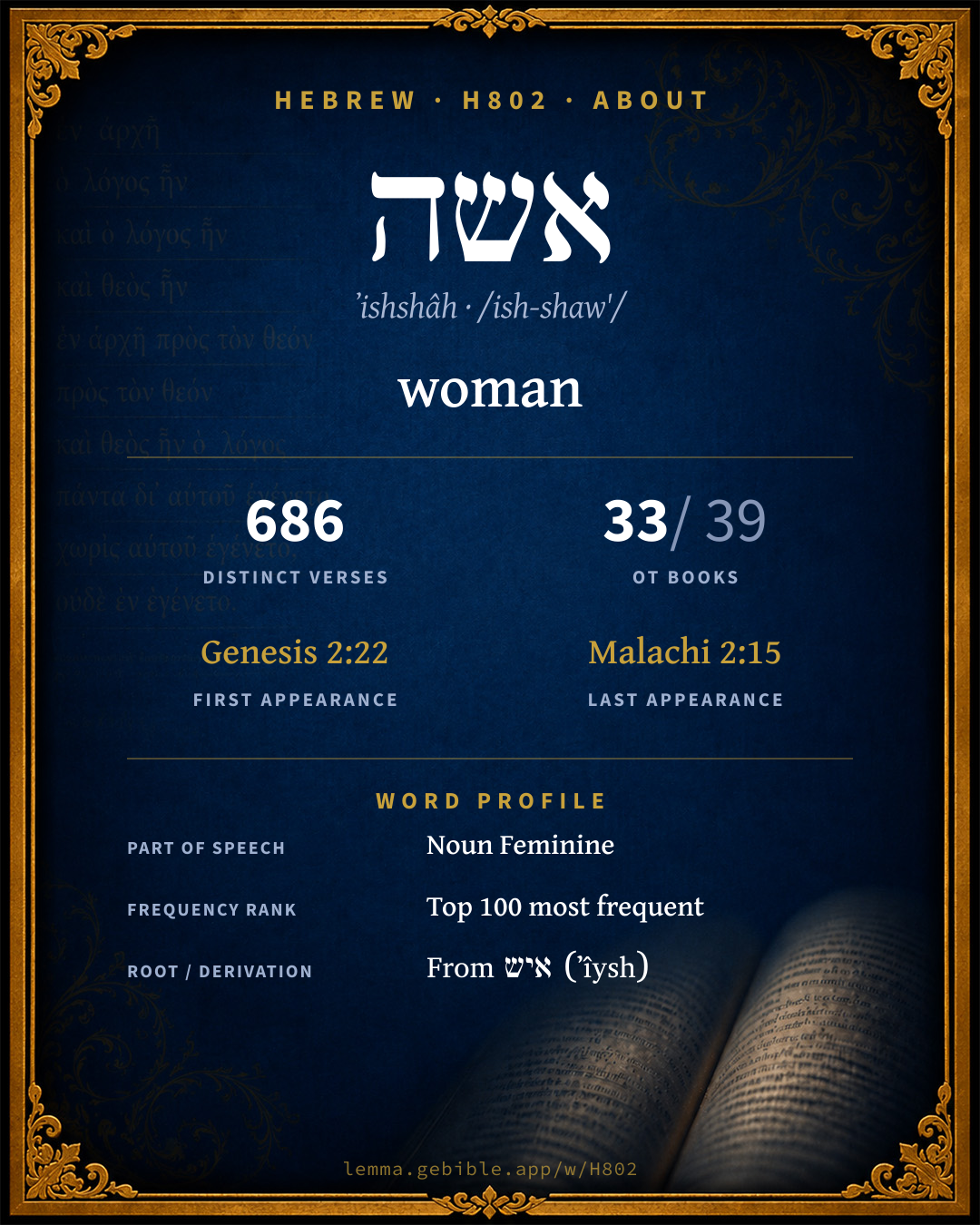
אִשָּׁה
woman
also: wife, female fuller range ↓
Full lexicon entry — Brown-Driver-Briggs (BDB)
From Brown-Driver-Briggs (BDB)
Where this word appears
See every Absolute-state word in the Hebrew Bible →
Grammar key — what these labels mean
Part of speech
- Noun
- A naming word — a person, place, thing, or idea.
Noun type
- Common
- A common noun — a general class of person, place, or thing (“king,” “city,” “water”), not a specific name.
State
- Absolute
- The independent form of a noun, not bound to a following word.
- Construct
- A noun bound to a following noun in a possessive / “of” relationship (the construct chain).
Gender
- Feminine
- Grammatically feminine.
Number
- Singular
- One.
- Plural
- More than one (in Hebrew, generally three or more).
Every verse where H802 appears in the Book of Judges — 55 distinct verses. Click any verse to open its interlinear word-by-word view. Verse text shown in the World English Bible for context — . Each verse’s Hebrew form is shown with its reference; the English is not keyword-highlighted, since the data carries no word-level English alignment. Use “Compare translations” on any verse to read it across multiple English versions. This concordance covers the Hebrew Bible; Septuagint (Greek Old Testament) occurrences are not indexed here.
Judges
- Judges 1:12 לְ/אִשָּֽׁה prep + n c fs Caleb said, He who strikes Kiriath Sepher, and takes it, to him will I give Achsah my daughter as wife.
- Judges 1:13 לְ/אִשָּֽׁה prep + n c fs Othniel the son of Kenaz, Caleb's younger brother, took it: and he gave him Achsah his daughter as wife.
- Judges 3:6 לְ/נָשִׁ֔ים prep + n c fp and they took their daughters to be their wives, and gave their own daughters to their sons and served their gods.
- Judges 4:4 אִשָּׁ֣ה אֵ֖שֶׁת n c fs n c fs cs Now Deborah, a prophetess, the wife of Lappidoth, she judged Israel at that time.
- Judges 4:9 אִשָּׁ֔ה n c fs She said, I will surely go with you: notwithstanding, the journey that you take shall not be for your honor; for Yahweh will sell Sisera into the hand of a woman. Deborah arose, and went with Barak to Kedesh.
- Judges 4:17 אֵ֖שֶּׁת n c fs cs However Sisera fled away on his feet to the tent of Jael the wife of Heber the Kenite; for there was peace between Jabin the king of Hazor and the house of Heber the Kenite.
- Judges 4:21 אֵֽשֶׁת n c fs cs Then Jael Heber's wife took a tent-pin, and took a hammer in her hand, and went softly to him, and struck the pin into his temples, and it pierced through into the ground; for he was in a deep sleep; so he swooned and died.
- Judges 5:24 מִ/נָּשִׁ֔ים אֵ֖שֶׁת מִ/נָּשִׁ֥ים prep + n c fp n c fs cs prep + n c fp Blessed above women shall Jael be, The wife of Heber the Kenite; Blessed shall she be above women in the tent.
- Judges 8:30 נָשִׁ֥ים n c fp Gideon had seventy sons conceived from his body; for he had many wives.
- Judges 9:49 וְ/אִשָּֽׁה conj + n c fs All the people likewise cut down every man his bough, and followed Abimelech, and put them to the stronghold, and set the stronghold on fire on them; so that all the men of the tower of Shechem died also, about a thousand men and women.
- Judges 9:51 וְ/הַ/נָּשִׁ֗ים conj + ptcl def.art + n c fp But there was a strong tower within the city, and there fled all the men and women, and all they of the city, and shut themselves in, and got them up to the roof of the tower.
- Judges 9:53 אִשָּׁ֥ה n c fs A certain woman cast an upper millstone on Abimelech's head, and broke his skull.
- Judges 9:54 אִשָּׁ֣ה n c fs Then he called hastily to the young man his armor bearer, and said to him, Draw your sword, and kill me, that men not say of me, A woman killed him. His young man thrust him through, and he died.
- Judges 11:1 אִשָּׁ֣ה n c fs Now Jephthah the Gileadite was a mighty man of valor, and he was the son of a prostitute: and Gilead became the father of Jephthah.
- Judges 11:2 אֵֽשֶׁת הָ/אִשָּׁ֜ה אִשָּׁ֥ה n c fs cs ptcl def.art + n c fs n c fs Gilead's wife bore him sons; and when his wife's sons grew up, they drove out Jephthah, and said to him, You shall not inherit in our father's house; for you are the son of another woman.
- Judges 13:2 וְ/אִשְׁתּ֥/וֹ conj + n c fs cs + sfx pers 3ms There was a certain man of Zorah, of the family of the Danites, whose name was Manoah; and his wife was barren, and didn't bear.
- Judges 13:3 הָ/אִשָּׁ֑ה ptcl def.art + n c fs The angel of Yahweh appeared to the woman, and said to her, See now, you are barren, and don't bear; but you shall conceive, and bear a son.
- Judges 13:6 הָ/אִשָּׁ֗ה ptcl def.art + n c fs Then the woman came and told her husband, saying, A man of God came to me, and his face was like the face of the angel of God, very awesome; and I didn't ask him whence he was, neither did he tell me his name:
- Judges 13:9 הָ/אִשָּׁ֗ה ptcl def.art + n c fs God listened to the voice of Manoah; and the angel of God came again to the woman as she sat in the field: but Manoah, her husband, wasn't with her.
- Judges 13:10 הָֽ/אִשָּׁ֔ה ptcl def.art + n c fs The woman made haste, and ran, and told her husband, and said to him, Behold, the man has appeared to me, who came to me the [other] day.
- Judges 13:11 אִשְׁתּ֑/וֹ הָ/אִשָּׁ֖ה n c fs cs + sfx pers 3ms ptcl def.art + n c fs Manoah arose, and went after his wife, and came to the man, and said to him, Are you the man who spoke to the woman? He said, I am.
- Judges 13:13 הָ/אִשָּׁ֖ה ptcl def.art + n c fs The angel of Yahweh said to Manoah, Of all that I said to the woman let her beware.
- Judges 13:19 וְ/אִשְׁתּ֖/וֹ conj + n c fs cs + sfx pers 3ms So Manoah took the kid with the meal-offering, and offered it on the rock to Yahweh: and [the angel] did wondrously, and Manoah and his wife looked on.
- Judges 13:20 וְ/אִשְׁתּ/וֹ֙ conj + n c fs cs + sfx pers 3ms For it happened, when the flame went up toward the sky from off the altar, that the angel of Yahweh ascended in the flame of the altar: and Manoah and his wife looked on; and they fell on their faces to the ground.
- Judges 13:21 אִשְׁתּ֑/וֹ n c fs cs + sfx pers 3ms But the angel of Yahweh did no more appear to Manoah or to his wife. Then Manoah knew that he was the angel of Yahweh.
- Judges 13:22 אִשְׁתּ֖/וֹ n c fs cs + sfx pers 3ms Manoah said to his wife, We shall surely die, because we have seen God.
- Judges 13:23 אִשְׁתּ֗/וֹ n c fs cs + sfx pers 3ms But his wife said to him, If Yahweh were pleased to kill us, he wouldn't have received a burnt offering and a meal-offering at our hand, neither would he have shown us all these things, nor would at this time have told such things as these.
- Judges 13:24 הָֽ/אִשָּׁה֙ ptcl def.art + n c fs The woman bore a son, and named him Samson: and the child grew, and Yahweh blessed him.
- Judges 14:1 אִשָּׁ֛ה n c fs Samson went down to Timnah, and saw a woman in Timnah of the daughters of the Philistines.
- Judges 14:2 אִשָּׁ֛ה לְ/אִשָּֽׁה n c fs prep + n c fs He came up, and told his father and his mother, and said, I have seen a woman in Timnah of the daughters of the Philistines: now therefore get her for me as wife.
- Judges 14:3 אִשָּׁ֔ה אִשָּׁ֔ה n c fs n c fs Then his father and his mother said to him, Is there never a woman among the daughters of your brothers, or among all my people, that you go to take a wife of the uncircumcised Philistines? Samson said to his father, Get her for me; for she pleases me well.
- Judges 14:7 לָ/אִשָּׁ֑ה prep det + n c fs He went down, and talked with the woman, and she pleased Samson well.
- Judges 14:10 הָ/אִשָּׁ֑ה ptcl def.art + n c fs His father went down to the woman: and Samson made there a feast; for so used the young men to do.
- Judges 14:15 לְ/אֵֽשֶׁת prep + n c fs cs It happened on the seventh day, that they said to Samson's wife, Entice your husband, that he may declare to us the riddle, lest we burn you and your father's house with fire: have you called us to impoverish us? is it not [so]?
- Judges 14:16 אֵ֨שֶׁת n c fs cs Samson's wife wept before him, and said, You do but hate me, and don't love me: you have put forth a riddle to the children of my people, and haven't told it me. He said to her, Behold, I haven't told it my father nor my mother, and shall I tell you?
- Judges 14:20 אֵ֣שֶׁת n c fs cs But Samson's wife was [given] to his companion, whom he had used as his friend.
- Judges 15:1 אִשְׁתּ/וֹ֙ אִשְׁתִּ֖/י n c fs cs + sfx pers 3ms n c fs cs + sfx pers 1cs But it happened after a while, in the time of wheat harvest, that Samson visited his wife with a kid; and he said, I will go in to my wife into the chamber. But her father wouldn't allow him to go in.
- Judges 15:6 אִשְׁתּ֔/וֹ n c fs cs + sfx pers 3ms Then the Philistines said, Who has done this? They said, Samson, the son-in-law of the Timnite, because he has taken his wife, and given her to his companion. The Philistines came up, and burnt her and her father with fire.
- Judges 16:1 אִשָּׁ֣ה n c fs Samson went to Gaza, and saw there a prostitute, and went in to her.
- Judges 16:4 אִשָּׁ֖ה n c fs It came to pass afterward, that he loved a woman in the valley of Sorek, whose name was Delilah.
- Judges 16:27 וְ/הַ/נָּשִׁ֔ים וְ/אִשָּׁ֔ה conj + ptcl def.art + n c fp conj + n c fs Now the house was full of men and women; and all the lords of the Philistines were there; and there were on the roof about three thousand men and women, who saw while Samson made sport.
- Judges 19:1 אִשָּׁ֣ה n c fs It happened in those days, when there was no king in Israel, that there was a certain Levite sojourning on the farther side of the hill-country of Ephraim, who took to him a concubine out of Bethlehem Judah.
- Judges 19:26 הָ/אִשָּׁ֖ה ptcl def.art + n c fs Then came the woman in the dawning of the day, and fell down at the door of the man's house where her lord was, until it was light.
- Judges 19:27 הָ/אִשָּׁ֣ה ptcl def.art + n c fs Her lord rose up in the morning, and opened the doors of the house, and went out to go his way; and, behold, the woman his concubine was fallen down at the door of the house, with her hands on the threshold.
- Judges 20:4 הָ/אִשָּׁ֥ה ptcl def.art + n c fs The Levite, the husband of the woman who was murdered, answered, I came into Gibeah that belongs to Benjamin, I and my concubine, to lodge.
- Judges 21:1 לְ/אִשָּֽׁה prep + n c fs Now the men of Israel had sworn in Mizpah, saying, There shall not any of us give his daughter to Benjamin as wife.
- Judges 21:7 לְ/נָשִׁ֑ים לְ/נָשִֽׁים prep + n c fp prep + n c fp How shall we do for wives for those who remain, seeing we have sworn by Yahweh that we will not give them of our daughters to wives?
- Judges 21:10 וְ/הַ/נָּשִׁ֖ים conj + ptcl def.art + n c fp The congregation sent there twelve thousand men of the most valiant, and commanded them, saying, Go and strike the inhabitants of Jabesh Gilead with the edge of the sword, with the women and the little ones.
- Judges 21:11 אִשָּׁ֛ה n c fs This is the thing that you shall do: you shall utterly destroy every male, and every woman who has lain by man.
- Judges 21:14 הַ/נָּשִׁ֔ים מִ/נְּשֵׁ֖י ptcl def.art + n c fp prep + n c fp cs Benjamin returned at that time; and they gave them the women whom they had saved alive of the women of Jabesh Gilead: and yet so they weren't enough for them.
- Judges 21:16 לְ/נָשִׁ֑ים אִשָּֽׁה prep + n c fp n c fs Then the elders of the congregation said, How shall we do for wives for those who remain, seeing the women are destroyed out of Benjamin?
- Judges 21:18 נָשִׁ֖ים אִשָּׁ֖ה n c fp n c fs However we may not give them wives of our daughters, for the children of Israel had sworn, saying, Cursed be he who gives a wife to Benjamin.
- Judges 21:21 אִשְׁתּ֖/וֹ n c fs cs + sfx pers 3ms and see, and, behold, if the daughters of Shiloh come out to dance in the dances, then come you out of the vineyards, and catch you every man his wife of the daughters of Shiloh, and go to the land of Benjamin.
- Judges 21:22 אִשְׁתּ֖/וֹ n c fs cs + sfx pers 3ms It shall be, when their fathers or their brothers come to complain to us, that we will say to them, Grant them graciously to us, because we didn't take for each man his wife in battle, neither did you give them to them, else would you now be guilty.
- Judges 21:23 נָשִׁים֙ n c fp The children of Benjamin did so, and took them wives, according to their number, of those who danced, whom they carried off: and they went and returned to their inheritance, and built the cities, and lived in them.
About this entry
At a glance — auto-summarized from this page’s data, not written by a person. Every figure links to its source below. This summary describes the numbers; it doesn’t interpret them.
“woman” is the headline sense of the Hebrew noun אשה (ʼishshâh). Not a single-sense word: its full sense range also takes in “wife” and “female”. It appears 686 verses across 33 books of the Hebrew Bible, among its most common vocabulary. Scripture first uses it in Genesis 2:22. It shares a root with איש, איש and אישון. The sections below give every sense, occurrence, and version rendering.
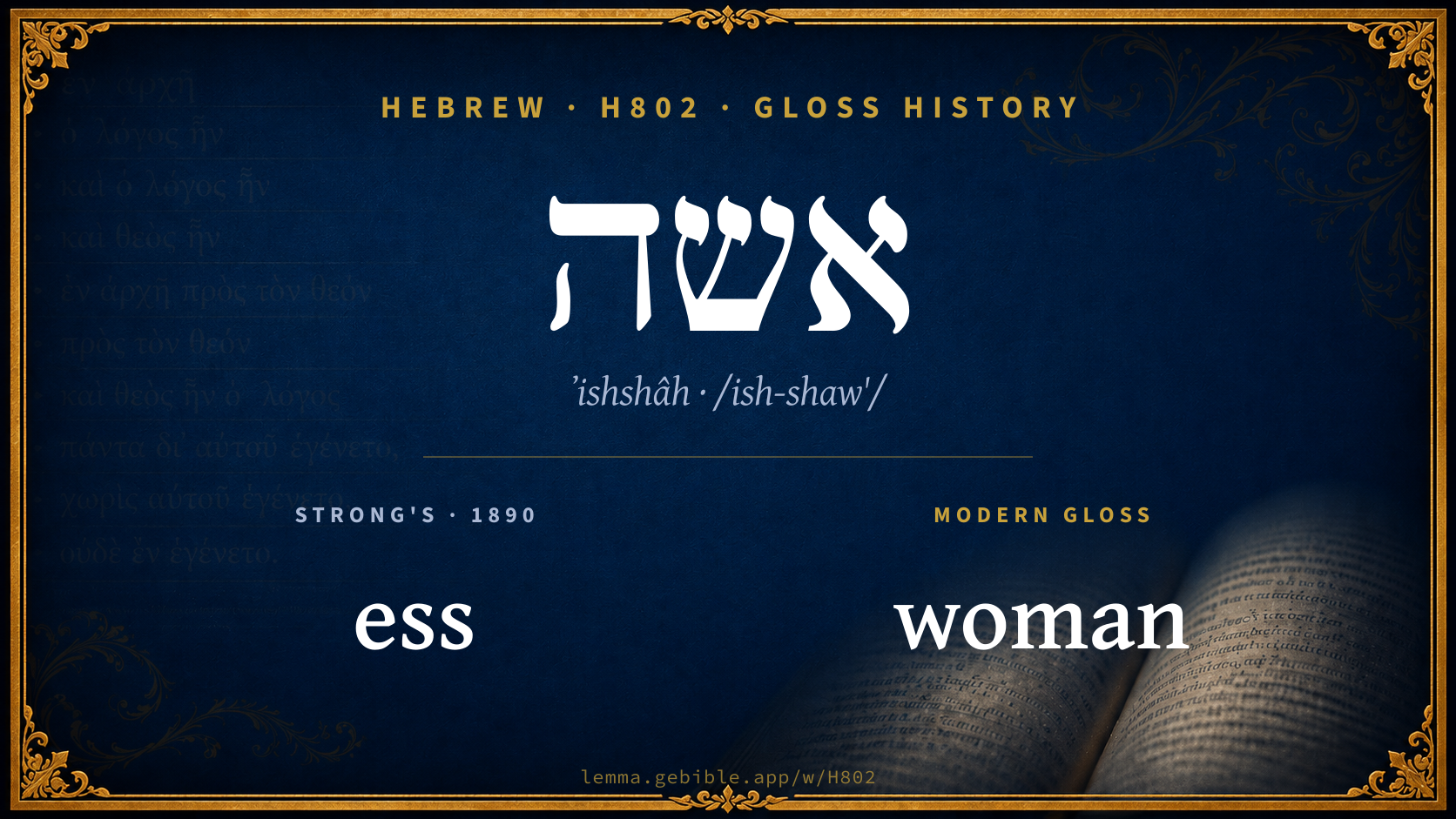
Gloss history
Strong's 1890 vs modern scholarship
About this word
Strong's H802 catalogs a Hebrew word from the Hebrew Old Testament.
These counts are not copied from any lexicon or concordance. They are computed here, from the morphology-tagged Hebrew Old Testament. What Lemma adds →
- 686
- distinct verses
- The word appears in 686 distinct verses.
- 33 / 39
- OT books
- The word appears in 33 of 39 Old Testament books.
- #60
- by frequency
- Top 100 most frequent Hebrew words (rank 60 of 8,640 Hebrew words by occurrence).
View all 686 occurrences in the concordance →
By section of the Old Testament
By traditional corpus
Conventional, traditional groupings — biblical authorship is debated, so this is a traditional corpus grouping, not an authorship claim. Each share is this word’s portion of its verses in that division of the Hebrew canon. Each figure is a share of the word’s 686 distinct verses.
- Prophets (Nevi'im) 282 verses · 41%
- Torah (Pentateuch) 267 verses · 39%
- Writings (Ketuvim) 137 verses · 20%
How translations render this word
Counts come from each version’s own published word-to-Strong’s tagging or interlinear alignment — an approximate guide to how each version renders this word, not a word-level alignment the data otherwise carries. Because each total is that version’s own tagged count, the per-version totals vary from one another and need not match the appearance or distinct-verse counts above. These counts may also differ from a printed concordance because Lemma counts each distinctly tagged rendering and does not collapse phrase taggings into a single head-word total. This is a fixed set of word-tagged versions (KJV, ASV, BSB, ULT) and does not change with the reading translation you choose elsewhere. Each version’s license is shown beside its name below (and on Sources).
BDB lists this Strong’s number as 2 distinct words (homographs). Each count above pools all of them and is not split by sense — see the Senses section below. A low-frequency rendering may belong to a different one of those words, not the primary meaning.
- King James Version†: Wife 257×, Woman 163×, Wives 96×
- American Standard Version†: Wife 183×, Woman 152×, Women 84×
- Berean Standard Bible†: Wife 242×, Woman 151×, Wives 88×
- unfoldingWord Literal Text†: Woman 213×, Wife 209×, Women 88×
King James Version Public Domain
Renders H802 across 778† tagged occurrences — most commonly:
Plus other, less common renderings. Plus 94 renderings that appear only once — usually multi-word phrases or single function words the recovered tagging swept in, not distinct renderings. Not rendered by a distinct English word in 2 further occurrences.
American Standard Version Public Domain
Renders H802 across 775† tagged occurrences — most commonly:
Plus other, less common renderings. Plus 122 renderings that appear only once — usually multi-word phrases or single function words the recovered tagging swept in, not distinct renderings.
Berean Standard Bible Public Domain
Renders H802 across 712† tagged occurrences — most commonly:
Plus other, less common renderings. Plus 62 renderings that appear only once — usually multi-word phrases or single function words the recovered tagging swept in, not distinct renderings. Not rendered by a distinct English word in 60 further occurrences.
unfoldingWord Literal Text CC BY-SA 4.0
Renders H802 across 803† tagged occurrences — most commonly:
Plus other, less common renderings. Plus 44 renderings that appear only once — usually multi-word phrases or single function words the recovered tagging swept in, not distinct renderings.
Senses in the full BDB
What do BDB’s symbols mean?
BDB uses these scholarly abbreviations:
| Symbol | Meaning |
|---|---|
| 𝔊 | the Septuagint (the ancient Greek translation, LXX) |
| 𝔙 | the Vulgate (the Latin translation) |
| 𝔖 | the Syriac version (the Peshitta) |
| 𝔗 | the Targum (the Aramaic translation) |
| ψ | the Psalms |
| √ | root (the underlying root or stem) |
| ‖ | parallel passage (a synonymous or contrasted parallel) |
| † | the dagger: every passage where the word occurs is cited |
The 4 senses and sub-senses the full Brown-Driver-Briggs lexicon distinguishes for this word, in lexicon order (not ranked by frequency), with BDB’s own verbatim wording and sub-sense lettering. Shown in Hebrew script with BDB’s own scholarly abbreviations. The condensed entry is in the Lexicon Entry tab. See also the Forms in the corpus table below.
- 1. woman Gn 3:1, 2; 12:11 +; opp. man 2:22, 23 Ex 35:29; 36:6; Dt 17:2, 5; 22:22; 1 S 21:5 +; א׳ emphat. a genuine (or ideal) woman Ec 7:28 (‖ אדם); sim. of men as feeble, timid Je 50:37; 51:30; note especially הַטַּף בַּנָּשִׁים the children among the women, female children Nu 31:18 (P); as conceiving Ex 2:2; Lv 12:2; 2 S 11:5 +; travailing Je 13:21; bearing children Ju 13:24; 1 K 3:18; cf. Jb 14:1; 15:14; 25:4 +, etc.; suckling Is 49:15; אֹרַח כַּנָּשִׁים Gn 18:11; דֶּרֶךְ נָשִׁים 31:35; with adj., or app., א׳מֵינֶקֶת nursing woman, nurse Ex 2:7; א׳ זוֹנָה harlot Jos 2:1; 6:22; Ju 11:1; 16:1; 1 K 3:16; Pr 6:26; Je 3:3 Ez 16:30; 23:44; so א׳ זָרָה Pr 2:16; 7:5; cf. also Ez 23:44 supr.; א׳ מְנָאָ֑פֶת adulteress Pr 30:20 (cf. אֵשֶׁת אִישׁ 6:26), אֵשֶׁת זְנוּנִים Ho 1:2; נָשִׁים נָכְרִיּוֹת foreign women 1 K 11:1, 8; Ezr 10:2, 10, 11, 14, 17, 18, 44; Ne 13:26, 27 (cf. v 23); א׳ חֲכָמָה wise woman, one known as clever, shrewd 2 S 14:2; 20:16, etc.; also א׳ פִּילֶגֶשׁ concubine Ju 19:1, 27: א׳ אַלְמָנָה widow 2 S 14:5; 1 K 11:26; 17:9, 10; א׳ נְבִיאָה prophetess Ju 4:4; also cstr. bef. noun of quality אֵשֶׁתרָ֑ע Pr 6:24; א׳ כְּסִילוּת 9:13; א׳ חֵן 11:16; א׳ חַיִל 12:4; 31:10; Ru 3:11; א׳ מִדְיָנִים Pr 21:9; 25:24; 27:15; א׳ מ׳ וָכָ֑עַס 21:19. e.g. Genesis 3:1
- 2. Wife (woman belonging to a man, usually cstr. or sf.) Gn 2:24, 25; 3:8, 17; 4:1, 17 + often; of one betrothed (ארשׂ) Dt 20:7; 28:30; בַּעַל (הָ)אִשָּׁה Ex 21:3, 22; אִישׁ הָאִשָּׁה Ju 20:4; לְאִשָּׁה to wife Gn 12:19; 16:3; 34:21 + often (after לָקַח, נָתַן husband or father subj.); for wife (after הָֽיְתָה, woman subj.) Gn 20:12; Nu 36:3, 6(×2), 11, 12; Dt 22:19, 29 +; for unfaithful wife cf. 1; cstr. in phr. אֵשֶׁת חֵיקֶ֑ךָ Dt 13:7 cf. 28:54; א׳ נְעוּרֶיךָ Pr 5:18; Mal 2:14, 15; א׳ בְּרִיתֶ֑ךָ v 14; אֵשֶׁת אָב = step-mother Lv 18:8, 11; 20:11. e.g. Genesis 2:24
- 3. Female of animals Gn 7:2(×2); v. also sub 4. e.g. Genesis 7:2
- 4. With distrib. & recipr. sense, א׳ מֵאֵת רְעוּתָהּ each woman from her neighbour Ex 11:2 (E); cf. Ru 1:8, 9; Je 9:19; each one, of birds of prey Is 34:15 cf. v 16 (del. Bi Che); of cows (fig. of heartless women of Isr.) Am 4:3; of sheep (fig. of Isr.) Zc 11:9; & of inanimate things (P, & late) א׳ אֶל אֲחֹתָהּ Ex 26:3(×2), 5, 6, 17 (P) Ez 1:9 (del. Co) v 23; 3:13. e.g. Exodus 11:2
Senses from the full Brown-Driver-Briggs lexicon (Brown, Driver, Briggs; Oxford 1906 — public domain), digitized via Sefaria, supplemented by the OpenScriptures HebrewLexicon (CC BY 4.0). Full attribution on Sources.
Word origin
I. n.f. woman, wife, female (Arabic أُنْثَى, Sab. אנתֿת etc. DHMZK 1884, 360, Aramaic אִתְּתָא, אִנְתְּתָא, אִתָּא, ܐܰܢ̱ܬܬܴܐ, Palm. Nab. אנתתא, Ethiopic አንስት Ph. אשת, Assyrian aššatu COTGloss)—א׳ abs. Gn 2:23 +; cstr. אֵשֶׁת Gn 11:29 + (appar. abs. Dt 21:11; 1 S 28:7 ψ 58:9 but cf. Bö§ 728 Ges§ 130, 5); sf. אִשְׁתִּי Gn 20:11 +; אִשְׁתְּךָ Gn 12:18 + (אֶשְׁתְּךָ ψ 128:3), etc.; Pl. †אִשֹּׁת Ez 23:44 (Co לעשׂות); נָשִׁים Gn 4:19 +; cstr. נְשֵׁי Gn 4:23 +; sf. נָשַׁי Gn 30:26; 1 K 20:7; נְשֵׁיכֶם Ex 22:23 +, etc.;—
II. v. sub III. אנשׁ. אִשֶּׁה v. sub אֵשׁ.
— Brown-Driver-Briggs (Oxford 1906, public domain), digitized via Sefaria, supplemented by the OpenScriptures HebrewLexicon (CC BY 4.0). See Sources.
Derived from איש (ʼîysh) (H376) — man.
Jastrow Dictionary
A second Hebrew/Aramaic lexicon for comparison, covering Aramaic and post-biblical (Talmudic, Targumic, Midrashic) usage that the biblical-Hebrew BDB does not. Matched by lemma rather than by Strong’s number, so a lemma may carry more than one Jastrow headword (shown separately below), and the entries cover usage well beyond the Bible.
אִשָּׁה
- v. איש,, const. אֵשֶׁת, woman, wife. Pes. VIII, 1. Ab. Zar. 25ᵇ א׳ כלי זיינה עליה woman carries her weapon with her, is protected against murder by gentiles (who would rather assault her innocence). Ib. א׳ חשובה a woman of high rank (influential). Ib. אִשְתּוֹ משמרתו his wife’s presence guards him from wrong-doing; a. fr.—Pl. (נָשׁוֹת) נָשִׁים q. v.
אִשֶּׁה
- burnt-offering, v. אִישֶּׁה.
A Dictionary of the Targumim, the Talmud Babli and Yerushalmi, and the Midrashic Literature (Marcus Jastrow; London, Luzac, 1903) — Public Domain. Digitized via Sefaria. Digitized via Sefaria. Full attribution on Sources.
Forms in the corpus
The 238 distinct written forms H802 takes in the Hebrew Bible, most frequent first — each parse links to that state’s occurrences in the concordance. Hebrew forms include their vowel points and cantillation, so a single lemma takes many written forms.
The 60 most common forms are shown; 178 rarer forms follow in the full concordance.
Same root — word family
Other BDB entries built from the same root as H802, grouped by Strong’s listed origin. These share a root / origin per the lexicon — not necessarily a shared meaning. Each links to that word’s own entry.
Derives from
Shares the same root
- איש ʼîysh H377 to be a man
- אישון ʼîyshôwn H380 pupil
- אישחיל ʼÎysh-Chayil H381 a mighty man, valiant man
Proper names from this root
People and places named from this root — a name, not an additional meaning of the word.
- אישבשת ʼÎysh-Bôsheth H378 Ishbosheth
- אישהוד ʼÎyshᵉhôwd H379 Ishod
- אישטוב ʼÎysh-Ṭôwb H382 Ish-tob
- אשבעל ʼEshbaʻal H792 Eshbaal
- בןימיני Ben-yᵉmîynîy H1145 Benjamite
Compare all same-root words → Showing 4 of 10 — not the complete family. 5 of the same-root words are proper names (people or places). They share a root, not necessarily a meaning.
Septuagint verse parallels
This word appears in 662 verses that also exist in the Greek Old Testament (Septuagint), out of the 686 Hebrew verses it occurs in. You can read those verses in Greek by switching the Old Testament edition to the Septuagint.
Read these verses in the Septuagint
- Genesis 2:22
- Exodus 1:19
- Leviticus 12:2
- Numbers 5:6
- Deuteronomy 2:34
- Joshua 1:14
- Judges 1:12
- Ruth 1:1
- 1 Samuel 1:2
- 2 Samuel 1:26
- 1 Kings 2:17
- 2 Kings 4:1
This is a verse-level parallel only — the same verses exist in both the Hebrew and Greek Old Testaments. No word-level Hebrew↔Greek correspondence is claimed: the data carries no such alignment, so no Greek word is shown as this Hebrew word’s translation. Coverage is not total — the Septuagint omits the deuterocanon and renumbers the Psalms, so some Hebrew verses have no direct Greek parallel.