Judges 13:10

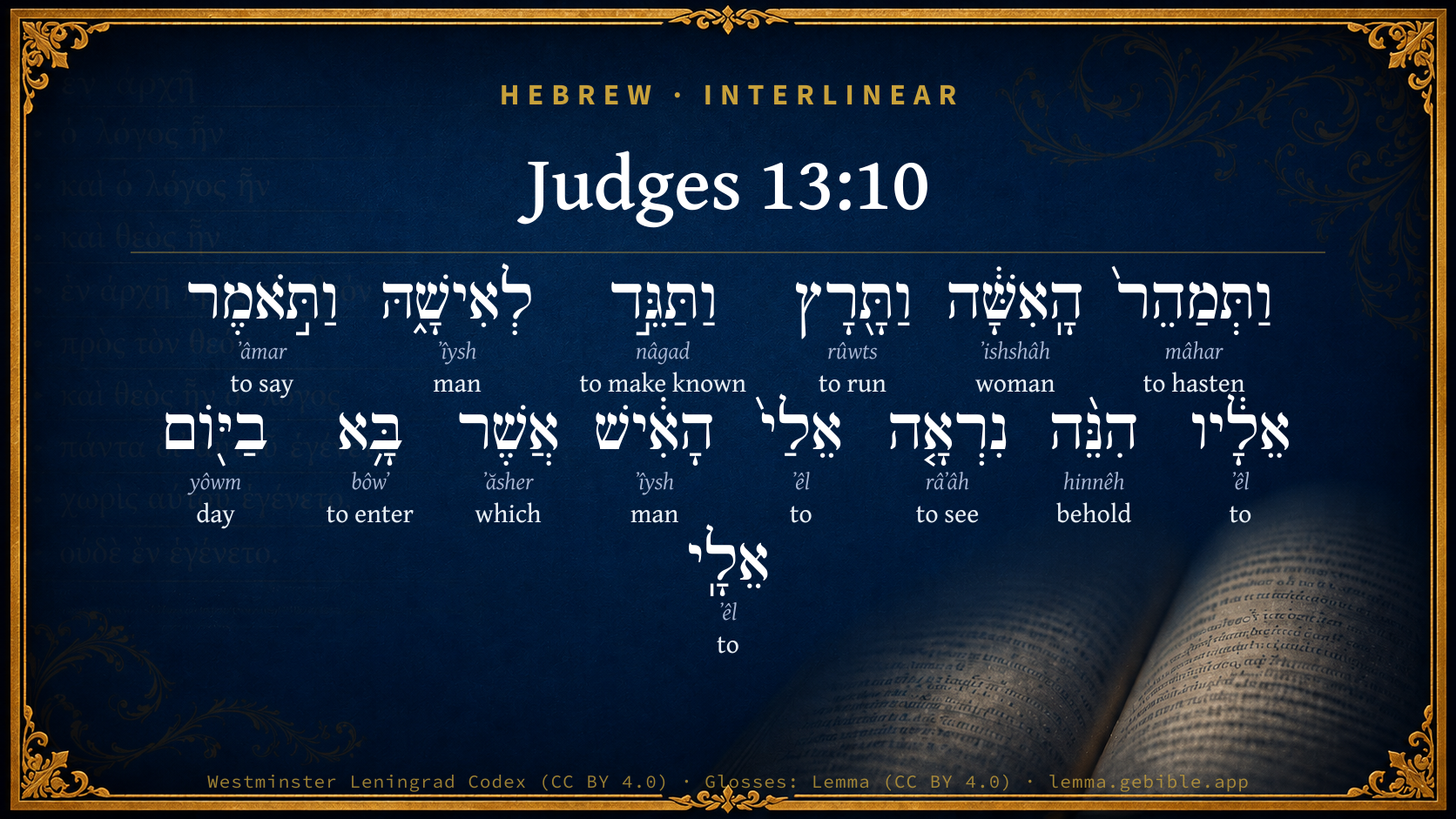
Hebrew (Westminster Leningrad Codex) Judges 13:10 appears in the Hebrew Old Testament. The text above is from the Westminster Leningrad Codex. Each word links to its Strong’s number, a concise gloss, and parsing drawn from the Open Scriptures Hebrew Bible morphology. Click any word for its full Brown-Driver-Briggs (BDB) entry.
Download image
Cite this verse

Judges 13:10 (World English Bible). Public Domain. Lemma interlinear Bible study tool, https://lemma.gebible.app/v/judges/13/10.

Show BibTeX & RIS
BibTeX
RIS
English Translation
The woman made haste, and ran, and told her husband, and said to him, Behold, the man has appeared to me, who came to me the [other] day.
World English Bible · Public Domain
Download a study sheet

One document with this verse’s original text, its word-by-word gloss line, the meaning frame, cross-references with their text, attributed commentary, and full source and license credits — printable, and it pastes into notes with its structure intact.

This verse Autodidact and up

Study sheet (.html) Plain text (.txt)

A passage Seminary Student

Up to 50 verses in one chapter. A passage sheet keeps up to 6 commentary sources and 12 cross-references per verse, in the order this page ranks them, and says so on the sheet whenever that leaves anything out. Ask for a single verse and you get the Autodidact verse sheet above.

Everything on this page stays free to read, with no account — the sheet is a download of what is already on screen, not access to it.

Want to remove ads? Support Godless Engineer
Compare translations 3

The same verse in 3 English versions, stacked beneath the original-language interlinear above. Click any original word for its lexicon entry.

Each is an independent rendering of the whole verse — the interlinear is not word-aligned to these translations.

Highlighted words mark where these versions differ — a whole-verse word diff, not a word-by-word alignment.

  • World English Bible Public Domain
    The woman made haste, and ran, and told her husband, and said to him, Behold, the man has appeared to me, who came to me the [other] day.
  • King James Version Public Domain
    And the woman made haste, and ran, and showed her husband, and said unto him, Behold, the man hath appeared unto me, that came unto me the other day.
  • unfoldingWord Literal Text CC BY-SA 4.0
    And the woman hurried and ran and declared to her husband and said to him, “Behold, the man has appeared to me who came to me on a day.”

unfoldingWord Literal Text — © unfoldingWord, licensed CC BY-SA 4.0. Word-aligned USFM3 via Door43 (git.door43.org/unfoldingWord/en_ult).

Versions to compare (up to 4)

3 of 4 selected

Show all 18 translations

Every available English version of this verse, each an independent rendering of the whole verse.

  • World English Bible Public Domain
    The woman made haste, and ran, and told her husband, and said to him, Behold, the man has appeared to me, who came to me the [other] day.
  • Berean Standard Bible Public Domain
    The woman ran quickly to tell her husband, “Behold, the man who came to me the other day has reappeared!”
  • Majority Standard Bible Public Domain
    The woman ran quickly to tell her husband, “Behold, the man who came to me the other day has reappeared!”
  • King James Version Public Domain
    And the woman made haste, and ran, and showed her husband, and said unto him, Behold, the man hath appeared unto me, that came unto me the other day.
  • American Standard Version (1901) Public Domain
    And the woman made haste, and ran, and told her husband, and said unto him, Behold, the man hath appeared unto me, that came unto me the `other' day.
  • Revised Version (1885) Public Domain
    And the woman made haste, and ran, and told her husband, and said unto him, Behold, the man hath appeared unto me, that came unto me the other day.
  • Geneva Bible (1599) Public Domain
    And the wife made haste and ranne, and shewed her husband and sayde vnto him, Behold, the man hath appeared vnto me, that came vnto me to day.
  • Douay-Rheims (1899) Public Domain
    She made haste and ran to her husband: and told him saying: Behold the man hath appeared to me whom I saw before.
  • Young's Literal Translation Public Domain
    and the woman hasteth, and runneth, and declareth to her husband, and saith unto him, `Lo, he hath appeared unto me -- the man who came on `that' day unto me.'
  • Literal Standard Version CC BY-SA 4.0
    and the woman hurries, and runs, and declares [it] to her husband, and says to him, “Behold, He has appeared to me—the Man who came on [that] day to me.”
  • Unlocked Literal Bible CC BY-SA 4.0
    So the woman ran quickly and told her husband, “Look! The man has appeared to me—the one who came to me the other day!”
  • unfoldingWord Literal Text CC BY-SA 4.0
    And the woman hurried and ran and declared to her husband and said to him, “Behold, the man has appeared to me who came to me on a day.”
  • Darby Bible Public Domain
    And the woman ran in haste and told her husband, "Behold, the man who came to me the other day has appeared to me."
  • World Messianic Bible Public Domain
    The woman hurried and ran, and told her husband, saying to him, “Behold, the man who came to me that day has appeared to me.”
  • Webster's Bible Public Domain
    And the woman made haste, and ran, and showed her husband, and said to him, Behold, the man hath appeared to me, that came to me the other day.
  • Free Bible Version CC BY-SA 4.0
    So she ran quickly to tell her husband, “Look! The man who appeared to me the other day has come back!”
  • Bible in Basic English Public Domain
    So the woman, running quickly, gave her husband the news, saying, I have seen the man who came to me the other day.
  • JPS Tanakh (1917) Public Domain
    And the woman made haste, and ran, and told her husband, and said unto him: 'Behold, the man hath appeared unto me, that came unto me that day.'

Literal Standard Version (2020), Covenant Press — licensed CC BY-SA 4.0. Text via the HelloAO Bible API (eBible.org). Unlocked Literal Bible (unfoldingWord) — licensed CC BY-SA 4.0. Text via the HelloAO Bible API (eBible.org). unfoldingWord Literal Text — © unfoldingWord, licensed CC BY-SA 4.0. Word-aligned USFM3 via Door43 (git.door43.org/unfoldingWord/en_ult). Free Bible Version, Dr. Jonathan Gallagher — licensed CC BY-SA 4.0. Text via the HelloAO Bible API (eBible.org).

Word by word

More ways to search: Search by grammar → Find every occurrence → Compare this word →

Practice this passage: Drill this verse → Learn its vocabulary →

וַתְּמַהֵר֙
mâhar
H4116
“and · to hasten”
Conjunction + Verb, Piel, Sequential Imperfect, 3rd Person, Feminine, Singular
Part of Speech
Conjunction + Verb
Stem
Piel
Form
Sequential Imperfect
Person
3rd Person
Gender
Feminine
Number
Singular
Full BDB Definition

Origin: a primitive root

TWOT: 1152

(Qal) to hasten - (Niphal) to be hurried, be anxious - hasty, precipitate, impetuous - (Piel) - to hasten, make haste - hasten (used as adverb with another verb) - to hasten, prepare quickly, do quickly, bring quickly
  1. הָֽאִשָּׁ֔ה ʼishshâh H802 “the · woman” Particle, Definite Article + Noun, Common, Feminine, Singular, Absolute
  2. וַתָּ֖רָץ rûwts H7323 “and · to run” Conjunction + Verb, Qal, Sequential Imperfect, 3rd Person, Feminine, Singular
  3. וַתַּגֵּ֣ד nâgad H5046 “and · to make known” Conjunction + Verb, Hiphil, Sequential Imperfect, 3rd Person, Feminine, Singular
  4. לְאִישָׁ֑הּ ʼîysh H376 “to/for · man · her” Preposition + Noun, Common, Masculine, Singular, Construct + Suffix, Personal, 3rd Person, Feminine, Singular
  5. וַתֹּ֣אמֶר ʼâmar H559 “and · to say” Conjunction + Verb, Qal, Sequential Imperfect, 3rd Person, Feminine, Singular
  6. אֵלָ֔יו ʼêl H413 “to · him” Preposition + Suffix, Personal, 3rd Person, Masculine, Singular
  7. הִנֵּ֨ה hinnêh H2009 “behold” Particle, Demonstrative
  8. נִרְאָ֤ה râʼâh H7200 “to see” Verb, Niphal, Perfect, 3rd Person, Masculine, Singular
  9. אֵלַי֙ ʼêl H413 “to · me” Preposition + Suffix, Personal, 1st Person, Common, Singular
  10. הָאִ֔ישׁ ʼîysh H376 “the · man” Particle, Definite Article + Noun, Common, Masculine, Singular, Absolute
  11. אֲשֶׁר ʼăsher H834 “which” Particle, Relative
  12. בָּ֥א bôwʼ H935 “to enter” Verb, Qal, Perfect, 3rd Person, Masculine, Singular
  13. בַיּ֖וֹם yôwm H3117 “in/at the · day” Preposition, Determined + Noun, Common, Masculine, Singular, Absolute
  14. אֵלָֽי ʼêl H413 “to · me” Preposition + Suffix, Personal, 1st Person, Common, Singular

About this verse

These counts appear in no published source. They are computed here, from the morphology-tagged text and Lemma’s own curated glosses. What Lemma adds →

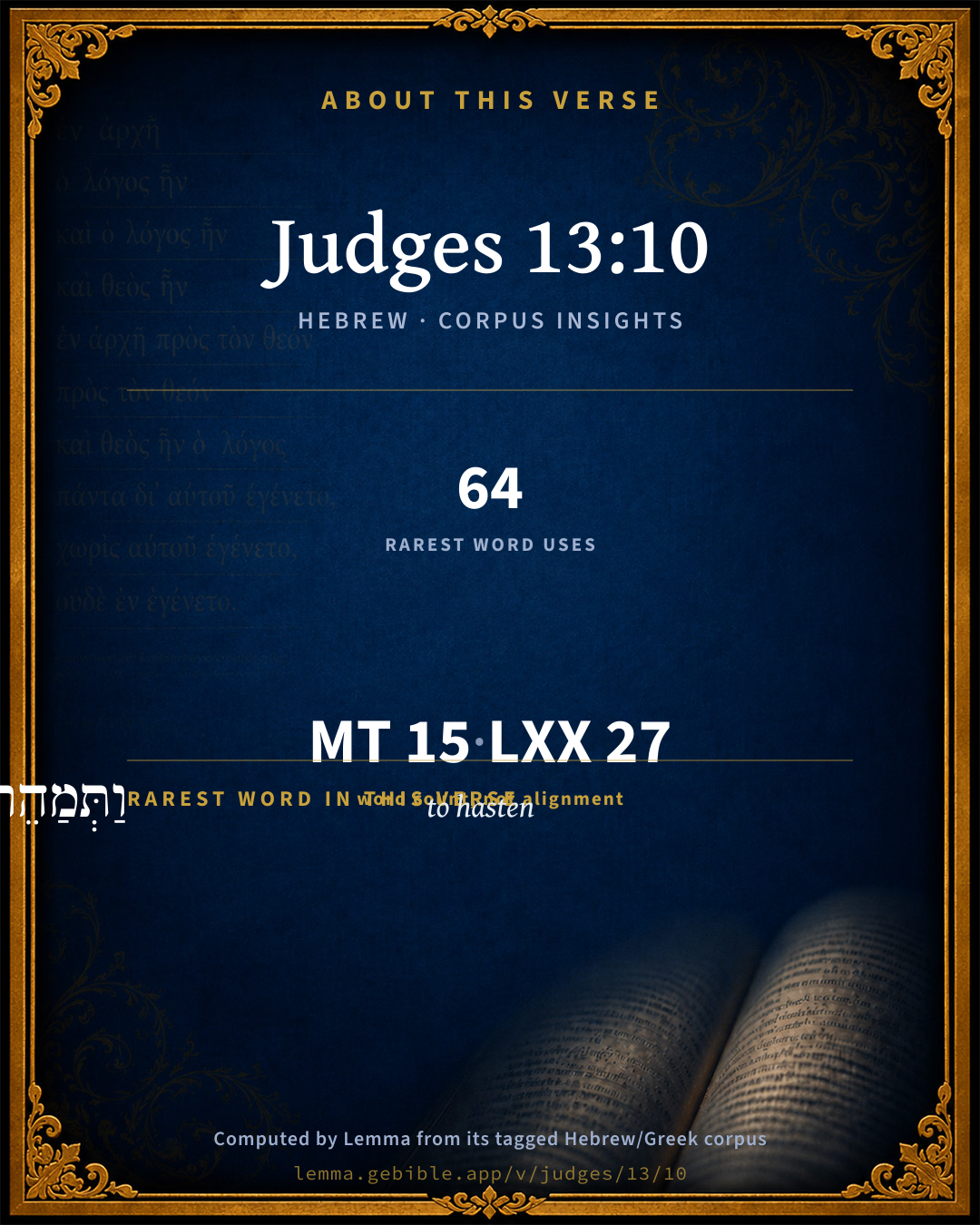
15
words
12
distinct lemmas
Historical
section

Grammatical profile

  • 6 verbs
  • 4 nouns
  • 3 prepositions
  • 2 particles

Verb forms

  • וַתְּמַהֵר֙ Piel · Sequential Imperfect
  • וַתָּ֖רָץ Qal · Sequential Imperfect
  • וַתַּגֵּ֣ד Hiphil · Sequential Imperfect
  • וַתֹּ֣אמֶר Qal · Sequential Imperfect
  • נִרְאָ֤ה Niphal · Perfect
  • בָּ֥א Qal · Perfect

Repetition

Words recur within this verse — often emphatic in Hebrew:

  • לְאִישָׁ֑הּ man H376 ×2
  • אֵלָ֔יו to H413 ×3

Hebrew & Septuagint length

In English translation the verse runs 28 words from the Hebrew and 31 from the Septuagint (LXX English) — closely comparable.

A rough comparison of the two English renderings, which tokenize alike — not a word-level alignment.

Word counts can differ between the Hebrew and the Greek without any difference in meaning — e.g. the Hebrew direct-object marker אֵת has no separate Greek word, and Greek often adds the article ὁ.

In the original languages it is 15 Hebrew tokens and 27 Greek tokens — but the two are counted differently (Hebrew bundles its prefixes and suffixes into one token; the Greek is in lemma form), so that isn’t a like-for-like length.

Cross-references

2

Topical passages linked to Judges 13:10 in the Treasury of Scripture Knowledge — connected by theme and wording, ordered by reader-vote popularity; previews shown in the World English Bible.

  • John 1:41–42 He first found his own brother, Simon, and said to him, "We have found the Messiah!" (which is, being interpreted, Christ).
  • John 4:28–29 So the woman left her water pot, and went away into the city, and said to the people,

Cross-references courtesy of OpenBible.info (CC BY 4.0).

Hebrew and Greek witnesses Masoretic Hebrew ↔ Greek Septuagint

The same verse in the two great witnesses to the Old Testament, shown verse-for-verse.

These are two independent witnesses, not word-aligned to each other, and the Septuagint is shown in lemma (dictionary) form.

Hebrew Judges 13:10 Masoretic · Westminster Leningrad Codex

וַתְּמַהֵר֙ הָֽאִשָּׁ֔ה וַתָּ֖רָץ וַתַּגֵּ֣ד לְאִישָׁ֑הּ וַתֹּ֣אמֶר אֵלָ֔יו הִנֵּ֨ה נִרְאָ֤ה אֵלַי֙ הָאִ֔ישׁ אֲשֶׁר בָּ֥א בַיּ֖וֹם אֵלָֽי

The woman made haste, and ran, and told her husband, and said to him, Behold, the man has appeared to me, who came to me the [other] day.

World English Bible · Public Domain

Greek LXX Judges 13:10 Septuagint · lemma form

καί ταχύνω ὁ γυνή καί τρέχω καί ἀναἀγγέλλω ὁ ἀνήρ αὐτός καί εἶπον πρός αὐτός ἰδού ὁράω πρός ἐγώ ὁ ἀνήρ ὅς ἔρχομαι ἐν ἡμέρα πρός ἐγώ

And the woman hasted, and ran, and brought word to her husband, and said to him, Behold the man who came in the other day to me has appeared to me.

LXX2012 (modern English Septuagint) · Public Domain

Hebrew: Westminster Leningrad Codex (CC BY 4.0). Greek: Septuagint (public domain); English from LXX2012 (modern English Septuagint) (Public Domain). How the Septuagint differs from the Hebrew →

Targum (Aramaic paraphrase)

1

The Targum is the ancient Jewish Aramaic paraphrase of the Hebrew Scriptures — an interpretive translation, not the Hebrew text itself. Onkelos (literal) and Pseudo-Jonathan (expansive) render the Torah, and Jonathan the Prophets. Coverage is partial: where no permissively-licensed English translation exists for a verse, only the Aramaic is shown. This is verse-level text, not a word-by-word alignment to the Hebrew.

  1. Targum Jonathan Prophets (Joshua–Malachi)
    וְאוֹחִיאַת אִתְּתָא וּרְהָטַת וְחַוִיאַת לְבַעֲלָהּ וַאֲמַרַת לֵיהּ הָא אִתְחַזֵי לִי גַבְרָא דִי אָתָא בְיוֹמָא דֵיכִי לְוָתִי:

    (no public-domain English translation for this verse)

    Targum Jonathan — Aramaic: “Mikraot Gedolot” (public domain). English: “Sefaria Community Translation” (CC0 1.0 (public-domain dedication)); “London "Chaldee Paraphrase," 1871” (public domain). Text via Sefaria.

Commentary

Notes on Judges 13:10 from classic Christian and Jewish commentators (each source and its license shown beneath its notes). The classic Christian expositions comment on the surrounding passage and are grouped to its opening verse, so a note may address several verses; the Jewish commentaries on the Tanakh (Rashi and others) are per-verse, so they appear only where the commentator wrote on this verse.

Lemma curates 59 commentaries, every one of them public domain or Creative Commons licensed, each selected and text-cleaned for this edition rather than reprinted as found. About our sources →

Trapp's Complete Commentary

John Trapp

Jdg 13:10 And the woman made haste, and ran, and shewed her husband, and said unto him, Behold, the man hath appeared unto me, that came unto me the [other] day.

Ver. 10. Ran, and showed her husband.] {See Trapp on "Jdg 13:6"}

John Trapp, A Commentary or Exposition upon All the Books of the Old and New Testament (1647–1656) — public domain. Text from a community e-Sword module.

Geneva Bible (1599)

Geneva Bible translators

It seemth that the Angel appeared unto her twice in one day.

Geneva Bible (1599) marginal notes — public domain. Text via Bolls.life.

John Gill's Exposition

And the woman made haste, and ran,.... It is not improbable what Josephus says (m), that she entreated the angel to stay a little till she fetched her husband, which he assented to, and then made all the haste she could to him, partly through eagerness to acquaint him with it, and partly that she might not make the prophet she took him to be wait too long:

and showed her husband; that his prayer was heard:

and said unto him, behold, the man hath appeared unto me that came unto me the other day; or, as the Targum, "this day"; so Kimchi and Ben Melech; for the word "other" is not in the text. It is very probable it was the same day he came again he had appeared to her; perhaps it was in the former part of the day he first came to her, when she went home to her husband, and acquainted him with it, who prayed to the Lord that he might be sent again; and then she returned to her place in the field, and in the latter part of the day the angel appeared again.

(m) Antiqu. l. 5. c. 8. sect. 3.

John Gill's Exposition of the Whole Bible (1746–1763) — public domain (CC PDM 1.0). Text via the HelloAO Bible API.

The Pulpit Commentary

And the woman... ran, etc. Acting in the true spirit of a loving and trustful wife, and showing that she felt that neither angel nor man of God stood before her own husband in the claim to her confidence and obedience.

The Pulpit Commentary (1880–1919), ed. H.D.M. Spence-Jones & Joseph S. Exell — public domain. Text from a community e-Sword module.

Keil & Delitzsch

C. F. Keil & F. Delitzsch

Then she hastened to fetch her husband, who first of all inquired of the person who had appeared, "Art thou the man who said to the woman" (sc., what has been related in Jdg 13:3-5)? And when this was answered in the affirmative, he said still further (Jdg 13:12), "Should thy word then come to pass, what will be the manner of the boy, and his doing?" The plural דּבריך is construed ad sensum with the singular verb, because the words form one promise, so that the expression is not to be taken distributively, as Rosenmller supposes. This also applies to Jdg 13:17, Mishpat, the right belonging to a boy, i.e., the proper treatment of him.

Keil & Delitzsch — Biblical Commentary on the Old Testament (1861–1891) — public domain (CC PDM 1.0). Text via the HelloAO Bible API. (Old Testament only.)

unfoldingWord translationNotes

Door43 World Missions Community

Look

"Listen" or "Pay attention to what I am about to tell you"

The man

This refers to the angel of God in Judges 13:3. This can be made explicit. AT: "the man of God" (See: Assumed Knowledge and Implicit Information)

unfoldingWord translationNotes — © Distant Shores Media and the Door43 World Missions Community, licensed CC BY-SA 4.0. Source: git.door43.org/Door43/en_tn.

Lesson kit

Teaching starters — assembled from the data on this page, not authored interpretation. Every prompt links to the verse data it draws on. Edit before teaching.

Judges, in the Historical, opens this verse with 15 words (12 distinct Hebrew lemmas). Its most distinctive word is mâhar (“to hasten”). A historical commentator’s framing appears above. Read the whole chapter for the surrounding context.

Discussion questions

  1. What does “to hasten” (mâhar) contribute to the verse as a whole?
  2. How does John 1:41–42, which shares this passage’s theme, read alongside this verse?
  3. What does the repetition of “man” (2× in this one verse) do in this verse?
  4. The translations on this page render this verse differently — a whole-verse word diff, not a word-by-word alignment. What might account for the different wordings?
  5. «וַתְּמַהֵר֙» is a Piel Sequential Imperfect verb. How does that grammatical form shape the action described?
  6. Compare how Trapp's Complete Commentary and Geneva Bible (1599) read this verse. Where do they agree or differ?

Things to notice

Reading settings

Reading text

Shown beneath each verse's original-language words.

Old Testament
Old Testament edition

Read the OT as the Masoretic Hebrew (MT) or the Greek Septuagint (LXX).

English shown for the Greek Septuagint (in the Hebrew ↔ Greek comparison).

Comparing translations? Open the Compare panel on any verse page to stack up to four side by side.