
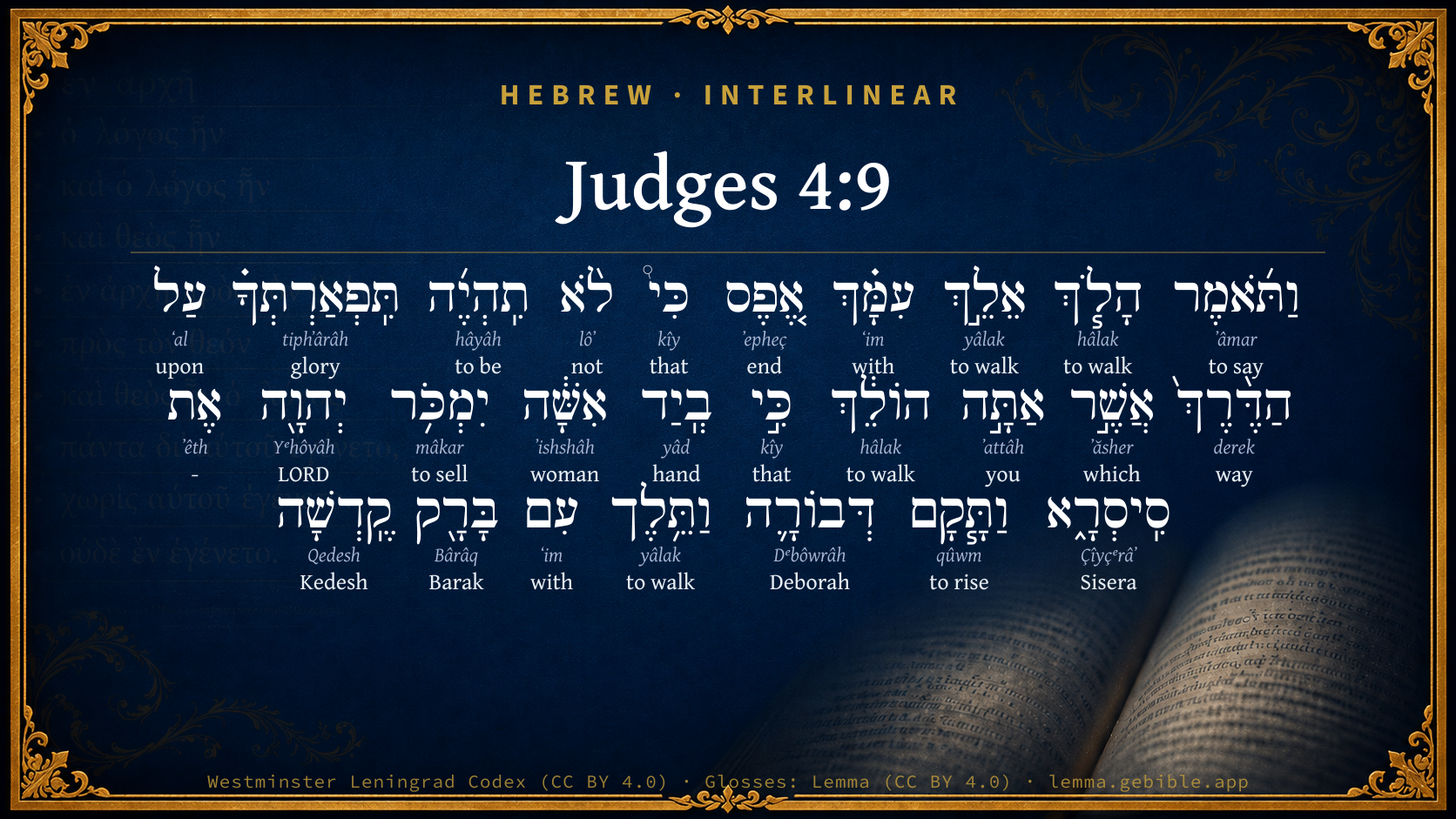
Judges 4:9

Hebrew (Westminster Leningrad Codex) Judges 4:9 appears in the Hebrew Old Testament. The text above is from the Westminster Leningrad Codex. Each word links to its Strong’s number, a concise gloss, and parsing drawn from the Open Scriptures Hebrew Bible morphology. Click any word for its full Brown-Driver-Briggs (BDB) entry.
Download image
Cite this verse

Judges 4:9 (World English Bible). Public Domain. Lemma interlinear Bible study tool, https://lemma.gebible.app/v/judges/4/9.

Show BibTeX & RIS
BibTeX
RIS
English Translation
She said, I will surely go with you: notwithstanding, the journey that you take shall not be for your honor; for Yahweh will sell Sisera into the hand of a woman. Deborah arose, and went with Barak to Kedesh.
World English Bible · Public Domain
Download a study sheet

One document with this verse’s original text, its word-by-word gloss line, the meaning frame, cross-references with their text, attributed commentary, and full source and license credits — printable, and it pastes into notes with its structure intact.

This verse Autodidact and up

Study sheet (.html) Plain text (.txt)

A passage Seminary Student

Up to 50 verses in one chapter. A passage sheet keeps up to 6 commentary sources and 12 cross-references per verse, in the order this page ranks them, and says so on the sheet whenever that leaves anything out. Ask for a single verse and you get the Autodidact verse sheet above.

Everything on this page stays free to read, with no account — the sheet is a download of what is already on screen, not access to it.

Want to remove ads? Support Godless Engineer
Compare translations 3

The same verse in 3 English versions, stacked beneath the original-language interlinear above. Click any original word for its lexicon entry.

Each is an independent rendering of the whole verse — the interlinear is not word-aligned to these translations.

Highlighted words mark where these versions differ — a whole-verse word diff, not a word-by-word alignment.

  • World English Bible Public Domain
    She said, I will surely go with you: notwithstanding, the journey that you take shall not be for your honor; for Yahweh will sell Sisera into the hand of a woman. Deborah arose, and went with Barak to Kedesh.
  • King James Version Public Domain
    And she said, I will surely go with thee: notwithstanding the journey that thou takest shall not be for thine honor; for the LORD shall sell Sisera into the hand of a woman. And Deborah arose, and went with Barak to Kedesh.
  • unfoldingWord Literal Text CC BY-SA 4.0
    And she said, “Going, I will go with you, only that it will not be your honor upon the way that you are going, for Yahweh will sell Sisera into the hand of a woman.” Then Deborah arose and went with Barak to Kedesh.

unfoldingWord Literal Text — © unfoldingWord, licensed CC BY-SA 4.0. Word-aligned USFM3 via Door43 (git.door43.org/unfoldingWord/en_ult).

Versions to compare (up to 4)

3 of 4 selected

Show all 18 translations

Every available English version of this verse, each an independent rendering of the whole verse.

  • World English Bible Public Domain
    She said, I will surely go with you: notwithstanding, the journey that you take shall not be for your honor; for Yahweh will sell Sisera into the hand of a woman. Deborah arose, and went with Barak to Kedesh.
  • Berean Standard Bible Public Domain
    “I will certainly go with you,” Deborah replied, “but the road you are taking will bring you no honor, because the LORD will be selling Sisera into the hand of a woman.” So Deborah got up and went with Barak to Kedesh,
  • Majority Standard Bible Public Domain
    “I will certainly go with you,” Deborah replied, “but the road you are taking will bring you no honor, because the LORD will be selling Sisera into the hand of a woman.” So Deborah got up and went with Barak to Kedesh,
  • King James Version Public Domain
    And she said, I will surely go with thee: notwithstanding the journey that thou takest shall not be for thine honor; for the LORD shall sell Sisera into the hand of a woman. And Deborah arose, and went with Barak to Kedesh.
  • American Standard Version (1901) Public Domain
    And she said, I will surely go with thee: notwithstanding, the journey that thou takest shall not be for thine honor; for Jehovah will sell Sisera into the hand of a woman. And Deborah arose, and went with Barak to Kedesh.
  • Revised Version (1885) Public Domain
    And she said, I will surely go with thee: notwithstanding the journey that thou takest shall not be for thine honour; for the LORD shall sell Sisera into the hand of a woman. And Deborah arose, and went with Barak to Kedesh.
  • Geneva Bible (1599) Public Domain
    Then shee answered, I will surely goe with thee, but this iourney that thou takest, shall not be for thine honour: for the Lord shall sell Sisera into the hand of a woman. And Deborah arose and went with Barak to Kedesh.
  • Douay-Rheims (1899) Public Domain
    She said to him: I will go indeed with thee, but at this time the victory shall not be attributed to thee, because Sisara shall be delivered into the hand of a woman. Debbora therefore arose, and went with Barac to Cedes.
  • Young's Literal Translation Public Domain
    and she saith, `I do certainly go with thee; only, surely thy glory is not on the way which thou art going, for into the hand of a woman doth Jehovah sell Sisera;' and Deborah riseth and goeth with Barak to Kedesh.
  • Literal Standard Version CC BY-SA 4.0
    and she says, “I certainly go with you; only, surely your glory is not on the way which you are going, for YHWH sells Sisera into the hand of a woman”; and Deborah rises and goes with Barak to Kedesh.
  • Unlocked Literal Bible CC BY-SA 4.0
    She said, “I will certainly go with you. However, the road on which you are going will not lead to your honor, for Yahweh will sell Sisera into the hand of a woman.” Then Deborah got up and went with Barak to Kedesh.
  • unfoldingWord Literal Text CC BY-SA 4.0
    And she said, “Going, I will go with you, only that it will not be your honor upon the way that you are going, for Yahweh will sell Sisera into the hand of a woman.” Then Deborah arose and went with Barak to Kedesh.
  • Darby Bible Public Domain
    And she said, "I will surely go with you; nevertheless, the road on which you are going will not lead to your glory, for the LORD will sell Sis'era into the hand of a woman." Then Deb'orah arose, and went with Barak to Kedesh.
  • World Messianic Bible Public Domain
    She said, “I will surely go with you. Nevertheless, the journey that you take won’t be for your honor; for the LORD will sell Sisera into a woman’s hand.” Deborah arose, and went with Barak to Kedesh.
  • Webster's Bible Public Domain
    And she said, I will surely go with thee: notwithstanding the journey that thou takest shall not be for thy honor; for the LORD will sell Sisera into the hand of a woman. And Deborah arose, and went with Barak to Kedesh.
  • Free Bible Version CC BY-SA 4.0
    “I'll definitely go with you,” Deborah answered, “but if you're going to take that route then you won't receive any respect, because the Lord will give Sisera into the hands of a woman.” Deborah got up and went with Barak to Kedesh.
  • Bible in Basic English Public Domain
    And she said, I will certainly go with you: though you will get no honour in your undertaking, for the Lord will give Sisera into the hands of a woman. So Deborah got up and went with Barak to Kedesh.
  • JPS Tanakh (1917) Public Domain
    And she said: 'I will surely go with thee; notwithstanding the journey that thou takest shall not be for thy honour; for the LORD will give Sisera over into the hand of a woman.' And Deborah arose, and went with Barak to Kedesh.

Literal Standard Version (2020), Covenant Press — licensed CC BY-SA 4.0. Text via the HelloAO Bible API (eBible.org). Unlocked Literal Bible (unfoldingWord) — licensed CC BY-SA 4.0. Text via the HelloAO Bible API (eBible.org). unfoldingWord Literal Text — © unfoldingWord, licensed CC BY-SA 4.0. Word-aligned USFM3 via Door43 (git.door43.org/unfoldingWord/en_ult). Free Bible Version, Dr. Jonathan Gallagher — licensed CC BY-SA 4.0. Text via the HelloAO Bible API (eBible.org).

Word by word

More ways to search: Search by grammar → Find every occurrence → Compare this word →

Practice this passage: Drill this verse → Learn its vocabulary →

דְּבוֹרָ֛ה
Dᵉbôwrâh
H1683
“Deborah”
Noun, Proper
Part of Speech
Noun
Type
Proper
Full BDB Definition

Origin: the same as H1682

TWOT: None

Deborah = "bee" - the nurse of Rebekah who accompanied her from the house of Bethuel - a prophetess who judged Israel
  1. וַתֹּ֜אמֶר ʼâmar H559 “and · to say” Conjunction + Verb, Qal, Sequential Imperfect, 3rd Person, Feminine, Singular
  2. הָלֹ֧ךְ hâlak H1980 “to walk” Verb, Qal, Infinitive Absolute
  3. אֵלֵ֣ךְ yâlak H3212 “to walk” Verb, Qal, Imperfect, 1st Person, Common, Singular
  4. עִמָּ֗ךְ ʻim H5973 “with · you” Preposition + Suffix, Personal, 2nd Person, Feminine, Singular
  5. אֶ֚פֶס ʼepheç H657 “end” Noun, Common, Masculine, Singular, Absolute
  6. כִּי֩ kîy H3588 “that” Conjunction
  7. לֹ֨א lôʼ H3808 “not” Particle, Negative
  8. תִֽהְיֶ֜ה hâyâh H1961 “to be” Verb, Qal, Imperfect, 3rd Person, Feminine, Singular
  9. תִּֽפְאַרְתְּךָ֗ tiphʼârâh H8597 “glory · your” Noun, Common, Feminine, Singular, Construct + Suffix, Personal, 2nd Person, Masculine, Singular
  10. עַל ʻal H5921 “upon” Preposition
  11. הַדֶּ֨רֶךְ֙ derek H1870 “the · way” Particle, Definite Article + Noun, Common, Both, Singular, Absolute
  12. אֲשֶׁ֣ר ʼăsher H834 “which” Particle, Relative
  13. אַתָּ֣ה ʼattâh H859 “you” Pronoun, Personal, 2nd Person, Masculine, Singular
  14. הוֹלֵ֔ךְ hâlak H1980 “walking” Verb, Qal, Participle Active, Masculine, Singular, Absolute
  15. כִּ֣י kîy H3588 “that” Conjunction
  16. בְֽיַד yâd H3027 “in/at · hand of” Preposition + Noun, Common, Both, Singular, Construct
  17. אִשָּׁ֔ה ʼishshâh H802 “woman” Noun, Common, Feminine, Singular, Absolute
  18. יִמְכֹּ֥ר mâkar H4376 “to sell” Verb, Qal, Imperfect, 3rd Person, Masculine, Singular
  19. יְהוָ֖ה Yᵉhôvâh H3068 “LORD” Noun, Proper
  20. אֶת ʼêth H853 “-” Particle, Direct Object
  21. סִֽיסְרָ֑א Çîyçᵉrâʼ H5516 “Sisera” Noun, Proper
  22. וַתָּ֧קָם qûwm H6965 “and · to rise” Conjunction + Verb, Qal, Sequential Imperfect, 3rd Person, Feminine, Singular
  23. וַתֵּ֥לֶך yâlak H3212 “and · to walk” Conjunction + Verb, Qal, Sequential Imperfect, 3rd Person, Feminine, Singular
  24. עִם ʻim H5973 “with” Preposition
  25. בָּרָ֖ק Bârâq H1301 “Barak” Noun, Proper
  26. קֶֽדְשָׁה Qedesh H6943 “Kedesh · toward” Noun, Proper + Suffix, Demonstrative

About this verse

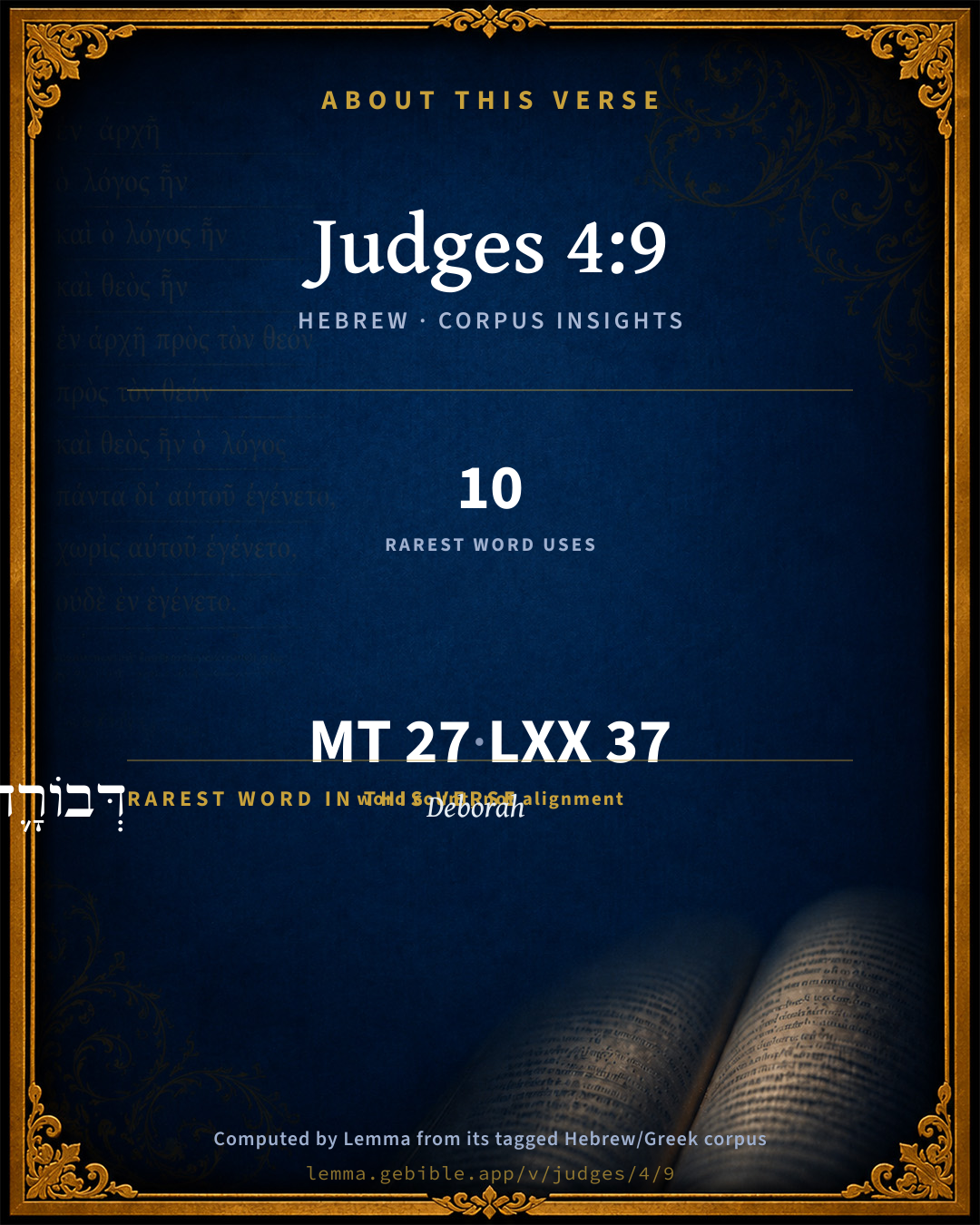
These counts appear in no published source. They are computed here, from the morphology-tagged text and Lemma’s own curated glosses. What Lemma adds →

27
words
23
distinct lemmas
Historical
section

Notable vocabulary

The rarest word here is דְּבוֹרָ֛ה Deborah H1683 — appearing just 10 times in the whole Hebrew Bible.

Shared distinctive vocabulary

דְּבוֹרָ֛ה Deborah H1683 occurs in 10 verses of the Hebrew Bible. Also found in:

Grammatical profile

  • 8 verbs
  • 10 nouns
  • 1 pronoun
  • 3 prepositions
  • 2 conjunctions
  • 3 particles

Verb forms

  • וַתֹּ֜אמֶר Qal · Sequential Imperfect
  • הָלֹ֧ךְ Qal · Infinitive Absolute
  • אֵלֵ֣ךְ Qal · Imperfect
  • תִֽהְיֶ֜ה Qal · Imperfect
  • הוֹלֵ֔ךְ Qal · Participle Active
  • יִמְכֹּ֥ר Qal · Imperfect
  • וַתָּ֧קָם Qal · Sequential Imperfect
  • וַתֵּ֥לֶך Qal · Sequential Imperfect

Repetition

Words recur within this verse — often emphatic in Hebrew:

  • הָלֹ֧ךְ to walk H1980 ×2
  • אֵלֵ֣ךְ to walk H3212 ×2
  • עִמָּ֗ךְ with H5973 ×2
  • כִּי֩ that H3588 ×2

Hebrew & Septuagint length

In English translation the verse runs 39 words from the Hebrew and 46 from the Septuagint (LXX English) — closely comparable.

A rough comparison of the two English renderings, which tokenize alike — not a word-level alignment.

Word counts can differ between the Hebrew and the Greek without any difference in meaning — e.g. the Hebrew direct-object marker אֵת has no separate Greek word, and Greek often adds the article ὁ.

In the original languages it is 27 Hebrew tokens and 37 Greek tokens — but the two are counted differently (Hebrew bundles its prefixes and suffixes into one token; the Greek is in lemma form), so that isn’t a like-for-like length.

Cross-references

7

Topical passages linked to Judges 4:9 in the Treasury of Scripture Knowledge — connected by theme and wording, ordered by reader-vote popularity; previews shown in the World English Bible.

  • 1 Samuel 2:30 Therefore Yahweh, the God of Israel, says, I said indeed that your house, and the house of your father, should walk before me forever: but now Yahweh says, Be it far from me; for those who honor me I will honor, and those who despise me shall be lightly esteemed.
  • Judges 2:14 The anger of Yahweh was kindled against Israel, and he delivered them into the hands of spoilers who despoiled them; and he sold them into the hands of their enemies round about, so that they could not any longer stand before their enemies.
  • Judges 4:17–22 However Sisera fled away on his feet to the tent of Jael the wife of Heber the Kenite; for there was peace between Jabin the king of Hazor and the house of Heber the Kenite.
  • Judges 5:24–27 Blessed above women shall Jael be, The wife of Heber the Kenite; Blessed shall she be above women in the tent.
  • Judges 9:54 Then he called hastily to the young man his armor bearer, and said to him, Draw your sword, and kill me, that men not say of me, A woman killed him. His young man thrust him through, and he died.
  • 2 Samuel 20:21–22 The matter is not so: but a man of the hill-country of Ephraim, Sheba the son of Bichri by name, has lifted up his hand against the king, even against David; deliver him only, and I will depart from the city. The woman said to Joab, Behold, his head shall be thrown to you over the wall.
  • 2 Chronicles 26:18 and they withstood Uzziah the king, and said to him, It pertains not to you, Uzziah, to burn incense to Yahweh, but to the priests the sons of Aaron, who are consecrated to burn incense: go out of the sanctuary; for you have trespassed; neither shall it be for your honor from Yahweh God.

Cross-references courtesy of OpenBible.info (CC BY 4.0).

Hebrew and Greek witnesses Masoretic Hebrew ↔ Greek Septuagint

The same verse in the two great witnesses to the Old Testament, shown verse-for-verse.

These are two independent witnesses, not word-aligned to each other, and the Septuagint is shown in lemma (dictionary) form.

Hebrew Judges 4:9 Masoretic · Westminster Leningrad Codex

וַתֹּ֜אמֶר הָלֹ֧ךְ אֵלֵ֣ךְ עִמָּ֗ךְ אֶ֚פֶס כִּי֩ לֹ֨א תִֽהְיֶ֜ה תִּֽפְאַרְתְּךָ֗ עַל הַדֶּ֨רֶךְ֙ אֲשֶׁ֣ר אַתָּ֣ה הוֹלֵ֔ךְ כִּ֣י בְֽיַד אִשָּׁ֔ה יִמְכֹּ֥ר יְהוָ֖ה אֶת סִֽיסְרָ֑א וַתָּ֧קָם דְּבוֹרָ֛ה וַתֵּ֥לֶך עִם בָּרָ֖ק קֶֽדְשָׁה

She said, I will surely go with you: notwithstanding, the journey that you take shall not be for your honor; for Yahweh will sell Sisera into the hand of a woman. Deborah arose, and went with Barak to Kedesh.

World English Bible · Public Domain

Greek LXX Judges 4:9 Septuagint · lemma form

καί εἶπον πορεύομαι πορεύομαι μετά σύ πλήν γιγνώσκω ὅτι οὐ εἰμί ὁ προτέρημα σύ ἐπί ὁ ὁδός ὅς σύ πορεύομαι ὅτι ἐν χείρ γυνή ἀποδίδωμι κύριος ὁ σισαρα καί ἀναἵστημι δεββωρα καί πορεύομαι μετά βαρακ ἐκ καδης

And she said, I will surely go with you; but know that your honor shall not attend on the expedition on which you go, for the Lord shall sell Sisara into the hands of a women: and Debbora arose, and went with Barac out of Cades.

LXX2012 (modern English Septuagint) · Public Domain

On this verse, Adam Clarke's Commentary discusses the Septuagint’s reading. Read the note in Commentary ↓

Hebrew: Westminster Leningrad Codex (CC BY 4.0). Greek: Septuagint (public domain); English from LXX2012 (modern English Septuagint) (Public Domain). How the Septuagint differs from the Hebrew →

Targum (Aramaic paraphrase)

1

The Targum is the ancient Jewish Aramaic paraphrase of the Hebrew Scriptures — an interpretive translation, not the Hebrew text itself. Onkelos (literal) and Pseudo-Jonathan (expansive) render the Torah, and Jonathan the Prophets. Coverage is partial: where no permissively-licensed English translation exists for a verse, only the Aramaic is shown. This is verse-level text, not a word-by-word alignment to the Hebrew.

  1. Targum Jonathan Prophets (Joshua–Malachi)
    וַאֲמַרַת מֵיזַל אֵיזִיל עִמָךְ לְחוֹד אֲרֵי לָא תְהֵי תוּשְׁבַּחְתָּךְ עַל אוֹרְחָא דְאַתְּ אָזֵיל אֲרֵי בְּיַד אִתְּתָא יִמְסוֹר יְיָ יַת סִיסְרָא וְקָמַת דְבוֹרָה וַאֲזַלַת עִם בָּרָק לְקֶדֶשׁ:

    (no public-domain English translation for this verse)

    Targum Jonathan — Aramaic: “Mikraot Gedolot” (public domain). English: “Sefaria Community Translation” (CC0 1.0 (public-domain dedication)); “London "Chaldee Paraphrase," 1871” (public domain). Text via Sefaria.

Commentary

Notes on Judges 4:9 from classic Christian and Jewish commentators (each source and its license shown beneath its notes). The classic Christian expositions comment on the surrounding passage and are grouped to its opening verse, so a note may address several verses; the Jewish commentaries on the Tanakh (Rashi and others) are per-verse, so they appear only where the commentator wrote on this verse.

Lemma curates 59 commentaries, every one of them public domain or Creative Commons licensed, each selected and text-cleaned for this edition rather than reprinted as found. About our sources →

Trapp's Complete Commentary

John Trapp

Jdg 4:9 And she said, I will surely go with thee: notwithstanding the journey that thou takest shall not be for thine honour; for the LORD shall sell Sisera into the hand of a woman. And Deborah arose, and went with Barak to Kedesh.

Ver. 9. Shall not be for thine honour.] Because a weak woman shall share with thee therein. Although in some women, such as were Deborah, Jael, Artemisia, Zenobia, Blandina, Queen Elizabeth, besides their sex there was nothing womanlike, or weak.

John Trapp, A Commentary or Exposition upon All the Books of the Old and New Testament (1647–1656) — public domain. Text from a community e-Sword module.

Joseph Benson's Commentary

Jdg 4:9. The journey thou takest — Hebrew, the way thou takest, which may mean the course he had resolved upon, not to go without her. Shall not be for thine honour — Though his faith was accepted, yet the weakness of it somewhat eclipsed his glory. The Lord shall sell Sisera into the hand of a woman — It is greatly to the honour of a conqueror to take the general of the enemy’s army, or to kill him with his own hand; which, she tells him, should be denied him, as a small punishment for his diffidence and reluctance to comply with her directions; and as he would not go without a woman, so a woman should take away his honour from him.

Joseph Benson's Commentary on the Old and New Testaments (1811–1818) — public domain. Text from a community e-Sword module.

Jamieson, Fausset & Brown

Robert Jamieson, A. R. Fausset & David Brown

the Lord shall sell Sisera into the hand of a woman--This was a prediction which Barak could not understand at the time; but the strain of it conveyed a rebuke of his unmanly fears.

Jamieson, Fausset & Brown — Commentary Critical and Explanatory on the Whole Bible (1871) — public domain (CC PDM 1.0). Text via the HelloAO Bible API.

Adam Clarke's Commentary

Verse 9. The Lord shall sell Sisera into the hand of a woman.] Does not this mean, If I go with thee, the conquest shall be attributed to me, and thou wilt have no honour? Or, is it a prediction of the exploit of Jael? In both these senses the words have been understood. It seems, however, more likely that Jael is intended.

The Septuagint made a remarkable addition to the speech of Barak: "If thou wilt go with me I will go; but if thou wilt not go with me, I will not go; Ὁτι ουκ οιδα την ἡμεραν εν ῃ ευοδοι Κυριος τον αγγελον μετ' εμου, because I know not the day in which the Lord will send his angel to give me success." By which he appears to mean, that although he was certain of a Divine call to this work, yet, as he knew not the time in which it would be proper for him to make the attack, he wishes that Deborah, on whom the Divine Spirit constantly rested, would accompany him to let him know when to strike that blow, which he knew would be decisive. This was quite natural, and quite reasonable, and is no impeachment whatever of Barak's faith. St. Ambrose and St. Augustine have the same reading; but it is found in no MS. nor in any other of the versions. See Jdg 4:14.

Adam Clarke's Commentary on the Bible (1810–1826) — public domain. Text from a community e-Sword/MySword module.

Ellicott's Commentary for English Readers

(9) I will surely go with thee.—Literally-Going, I will go.

Shall not be for thine honour.—Literally, thy pre-eminence (LXX. “proterçma”; Luther, “der Preis “) shall not be on the path which thou enterest.

Of a woman.—To enter into the force of this we must remember the humble and almost down-trodden position of women in the East, so that it could hardly fail to be a humiliation to a great warrior to be told that the chief glory would fall to a woman. He may have supposed that the woman was Deborah herself; but the woman was not the great prophetess, but Jael, the wife of the nomad chief (R. Tanchum, and Jos., Antt. v. 5, § 4). Compare the feeling implied in Jdg_9:24.

A Bible Commentary for English Readers, edited by Charles John Ellicott (1878–1897) — public domain. Text from a community e-Sword module.

The Cambridge Bible for Schools and Colleges

gen. ed. J. J. S. Perowne

9. notwithstanding] Lest Barak’s hopes should soar too high, the prophetess foretells that the crowning glory shall not be his but Jael’s. It is doubtful whether any blame of Barak is implied: the words mean simply ‘thou wilt not gain the honours of the expedition.’

And Deborah arose … to Kedesh] From the neighbourhood of Beth-el the journey would take four or five days. But we have seen reason to doubt the existence of Deborah’s home in the S.; these words are perhaps a harmonizing addition; see notes on 5 and 6a.

The Cambridge Bible for Schools and Colleges (gen. ed. J. J. S. Perowne; Cambridge University Press, 1878–1918) — public domain. Text from a community e-Sword module.

John Gill's Exposition

And she said, I will surely go with thee, She made no hesitation about it, but agreed at once to go with him for his encouragement; perceiving some degree of weakness in him, and yet an hearty and sincere inclination to engage in the work proposed, and that this might be no hinderance, she readily assents to it: adding:

notwithstanding the journey thou takest; the way or course he steered, the methods he took in insisting on it that she should go with him:

shall not be for thine honour; as a general of an army, who is commonly solicitous to have the whole glory of an action:

for the Lord shall sell Sisera into the hand of a woman; meaning either herself, for she being judge of Israel, and going along with him, would have the glory of the victory ascribed to her, as usually is to the principal person in the army; and so it would be said in future time, that the Lord delivered Sisera and his army, not into the hand of Barak, but into the hand of Deborah, whereby he would not have all the honour which otherwise he would have, if she went not with him; or else Jael, Heber's wife, is meant, into whose hands Sisera did fall, and by whom he was slain; but this seems to have no connection with Deborah's going or not going with him, it did not depend upon that one way or another; unless it can be thought that thus it was ordered in Providence as a rebuke of his diffidence and weakness, that because he would not go without a woman, Sisera should fall not into his hands, but into the hands of a woman; and if so, this is a clear instance of Deborah's having a spirit of prophecy, and of a prediction of a future contingent event:

and Deborah arose, and went with Barak to Kedesh; that is, they went together from the palm tree between Ramah and Bethel in Mount Ephraim, to Kedesh in Mount Naphtali, in order to raise the ten thousand men that were to fight with Sisera.

John Gill's Exposition of the Whole Bible (1746–1763) — public domain (CC PDM 1.0). Text via the HelloAO Bible API.

Albert Barnes' Notes on the Bible

Mark the unhesitating faith and courage of Deborah, and the rebuke to Barak’s timidity, “the Lord shall sell Sisera into the hand of a woman” (Jael, Jdg 4:22). For a similar use of a weak instrument, that the excellency of the power might be of God, compare the history of Gideon and his 300, David and his sling, Shamgar and his ox-goad, Samson and the jawbone of the ass. (See 1Co 1:26, 1Co 1:31.) Barak would probably think the woman must be Deborah. The prophecy was only explained by its fulfillment. Her presence as a prophetess would give a divine sanction to Barak’s attempt to raise the tribes of Zebulun and Naphtali. To Barak himself it would be a pledge of her truth and sincerity. She probably commissioned some chief to raise the tribes of Ephraim, Benjamin, and Manasseh (Jdg 5:14, compare Psa 80:2), while she went with Barak and mustered Zebulun, Naphtali, and Issachar.

Albert Barnes' Notes on the Bible (1834–1885) — public domain. Text from a community e-Sword/MySword module.

Haydock's Catholic Bible Commentary

Thee. Protestants, "the journey that thou takest, shall not be for thine honour, for the Lord shall sell Sisara," &c. It is certain, however, that Barac acquired great commendations on this occasion: but if he had not been accompanied by Debbora, he would not have shared the glory of the victory with her and another woman. (Haydock) --- Some suppose that Debbora speaks of herself; others explain her words of Jahel. They may both be right. (Menochius) --- Cedes. Here the Israelites took the generous resolution to throw off the yoke, and marched to seize the fort of Thabor. This motion gave the alarm to Jabin, who sent his general to besiege them, and to occupy the passages of the Cison, chap. v. 18.

George Leo Haydock (1774–1849), Haydock's Catholic Family Bible and Commentary, 1859 edition — public domain. Excludes Psalms (Douay-Rheims chapter numbering differs from Protestant) and Deuterocanonical books (Catholic canon only).

Matthew Poole's English Annotations

Notwithstanding the journey, Heb. the way, i.e. the course or practice, as the way is taken, Num 22:32.

A woman; either,

1. Jael; or rather,

2. Deborah, who being, as it were, the judge and chief commandress of the army, the honour of the victory would be ascribed to her. But for Jael, her fact would have been the same, though Barak had gone into the field without Deborah.

Matthew Poole's English Annotations on the Holy Bible (1683–1685) — public domain. Text from a community e-Sword/MySword module.

Whedon's Commentary on the Bible

Daniel D. Whedon

9. Not be for thine honour — The honour would go to Jehovah as the author, and to a woman as the instrument. No one, indeed, could say, “No thanks to Barak,” for he bravely led the hosts to battle; but how immensely greater his honour had he gone without the prophetess, trusting solely in the word and power of his God!

Sell Sisera into the hand of a woman — The victory will be ascribed to Deborah rather than to Barak, and Sisera will fall by a woman’s hand, even by the hand of Jael, the wife of Heber. Jdg_4:21. Thus Barak suffered loss of honour in that Deborah, in a general sense, and Jael more particularly, robbed him of this crown. This prophecy, that Sisera was to fall by a woman’s hand, was probably noised abroad, and reached the ears of Heber’s wife.

Went with Barak — “For the sake of the great national cause she leaves her peaceful palm, and by her readiness to share in every danger evidences the truth of her announcements.” — Cassel.

To Kedesh — The house of Barak, and the rendezvous of the northern tribes. Jdg_4:6.

Daniel D. Whedon (gen. ed.), Commentary on the Old and New Testaments (1874–1909) — public domain. Text from a community e-Sword module.

Radak

Rabbi David Kimhi (Radak)

Into the hands of a woman: Some explain it as Yael, since Sisera was delivered into her hands; and that Devorah said this prophetically. But it is not correct with relation to the verse, when it stated, "However, there will be no glory for you." Rather its explanation is like this: If I go, there will be no glory for you, but rather the glory will be for me, since the salvation will be through me and they will say that the Lord delivered Sisera into the hands of Devorah. So this salvation will not be called by your name.

Radak on the Tanakh — English translations: “Sefaria Community Translation” (CC0 1.0 (public-domain dedication)); “Eliyahu Munk, HaChut Hameshulash” (CC BY 4.0); “Rabbi Mike Feuer, Jerusalem Anthology” (CC BY 4.0); and “R. David Kimhi on the first book of Psalms, Translated by R.G. Finch, London, 1919” (public domain). Text via Sefaria.

Lesson kit

Teaching starters — assembled from the data on this page, not authored interpretation. Every prompt links to the verse data it draws on. Edit before teaching.

Judges, in the Historical, opens this verse with 27 words (23 distinct Hebrew lemmas). Its most distinctive word is Dᵉbôwrâh (“Deborah”). A historical commentator’s framing appears above. Read the whole chapter for the surrounding context.

Discussion questions

  1. How does “Deborah” (Dᵉbôwrâh) shape what this verse is saying?
  2. How does Genesis 35:8, which shares the word «Deborah», read alongside this verse?
  3. What does the repetition of “to walk” (2× in this one verse) do in this verse?
  4. These translations render this verse differently. What is at stake in choosing one wording over another?
  5. «וַתֹּ֜אמֶר» is a Qal Sequential Imperfect verb. How does that grammatical form shape the action described?
  6. Compare how Trapp's Complete Commentary and Joseph Benson's Commentary read this verse. Where do they agree or differ?

Things to notice

Reading settings

Reading text

Shown beneath each verse's original-language words.

Old Testament
Old Testament edition

Read the OT as the Masoretic Hebrew (MT) or the Greek Septuagint (LXX).

English shown for the Greek Septuagint (in the Hebrew ↔ Greek comparison).

Comparing translations? Open the Compare panel on any verse page to stack up to four side by side.