
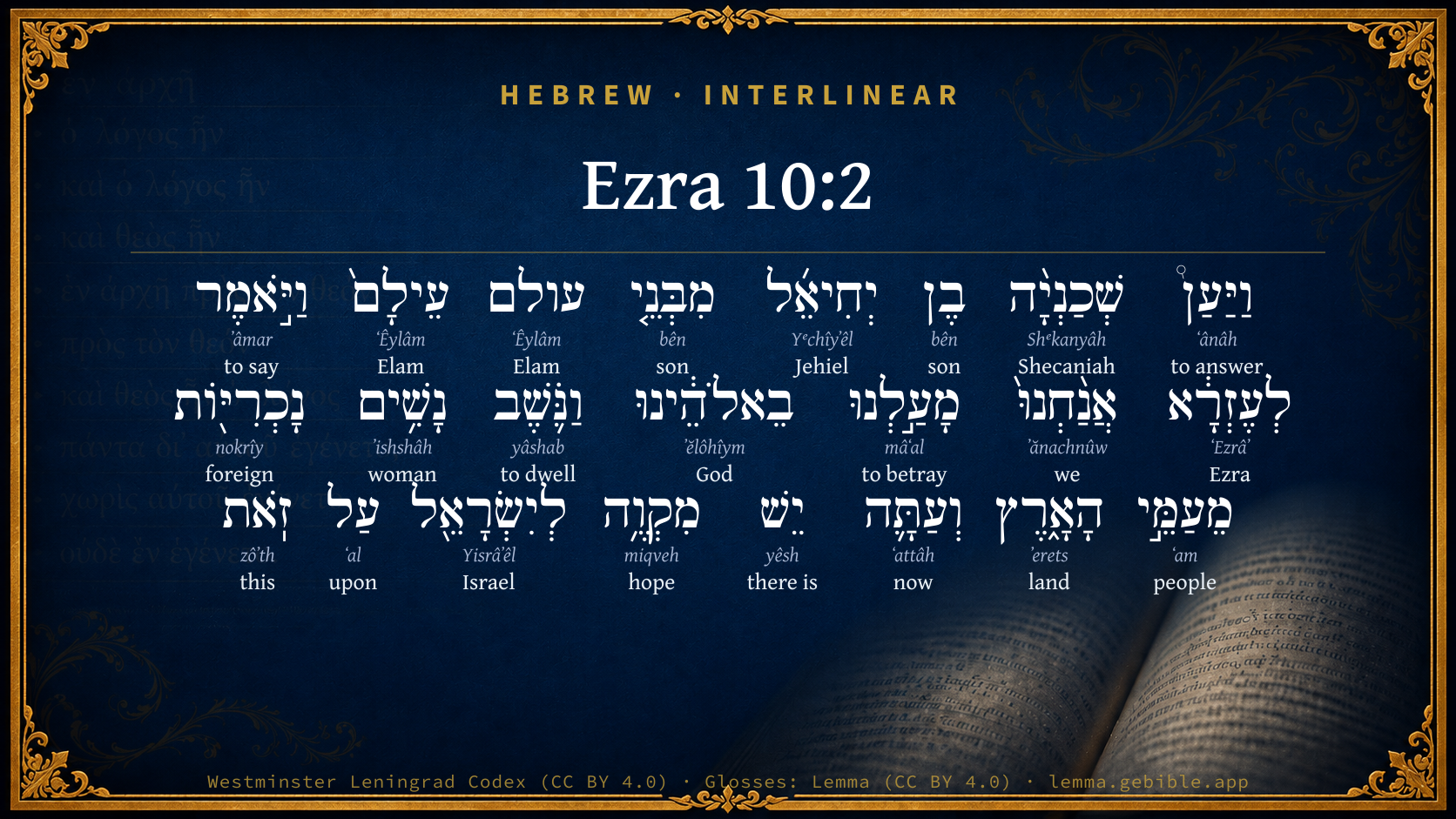
Ezra 10:2

Hebrew (Westminster Leningrad Codex) Ezra 10:2 appears in the Hebrew Old Testament. The text above is from the Westminster Leningrad Codex. Each word links to its Strong’s number, a concise gloss, and parsing drawn from the Open Scriptures Hebrew Bible morphology. Click any word for its full Brown-Driver-Briggs (BDB) entry.
Download image
Cite this verse

Ezra 10:2 (World English Bible). Public Domain. Lemma interlinear Bible study tool, https://lemma.gebible.app/v/ezra/10/2.

Show BibTeX & RIS
BibTeX
RIS
English Translation
Shecaniah the son of Jehiel, one of the sons of Elam, answered Ezra, We have trespassed against our God, and have married foreign women of the peoples of the land: yet now there is hope for Israel concerning this thing.
World English Bible · Public Domain
Download a study sheet

One document with this verse’s original text, its word-by-word gloss line, the meaning frame, cross-references with their text, attributed commentary, and full source and license credits — printable, and it pastes into notes with its structure intact.

This verse Autodidact and up

Study sheet (.html) Plain text (.txt)

A passage Seminary Student

Up to 50 verses in one chapter. A passage sheet keeps up to 6 commentary sources and 12 cross-references per verse, in the order this page ranks them, and says so on the sheet whenever that leaves anything out. Ask for a single verse and you get the Autodidact verse sheet above.

Everything on this page stays free to read, with no account — the sheet is a download of what is already on screen, not access to it.

Want to remove ads? Support Godless Engineer
Compare translations 3

The same verse in 3 English versions, stacked beneath the original-language interlinear above. Click any original word for its lexicon entry.

Each is an independent rendering of the whole verse — the interlinear is not word-aligned to these translations.

Highlighted words mark where these versions differ — a whole-verse word diff, not a word-by-word alignment.

  • World English Bible Public Domain
    Shecaniah the son of Jehiel, one of the sons of Elam, answered Ezra, We have trespassed against our God, and have married foreign women of the peoples of the land: yet now there is hope for Israel concerning this thing.
  • King James Version Public Domain
    And Shechaniah the son of Jehiel, one of the sons of Elam, answered and said unto Ezra, We have trespassed against our God, and have taken strange wives of the people of the land: yet now there is hope in Israel concerning this thing.
  • unfoldingWord Literal Text CC BY-SA 4.0
    Then Shecaniah, the son of Jehiel, from the sons of Elam, answered and said to Ezra, “We ourselves have acted unfaithfully against our God and have caused foreign women from the peoples of the land to dwell. But now, there is hope for Israel concerning this.

unfoldingWord Literal Text — © unfoldingWord, licensed CC BY-SA 4.0. Word-aligned USFM3 via Door43 (git.door43.org/unfoldingWord/en_ult).

Versions to compare (up to 4)

3 of 4 selected

Show all 18 translations

Every available English version of this verse, each an independent rendering of the whole verse.

  • World English Bible Public Domain
    Shecaniah the son of Jehiel, one of the sons of Elam, answered Ezra, We have trespassed against our God, and have married foreign women of the peoples of the land: yet now there is hope for Israel concerning this thing.
  • Berean Standard Bible Public Domain
    Then Shecaniah son of Jehiel, an Elamite, said to Ezra: “We have been unfaithful to our God by marrying foreign women from the people of the land, yet in spite of this, there is hope for Israel.
  • Majority Standard Bible Public Domain
    Then Shecaniah son of Jehiel, an Elamite, said to Ezra: “We have been unfaithful to our God by marrying foreign women from the people of the land, yet in spite of this, there is hope for Israel.
  • King James Version Public Domain
    And Shechaniah the son of Jehiel, one of the sons of Elam, answered and said unto Ezra, We have trespassed against our God, and have taken strange wives of the people of the land: yet now there is hope in Israel concerning this thing.
  • American Standard Version (1901) Public Domain
    And Shecaniah the son of Jehiel, one of the sons of Elam, answered and said unto Ezra, We have trespassed against our God, and have married foreign women of the peoples of the land: yet now there is hope for Israel concerning this thing.
  • Revised Version (1885) Public Domain
    And Shecaniah the son of Jehiel, one of the sons of Elam, answered and said unto Ezra, We have trespassed against our God, and have married strange women of the peoples of the land: yet now there is hope for Israel concerning this thing.
  • Geneva Bible (1599) Public Domain
    Then Shechaniah the sonne of Iehiel one of the sonnes of Elam answered, and sayd to Ezra, We haue trespassed against our God, and haue taken strange wiues of the people of the land, yet nowe there is hope in Israel concerning this.
  • Douay-Rheims (1899) Public Domain
    And Sechenias the son of Jehiel of the sons of Elam answered, and said to Esdras: We have sinned against our God, and have taken strange wives of the people of the land: and now if there be repentance in Israel concerning this,
  • Young's Literal Translation Public Domain
    And Shechaniah son of Jehiel, of the sons of Elam, answereth and saith to Ezra, `We -- we have trespassed against our God, and we settle strange women of the peoples of the land; and now there is hope for Israel concerning this,
  • Literal Standard Version CC BY-SA 4.0
    And Shechaniah son of Jehiel, of the sons of Elam, answers and says to Ezra, “We have trespassed against our God, and we settle strange women of the peoples of the land; and now there is hope for Israel concerning this,
  • Unlocked Literal Bible CC BY-SA 4.0
    Shekaniah son of Jehiel of the descendants of Elam said to Ezra, “We have been unfaithful to our God and have married foreign women from the people of the other lands. But in spite of this, there is still hope for Israel.
  • unfoldingWord Literal Text CC BY-SA 4.0
    Then Shecaniah, the son of Jehiel, from the sons of Elam, answered and said to Ezra, “We ourselves have acted unfaithfully against our God and have caused foreign women from the peoples of the land to dwell. But now, there is hope for Israel concerning this.
  • Darby Bible Public Domain
    And Shechaniah the son of Jehiel, of the sons of Elam, answered and said to Ezra, We have acted unfaithfully toward our God, and have taken foreign wives of the peoples of the land; yet now there is hope for Israel concerning this thing.
  • World Messianic Bible Public Domain
    Shecaniah the son of Jehiel, one of the sons of Elam, answered Ezra, “We have trespassed against our God, and have married foreign women of the peoples of the land. Yet now there is hope for Israel concerning this thing.
  • Webster's Bible Public Domain
    And Shechaniah the son of Jehiel, one of the sons of Elam, answered and said to Ezra, We have trespassed against our God, and have taken foreign wives of the people of the land: yet now there is hope in Israel concerning this thing.
  • Free Bible Version CC BY-SA 4.0
    Shecaniah, son of Jehiel, an Elamite, said to Ezra: “Yes, we have been unfaithful to our God because we have married foreign women from the people of the land. But even so there is still hope for Israel over this.
  • Bible in Basic English Public Domain
    And Shecaniah, the son of Jehiel, one of the sons of Elam, answering, said to Ezra, We have done evil against our God, and have taken as our wives strange women of the peoples of the land: but still there is hope for Israel in this question.
  • JPS Tanakh (1917) Public Domain
    And Shecaniah the son of Jehiel, one of the sons of Elam, answered and said unto Ezra: 'We have broken faith with our God, and have married foreign women of the peoples of the land; yet now there is hope for Israel concerning this thing.

Literal Standard Version (2020), Covenant Press — licensed CC BY-SA 4.0. Text via the HelloAO Bible API (eBible.org). Unlocked Literal Bible (unfoldingWord) — licensed CC BY-SA 4.0. Text via the HelloAO Bible API (eBible.org). unfoldingWord Literal Text — © unfoldingWord, licensed CC BY-SA 4.0. Word-aligned USFM3 via Door43 (git.door43.org/unfoldingWord/en_ult). Free Bible Version, Dr. Jonathan Gallagher — licensed CC BY-SA 4.0. Text via the HelloAO Bible API (eBible.org).

Word by word

More ways to search: Search by grammar → Find every occurrence → Compare this word →

Practice this passage: Drill this verse → Learn its vocabulary →

שְׁכַנְיָ֨ה
Shᵉkanyâh
H7935
“Shecaniah”
Noun, Proper
Part of Speech
Noun
Type
Proper
Full BDB Definition

Origin: from H7931 and H3050

TWOT: None

Shecaniah or Shechaniah = "dweller with Jehovah" - a descendant of Zerubbabel whose descendants returned from exile with Ezra - son of Jehiel of the sons of Elam and one who had a foreign wife in the time of Ezra - father of Shemaiah who repaired part of the wall of Jerusalem in the time of Nehemiah - son of Arah, father-in-law of Tobiah who opposed Nehemiah - a priest who returned from exile with Zerubbabel - a priest in the time of king Hezekiah of Judah
  1. וַיַּעַן֩ ʻânâh H6030 “and · to answer” Conjunction + Verb, Qal, Sequential Imperfect, 3rd Person, Masculine, Singular
  2. בֶן bên H1121 “son of” Noun, Common, Masculine, Singular, Construct
  3. יְחִיאֵ֜ל Yᵉchîyʼêl H3171 “Jehiel” Noun, Proper
  4. מִבְּנֵ֤י bên H1121 “from · sons of” Preposition + Noun, Common, Masculine, Plural, Construct
  5. עולם ʻÊylâm H5867 “Elam” Noun, Proper
  6. עֵילָם֙ ʻÊylâm H5867 “Elam” Noun, Proper
  7. וַיֹּ֣אמֶר ʼâmar H559 “and · to say” Conjunction + Verb, Qal, Sequential Imperfect, 3rd Person, Masculine, Singular
  8. לְעֶזְרָ֔א ʻEzrâʼ H5830 “to/for · Ezra” Preposition + Noun, Proper
  9. אֲנַ֨חְנוּ֙ ʼănachnûw H587 “we” Pronoun, Personal, 1st Person, Common, Plural
  10. מָעַ֣לְנוּ mâʻal H4603 “to betray” Verb, Qal, Perfect, 1st Person, Common, Plural
  11. בֵאלֹהֵ֔ינוּ ʼĕlôhîym H430 “in/at · God(s) · our” Preposition + Noun, Common, Masculine, Plural, Construct + Suffix, Personal, 1st Person, Common, Plural
  12. וַנֹּ֛שֶׁב yâshab H3427 “and · to dwell” Conjunction + Verb, Hiphil, Sequential Imperfect, 1st Person, Common, Plural
  13. נָשִׁ֥ים ʼishshâh H802 “women” Noun, Common, Feminine, Plural, Absolute
  14. נָכְרִיּ֖וֹת nokrîy H5237 “foreign” Adjective, Adjective, Feminine, Plural, Absolute
  15. מֵעַמֵּ֣י ʻam H5971 “from · peoples of” Preposition + Noun, Common, Masculine, Plural, Construct
  16. הָאָ֑רֶץ ʼerets H776 “the · land” Particle, Definite Article + Noun, Common, Both, Singular, Absolute
  17. וְעַתָּ֛ה ʻattâh H6258 “and · now” Conjunction + Adverb
  18. יֵשׁ yêsh H3426 “there is” Particle, Demonstrative
  19. מִקְוֶ֥ה miqveh H4723 “hope” Noun, Common, Masculine, Singular, Absolute
  20. לְיִשְׂרָאֵ֖ל Yisrâʼêl H3478 “to/for · Israel” Preposition + Noun, Proper
  21. עַל ʻal H5921 “upon” Preposition
  22. זֹֽאת zôʼth H2063 “this” Pronoun, Demonstrative, Feminine, Singular

About this verse

These counts appear in no published source. They are computed here, from the morphology-tagged text and Lemma’s own curated glosses. What Lemma adds →

23
words
21
distinct lemmas
Historical
section

Notable vocabulary

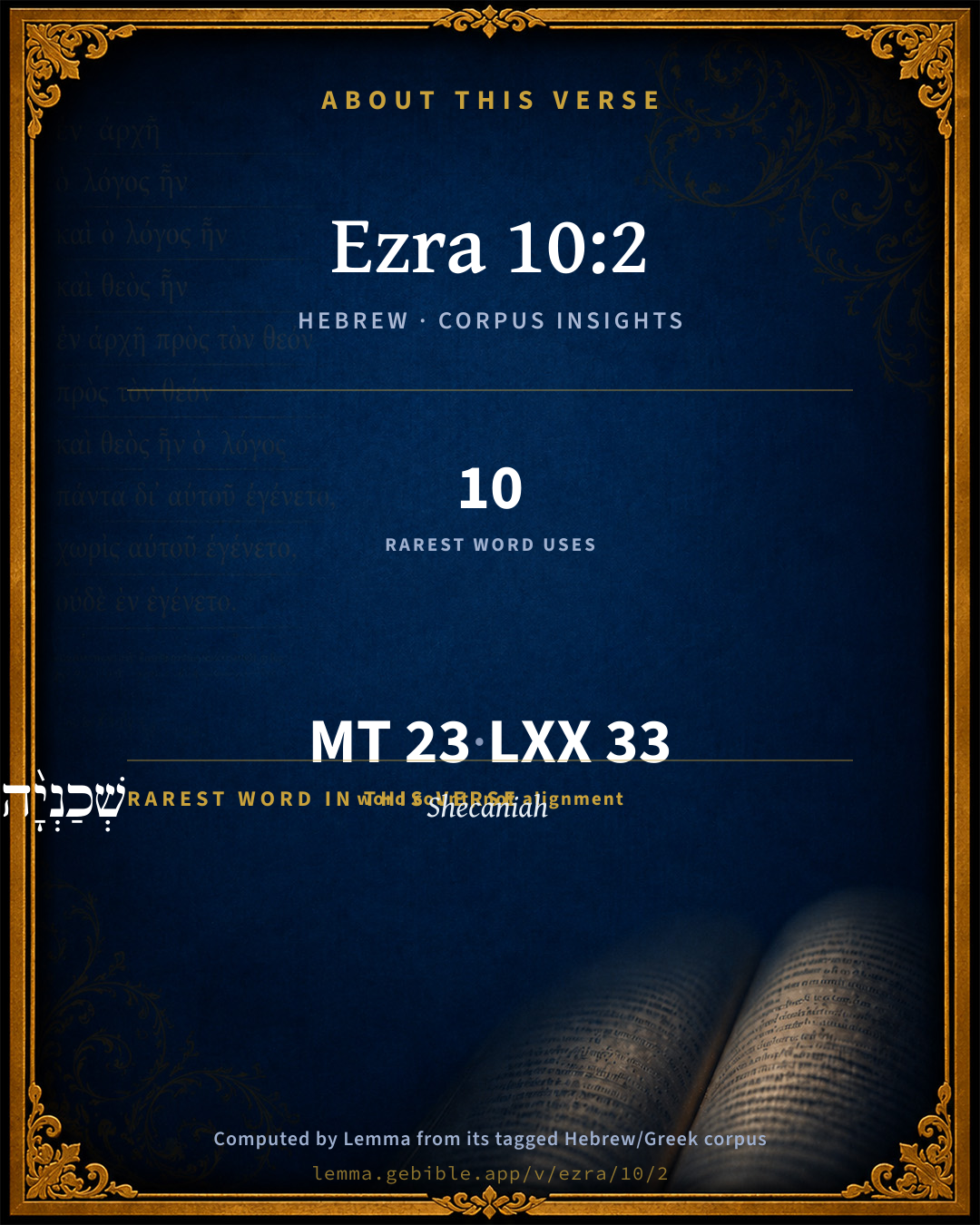
The rarest word here is שְׁכַנְיָ֨ה Shecaniah H7935 — appearing just 10 times in the whole Hebrew Bible.

Shared distinctive vocabulary

שְׁכַנְיָ֨ה Shecaniah H7935 occurs in 10 verses of the Hebrew Bible. Also found in:

Grammatical profile

  • 4 verbs
  • 13 nouns
  • 1 adjective
  • 2 pronouns
  • 1 preposition
  • 1 adverb
  • 1 particle

Verb forms

  • וַיַּעַן֩ Qal · Sequential Imperfect
  • וַיֹּ֣אמֶר Qal · Sequential Imperfect
  • מָעַ֣לְנוּ Qal · Perfect
  • וַנֹּ֛שֶׁב Hiphil · Sequential Imperfect

Repetition

Words recur within this verse — often emphatic in Hebrew:

Hebrew & Septuagint length

In English translation the verse runs 40 words from the Hebrew and 46 from the Septuagint (LXX English) — closely comparable.

A rough comparison of the two English renderings, which tokenize alike — not a word-level alignment.

Word counts can differ between the Hebrew and the Greek without any difference in meaning — e.g. the Hebrew direct-object marker אֵת has no separate Greek word, and Greek often adds the article ὁ.

In the original languages it is 23 Hebrew tokens and 33 Greek tokens — but the two are counted differently (Hebrew bundles its prefixes and suffixes into one token; the Greek is in lemma form), so that isn’t a like-for-like length.

Cross-references

14

Topical passages linked to Ezra 10:2 in the Treasury of Scripture Knowledge — connected by theme and wording, ordered by reader-vote popularity; previews shown in the World English Bible.

  • Nehemiah 13:27 Shall we then listen to you to do all this great evil, to trespass against our God in marrying foreign women?
  • Ezra 9:2 For they have taken of their daughters for themselves and for their sons, so that the holy seed have mixed themselves with the peoples of the lands: yes, the hand of the princes and rulers has been chief in this trespass.
  • Exodus 34:12 Be careful, lest you make a covenant with the inhabitants of the land where you are going, lest it be for a snare in the midst of you:
  • Jeremiah 3:12–13 Go, and proclaim these words toward the north, and say, Return, you backsliding Israel, says Yahweh; I will not look in anger on you; for I am merciful, says Yahweh, I will not keep [anger] forever.
  • Exodus 34:6–7 Yahweh passed by before him, and proclaimed, "Yahweh! Yahweh, a merciful and gracious God, slow to anger, and abundant in loving kindness and truth,
  • Ezra 10:26 Of the sons of Elam: Mattaniah, Zechariah, and Jehiel, and Abdi, and Jeremoth, and Elijah.
  • Nehemiah 3:29 After them repaired Zadok the son of Immer over against his own house. After him repaired Shemaiah the son of Shecaniah, the keeper of the east gate.
  • Isaiah 55:6–7 Seek you Yahweh while he may be found; call you on him while he is near:
  • James 2:9 But if you show partiality, you commit sin, being convicted by the law as transgressors.
  • 1 John 1:7–9 But if we walk in the light, as he is in the light, we have fellowship with one another, and the blood of Jesus Christ, his Son, cleanses us from all sin.
  • Ezra 2:7 The children of Elam, one thousand two hundred fifty-four.
  • Ezra 2:31 The children of the other Elam, one thousand two hundred fifty-four.
  • Nehemiah 7:12 The children of Elam, one thousand two hundred fifty-four.
  • Nehemiah 7:34 The children of the other Elam, one thousand two hundred fifty-four.

Cross-references courtesy of OpenBible.info (CC BY 4.0).

Hebrew and Greek witnesses Masoretic Hebrew ↔ Greek Septuagint

The same verse in the two great witnesses to the Old Testament, shown verse-for-verse.

These are two independent witnesses, not word-aligned to each other, and the Septuagint is shown in lemma (dictionary) form.

Hebrew Ezra 10:2 Masoretic · Westminster Leningrad Codex

וַיַּעַן֩ שְׁכַנְיָ֨ה בֶן יְחִיאֵ֜ל מִבְּנֵ֤י עולם עֵילָם֙ וַיֹּ֣אמֶר לְעֶזְרָ֔א אֲנַ֨חְנוּ֙ מָעַ֣לְנוּ בֵאלֹהֵ֔ינוּ וַנֹּ֛שֶׁב נָשִׁ֥ים נָכְרִיּ֖וֹת מֵעַמֵּ֣י הָאָ֑רֶץ וְעַתָּ֛ה יֵשׁ מִקְוֶ֥ה לְיִשְׂרָאֵ֖ל עַל זֹֽאת

Shecaniah the son of Jehiel, one of the sons of Elam, answered Ezra, We have trespassed against our God, and have married foreign women of the peoples of the land: yet now there is hope for Israel concerning this thing.

World English Bible · Public Domain

Greek LXX Ezra 10:2 Septuagint · lemma form

καί ἀποκρίνω σεχενιας υἱός ιιηλ ἀπό υἱός ηλαμ καί εἶπον ὁ εσδρα ἐγώ ἀσυνθετέω ὁ θεός ἐγώ καί καταἵζω γυνή ἀλλότριος ἀπό λαός ὁ γῆ καί νῦν εἰμί ὑπομονή ὁ ἰσραήλ ἐπί οὗτος

And Sechenias the son of Jeel, of the sons of Elam, answered and said to Esdras, We have broken covenant with our God, and have taken strange wives of the nations of the land: yet now there is patience of hope to Israel concerning this thing.

LXX2012 (modern English Septuagint) · Public Domain

In the Septuagint this is one book — Esdras B (2 Esdras): Ezra is chapters 1–10, Nehemiah 11–23.

On this verse, Keil & Delitzsch discusses the Septuagint’s reading. Read the note in Commentary ↓

Hebrew: Westminster Leningrad Codex (CC BY 4.0). Greek: Septuagint (public domain); English from LXX2012 (modern English Septuagint) (Public Domain). How the Septuagint differs from the Hebrew →

Commentary

Notes on Ezra 10:2 from classic Christian and Jewish commentators (each source and its license shown beneath its notes). The classic Christian expositions comment on the surrounding passage and are grouped to its opening verse, so a note may address several verses; the Jewish commentaries on the Tanakh (Rashi and others) are per-verse, so they appear only where the commentator wrote on this verse.

Lemma curates 59 commentaries, every one of them public domain or Creative Commons licensed, each selected and text-cleaned for this edition rather than reprinted as found. About our sources →

Trapp's Complete Commentary

John Trapp

Ezr 10:2 And Shechaniah the son of Jehiel, [one] of the sons of Elam, answered and said unto Ezra, We have trespassed against our God, and have taken strange wives of the people of the land: yet now there is hope in Israel concerning this thing.

Ver. 2. And Shechaniah the son of Jehiel] Egregie cordatus homo A prudent and a pious man, one that had feeding lips, and a healing tongue, one that knew how to time a word, and to set it upon the wheels, Isa 50:4 Pro 25:11.

Answered and said unto Ezra] Such words as were uttered more from the bowels than the brain, and thereby proved so effectual.

We have trespassed against our God] His father Jehiel had taken a strange wife, Ezr 10:18; Ezr 10:26, so perhaps had he himself; or if not, yet he might fear wrath, because of the same body politic with those sinners against their own souls. God, he knew, might well draw blood of the arm for the cure of the head; as Theodoret saith he did when he slew Pharaoh’s first-born.

Yet now there is hope in Israel, &c.] Hope that the people will repent, and hope that God will have mercy, upon their repentance. Superest sperare salutem, He survives to hope for health. If it were not for hope the heart would break. God, having opened a door of hope, let us go boldly to the throne of grace; what should hinder?

“ Qui nil sperare potest, desperet nihil. ”

Who is able to hope for nothing, gives up hope for nothing. Cast not away your confidence, which hath so great recompence of reward; but cast anchor within the veil, and wait for day, as Paul did in the shipwreck. See Isa 50:10.

John Trapp, A Commentary or Exposition upon All the Books of the Old and New Testament (1647–1656) — public domain. Text from a community e-Sword module.

Joseph Benson's Commentary

Ezr 10:2. We have trespassed against our God — He says we, in the name of the people, and their several families, and his own among the rest. For this man’s name is not in the following catalogue, but there we have his father Jehiel, and his father’s brethren, five other sons of his grandfather Elam, Ezr 10:26. It was therefore an evidence of his great courage and disinterested faithfulness, that he durst so freely discharge his duty, whereby he showed that he honoured God more than his nearest and dearest relations, and set an admirable example of zealous integrity. And have taken strange wives — Into conjugal society with ourselves. Yet now there is hope in Israel concerning this thing — The case is sad, but not desperate: the disease threatening, but not incurable. Our ruin may yet be prevented by repentance and reformation. And there is hope that the people may be reformed, the guilty reclaimed, a stop put to the spreading of the contagion, and so the judgments which the sin deserves may be prevented. Therefore, let us not sorrow like persons without hope, or sit down in despair, but let us fall upon action, and amend our errors, and then trust to God’s mercy.

Joseph Benson's Commentary on the Old and New Testaments (1811–1818) — public domain. Text from a community e-Sword module.

Keil & Delitzsch

C. F. Keil & F. Delitzsch

Then one of the sons of Elam, Shecaniah, the son of Jehiel, stood forth from amidst the assembly, and uttered the confession: "We have been unfaithful towards our God by marrying strange wives, but there is yet hope for Israel concerning this thing. We will now make a covenant with God to put away all the strange wives and their children from the congregation, according to the counsel of the Lord, and of those who fear the commandment of our God, that it may be done according to the law." Shecaniah, of the sons of Elam (comp. Ezr 2:7; Ezr 8:7), is a different person from the descendant of Zattu, mentioned Ezr 8:5; nor is Jehiel identical with the individual whose name occurs in Ezr 10:26. ונּשׁב, and have brought home strange wives. הושׁיב, to cause to dwell (in one's house), said in Ezr 10:10, Ezr 10:14, Ezr 10:17, Ezr 10:18, and Neh 13:23, Neh 13:27, of bringing a wife home. Shecaniah founds his hope for Israel in this trespass upon the circumstance, that they bind themselves by a solemn covenant before God to put away this scandal from the congregation, and to act in conformity with the law. To make a covenant with our God, i.e., to bind themselves by an oath with respect to God, comp. Ch2 29:10. הוציא, to put away - the opposite of הושׁיב. All the wives are, according to the context, all the strange women (Ezr 10:2), and that which is born of them, their children. Instead of אדני בּעצת, according to the counsel of the Lord, De Wette, Bertheau, and others, following the paraphrase in the lxx and 1 Esdras, read אדני, according to the counsel of my lord, i.e., of Ezra. But this paraphrase being of no critical authority, there is no sufficient reason for the alteration. For Shecaniah to call Ezra my lord sounds strange, since usually this title was only given by servants to their master, or subjects to their sovereign, and Shecaniah afterwards addresses him simply as thou. Besides, Ezra had given no advice at all in this matter, and still less had he come to any resolution about it with the God-fearing members of the community. יעשׂה after the preceding נכרת־בּרית, we will make a covenant, must be taken as hortative: and let it be done according to the law. בּ חרד, caring for with trembling.

Keil & Delitzsch — Biblical Commentary on the Old Testament (1861–1891) — public domain (CC PDM 1.0). Text via the HelloAO Bible API. (Old Testament only.)

Tyndale Open Study Notes

Tyndale Open Resources

10:2 Shecaniah was the first person brave enough to publicly admit that he had been unfaithful to God. Admission of guilt gives the hope of forgiveness for sin.

Tyndale Open Study Notes — © Tyndale Open Resources, licensed CC BY-SA 4.0. Text via the HelloAO Bible API.

Geneva Bible (1599)

Geneva Bible translators

Meaning, that God would receive them to mercy.

Geneva Bible (1599) marginal notes — public domain. Text via Bolls.life.

Jamieson, Fausset & Brown

Robert Jamieson, A. R. Fausset & David Brown

Shechaniah . . . answered and said unto Ezra, We have trespassed--This was one of the leading men, who was not himself a delinquent in the matter, for his name does not occur in the following list. He spoke in the general name of the people, and his conduct evinced a tender conscience, as well as no small fortitude in making such a proposal; for as his father and five paternal uncles (Ezr 10:26) were involved in the guilt of unlawful marriages, he showed, by the measure he recommended, that he deemed it better to obey God than to please his nearest relatives.

yet now there is hope in Israel concerning this thing--This hope, however, depended on timely measures of reformation, and therefore, instead of surrendering themselves to despair or despondency, he counselled them to amend their error without delay, relying on God's mercy for the past. Though the proposal may seem harsh and cruel, yet in the peculiar circumstances of the Jews it was just as well as necessary; and he urged the duty of seeing it executed on Ezra, as the only person competent to carry it into effect, being possessed of skill and address for so delicate and difficult a work, and invested by God, and under Him by the Persian king (Ezr 7:23-28), with the requisite authority to enforce it.

Jamieson, Fausset & Brown — Commentary Critical and Explanatory on the Whole Bible (1871) — public domain (CC PDM 1.0). Text via the HelloAO Bible API.

Adam Clarke's Commentary

Verse 2. Shechaniah the son of Jehiel] He speaks here in the name of the people, not acknowledging himself culpable, for he is not in the following list. It is in the same form of speech with that in James, Jas 3:9. With the tongue curse we men. He seems to have been a chief man among the people; and Ezra, at present, stood in need of his influence and support.

Yet now there is hope in Israel] מקוה mikveh, expectation, of pardon; for the people were convinced of the evil, and were deeply penitent: hence it is said, Ezr 10:1, that they wept sore.

Adam Clarke's Commentary on the Bible (1810–1826) — public domain. Text from a community e-Sword/MySword module.

The Cambridge Bible for Schools and Colleges

gen. ed. J. J. S. Perowne

2. And Shechaniah the son of Jehiel, one of the sons of Elam] R.V. Shecaniah. A Jehiel is mentioned in Ezr_10:26 as one ‘of the sons of Elam’ that had married ‘strange women’. It is hardly likely that Shecaniah would have taken action against his own father and mother (or stepmother); though, if he did, it would strikingly illustrate the intensity of the feeling aroused. ‘The children of Elam’ are mentioned in Ezr_2:7, Ezr_8:7.

We have trespassed] See on Ezr_9:2.

have taken strange wives] R.V. have married strange women. ‘Have married’ a word meaning literally ‘caused to dwell’ used in this technical sense here and Ezr_10:10; Ezr_10:14; Ezr_10:17-18; Neh_13:23; Neh_13:27.

of the people of the land] R.V. of the peoples of the land. ‘of the land’, not as in Ezr_9:1-2; Ezr_9:11 ‘of the lands’. Shecaniah refers especially to the heathen living amongst the people of Israel.

yet now there is hope in Israel] ‘Hope’. This word in the Hebrew is used for the object of hope in Jer_14:8; Jer_17:13; Jer_50:7. In 1Ch_29:15 ‘our days on the earth are as a shadow, and there is no abiding (Heb. ‘hope’)’, and in this passage, the source or means of ‘hope’ is denoted.

Shecaniah relied upon the promise attached to repentance (e.g. Deu_30:1-10). ‘Even now’ corresponds to the ‘and now’ in Ezr_9:10.

concerning this thing] The same words in the Hebrew as ‘because of this’ (Ezr_9:15). Shecaniah clearly does not mean ‘on account of this repentance’, but ‘with reference to this offence’.

The Cambridge Bible for Schools and Colleges (gen. ed. J. J. S. Perowne; Cambridge University Press, 1878–1918) — public domain. Text from a community e-Sword module.

John Gill's Exposition

And Shechaniah the son of Jehiel, one of the sons of Elam, answered and said unto Ezra,.... This man seems to be one of those that now came with Ezra from Babylon, see Ezr 8:3,

we have trespassed against our God, and have taken strange wives of the people of the land; not that he had taken any himself, being but just come into the land, nor is his name in the list of those that had; but inasmuch as many of the nation, of which he was a part, and his own father, and several of his uncles had, Ezr 10:26, he expresses himself in this manner:

yet now there is hope in Israel concerning this thing; of a reformation of this evil, and of pardon for it.

John Gill's Exposition of the Whole Bible (1746–1763) — public domain (CC PDM 1.0). Text via the HelloAO Bible API.

Albert Barnes' Notes on the Bible

Jehiel was one of those who had taken an idolatrous wife Ezr 10:26; and Shechaniah had therefore had the evil brought home to him.

Albert Barnes' Notes on the Bible (1834–1885) — public domain. Text from a community e-Sword/MySword module.

Haydock's Catholic Bible Commentary

Sechenias. 3 Esdras calls him "Jechoias." See chap. viii. 5. The name of Sechenias is not found among the transgressors; (ver. 20.) but that of Jehiel is, ver. 26. It seems, however, that the former returned with Esdras, and speaks in the name of the people, to encourage them to confess their guilt, (Calmet) unless his name be omitted. (Menochius) --- Repentance. Hebrew, "yet there is hope, (Protestants) or an assembly of Israel." (Du Dieu)

George Leo Haydock (1774–1849), Haydock's Catholic Family Bible and Commentary, 1859 edition — public domain. Excludes Psalms (Douay-Rheims chapter numbering differs from Protestant) and Deuterocanonical books (Catholic canon only).

Matthew Poole's English Annotations

He saith

we, either,

1. Because he was guilty in this matter. Or rather,

2. In the name of the people, and their several families, and his own amongst the rest. For this man’s name is not in the following catalogue, but there we have his father, Jehiel, and his father’s brethren, five other sons of his grandfather Elam, Ezr 10:26. It was therefore an evidence of his great courage, and good conscience, that he durst so freely and fully discharge his duty, whereby he showed that he honored God more than his nearest and dearest relations.

There is hope concerning this thing, in case of our repentance and reformation. Therefore let us not sorrow like persons without hope, nor sit down in despair, but let us fall upon action, and amend our errors, and then trust to God’s mercy.

Matthew Poole's English Annotations on the Holy Bible (1683–1685) — public domain. Text from a community e-Sword/MySword module.

Whedon's Commentary on the Bible

Daniel D. Whedon

2. Of the sons of Elam — Two individuals of this name are mentioned in the list of those who returned with Zerubbabel, (Ezr_2:7; Ezr_2:31,) but there is nothing to decide which one of them is here intended. Compare Ezr_10:26.

Now there is hope — From the fact that the people weep. There is always hope for sinners that are penitent enough to weep.

Daniel D. Whedon (gen. ed.), Commentary on the Old and New Testaments (1874–1909) — public domain. Text from a community e-Sword module.

The Pulpit Commentary

Jehiel. Probably the Jehiel" mentioned again in ver. 26, who was "of the sons of Elam," and had married an idolatrous wife. Yet now there is hope. The penitence of the people, evidenced by their "sore weeping, gave hope that they might be brought to amend their ways and return to God.

The Pulpit Commentary (1880–1919), ed. H.D.M. Spence-Jones & Joseph S. Exell — public domain. Text from a community e-Sword module.

John Wesley's Explanatory Notes

We - He saith, we, in the name of the people, and their several families, and his own amongst the rest. For this man's name is not in the following catalogue, but there we have his father, Jehiel, and his father's brethren, five other sons of his grandfather, Elam, ver. 26. It was therefore an evidence of his great courage, and good conscience, that he durst so freely discharge his duty, whereby he shewed, that he honoured God more than his nearest and dearest relations. Hope - In case of our repentance, and reformation.

John Wesley, Explanatory Notes Upon the Whole Bible (1754–1765) — public domain. Text via the GEBible commentary corpus.

Rashi

Rabbi Shlomo Yitzchaki (Rashi)

and we have taken And we took them in.

there is hope There is hope for Israel concerning this, for they can cast out their foreign wives and their offspring and cast out all the children born from these foreign wives.

Rashi on the Tanakh — English translations: “The Judaica Press complete Tanach with Rashi, translated by A. J. Rosenberg” (CC BY 4.0); “Pentateuch with Rashi's commentary by M. Rosenbaum and A.M. Silbermann, 1929-1934” (public domain); “The Metsudah Tanach series, Lakewood, N.J” (CC BY 4.0); and “The Book of Joshua, Metsudah Publications, 1997” (CC BY 4.0). Text via Sefaria.

Lesson kit

Teaching starters — assembled from the data on this page, not authored interpretation. Every prompt links to the verse data it draws on. Edit before teaching.

Ezra, in the Historical, opens this verse with 23 words (21 distinct Hebrew lemmas). Its most distinctive word is Shᵉkanyâh (“Shecaniah”). A historical commentator’s framing appears above. Read the whole chapter for the surrounding context.

Discussion questions

  1. How does “Shecaniah” (Shᵉkanyâh) shape what this verse is saying?
  2. How does 1 Chronicles 3:21, which shares the word «Shecaniah», read alongside this verse?
  3. What does the repetition of “son” (2× in this one verse) do in this verse?
  4. These translations render this verse differently; the difference is in the English rendering, not the original. What questions does that raise?
  5. «וַיַּעַן֩» is a Qal Sequential Imperfect verb. How does that grammatical form shape the action described?
  6. Compare how Trapp's Complete Commentary and Joseph Benson's Commentary read this verse. Where do they agree or differ?

Things to notice

Reading settings

Reading text

Shown beneath each verse's original-language words.

Old Testament
Old Testament edition

Read the OT as the Masoretic Hebrew (MT) or the Greek Septuagint (LXX).

English shown for the Greek Septuagint (in the Hebrew ↔ Greek comparison).

Comparing translations? Open the Compare panel on any verse page to stack up to four side by side.