Judges 14:10

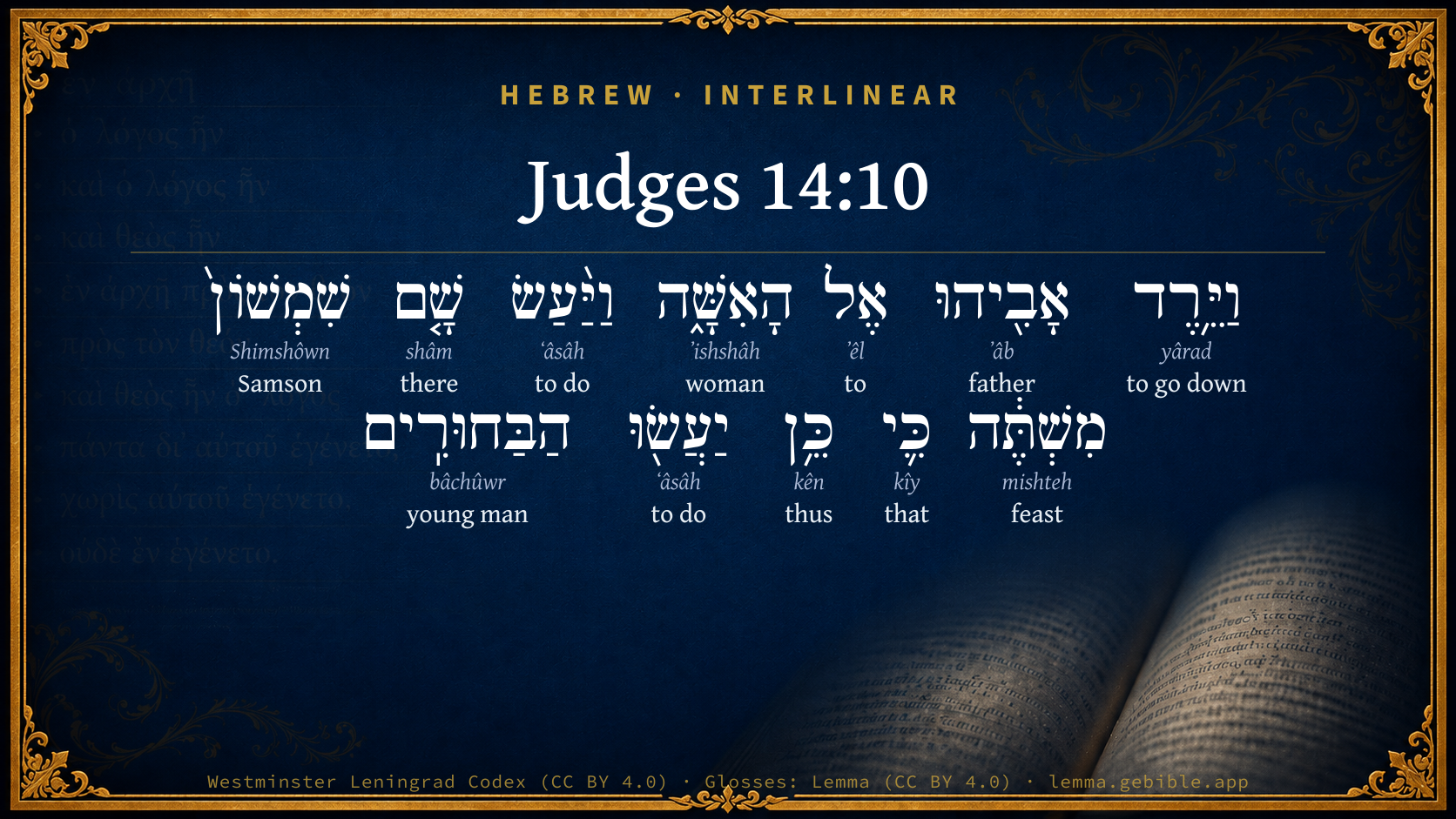
Hebrew (Westminster Leningrad Codex) Judges 14:10 appears in the Hebrew Old Testament. The text above is from the Westminster Leningrad Codex. Each word links to its Strong’s number, a concise gloss, and parsing drawn from the Open Scriptures Hebrew Bible morphology. Click any word for its full Brown-Driver-Briggs (BDB) entry.
Download image
Cite this verse

Judges 14:10 (World English Bible). Public Domain. Lemma interlinear Bible study tool, https://lemma.gebible.app/v/judges/14/10.

Show BibTeX & RIS
BibTeX
RIS
English Translation
His father went down to the woman: and Samson made there a feast; for so used the young men to do.
World English Bible · Public Domain
Download a study sheet

One document with this verse’s original text, its word-by-word gloss line, the meaning frame, cross-references with their text, attributed commentary, and full source and license credits — printable, and it pastes into notes with its structure intact.

This verse Autodidact and up

Study sheet (.html) Plain text (.txt)

A passage Seminary Student

Up to 50 verses in one chapter. A passage sheet keeps up to 6 commentary sources and 12 cross-references per verse, in the order this page ranks them, and says so on the sheet whenever that leaves anything out. Ask for a single verse and you get the Autodidact verse sheet above.

Everything on this page stays free to read, with no account — the sheet is a download of what is already on screen, not access to it.

Want to remove ads? Support Godless Engineer
Compare translations 3

The same verse in 3 English versions, stacked beneath the original-language interlinear above. Click any original word for its lexicon entry.

Each is an independent rendering of the whole verse — the interlinear is not word-aligned to these translations.

Highlighted words mark where these versions differ — a whole-verse word diff, not a word-by-word alignment.

  • World English Bible Public Domain
    His father went down to the woman: and Samson made there a feast; for so used the young men to do.
  • King James Version Public Domain
    So his father went down unto the woman: and Samson made there a feast; for so used the young men to do.
  • unfoldingWord Literal Text CC BY-SA 4.0
    And his father went down to the woman, and Samson made a feast there, for thus the young men would do.

unfoldingWord Literal Text — © unfoldingWord, licensed CC BY-SA 4.0. Word-aligned USFM3 via Door43 (git.door43.org/unfoldingWord/en_ult).

Versions to compare (up to 4)

3 of 4 selected

Show all 18 translations

Every available English version of this verse, each an independent rendering of the whole verse.

  • World English Bible Public Domain
    His father went down to the woman: and Samson made there a feast; for so used the young men to do.
  • Berean Standard Bible Public Domain
    Then his father went to visit the woman, and Samson prepared a feast there, as was customary for the bridegroom.
  • Majority Standard Bible Public Domain
    Then his father went to visit the woman, and Samson prepared a feast there, as was customary for the bridegroom.
  • King James Version Public Domain
    So his father went down unto the woman: and Samson made there a feast; for so used the young men to do.
  • American Standard Version (1901) Public Domain
    And his father went down unto the woman: and Samson made there a feast; for so used the young men to do.
  • Revised Version (1885) Public Domain
    And his father went down unto the woman: and Samson made there a feast; for so used the young men to do.
  • Geneva Bible (1599) Public Domain
    So his father went down vnto the woman, and Samson made there a feast: for so vsed the yong men to doe.
  • Douay-Rheims (1899) Public Domain
    So his father went down to the woman, and made a feast for his son Samson: for so the young men used to do.
  • Young's Literal Translation Public Domain
    And his father goeth down unto the woman, and Samson maketh there a banquet, for so the young men do;
  • Literal Standard Version CC BY-SA 4.0
    And his father goes down to the woman, and Samson makes a banquet there, for so the young men does;
  • Unlocked Literal Bible CC BY-SA 4.0
    Samson's father went down to where the woman was, and Samson gave a feast there, for this was the custom of the young men.
  • unfoldingWord Literal Text CC BY-SA 4.0
    And his father went down to the woman, and Samson made a feast there, for thus the young men would do.
  • Darby Bible Public Domain
    And his father went down to the woman, and Samson made a feast there; for so the young men used to do.
  • World Messianic Bible Public Domain
    His father went down to the woman; and Samson made a feast there, for the young men used to do so.
  • Webster's Bible Public Domain
    So his father went down to the woman: and Samson made there a feast; for so used the young men to do.
  • Free Bible Version CC BY-SA 4.0
    While his father went to visit the woman, Samson held a drinking party there, because this was the custom among high-class young men.
  • Bible in Basic English Public Domain
    Then Samson went down to the woman, and made a feast there, as was the way among young men.
  • JPS Tanakh (1917) Public Domain
    And his father went down unto the woman; and Samson made there a feast; for so used the young men to do.

Literal Standard Version (2020), Covenant Press — licensed CC BY-SA 4.0. Text via the HelloAO Bible API (eBible.org). Unlocked Literal Bible (unfoldingWord) — licensed CC BY-SA 4.0. Text via the HelloAO Bible API (eBible.org). unfoldingWord Literal Text — © unfoldingWord, licensed CC BY-SA 4.0. Word-aligned USFM3 via Door43 (git.door43.org/unfoldingWord/en_ult). Free Bible Version, Dr. Jonathan Gallagher — licensed CC BY-SA 4.0. Text via the HelloAO Bible API (eBible.org).

Word by word

More ways to search: Search by grammar → Find every occurrence → Compare this word →

Practice this passage: Drill this verse → Learn its vocabulary →

שִׁמְשׁוֹן֙
Shimshôwn
H8123
“Samson”
Noun, Proper
Part of Speech
Noun
Type
Proper
Full BDB Definition

Origin: from H8121

TWOT: None

Samson = "like the sun" - a Danite, son of Manoah, a Nazarite for life, and a judge of Israel for 20 years
  1. וַיֵּ֥רֶד yârad H3381 “and · to go down” Conjunction + Verb, Qal, Sequential Imperfect, 3rd Person, Masculine, Singular
  2. אָבִ֖יהוּ ʼâb H1 “father · his” Noun, Common, Masculine, Singular, Construct + Suffix, Personal, 3rd Person, Masculine, Singular
  3. אֶל ʼêl H413 “to” Preposition
  4. הָאִשָּׁ֑ה ʼishshâh H802 “the · woman” Particle, Definite Article + Noun, Common, Feminine, Singular, Absolute
  5. וַיַּ֨עַשׂ ʻâsâh H6213 “and · to do” Conjunction + Verb, Qal, Sequential Imperfect, 3rd Person, Masculine, Singular
  6. שָׁ֤ם shâm H8033 “there” Adverb
  7. מִשְׁתֶּ֔ה mishteh H4960 “feast” Noun, Common, Masculine, Singular, Absolute
  8. כִּ֛י kîy H3588 “that” Conjunction
  9. כֵּ֥ן kên H3651 “thus” Particle, Demonstrative
  10. יַעֲשׂ֖וּ ʻâsâh H6213 “to do” Verb, Qal, Imperfect, 3rd Person, Masculine, Plural
  11. הַבַּחוּרִֽים bâchûwr H970 “the · young men” Particle, Definite Article + Noun, Common, Masculine, Plural, Absolute

About this verse

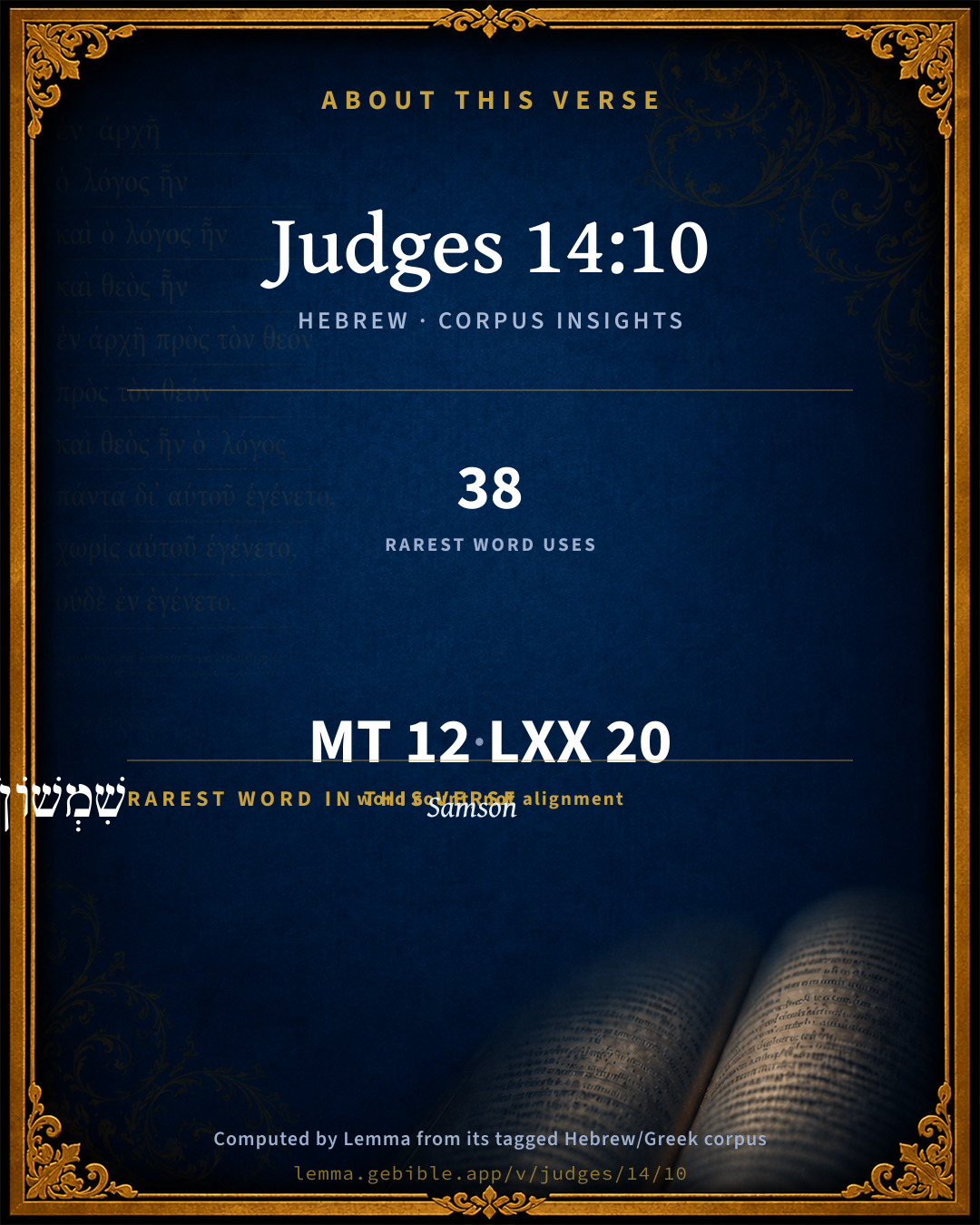
These counts appear in no published source. They are computed here, from the morphology-tagged text and Lemma’s own curated glosses. What Lemma adds →

12
words
11
distinct lemmas
Historical
section

Shared distinctive vocabulary

שִׁמְשׁוֹן֙ Samson H8123 occurs in 37 verses of the Hebrew Bible. Also found in:

Grammatical profile

  • 3 verbs
  • 5 nouns
  • 1 preposition
  • 1 conjunction
  • 1 adverb
  • 1 particle

Verb forms

  • וַיֵּ֥רֶד Qal · Sequential Imperfect
  • וַיַּ֨עַשׂ Qal · Sequential Imperfect
  • יַעֲשׂ֖וּ Qal · Imperfect

Repetition

A word recurs within this verse — often emphatic in Hebrew:

  • וַיַּ֨עַשׂ to do H6213 ×2

Hebrew & Septuagint length

In English translation the verse runs 21 words from the Hebrew and 26 from the Septuagint (LXX English) — closely comparable.

A rough comparison of the two English renderings, which tokenize alike — not a word-level alignment.

Word counts can differ between the Hebrew and the Greek without any difference in meaning — e.g. the Hebrew direct-object marker אֵת has no separate Greek word, and Greek often adds the article ὁ.

In the original languages it is 12 Hebrew tokens and 20 Greek tokens — but the two are counted differently (Hebrew bundles its prefixes and suffixes into one token; the Greek is in lemma form), so that isn’t a like-for-like length.

Cross-references

6

Topical passages linked to Judges 14:10 in the Treasury of Scripture Knowledge — connected by theme and wording, ordered by reader-vote popularity; previews shown in the World English Bible.

  • Genesis 29:22 Laban gathered together all the men of the place, and made a feast.
  • Esther 1:7–22 They gave them drink in vessels of gold (the vessels being diverse one from another), and royal wine in abundance, according to the bounty of the king.
  • Ecclesiastes 10:19 A feast is made for laughter, And wine makes the life glad; And money is the answer for all things.
  • Matthew 22:2–4 "The Kingdom of Heaven is like a certain king, who made a marriage feast for his son,
  • John 2:9 When the ruler of the feast tasted the water now become wine, and didn't know where it came from (but the servants who had drawn the water knew), the ruler of the feast called the bridegroom,
  • Revelation 19:9 He said to me, "Write, 'Blessed are those who are invited to the marriage supper of the Lamb.'" He said to me, "These are true words of God."

Cross-references courtesy of OpenBible.info (CC BY 4.0).

Hebrew and Greek witnesses Masoretic Hebrew ↔ Greek Septuagint

The same verse in the two great witnesses to the Old Testament, shown verse-for-verse.

These are two independent witnesses, not word-aligned to each other, and the Septuagint is shown in lemma (dictionary) form.

Hebrew Judges 14:10 Masoretic · Westminster Leningrad Codex

וַיֵּ֥רֶד אָבִ֖יהוּ אֶל הָאִשָּׁ֑ה וַיַּ֨עַשׂ שָׁ֤ם שִׁמְשׁוֹן֙ מִשְׁתֶּ֔ה כִּ֛י כֵּ֥ן יַעֲשׂ֖וּ הַבַּחוּרִֽים

His father went down to the woman: and Samson made there a feast; for so used the young men to do.

World English Bible · Public Domain

Greek LXX Judges 14:10 Septuagint · lemma form

καί καταβαίνω ὁ πατήρ αὐτός πρός ὁ γυνή καί ποιέω ἐκεῖ σαμψων πότος ἑπτά ἡμέρα ὅτι οὕτως ποιέω ὁ νεανίσκος

And his father went down to the woman, and Sampson made there a banquet for seven days, for so the young men are used to do.

LXX2012 (modern English Septuagint) · Public Domain

On this verse, Keil & Delitzsch discusses the Septuagint’s reading. Read the note in Commentary ↓

Hebrew: Westminster Leningrad Codex (CC BY 4.0). Greek: Septuagint (public domain); English from LXX2012 (modern English Septuagint) (Public Domain). How the Septuagint differs from the Hebrew →

Targum (Aramaic paraphrase)

1

The Targum is the ancient Jewish Aramaic paraphrase of the Hebrew Scriptures — an interpretive translation, not the Hebrew text itself. Onkelos (literal) and Pseudo-Jonathan (expansive) render the Torah, and Jonathan the Prophets. Coverage is partial: where no permissively-licensed English translation exists for a verse, only the Aramaic is shown. This is verse-level text, not a word-by-word alignment to the Hebrew.

  1. Targum Jonathan Prophets (Joshua–Malachi)
    וּנְחַת אֲבוּהִי עַל עֵיסַק אִתְּתָא וַעֲבַד תַּמָן שִׁמְשׁוֹן מִשְׁתַּיָא אֲרֵי כֵּן עָבְדִין עוּלֵמַיָא:

    (no public-domain English translation for this verse)

    Targum Jonathan — Aramaic: “Mikraot Gedolot” (public domain). English: “Sefaria Community Translation” (CC0 1.0 (public-domain dedication)); “London "Chaldee Paraphrase," 1871” (public domain). Text via Sefaria.

Commentary

Notes on Judges 14:10 from classic Christian and Jewish commentators (each source and its license shown beneath its notes). The classic Christian expositions comment on the surrounding passage and are grouped to its opening verse, so a note may address several verses; the Jewish commentaries on the Tanakh (Rashi and others) are per-verse, so they appear only where the commentator wrote on this verse.

Lemma curates 59 commentaries, every one of them public domain or Creative Commons licensed, each selected and text-cleaned for this edition rather than reprinted as found. About our sources →

Matthew Henry's Commentary

We have here an account of Samson's wedding feast and the occasion it gave him to fall foul upon the Philistines.

I. Samson conformed to the custom of the country in making a festival of his nuptial solemnities, which continued seven days, Jdg 14:10. Though he was a Nazarite, he did not affect, in a thing of this nature, to be singular, but did as the young men used to do upon such occasions. It is no part of religion to go contrary to the innocent usages of the places where we live: nay, it is a reproach to religion when those who profess it give just occasion to others to call them covetous, sneaking, and morose. A good man should strive to make himself, in the best sense, a good companion.

II. His wife's relations paid him the accustomed respect of the place upon that occasion, and brought him thirty young men to keep him company during the solemnity, and to attend him as his grooms-men (Jdg 14:11): When they saw him, what a comely man he was, and what an ingenuous graceful look he had, they brought him these to do him honour, and to improve by his conversation while he staid among them. Or, rather, when they saw him, what a strong stout man he was, they brought these, seemingly to be his companions, but really to be a guard upon him, or spies to observe him. Jealous enough they were of him, but would have been more so had they known of his victory over the lion, which therefore he had industriously concealed. The favours of Philistines have often some mischief or other designed in them.

III. Samson, to entertain the company, propounds a riddle to them, and lays a wager with them that they cannot find it out in seven days, Jdg 14:12-14. The usage, it seems, was very ancient upon such occasions, when friends were together, to be innocently merry, not to spend all the time in dull eating and drinking, as bishop Patrick expresses it, or in other gratifications of sense, as music, dancing, or shows, but to propose questions, by which their learning and ingenuity might be tried and improved. This becomes men, wise men, that value themselves by their reason; but very unlike to it are the infamous and worse than brutish entertainments of this degenerate age, which send nothing round but the glass and the health, till reason is drowned, and wisdom sunk. Now, 1. Samson's riddle was his own invention, for it was his own achievement that gave occasion for it: Out of the eater came forth meat, and out of the strong came forth sweetness. Read my riddle, what is this? Beasts of prey do not yield meat for man, yet food came from the devourer; and those creatures that are strong when they are alive commonly smell strong and are every way offensive when they are dead, as horses, and yet out of the strong, or out of the bitter, so the Syriac and Arabic read it, came sweetness. If they had but so much sense as to consider what eater is most strong, and what meat is most sweet, they would have found out the riddle, and neither lions nor honey were such strangers to their country that the thoughts of them needed to be out of the way; and the solving of the riddle would have given him occasion to tell them the entertaining story on which it was founded. This riddle is applicable to many of the methods of divine providence and grace. When God, by an over-ruling providence, brings good out of evil to his church and people, - when that which threatened their ruin turns to their advantage, - when their enemies are made serviceable to them, and the wrath of men turns to God's praise, - then comes meat out of the eater and sweetness out of the strong. See Phi 1:12. 2. His water was more considerable to him than to them, because he was one against thirty partners. It was not a wager laid upon God's providence, or upon the chance of a die or a card, but upon their ingenuity, and amounted to no more than an honorary recompence of wit and a disgrace upon stupidity.

IV. His companions, when they could not expound the riddle themselves, obliged his wife to get from him the exposition of it, Jdg 14:15. Whether they were really of a dull capacity, or whether under a particular infatuation at this time, it was strange that none of the thirty could in all this time stumble upon so plain a thing as that, What is sweeter than honey and what stronger than a lion? It should seem that in wit, as well as manners, they were barbarous - barbarous indeed to threaten the bride that, if she would not use means with the bridegroom to let them into the meaning of it, they would burn her and her father's house with fire. Could any thing be more brutish? It was base enough to turn a jest into earnest, and those were unworthy of conversation that would grow so outrageous rather than confess their ignorance and lose so small a wager; nor would it save their credit at all to tell the riddle when they were told it. It was yet more villainous to engage Samson's wife to be a traitor to her own husband, and to pretend a greater interest in her than he had. Now that she was married she must forget her own people. Yet most inhuman of all was it to threaten, if she could not prevail, to burn her and all her relations with fire, and all for fear of losing each of them the value of a shirt and a coat: Have you called us to take what we have? Those must never lay wagers that cannot lose more tamely and easily than thus.

V. His wife, by unreasonable importunity, obtains from him a key to his riddle. It was on the seventh day, that is, the seventh day of the week (as Dr. Lightfoot conjectures), but the fourth day of the feast, that they solicited her to entice her husband (Jdg 14:15), and she did it, 1. With great art and management (Jdg 14:16), resolving not to believe he loved her, unless he would gratify her in this thing. She knew he could not bear to have his love questioned, and therefore, if any thing would work upon him, that would: "Thou dost but hate me, and lovest me not, if thou deniest me;" whereas he had much more reason to say, "Thou dost but hate me, and lovest me not, if thou insistest on it." And, that she might not make this the test of his affection, he assures her he had not told his own parents, notwithstanding the confidence he reposed in them. If this prevail not, she will try the powerful eloquence of tears: she wept before him the rest of the days of the feast, choosing rather to mar the mirth, as the bride's tears must needs do, than not gain her point, and oblige her countrymen, Jdg 14:17. 2. With great success. At last, being quite wearied with her importunity, he told her what was the meaning of his riddle, and though we may suppose she promised secresy, and that if he would but let her know she would tell nobody, she immediately told it to the children of her people; nor could he expect better from a Philistine, especially when the interests of her country were ever so little concerned. See Mic 7:5, Mic 7:6. The riddle is at length unriddled (Jdg 14:18): What is sweeter than honey, or a better meat? Pro 24:13. What is stronger than a lion, or a greater devourer? Samson generously owns they had won the wager, though he had good reason to dispute it, because they had not declared the riddle, as the bargain was (Jdg 14:12), but it had been declared to them. But he only thought fit to tell them of it: If you had not ploughed with my heifer, made use of your interest with my wife, you would not have found out my riddle. Satan, in his temptations, could not do us the mischief he does if he did not plough with the heifer of our own corrupt nature.

VI. Samson pays his wager to these Philistines with the spoils of others of their countrymen, Jdg 14:19. He took this occasion to quarrel with the Philistines, went down to Ashkelon, one of their cities, where probably he knew there was some great festival observed at this time, to which many flocked, out of whom he picked out thirty, slew them, and took their clothes, and gave them to those that had expounded the riddle; so that, in balancing the account, it appeared that the Philistines were the losers, for one of the lives they lost was worth all the suits of clothes they won: the body is more than raiment. The Spirit of the Lord came upon him, both to authorize and to enable him to do this.

VII. This proves a good occasion of weaning Samson from his new relations. He found how his companions had abused him and how his wife had betrayed him, and therefore his anger was kindled, Jdg 14:19. Better be angry with Philistines than in love with them, because, when we join ourselves to them, we are most in danger of being ensnared by them. And, meeting with this ill usage among them, he went up to his father's house. It were well for us if the unkindnesses we meet with from the world, and our disappointments in it, had but this good effect upon us, to oblige us by faith and prayer to return to our heavenly Father's house and rest there. The inconveniences that occur in our way should make us love home and long to be there. No sooner had he gone than his wife was disposed of to another, Jdg 14:20. Instead of begging his pardon for the wrong she had done him, when he justly signified his resentment of it only by withdrawing in displeasure for a time, she immediately marries him that was the chief of the guests, the friend of the bridegroom, whom perhaps she loved too well, and was too willing to oblige, when she got her husband to tell her the riddle. See how little confidence is to be put in man, when those may prove our enemies whom we have used as our friends.

Matthew Henry's Commentary on the Whole Bible (1708–1710) — public domain (CC PDM 1.0). Text via the HelloAO Bible API.

Jamieson, Fausset & Brown

Robert Jamieson, A. R. Fausset & David Brown

HIS MARRIAGE FEAST. (Jdg 14:10-11)

his father went down--The father is mentioned as the head and representative of Samson's relatives.

Samson made there a feast--The wedding festivity lasted a week. The men and women were probably entertained in separate apartments--the bride, with her female relatives, at her parents' house; Samson, in some place obtained for the occasion, as he was a stranger. A large number of paranymphs, or "friends of the bridegroom," furnished, no doubt, by the bride's family, attended his party, ostensibly to honor the nuptials, but really as spies on his proceedings.

Jamieson, Fausset & Brown — Commentary Critical and Explanatory on the Whole Bible (1871) — public domain (CC PDM 1.0). Text via the HelloAO Bible API.

Trapp's Complete Commentary

John Trapp

Jdg 14:10 So his father went down unto the woman: and Samson made there a feast; for so used the young men to do.

Ver. 10. So his father went down to the woman.] To warn her of the wedding, and that she might make ready.

For so used the young men to do,] sc., When they were married. And surely a feast can never be more seasonable than at the recovery of the lost rib: only let it be kept without dancing, dalliance, and other such disorders.

John Trapp, A Commentary or Exposition upon All the Books of the Old and New Testament (1647–1656) — public domain. Text from a community e-Sword module.

Keil & Delitzsch

C. F. Keil & F. Delitzsch

Samson's Wedding and Riddle. - Jdg 14:10. When his father had come down to the girl (sc., to keep the wedding, not merely to make the necessary preparations for his marriage), Samson prepared for a feast there (in Timnath), according to the usual custom (for so used the young men to do).

Jdg 14:11

"And when they saw him, they fetched thirty friends, and they were with him." The parents or relations of the bride are the subject of the first clause. They invited thirty of their friends in Timnath to the marriage feast, as "children of the bride-chamber" (Mat 9:15), since Samson had not brought any with him. The reading כּראותם from ראה needs no alteration, though Bertheau would read כּראתם daer from ירא, in accordance with the rendering of the lxx (Cod. Al.) and Josephus, ἐν τῷ φοβεῖσθαι αὐτούς. Fear of Samson would neither be in harmony with the facts themselves, nor with the words אתּו ויּהיוּ, "they were with him," which it is felt to be necessary to paraphrase in the most arbitrary manner "they watched him."

Jdg 14:12-14

At the wedding feast Samson said to the guests, "I will give you a riddle. If you show it to me during the seven days of the meal (the wedding festival), and guess it, I will give you thirty sedinim (σινδόνες, tunicae, i.e., clothes worn next to the skin) and thirty changes of garments (costly dresses, that were frequently changed: see at Gen 45:22); but if ye cannot show it to me, ye shall give me the same number of garments." The custom or proposing riddles at banquets by way of entertainment is also to be met with among the ancient Grecians. (For proofs from Athenaeus, Pollux, Gellius, see Bochart, Hieroz. P. ii. l. ii. c. 12; and K. O. Mller, Dorier, ii. p. 392). As the guests consented to this proposal, Samson gave them the following riddle (Jdg 14:14): "Out of the eater came forth meat, and out of the strong came forth sweetness." This riddle they could not show, i.e., solve, for three days. That is to say, they occupied themselves for three days in trying to find the solution; after that they let the matter rest until the appointed term was drawing near.

Jdg 14:15-16

On the seventh day they said to Samson's wife, "Persuade thy husband to show us the riddle," sc., through thee, without his noticing it, "lest we burn thee and thy father's house with fire. Have ye invited us to make us poor; is it not so?" In this threat the barbarism and covetousness of the Philistines came openly to light. הלירשׁנוּ without Metheg in the י is the inf. Kal of ירשׁ, to make poor-a meaning derived from inheriting, not the Piel of ירשׁ = רוּשׁ, to be poor. הלא, nonne, strengthens the interrogative clause, and has not the signification "here" = הלם. Samson's wife, however, wept over him, i.e., urged him with tears in her eyes, and said, "Thou dost but hate me, and lovest me not; thou hast put forth a riddle unto the children of my people (my countrymen), and hast not shown it to me." חדתּה is from חוּד. Samson replied, that he had not even shown it to his father and mother, "and shall I show it to thee?"

Jdg 14:17

"Thus his wife wept before him the seven days of the banquet." This statement is not at variance with that in Jdg 14:15, to the effect that it was only on the seventh day that the Philistine young men urged her with threats to entice Samson to tell the riddle, but may be explained very simply in the following manner. The woman had already come to Samson every day with her entreaties from simple curiosity; but Samson resisted them until the seventh day, when she became more urgent than ever, in consequence of this threat on the part of the Philistines. And "Samson showed it to her, because she lay sore upon him;" whereupon she immediately betrayed it to her countrymen.

Jdg 14:18

Thus on the seventh day, before the sun went down (חרסה = חרס, Jdg 8:13; Job 9:7, with a toneless ah, a softening down of the feminine termination: see Ewald, 173, h.), the men of the city (i.e., the thirty young men who had been invited) said to Samson, "What is sweeter than honey, and what stronger than a lion?" But Samson saw through the whole thing, and replied, "If ye had not ploughed with my heifer, ye had not hit upon (guessed) my riddle,"-a proverbial saying, the meaning of which is perfectly clear.

Jdg 14:19

Nevertheless he was obliged to keep his promise (Jdg 14:12). Then the Spirit of Jehovah came upon him. He went down to Ashkelon, slew thirty men of them, i.e., of the Ashkelonites, took their clothes (חליצות, exuviae: see Sa2 2:21), and gave the changes of garments to those who had shown the riddle. This act is described as the operation of the Spirit of Jehovah which came upon Samson, because it showed to the Philistines the superior power of the servants of Jehovah. It was not carnal revenge that had impelled Samson to the deed. It was not till the deed itself was done that his anger was kindled; and even then it was not against the Philistines, to whom he had been obliged to pay or give the thirty garments, but against his wife, who had betrayed his secret to her countrymen, so that he returned to his father's house, viz., without his wife.

Jdg 14:20

"And Samson's wife was given to his friend, whom he had chosen as a friend." מרע is not doubt to be understood here in the sense of "the friend of the bridegroom" (Joh 3:29), ὁ νυμφαγωγός (lxx), the conductor of the bride-namely, one of the thirty companions (Jdg 14:10), whom Samson had entrusted with this office at the marriage festival. The faithlessness of the Philistines towards the Israelites was no doubt apparent here; for even if Samson went home enraged at the treacherous behaviour of his wife, without taking her with him, he did not intend to break the marriage tie, as Jdg 15:1-2 clearly shows. So that instead of looking at the wrong by which Samson felt himself aggrieved, and trying to mitigate his wrath, the parents of the woman made the breach irreparable by giving their daughter as a wife to his companion.

Keil & Delitzsch — Biblical Commentary on the Old Testament (1861–1891) — public domain (CC PDM 1.0). Text via the HelloAO Bible API. (Old Testament only.)

Lange's Commentary on the Holy Scriptures

Samson’s wedding-feast. He proposes a riddle to his companions.

Jdg_14:10-14.

10So [And] his father went down unto the woman: and Samson made there a feast; for so used [it is customary for] the young men to do. 11And it came to pass, when they saw him, that they brought [chose] thirty companions to be with him. 12And Samson said unto them, I will now put forth a riddle unto you: if ye can certainly [if ye indeed] declare it me within the seven days of the feast, and find it out, then I will give you thirty sheets [shirts]10 and thirty change [changes] of garments 13But if ye cannot declare it me, then shall ye give me thirty sheets [shirts] and thirty change [changes] of garments. And they said unto him, Put forth thy riddle, that we may hear it. 14And he said unto them, Out of the eater came forth meat, and out of the strong came forth sweetness. And they could not in three days expound the riddle.

TEXTUAL AND GRAMMATICAL

[1 Jdg_14:12.—סְדִינִים. Dr. Cassel translates this word by the general term Gewande, garments. He apparently considers the only distinction between the סְדִנִים and the חֲלִפֹת בְּיָדִים, to be that between common and more costly garments (see below). But the סְדִינִים are probably under-garments, tunicœ, shirts, made of a fine linen. The derivation of the word סָדִין, and whether it be related to the Greek σίνδων (Sept.), can hardly be determined.—Tr.]

EXEGETICAL AND DOCTRINAL

Jdg_14:10. And his father went down unto the woman. The whole narrative is full of naive delineations of manners and customs. The father’s present visit to the maiden is in his son’s behalf, and expresses the parental approbation of Samson’s marriage engagement. That the parents of the bride were consulted about the marriage is not indicated in any way, although we know that the father was still living (cf. Jdg_15:6). Are we to suppose that among the Philistines an application to the parents was unnecessary? Did not Isaac, through Eliezer, make suit for Rebecca to her father? and Jacob to Laban? Was not the same custom current also among other, heathen nations? Is not the young woman in the nuptial song of Catullus (Carmen, xii. 14:61) exhorted that it is the father and mother who must be obeyed?11 The Philistine women seem really to have enjoyed a position of great social freedom. They are seen on the street, and are visited by men, without being on that account regarded as “harlots.”

And Samson made there a feast; for such is the custom of young men. He did not take her with him into his father’s house,12 after the marriage was settled, but remained in Timnah, and there gave the feast. Among the Philistines it was customary for the bridegroom (בָּחוּר) to arrange the banquet. At the wedding of Cana, also, described by St. John (Jdg_2:10), the bridegroom seems to have been the entertainer. But this was not the case when Laban gave his daughter to Jacob, or when Tobias married the daughter of Raguel (Tob_8:19). In those instances, the parents of the bride give the feast.

Marriage feasts were much liked among all nations. When, in the Odyssey (4:3), Telemachus comes to king Menelaus, the latter is just celebrating the nuptial feasts of his children. Among the Romans, the name repotia13 was in use for the entertainments which (according to Festus) were given on the day after the marriage at the new husband’s house (cf. Horace, Sat. ii. 60). Plutarch makes the question, Why even law-givers have appointed a certain degree of luxury to be observed in connection with such feasts, a subject of discussion in his Symposium (lib. iv. quæJames 3). Samson’s marriage-celebration lasted seven days. The parents-in-law of Tobias, in their joy, appropriated fourteen days. But down to late times luxury and sensuality are more characteristic of such feasts than is compatible with their proper observance. Neither the spirit of Samson, nor the piety of Tobias fills and governs them, albeit in some instances the duration of those ancient celebrations may be rivaled. We hardly seem to have taken a long leap backward, when in the fourteenth century we hear it provided by the Ravensburg Regulation concerning weddings, that “the nuptial celebration shall only last till the next day, no longer” (Birlinger, Volksthümliches, ii. 399); or when, in 1643, the Würtzburg bishop, John Philip, orders that the custom of protracting banquets through three days be discontinued, “as a useless and hurtful expense” (Schaltjahr, i. 445). For even in our day, like excesses occur, wherever there is money and wantonness. So late as ten years ago, it was stated that in Swabia the feasting attendant upon a village wedding still frequently lasted from four to five days (Meier, Schwab. Sagen, p. 479).

Jdg_14:11. And when they saw him, they chose thirty companions, who were with him. A bridegroom is like a king’s son. His wedding is his coronation. Hence, also, crown and chaplet are not wanting for the wedded pair. For the same reason they have also a following. These are ancient, universally diffused ideas, which it would lead us too far to collect together from all nations and languages. In comparatively recent times, the Jews have minutely traced the analogy of the bridegroom with the king, through all the customs pertaining to them respectively, even to the point of calling attention to the fact that חָתָן and מֶלֶךְ have each three letters. (On the proofs that חתן דומה למלך,14 compare the liturgical works, of which Tania, ed. Cremona, 1565, p. 130, and Taschbaz, of R. Meier of Rotenburg, p. 45, may here be especially cited.)

Accordingly, the כִּ־ְאוֹתם, “when they saw him,” is to be so understood, that when Samson appeared, i. e. publicly, both at the time of the marriage, concerning the manner of which nothing is said, and during the seven festive days, it was always with a retinue of thirty companions, somewhat as in our day brides are still attended by suites of bridesmaids.

וַיּקְחוּ, and they chose. It was customary, no doubt, when a daughter or son of the city was married, for the bridegroom to provide himself with a retinue. As Samson was a stranger, his bride and her father told him whom to invite, and therefore the writer says “they chose.” The number of young men chosen was thirty. Samson’s parents seem to have been in good circumstances, and hence the bridegroom appeared not without splendor, as the giver of a seven days’ feast. That thirty was the unvarying number, cannot be maintained. The ancients had a philosophical number, which they called the “wedding,” and which consisted of five or six. (Both chosen on account of their being formed from 2 × 3 and 2 + 3, one even, the other odd.) But 5 × 6 is also = 30.15 In later times, also, the Jews had many brides’-men. In Worms, their number had been restricted to eight. The later Jews called such a brides’-man ששבין, which term does not, however, come from the Syriac, as Sachs thought (Beiträge, i. 82), but is only the Hebraized form of sponsor (otherwise auspex, paranymphios, cf. Mat_9:15).—The idea of Josephus, which Bertheau adopts, that the thirty young men were to watch Samson, is to be rejected. For, in the first place, nothing was as yet known concerning Samson that could render him so seriously suspected; and, in the next place, it is manifest from Jdg_14:15, that they were invited on the part of the bridegroom himself.

Jdg_14:12-13. I will put forth a riddle unto you. The custom of propounding riddles for amusement is very ancient. The acuteness which exercised itself therein, was, as it were, the counterpart of that which invented the language of figure, signs, and symbols. For it brought to light again the secrets which the latter had locked up. “In ancient times,” says Plutarch, “the Greeks were already in the habit of propounding riddles to each other.” It is related of the maiden Cleobuline, the daughter of a wise man, that she was so ingenious, as to play with riddles as if they were dice, propounding or solving them with equal ease. The banquet of the seven wise men, in Plutarch, shows the high estimation in which the diversion was held; and Cleodemus, the physician, who was unskillful at solving riddles, is not unaptly rebuked by Æsop, for holding such occupation to be suitable only for girls when engaged in knitting girdles and hoods, but not for intelligent men. Athenæus, also, in his work (pp. 453–459), cites large extracts from the book of Clearchus on riddles, and adds, “that the unraveling of such riddles is very similar to the pursuit of philosophy, and that therefore their solution, as a sign of wisdom, is held in favor, and deemed an appropriate mode of entertainment at table.” We, however, pass by these examples from Clearchus, not only because they were already brought to the notice of expositors by Bochart, but especially because in the case of Samson’s riddle the real stake at issue is higher than a garland for the winner, or the drinking of a forfeit-cup16 by the loser. It evokes a stern conflict.

Then I will give you thirty garments (סְדִינִים) and thirty changes of raiment (חֲלִיפֹת בְּגָדִים). With this explanation, the more recent expositors would probably agree. By a “change” of raiment we are to understand a dress of state—a Sunday suit, as we would say—for which the every-day dress may be exchanged on festive occasions. The Targum, however, has another explanation, which deserves to be mentioned. Like the Septuagint and Josephus, it translates חֲלִיפֹת (changes) by אצטלית, στόλη; assuming thereby for חָלף, a signification which indeed it sometimes seems to have, namely, to fight, to wound (Sept πατάσσειν, τιτρώσκειν). For στόλη is the classical term for a soldier’s dress. In like manner, it translates סְדִינִים by פלדסים, i. e. balteus, the girdle or belt which the soldier buckled around his body (cf. 2Ki_5:23).—It was thus no small price that was put upon the solution of the riddle. But in other cases also it was probably not unusual for large sums to be staked. Thus, if we are to believe Dius, quoted by Josephus (Antiq. viii. 5, 3; cf. Jablonski, Pantheon Ægypt., Proleg., p. cxiv), Solomon and Hiram lost a great deal of money to each other. Plutarch relates how that the Ethiopian king staked many cities and villages on a riddle propounded to Amasis, and would have won them, had not the philosophical Bias come to the aid of the Egyptian monarch. It was in consequence of solving a riddle that the legendary Persian hero was permitted to marry Rudabe, the mother of Rustem. According to ancient Scandinavian law, criminals could save themselves from death by means of a riddle (Olin Dalin, Gesch. Schwedens, German, i. 155). The same idea occurs in German riddle-books (Simrock, Räthselbuch, p. 463; Menzel, d. Dichtung, i. 427).—King Heidrik in Ridgotland had a severe war with Gester Blinde, king in Gothland. Finally, he challenged him to solve riddles. The latter invoked Odin, and conquered (Olin Dalin, i. 186).

Jdg_14:14. Out of the consumer came material for consumption, and out of the terrible came sweetness. The translator must take care not to destroy the ambiguity of the term אֹכֵל, consumer. For this reason, the rendering of De Wette and Arnheim, “vom Fresser kommt Frass” [from the feeder comes feed], is not good; for, on the one hand, Frass [feed, a term used only for the food of beasts]17 is not applicable to the honey which is meant, and on the other hand, human beings [do not feed, but] eat. Ewald’s rendering, “aus dem Esser kam ein Essen” [out of the eater came an eating, i. e. something eatable], is unsuitable, because the lion, who is meant, is not an Esser, eater, nor yet as Bertheau renders, a Speiser [both terms being used of human beings only]. Equally erroneous is it to translate עַז by “sour.” For the antithesis between this word and מָתוֹק is here to be taken in a wider sense, so as to give rise to a second equivoque; for מָתוִֹק means not only “sweet,” but metaphorically also “pleasant,” agreeable. The ingenuity of the riddle consists precisely in this, that the ambiguity both of its language and contents can be turned in every direction, and thus conceals the answer. It is like a knot whose right end cannot be found,—a figure from which the sense of the Hebrew חוּד, to propose a riddle, as also that of the Greek γρῖφος (cf. γρῖπος, the braided fishing net), is doubtless to be derived. The Gordian knot was likewise an emblematical riddle. Samson’s problem distinguishes itself only by its peculiar ingenuity. It is short and simple, and its words are used in their natural signification (אֹכֵל is to consume, in general, without regard to the specific form or nature of the consumption, and עַז is terrible, as “the strong one,” whether in a good or evil sense, always is). It is so clear as to be obscure. It is not properly liable to the objection, that it refers to an historical act which no one could know. The act is one which was natural in that country. Its turning-point, with reference to the riddle, was, not that it was an incident of Samson’s personal history, but that its occurrence in general was not impossible.

The ingenuity of the riddle shows itself further in that it applies equally well both to an historical occurrence and a mere abstract conception. This was a characteristic of ancient popular riddles in general, and indicates their origin. Just as it was an art to represent historical facts symbolically by pictures (of which the modern rebus is an insipid distortion), so it was an art out of such abstractions to disinter an historical fact. Most popular riddles call for the exercise of this art. The instance showing most likeness to the riddle proposed by Samson, is found in a story current in North Germany, and communicated by Müllenhoff (Sagen, p. 504): A man was condemned to death. His wife intercedes for him. The judges offer to let him go, if she can propose a riddle which they shall not be able to solve. The woman says:—

“ As ik hin güng, as ik wedder kam,

Den Lebendigen ik uet den Doden nam.

Süss (Sechs) de güngen de Saewten (den Siebenten) quitt,

Raet to, gy Herren, nu ist Tyt.”18

The woman had found the carcass of a horse by the way, and in it a bird’s-nest, and in the nest six young birds. The six young ones she took with her, whereby these became quit of the seventh; and thus she had taken the living out of the dead. It went with the wise judges even as it did with the proud Philistines—they guessed nothing.

Footnotes:

[10][Jdg_14:12.—סְדִינִים. Dr. Cassel translates this word by the general term Gewande, garments. He apparently considers the only distinction between the סְדִנִים and the חֲלִפֹת בְּיָדִים, to be that between common and more costly garments (see below). But the סְדִינִים are probably under-garments, tunicœ, shirts, made of a fine linen. The derivation of the word סָדִין, and whether it be related to the Greek σίνδων (Sept.), can hardly be determined.—Tr.]

[11]Quibus parere necesse est.

[12]Because she was an alien. He does not impose upon his father’s house that in which he allows himself. That would have been an insult to the law and customs of Israel.

[13]“An after drinking.” The Sept. renders מִשְׁתֶּה (Jdg_14:10) by πότος, a drinking.

[14]Cf. Jalkut, Shophetim, n. 70, p. 11 c.

[15]Cf. Plutarch, on the doctrine of the Timœus concerning the origin of souls.

[16][That is, a cup of unmixed wine, or of wine mixed with salt-water, to be emptied at one draught. See Smith’s Dict. Antiq., s. v. “Symposium.” It will be remembered that the Greeks always mingled water with their wine. They considered it not only unhealthy, but barbarous, to drink clear wine, which may suggest an explanation of the above-mentioned penalty.—Tr.]

[17][In German, the act of eating on the part of beasts is called fressen; on the part of human beings, essen or speisen. The nearest approach we have to this distinction in English is between feeding and eating.—Tr.]

[18][“As I came along, I took the living out of the dead; six got quit of the seventh; guess away, my masters, now is the time.”—Tr.]

Lange's Commentary on the Holy Scriptures (Critical, Doctrinal, and Homiletical), ed. John Peter Lange, English translation edited by Philip Schaff (1864–1880) — public domain. Text from a community e-Sword module.

Geneva Bible (1599)

Geneva Bible translators

Meaning, when he was married.

Geneva Bible (1599) marginal notes — public domain. Text via Bolls.life.

Adam Clarke's Commentary

Verse 10. Samson made there a feast] The marriage feast, when he went to marry his espoused wife.

Adam Clarke's Commentary on the Bible (1810–1826) — public domain. Text from a community e-Sword/MySword module.

Ellicott's Commentary for English Readers

(10) Went down unto the woman.—Formally, to claim her as the bride of his son.

Made there a feast.—According to the universal custom in all ages (Gen_29:22; Rev_19:9). The LXX. add the words “seven days.” (Comp. Gen_29:27.)

A Bible Commentary for English Readers, edited by Charles John Ellicott (1878–1897) — public domain. Text from a community e-Sword module.

The Cambridge Bible for Schools and Colleges

gen. ed. J. J. S. Perowne

10. his father] Again, an insertion. If the father was out of place in Jdg_14:5, he is more impossible at this stage. Originally the text ran and he went down … and made, or and Samson went down … and made.

a feast] The LXX adds of seven days, perhaps merely an inference from Jdg_14:12. The young men mean bridegrooms. It was customary for the wedding feast to be held in the bridegroom’s home (cf. 2Es_9:47, Tob_8:19 f., Jdg_11:19, St Mat_22:2); in the present case, however, Samson gave the feast in the bride’s village, if not in her father’s house, Jdg_14:15.

The Cambridge Bible for Schools and Colleges (gen. ed. J. J. S. Perowne; Cambridge University Press, 1878–1918) — public domain. Text from a community e-Sword module.

John Gill's Exposition

So his father went down unto the woman,.... At Timnath, whom Samson had espoused; the Targum is,"about the business of the woman;''about the consummation of the marriage with her; they all three went, the father, the mother, and the son, as appears from the preceding verse:

for Samson made a feast, for so used the young men to do; at the time of marriage; this was the nuptial feast common in all nations; but it seems the custom now and here was for the bridegroom to make it; whereas from other instances we learn, that the father of the bridegroom used to make it,, Mat 22:2 and the Vulgate Latin version here renders it:

and he made a feast for his son Samson; the Septuagint, Syriac, and Arabic versions add, seven days, and so long this feast was kept, Jdg 14:12. Now this marriage of Samson with a daughter of the Philistines was a type of the marriage of Christ with his people, especially with the Gentile church, such as were not of the commonwealth of Israel, but sinners of the Gentiles, very ignorant of divine things, reproached by the Jews, and their calling an offence to them; and may fitly express the love of Christ to his church, though unworthy of it, which is a love of complacency and delight, arising from his own good will and pleasure, and not owing to any superior beauty, excellence, worth, or worthiness in them, they being no better than others, children of wrath, even as others, see Jdg 15:2 as well as there is an agreement in the manner of his obtaining and betrothing her, which was by applying to his father to get her for him, and being got and given, be betrothed her; so Christ asked his people of his father to be his spouse, which request being obtained, he betrothed them to himself in righteousness; and the Gospel feast, or ministry of the word, is kept and continued on account of it, Psa 21:2.

John Gill's Exposition of the Whole Bible (1746–1763) — public domain (CC PDM 1.0). Text via the HelloAO Bible API.

Albert Barnes' Notes on the Bible

Made a feast ... - This was the wedding-feast, protracted in this instance seven days, in that of Tobias (Tobit 8:19) fourteen days. It was an essential part of the marriage ceremony Gen 29:22; Est 2:18; Mat 22:2-4; Rev 19:7, Rev 19:9.

Albert Barnes' Notes on the Bible (1834–1885) — public domain. Text from a community e-Sword/MySword module.

Haydock's Catholic Bible Commentary

Father. Before the nuptial, the young man was not accustomed to go to the house of his future bride. (Montanus) --- Samson’s mother also accompanied him. (Abulensis) --- Do. Septuagint, "Samson made there a feast for seven days, because young men do so." (Haydock)

George Leo Haydock (1774–1849), Haydock's Catholic Family Bible and Commentary, 1859 edition — public domain. Excludes Psalms (Douay-Rheims chapter numbering differs from Protestant) and Deuterocanonical books (Catholic canon only).

Whedon's Commentary on the Bible

Daniel D. Whedon

10. Samson made there a feast — The marriage feast lasted seven days, (Gen_29:27,) at the close of which the bridegroom led his bride in joyful procession from her father’s house to his own, or to the house of his father. Samson probably held his feast at the house of a friend or acquaintance in Timnath, for as the sexes did not feast together, and the nuptials were not completed till the close of the seventh day, the feast of the bridegroom would not have been held in the house of the bride’s father. Had his own residence been in Timnath, Samson would have made his feast at home; but as Zorah was some five miles away, it only remained for him to hire a house for his feast, or else use the house of some friend.

Daniel D. Whedon (gen. ed.), Commentary on the Old and New Testaments (1874–1909) — public domain. Text from a community e-Sword module.

The Pulpit Commentary

So his father went down. It is not clear what is meant by this mention of his father alone; but it was probably some part of the wedding etiquette that the father should go to the bride first alone; perhaps, as Kimehi says, to give her notice of the bridegroom"s approach, that she might get ready. Among the preparations may have been the selection of the thirty young men to be "the children of the bride-chamber". (Mat_9:15) As these were all Philistines, the inference is that they were selected by the bride, just as with us the bride has the privilege of choosing the minister who is to officiate at the marriage.

Vers. 10-20. Another view of married life.

The lessons which we drew from the married life of Manoah and his wife seem to receive a striking confirmation, by contrast, from the unhappy union of their son with the daughter of the Philistines. Here everything was against a reasonable prospect of happiness. Their religion was different, one might say opposite. Samson had been brought up in the faith of the LORD God of Israel. He was in covenant with him by circumcision. His creed was that there was one true and living God, the Lord of heaven and earth, and that all the gods of the heathen were but vain idols. His religious duty was to love the Lord his God with all his heart, and with all his soul, and with all his might, and to serve him alone. His wife did not believe in the Lord, nor love him, nor fear him, but was a worshipper of Dagon, whose temples were at Gaza (Jud 16:21-30) and at Ashdod. (1Sa_5:1-5) There could therefore be no union for them in that great bond of union which is the living God. Righteousness can have no fellowship with unrighteousness, nor light with darkness, nor the believer with an infidel, nor the temple of God with idols. Then again the interests of their respective peoples were opposite. To break off the Philistine yoke from the neck of Israel; to set his people free from a shameful bondage; to rescue his native towns, and fields, and vineyards, from the usurped possession of the uncircumcised invader; to drive out the foreigner from the land which God gave to his forefathers; was Samson"s natural aim, and the use which he must needs make of his supernatural strength. But his wife"s sympathies were all with the children of her people. Her heart would swell with pride as she thought of their conquests over Israel, of Dagon"s conquests over the people of Jehovah. She would look with scorn upon the subject race, and be proud of her kindred with the conquerors. Every movement of either people must at once put them on opposite sides. What was joy to him would be grief to her; and what made her glad would make him sorry. Their language was different, their tastes were different, their habits of thought and life were different. They had nothing in common to cement their hearts and interests together, and to bind their life into one. He was pleased with her beauty, and she was gratified by his admiration. That was all. And how long would that last? What strong temptation, what powerful motive of action, what great provocation, would those influences be able to withstand? What promise did they give of unity of sentiment, and harmony of conduct, amidst the difficulties of troublous times, and the intricacies of conflicting duties? One week in their case was sufficient to supply the answer to these questions. A betrayed husband, a deserted wife, discord, strife, bloodshed, were the fruit of seven days of this ill-assorted union. The wife married to another husband is cut off by murderous hands in the prime of her youth and beauty. The husband married to another wife is again betrayed and given up to his enemies to be mocked, and blinded, and to die. The man of splendid gifts, but irregular passions, lives a stormy life, and dies a violent death. He has no gentle, clear-sighted woman to restrain and guide him; no sympathising wife to share his sorrows, and by sharing to lighten them. He only knows what is bad in woman, because he only seeks them on the bad side. And that one week of disappointed love in an unhappy and unholy wedlock casts its shade upon a whole life which might have been a most happy and glorious one. We seem, therefore, to be taught by the ill-starred marriage of Samson with the Thimnathite, as forcibly as by the blessed union of his father and mother, what to seek and what to avoid in choosing a partner for life. The union of two souls in the love of God and in the faith of the Lord Jesus Christ; the union of two minds in all rational and sober pursuits, whether intellectual, political, or social; the identity of interests; the community of purpose to make the most of what God has given to each for the common stock of happiness; the care of each for the other as the first human duty, and the faithfulness of each to the other in the whole series of actions, from the least to the greatest this is the ideal of Christian wedlock to which we are led by the failures of the erie as well as by the virtues of the other. It is sad to think how frequently happy married life is an idea only, and not a reality, from the entire failure on both sides to carry out the conditions upon which happiness depends. A foolish choice at first, based only upon beauty and vanity, upon wealth and position, upon whim and fancy, without consulting religion, or reason, or true affection, is followed up by independent and selfish action, by each crossing the other"s wishes, by mutual neglect, by mutual reproach, by mutual violation of the spirit of the marriage contract. There follow in different cases various degrees of unhappiness and disorder according to the various measures of temper, and violence, and self-will, and disregard of solemn vows, and contempt of God"s word, of the parties concerned. In one home it is the constant jarring of antagonistic wills, and unloving tempers; in another it is the coldness of distant and reproachful spirits; the constant sense of injury from unfulfilled duties: in others, the man having failed to find in his wife the kindness, the solace, the help, which he expected, seeks to indemnify himself in the flatteries and cajoleries of other women; and the wife, wounded in her pride, and hurt in her affections, looks for balm and for revenge in the attentions of the profligate, and the admiration of the licentious. In both cases true manhood and womanhood are marred and crushed, and the whole life is distorted, and like a building in ruins. Public duties in the cabinet and in the field may indeed be performed by men of gifted minds and transcendent powers, in spite of their aberrations from moral rectitude; but the delicate organisation of affections and faculties which were given to make up the charm and beauty of private and domestic life cannot live in an atmosphere of vice; and when there is a breakdown of the love and obedience due to God, there is a breakdown also of the dignity and happiness of man. The careful study by married people, in a spirit of true Christian philosophy, of what is necessary to make wedlock the blessing God intended it to be when he "made the woman and brought her unto the man," and the careful daily endeavour, in the spirit of saintly obedience, to perform each his or her part in the mutual contract, in spite of difficulties and hindrances, would be a large contribution to human happiness, and to the beauty of the Church of God.

The Pulpit Commentary (1880–1919), ed. H.D.M. Spence-Jones & Joseph S. Exell — public domain. Text from a community e-Sword module.

Kretzmann's Popular Commentary

Paul E. Kretzmann

The Riddle at the Wedding-Feast. —

v. 10. So his father went down unto the woman, to signify his parental approval of the match and to attend the wedding; and Samson made there a feast, intending to live in Timnath and not take his bride to the city of his parents; for so used the young men to do, that was the custom at that time, that the bridegroom provided the entertainment.

v. 11. And it came to pass, when they, the parents and relatives of the bride, saw him, that they brought thirty companions, attendants of the groom, "sons of the bride-chamber," to be with him, for Samson had neglected to provide himself with these very necessary witnesses, with this retinue of merrymakers.

v. 12. And Samson said unto them, evidently as soon as the festivities began, I will now put forth a riddle unto you, announce or propose it to them; if ye can certainly declare it me, give its solution, within the seven days of the feast, and find it out, then I will give you thirty sheets, ordinary garments, and thirty change of garments, dresses of state, to be worn on festival occasions;

v. 13. but if ye cannot declare it me, then shall ye give me thirty sheets and thirty change of garments. And they said unto him, feeling sure of their ability to gain the prize held out before them, Put forth thy riddle that we may hear it.

v. 14. And he said unto them, Out of the eater came forth meat, and out of the strong came forth sweetness, literally, "Out of the feeder, consumer [German, Fresser], came forth food, and out of the powerful one something sweet. " And they could not in three days expound the riddle, for so long they attempted to get the solution honestly.

v. 15. And it came to pass on the seventh day that they said unto Samson’s wife, Entice thy husband that he may declare unto us the riddle, she was to manage in some way to get him to reveal the solution or at least a key to its understanding, lest we burn thee and thy father’s house with fire; have ye called, invited, us to take that we have, to impoverish, to plunder them? Is it not so? They implied that the riddle was merely a pretense, a scheme, to make them pay, although they had willingly agreed to the terms stated by Samson. Their threat shows their callous brutality, their miserable covetousness.

v. 16. And Samson’s wife wept before him and said, Thou dost but hate me, and lovest me not, the easiest and handiest reproach in the circumstances; thou hast put forth a riddle unto the children of my people and hast not told it me. Her speech shows that the woman, in a choice between her husband and her people, inclined to the Philistines, the usual result in the case of mixed marriages. And he said unto her, Behold, I have not told it my father nor my mother, who might, till now, have expected him to share his secrets with them, and shall I tell it thee?

v. 17. And she wept before him the seven days, for her curiosity had prompted her to badger him from the very first day, while their feast lasted; and it came to pass on the seventh day that he told her, because she lay sore upon him, she was unbearably importunate in her pleading; and she told the riddle to the children of her people, thus betraying the confidence of her husband.

v. 18. And the men of the city said unto him on the seventh day before the sun went down, before the time as fixed by him had expired, What is sweeter than honey? And what is stronger than a lion? And he said unto them, If ye had not plowed with my heifer, ye had not found out my riddle, a proverbial expression which, at the same time, indicated his contempt for the method employed by them.

v. 19. And the Spirit of the Lord came upon him, and he went down to Ashkelon, a city of the Philistines on the coast of the Mediterranean, and slew thirty men of them, and took their spoil, their attire, of which the fallen were usually stripped, and gave change of garments unto them which expounded the riddle. "It is in harmony with the dramatic course of the action that Samson flung to his treacherous friends, as the price of their deception, garments snatched from their own countrymen. " (Lange. ) And his anger was kindled, in a flame of bitter resentment against the entire Philistine nation, and he went up to his father’s house, leaving his wife at Timnath.

v. 20. But Samson’s wife, for such the woman now was before all the world, was given to his companion, to his chief attendant at the wedding festival, to his "best man," whom he had used as his friend. Cf Joh 3:29. This action on the part of the woman’s parents shows the low state of morals in their nation, and the fact that the woman added infidelity to treason characterizes her as well; hers was a mean and small soul. Note: It was the Spirit of God who urged Samson to slay the Philistines. The same Spirit today is full of zeal against all godlessness and impels the believers to use the weapons of the Word in combating every form of unchristian doctrine and conduct.

Paul E. Kretzmann, Popular Commentary of the Bible (1921–1924) — public domain. Text from a community e-Sword module.

unfoldingWord translationNotes

Door43 World Missions Community

Samson's father went down to where the woman was

The phrase "went down" is used to describe Timnah which is lower in elevation than where Samson's father lives. AT: "Samson's father went to where the woman lived" (See: Idiom)

the custom of the young men

It may be helpful to state that this was a marriage custom. AT: "the custom of young men who were getting married" (See: Assumed Knowledge and Implicit Information)

thirty of their friends

"30 of their friends" (See: Numbers)

translationWords

Samson

feast

unfoldingWord translationNotes — © Distant Shores Media and the Door43 World Missions Community, licensed CC BY-SA 4.0. Source: git.door43.org/Door43/en_tn.

Rashi

Rabbi Shlomo Yitzchaki (Rashi)

His father descended to discuss the woman. With regard to the woman.

Rashi on the Tanakh — English translations: “The Judaica Press complete Tanach with Rashi, translated by A. J. Rosenberg” (CC BY 4.0); “Pentateuch with Rashi's commentary by M. Rosenbaum and A.M. Silbermann, 1929-1934” (public domain); “The Metsudah Tanach series, Lakewood, N.J” (CC BY 4.0); and “The Book of Joshua, Metsudah Publications, 1997” (CC BY 4.0). Text via Sefaria.

Lesson kit

Teaching starters — assembled from the data on this page, not authored interpretation. Every prompt links to the verse data it draws on. Edit before teaching.

Judges, in the Historical, opens this verse with 12 words (11 distinct Hebrew lemmas). Its most distinctive word is Shimshôwn (“Samson”). A historical commentator’s framing appears above. Read the whole chapter for the surrounding context.

Discussion questions

  1. The word Shimshôwn carries the sense “Samson.” How does it shape the verse?
  2. Judges 13:24 shares the word «Samson» with this verse. How do the two illuminate each other?
  3. “to do” occurs 2× in this one verse. What is the effect of the repetition?
  4. These translations render this verse differently; the difference is in the English rendering, not the original. What questions does that raise?
  5. The verb «וַיֵּ֥רֶד» is Qal Sequential Imperfect. How does its form color the action?
  6. Reading how Matthew Henry's Commentary and Jamieson, Fausset & Brown read this verse, where do the two commentators agree and where do they part?

Things to notice

Reading settings

Reading text

Shown beneath each verse's original-language words.

Old Testament
Old Testament edition

Read the OT as the Masoretic Hebrew (MT) or the Greek Septuagint (LXX).

English shown for the Greek Septuagint (in the Hebrew ↔ Greek comparison).

Comparing translations? Open the Compare panel on any verse page to stack up to four side by side.