
Judges 13:22

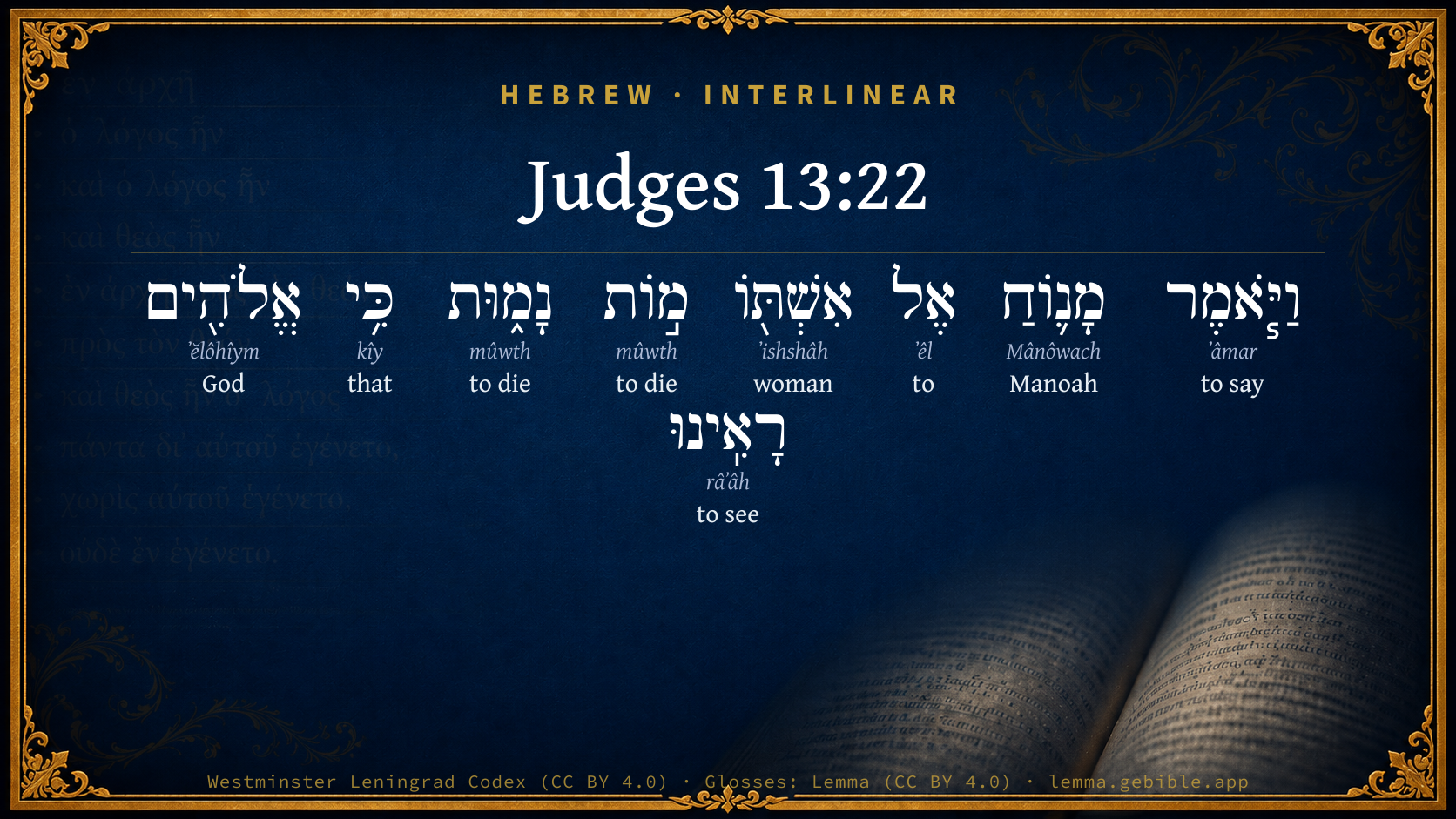
Hebrew (Westminster Leningrad Codex) Judges 13:22 appears in the Hebrew Old Testament. The text above is from the Westminster Leningrad Codex. Each word links to its Strong’s number, a concise gloss, and parsing drawn from the Open Scriptures Hebrew Bible morphology. Click any word for its full Brown-Driver-Briggs (BDB) entry.
Download image
Cite this verse

Judges 13:22 (World English Bible). Public Domain. Lemma interlinear Bible study tool, https://lemma.gebible.app/v/judges/13/22.

Show BibTeX & RIS
BibTeX
RIS
English Translation
Manoah said to his wife, We shall surely die, because we have seen God.
World English Bible · Public Domain
Download a study sheet

One document with this verse’s original text, its word-by-word gloss line, the meaning frame, cross-references with their text, attributed commentary, and full source and license credits — printable, and it pastes into notes with its structure intact.

This verse Autodidact and up

Study sheet (.html) Plain text (.txt)

A passage Seminary Student

Up to 50 verses in one chapter. A passage sheet keeps up to 6 commentary sources and 12 cross-references per verse, in the order this page ranks them, and says so on the sheet whenever that leaves anything out. Ask for a single verse and you get the Autodidact verse sheet above.

Everything on this page stays free to read, with no account — the sheet is a download of what is already on screen, not access to it.

Want to remove ads? Support Godless Engineer
Compare translations 3

The same verse in 3 English versions, stacked beneath the original-language interlinear above. Click any original word for its lexicon entry.

Each is an independent rendering of the whole verse — the interlinear is not word-aligned to these translations.

Highlighted words mark where these versions differ — a whole-verse word diff, not a word-by-word alignment.

  • World English Bible Public Domain
    Manoah said to his wife, We shall surely die, because we have seen God.
  • King James Version Public Domain
    And Manoah said unto his wife, We shall surely die, because we have seen God.
  • unfoldingWord Literal Text CC BY-SA 4.0
    And Manoah said to his wife, “Dying, we shall die, for we have seen God.”

unfoldingWord Literal Text — © unfoldingWord, licensed CC BY-SA 4.0. Word-aligned USFM3 via Door43 (git.door43.org/unfoldingWord/en_ult).

Versions to compare (up to 4)

3 of 4 selected

Show all 18 translations

Every available English version of this verse, each an independent rendering of the whole verse.

  • World English Bible Public Domain
    Manoah said to his wife, We shall surely die, because we have seen God.
  • Berean Standard Bible Public Domain
    “We are going to die,” he said to his wife, “for we have seen God!”
  • Majority Standard Bible Public Domain
    “We are going to die,” he said to his wife, “for we have seen God!”
  • King James Version Public Domain
    And Manoah said unto his wife, We shall surely die, because we have seen God.
  • American Standard Version (1901) Public Domain
    And Manoah said unto his wife, We shall surely die, because we have seen God.
  • Revised Version (1885) Public Domain
    And Manoah said unto his wife, We shall surely die, because we have seen God.
  • Geneva Bible (1599) Public Domain
    And Manoah said vnto his wife, We shall surely dye, because we haue seene God.
  • Douay-Rheims (1899) Public Domain
    And he said to his wife: We shall certainly die, because we have seen God.
  • Young's Literal Translation Public Domain
    And Manoah saith unto his wife, `We certainly die, for we have seen God.'
  • Literal Standard Version CC BY-SA 4.0
    And Manoah says to his wife, “We certainly die, for we have seen God.”
  • Unlocked Literal Bible CC BY-SA 4.0
    Manoah said to his wife, “We are sure to die, because we have seen God!”
  • unfoldingWord Literal Text CC BY-SA 4.0
    And Manoah said to his wife, “Dying, we shall die, for we have seen God.”
  • Darby Bible Public Domain
    And Mano'ah said to his wife, "We shall surely die, for we have seen God."
  • World Messianic Bible Public Domain
    Manoah said to his wife, “We shall surely die, because we have seen God.”
  • Webster's Bible Public Domain
    And Manoah said to his wife, We shall surely die, because we have seen God.
  • Free Bible Version CC BY-SA 4.0
    “We're definitely going to die,” he told his wife, “for we have seen God!”
  • Bible in Basic English Public Domain
    And Manoah said to his wife, Death will certainly be our fate, for it is a god whom we have seen.
  • JPS Tanakh (1917) Public Domain
    And Manoah said unto his wife: 'We shall surely die, because we have seen God.'

Literal Standard Version (2020), Covenant Press — licensed CC BY-SA 4.0. Text via the HelloAO Bible API (eBible.org). Unlocked Literal Bible (unfoldingWord) — licensed CC BY-SA 4.0. Text via the HelloAO Bible API (eBible.org). unfoldingWord Literal Text — © unfoldingWord, licensed CC BY-SA 4.0. Word-aligned USFM3 via Door43 (git.door43.org/unfoldingWord/en_ult). Free Bible Version, Dr. Jonathan Gallagher — licensed CC BY-SA 4.0. Text via the HelloAO Bible API (eBible.org).

Word by word

More ways to search: Search by grammar → Find every occurrence → Compare this word →

Practice this passage: Drill this verse → Learn its vocabulary →

About this verse

These counts appear in no published source. They are computed here, from the morphology-tagged text and Lemma’s own curated glosses. What Lemma adds →

9
words
8
distinct lemmas
Historical
section

Notable vocabulary

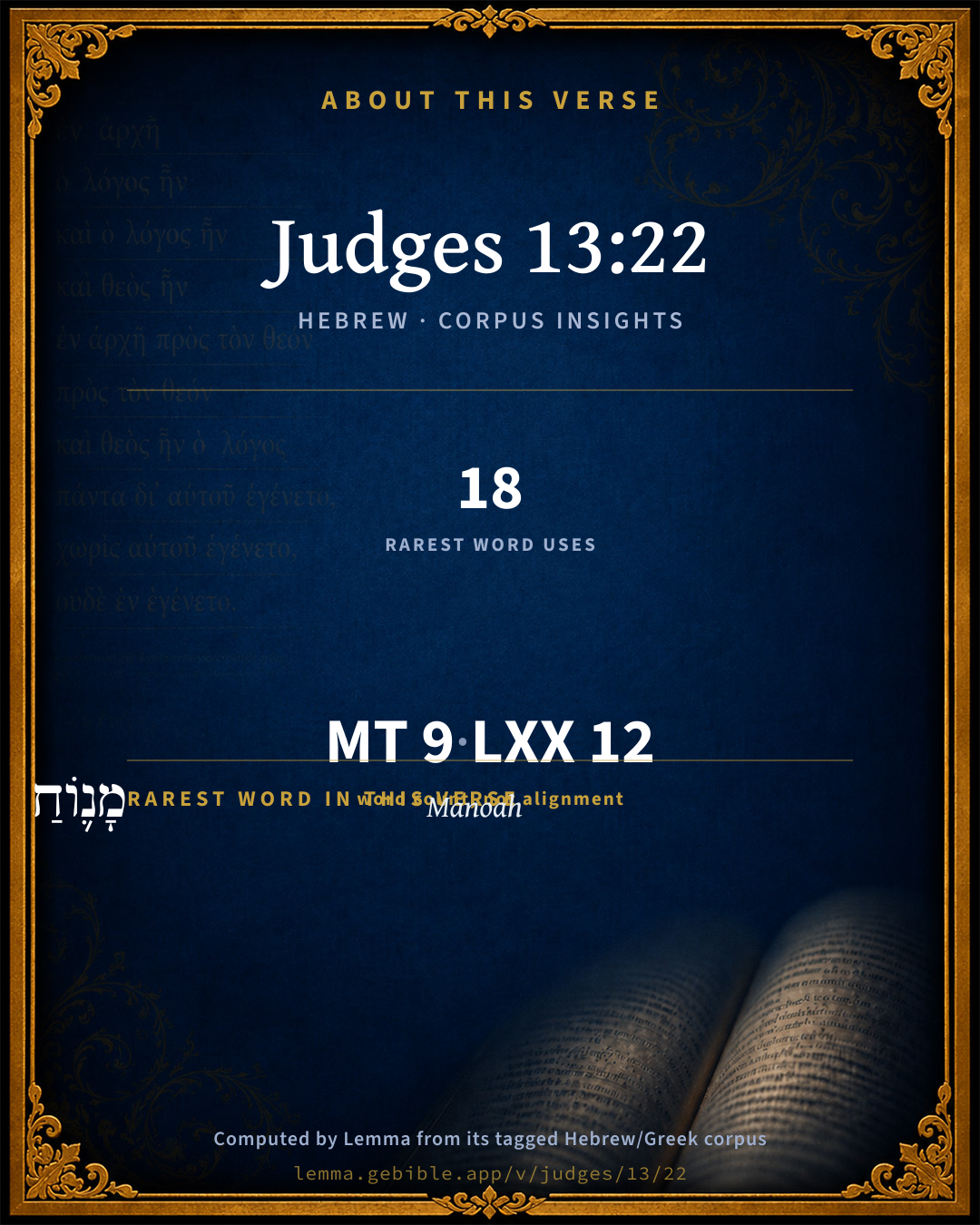
The rarest word here is מָנ֛וֹחַ Manoah H4495 — appearing just 18 times in the whole Hebrew Bible.

Shared distinctive vocabulary

מָנ֛וֹחַ Manoah H4495 occurs in 14 verses of the Hebrew Bible. Also found in:

Grammatical profile

  • 4 verbs
  • 3 nouns
  • 1 preposition
  • 1 conjunction

Verb forms

  • וַיֹּ֧אמֶר Qal · Sequential Imperfect
  • מ֣וֹת Qal · Infinitive Absolute
  • נָמ֑וּת Qal · Imperfect
  • רָאִֽינוּ Qal · Perfect

Repetition

A word recurs within this verse — often emphatic in Hebrew:

  • מ֣וֹת to die H4191 ×2

Hebrew & Septuagint length

In English translation the verse runs 14 words from the Hebrew and 15 from the Septuagint (LXX English) — closely comparable.

A rough comparison of the two English renderings, which tokenize alike — not a word-level alignment.

Word counts can differ between the Hebrew and the Greek without any difference in meaning — e.g. the Hebrew direct-object marker אֵת has no separate Greek word, and Greek often adds the article ὁ.

In the original languages it is 9 Hebrew tokens and 12 Greek tokens — but the two are counted differently (Hebrew bundles its prefixes and suffixes into one token; the Greek is in lemma form), so that isn’t a like-for-like length.

Cross-references

8

Topical passages linked to Judges 13:22 in the Treasury of Scripture Knowledge — connected by theme and wording, ordered by reader-vote popularity; previews shown in the World English Bible.

  • Genesis 32:30 Jacob called the name of the place Peniel: for, he said, "I have seen God face to face, and my life is preserved."
  • Deuteronomy 5:26 For who is there of all flesh, that has heard the voice of the living God speaking out of the midst of the fire, as we have, and lived?
  • Exodus 33:20 He said, "You cannot see my face, for man may not see me and live."
  • John 1:18 No one has seen God at any time. The one and only Son, who is in the bosom of the Father, he has declared him.
  • Isaiah 6:5 Then I said, "Woe is me! For I am undone, because I am a man of unclean lips, and I dwell in the midst of a people of unclean lips: for my eyes have seen the King, Yahweh of Hosts!"
  • John 5:37 The Father himself, who sent me, has testified about me. You have neither heard his voice at any time, nor seen his form.
  • Deuteronomy 4:38 to drive out nations from before you greater and mightier than you, to bring you in, to give you their land for an inheritance, as at this day.
  • Judges 6:22 Gideon saw that he was the angel of Yahweh; and Gideon said, Alas, Lord Yahweh! because I have seen the angel of Yahweh face to face.

Cross-references courtesy of OpenBible.info (CC BY 4.0).

Hebrew and Greek witnesses Masoretic Hebrew ↔ Greek Septuagint

The same verse in the two great witnesses to the Old Testament, shown verse-for-verse.

These are two independent witnesses, not word-aligned to each other, and the Septuagint is shown in lemma (dictionary) form.

Hebrew Judges 13:22 Masoretic · Westminster Leningrad Codex

וַיֹּ֧אמֶר מָנ֛וֹחַ אֶל אִשְׁתּ֖וֹ מ֣וֹת נָמ֑וּת כִּ֥י אֱלֹהִ֖ים רָאִֽינוּ

Manoah said to his wife, We shall surely die, because we have seen God.

World English Bible · Public Domain

Greek LXX Judges 13:22 Septuagint · lemma form

καί εἶπον μανωε πρός ὁ γυνή αὐτός θάνατος ἀποθνήσκω ὅτι θεός ὁράω

And Manoe said to his wife, We shall surely die, because we have seen God.

LXX2012 (modern English Septuagint) · Public Domain

Hebrew: Westminster Leningrad Codex (CC BY 4.0). Greek: Septuagint (public domain); English from LXX2012 (modern English Septuagint) (Public Domain). How the Septuagint differs from the Hebrew →

Targum (Aramaic paraphrase)

1

The Targum is the ancient Jewish Aramaic paraphrase of the Hebrew Scriptures — an interpretive translation, not the Hebrew text itself. Onkelos (literal) and Pseudo-Jonathan (expansive) render the Torah, and Jonathan the Prophets. Coverage is partial: where no permissively-licensed English translation exists for a verse, only the Aramaic is shown. This is verse-level text, not a word-by-word alignment to the Hebrew.

  1. Targum Jonathan Prophets (Joshua–Malachi)
    וַאֲמַר מָנוֹחַ לְאִתְּתֵיהּ מֵמַת נְמוּת אֲרֵי מַלְאָכָא דַייָ חֲזֵינָא:

    (no public-domain English translation for this verse)

    Targum Jonathan — Aramaic: “Mikraot Gedolot” (public domain). English: “Sefaria Community Translation” (CC0 1.0 (public-domain dedication)); “London "Chaldee Paraphrase," 1871” (public domain). Text via Sefaria.

Commentary

Notes on Judges 13:22 from classic Christian and Jewish commentators (each source and its license shown beneath its notes). The classic Christian expositions comment on the surrounding passage and are grouped to its opening verse, so a note may address several verses; the Jewish commentaries on the Tanakh (Rashi and others) are per-verse, so they appear only where the commentator wrote on this verse.

Lemma curates 59 commentaries, every one of them public domain or Creative Commons licensed, each selected and text-cleaned for this edition rather than reprinted as found. About our sources →

Trapp's Complete Commentary

John Trapp

Jdg 13:22 And Manoah said unto his wife, We shall surely die, because we have seen God.

Ver. 22. And Manoah said unto his wife, We shall surely die.] The most valiant Gideon said as much in effect. {Jdg 6:22} This opinion grew, as it is thought, from the misunderstanding of that text, "There shall no man see me, and live." {Exo 33:20} But albeit we cannot see God in his majesty; yet Jacob, Moses, and others have seen some simulacra vel species, whereby he hath made himself visible to them; they have seen the chariot in which God rode, but not the rider, as the Rabbis express it. {a}

{a} Merchabah, velo Rochebh.

John Trapp, A Commentary or Exposition upon All the Books of the Old and New Testament (1647–1656) — public domain. Text from a community e-Sword module.

Adam Clarke's Commentary

Verse 22. We shall surely die, because we have seen God.] See Clarke on Jud 6:22.

Adam Clarke's Commentary on the Bible (1810–1826) — public domain. Text from a community e-Sword/MySword module.

Ellicott's Commentary for English Readers

(22) We shall surely die.—See on Jdg_6:22.

We have seen God.—As seeing Him who is invisible; by seeing a manifestation of Him in human form, “Thou canst not see my face: for there shall no man see me and live” (Exo_33:20). (Comp. Gen_32:30; Deu_5:24.)

A Bible Commentary for English Readers, edited by Charles John Ellicott (1878–1897) — public domain. Text from a community e-Sword module.

The Cambridge Bible for Schools and Colleges

gen. ed. J. J. S. Perowne

22. we have seen God] lit. for elohim we have seen, i.e. a supernatural being; cf. 1Sa_28:13 and prob. Gen_32:30; God is too definite. See on Jdg_6:22.

The Cambridge Bible for Schools and Colleges (gen. ed. J. J. S. Perowne; Cambridge University Press, 1878–1918) — public domain. Text from a community e-Sword module.

John Gill's Exposition

And Manoah said unto his wife,.... Being risen from the ground, where they fell on their faces:

we shall surely die, because we have seen God; by which it appears that he not only believed him to be an angel, and not a man, but a divine Person; for though angels are sometimes called "Elohim", the word here used, yet good men were not wont to fear death, or conclude they should die on sight of an angel; but their notion was, that an appearance of God to them was death, and were surprised when it did not follow, Gen 32:30.

John Gill's Exposition of the Whole Bible (1746–1763) — public domain (CC PDM 1.0). Text via the HelloAO Bible API.

Haydock's Catholic Bible Commentary

Seen God: not in his own person, but in the person of his messenger. The Israelites, in those days imagined they should die if they saw an angel, taking occasion perhaps from those words spoken by the Lord to Moses, (Exodus xxxiii. 20.) No man shall see me and live. But the event demonstrated that it was but a groundless imagination. (Challoner) --- Elohim is applied to angels and men, as well as to God. (Calmet)

George Leo Haydock (1774–1849), Haydock's Catholic Family Bible and Commentary, 1859 edition — public domain. Excludes Psalms (Douay-Rheims chapter numbering differs from Protestant) and Deuterocanonical books (Catholic canon only).

Whedon's Commentary on the Bible

Daniel D. Whedon

22. We shall surely die — Compare note on Jdg_6:22.

Daniel D. Whedon (gen. ed.), Commentary on the Old and New Testaments (1874–1909) — public domain. Text from a community e-Sword module.

The Pulpit Commentary

We shall surely die, etc. Similarly Gideon (Jud_1:6:22, 28) expressed his alarm because he had "seen an angel of the Lord face to face," but was assured, "Thou shalt not die." And so Isaiah said, "Woe is me! for mine eyes have seen the King, the Lord of hosts". So (Isa_6:5) again the Lord said to Moses, "There shall no man see me and live". (Exo_33:20) The name of the well, Beer-lahai-roi, is also thought to mean the well of him that is alive after seeing God. (Gen_16:14) And Jacob called the name of the place where he wrestled with the angel Peniel, "for I have seen God face to face, and my life is preserved". (Gen_32:30) See too Exo_20:19. The same belief also prevailed amongst the heathen, that seeing a god without his special permission was visited by death or some grave calamity, as Callimachus, quoted by Grotius, says "The laws of Saturn thus decree, Who dares immortal gods to see Shall suffer loss, whoe"er he be.

Vers. 22, 23. Reassurance of Divine favour.

Manoah is now uncertain whether to consider himself blessed or miserable. He has the deep-rooted superstition of a fleshly age strong within him, and is alarmed. But this arises from a defective spiritual education. He does not consider sufficiently the method and the manner of God"s approaches to him.

I FEAR REGARDING GOD"S VISITATIONS IS A NATURAL FEELING. The consciousness of sin is easily roused to alarm, and the unknown is ever awe-inspiring. Our own littleness too is made the more manifest: "What is man, that thou art mindful of him? and the son of man, that thou visitest him?". (Psa_8:4)

II How IT MAY BE OVERCOME. Considering,

1. The character of God;

2. His continuous scheme of redemption;

3. The blessings he has already bestowed;

4. The voice of Christ ("Fear not"), and the witness of the Spirit ("Abba, Father").

III GOD WILL NOT LEAVE HIS CHILD IN UNCERTAINTY OF HIS MEANING. "Two are better than one." How often in life is the husband, wife, parent, child, brother, sister, or friend, close beside us, the witness of God and the spiritual help-meet! The simple soul teaches the more complex and experienced, being itself taught of God. And so: somewhere or other, he is never without a witness. M.

Vers. 22, 23. The fear of the vision of God.

The Divine vision was connected with a blessing to Manoah and his wife. The vision of God by the soul is itself the highest blessing; yet, as in the case of Manoah, it fills men with fear.

I THE CAUSE OF THE FEAR.

1. Mystery. We naturally dread the unknown. Darkness hides possibilities of danger. Superstition peoples the unseen with horrors.

2. Guilt. "Conscience makes cowards of us all. " So Adam and Eve hid themselves from God in the garden. (Gen_3:8) Because we are all sinners before God we have a natural shrinking from him

1. who knows our secret hearts,

2. against whom we have offended,

3. who is holy to hate sin and

4. just to punish it.

3. Unbelief. We do not sufficiently understand the character of God nor trust his grace. If we did, we should feel safer with all our guilt in his hands than we are when left to ourselves and to the world. Men fear God because they do not know him.

II THE REMEDIES OF THE FEAR. Manoah"s wife encourages her husband. Though men may be brave before physical danger, women sometimes show more courage in spiritual difficulties. This moral courage is nobler than the brute courage which man shares with the lower animals. It has its source in true excellences of character.

1. Self-possession. Manoah is confused and dismayed by terror beyond the power of reflection; but his wife is calm and collected, and thus able to see indications of mercy in the vision.

2. Reflection on the character of the vision. God has given to us powers of observation, discernment, reasoning. Superstitious terrors more commonly haunt the minds of those people who have neglected to use those powers, while weakly yielding to foolish emotions. Religion to be healthy must be thoughtful. God has given us sufficient indications of his character in the Bible, in Christ, in life, to deliver us from slavish fear, if only we consider and reflect on these. The more we know of God, the less shall we be afraid of him. May not the most fearful learn to reason with Manoah"s wife God had meant harm to us, would he have blessed us as he has done hitherto?" The Christian may go further, and be sure that after the great gift of his Son, God must wish well to us in all lesser things. (Rom_5:10)

3. Faith. We cannot see perfect evidence that God is blessing us in every mystery; but if we know his character we ought to trust his actions, even when they seem most alarming, as they cannot be contrary to his nature.

4. The acceptance of sacrifice. God had accepted Manoah"s sacrifice, therefore he could not regard him with disfavour. He has accepted the sacrifice of Christ, and accordingly our guilt need not make us fear God if we rely on the atonement Christ has effected. A.

The Pulpit Commentary (1880–1919), ed. H.D.M. Spence-Jones & Joseph S. Exell — public domain. Text from a community e-Sword module.

Scofield Reference Notes

C. I. Scofield

God

(See Scofield "Joh 1:18").

The Scofield Reference Bible (1917 edition), notes by C. I. Scofield — public domain. Text from a community e-Sword module.

Lesson kit

Teaching starters — assembled from the data on this page, not authored interpretation. Every prompt links to the verse data it draws on. Edit before teaching.

Judges, in the Historical, opens this verse with 9 words (8 distinct Hebrew lemmas). Its most distinctive word is Mânôwach (“Manoah”). A historical commentator’s framing appears above. Read the whole chapter for the surrounding context.

Discussion questions

  1. The word Mânôwach carries the sense “Manoah.” How does it shape the verse?
  2. Judges 13:2 shares the word «Manoah» with this verse. How do the two illuminate each other?
  3. “to die” occurs 2× in this one verse. What is the effect of the repetition?
  4. These translations render this verse differently; the difference is in the English rendering, not the original. What questions does that raise?
  5. The verb «וַיֹּ֧אמֶר» is Qal Sequential Imperfect. How does its form color the action?
  6. Reading how Trapp's Complete Commentary and Adam Clarke's Commentary read this verse, where do the two commentators agree and where do they part?

Things to notice

Reading settings

Reading text

Shown beneath each verse's original-language words.

Old Testament
Old Testament edition

Read the OT as the Masoretic Hebrew (MT) or the Greek Septuagint (LXX).

English shown for the Greek Septuagint (in the Hebrew ↔ Greek comparison).

Comparing translations? Open the Compare panel on any verse page to stack up to four side by side.