
Judges 14:2

Hebrew (Westminster Leningrad Codex) Judges 14:2 appears in the Hebrew Old Testament. The text above is from the Westminster Leningrad Codex. Each word links to its Strong’s number, a concise gloss, and parsing drawn from the Open Scriptures Hebrew Bible morphology. Click any word for its full Brown-Driver-Briggs (BDB) entry.
Download image
Cite this verse

Judges 14:2 (World English Bible). Public Domain. Lemma interlinear Bible study tool, https://lemma.gebible.app/v/judges/14/2.

Show BibTeX & RIS
BibTeX
RIS
English Translation
He came up, and told his father and his mother, and said, I have seen a woman in Timnah of the daughters of the Philistines: now therefore get her for me as wife.
World English Bible · Public Domain
Download a study sheet

One document with this verse’s original text, its word-by-word gloss line, the meaning frame, cross-references with their text, attributed commentary, and full source and license credits — printable, and it pastes into notes with its structure intact.

This verse Autodidact and up

Study sheet (.html) Plain text (.txt)

A passage Seminary Student

Up to 50 verses in one chapter. A passage sheet keeps up to 6 commentary sources and 12 cross-references per verse, in the order this page ranks them, and says so on the sheet whenever that leaves anything out. Ask for a single verse and you get the Autodidact verse sheet above.

Everything on this page stays free to read, with no account — the sheet is a download of what is already on screen, not access to it.

Want to remove ads? Support Godless Engineer
Compare translations 3

The same verse in 3 English versions, stacked beneath the original-language interlinear above. Click any original word for its lexicon entry.

Each is an independent rendering of the whole verse — the interlinear is not word-aligned to these translations.

Highlighted words mark where these versions differ — a whole-verse word diff, not a word-by-word alignment.

  • World English Bible Public Domain
    He came up, and told his father and his mother, and said, I have seen a woman in Timnah of the daughters of the Philistines: now therefore get her for me as wife.
  • King James Version Public Domain
    And he came up, and told his father and his mother, and said, I have seen a woman in Timnath of the daughters of the Philistines: now therefore get her for me to wife.
  • unfoldingWord Literal Text CC BY-SA 4.0
    And he went up and declared to his father and to his mother and said, “I saw a woman in Timnah from the daughters of the Philistines. And now, get her for me for a wife.”

unfoldingWord Literal Text — © unfoldingWord, licensed CC BY-SA 4.0. Word-aligned USFM3 via Door43 (git.door43.org/unfoldingWord/en_ult).

Versions to compare (up to 4)

3 of 4 selected

Show all 18 translations

Every available English version of this verse, each an independent rendering of the whole verse.

  • World English Bible Public Domain
    He came up, and told his father and his mother, and said, I have seen a woman in Timnah of the daughters of the Philistines: now therefore get her for me as wife.
  • Berean Standard Bible Public Domain
    So he returned and told his father and mother, “I have seen a daughter of the Philistines in Timnah. Now get her for me as a wife.”
  • Majority Standard Bible Public Domain
    So he returned and told his father and mother, “I have seen a daughter of the Philistines in Timnah. Now get her for me as a wife.”
  • King James Version Public Domain
    And he came up, and told his father and his mother, and said, I have seen a woman in Timnath of the daughters of the Philistines: now therefore get her for me to wife.
  • American Standard Version (1901) Public Domain
    And he came up, and told his father and his mother, and said, I have seen a woman in Timnah of the daughters of the Philistines: now therefore get her for me to wife.
  • Revised Version (1885) Public Domain
    And he came up, and told his father and his mother, and said, I have seen a woman in Timnah of the daughters of the Philistines: now therefore get her for me to wife.
  • Geneva Bible (1599) Public Domain
    And he came vp and told his father and his mother and saide, I haue seene a woman in Timnath of the daughters of the Philistims: now therfore giue me her to wife.
  • Douay-Rheims (1899) Public Domain
    He came up, and told his father and his mother, saying: I saw a woman in Thamnatha of the daughters of the Philistines: I beseech you, take her for me to wife.
  • Young's Literal Translation Public Domain
    and cometh up and declareth to his father, and to his mother, and saith, `A woman I have seen in Timnath, of the daughters of the Philistines; and now, take her for me for a wife.'
  • Literal Standard Version CC BY-SA 4.0
    and comes up and declares [it] to his father and to his mother, and says, “I have seen a woman in Timnath, of the daughters of the Philistines; and now, take her for me for a wife.”
  • Unlocked Literal Bible CC BY-SA 4.0
    When he returned, he told his father and mother, “I saw a woman in Timnah, one of the daughters of the Philistines. Now get her for me to be my wife.”
  • unfoldingWord Literal Text CC BY-SA 4.0
    And he went up and declared to his father and to his mother and said, “I saw a woman in Timnah from the daughters of the Philistines. And now, get her for me for a wife.”
  • Darby Bible Public Domain
    Then he came up, and told his father and mother, "I saw one of the daughters of the Philistines at Timnah; now get her for me as my wife."
  • World Messianic Bible Public Domain
    He came up, and told his father and his mother, saying, “I have seen a woman in Timnah of the daughters of the Philistines. Now therefore get her for me as my wife.”
  • Webster's Bible Public Domain
    And he came up, and told his father and his mother, and said, I have seen a woman in Timnath of the daughters of the Philistines: now therefore get her for me for a wife.
  • Free Bible Version CC BY-SA 4.0
    He went back home and told his father and mother, “A Philistine woman in Timnah caught my attention. Now get her for me because I want to marry her.”
  • Bible in Basic English Public Domain
    And when he came back he said to his father and mother, I have seen a woman in Timnah, of the daughters of the Philistines: get her now for me for my wife.
  • JPS Tanakh (1917) Public Domain
    And he came up, and told his father and his mother, and said: 'I have seen a woman in Timnah of the daughters of the Philistines; now therefore get her for me to wife.'

Literal Standard Version (2020), Covenant Press — licensed CC BY-SA 4.0. Text via the HelloAO Bible API (eBible.org). Unlocked Literal Bible (unfoldingWord) — licensed CC BY-SA 4.0. Text via the HelloAO Bible API (eBible.org). unfoldingWord Literal Text — © unfoldingWord, licensed CC BY-SA 4.0. Word-aligned USFM3 via Door43 (git.door43.org/unfoldingWord/en_ult). Free Bible Version, Dr. Jonathan Gallagher — licensed CC BY-SA 4.0. Text via the HelloAO Bible API (eBible.org).

Word by word

More ways to search: Search by grammar → Find every occurrence → Compare this word →

Practice this passage: Drill this verse → Learn its vocabulary →

בְתִמְנָ֖תָה
Timnâh
H8553
“in/at · Timnah · toward”
Preposition + Noun, Proper + Suffix, Demonstrative
Part of Speech
Preposition + Noun
Type
Proper
Full BDB Definition

Origin: from H4487

TWOT: None

Timnath or Timnah or Thimnathah = "portion" - a town on the northern boundary of Judah later assigned to Dan - a town in the hill country of Judah
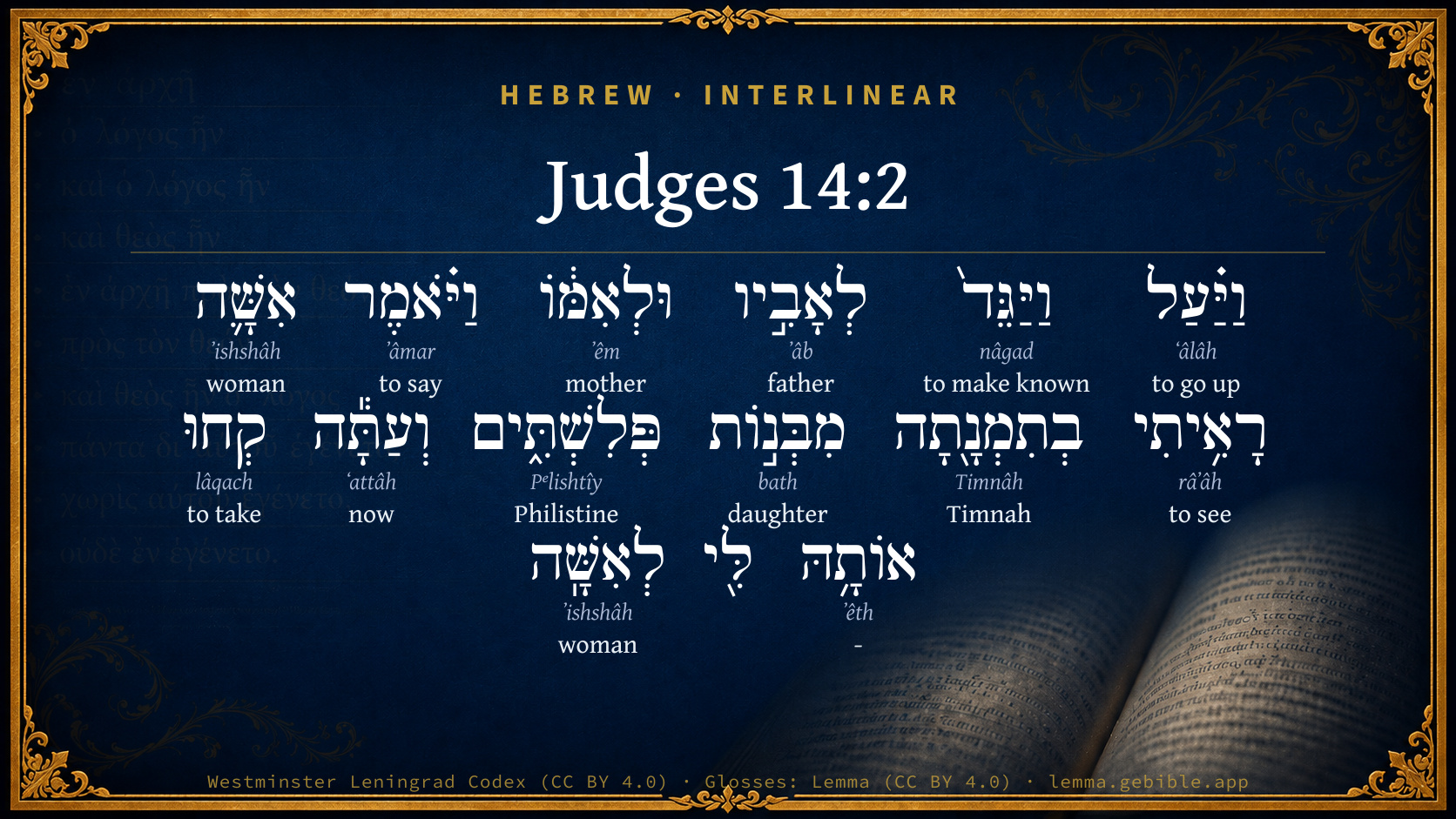
  1. וַיַּ֗עַל ʻâlâh H5927 “and · to go up” Conjunction + Verb, Qal, Sequential Imperfect, 3rd Person, Masculine, Singular
  2. וַיַּגֵּד֙ nâgad H5046 “and · to make known” Conjunction + Verb, Hiphil, Sequential Imperfect, 3rd Person, Masculine, Singular
  3. לְאָבִ֣יו ʼâb H1 “to/for · father · his” Preposition + Noun, Common, Masculine, Singular, Construct + Suffix, Personal, 3rd Person, Masculine, Singular
  4. וּלְאִמּ֔וֹ ʼêm H517 “and · to/for · mother · his” Conjunction + Preposition + Noun, Common, Feminine, Singular, Construct + Suffix, Personal, 3rd Person, Masculine, Singular
  5. וַיֹּ֗אמֶר ʼâmar H559 “and · to say” Conjunction + Verb, Qal, Sequential Imperfect, 3rd Person, Masculine, Singular
  6. אִשָּׁ֛ה ʼishshâh H802 “woman” Noun, Common, Feminine, Singular, Absolute
  7. רָאִ֥יתִי râʼâh H7200 “to see” Verb, Qal, Perfect, 1st Person, Common, Singular
  8. מִבְּנ֣וֹת bath H1323 “from · daughters of” Preposition + Noun, Common, Feminine, Plural, Construct
  9. פְּלִשְׁתִּ֑ים Pᵉlishtîy H6430 “Philistines” Noun, Gentilic, Masculine, Plural, Absolute
  10. וְעַתָּ֕ה ʻattâh H6258 “and · now” Conjunction + Adverb
  11. קְחוּ lâqach H3947 “take” Verb, Qal, Imperative, 2nd Person, Masculine, Plural
  12. אוֹתָ֥הּ ʼêth H853 “- · her” Particle, Direct Object + Suffix, Personal, 3rd Person, Feminine, Singular
  13. לְאִשָּֽׁה ʼishshâh H802 “to/for · woman” Preposition + Noun, Common, Feminine, Singular, Absolute

About this verse

These counts appear in no published source. They are computed here, from the morphology-tagged text and Lemma’s own curated glosses. What Lemma adds →

15
words
13
distinct lemmas
Historical
section

Notable vocabulary

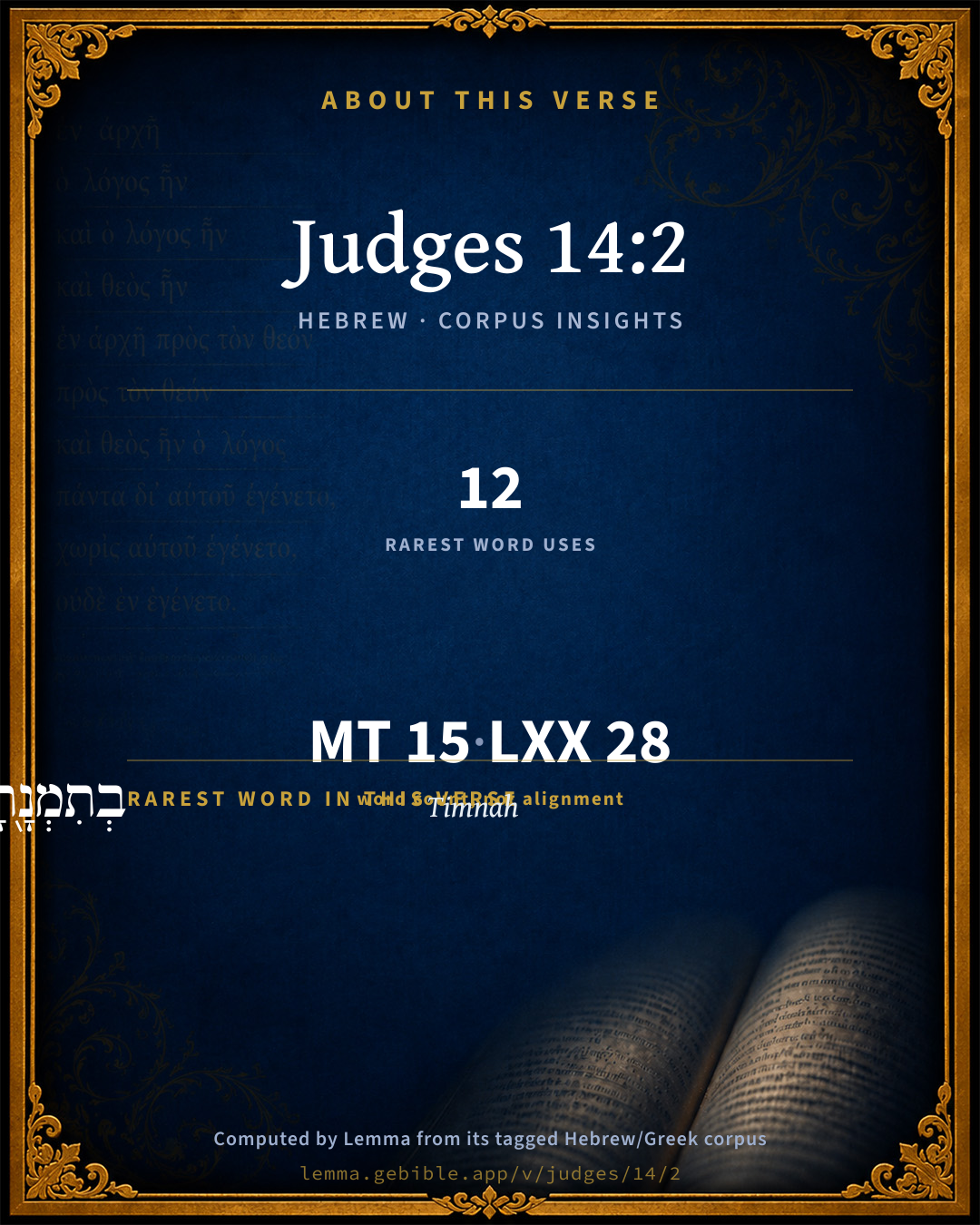
The rarest word here is בְתִמְנָ֖תָה Timnah H8553 — appearing just 12 times in the whole Hebrew Bible.

Shared distinctive vocabulary

בְתִמְנָ֖תָה Timnah H8553 occurs in 10 verses of the Hebrew Bible. Also found in:

Grammatical profile

  • 5 verbs
  • 7 nouns
  • 1 preposition
  • 1 adverb
  • 1 particle

Verb forms

  • וַיַּ֗עַל Qal · Sequential Imperfect
  • וַיַּגֵּד֙ Hiphil · Sequential Imperfect
  • וַיֹּ֗אמֶר Qal · Sequential Imperfect
  • רָאִ֥יתִי Qal · Perfect
  • קְחוּ Qal · Imperative

Repetition

A word recurs within this verse — often emphatic in Hebrew:

  • אִשָּׁ֛ה woman H802 ×2

Hebrew & Septuagint length

In English translation the verse runs 33 words from the Hebrew and 35 from the Septuagint (LXX English) — closely comparable.

A rough comparison of the two English renderings, which tokenize alike — not a word-level alignment.

Word counts can differ between the Hebrew and the Greek without any difference in meaning — e.g. the Hebrew direct-object marker אֵת has no separate Greek word, and Greek often adds the article ὁ.

In the original languages it is 15 Hebrew tokens and 28 Greek tokens — but the two are counted differently (Hebrew bundles its prefixes and suffixes into one token; the Greek is in lemma form), so that isn’t a like-for-like length.

Cross-references

5

Topical passages linked to Judges 14:2 in the Treasury of Scripture Knowledge — connected by theme and wording, ordered by reader-vote popularity; previews shown in the World English Bible.

  • Genesis 34:4 Shechem spoke to his father, Hamor, saying, "Get me this young lady as a wife."
  • Genesis 24:2–3 Abraham said to his servant, the elder of his house, who ruled over all that he had, "Please put your hand under my thigh.
  • Genesis 21:21 He lived in the wilderness of Paran. His mother took a wife for him out of the land of Egypt.
  • Genesis 38:6 Judah took a wife for Er, his firstborn, and her name was Tamar.
  • 2 Kings 14:9 Jehoash the king of Israel sent to Amaziah king of Judah, saying, The thistle that was in Lebanon sent to the cedar that was in Lebanon, saying, Give your daughter to my son as wife: and there passed by a wild animal that was in Lebanon, and trod down the thistle.

Cross-references courtesy of OpenBible.info (CC BY 4.0).

Hebrew and Greek witnesses Masoretic Hebrew ↔ Greek Septuagint

The same verse in the two great witnesses to the Old Testament, shown verse-for-verse.

These are two independent witnesses, not word-aligned to each other, and the Septuagint is shown in lemma (dictionary) form.

Hebrew Judges 14:2 Masoretic · Westminster Leningrad Codex

וַיַּ֗עַל וַיַּגֵּד֙ לְאָבִ֣יו וּלְאִמּ֔וֹ וַיֹּ֗אמֶר אִשָּׁ֛ה רָאִ֥יתִי בְתִמְנָ֖תָה מִבְּנ֣וֹת פְּלִשְׁתִּ֑ים וְעַתָּ֕ה קְחוּ אוֹתָ֥הּ לִּ֖י לְאִשָּֽׁה

He came up, and told his father and his mother, and said, I have seen a woman in Timnah of the daughters of the Philistines: now therefore get her for me as wife.

World English Bible · Public Domain

Greek LXX Judges 14:2 Septuagint · lemma form

καί ἀναβαίνω καί ἀποἀγγέλλω ὁ πατήρ αὐτός καί ὁ μήτηρ αὐτός καί εἶπον γυνή ὁράω ἐν θαμναθα ἀπό ὁ θυγάτηρ φυλιστιιμ καί νῦν λαμβάνω αὐτός ἐγώ εἰς γυνή

And he went up and told his father and his mother, and said, I have seen a woman in Thamnatha of the daughters of the Phylistines; and now take her to me for a wife.

LXX2012 (modern English Septuagint) · Public Domain

Hebrew: Westminster Leningrad Codex (CC BY 4.0). Greek: Septuagint (public domain); English from LXX2012 (modern English Septuagint) (Public Domain). How the Septuagint differs from the Hebrew →

Targum (Aramaic paraphrase)

1

The Targum is the ancient Jewish Aramaic paraphrase of the Hebrew Scriptures — an interpretive translation, not the Hebrew text itself. Onkelos (literal) and Pseudo-Jonathan (expansive) render the Torah, and Jonathan the Prophets. Coverage is partial: where no permissively-licensed English translation exists for a verse, only the Aramaic is shown. This is verse-level text, not a word-by-word alignment to the Hebrew.

  1. Targum Jonathan Prophets (Joshua–Malachi)
    וּסְלִיק וְחַוִי לַאֲבוּהִי וּלְאִמֵיהּ וַאֲמַר אִתְּתָא חֲזֵיתִי בְּתִמְנָת מִבְּנַת פְּלִשְׁתָּאֵי וּכְעַן סָבוּ יָתָהּ לִי לְאִתּוּ:

    (no public-domain English translation for this verse)

    Targum Jonathan — Aramaic: “Mikraot Gedolot” (public domain). English: “Sefaria Community Translation” (CC0 1.0 (public-domain dedication)); “London "Chaldee Paraphrase," 1871” (public domain). Text via Sefaria.

Commentary

Notes on Judges 14:2 from classic Christian and Jewish commentators (each source and its license shown beneath its notes). The classic Christian expositions comment on the surrounding passage and are grouped to its opening verse, so a note may address several verses; the Jewish commentaries on the Tanakh (Rashi and others) are per-verse, so they appear only where the commentator wrote on this verse.

Lemma curates 59 commentaries, every one of them public domain or Creative Commons licensed, each selected and text-cleaned for this edition rather than reprinted as found. About our sources →

Trapp's Complete Commentary

John Trapp

Jdg 14:2 And he came up, and told his father and his mother, and said, I have seen a woman in Timnath of the daughters of the Philistines: now therefore get her for me to wife.

Ver. 2. Now therefore get her for me to wife.] Though set upon it, and, as some gather from Jdg 14:4, warranted by God to do as he did, yet he would not take a wife without his parents’ consent. This is of the law of nature.

John Trapp, A Commentary or Exposition upon All the Books of the Old and New Testament (1647–1656) — public domain. Text from a community e-Sword module.

Geneva Bible (1599)

Geneva Bible translators

Hebrew, take her for me to wife.

Geneva Bible (1599) marginal notes — public domain. Text via Bolls.life.

Ellicott's Commentary for English Readers

(2) Get her for me to wife.—These arrangements were always left to parents, who paid the marriage dower (Gen_34:4-12). (Comp. Jdg_12:9; Neh_10:30, &c.)

A Bible Commentary for English Readers, edited by Charles John Ellicott (1878–1897) — public domain. Text from a community e-Sword module.

The Cambridge Bible for Schools and Colleges

gen. ed. J. J. S. Perowne

2. Samson at first behaves as a dutiful son, and consults both parents about his marriage. It is hardly necessary to strike out the reference to his mother.

The Cambridge Bible for Schools and Colleges (gen. ed. J. J. S. Perowne; Cambridge University Press, 1878–1918) — public domain. Text from a community e-Sword module.

John Gill's Exposition

And he came up, and told his father and his mother,.... Of his passion of love, being desirous of having their approbation and consent, in which he acted a dutiful part, and what became him; and may be an example to children to advise with their parents, and have their opinion and consent before they engage in such an enterprise, even before courtship: and said:

I have seen a woman in Timnath of the daughters of the Philistines; whom he had a good liking of, and a strong affection for; he is very open and ingenuous in his account, does not go about to hide anything from his parents, or colour things over, or conceal her descent, but frankly tells them she was a Philistine woman, which he knew would at once furnish out an objection against her:

now therefore get her for me to wife: for it seems it was the custom then, when a young man had found a woman he liked, that it was left to his parents to entreat with the woman and her friends about the marriage of her to him.

John Gill's Exposition of the Whole Bible (1746–1763) — public domain (CC PDM 1.0). Text via the HelloAO Bible API.

Albert Barnes' Notes on the Bible

Get her for me - namely, by Paying the requisite dowry (see marginal references) and gifts to relations. Hence, the frequent mention of parents taking wives for their sons Exo 34:16; Neh 10:30, because the parents of the bridegroom conducted the negotiation, and paid the dower to the parents of the bride.

Albert Barnes' Notes on the Bible (1834–1885) — public domain. Text from a community e-Sword/MySword module.

Whedon's Commentary on the Bible

Daniel D. Whedon

2. Get her for me to wife — Proposals for marriage were made by parents at the request of their sons, (Gen_34:4; Gen_34:8,) and hence must Samson’s parents go down with him to Timnath.

Daniel D. Whedon (gen. ed.), Commentary on the Old and New Testaments (1874–1909) — public domain. Text from a community e-Sword module.

The Pulpit Commentary

Get her, etc. Rather, take her. It is the technical phrase

(1) for a man taking a wife for himself, as Gen_4:19 Gen_6:2 1Sa_25:39, 1Sa_25:43, and vers. 3, 8 of this chapter;

(2) for a man"s parents taking a wife for him, as Exo_34:16 Neh_10:30. The parents of the bridegroom paid the dowry agreed upon. (see Gen_34:12 1Sa_18:25)

The Pulpit Commentary (1880–1919), ed. H.D.M. Spence-Jones & Joseph S. Exell — public domain. Text from a community e-Sword module.

John Wesley's Explanatory Notes

To wife - Herein he is an example to all children, conformable to the fifth commandment. Children ought not to marry, nor to move toward it without the advice and consent of their parents. They that do, as Bishop Hall speaks, unchild themselves. Parents have a property in their children, as parts of themselves. In marriage this property is transferred. It is therefore not only unkind and ungrateful, but palpably unjust, to alienate this property, without their concurrence. Who so thus robbeth his father or mother, stealing himself from them who is nearer and dearer to them than their goods, and yet saith, It is no transgression, the same is the companion of a destroyer, Prov. xxviii, 24.

John Wesley, Explanatory Notes Upon the Whole Bible (1754–1765) — public domain. Text via the GEBible commentary corpus.

Lesson kit

Teaching starters — assembled from the data on this page, not authored interpretation. Every prompt links to the verse data it draws on. Edit before teaching.

Judges, in the Historical, opens this verse with 15 words (13 distinct Hebrew lemmas). Its most distinctive word is Timnâh (“Timnah”). A historical commentator’s framing appears above. Read the whole chapter for the surrounding context.

Discussion questions

  1. The word Timnâh carries the sense “Timnah.” How does it shape the verse?
  2. How does Genesis 38:12, which shares the word «Timnah», read alongside this verse?
  3. What does the repetition of “woman” (2× in this one verse) do in this verse?
  4. The translations on this page render this verse differently — a whole-verse word diff, not a word-by-word alignment. What might account for the different wordings?
  5. «וַיַּ֗עַל» is a Qal Sequential Imperfect verb. How does that grammatical form shape the action described?
  6. Compare how Trapp's Complete Commentary and Geneva Bible (1599) read this verse. Where do they agree or differ?

Things to notice

Reading settings

Reading text

Shown beneath each verse's original-language words.

Old Testament
Old Testament edition

Read the OT as the Masoretic Hebrew (MT) or the Greek Septuagint (LXX).

English shown for the Greek Septuagint (in the Hebrew ↔ Greek comparison).

Comparing translations? Open the Compare panel on any verse page to stack up to four side by side.