
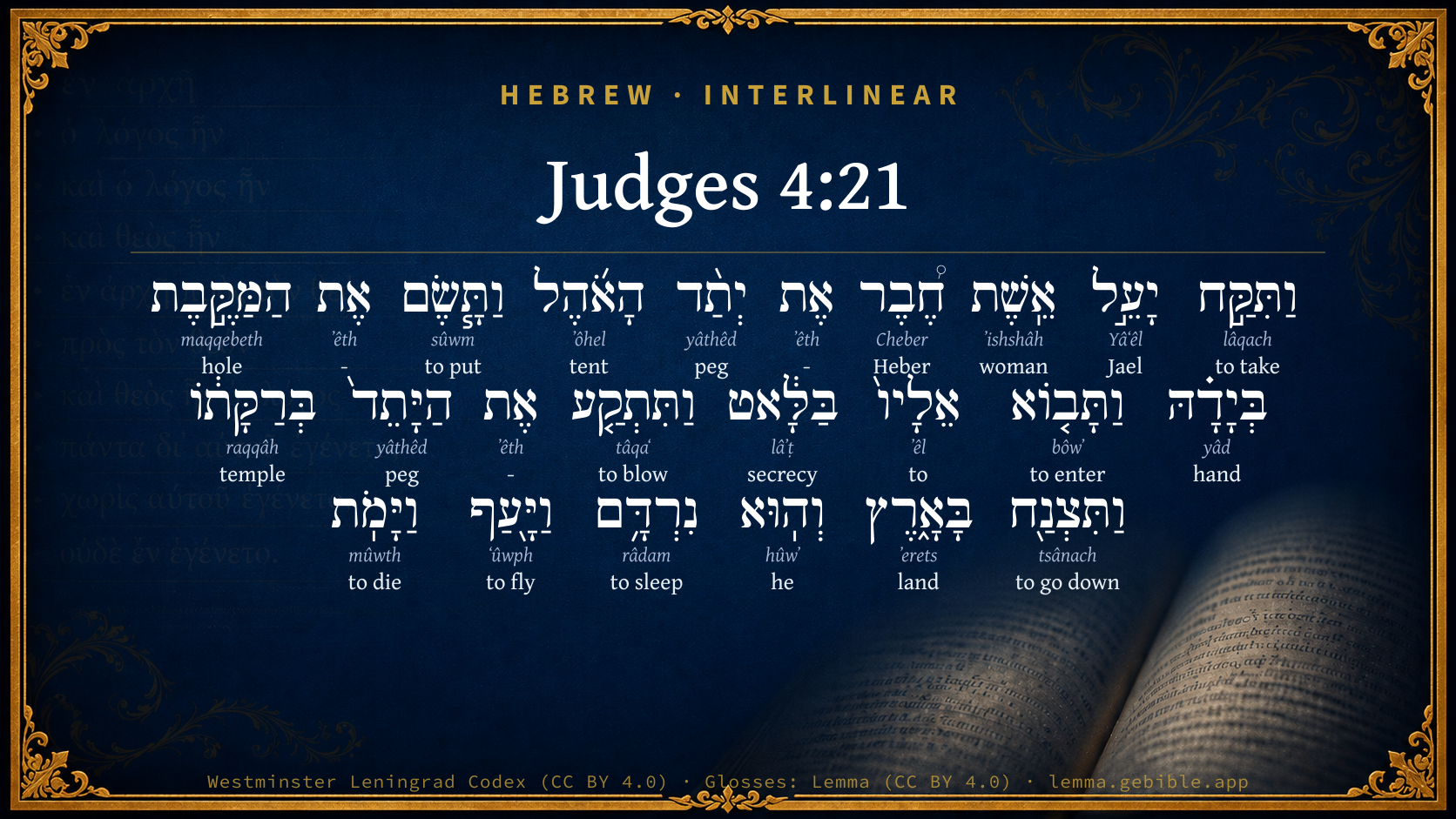
Judges 4:21

Hebrew (Westminster Leningrad Codex) Judges 4:21 appears in the Hebrew Old Testament. The text above is from the Westminster Leningrad Codex. Each word links to its Strong’s number, a concise gloss, and parsing drawn from the Open Scriptures Hebrew Bible morphology. Click any word for its full Brown-Driver-Briggs (BDB) entry.
Download image
Cite this verse

Judges 4:21 (World English Bible). Public Domain. Lemma interlinear Bible study tool, https://lemma.gebible.app/v/judges/4/21.

Show BibTeX & RIS
BibTeX
RIS
English Translation
Then Jael Heber's wife took a tent-pin, and took a hammer in her hand, and went softly to him, and struck the pin into his temples, and it pierced through into the ground; for he was in a deep sleep; so he swooned and died.
World English Bible · Public Domain
Highlights
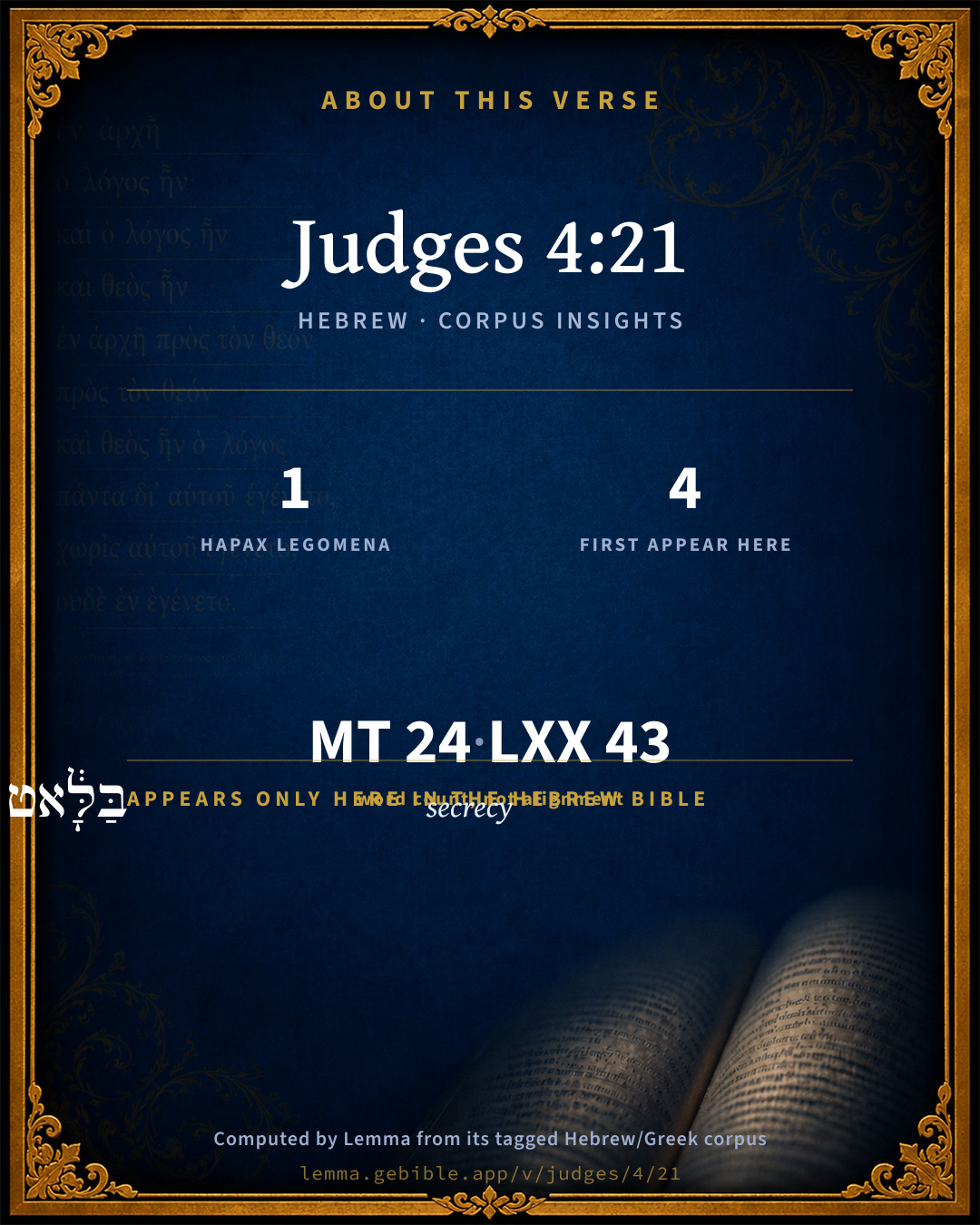
  • 1 hapax legomenon — only here in the Hebrew Bible
  • 4 first appearances in the Hebrew Bible
Full analysis ↓
Download a study sheet

One document with this verse’s original text, its word-by-word gloss line, the meaning frame, cross-references with their text, attributed commentary, and full source and license credits — printable, and it pastes into notes with its structure intact.

This verse Autodidact and up

Study sheet (.html) Plain text (.txt)

A passage Seminary Student

Up to 50 verses in one chapter. A passage sheet keeps up to 6 commentary sources and 12 cross-references per verse, in the order this page ranks them, and says so on the sheet whenever that leaves anything out. Ask for a single verse and you get the Autodidact verse sheet above.

Everything on this page stays free to read, with no account — the sheet is a download of what is already on screen, not access to it.

Want to remove ads? Support Godless Engineer
Compare translations 3

The same verse in 3 English versions, stacked beneath the original-language interlinear above. Click any original word for its lexicon entry.

Each is an independent rendering of the whole verse — the interlinear is not word-aligned to these translations.

Highlighted words mark where these versions differ — a whole-verse word diff, not a word-by-word alignment.

  • World English Bible Public Domain
    Then Jael Heber's wife took a tent-pin, and took a hammer in her hand, and went softly to him, and struck the pin into his temples, and it pierced through into the ground; for he was in a deep sleep; so he swooned and died.
  • King James Version Public Domain
    Then Jael Heber's wife took a nail of the tent, and took an hammer in her hand, and went softly unto him, and smote the nail into his temples, and fastened it into the ground: for he was fast asleep and weary. So he died.
  • unfoldingWord Literal Text CC BY-SA 4.0
    Then Jael, the wife of Heber, took a peg of the tent, and she put the hammer in her hand, and she came to him in secret, and she drove the peg into his temple and pounded into the ground, for he was sleeping deeply and was weary, and he died.

unfoldingWord Literal Text — © unfoldingWord, licensed CC BY-SA 4.0. Word-aligned USFM3 via Door43 (git.door43.org/unfoldingWord/en_ult).

Versions to compare (up to 4)

3 of 4 selected

Show all 18 translations

Every available English version of this verse, each an independent rendering of the whole verse.

  • World English Bible Public Domain
    Then Jael Heber's wife took a tent-pin, and took a hammer in her hand, and went softly to him, and struck the pin into his temples, and it pierced through into the ground; for he was in a deep sleep; so he swooned and died.
  • Berean Standard Bible Public Domain
    But as he lay sleeping from exhaustion, Heber’s wife Jael took a tent peg, grabbed a hammer, and went silently to Sisera. She drove the peg through his temple and into the ground, and he died.
  • Majority Standard Bible Public Domain
    But as he lay sleeping from exhaustion, Heber’s wife Jael took a tent peg, grabbed a hammer, and went silently to Sisera. She drove the peg through his temple and into the ground, and he died.
  • King James Version Public Domain
    Then Jael Heber's wife took a nail of the tent, and took an hammer in her hand, and went softly unto him, and smote the nail into his temples, and fastened it into the ground: for he was fast asleep and weary. So he died.
  • American Standard Version (1901) Public Domain
    Then Jael Heber's wife took a tent-pin, and took a hammer in her hand, and went softly unto him, and smote the pin into his temples, and it pierced through into the ground; for he was in a deep sleep; so he swooned and died.
  • Revised Version (1885) Public Domain
    Then Jael Heber’s wife took a tent-pin, and took an hammer in her hand, and went softly unto him, and smote the pin into his temples, and it pierced through into the ground; for he was in a deep sleep; so he swooned and died.
  • Geneva Bible (1599) Public Domain
    Then Iael Hebers wife tooke a nayle of the tent, and tooke an hammer in her hande, and went softly vnto him, and smote the nayle into his temples, and fastened it into the grounde, (for he was fast a sleepe and weary) and so he dyed.
  • Douay-Rheims (1899) Public Domain
    So Jahel Haber's wife took a nail of the tent, and taking also a hammer: and going in softly, and with silence, she put the nail upon the temples of his head, and striking it With the hammer, drove it through his brain fast into the ground: and so passing from deep sleep to death, he fainted away and died.
  • Young's Literal Translation Public Domain
    And Jael wife of Heber taketh the pin of the tent, and taketh the hammer in her hand, and goeth unto him gently, and striketh the pin into his temples, and it fasteneth in the earth -- and he hath been fast asleep, and is weary -- and he dieth.
  • Literal Standard Version CC BY-SA 4.0
    And Jael wife of Heber takes the pin of the tent, and takes the hammer in her hand, and goes to him gently, and strikes the pin into his temples, and it fastens in the earth—and he has been fast asleep, and is weary—and he dies.
  • Unlocked Literal Bible CC BY-SA 4.0
    Then Jael (the wife of Heber) took a tent peg and a hammer in her hand and went in secretly to him, for he was in a deep sleep, and she hammered the tent peg into the side of his head until it went down into the ground, and he died.
  • unfoldingWord Literal Text CC BY-SA 4.0
    Then Jael, the wife of Heber, took a peg of the tent, and she put the hammer in her hand, and she came to him in secret, and she drove the peg into his temple and pounded into the ground, for he was sleeping deeply and was weary, and he died.
  • Darby Bible Public Domain
    But Ja'el the wife of Heber took a tent peg, and took a hammer in her hand, and went softly to him and drove the peg into his temple, till it went down into the ground, as he was lying fast asleep from weariness. So he died.
  • World Messianic Bible Public Domain
    Then Jael, Heber’s wife, took a tent peg, and took a hammer in her hand, and went softly to him, and struck the pin into his temples, and it pierced through into the ground, for he was in a deep sleep; so he fainted and died.
  • Webster's Bible Public Domain
    Then Jael, Heber's wife, took a nail of the tent, and took a hammer in her hand, and went softly to him, and smote the nail into his temples, and fastened it into the ground: for he was fast asleep, and weary. So he died.
  • Free Bible Version CC BY-SA 4.0
    But Jael, Heber's wife, picked up a tent peg and a hammer and crept quietly over to him where he lay fast sleep and exhausted. She drove the tent peg through his temple and into the ground, and he died.
  • Bible in Basic English Public Domain
    Then Jael, Heber's wife, took a tent-pin and a hammer and went up to him quietly, driving the pin into his head, and it went through his head into the earth, for he was in a deep sleep from weariness; and so he came to his end.
  • JPS Tanakh (1917) Public Domain
    Then Jael Heber's wife took a tent-pin, and took a hammer in her hand, and went softly unto him, and smote the pin into his temples, and it pierced through into the ground; for he was in a deep sleep; so he swooned and died.

Literal Standard Version (2020), Covenant Press — licensed CC BY-SA 4.0. Text via the HelloAO Bible API (eBible.org). Unlocked Literal Bible (unfoldingWord) — licensed CC BY-SA 4.0. Text via the HelloAO Bible API (eBible.org). unfoldingWord Literal Text — © unfoldingWord, licensed CC BY-SA 4.0. Word-aligned USFM3 via Door43 (git.door43.org/unfoldingWord/en_ult). Free Bible Version, Dr. Jonathan Gallagher — licensed CC BY-SA 4.0. Text via the HelloAO Bible API (eBible.org).

Word by word

More ways to search: Search by grammar → Find every occurrence → Compare this word →

Practice this passage: Drill this verse → Learn its vocabulary →

בַּלָּ֔אט
lâʼṭ
H3814
“in/at the · secrecy”
Preposition, Determined + Noun, Common, Masculine, Singular, Absolute
Part of Speech
Preposition + Noun
Type
Common
Gender
Masculine
Number
Singular
State
Absolute
Full BDB Definition

Origin: from H3813 (or perhaps for act. participle of H3874 )

TWOT: 1092a

secrecy, mystery - secrecy, secretly - mystery, enchantment
  1. וַתִּקַּ֣ח lâqach H3947 “and · to take” Conjunction + Verb, Qal, Sequential Imperfect, 3rd Person, Feminine, Singular
  2. יָעֵ֣ל Yâʻêl H3278 “Jael” Noun, Proper
  3. אֵֽשֶׁת ʼishshâh H802 “woman of” Noun, Common, Feminine, Singular, Construct
  4. חֶ֠בֶר Cheber H2268 “Heber” Noun, Proper
  5. אֶת ʼêth H853 “-” Particle, Direct Object
  6. יְתַ֨ד yâthêd H3489 “peg of” Noun, Common, Feminine, Singular, Construct
  7. הָאֹ֜הֶל ʼôhel H168 “the · tent” Particle, Definite Article + Noun, Common, Masculine, Singular, Absolute
  8. וַתָּ֧שֶׂם sûwm H7760 “and · to put” Conjunction + Verb, Qal, Sequential Imperfect, 3rd Person, Feminine, Singular
  9. אֶת ʼêth H853 “-” Particle, Direct Object
  10. הַמַּקֶּ֣בֶת maqqebeth H4718 “the · hole” Particle, Definite Article + Noun, Common, Feminine, Singular, Absolute
  11. בְּיָדָ֗הּ yâd H3027 “in/at · hand · her” Preposition + Noun, Common, Both, Singular, Construct + Suffix, Personal, 3rd Person, Feminine, Singular
  12. וַתָּב֤וֹא bôwʼ H935 “and · to enter” Conjunction + Verb, Qal, Sequential Imperfect, 3rd Person, Feminine, Singular
  13. אֵלָיו֙ ʼêl H413 “to · him” Preposition + Suffix, Personal, 3rd Person, Masculine, Singular
  14. וַתִּתְקַ֤ע tâqaʻ H8628 “and · to blow” Conjunction + Verb, Qal, Sequential Imperfect, 3rd Person, Feminine, Singular
  15. אֶת ʼêth H853 “-” Particle, Direct Object
  16. הַיָּתֵד֙ yâthêd H3489 “the · peg” Particle, Definite Article + Noun, Common, Feminine, Singular, Absolute
  17. בְּרַקָּת֔וֹ raqqâh H7541 “in/at · temple · his” Preposition + Noun, Common, Feminine, Singular, Construct + Suffix, Personal, 3rd Person, Masculine, Singular
  18. וַתִּצְנַ֖ח tsânach H6795 “and · to go down” Conjunction + Verb, Qal, Sequential Imperfect, 3rd Person, Feminine, Singular
  19. בָּאָ֑רֶץ ʼerets H776 “in/at the · land” Preposition, Determined + Noun, Common, Both, Singular, Absolute
  20. וְהֽוּא hûwʼ H1931 “and · he” Conjunction + Pronoun, Personal, 3rd Person, Masculine, Singular
  21. נִרְדָּ֥ם râdam H7290 “sleeping” Verb, Niphal, Participle Active, Masculine, Singular, Absolute
  22. וַיָּ֖עַף ʻûwph H5774 “and · to fly” Conjunction + Verb, Qal, Sequential Imperfect, 3rd Person, Masculine, Singular
  23. וַיָּמֹֽת mûwth H4191 “and · to die” Conjunction + Verb, Qal, Sequential Imperfect, 3rd Person, Masculine, Singular

About this verse

These counts appear in no published source. They are computed here, from the morphology-tagged text and Lemma’s own curated glosses. What Lemma adds →

24
words
21
distinct lemmas
Historical
section

Notable vocabulary

1 hapax legomenon — a word that appears only here in the entire Hebrew Bible:

  • בַּלָּ֔אט secrecy H3814

First appearance in Scripture

These words make their first canonical appearance in the Hebrew Bible here:

  • הַמַּקֶּ֣בֶת hole H4718
  • בַּלָּ֔אט secrecy H3814
  • בְּרַקָּת֔וֹ temple H7541
  • נִרְדָּ֥ם to sleep H7290

Shared distinctive vocabulary

הַמַּקֶּ֣בֶת hole H4718 occurs in 2 verses of the Hebrew Bible. Also found in:

Grammatical profile

  • 8 verbs
  • 11 nouns
  • 1 pronoun
  • 1 preposition
  • 3 particles

Verb forms

  • וַתִּקַּ֣ח Qal · Sequential Imperfect
  • וַתָּ֧שֶׂם Qal · Sequential Imperfect
  • וַתָּב֤וֹא Qal · Sequential Imperfect
  • וַתִּתְקַ֤ע Qal · Sequential Imperfect
  • וַתִּצְנַ֖ח Qal · Sequential Imperfect
  • נִרְדָּ֥ם Niphal · Participle Active
  • וַיָּ֖עַף Qal · Sequential Imperfect
  • וַיָּמֹֽת Qal · Sequential Imperfect

Repetition

A word recurs within this verse — often emphatic in Hebrew:

  • יְתַ֨ד peg H3489 ×2

Hebrew & Septuagint length

In English translation the verse runs 45 words from the Hebrew and 50 from the Septuagint (LXX English) — closely comparable.

A rough comparison of the two English renderings, which tokenize alike — not a word-level alignment.

Word counts can differ between the Hebrew and the Greek without any difference in meaning — e.g. the Hebrew direct-object marker אֵת has no separate Greek word, and Greek often adds the article ὁ.

In the original languages it is 24 Hebrew tokens and 43 Greek tokens — but the two are counted differently (Hebrew bundles its prefixes and suffixes into one token; the Greek is in lemma form), so that isn’t a like-for-like length.

Cross-references

9

Topical passages linked to Judges 4:21 in the Treasury of Scripture Knowledge — connected by theme and wording, ordered by reader-vote popularity; previews shown in the World English Bible.

  • Judges 5:26–27 She put her hand to the tent-pin, Her right hand to the workmen's hammer; With the hammer she struck Sisera, she struck through his head; Yes, she pierced and struck through his temples.
  • Psalms 3:7 Arise, Yahweh! Save me, my God! For you have struck all of my enemies on the cheek bone. You have broken the teeth of the wicked.
  • 1 Corinthians 1:27 but God chose the foolish things of the world that he might put to shame those who are wise. God chose the weak things of the world, that he might put to shame the things that are strong;
  • Judges 3:21 Ehud put forth his left hand, and took the sword from his right thigh, and thrust it into his body:
  • Judges 3:31 After him was Shamgar the son of Anath, who struck of the Philistines six hundred men with an ox-goad: and he also saved Israel.
  • Judges 15:15 He found a fresh jawbone of a donkey, and put forth his hand, and took it, and struck a thousand men therewith.
  • 1 Samuel 17:43 The Philistine said to David, Am I a dog, that you come to me with sticks? The Philistine cursed David by his gods.
  • 1 Samuel 17:49–50 David put his hand in his bag, and took there a stone, and slang it, and struck the Philistine in his forehead; and the stone sank into his forehead, and he fell on his face to the earth.
  • 1 Corinthians 1:19 For it is written, "I will destroy the wisdom of the wise, I will bring the discernment of the discerning to nothing."

Cross-references courtesy of OpenBible.info (CC BY 4.0).

Hebrew and Greek witnesses Masoretic Hebrew ↔ Greek Septuagint

The same verse in the two great witnesses to the Old Testament, shown verse-for-verse.

These are two independent witnesses, not word-aligned to each other, and the Septuagint is shown in lemma (dictionary) form.

Hebrew Judges 4:21 Masoretic · Westminster Leningrad Codex

וַתִּקַּ֣ח יָעֵ֣ל אֵֽשֶׁת חֶ֠בֶר אֶת יְתַ֨ד הָאֹ֜הֶל וַתָּ֧שֶׂם אֶת הַמַּקֶּ֣בֶת בְּיָדָ֗הּ וַתָּב֤וֹא אֵלָיו֙ בַּלָּ֔אט וַתִּתְקַ֤ע אֶת הַיָּתֵד֙ בְּרַקָּת֔וֹ וַתִּצְנַ֖ח בָּאָ֑רֶץ וְהֽוּא נִרְדָּ֥ם וַיָּ֖עַף וַיָּמֹֽת

Then Jael Heber's wife took a tent-pin, and took a hammer in her hand, and went softly to him, and struck the pin into his temples, and it pierced through into the ground; for he was in a deep sleep; so he swooned and died.

World English Bible · Public Domain

Greek LXX Judges 4:21 Septuagint · lemma form

καί λαμβάνω ιαηλ γυνή χαβερ ὁ πάσσαλος ὁ σκηνή καί τίθημι ὁ σφῦρα ἐν ὁ χείρ αὐτός καί εἰςἔρχομαι πρός αὐτός ἐν κρυφῇ καί πήγνυμι ὁ πάσσαλος ἐν ὁ κρόταφος αὐτός καί δια ἐκἔρχομαι ἐν ὁ γῆ καί αὐτός ἐκἵστημι σκοτόω καί ἀποθνήσκω

And Jael the wife of Chaber took a pin of the tent, and took a hammer in her hand, and went secretly to him, and fastened the pin in his temple, and it went through to the earth, and he fainted away, and darkness fell upon him and he died.

LXX2012 (modern English Septuagint) · Public Domain

On this verse, Ellicott's Commentary for English Readers discusses the Septuagint’s reading. Read the note in Commentary ↓

Hebrew: Westminster Leningrad Codex (CC BY 4.0). Greek: Septuagint (public domain); English from LXX2012 (modern English Septuagint) (Public Domain). How the Septuagint differs from the Hebrew →

Targum (Aramaic paraphrase)

1

The Targum is the ancient Jewish Aramaic paraphrase of the Hebrew Scriptures — an interpretive translation, not the Hebrew text itself. Onkelos (literal) and Pseudo-Jonathan (expansive) render the Torah, and Jonathan the Prophets. Coverage is partial: where no permissively-licensed English translation exists for a verse, only the Aramaic is shown. This is verse-level text, not a word-by-word alignment to the Hebrew.

  1. Targum Jonathan Prophets (Joshua–Malachi)
    וּנְסִיבַת יָעֵל אִתַּת חֶבֶר יַת סִכַּת מַשְׁכְּנָא וְשַׁוִיאַת יַת אַרְזַפְתָּא בִּידָהּ וַעֲלַת לְוָתֵיהּ בְּרָז וּנְקִישַׁת יַת סִכְּתָא בְּצִדְעֵיהּ וּנְעָצַת בְּעַרְעָא וְהוּא דְמוּךְ וְאִשְׁתַּלְהִי וּמִית:

    (no public-domain English translation for this verse)

    Targum Jonathan — Aramaic: “Mikraot Gedolot” (public domain). English: “Sefaria Community Translation” (CC0 1.0 (public-domain dedication)); “London "Chaldee Paraphrase," 1871” (public domain). Text via Sefaria.

Commentary

Notes on Judges 4:21 from classic Christian and Jewish commentators (each source and its license shown beneath its notes). The classic Christian expositions comment on the surrounding passage and are grouped to its opening verse, so a note may address several verses; the Jewish commentaries on the Tanakh (Rashi and others) are per-verse, so they appear only where the commentator wrote on this verse.

Lemma curates 59 commentaries, every one of them public domain or Creative Commons licensed, each selected and text-cleaned for this edition rather than reprinted as found. About our sources →

Trapp's Complete Commentary

John Trapp

Jdg 4:21 Then Jael Heber’s wife took a nail of the tent, and took an hammer in her hand, and went softly unto him, and smote the nail into his temples, and fastened it into the ground: for he was fast asleep and weary. So he died.

Ver. 21. Took a nail of the tent.] Which was long and strong enough for her purpose to pierce his skull, and to fasten him to the ground.

And smote the nail into his temples.] Lo, there lay this proud worms’ meat sprawling, with his head fastened to the ground, as if it had been now listening what was become of the soul. In Eze 32:27, it is said, that such as cause terror in the land of the living, are tumbled together into hell.

For he was fast asleep and weary.] Fright, and flight, and grief, and perhaps long watching, had cast him into a deep sleep: which made way to that somnus ferreus, as the poets call death.

John Trapp, A Commentary or Exposition upon All the Books of the Old and New Testament (1647–1656) — public domain. Text from a community e-Sword module.

Joseph Benson's Commentary

Jdg 4:21-22. Then Jael took a nail of the tent — That is, one of that sort on which the cords of the tent were fastened, and which consequently were of a large size. Come, and I will show thee the man whom thou seekest — Thus both parts of Deborah’s prophecy concerning Sisera were fulfilled. He was delivered into the hand of Barak, according to the prediction, Jdg 4:7; but not alive, and therefore not to Barak’s honour, as was foretold Jdg 4:9. For, when he came into her tent, behold Sisera lay dead, and the nail was in his temples.

Joseph Benson's Commentary on the Old and New Testaments (1811–1818) — public domain. Text from a community e-Sword module.

Geneva Bible (1599)

Geneva Bible translators

That is, the pin or stake, whereby it was fastened to the ground.

Geneva Bible (1599) marginal notes — public domain. Text via Bolls.life.

Jamieson, Fausset & Brown

Robert Jamieson, A. R. Fausset & David Brown

Then Jael took a nail of the tent--most probably one of the pins with which the tent ropes are fastened to the ground. Escape was almost impossible for Sisera. But the taking of his life by the hand of Jael was murder. It was a direct violation of all the notions of honor and friendship that are usually held sacred among pastoral people, and for which it is impossible to conceive a woman in Jael's circumstances to have had any motive, except that of gaining favor with the victors. Though predicted by Deborah [Jdg 4:9], it was the result of divine foreknowledge only--not the divine appointment or sanction; and though it is praised in the song [Jdg 5:24-27], the eulogy must be considered as pronounced not on the moral character of the woman and her deed, but on the public benefits which, in the overruling providence of God, would flow from it.

Next: Judges Chapter 5

Jamieson, Fausset & Brown — Commentary Critical and Explanatory on the Whole Bible (1871) — public domain (CC PDM 1.0). Text via the HelloAO Bible API.

Adam Clarke's Commentary

Verse 21. A nail of the tent] One of the spikes by which they fasten to the ground the cords which are attached to the cloth or covering.

He was fast asleep and weary.] As he lay on one side, and was overwhelmed with sleep through the heat and fatigues of the day, the piercing of his temples must have in a moment put him past resistance.

Adam Clarke's Commentary on the Bible (1810–1826) — public domain. Text from a community e-Sword/MySword module.

Ellicott's Commentary for English Readers

(21) Then.—Many commentators have ventured to assume that at this instant Jael received a Divine intimation of what she was to do. To make such an assumption as a way of defending an act of assassination peculiarly terrible and peculiarly treacherous seems to be to the last degree unwarrantable. If any readers choose to adopt such methods for themselves they ought not to attempt the enforcement of such “private interpretations” on others. The mind which is unsophisticated by the casuistry of exegesis will find little difficulty in arriving at a fair estimate of Jael’s conduct without resorting to dangerous and arbitrary interpolations of supposition into the simple Scripture narrative.

Heber’s wife.—This addition, being needless, might be regarded as emphatic, and as involving an element of condemnation by calling prominent attention to the “peace between Jabin and the house of Heber,” which has been mentioned where last his name occurs (Jdg_4:17). It is, however, due in all probability to the very ancient and inartificial character of the narrative.

A nail of the tent.—Probably one of the great tent-pegs used to fasten down the cords which keep the tent in its place (Exo_27:19; Isa_22:23; Isa_54:2, &c). Josephus says an iron nail, but there is nothing to show whether it was of iron or of wood, and the LXX., by rendering it passalon (“a wooden plug “), seem to have understood the latter.

An hammer.—Rather, the hammer. The ponderous wooden mallet kept in every tent to beat down the cord-pegs. The word is Makkebeth, from which is derived the word Maccabee. The warrior-priests, to whom that title was given, were the “hammers” of their enemies, and Karl received the title of Martel for a similar reason.

Went softly unto him.—So as not to awake him. The description of Sisera’s murder is exceedingly graphic, but as far as the prose account of it is concerned, the silence as to any condemnation of the worst and darkest features of it by no means necessarily excludes the idea of the most complete disapproval. The method of the narrative is the same as that found in all ancient literature, and is a method wholly different from that of the moderns, which abounds in subjective reflections. Thus Homer sometimes relates an atrocity without a word of censure, and sometimes indicates disapproval by a single casual adjective.

Smote.—With more than one blow, if we take the poet’s account (Jdg_5:26) literally.

Fastened it into the ground.—Rather, it (the nail) went down into the around. The verb used is rendered “lighted off” in Jdg_1:14.

For he was fast asleep and weary.—The versions here vary considerably, but the English version seems to be perfectly correct. The verb for “he was fast asleep” is the same as in the forcible metaphor of Psa_76:6 : “The horse and chariot are cast into a deep sleep.” The description of his one spasm of agony is given in Jdg_5:27. There is no authority in the original for the gloss found in some MSS. of the LXX.: “And he was convulsed (ὰπηεσκάρισεν) between her knees, and fainted and died.” The words here used are only meant to account for his not being awakened by the approach or preparations of Jael (Kimchi), unless they involve a passing touch of pity or disapproval. Similarly it was, when Holofernes was “filled with wine,” that Judith “approached to his bed, and took hold of the hair of his head . . . and smote twice upon his neck with all her might, and she took away his head from him.” (Jdt_13:2; Jdt_13:7-8.)

A Bible Commentary for English Readers, edited by Charles John Ellicott (1878–1897) — public domain. Text from a community e-Sword module.

The Cambridge Bible for Schools and Colleges

gen. ed. J. J. S. Perowne

21. a tent-pin] a wooden peg, used for fastening the ropes, and driven in with the mallet, both of them instruments which Bedouin women are accustomed to use.

and it pierced through] and it descended; the verb only again in Jdg_1:14, Jos_15:18, where it means alight, descend from.

for he was in a deep sleep; so he swooned and died] The word for swooned is uncertain. With a slight change, but following the Hebr. accents, AV. reads ‘for he was in a deep sleep and weary; so he died.’ This makes smoother grammar. In Jdg_5:26-27 Jael murders Sisera while he is standing and drinking out of the bowl. Some have explained the different account given here as due to a misunderstanding of the parallelism of Jdg_5:26, as though peg and hammer meant two different implements, seized, the one by her hand, the other by her right hand. But it is more probable that the whole account of Jael’s action in ch. 4 is founded on a slightly different tradition, which made Jael murder Sisera in his sleep.

The Cambridge Bible for Schools and Colleges (gen. ed. J. J. S. Perowne; Cambridge University Press, 1878–1918) — public domain. Text from a community e-Sword module.

John Gill's Exposition

Then Jael, Heber's wife, took a nail of the tent,.... When she perceived he was fast asleep, and it being now put into her heart to kill him, having an impulse upon her spirit, which she was persuaded, by the effect it had upon her, that it was of God; not filling her with malice and revenge, but a concern for the glory of God, the interest of religion, and the good of Israel, she took this method to effect the death of this enemy of God, and his people; having no arms in the house, for the Kenites used none, she took up an iron pin, with which her tent was fastened to the ground:

and took a hammer in her hand; which perhaps she knew full well how to handle, being used to drive the pins of the tents into the ground with it:

and went softly unto him; lest she should awake him

and smote the nail into his temples: as he lay on one side, these being the tenderest part of the head, from whence they have their name in the Hebrew language, and into which therefore a nail, or iron pin, might be more easily driven:

and fastened it into the ground; she smote the nail with such force and violence, that she drove it through both his temples into the ground on which he lay; and then, as it seems, from Jdg 5:26; cut off his head, to make sure work of it:

for he was fast asleep and weary; and so heard not; when she came to him:

so he died; not in the field of battle, but in a tent; not by the sword, but by a nail; not by the hand of a man, but of a woman, as Deborah foretold, Jdg 4:9.

John Gill's Exposition of the Whole Bible (1746–1763) — public domain (CC PDM 1.0). Text via the HelloAO Bible API.

Albert Barnes' Notes on the Bible

If we can overlook the treachery and violence which belonged to the morals of the age and country, and bear in mind Jael’s ardent sympathies with the oppressed people of God, her faith in the right of Israel to possess the land in which they were now slaves, her zeal for the glory of Yahweh as against the gods of Canaan, and the heroic courage and firmness with which she executed her deadly purpose, we shall be ready to yield to her the praise which is her due. See Jdg 3:30 note.

Albert Barnes' Notes on the Bible (1834–1885) — public domain. Text from a community e-Sword/MySword module.

Haydock's Catholic Bible Commentary

Tent. Such nails were used to fasten down the skins, of which the tent was composed. (Calmet) --- This resembled a stake, though Josephus says it was made of iron. (Menochius) --- And died. Thus he met a more ignoble fate, which would be more hateful to a warrior. Abimelech ordered his armour-bearer to kill him, that it might not be said that he had fallen by the hand of a woman, chap. ix. 54. Extreme fatigue, and the will of Providence, caused Sisara to fall asleep so soon. How many, like him, like down in health, and rise no more! (Haydock)

George Leo Haydock (1774–1849), Haydock's Catholic Family Bible and Commentary, 1859 edition — public domain. Excludes Psalms (Douay-Rheims chapter numbering differs from Protestant) and Deuterocanonical books (Catholic canon only).

Matthew Poole's English Annotations

A nail of the tent; wherewith they used to fasten the tent, which consequently was long and sharp, being headed with iron: these weapons she chooseth, either,

1. Because she had no better weapons at hand, this being only the woman’s tent, where arms use not to be kept, and these people being wholly given to peace, and negligent of war, or Sisera having disarmed them before this time. Or,

2. Because she had more skill in the handling these than other weapons, being probably accustomed to fasten the tents herewith. Or,

3. Because this was very proper for his present posture, and which she knew would be effectual.

Into his temples; which is the softest part of the skull, and soonest pierced. This might seem a very bold attempt; but it must be considered that she was encouraged to it, partly, by observing that the heavens and all the elements conspired against him, as against one devoted to destruction; partly, by the fair opportunity which God’s providence put into her hands; and principally, by the secret instinct of God inciting her to it, and assuring her of success in it.

Quest. What shall we judge of this act of Jael’s? It is a difficult question, and necessary to be determined, because on the one hand there seems to be gross perfidiousness, and a horrid violation of all the laws of hospitality and friendship, and of the peace which was established between Sisera and her; and on the other side, this fact of hers is applauded and commended in Deborah’s song, Jdg 5:24, &c. And some who make it their business to pick quarrels with the Holy Scriptures, from hence take occasion to question and reject their Divine authority for this very passage, because it commends an act so contrary to all humanity, and so great a breach of faith. And whereas all the pretence of their infidelity is taken from the following song, and not from this history, wherein the fact is barely related, without any reflection upon it, there are many answers given to that argument; as,

1. That there was no league of friendship between Jael and Sisera, but only a cessation of acts of hostility; of which See Poole "Jdg 4:17".

2. That Deborah doth not commend Jael’s words, Jdg 4:18, Turn in, my lord; fear not; in which the great strength of this objection lies; but only her action, and that artifice, that he asked water, and she gave him milk; which, if impartially examined, will be found to differ but little from that of warlike stratagems, wherein a man lays a snare for his enemy, and deceives him with pretenses of doing something which he never intends. And Sisera, though for the time he pretended to be a friend, yet was in truth a bitter and implacable enemy unto God, and all his people, and consequently to Jael herself. But these and other answers may be omitted, and this one consideration following may abundantly suffice to stop the mouths of these men. It cannot be denied that every word, or passage, or discourse which is recorded in Scripture is not divinely inspired, because some of them were uttered by the devil, and others by holy men of God, but mistaken, (the prophets themselves not always speaking by inspiration,) such as the discourse of Nathan to David, 2Sa 7:3, which God presently contradicted, 2Sa 7:4,5, &c., and several discourses of Job’s three friends, which were so far from being divinely inspired, that they were in a great degree unsound, as God himself tells them, Job 42:7,

Ye have not spoken of me the thing that is right, as my servant Job hath. This being so, the worst that any malicious mind can infer from this place is, That this song, though indited by a good man or woman, was not divinely inspired, but only composed by a person piously-minded, and transported with joy for the deliverance of God’s people, but subject to mistake; who therefore, out of zeal to commend the happy instrument of so great a deliverance, might easily overlook the indirectness of the means by which it was accomplished, and commend that which should have been disliked. And if they further object, that it was composed by a prophetess, Deborah, and therefore must be divinely inspired; it may be replied,

1. That it is not certain what kind of prophetess Deborah was, whether extraordinary and infallible, or ordinary, and so liable to mistakes; for there were prophets of both kinds, as hath been proved above, on Jdg 4:4.

2. That every expression of a true and extraordinary prophet was not divinely inspired, as is evident from Nathan’s mistake above mentioned, and from Samuel’s mistake concerning Eliab, whom he thought to be the Lord’s anointed, 1Sa 16:6.

Matthew Poole's English Annotations on the Holy Bible (1683–1685) — public domain. Text from a community e-Sword/MySword module.

Whedon's Commentary on the Bible

Daniel D. Whedon

21. A nail of the tent — Or, a tent-pin, sometimes made of iron, but commonly of wood, to which, when driven into the ground, the ropes of a tent are fastened. “The nail which Jael used was a tent-pin, now, as then, called wated, and the hammer was the mallet with which it is driven into the ground. It is not necessary to suppose that either of them were of iron. The wated was probably a sharp-pointed pin of hard wood, and the hammer was the ordinary mallet used by these tent-dwelling Arabs.” — Thomson.

Smote the nail into his temples — Stanley thus pictures this scene: “Her attitude, her weapon, her deed, are described both in the historic and poetic account of the event, as if fixed in the national mind. She stands like the personification of the figure of speech so famous in the names of Judas the Maccabee, (the Hebrew word for hammer is maccab,) and Charles Martel — the Hammer of her country’s enemies. Step by step we see her advance: first, the dead silence with which she approaches the sleeper, slumbering with the weariness of one who has run far and fast; then the successive blows with which she hammers, crushes, beats, and pierces through and through the forehead of the upturned face, till the point of the nail reaches the very ground on which the slumberer is stretched; and then comes the one startling bound, the contortion of agony with which the expiring man rolls over from the low divan, and lies weltering in blood between her feet as she strides over the lifeless corpse.”

Fastened it into the ground — Rather, it went down into the ground; the tent pin passed through his head so as to reach to the very earth beneath him.

For he was fast asleep and weary — This statement is parenthetical, showing how it was practicable for Jael to dispatch Sisera in the way she did. Compare the poetical description in Jdg_5:26-27.

Daniel D. Whedon (gen. ed.), Commentary on the Old and New Testaments (1874–1909) — public domain. Text from a community e-Sword module.

The Pulpit Commentary

Then Jael, etc. Sisera, having taken every precaution, had lain him down to rest; not, like David, trusting to the Lord to make him dwell in safety, but confiding in Jael"s friendship and his own crafty directions. But no sooner had he fallen into a deep sleep, than the crafty and courageous woman, into whose hands Sisera was to be sold, took a tent pin and the heavy hammer with which they drove the pin into the ground, and with a desperate blow forced it through his temples, and pinned him to the ground. Without a struggle, he swooned and died. Instead of and fastened it into the ground, it is better to translate, that it (the pin) came down to the ground. It is the same word as is translated lighted Exo_15:1, Exo_15:21) It is a song of wonderful beauty and lyric power, somewhat difficult, as all Hebrew poetry is.

This splendid ode, so full of poetic fire and vivid dramatic effect, with its startling contrasts, its picturesque descriptions, its glowing eulogiums, its burning patriotism, its striking characters thrown into high relief by the stroke or two of genius, its passion and its pathos, is not deficient in ethos. We will single out two or three ethical lessons from their surroundings.

I SELF-SACRIFICE FOR THE GOOD OF OTHERS. The ninth verse is an awakening call to voluntary sacrifice on the altar of the public good. While men in general are hanging back from exertion and danger in sloth or timidity, unwilling to run any risk, or to make any effort, there are those who, with high-minded zeal for their country"s or their Church"s weal, burst asunder the restraining bonds of selfishness, and, with their life in their hands, offer themselves willingly for the common cause. Deborah"s burst of generous admiration toward those who did so in her time is a stirring call to us to imitate their example. But let us not imagine that such self sacrifice is confined to extraordinary occasions: or can be executed only on the platform of great emergencies. Unselfish efforts for the good of others find room for their exercise in the common round of every-day life. He who works when he is weary, who overcomes his natural shyness or timidity, who lays aside his own schemes or tastes and takes up work which is distasteful to him, who risks losses in money, in consideration, in convenience, in comfort, in ease, in leisure, that he may do something which he believes will be useful to others, is treading in the steps of these "willing governors," and deserves like them the warm approval of all generous hearts.

II WORLDLY HINDRANCES. But we may see in the examples of Reuben and Gad what are the hindrances to such self-sacrificing work. There is a counter-call to the call of duty and of love, and that call is too a louder and a more persuasive one the call of gain and worldly interest. When Deborah"s message came to the Reubenites and Gileadites, and the blast of Barak"s trumpet sounded in their ears, calling them to the help of the Lord against the mighty, the bleatings of their flocks and the lowing of their herds among the rich pastures of Jazer and Gilead seemed to tell them a different tale. (see Nu 32) How could they leave those peaceful pastures, and exchange them for the battle-field? Jabin"s iron chariots were nothing to them. What would become of their flocks and herds while they were far away? As their eyes ran through the sheep-folds, and they reckoned up in thought the wealth which they contained; as they thought of the lambing, and the sheep. shearing, and the sheep-market, and told the increase which they might expect, they seemed tied to those sheep-folds by bonds which could not be broken, and by a spell which could not be loosed. After a few doubts and hesitations they abode among the folds, and left their brothers across the Jordan to fight by themselves. And so it was with Dan and Asher. The movements of Sisera had not interfered with the trade of Joppa, or the fishing-boats of the sea-coast. The ships of Tarshish were coming and going as of old, laden with merchandise from all parts of the world; some touching there on their way to Tyre, others supplying the markets of Palestine with wrought iron, and cassia, and sweet-calamus. Already perhaps the silver and iron, the tin and the lead, brought by the ships of Tarshish from the Cassiterides, found their way to the fairs of Joppa; and the wheat of Minnith, and the oil and honey and pastry (Hebrew, pannag) of Judah, went out through its harbour to Tyre. (Eze_27:12, Eze_27:17, Eze_27:19) And the men of Dan were all busy by that sea-side. Lading and unlading the ships, carrying the bales of merchandise on their strong backs, giving and receiving orders, piloting the foreign ships into harbour, plying to and fro as they handled the oar, stopping the leaks or mending the sails of ships that had come out of rough waters there was no end of business to be done, and of money to be made. Why leave these peaceful gains and rush inland to perish by the sword? Surely they might be excused if they remained in ships, and continued on the sea-shore, enriching their country by their industry, while they left it to others to jeopard their lives in the high places of the field. And they did so; and in doing so have left us an instructive warning as to the hindrances which the world continually places in the way of high-minded action and generous self-sacrifice. "Love not the world, neither the things that are in the world," if you would be free to serve either God or man, is the precept that settles upon the thoughts as we consider the gaps in the muster-roll of Israel at the battle by the waters of Megiddo.

III THE ENMITY OF NEUTRALITY. But ver. 23 reads us a yet sterner lesson. There are occasions when not to act for God is to act against God. There are occasions when a man cannot be neutral. When the Lord calls for help against the mighty, he that withholds that help is cursed. By so doing he is helping the enemies of God, and among the enemies of God he will fall. Here was Meroz in the very thick of the fight. Ephraim and Benjamin, Issachar and Manasseh, Zebulun and Naphtali, were pouring out their thousands to defend their altars and their homes. The honour of God, the freedom of God"s people, the cause of truth against heathen error, the kingdom of God against the tyranny of Satan, were trembling in the balance. A few hundreds more or less might turn the scale. All Israel was awake and alive to the noble task before them. There was music in the tramp of the thousands of devoted men marching to the war which might have aroused the dullest soul and kindled the faintest spirit. It did not move the men of Meroz; they hung back in sullen indifference; they skulked behind their walls. No zeal for the glory of God, no sympathy with their brethren, could pierce through their heartless selfishness. As the angel of the Lord looked out from the windows of heaven, he saw their cowardice, he marked their back-drawing, he pronounced them cursed. There are times, our own times are such, when the enemies of the cross of Christ are unusually active against the truth. At such times Satan musters all his forces and would fain overthrow the Church of God. Infidelity stalks through the land. The leaders of sceptical opinion join hand in hand. Science and literature, wit and intellect, the press and the platform, fashion and numbers, are pressed into the service, to cast discredit upon the everlasting gospel of the grace of God. At such a time to be neutral and indifferent is to be a traitor to the Lord Jesus Christ. At such a time he calls to his help against the mighty all who believe in him, who love him, and who hope in his salvation, "Who is on the Lord"s side, who?" is his appeal to his redeemed. Let no believer hold back from giving what help is in his power: the help of word and deed; the help of bold confession and of unflinching countenance; the help of tongue and pen; the help, if need be, of suffering and of martyrdom; the help of a devoted life, and of a holy Christian walk, in all humility, and purity, and faith, knowing whom he has believed, and fully assured that faith will be crowned with victory.

IV THE END OF THE UNGODLY (ver. 31). All the enemies of the Lord will surely perish. The day is not far off which will mark the difference between the righteous and the wicked, between him that serveth God and him that serveth him not. The Lord Jesus shall be revealed from heaven with his mighty angels, in flaming fire taking vengeance on them that know not God, and that obey not the gospel of our Lord Jesus Christ; and then they that love him shall be as the sun when he goeth forth in his might. The righteous will shine forth as the sun in the kingdom of their Father, and they who confessed Christ before men will be confessed of him before the angels of God. Such are the fuller prophecies of the New Testament, confirming the obscurer prophecies of the Old, and encouraging us to hold on our faith without wavering, in the certainty of the great reward.

The Pulpit Commentary (1880–1919), ed. H.D.M. Spence-Jones & Joseph S. Exell — public domain. Text from a community e-Sword module.

John Wesley's Explanatory Notes

A nail of the tent - Wherewith they used to fasten the tent, which consequently was long and sharp. This might seem a very bold attempt, but it must be considered, that she was encouraged to it, by observing that the heavens and all the elements conspired against him, as one devoted to destruction. In the following son, Deborah doth not commend Jael's words, ver. 18. Turn in my Lord, fear not; but only her action: touching which, this one consideration may abundantly suffice to stop the mouths of objectors. It cannot be denied, that every discourse which is recorded in scripture, is not divinely inspired, because some of them were uttered by the devil, and others by holy men, but mistaken. This being so, the worst that any can infer from this place is, that this song, tho' indited by a good woman, was not divinely inspired, but only composed by a person transported with joy for the deliverance of God's people, but subject to mistake; who therefore, out of zeal to commend the instrument of so great a deliverance, might overlook the indirectness of the means, and commend that which should have been disliked, And if they farther object, that it was composed by a prophetess, and therefore must be divinely inspired; it may be replied, that every expression of a true prophet was not divinely inspired; as is evident from Samuel's mistake concerning Eliab, whom he thought to be the Lord's anointed, 1 Sam. xvi, 6. This is said upon supposition that Jael acted deceitfully in this affair; but if we suppose, which is much more likely, that Jael fully intended to afford Sisera the shelter and protection which he sought of her, but was afterwards by the immediate direction of heaven ordered to kill him, the whole difficulty vanishes, and the character both of Jael and of Deborah remains unimpeached.

John Wesley, Explanatory Notes Upon the Whole Bible (1754–1765) — public domain. Text via the GEBible commentary corpus.

unfoldingWord translationNotes

Door43 World Missions Community

tent peg

a pointed piece of wood or metal, like a large nail, that is hammered into the ground to hold down a corner of a tent

hammer

a heavy tool made of wood used to hit a tent peg into the ground

a deep sleep

Like a person in a deep hole cannot easily climb out, a person in a deep sleep cannot easily wake up. (See: Metaphor)

Barak was pursuing

"Barak was chasing" or "Barak was following after"

translationWords

tent

asleep

die

unfoldingWord translationNotes — © Distant Shores Media and the Door43 World Missions Community, licensed CC BY-SA 4.0. Source: git.door43.org/Door43/en_tn.

Rashi

Rabbi Shlomo Yitzchaki (Rashi)

A tent peg. "Chevilles" in old French. This is embedded in the ground with the lower flap of the tent in order to extend it fully.

A hammer. Hammer, "martel" in old French.

Furtively. Stealthily, in secret.

And impaled it into the ground.וּנְעַצַתְּ בְּאַרְעָא, and impaled it into the ground.

Rashi on the Tanakh — English translations: “The Judaica Press complete Tanach with Rashi, translated by A. J. Rosenberg” (CC BY 4.0); “Pentateuch with Rashi's commentary by M. Rosenbaum and A.M. Silbermann, 1929-1934” (public domain); “The Metsudah Tanach series, Lakewood, N.J” (CC BY 4.0); and “The Book of Joshua, Metsudah Publications, 1997” (CC BY 4.0). Text via Sefaria.

Lesson kit

Teaching starters — assembled from the data on this page, not authored interpretation. Every prompt links to the verse data it draws on. Edit before teaching.

Judges, in the Historical, opens this verse with 24 words (21 distinct Hebrew lemmas). Its most distinctive word is lâʼṭ (“secrecy”). A historical commentator’s framing appears above. Read the whole chapter for the surrounding context.

Discussion questions

  1. What does “secrecy” (lâʼṭ) contribute to the verse as a whole?
  2. 1 word here appears nowhere else in the Hebrew Bible. Why might the author reach for such rare wording?
  3. 4 words make their first appearance in Scripture here. What does this debut establish?
  4. How does Isaiah 51:1, which shares the word «hole», read alongside this verse?
  5. What does the repetition of “peg” (2× in this one verse) do in this verse?
  6. These translations render this verse differently. What is at stake in choosing one wording over another?
  7. «וַתִּקַּ֣ח» is a Qal Sequential Imperfect verb. How does that grammatical form shape the action described?
  8. Compare how Trapp's Complete Commentary and Joseph Benson's Commentary read this verse. Where do they agree or differ?

Things to notice

  • 1 word in this verse appears nowhere else in the Hebrew Bible.
  • 4 words make their first canonical appearance in Scripture here.
  • This verse counts 24 Hebrew ↔ 43 Greek words.
  • These translations choose different wording for 29 words in this verse.
  • “peg” occurs 2× in this single verse.

Reading settings

Reading text

Shown beneath each verse's original-language words.

Old Testament
Old Testament edition

Read the OT as the Masoretic Hebrew (MT) or the Greek Septuagint (LXX).

English shown for the Greek Septuagint (in the Hebrew ↔ Greek comparison).

Comparing translations? Open the Compare panel on any verse page to stack up to four side by side.