Judges 21:11

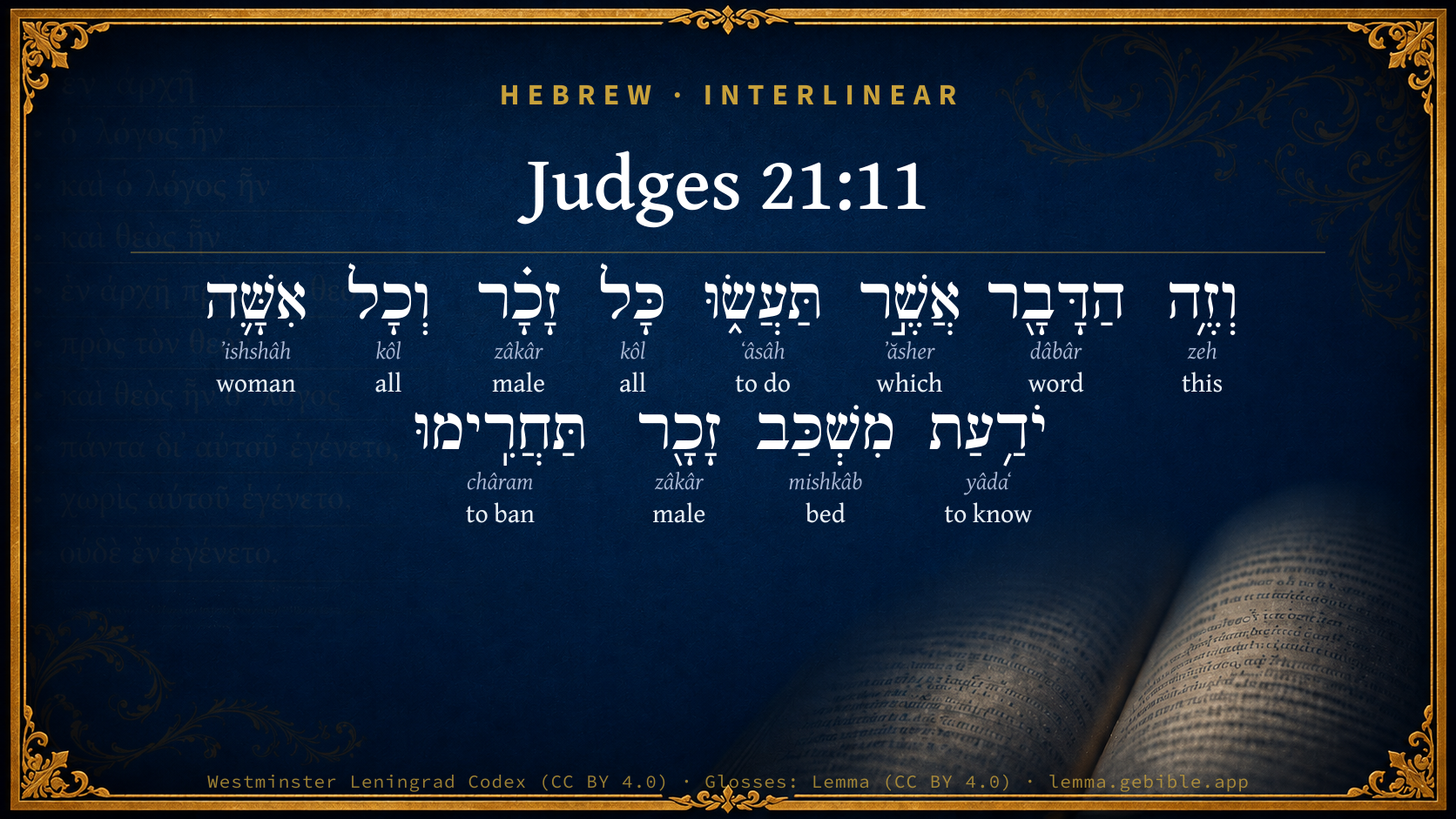
Hebrew (Westminster Leningrad Codex) Judges 21:11 appears in the Hebrew Old Testament. The text above is from the Westminster Leningrad Codex. Each word links to its Strong’s number, a concise gloss, and parsing drawn from the Open Scriptures Hebrew Bible morphology. Click any word for its full Brown-Driver-Briggs (BDB) entry.
Download image
Cite this verse

Judges 21:11 (World English Bible). Public Domain. Lemma interlinear Bible study tool, https://lemma.gebible.app/v/judges/21/11.

Show BibTeX & RIS
BibTeX
RIS
English Translation
This is the thing that you shall do: you shall utterly destroy every male, and every woman who has lain by man.
World English Bible · Public Domain
Download a study sheet

One document with this verse’s original text, its word-by-word gloss line, the meaning frame, cross-references with their text, attributed commentary, and full source and license credits — printable, and it pastes into notes with its structure intact.

This verse Autodidact and up

Study sheet (.html) Plain text (.txt)

A passage Seminary Student

Up to 50 verses in one chapter. A passage sheet keeps up to 6 commentary sources and 12 cross-references per verse, in the order this page ranks them, and says so on the sheet whenever that leaves anything out. Ask for a single verse and you get the Autodidact verse sheet above.

Everything on this page stays free to read, with no account — the sheet is a download of what is already on screen, not access to it.

Want to remove ads? Support Godless Engineer
Compare translations 3

The same verse in 3 English versions, stacked beneath the original-language interlinear above. Click any original word for its lexicon entry.

Each is an independent rendering of the whole verse — the interlinear is not word-aligned to these translations.

Highlighted words mark where these versions differ — a whole-verse word diff, not a word-by-word alignment.

  • World English Bible Public Domain
    This is the thing that you shall do: you shall utterly destroy every male, and every woman who has lain by man.
  • King James Version Public Domain
    And this is the thing that ye shall do, Ye shall utterly destroy every male, and every woman that hath lain by man.
  • unfoldingWord Literal Text CC BY-SA 4.0
    And this the thing that you shall do: every male and every woman having known the lying of a male, you shall devote.”

unfoldingWord Literal Text — © unfoldingWord, licensed CC BY-SA 4.0. Word-aligned USFM3 via Door43 (git.door43.org/unfoldingWord/en_ult).

Versions to compare (up to 4)

3 of 4 selected

Show all 18 translations

Every available English version of this verse, each an independent rendering of the whole verse.

  • World English Bible Public Domain
    This is the thing that you shall do: you shall utterly destroy every male, and every woman who has lain by man.
  • Berean Standard Bible Public Domain
    This is what you are to do: Devote to destruction every male, as well as every female who has had relations with a man.”
  • Majority Standard Bible Public Domain
    This is what you are to do: Devote to destruction every male, as well as every female who has had relations with a man.”
  • King James Version Public Domain
    And this is the thing that ye shall do, Ye shall utterly destroy every male, and every woman that hath lain by man.
  • American Standard Version (1901) Public Domain
    And this is the thing that ye shall do: ye shall utterly destroy every male, and every woman that hath lain by man.
  • Revised Version (1885) Public Domain
    And this is the thing that ye shall do; ye shall utterly destroy every male, and every woman that hath lain by man.
  • Geneva Bible (1599) Public Domain
    And this is it that ye shall do: ye shall vtterly destroye all the males and all the women that haue lien by men.
  • Douay-Rheims (1899) Public Domain
    And this is what you shall observe: Every male, and all women that have known men, you shall kill, but the virgins you shall save.
  • Young's Literal Translation Public Domain
    And this `is' the thing which ye do; every male, and every woman knowing the lying of a male, ye devote.'
  • Literal Standard Version CC BY-SA 4.0
    And this [is] the thing which you do; every male, and every woman knowing the lying of a male, you devote.”
  • Unlocked Literal Bible CC BY-SA 4.0
    “Do this: You must kill every male and every woman who has slept with a man.”
  • unfoldingWord Literal Text CC BY-SA 4.0
    And this the thing that you shall do: every male and every woman having known the lying of a male, you shall devote.”
  • Darby Bible Public Domain
    This is what you shall do; every male and every woman that has lain with a male you shall utterly destroy."
  • World Messianic Bible Public Domain
    This is the thing that you shall do: you shall utterly destroy every male, and every woman who has lain with a man.”
  • Webster's Bible Public Domain
    And this is the thing that ye shall do, Ye shall utterly destroy every male, and every woman that hath lain by man.
  • Free Bible Version CC BY-SA 4.0
    This is what you have to do: Destroy every male and every woman who has had sex with a man.”
  • Bible in Basic English Public Domain
    And this is what you are to do: every male, and every woman who has had sex relations with a man, you are to put to the curse, but you are to keep safe the virgins. And they did so.
  • JPS Tanakh (1917) Public Domain
    And this is the thing that ye shall do: ye shall utterly destroy every male, and every woman that hath lain by man.'

Literal Standard Version (2020), Covenant Press — licensed CC BY-SA 4.0. Text via the HelloAO Bible API (eBible.org). Unlocked Literal Bible (unfoldingWord) — licensed CC BY-SA 4.0. Text via the HelloAO Bible API (eBible.org). unfoldingWord Literal Text — © unfoldingWord, licensed CC BY-SA 4.0. Word-aligned USFM3 via Door43 (git.door43.org/unfoldingWord/en_ult). Free Bible Version, Dr. Jonathan Gallagher — licensed CC BY-SA 4.0. Text via the HelloAO Bible API (eBible.org).

Word by word

More ways to search: Search by grammar → Find every occurrence → Compare this word →

Practice this passage: Drill this verse → Learn its vocabulary →

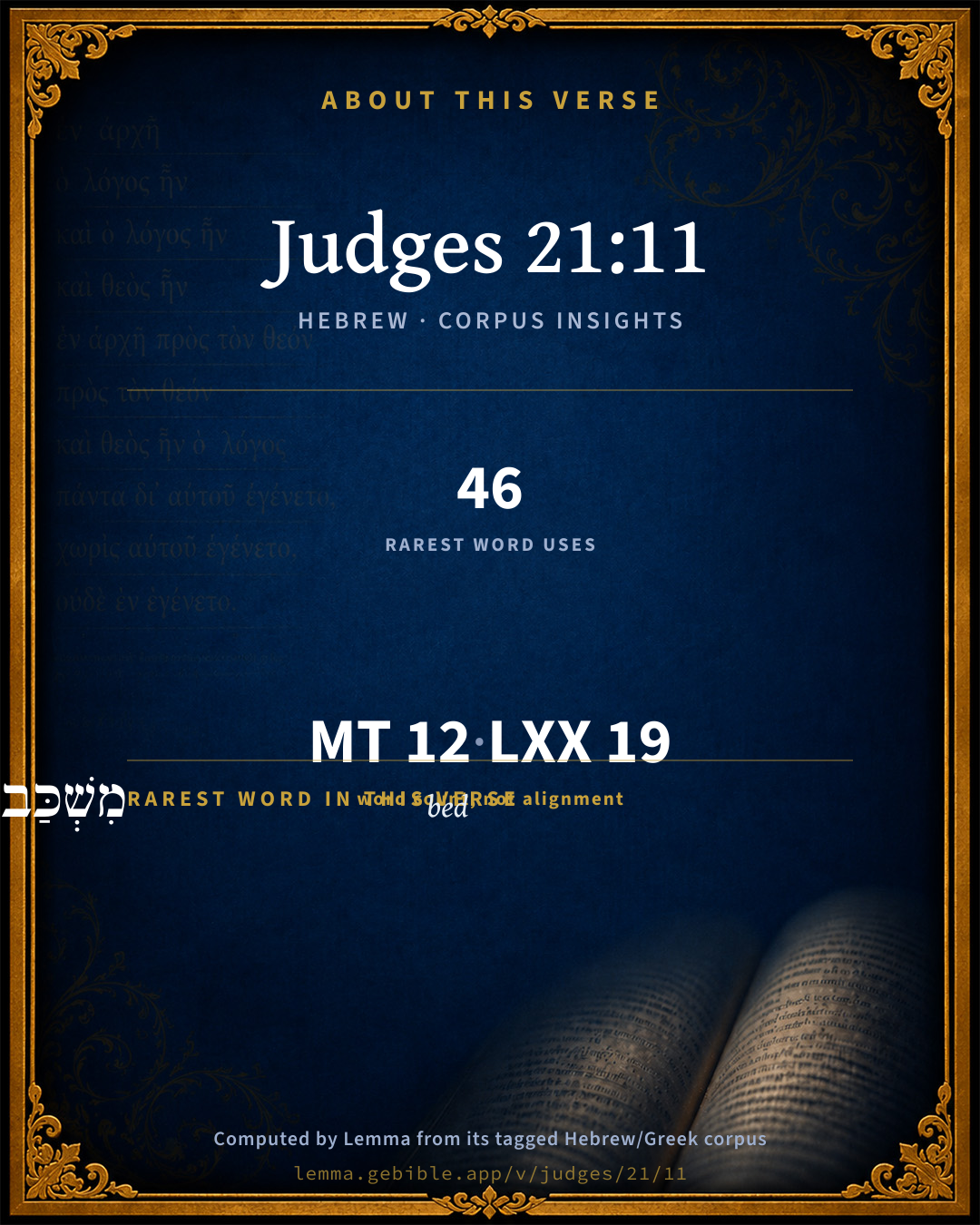
מִשְׁכַּב
mishkâb
H4904
“bed of”
Noun, Common, Masculine, Singular, Construct
Part of Speech
Noun
Type
Common
Gender
Masculine
Number
Singular
State
Construct
Full BDB Definition

Origin: from H7901

TWOT: 2381c

a lying down, couch, bier, act of lying - couch, bed - act of lying, lying down or sleeping room, bedroom - lying down (for sexual contact)
  1. וְזֶ֥ה zeh H2088 “and · this” Conjunction + Pronoun, Demonstrative, Masculine, Singular
  2. הַדָּבָ֖ר dâbâr H1697 “the · word” Particle, Definite Article + Noun, Common, Masculine, Singular, Absolute
  3. אֲשֶׁ֣ר ʼăsher H834 “which” Particle, Relative
  4. תַּעֲשׂ֑וּ ʻâsâh H6213 “to do” Verb, Qal, Imperfect, 2nd Person, Masculine, Plural
  5. כָּל kôl H3605 “all of” Noun, Common, Masculine, Singular, Construct
  6. זָכָ֗ר zâkâr H2145 “male” Adjective, Adjective, Masculine, Singular, Absolute
  7. וְכָל kôl H3605 “and · all of” Conjunction + Noun, Common, Masculine, Singular, Construct
  8. אִשָּׁ֛ה ʼishshâh H802 “woman” Noun, Common, Feminine, Singular, Absolute
  9. יֹדַ֥עַת yâdaʻ H3045 “knowing” Verb, Qal, Participle Active, Feminine, Singular, Absolute
  10. זָכָ֖ר zâkâr H2145 “male” Adjective, Adjective, Masculine, Singular, Absolute
  11. תַּחֲרִֽימוּ châram H2763 “to ban” Verb, Hiphil, Imperfect, 2nd Person, Masculine, Plural

About this verse

These counts appear in no published source. They are computed here, from the morphology-tagged text and Lemma’s own curated glosses. What Lemma adds →

12
words
10
distinct lemmas
Historical
section

Shared distinctive vocabulary

מִשְׁכַּב bed H4904 occurs in 44 verses of the Hebrew Bible. Also found in:

Grammatical profile

  • 3 verbs
  • 5 nouns
  • 2 adjectives
  • 1 pronoun
  • 1 particle

Verb forms

  • תַּעֲשׂ֑וּ Qal · Imperfect
  • יֹדַ֥עַת Qal · Participle Active
  • תַּחֲרִֽימוּ Hiphil · Imperfect

Repetition

Words recur within this verse — often emphatic in Hebrew:

  • כָּל all H3605 ×2
  • זָכָ֗ר male H2145 ×2

Hebrew & Septuagint length

In English translation the verse runs 22 words from the Hebrew and 33 from the Septuagint (LXX English) — the Septuagint runs noticeably longer here. See the side-by-side →

A rough comparison of the two English renderings, which tokenize alike — not a word-level alignment.

Word counts can differ between the Hebrew and the Greek without any difference in meaning — e.g. the Hebrew direct-object marker אֵת has no separate Greek word, and Greek often adds the article ὁ.

In the original languages it is 12 Hebrew tokens and 19 Greek tokens — but the two are counted differently (Hebrew bundles its prefixes and suffixes into one token; the Greek is in lemma form), so that isn’t a like-for-like length.

Cross-references

2

Topical passages linked to Judges 21:11 in the Treasury of Scripture Knowledge — connected by theme and wording, ordered by reader-vote popularity; previews shown in the World English Bible.

  • Numbers 31:17–18 Now therefore kill every male among the little ones, and kill every woman who has known man by lying with him.
  • Deuteronomy 2:34 We took all his cities at that time, and utterly destroyed every inhabited city, with the women and the little ones; we left none remaining:

Cross-references courtesy of OpenBible.info (CC BY 4.0).

Hebrew and Greek witnesses Masoretic Hebrew ↔ Greek Septuagint

The same verse in the two great witnesses to the Old Testament, shown verse-for-verse.

Here the Septuagint runs noticeably longer than the Hebrew — LXX2012 (modern English Septuagint) 33 words vs World English Bible 22. A rough length comparison of the two English translations, not a word-level alignment — read both below.

These are two independent witnesses, not word-aligned to each other, and the Septuagint is shown in lemma (dictionary) form.

Hebrew Judges 21:11 Masoretic · Westminster Leningrad Codex

וְזֶ֥ה הַדָּבָ֖ר אֲשֶׁ֣ר תַּעֲשׂ֑וּ כָּל זָכָ֗ר וְכָל אִשָּׁ֛ה יֹדַ֥עַת מִשְׁכַּב זָכָ֖ר תַּחֲרִֽימוּ

This is the thing that you shall do: you shall utterly destroy every male, and every woman who has lain by man.

World English Bible · Public Domain

Greek LXX Judges 21:11 Septuagint · lemma form

καί οὗτος ποιέω πᾶς ἄρσην καί πᾶς γυνή οἶδα κοίτη ἄρσην ἀναθεματίζω ὁ δέ παρθένος περιποιέω καί ποιέω οὕτως

And this shall you⌃ do: every male and every woman that has known the lying with man you⌃ shall devote to destruction, but the virgins you⌃ shall save alive: and they did so.

LXX2012 (modern English Septuagint) · Public Domain

On this verse, The Cambridge Bible for Schools and Colleges discusses the Septuagint’s reading. Read the note in Commentary ↓

Hebrew: Westminster Leningrad Codex (CC BY 4.0). Greek: Septuagint (public domain); English from LXX2012 (modern English Septuagint) (Public Domain). How the Septuagint differs from the Hebrew →

Targum (Aramaic paraphrase)

1

The Targum is the ancient Jewish Aramaic paraphrase of the Hebrew Scriptures — an interpretive translation, not the Hebrew text itself. Onkelos (literal) and Pseudo-Jonathan (expansive) render the Torah, and Jonathan the Prophets. Coverage is partial: where no permissively-licensed English translation exists for a verse, only the Aramaic is shown. This is verse-level text, not a word-by-word alignment to the Hebrew.

  1. Targum Jonathan Prophets (Joshua–Malachi)
    וְדֵין פִּתְגָמָא דִי תַעְבְּדוּן כָּל דְכוּרָא וְכָל אִתְּתָא דִידַעַת מִשְׁכְּבֵי דְכוּרָא תִּגְמְרוּן:

    (no public-domain English translation for this verse)

    Targum Jonathan — Aramaic: “Mikraot Gedolot” (public domain). English: “Sefaria Community Translation” (CC0 1.0 (public-domain dedication)); “London "Chaldee Paraphrase," 1871” (public domain). Text via Sefaria.

Commentary

Notes on Judges 21:11 from classic Christian and Jewish commentators (each source and its license shown beneath its notes). The classic Christian expositions comment on the surrounding passage and are grouped to its opening verse, so a note may address several verses; the Jewish commentaries on the Tanakh (Rashi and others) are per-verse, so they appear only where the commentator wrote on this verse.

Lemma curates 59 commentaries, every one of them public domain or Creative Commons licensed, each selected and text-cleaned for this edition rather than reprinted as found. About our sources →

Trapp's Complete Commentary

John Trapp

Jdg 21:11 And this [is] the thing that ye shall do, Ye shall utterly destroy every male, and every woman that hath lain by man.

Ver. 11. Ye shall utterly destroy every male.] This also was a barbarous and bloody decree, {Eze 18:20} not unlike Draco’s laws, whereof Aristotle giveth this commendation, that they are not worth remembrance, but only for their severity.

John Trapp, A Commentary or Exposition upon All the Books of the Old and New Testament (1647–1656) — public domain. Text from a community e-Sword module.

Joseph Benson's Commentary

Jdg 21:11. Ye shall utterly destroy every male, &c. — Strange infatuation of the human mind! That they should imagine the Divine Majesty would be more honoured and pleased by an action quite contrary to, and abhorrent from, his essential nature and attributes, than if they had implored his pardon for a rash oath, and honoured him by not keeping it! Would to God that this had been the only time that the human race have thought to honour God by acts which are the most hateful to him! The cruel havocs made by religious persecution in different ages and countries have, alas! too fully witnessed how far the mind of man is capable of erring in this respect! O shocking blindness and infatuation! that men should think that the God of love, he who is love itself, can be pleased or honoured by acts of the most barbarous cruelty!

As Jabesh-gilead was beyond Jordan, and at a great distance, it is probable the inhabitants thereof had not heard of the vow which the Israelites had made. “But if they had been guilty of neglect and disaffection to the common cause,” as Mr. Scott argues, “they had not assisted the Benjamites: and yet when the people were lamenting the desolations of that tribe, they proceeded to treat those who were far less criminal with equal rigour!”

Joseph Benson's Commentary on the Old and New Testaments (1811–1818) — public domain. Text from a community e-Sword module.

Ellicott's Commentary for English Readers

(11) Ye shall utterly destroy.—The verb is tacharîmû—i.e., Ye shall place under the ban (cherem), ye shall devote to destruction. The words of the cherem are almost identical with those of the indignant command of Moses after the war with Midian alluded to in the last verse (Num_31:17-18), and there the same exception is made. (Comp. Lev_27:21-28; Num_21:2-3.) The words are easy to read; it is needless to dwell on the horror of the massacre which they describe. We are dealing throughout with the fierce passions of men living in times of gross spiritual darkness; for we cannot doubt that the oath against Jabesh-Gilead was carried out, though the writer drops a veil over all but the result. The vow of destruction (cherem, anathema, Lev_27:28-29) was quite different from the vow of devotion (neder) and the vow of abstinence (corban).

(11) To dance in dances.—Possibly the dances of the vintage festival. There is a fountain in a narrow dale, at a little distance from Shiloh, which was very probably the scene of this event. It is a needless conjecture that the feast was the Passover, and the dances a commemoration of the defeat of the Egyptians, like those of Miriam. There seems to have been no regular town at Shiloh; at least, no extensive ruins are traceable. It was probably a community like the Beth-Micah (see Note on Jdg_18:2), which was mainly connected with the service of the Tabernacle. The “daughters of Shiloh” would naturally include many women who were in one way or other employed in various functions about the Tabernacle, and not only those who came there to worship (1Sa_2:22, where “assembled” should be rendered served, as in Num_4:23; “the handmaid” of the priests is mentioned in 2Sa_17:17). But the traces of female attendants in the sanctuary are more numerous in Jewish traditions than in Scripture.

Catch you every man his wife.—The scene is very analogous to the famous seizure of the Sabine women at the Consualia, as described in Liv. i. 9. St. Jerome (adv. Jovin, 1 § 41) quotes another parallel from the history of Aristomenes of Messene, who once, in a similar way, seized fifteen Spartan maidens, who were dancing at the Hyacinthia, and escaped with them.

A Bible Commentary for English Readers, edited by Charles John Ellicott (1878–1897) — public domain. Text from a community e-Sword module.

The Cambridge Bible for Schools and Colleges

gen. ed. J. J. S. Perowne

11. And this is the thing … do] Similarly Jdg_20:9.

ye shall utterly destroy] The city and all its inhabitants were to become ḥérem, placed under the ban, for not taking part in the holy war against Benjamin; cf. Jdg_20:48 n. This episode is based upon Num_31:7; Num_31:17 f. (a late stratum of P). The writer again betrays his forgetfulness: he fails to copy his model in the important particular ye shall keep alive the virgins for yourselves Num_31:18. The words are accordingly supplied by LXX. cod. B and mss.

The Cambridge Bible for Schools and Colleges (gen. ed. J. J. S. Perowne; Cambridge University Press, 1878–1918) — public domain. Text from a community e-Sword module.

John Gill's Exposition

And this is the thing that ye shall do,.... Which they gave them in charge to execute:

ye shall utterly destroy every male; without any reserve, young or old, married or unmarried:

and every woman that hath lain by man; whether lawfully or unlawfully, in a married or unmarried state.

John Gill's Exposition of the Whole Bible (1746–1763) — public domain (CC PDM 1.0). Text via the HelloAO Bible API.

Albert Barnes' Notes on the Bible

Ye shall utterly destroy - More exactly, “Ye shall devote to utter destruction,” or “cherem” (Lev 27:28 note).

Albert Barnes' Notes on the Bible (1834–1885) — public domain. Text from a community e-Sword/MySword module.

Haydock's Catholic Bible Commentary

But, &c. This is not expressed in the Hebrew or the Septuagint, though it be sufficiently implied, (Calmet) as the males and married women only are ordered to be slain. (Haydock) --- It is doubted whether the virgins, who were not fit for marriage, were reserved or butchered. But probably all the younger children were saved (Calmet) of that sex, though the order was to kill the wives and children; and the reason for sparing any was, that the Benjamites might be supplied with wives immediately. (Haydock) --- Hebrew and Septuagint insinuate, that the citizens were to be treated as those who were under an anathema: "ye shall utterly destroy;" anathematize. Yet the house and cattle were spared. (Menochius)

George Leo Haydock (1774–1849), Haydock's Catholic Family Bible and Commentary, 1859 edition — public domain. Excludes Psalms (Douay-Rheims chapter numbering differs from Protestant) and Deuterocanonical books (Catholic canon only).

Matthew Poole's English Annotations

But not the virgins, as appears from the next verses. It is questionable whether they were not obliged to destroy these also by virtue of their oath, and of God’s express command concerning devoted persons, such as these certainly were, that they should surely be put to death. Lev 27:29, which was also particularly enjoined and practised in such cases, as Deu 13; Jos 7, &c. But the natural and necessary duty of preserving a tribe from total ruin, might seem to render the case difficult and doubtful, and incline their opinions, as well as their affections, to the more favourable side. And it may be, the Lord, whom they were here consulting with upon all their occasions, gave them a dispensation thus to do, though that be not expressed; which is the case of many other things which were done, though not recorded; as this very oath was omitted in its proper place, and had not been recorded if this extraordinary occasion had not been offered.

Matthew Poole's English Annotations on the Holy Bible (1683–1685) — public domain. Text from a community e-Sword/MySword module.

unfoldingWord translationNotes

Door43 World Missions Community

Jabesh Gilead

This is the name of a city. See how you translated this in Judges 21:8.

slept with a man

This is a euphemism for sexual relations. (See: Euphemism)

four hundred young women

"400 young women" (See: Numbers)

translationWords

had relations with

life

Shiloh

Canaan

unfoldingWord translationNotes — © Distant Shores Media and the Door43 World Missions Community, licensed CC BY-SA 4.0. Source: git.door43.org/Door43/en_tn.

Lesson kit

Teaching starters — assembled from the data on this page, not authored interpretation. Every prompt links to the verse data it draws on. Edit before teaching.

Judges, in the Historical, opens this verse with 12 words (10 distinct Hebrew lemmas). Its most distinctive word is mishkâb (“bed”). The Greek Septuagint runs longer here. A historical commentator’s framing appears above. Read the whole chapter for the surrounding context.

Discussion questions

  1. The word mishkâb carries the sense “bed.” How does it shape the verse?
  2. How does Genesis 49:4, which shares the word «bed», read alongside this verse?
  3. What does the repetition of “all” (2× in this one verse) do in this verse?
  4. The Septuagint runs longer here than the Hebrew. What might account for the difference?
  5. The translations on this page render this verse differently — a whole-verse word diff, not a word-by-word alignment. What might account for the different wordings?
  6. «תַּעֲשׂ֑וּ» is a Qal Imperfect verb. How does that grammatical form shape the action described?
  7. Compare how Trapp's Complete Commentary and Joseph Benson's Commentary read this verse. Where do they agree or differ?

Things to notice

Reading settings

Reading text

Shown beneath each verse's original-language words.

Old Testament
Old Testament edition

Read the OT as the Masoretic Hebrew (MT) or the Greek Septuagint (LXX).

English shown for the Greek Septuagint (in the Hebrew ↔ Greek comparison).

Comparing translations? Open the Compare panel on any verse page to stack up to four side by side.