
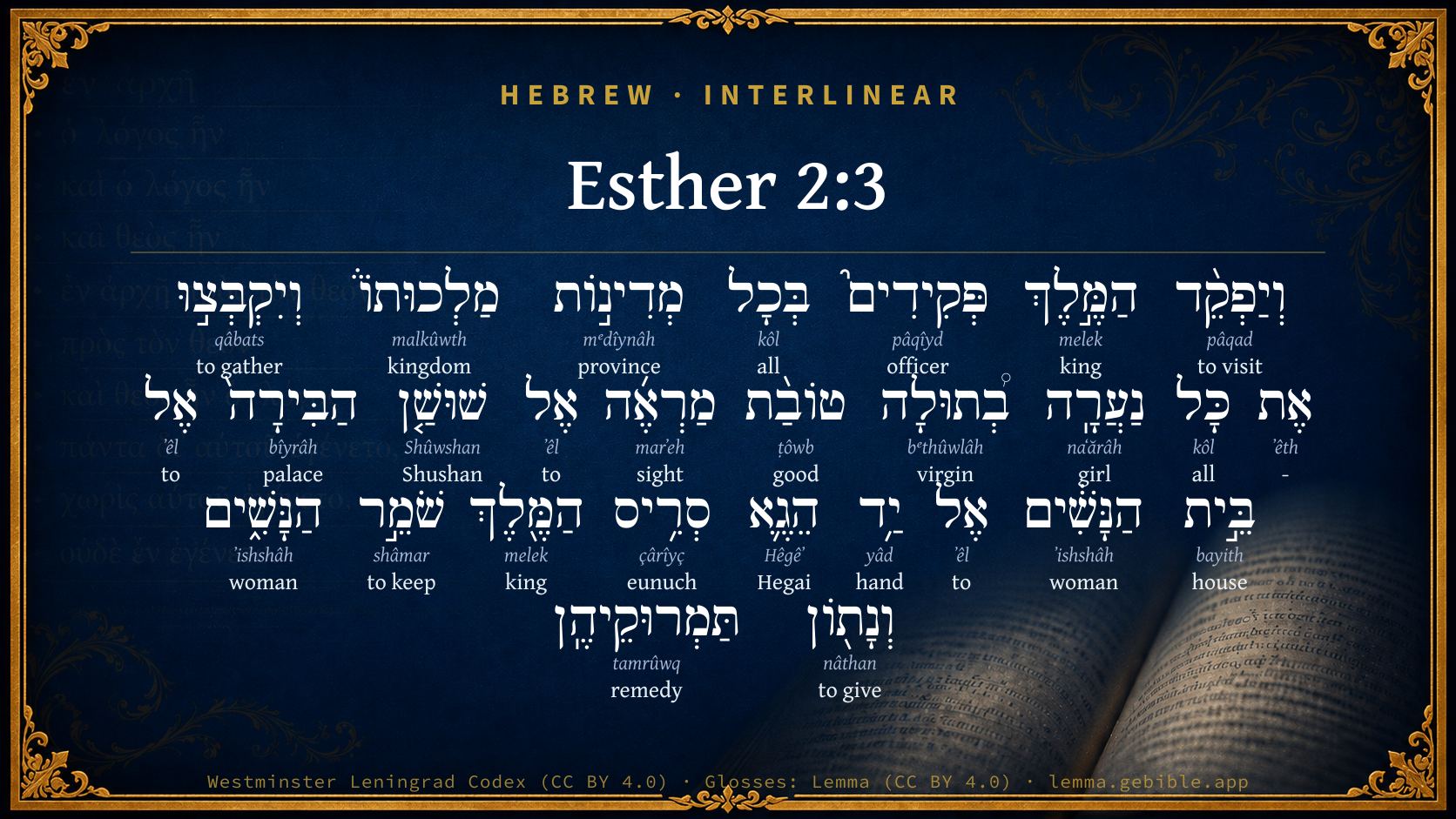
Esther 2:3

Hebrew (Westminster Leningrad Codex) Esther 2:3 appears in the Hebrew Old Testament. The text above is from the Westminster Leningrad Codex. Each word links to its Strong’s number, a concise gloss, and parsing drawn from the Open Scriptures Hebrew Bible morphology. Click any word for its full Brown-Driver-Briggs (BDB) entry.
Download image
Cite this verse

Esther 2:3 (World English Bible). Public Domain. Lemma interlinear Bible study tool, https://lemma.gebible.app/v/esther/2/3.

Show BibTeX & RIS
BibTeX
RIS
English Translation
and let the king appoint officers in all the provinces of his kingdom, that they may gather together all the beautiful young virgins to Shushan the palace, to the house of the women, to the custody of Hegai the king's chamberlain, keeper of the women; and let their things for purification be given them;
World English Bible · Public Domain
Highlights
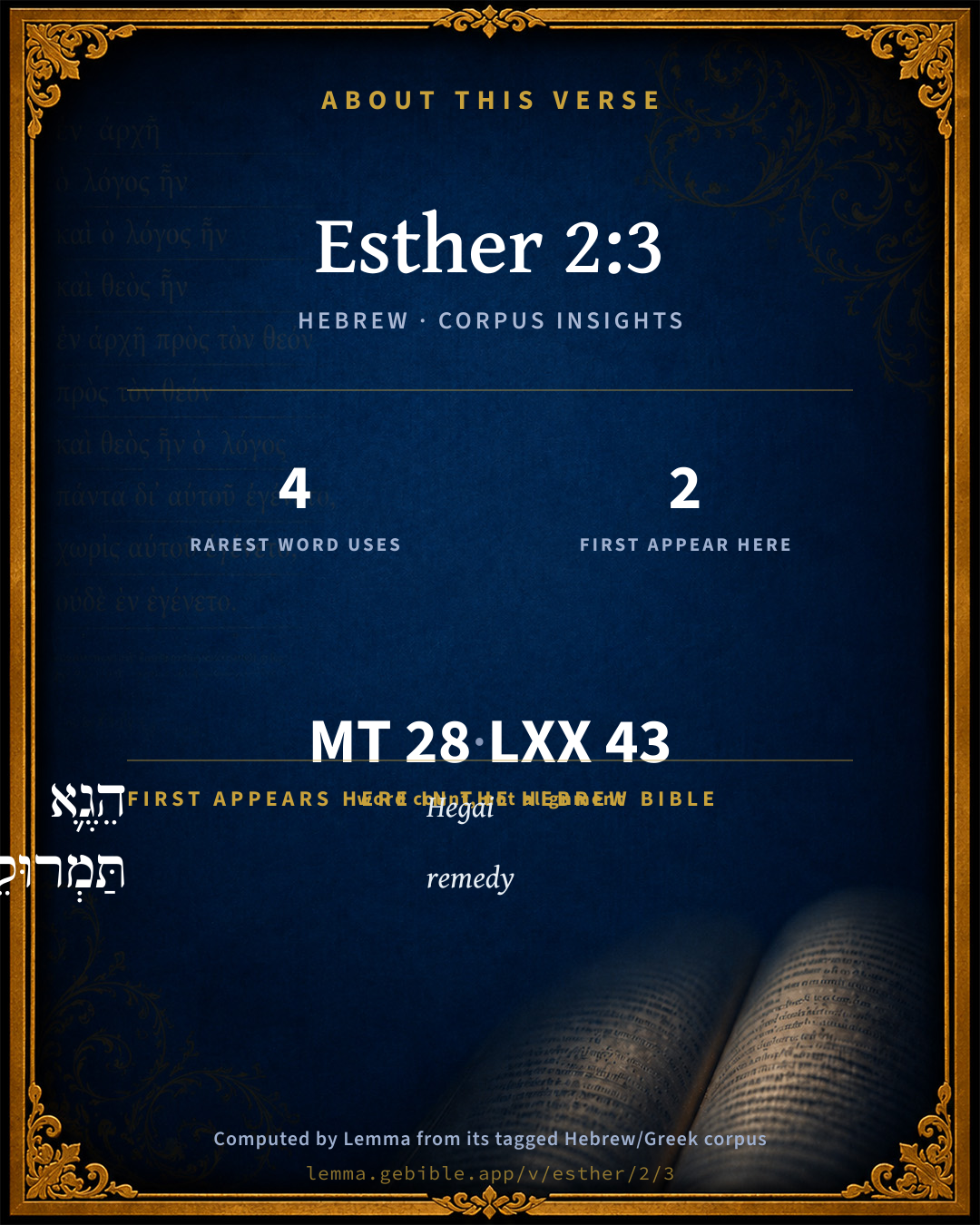
  • 2 first appearances in the Hebrew Bible
Full analysis ↓
Download a study sheet

One document with this verse’s original text, its word-by-word gloss line, the meaning frame, cross-references with their text, attributed commentary, and full source and license credits — printable, and it pastes into notes with its structure intact.

This verse Autodidact and up

Study sheet (.html) Plain text (.txt)

A passage Seminary Student

Up to 50 verses in one chapter. A passage sheet keeps up to 6 commentary sources and 12 cross-references per verse, in the order this page ranks them, and says so on the sheet whenever that leaves anything out. Ask for a single verse and you get the Autodidact verse sheet above.

Everything on this page stays free to read, with no account — the sheet is a download of what is already on screen, not access to it.

Want to remove ads? Support Godless Engineer
Compare translations 3

The same verse in 3 English versions, stacked beneath the original-language interlinear above. Click any original word for its lexicon entry.

Each is an independent rendering of the whole verse — the interlinear is not word-aligned to these translations.

Highlighted words mark where these versions differ — a whole-verse word diff, not a word-by-word alignment.

  • World English Bible Public Domain
    and let the king appoint officers in all the provinces of his kingdom, that they may gather together all the beautiful young virgins to Shushan the palace, to the house of the women, to the custody of Hegai the king's chamberlain, keeper of the women; and let their things for purification be given them;
  • King James Version Public Domain
    And let the king appoint officers in all the provinces of his kingdom, that they may gather together all the fair young virgins unto Shushan the palace, to the house of the women, unto the custody of Hege the king's chamberlain, keeper of the women; and let their things for purification be given them:
  • unfoldingWord Literal Text CC BY-SA 4.0
    And let the king appoint administrators in all the provinces of his kingdom. Then let them gather every young woman who is a virgin and pleasing of appearance to Susa the citadel, to the house of women into the hand of Hegai (the eunuch of the king who is overseer of the women). Then give their ointments.

unfoldingWord Literal Text — © unfoldingWord, licensed CC BY-SA 4.0. Word-aligned USFM3 via Door43 (git.door43.org/unfoldingWord/en_ult).

Versions to compare (up to 4)

3 of 4 selected

Show all 18 translations

Every available English version of this verse, each an independent rendering of the whole verse.

  • World English Bible Public Domain
    and let the king appoint officers in all the provinces of his kingdom, that they may gather together all the beautiful young virgins to Shushan the palace, to the house of the women, to the custody of Hegai the king's chamberlain, keeper of the women; and let their things for purification be given them;
  • Berean Standard Bible Public Domain
    and let the king appoint commissioners in each province of his kingdom to assemble all the beautiful young women into the harem at the citadel of Susa. Let them be placed under the care of Hegai, the king’s eunuch in charge of the women, and let them be given beauty treatments.
  • Majority Standard Bible Public Domain
    and let the king appoint commissioners in each province of his kingdom to assemble all the beautiful young women into the harem at the citadel of Susa. Let them be placed under the care of Hegai, the king’s eunuch in charge of the women, and let them be given beauty treatments.
  • King James Version Public Domain
    And let the king appoint officers in all the provinces of his kingdom, that they may gather together all the fair young virgins unto Shushan the palace, to the house of the women, unto the custody of Hege the king's chamberlain, keeper of the women; and let their things for purification be given them:
  • American Standard Version (1901) Public Domain
    and let the king appoint officers in all the provinces of his kingdom, that they may gather together all the fair young virgins unto Shushan the palace, to the house of the women, unto the custody of Hegai the king's chamberlain, keeper of the women; and let their things for purification be given them;
  • Revised Version (1885) Public Domain
    and let the king appoint officers in all the provinces of his kingdom, that young virgins unto Shushan the palace, they may gather together all the fair to the house of the women, unto the custody of Hegai the king’s chamberlain, keeper of the women; and let their things for purification be given them:
  • Geneva Bible (1599) Public Domain
    And let the King appoynt officers through all the prouinces of his kingdome, and let them gather all the beautiful yong virgins vnto the palace of Shushan, into the house of the women, vnder the hand of Hege the Kings eunuche, keeper of the women, to giue them their things for purification.
  • Douay-Rheims (1899) Public Domain
    And let some persons be sent through all the provinces to look for beautiful maidens and virgins: and let them bring them to the city of Susan, and put them into the house of the women under the hand of Egeus the eunuch, who is the overseer and keeper of the king's women: and let them receive women's ornaments, and other things necessary for their use.
  • Young's Literal Translation Public Domain
    and the king doth appoint inspectors in all provinces of his kingdom, and they gather every young woman -- virgin, of good appearance -- unto Shushan the palace, unto the house of the women, unto the hand of Hege eunuch of the king, keeper of the women, and to give their purifications,
  • Literal Standard Version CC BY-SA 4.0
    and the king appoints inspectors in all provinces of his kingdom, and they gather every young woman—virgin, of good appearance—to Shushan the palace, to the house of the women, to the hand of Hegai eunuch of the king, keeper of the women, and to give their purifications,
  • Unlocked Literal Bible CC BY-SA 4.0
    Let the king appoint officers in all the provinces of his kingdom, to gather together all the beautiful young virgins to the harem in the fortress in Susa. Let them be put under the care of Hegai, the king's official, who is in charge of the women, and let him give them their cosmetics.
  • unfoldingWord Literal Text CC BY-SA 4.0
    And let the king appoint administrators in all the provinces of his kingdom. Then let them gather every young woman who is a virgin and pleasing of appearance to Susa the citadel, to the house of women into the hand of Hegai (the eunuch of the king who is overseer of the women). Then give their ointments.
  • Darby Bible Public Domain
    and let the king appoint officers in all the provinces of his kingdom, that they may gather together all the young virgins of beautiful countenance to Shushan the fortress, to the house of the women, unto the custody of Hegai the king's chamberlain, keeper of the women; and let their things for purification be given.
  • World Messianic Bible Public Domain
    Let the king appoint officers in all the provinces of his kingdom, that they may gather together all the beautiful young virgins to the citadel of Susa, to the women’s house, to the custody of Hegai the king’s eunuch, keeper of the women. Let cosmetics be given them;
  • Webster's Bible Public Domain
    And let the king appoint officers in all the provinces of his kingdom, that they may collect all the fair young virgins to Shushan the palace, to the house of the women, into the custody of Hege the king's chamberlain, keeper of the women; and let their things for purification be given them:
  • Free Bible Version CC BY-SA 4.0
    Your Majesty should appoint officers in each province of his empire to gather all the beautiful young women and bring them to the king's harem at the fortress of Susa. They should be placed under the supervision of Hegai, the king's eunuch in charge of the women, and they should be given beauty treatments.
  • Bible in Basic English Public Domain
    Let the king give authority to certain men in all the divisions of his kingdom, to get together all the fair young virgins and send them to Shushan, the king's town, to the women's house, under the care of Hegai, the king's servant, the keeper of the women: and let the things needed for making them clean be given to them;
  • JPS Tanakh (1917) Public Domain
    and let the king appoint officers in all the provinces of his kingdom, that they may gather together all the fair young virgins unto Shushan the castle, to the house of the women, unto the custody of Hegai the king's chamberlain, keeper of the women; and let their ointments be given them;

Literal Standard Version (2020), Covenant Press — licensed CC BY-SA 4.0. Text via the HelloAO Bible API (eBible.org). Unlocked Literal Bible (unfoldingWord) — licensed CC BY-SA 4.0. Text via the HelloAO Bible API (eBible.org). unfoldingWord Literal Text — © unfoldingWord, licensed CC BY-SA 4.0. Word-aligned USFM3 via Door43 (git.door43.org/unfoldingWord/en_ult). Free Bible Version, Dr. Jonathan Gallagher — licensed CC BY-SA 4.0. Text via the HelloAO Bible API (eBible.org).

Word by word

More ways to search: Search by grammar → Find every occurrence → Compare this word →

Practice this passage: Drill this verse → Learn its vocabulary →

הֵגֶ֛א
Hêgêʼ
H1896
“Hegai”
Noun, Proper
Part of Speech
Noun
Type
Proper
Full BDB Definition

Origin: probably of Persian origin

TWOT: None

Hegai or Hege = "eunuch" - one of the eunuchs of the court of Ahasuerus
  1. וְיַפְקֵ֨ד pâqad H6485 “and · to visit” Conjunction + Verb, Hiphil, Jussive, 3rd Person, Masculine, Singular
  2. הַמֶּ֣לֶךְ melek H4428 “the · king” Particle, Definite Article + Noun, Common, Masculine, Singular, Absolute
  3. פְּקִידִים֮ pâqîyd H6496 “officers” Noun, Common, Masculine, Plural, Absolute
  4. בְּכָל kôl H3605 “in/at · all of” Preposition + Noun, Common, Masculine, Singular, Construct
  5. מְדִינ֣וֹת mᵉdîynâh H4082 “provinces of” Noun, Common, Feminine, Plural, Construct
  6. מַלְכוּתוֹ֒ malkûwth H4438 “kingdom · his” Noun, Common, Feminine, Singular, Construct + Suffix, Personal, 3rd Person, Masculine, Singular
  7. וְיִקְבְּצ֣וּ qâbats H6908 “and · to gather” Conjunction + Verb, Qal, Jussive, 3rd Person, Masculine, Plural
  8. אֶת ʼêth H853 “-” Particle, Direct Object
  9. כָּל kôl H3605 “all of” Noun, Common, Masculine, Singular, Construct
  10. נַעֲרָֽה naʻărâh H5291 “girl” Noun, Common, Feminine, Singular, Absolute
  11. בְ֠תוּלָה bᵉthûwlâh H1330 “virgin” Noun, Common, Feminine, Singular, Absolute
  12. טוֹבַ֨ת ṭôwb H2896 “good of” Adjective, Adjective, Feminine, Singular, Construct
  13. מַרְאֶ֜ה marʼeh H4758 “sight” Noun, Common, Masculine, Singular, Absolute
  14. אֶל ʼêl H413 “to” Preposition
  15. שׁוּשַׁ֤ן Shûwshan H7800 “Shushan” Noun, Proper
  16. הַבִּירָה֙ bîyrâh H1002 “the · palace” Particle, Definite Article + Noun, Common, Feminine, Singular, Absolute
  17. אֶל ʼêl H413 “to” Preposition
  18. בֵּ֣ית bayith H1004 “house of” Noun, Common, Masculine, Singular, Construct
  19. הַנָּשִׁ֔ים ʼishshâh H802 “the · women” Particle, Definite Article + Noun, Common, Feminine, Plural, Absolute
  20. אֶל ʼêl H413 “to” Preposition
  21. יַ֥ד yâd H3027 “hand of” Noun, Common, Both, Singular, Construct
  22. סְרִ֥יס çârîyç H5631 “eunuch of” Noun, Common, Masculine, Singular, Construct
  23. הַמֶּ֖לֶךְ melek H4428 “the · king” Particle, Definite Article + Noun, Common, Masculine, Singular, Absolute
  24. שֹׁמֵ֣ר shâmar H8104 “keeping” Verb, Qal, Participle Active, Masculine, Singular, Construct
  25. הַנָּשִׁ֑ים ʼishshâh H802 “the · women” Particle, Definite Article + Noun, Common, Feminine, Plural, Absolute
  26. וְנָת֖וֹן nâthan H5414 “and · to give” Conjunction + Verb, Qal, Infinitive Absolute
  27. תַּמְרוּקֵיהֶֽן tamrûwq H8562 “remedies · their” Noun, Common, Masculine, Plural, Construct + Suffix, Personal, 3rd Person, Feminine, Plural

About this verse

These counts appear in no published source. They are computed here, from the morphology-tagged text and Lemma’s own curated glosses. What Lemma adds →

28
words
23
distinct lemmas
Historical
section

Notable vocabulary

The rarest word here is הֵגֶ֛א Hegai H1896 — appearing just 4 times in the whole Hebrew Bible.

First appearance in Scripture

These words make their first canonical appearance in the Hebrew Bible here:

  • הֵגֶ֛א Hegai H1896
  • תַּמְרוּקֵיהֶֽן remedy H8562

Shared distinctive vocabulary

הֵגֶ֛א Hegai H1896 occurs in 3 verses of the Hebrew Bible. Also found in:

Grammatical profile

  • 4 verbs
  • 19 nouns
  • 1 adjective
  • 3 prepositions
  • 1 particle

Verb forms

  • וְיַפְקֵ֨ד Hiphil · Jussive
  • וְיִקְבְּצ֣וּ Qal · Jussive
  • שֹׁמֵ֣ר Qal · Participle Active
  • וְנָת֖וֹן Qal · Infinitive Absolute

Repetition

Words recur within this verse — often emphatic in Hebrew:

  • הַמֶּ֣לֶךְ king H4428 ×2
  • בְּכָל all H3605 ×2
  • הַנָּשִׁ֔ים woman H802 ×2
  • אֶל to H413 ×3

Hebrew & Septuagint length

In English translation the verse runs 54 words from the Hebrew and 60 from the Septuagint (LXX English) — closely comparable.

A rough comparison of the two English renderings, which tokenize alike — not a word-level alignment.

Word counts can differ between the Hebrew and the Greek without any difference in meaning — e.g. the Hebrew direct-object marker אֵת has no separate Greek word, and Greek often adds the article ὁ.

In the original languages it is 28 Hebrew tokens and 43 Greek tokens — but the two are counted differently (Hebrew bundles its prefixes and suffixes into one token; the Greek is in lemma form), so that isn’t a like-for-like length.

Cross-references

4

Topical passages linked to Esther 2:3 in the Treasury of Scripture Knowledge — connected by theme and wording, ordered by reader-vote popularity; previews shown in the World English Bible.

  • Esther 1:1–2 Now it happened in the days of Ahasuerus (this is Ahasuerus who reigned from India even to Ethiopia, over one hundred twenty-seven provinces),
  • Esther 2:8–9 So it happened, when the king's commandment and his decree was heard, and when many maidens were gathered together to Shushan the palace, to the custody of Hegai, that Esther was taken into the king's house, to the custody of Hegai, keeper of the women.
  • Esther 2:12–15 Now when the turn of every maiden was come to go in to king Ahasuerus, after it had been done to her as prescribed for the women twelve months (for so were the days of their purification accomplished, [to wit], six months with oil of myrrh, and six months with sweet odors and with the things for the purifying of the women),
  • Isaiah 3:18–23 In that day the Lord will take away the beauty of their anklets, the headbands, the crescent necklaces,

Cross-references courtesy of OpenBible.info (CC BY 4.0).

Hebrew and Greek witnesses Masoretic Hebrew ↔ Greek Septuagint

The same verse in the two great witnesses to the Old Testament, shown verse-for-verse.

These are two independent witnesses, not word-aligned to each other, and the Septuagint is shown in lemma (dictionary) form.

Hebrew Esther 2:3 Masoretic · Westminster Leningrad Codex

וְיַפְקֵ֨ד הַמֶּ֣לֶךְ פְּקִידִים֮ בְּכָל מְדִינ֣וֹת מַלְכוּתוֹ֒ וְיִקְבְּצ֣וּ אֶת כָּל נַעֲרָֽה בְ֠תוּלָה טוֹבַ֨ת מַרְאֶ֜ה אֶל שׁוּשַׁ֤ן הַבִּירָה֙ אֶל בֵּ֣ית הַנָּשִׁ֔ים אֶל יַ֥ד הֵגֶ֛א סְרִ֥יס הַמֶּ֖לֶךְ שֹׁמֵ֣ר הַנָּשִׁ֑ים וְנָת֖וֹן תַּמְרוּקֵיהֶֽן

and let the king appoint officers in all the provinces of his kingdom, that they may gather together all the beautiful young virgins to Shushan the palace, to the house of the women, to the custody of Hegai the king's chamberlain, keeper of the women; and let their things for purification be given them;

World English Bible · Public Domain

Greek LXX Esther 2:3 Septuagint · lemma form

καί καταἵστημι ὁ βασιλεύς κωμάρχης ἐν πᾶς ὁ χώρα ὁ βασιλεία αὐτός καί ἐπιλέγω κοράσιον παρθενικός καλός ὁ εἶδος εἰς σουσαν ὁ πόλις εἰς ὁ γυναικών καί παραδίδωμι ὁ εὐνοῦχος ὁ βασιλεύς ὁ φύλαξ ὁ γυνή καί δίδωμι σμῆγμα καί ὁ λοιπός ἐπιμέλεια

And let the king appoint local governors in all the provinces of his kingdom, and let them select fair and chaste young damsels and bring them to the city Susa, into the women's apartment, and let them be consigned to the king's chamberlain, the keeper of the women; and let things for purification and other attendance be given to them.

LXX2012 (modern English Septuagint) · Public Domain

On this verse, Adam Clarke's Commentary discusses the Septuagint’s reading. Read the note in Commentary ↓

Hebrew: Westminster Leningrad Codex (CC BY 4.0). Greek: Septuagint (public domain); English from LXX2012 (modern English Septuagint) (Public Domain). How the Septuagint differs from the Hebrew →

Commentary

Notes on Esther 2:3 from classic Christian and Jewish commentators (each source and its license shown beneath its notes). The classic Christian expositions comment on the surrounding passage and are grouped to its opening verse, so a note may address several verses; the Jewish commentaries on the Tanakh (Rashi and others) are per-verse, so they appear only where the commentator wrote on this verse.

Lemma curates 59 commentaries, every one of them public domain or Creative Commons licensed, each selected and text-cleaned for this edition rather than reprinted as found. About our sources →

Trapp's Complete Commentary

John Trapp

Est 2:3 And let the king appoint officers in all the provinces of his kingdom, that they may gather together all the fair young virgins unto Shushan the palace, to the house of the women, unto the custody of Hege the king’s chamberlain, keeper of the women; and let their things for purification be given [them]:

Ver. 3. And let the king appoint officers] Praeficiat praefectos. Costly counsel. This could not be done without much trouble and charge to the king. Two or three years are spent in gathering, purifying, and preparing these choice virgins for the impure bed of this heathen prince, while he is following the chase of his ambition, in the wars of Greece.

In all the provinces of his kingdom] A large commission they must have, the whole kingdom is their circuit; and note that they went not to foreigners; which those princes that do, while thereby they seek for greatness, they many times miss goodness; while they labour to be strong abroad (and so to have a stake in store, as they say, however the dice chance to turn), they weaken themselves at home, and while by foreign matches they intend unity, it proves an occasion both of civil and foreign dissensions. We of this nation have had sad experience of these mischiefs.

That they may gather together] This could not be done without the great grief and general discontent of the king’s best subjects ( nimium serviliter huic hirco subiectorum, as one hath it), thus bereft and despoiled of their dearest daughters, the staves of their age.

All the fair young virgins] Beauty (the best pearl in a carnal eye) is all that is here looked after, quae plerumque virtute et pudicitia caret, which is oft without virtue and common honesty, as, where they meet, it is a rare mixture. The heathen man saith, Non est formosa mulier cuius crus laudatur aut brachium, sed illa cuius universa facies admirationem singulis partibus abstulit. Now if this be true, long enough might these commissionated officers look for fair young virgins, truly so called, there being very few that are not peccant in some minnum, some tittle of beauty, or other. It is a praise peculiar to the virgin daughter of Zion to be all fair, Son 4:7, to be αμωμος, Eph 5:26, such as in whom even Momus himself could find no error.

Unto Shushan the palace] In which one place there might have been found choice enough, without speaking further; but that lust is unsatisfiable. The eye is not satisfied with seeing; and in such a multitude how could it be but that the king’s mind must needs be distracted, which one to make choice of?

To the house of the women] Such as is now the Turk’s Seraglio. See the description of the Grand Signior’s Seraglio, by Master John Greanes, chap. iv.

Unto the custody of Hege] Who was their keeper, or rather their jailer. For what was this house of women but a perpetual prison to them, clapped under hatches, as it were, and, haply, held in as great servitude as those in Barbary are at this day; where it is death for any man to see one of the Xeriff’s concubines; and for them too, it, when they see a man, though but through a casement, they do not suddenly screek out.

And let their things for purification] σμηγματα, their cleansing, to dry up the filth of the flesh, and to cleanse nature’s infirmities, that they might be six months purified with oil of myrrh, and six other months perfumed with sweet odours, as Est 2:12. Here the maids were first purified before the king chose one. But Christ first chooseth his spouse, and then purifieth her, Eph 5:26.

John Trapp, A Commentary or Exposition upon All the Books of the Old and New Testament (1647–1656) — public domain. Text from a community e-Sword module.

Geneva Bible (1599)

Geneva Bible translators

Read what this purification was, verse 12.

The abuse of these countries was so great, that they invented many means to serve the lusts of Princes, and therefore as they ordained wicked laws, that the king might have whose daughters he would, so they had divers houses appointed, as one for them while they were virgins, another when they were concubines and for the Queens another.

Geneva Bible (1599) marginal notes — public domain. Text via Bolls.life.

Adam Clarke's Commentary

Verse 3. Hege the king's chamberlain] הגא סריס המלך Hege seris hammelech, "Hege, the king's eunuch;" so the Septuagint, Vulgate, Targum, and Syriac. In the Eastern countries the women are intrusted to the care of the eunuchs only.

Let their things for purification be given them] תמרקיהן tamrukeyhen, their cosmetics. What these were we are told in Es 2:12; oil of myrrh, and sweet odours. The myrrh was employed for six months, and the odours for six months more, after which the person was brought to the king. This space was sufficient to show whether the young woman had been chaste; whether she were with child or not, that the king might not be imposed on, and be obliged to father a spurious offspring, which might have been the case had not this precaution been used.

Instead of the oil or myrrh, the Targum says it was the oil of unripe olives which caused the hair to fall off, and rendered the skin delicate.

Adam Clarke's Commentary on the Bible (1810–1826) — public domain. Text from a community e-Sword/MySword module.

Ellicott's Commentary for English Readers

(3) The house of the women.—The harem, then as now, a prominent feature in the establishment of an Eastern king.

Hege.—Called Hegai in Est_2:8; a eunuch whose special charge seems to have been the virgins, while another, named Shaashgaz (Est_2:14), had the custody of the concubines. The whole verse shows, as conclusively as anything could do, in how degrading an aspect Eastern women were, as a whole, viewed. It was reserved for Christianity to indicate the true position of woman, not man’s plaything, but the help meet for him, able to aid him in his spiritual and intellectual progress, yielding him intelligent obedience, not slavery.

A Bible Commentary for English Readers, edited by Charles John Ellicott (1878–1897) — public domain. Text from a community e-Sword module.

The Cambridge Bible for Schools and Colleges

gen. ed. J. J. S. Perowne

3. to the house of the women] the harem, which must have been of large dimensions, and was made up, as we see from Est_2:14, of more than one building. It most likely consisted of three portions, viz. the house of the queen, such as Solomon built for Pharaoh’s daughter (1Ki_7:8), the house of the virgins (Est_2:9), and that of the concubines (Est_2:14).

Hegai] It is best, for the sake of uniformity, to spell thus throughout (cp. Est_2:8; Est_2:15). The A.V. follows the Heb., which is inconsistent, giving in this verse Hege, and elsewhere Hegai.

their things for purification] See Est_2:12. The Heb. word for ‘purification’ means properly scraping or rubbing, for the purpose of cleansing or polishing.

The Cambridge Bible for Schools and Colleges (gen. ed. J. J. S. Perowne; Cambridge University Press, 1878–1918) — public domain. Text from a community e-Sword module.

John Gill's Exposition

And let the king appoint officers in all the provinces of his kingdom,.... Who best knew where beautiful virgins might be found in their respective provinces, in which they dwelt:

that they may gather together all the fair young virgins unto Shushan the palace; the metropolis of the kingdom, where was the royal palace:

to the house of the women, unto the custody of Hege the king's chamberlain, the keeper of the women; in which house it seems were two apartments, one for the virgins before they were introduced to the king, the other for them when they were become his concubines, which had a keeper also; but this Hege seems to have been over the whole house, Est 2:14. It was not only usual with the eastern people, as with the Turks now, for great personages to have keepers of their wives and concubines, but with the Romans also (d):

and let their things for purification be given them; such as oil of myrrh, spices, &c. to remove all impurity and ill scent from them, and make them look smooth and beautiful.

(d) "Pone seram, cohibe", &c. Juvenal. Satyr. 6. ver. 346, 347.

John Gill's Exposition of the Whole Bible (1746–1763) — public domain (CC PDM 1.0). Text via the HelloAO Bible API.

Albert Barnes' Notes on the Bible

The house of the women - i. e. the “gynaeceon,” or “haram” - always an essential part of an Oriental palace (Compare 1Ki 7:8). In the Persian palaces it was very extensive, since the monarchs maintained, besides their legitimate wives, as many as 300 or 400 concubines (compare Est 2:14).

Albert Barnes' Notes on the Bible (1834–1885) — public domain. Text from a community e-Sword/MySword module.

Haydock's Catholic Bible Commentary

House. Distinct from the palace, ver. 14. --- Women’s. Hebrew, "things for rubbing, (Calmet) or purification;" (Haydock) such as perfumes, but not clothes.

George Leo Haydock (1774–1849), Haydock's Catholic Family Bible and Commentary, 1859 edition — public domain. Excludes Psalms (Douay-Rheims chapter numbering differs from Protestant) and Deuterocanonical books (Catholic canon only).

Matthew Poole's English Annotations

Keeper of the women; either,

1. Of the virgins, who are oft called women, as here, Est 2:11,12, and elsewhere. So it is a synecdoche. Or,

2. Of all the women, both virgins and concubines; only the virgins he himself took care of, as requiring more care and caution, and the concubines he committed to Shaashgaz, Est 2:14, his deputy.

For purification, i.e. to cleanse them from all impurities and indecencies, to anoint, and perfume, and adorn, and every way prepare them for the king’s presence and service; for the legal purifications of the Jews he never regarded.

Matthew Poole's English Annotations on the Holy Bible (1683–1685) — public domain. Text from a community e-Sword/MySword module.

Whedon's Commentary on the Bible

Daniel D. Whedon

3. In all the provinces… that they may gather — Had the king been wanting a legitimate wife, no Persian officer would have proposed a measure like this. The laws of Persia and Media required the king to select his wives from the seven noble families. (Herod., 3:84.) Hence this gathering of virgins from all the provinces, irrespective of country or race, shows that the search was for a favourite concubine, not a legitimate queen.

The house of the women — The harem, or apartment of the royal palace in which were kept the king’s wives and concubines, numbering often several hundred. See note on 1Ki_11:3. The necessary degradation of woman under such usages is a matter of note, and the parents of beautiful maidens evidently had no power to withhold their daughters if demanded for the royal harem.

Hege… keeper of the women — He seems to have been chief eunuch, and principal overseer of the harem. Rawlinson thinks he may have been the keeper of the virgins only, since Shaashgaz was keeper of the concubines. Est_2:14.

Things for purification — Such as are mentioned in Est_2:12.

Daniel D. Whedon (gen. ed.), Commentary on the Old and New Testaments (1874–1909) — public domain. Text from a community e-Sword module.

The Pulpit Commentary

The house of the women. In an Oriental palace the women"s apartments are always distinct from those of the men, and are usually placed in a separate building, which the Greeks called the gynaeceum, and the Jews "the house of the women." At Susa this was a large edifice, and comprised several subdivisions (see ver. 14). Hege, the king"s chamberlain. Literally, "the king"s eunuch, i.e. one of the royal eunuchs. (Est_1:10) Keeper of the women. Strictly speaking, Hege seems to have been keeper of the virgins only (see ver. 14); but he may have exercised a certain superintendence over the entire gynaeceum. Their things for purification. See ver. 12. Such a divinity lodged in the Persian king that even pure maidens had to be purified before approaching him! It would have been well if the divinity had been himself less impure.

The Pulpit Commentary (1880–1919), ed. H.D.M. Spence-Jones & Joseph S. Exell — public domain. Text from a community e-Sword module.

John Wesley's Explanatory Notes

Keeper - Of all the women, both virgins and concubines: only the virgins he himself took care of, as requiring more care and caution, and the concubines be committed to Shaashgaz, ver. 14, his deputy. Purification - That is, to cleanse them from all impurities, to perfume, and adorn, and every way prepare them for the king: for the legal purification of the Jews he never regarded.

John Wesley, Explanatory Notes Upon the Whole Bible (1754–1765) — public domain. Text via the GEBible commentary corpus.

Scofield Reference Notes

C. I. Scofield

Hege

Or, Hegai, Est 2:8

The Scofield Reference Bible (1917 edition), notes by C. I. Scofield — public domain. Text from a community e-Sword module.

unfoldingWord translationNotes

Door43 World Missions Community

Connecting Statement:

The young servants continue to speak to the king.

Let the king ... the king's official ... pleases the king

The servants spoke to the king in third person as a sign of respect. AT: "You should ... your official ... pleases you" (See: First, Second, or Third Person)

provinces

A province is a large area into which some countries are divided for the purposes of government. See how you translated this in Esther 1:1.

harem

where the wives of a man with many wives live

the fortress

This refers to a castle, stronghold or fortified city. See how you translated this in Esther 1:2.

Susa

See how you translated the name of this place in Esther 1:2. (See: How to Translate Names)

Let them be put under the care of Hegai, the king's official, who is in charge of the women

This can be stated in active form. AT: "Let Hegai, the king's official, who is in charge of the women, take care of them" (See: Active or Passive)

Hegai

This is a man's name. (See: How to Translate Names)

their cosmetics

A "cosmetic" is a substance such as a cream, lotion, or powder that women usually put on their face or body to improve their appearance.

translationWords

king

kingdom

virgin

queen

Vashti

unfoldingWord translationNotes — © Distant Shores Media and the Door43 World Missions Community, licensed CC BY-SA 4.0. Source: git.door43.org/Door43/en_tn.

Rashi

Rabbi Shlomo Yitzchaki (Rashi)

And let the king appoint commissioners since each commissioner is familiar with the beautiful women in his province.

their ointments These are things that cleanse, like (Lev. 6:21): “it shall be scoured (וּמֹרַק) and rinsed.” [This includes] perfumed oil, various ingredients and spices that cleanse and smoothen the skin.

Rashi on the Tanakh — English translations: “The Judaica Press complete Tanach with Rashi, translated by A. J. Rosenberg” (CC BY 4.0); “Pentateuch with Rashi's commentary by M. Rosenbaum and A.M. Silbermann, 1929-1934” (public domain); “The Metsudah Tanach series, Lakewood, N.J” (CC BY 4.0); and “The Book of Joshua, Metsudah Publications, 1997” (CC BY 4.0). Text via Sefaria.

Lesson kit

Teaching starters — assembled from the data on this page, not authored interpretation. Every prompt links to the verse data it draws on. Edit before teaching.

Esther, in the Historical, opens this verse with 28 words (23 distinct Hebrew lemmas). Its most distinctive word is Hêgêʼ (“Hegai”). A historical commentator’s framing appears above. Read the whole chapter for the surrounding context.

Discussion questions

  1. How does “Hegai” (Hêgêʼ) shape what this verse is saying?
  2. 2 words here appear for the first time in Scripture. What is being introduced at this debut?
  3. Esther 2:8 shares the word «Hegai» with this verse. How do the two illuminate each other?
  4. “king” occurs 2× in this one verse. What is the effect of the repetition?
  5. The translations on this page render this verse differently — a whole-verse word diff, not a word-by-word alignment. What might account for the different wordings?
  6. The verb «וְיַפְקֵ֨ד» is Hiphil Jussive. How does its form color the action?
  7. Reading how Trapp's Complete Commentary and Geneva Bible (1599) read this verse, where do the two commentators agree and where do they part?

Things to notice

Reading settings

Reading text

Shown beneath each verse's original-language words.

Old Testament
Old Testament edition

Read the OT as the Masoretic Hebrew (MT) or the Greek Septuagint (LXX).

English shown for the Greek Septuagint (in the Hebrew ↔ Greek comparison).

Comparing translations? Open the Compare panel on any verse page to stack up to four side by side.