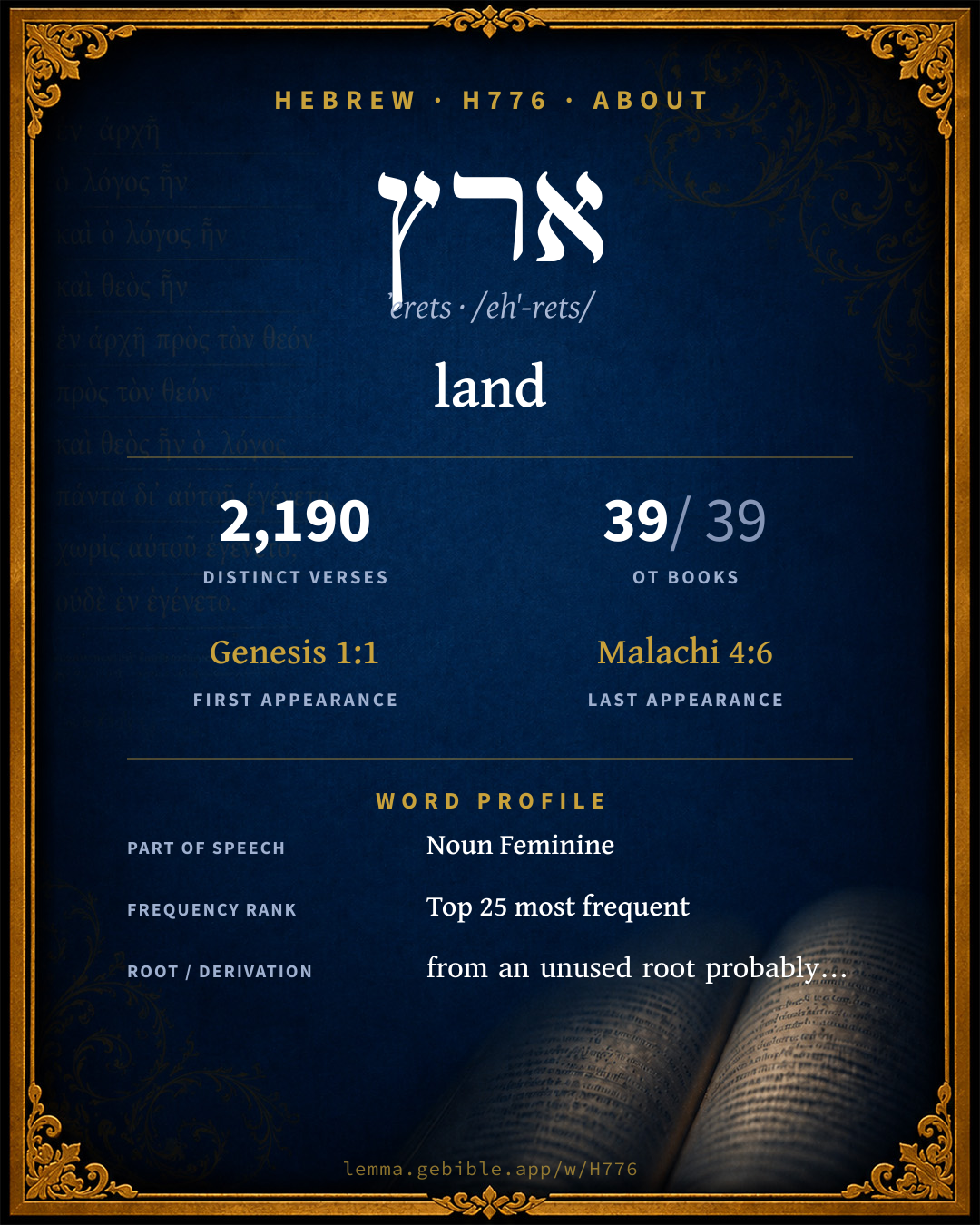
אֶ֫רֶץ
land
‘land’ is one of 4 main senses fuller range ↓
Full lexicon entry — Brown-Driver-Briggs (BDB)
From Brown-Driver-Briggs (BDB)
Where this word appears
See every Construct-state word in the Hebrew Bible →
Grammar key — what these labels mean
Part of speech
- Noun
- A naming word — a person, place, thing, or idea.
Noun type
- Common
- A common noun — a general class of person, place, or thing (“king,” “city,” “water”), not a specific name.
State
- Absolute
- The independent form of a noun, not bound to a following word.
- Construct
- A noun bound to a following noun in a possessive / “of” relationship (the construct chain).
Gender
- Both
- Attested as both masculine and feminine.
Number
- Singular
- One.
- Plural
- More than one (in Hebrew, generally three or more).
49 verses where H776 appears in the Absolute state in the Book of Exodus. Filtered view — show all forms. Click any verse to open its interlinear word-by-word view. Verse text shown in the World English Bible for context — . Each verse’s Hebrew form is shown with its reference; the English is not keyword-highlighted, since the data carries no word-level English alignment. Use “Compare translations” on any verse to read it across multiple English versions. This concordance covers the Hebrew Bible; Septuagint (Greek Old Testament) occurrences are not indexed here.
Exodus
- Exodus 1:7 הָ/אָ֖רֶץ ptcl def.art + n c bs The children of Israel were fruitful, and increased abundantly, and multiplied, and grew exceedingly mighty; and the land was filled with them.
- Exodus 1:10 הָ/אָֽרֶץ ptcl def.art + n c bs Come, let us deal wisely with them, lest they multiply, and it happen that when any war breaks out, they also join themselves to our enemies, and fight against us, and escape out of the land."
- Exodus 2:22 בְּ/אֶ֖רֶץ prep + n c bs She bore a son, and he named him Gershom, for he said, "I have lived as a foreigner in a foreign land."
- Exodus 3:8 הָ/אָ֣רֶץ אֶ֤רֶץ אֶ֛רֶץ ptcl def.art + n c bs n c bs n c bs I have come down to deliver them out of the hand of the Egyptians, and to bring them up out of that land to a good and large land, to a land flowing with milk and honey; to the place of the Canaanite, the Hittite, the Amorite, the Perizzite, the Hivite, and the Jebusite.
- Exodus 3:17 אֶ֤רֶץ אֶ֛רֶץ n c bs cs n c bs and I have said, I will bring you up out of the affliction of Egypt to the land of the Canaanite, the Hittite, the Amorite, the Perizzite, the Hivite, and the Jebusite, to a land flowing with milk and honey."'
- Exodus 4:3 אַ֔רְצָ/ה אַ֖רְצָ/ה n c bs + sfx dem n c bs + sfx dem He said, "Throw it on the ground." He threw it on the ground, and it became a snake; and Moses ran away from it.
- Exodus 5:5 הָ/אָ֑רֶץ ptcl def.art + n c bs Pharaoh said, "Behold, the people of the land are now many, and you make them rest from their burdens."
- Exodus 6:8 הָ/אָ֔רֶץ ptcl def.art + n c bs I will bring you into the land which I swore to give to Abraham, to Isaac, and to Jacob; and I will give it to you for a heritage: I am Yahweh.'"
- Exodus 8:14 הָ/אָֽרֶץ ptcl def.art + n c bs They gathered them together in heaps, and the land stank.
- Exodus 8:16 הָ/אָ֑רֶץ אֶ֥רֶץ ptcl def.art + n c bs n c bs cs Yahweh said to Moses, "Tell Aaron, 'Stretch out your rod, and strike the dust of the earth, that it may become lice throughout all the land of Egypt.'"
- Exodus 8:17 הָ/אָ֔רֶץ הָ/אָ֛רֶץ אֶ֥רֶץ ptcl def.art + n c bs ptcl def.art + n c bs n c bs cs They did so; and Aaron stretched out his hand with his rod, and struck the dust of the earth, and there were lice on man, and on animal; all the dust of the earth became lice throughout all the land of Egypt.
- Exodus 8:22 אֶ֣רֶץ הָ/אָֽרֶץ n c bs cs ptcl def.art + n c bs I will set apart in that day the land of Goshen, in which my people dwell, that no swarms of flies shall be there; to the end you may know that I am Yahweh in the midst of the earth.
- Exodus 8:24 אֶ֧רֶץ הָ/אָ֖רֶץ n c bs cs ptcl def.art + n c bs Yahweh did so; and there came grievous swarms of flies into the house of Pharaoh, and into his servants' houses: and in all the land of Egypt the land was corrupted by reason of the swarms of flies.
- Exodus 8:25 בָּ/אָֽרֶץ prep det + n c bs Pharaoh called for Moses and for Aaron, and said, "Go, sacrifice to your God in the land!"
- Exodus 9:5 בָּ/אָֽרֶץ prep det + n c bs Yahweh appointed a set time, saying, "Tomorrow Yahweh shall do this thing in the land."
- Exodus 9:14 הָ/אָֽרֶץ ptcl def.art + n c bs For this time I will send all my plagues against your heart, against your officials, and against your people; that you may know that there is none like me in all the earth.
- Exodus 9:15 הָ/אָֽרֶץ ptcl def.art + n c bs For now I would have put forth my hand, and struck you and your people with pestilence, and you would have been cut off from the earth;
- Exodus 9:16 הָ/אָֽרֶץ ptcl def.art + n c bs but indeed for this cause I have made you stand: to show you my power, and that my name may be declared throughout all the earth;
- Exodus 9:23 אָ֑רְצָ/ה אֶ֥רֶץ n c bs + sfx dem n c bs cs Moses stretched forth his rod toward the heavens, and Yahweh sent thunder, hail, and lightning flashed down to the earth. Yahweh rained hail on the land of Egypt.
- Exodus 9:29 הָ/אָֽרֶץ ptcl def.art + n c bs Moses said to him, "As soon as I have gone out of the city, I will spread abroad my hands to Yahweh. The thunders shall cease, neither shall there be any more hail; that you may know that the earth is Yahweh's.
- Exodus 9:33 אָֽרְצָ/ה n c bs + sfx dem Moses went out of the city from Pharaoh, and spread abroad his hands to Yahweh; and the thunders and hail ceased, and the rain was not poured on the earth.
- Exodus 10:5 הָ/אָ֔רֶץ הָ/אָ֑רֶץ ptcl def.art + n c bs ptcl def.art + n c bs and they shall cover the surface of the earth, so that one won't be able to see the earth. They shall eat the residue of that which has escaped, which remains to you from the hail, and shall eat every tree which grows for you out of the field.
- Exodus 10:12 אֶ֤רֶץ אֶ֣רֶץ הָ/אָ֔רֶץ n c bs cs n c bs cs ptcl def.art + n c bs Yahweh said to Moses, "Stretch out your hand over the land of Egypt for the locusts, that they may come up on the land of Egypt, and eat every herb of the land, even all that the hail has left."
- Exodus 10:13 אֶ֣רֶץ בָּ/אָ֔רֶץ n c bs cs prep det + n c bs Moses stretched forth his rod over the land of Egypt, and Yahweh brought an east wind on the land all that day, and all the night; and when it was morning, the east wind brought the locusts.
- Exodus 10:15 הָ/אָרֶץ֮ הָ/אָרֶץ֒ הָ/אָ֗רֶץ אֶ֥רֶץ ptcl def.art + n c bs ptcl def.art + n c bs ptcl def.art + n c bs n c bs cs For they covered the surface of the whole earth, so that the land was darkened, and they ate every herb of the land, and all the fruit of the trees which the hail had left. There remained nothing green, either tree or herb of the field, through all the land of Egypt.
- Exodus 12:19 הָ/אָֽרֶץ ptcl def.art + n c bs Seven days shall there be no yeast found in your houses, for whoever eats that which is leavened, that soul shall be cut off from the congregation of Israel, whether he be a foreigner, or one who is born in the land.
- Exodus 12:25 הָ/אָ֗רֶץ ptcl def.art + n c bs It shall happen when you have come to the land which Yahweh will give you, according as he has promised, that you shall keep this service.
- Exodus 12:33 הָ/אָ֑רֶץ ptcl def.art + n c bs The Egyptians were urgent with the people, to send them out of the land in haste, for they said, "We are all dead men."
- Exodus 12:48 הָ/אָ֑רֶץ ptcl def.art + n c bs When a stranger shall live as a foreigner with you, and will keep the Passover to Yahweh, let all his males be circumcised, and then let him come near and keep it; and he shall be as one who is born in the land: but no uncircumcised person shall eat of it.
- Exodus 13:5 אֶ֣רֶץ אֶ֛רֶץ n c bs cs n c bs It shall be, when Yahweh shall bring you into the land of the Canaanite, and the Hittite, and the Amorite, and the Hivite, and the Jebusite, which he swore to your fathers to give you, a land flowing with milk and honey, that you shall keep this service in this month.
- Exodus 14:3 בָּ/אָ֑רֶץ prep det + n c bs Pharaoh will say of the children of Israel, 'They are entangled in the land. The wilderness has shut them in.'
- Exodus 15:12 אָֽרֶץ n c bs You stretched out your right hand. The earth swallowed them.
- Exodus 16:14 הָ/אָֽרֶץ ptcl def.art + n c bs When the dew that lay had gone, behold, on the surface of the wilderness was a small round thing, small as the hoar-frost on the ground.
- Exodus 16:35 אֶ֣רֶץ אֶ֥רֶץ n c bs n c bs cs The children of Israel ate the manna forty years, until they came to an inhabited land. They ate the manna until they came to the borders of the land of Canaan.
- Exodus 18:3 בְּ/אֶ֖רֶץ prep + n c bs and her two sons. The name of one son was Gershom, for Moses said, "I have lived as a foreigner in a foreign land".
- Exodus 19:5 הָ/אָֽרֶץ ptcl def.art + n c bs Now therefore, if you will indeed obey my voice, and keep my covenant, then you shall be my own possession from among all peoples; for all the earth is mine;
- Exodus 20:4 בָּ/אָ֖רֶץ לָ/אָֽרֶץ prep det + n c bs prep det + n c bs "You shall not make for yourselves an idol, nor any image of anything that is in the heavens above, or that is in the earth beneath, or that is in the water under the earth:
- Exodus 20:11 הָ/אָ֗רֶץ ptcl def.art + n c bs for in six days Yahweh made heaven and earth, the sea, and all that is in them, and rested the seventh day; therefore Yahweh blessed the Sabbath day, and made it holy.
- Exodus 23:29 הָ/אָ֨רֶץ֙ ptcl def.art + n c bs I will not drive them out from before you in one year, lest the land become desolate, and the animals of the field multiply against you.
- Exodus 23:30 הָ/אָֽרֶץ ptcl def.art + n c bs Little by little I will drive them out from before you, until you have increased and inherit the land.
- Exodus 23:31 הָ/אָ֔רֶץ ptcl def.art + n c bs I will set your border from the Red Sea even to the sea of the Philistines, and from the wilderness to the River; for I will deliver the inhabitants of the land into your hand, and you shall drive them out before you.
- Exodus 31:17 הָ/אָ֔רֶץ ptcl def.art + n c bs It is a sign between me and the children of Israel forever; for in six days Yahweh made heaven and earth, and on the seventh day he rested, and was refreshed.'"
- Exodus 32:13 הָ/אָ֨רֶץ ptcl def.art + n c bs Remember Abraham, Isaac, and Israel, your servants, to whom you swore by your own self, and said to them, 'I will multiply your seed as the stars of the sky, and all this land that I have spoken of I will give to your seed, and they shall inherit it forever.'"
- Exodus 33:1 מֵ/אֶ֣רֶץ הָ/אָ֗רֶץ prep + n c bs cs ptcl def.art + n c bs Yahweh spoke to Moses, "Depart, go up from here, you and the people that you have brought up out of the land of Egypt, to the land of which I swore to Abraham, to Isaac, and to Jacob, saying, 'I will give it to your seed.'
- Exodus 33:3 אֶ֛רֶץ n c bs to a land flowing with milk and honey: for I will not go up in the midst of you, for you are a stiff-necked people, lest I consume you in the way."
- Exodus 34:8 אַ֖רְצָ/ה n c bs + sfx dem Moses hurried and bowed his head toward the earth, and worshiped.
- Exodus 34:10 הָ/אָ֖רֶץ ptcl def.art + n c bs He said, "Behold, I make a covenant: before all your people I will do marvels, such as have not been worked in all the earth, nor in any nation; and all the people among which you are shall see the work of Yahweh; for it is an awesome thing that I do with you.
- Exodus 34:12 הָ/אָ֔רֶץ ptcl def.art + n c bs Be careful, lest you make a covenant with the inhabitants of the land where you are going, lest it be for a snare in the midst of you:
- Exodus 34:15 הָ/אָ֑רֶץ ptcl def.art + n c bs Don't make a covenant with the inhabitants of the land, lest they play the prostitute after their gods, and sacrifice to their gods, and one call you and you eat of his sacrifice;
About this entry
At a glance — auto-summarized from this page’s data, not written by a person. Every figure links to its source below. This summary describes the numbers; it doesn’t interpret them.
At its core, ארץ (ʼerets) means “land.” Carrying more than one sense, it rewards its full sense range. Spanning 2,190 verses in 39 books, it ranks among the most common words of the Hebrew Bible. Scripture first uses it in Genesis 1:1. From the same root come ארע and ארצא. See the sense tree, 2,190-verse concordance, and the renderings breakdown below.
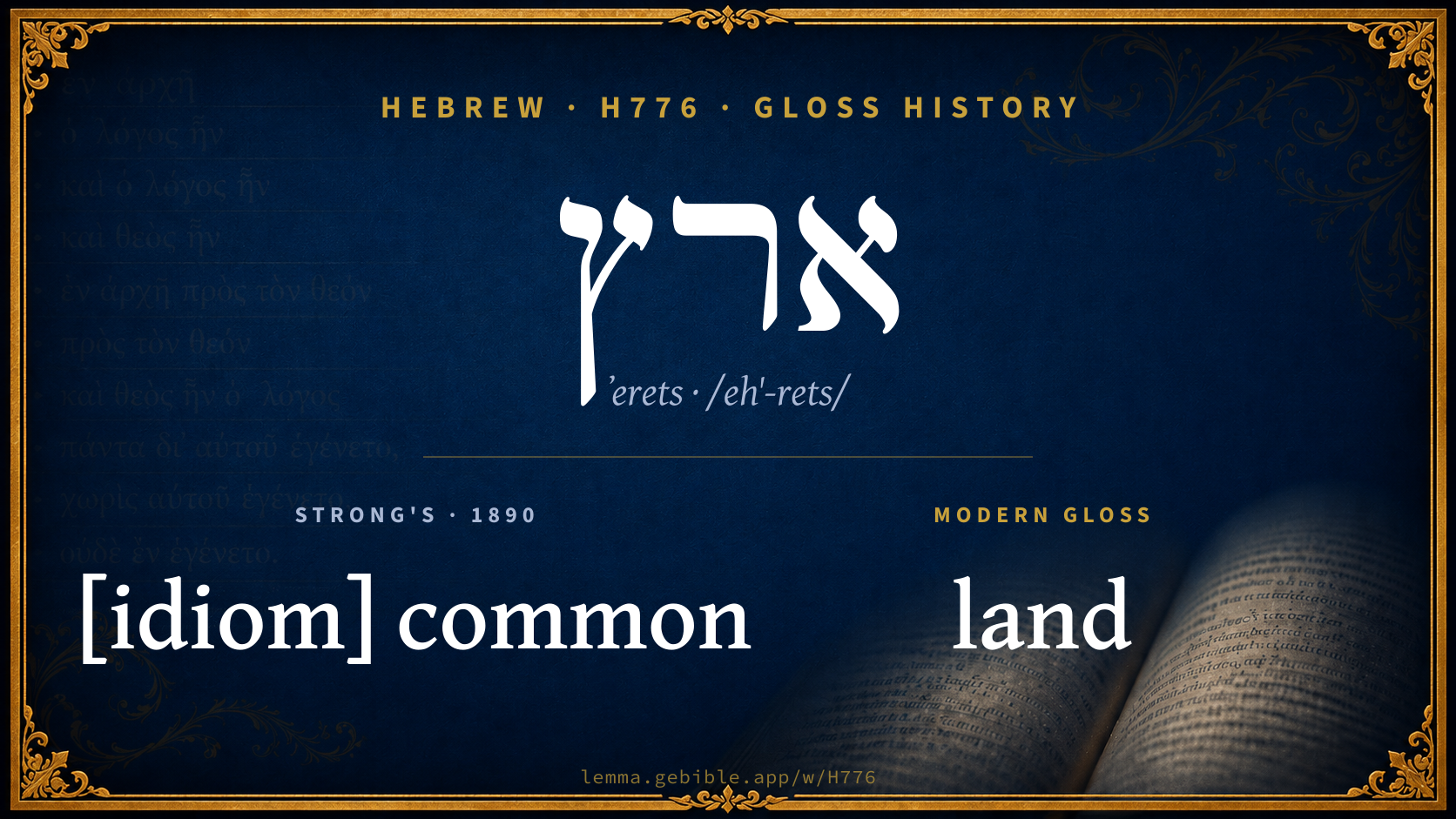
Gloss history
Strong's 1890 vs modern scholarship
About this word
Strong's H776 catalogs a Hebrew word from the Hebrew Old Testament.
These counts are not copied from any lexicon or concordance. They are computed here, from the morphology-tagged Hebrew Old Testament. What Lemma adds →
- 2,190
- distinct verses
- The word appears in 2,190 distinct verses.
- 39 / 39
- OT books
- The word appears in 39 of 39 Old Testament books.
- #17
- by frequency
- Top 25 most frequent Hebrew words (rank 17 of 8,640 Hebrew words by occurrence).
View all 2,190 occurrences in the concordance →
By section of the Old Testament
By traditional corpus
Conventional, traditional groupings — biblical authorship is debated, so this is a traditional corpus grouping, not an authorship claim. Each share is this word’s portion of its verses in that division of the Hebrew canon. Each figure is a share of the word’s 2,190 distinct verses.
- Prophets (Nevi'im) 1,038 verses · 47%
- Torah (Pentateuch) 705 verses · 32%
- Writings (Ketuvim) 447 verses · 20%
How translations render this word
Counts come from each version’s own published word-to-Strong’s tagging or interlinear alignment — an approximate guide to how each version renders this word, not a word-level alignment the data otherwise carries. Because each total is that version’s own tagged count, the per-version totals vary from one another and need not match the appearance or distinct-verse counts above. These counts may also differ from a printed concordance because Lemma counts each distinctly tagged rendering and does not collapse phrase taggings into a single head-word total. This is a fixed set of word-tagged versions (KJV, ASV, BSB, ULT) and does not change with the reading translation you choose elsewhere. Each version’s license is shown beside its name below (and on Sources).
- King James Version: Land 1,210×, Earth 543×, Ground 82×
- American Standard Version: Land 1,137×, Earth 505×, Ground 73×
- Berean Standard Bible: Land 1,415×, Earth 544×, Ground 117×
- unfoldingWord Literal Text: Land 994×, Earth 596×, Land of 491×
King James Version Public Domain
Renders H776 across 2,504 tagged occurrences — most commonly:
Plus other, less common renderings. Plus 180 renderings that appear only once — usually multi-word phrases or single function words the recovered tagging swept in, not distinct renderings.
American Standard Version Public Domain
Renders H776 across 2,502 tagged occurrences — most commonly:
Plus other, less common renderings. Plus 304 renderings that appear only once — usually multi-word phrases or single function words the recovered tagging swept in, not distinct renderings.
Berean Standard Bible Public Domain
Renders H776 across 2,375 tagged occurrences — most commonly:
Plus other, less common renderings. Plus 82 renderings that appear only once — usually multi-word phrases or single function words the recovered tagging swept in, not distinct renderings. Not rendered by a distinct English word in 108 further occurrences.
unfoldingWord Literal Text CC BY-SA 4.0
Renders H776 across 2,463 tagged occurrences — most commonly:
Plus other, less common renderings. Plus 60 renderings that appear only once — usually multi-word phrases or single function words the recovered tagging swept in, not distinct renderings.
18 senses and sub-senses in the full BDB
What do BDB’s symbols mean?
BDB uses these scholarly abbreviations:
| Symbol | Meaning |
|---|---|
| 𝔊 | the Septuagint (the ancient Greek translation, LXX) |
| 𝔙 | the Vulgate (the Latin translation) |
| 𝔖 | the Syriac version (the Peshitta) |
| 𝔗 | the Targum (the Aramaic translation) |
| ψ | the Psalms |
| √ | root (the underlying root or stem) |
| ‖ | parallel passage (a synonymous or contrasted parallel) |
| † | the dagger: every passage where the word occurs is cited |
The 18 senses and sub-senses the full Brown-Driver-Briggs lexicon distinguishes for this word, in lexicon order (not ranked by frequency), with BDB’s own verbatim wording and sub-sense lettering. Shown in Hebrew script with BDB’s own scholarly abbreviations. The condensed entry is in the Lexicon Entry tab. See also the Forms in the corpus table below.
- 1.
- a. earth, whole earth (opp. to a part) Gn 18:18, 25; 22:18 (= הָאֲדָמָה 12:3) Je 25:26, 29, 30; 26:6 Is 37:16, 20 = 2 K 19:15, 19 Zc 4:10, 14 +. e.g. Genesis 18:18
- b. earth, opp. to heaven, sky Gn 1:2 Ex 20:4 Dt 5:8; 30:19 Ju 5:4 La 2:1 Is 37:16 = 2 K 19:15 ψ 146:6 1 Ch 21:16; 29:11 2 Ch 2:11 +; as permanent Ec 1:4; built on foundations, or pillars 1 S 2:8 ψ 104:5 Jb 38:4 Is 48:13; 51:13, 16 cf. also Is 24:18 ψ 82:5; firm, so that its shaking is something terrible, & token of terrible power 1 S 14:5 2 S 22:8 = ψ 18:8 Jb 9:6 cf. ψ 46:3 & v 7; so also Am 8:8 Is 2:19, 21; 24:18, 19, 20 ψ 60:4; 77:19; 99:1; 114:7; as hung on nothing Jb 26:7; with waters under it Ex 20:4 = Dt 5:8 cf. Gn 7:11; personified, especially as addressed, called to witness, etc. Dt 32:1 Je 6:19; 22:29 Is 1:2 Mi 1:2 Jb 16:18. e.g. Genesis 1:2
- c. earth = inhabitants of earth Gn 6:11; 11:1 1 K 2:2; 10:24 ψ 33:8; 66:4 + cf. תֵּבֵל א׳ Pr 8:31 Jb 37:12. e.g. Genesis 6:11
- 2. land =
- a. country, territory, א׳ שִׁנְעָר Gn 10:10, א׳ מִצְרַיִם 21:21; cf. also 10:11; 11:28, 31; 13:10; 47:6, 27; 50:8 Is 7:18; 23:1, 13; 27:13 ψ 78:12 Je 25:20 1 Ch 1:43; personif. Is 62:4 Ec 10:16, 17. e.g. Genesis 10:10
- b. district, region Gn 19:28; 22:2 Jos 11:3 ψ 42:7. e.g. Genesis 19:28
- c. tribal territory Dt 34:2 Ju 21:21 1 S 9:4, 16; 13:7 1 K 15:20 Is 8:23; and still smaller territories 1 S 9:4, 5. e.g. Deuteronomy 34:2
- d. piece of ground Gn 23:15. e.g. Genesis 23:15
- e. specif. land of Canaan, or Israel Gn 11:31; 12:1, 5, 6, 7; 31:3 Lv 14:34 Dt 17:14; 18:9 2 K 5:2, 4 +; especially obj. of יָרַשׁ possess Dt 3:20 + often Dt ψ al.; so after נָחַל Jos 19:49 +; נָתַן Dt 1:21 +. f. = inhabitants of land Lv 19:29 Ez 14:13 + cf. Dt 24:4 Zc 12:12 etc. g. used even of Sheʾôl Jb 10:21, 22 (cf. Assyrian irṣit la târat, land without return, in Descent of Ishtar, v. Jr 10.65); v. also ψ 139:15 Is 44:23. e.g. Genesis 11:31
- 3.
- a. ground, surface of ground = אֲדָמָה q.v. Gn 1:26, 30; 18:2; 33:3; 38:9 Ex 4:3; 16:14 Ru 2:10 1 S 5:4 + very often in S. e.g. Genesis 1:26
- b. soil, as productive = אֲדָמָה Gn 1:11, 12 Lv 19:9; 25:19; 26:4 cf. Nu 14:7, 8 Is 36:17 = 2 K 18:32 ψ 72:6, 16; 107:34, 35 Ezr 9:12 Ne 9:35. e.g. Genesis 1:11
- 4. אֶרֶץ in phrases:
- a. people of the land עַם־הָא׳ of non-Israelites Gn 23:7, 12, 13 (P) Nu 14:9 (JE); as well as Isr. Lv 20:4 (H) 2 K 15:5; 16:15; 21:24(×2); especially common people, opp. officials, princes Lv 4:27 (P) Ez 7:27 2 K 11:18, 19. e.g. Genesis 23:7
- b. in measurements of distance, כִּבְרַת הָא׳ the space or distance of country (v. כּברה) Gn 35:16, so כִּבְרַת א׳ some distance Gn 48:7 2 K 5:19. e.g. Genesis 35:16
- c. אֶרֶץ הַמִּישׁוֹר the country of the plain, level or plain country Dt 4:33 Je 48:21; א׳ מִישׁוֹר fig. ψ 143:10 (but read אֹרַח 𝔖 Bi Gr Che, cf. ψ 27:11). e.g. Deuteronomy 4:33
- d. א׳חַיִּים land of the living ψ 27:13; א׳ הַחַיִּים ψ 142:6 +. e.g. Psalms 27:13
- e. קְצֵה הָא׳ end(s) of the earth Is 42:10; 43:6 (‖ רָחוֹק) ψ 135:7 Pr 17:24, so אַפְסֵי א׳ Pr 30:4 +; קְצוֹת הָא׳ Is 40:28; 41:5, 9. e.g. Isaiah 42:10
- 5. pl. אֲרָצוֹת is almost wholly late, Je 16:15 + 6 times Je; 23 times Ez; Is 36:20; 37:11 = 2 K 18:35; 19:11 (Is 37:18 read הַגּוֹיִם v. Che Di & cf. 2 K 19:17); 22 times Chr; Dn 9:7; 11:40, 42; ψ 105:44; 106:27; 107:3; 116:9; besides these only P Gn 10:5, 20, 31 Lv 26:36, 39, except Gn 26:3, 4 (JR) 41:54 (JE); it denotes lands, countries, often in contrast to Canaan, lands of the nations, etc., v. especially abs. Ez 20:32; 22:4; = the various petty divisions of Canaan afterward united under Israel’s control Gn 26:3, 4, cf. 1 Ch 13:2 אַרְצוֹת יִשְׂרָאֵל, 2 Ch 11:23 אַרְצוֹת יְהוּדָה. e.g. Jeremiah 16:15
Senses from the full Brown-Driver-Briggs lexicon (Brown, Driver, Briggs; Oxford 1906 — public domain), digitized via Sefaria, supplemented by the OpenScriptures HebrewLexicon (CC BY 4.0). Full attribution on Sources.
Word origin
n.f. Gn 10:11 & (seld.) m. Ez 21:24 earth, land (Ph. MI ארץ, Assyrian irṣitu COTGloss, Arabic أَرْضٌ, Sab. ארץֿ e.g. Os 9 DHMZMG 1875, 594, 614; Sem. Sprachf. 12, cf. PräBAS i. 374 n., Aramaic אֲרַע, ܐܰܪܥܳܐ )—א׳ abs. Gn 1:24 +; cstr. 2:11 +; אָ֑רֶץ 1:10 +; c. art. always הָאָ֫רֶץ 1:11 +; c. ה—ָloc. אַ֫רְצָה 11:31 +, (poet. = אָרֶץ Jb 34:13; cf. 1 S 25:23 1 K 1:31); sf. אַרְצִי 20:15 + אַרְצְךָ (אַרְצֶ֑ךָ) 12:1 +, etc.; pl. אֲרָצוֹת Je 28:8 + 65 times; cstr. אַרְצוֹת Ez 39:27 + 6 times; sf. אַרְצֹתָם Gn 10:5 + 2 times;—
— Brown-Driver-Briggs (Oxford 1906, public domain), digitized via Sefaria, supplemented by the OpenScriptures HebrewLexicon (CC BY 4.0). See Sources.
Origin: from an unused root probably meaning to be firm
Jastrow Dictionary
A second Hebrew/Aramaic lexicon for comparison, covering Aramaic and post-biblical (Talmudic, Targumic, Midrashic) usage that the biblical-Hebrew BDB does not. Matched by lemma rather than by Strong’s number, so a lemma may carry more than one Jastrow headword (shown separately below), and the entries cover usage well beyond the Bible.
אֶרֶץ
- רצץ; Ch. a. oth. dial. ארע fr. רעע to press together, stamp—from the rugged appearance of the surface after the subsidence of the waters) earth, dry land; country, land, field (opp. to town). Ex. R. s. 13 … threw dust upon the waters ונעשה א׳ and earth (crust) was formed.—א׳ ישראל (abbr. א"י) Palestine, opp. חוצה לָאָ׳, or מדינת הים foreign countries, or distant countries. Gitt. I, 2. Ib. 6ᵃ; a. fr.—הָאָרֶץ Palestine, Ḥull. 16ᵇ משנכנסו לא׳ since entering Palestine (under Joshua); a. fr.—עם הָאָ׳ (abbr. ע"ה) country people, hence illiterate, coarse, unrefined (often applied to an individual); pl. עַמֵּי הא׳, opp. תלמיד חכם. Sabb. 63ᵃ. Ḥull. 92ᵃ; a. v. fr.—Esp. ע"ה those not observing certain religious customs regarding tithes, levitical cleanness &c., opp. חָבֵר q. v. Dem. I, 2; a. fr.—Pl. אֲרָצוֹת. Shebi. IX, 2 שלש א׳ וכ׳ Palestine is divided into three countries with reference to the laws of the Sabbath year. Keth. 111ᵃ; a. e., v. עִיסָה; a. fr.
A Dictionary of the Targumim, the Talmud Babli and Yerushalmi, and the Midrashic Literature (Marcus Jastrow; London, Luzac, 1903) — Public Domain. Digitized via Sefaria. Digitized via Sefaria. Full attribution on Sources.
Forms in the corpus
The 297 distinct written forms H776 takes in the Hebrew Bible, most frequent first — each parse links to that state’s occurrences in the concordance. Hebrew forms include their vowel points and cantillation, so a single lemma takes many written forms.
The 60 most common forms are shown; 237 rarer forms follow in the full concordance.
Same root — word family
Other BDB entries built from the same root as H776, grouped by Strong’s listed origin. These share a root / origin per the lexicon — not necessarily a shared meaning. Each links to that word’s own entry.
Derived from this word
Proper names from this root
People and places named from this root — a name, not an additional meaning of the word.
Compare all same-root words → 1 of the same-root words is a proper name (a person or place). They share a root, not necessarily a meaning.
Septuagint verse parallels
This word appears in 2,063 verses that also exist in the Greek Old Testament (Septuagint), out of the 2,190 Hebrew verses it occurs in. You can read those verses in Greek by switching the Old Testament edition to the Septuagint.
Read these verses in the Septuagint
- Genesis 1:1
- Exodus 1:7
- Leviticus 4:27
- Numbers 1:1
- Deuteronomy 1:5
- Joshua 1:2
- Judges 1:2
- Ruth 1:1
- 1 Samuel 2:8
- 2 Samuel 1:2
- 1 Kings 1:23
- 2 Kings 2:15
This is a verse-level parallel only — the same verses exist in both the Hebrew and Greek Old Testaments. No word-level Hebrew↔Greek correspondence is claimed: the data carries no such alignment, so no Greek word is shown as this Hebrew word’s translation. Coverage is not total — the Septuagint omits the deuterocanon and renumbers the Psalms, so some Hebrew verses have no direct Greek parallel.