
Exodus 16:35

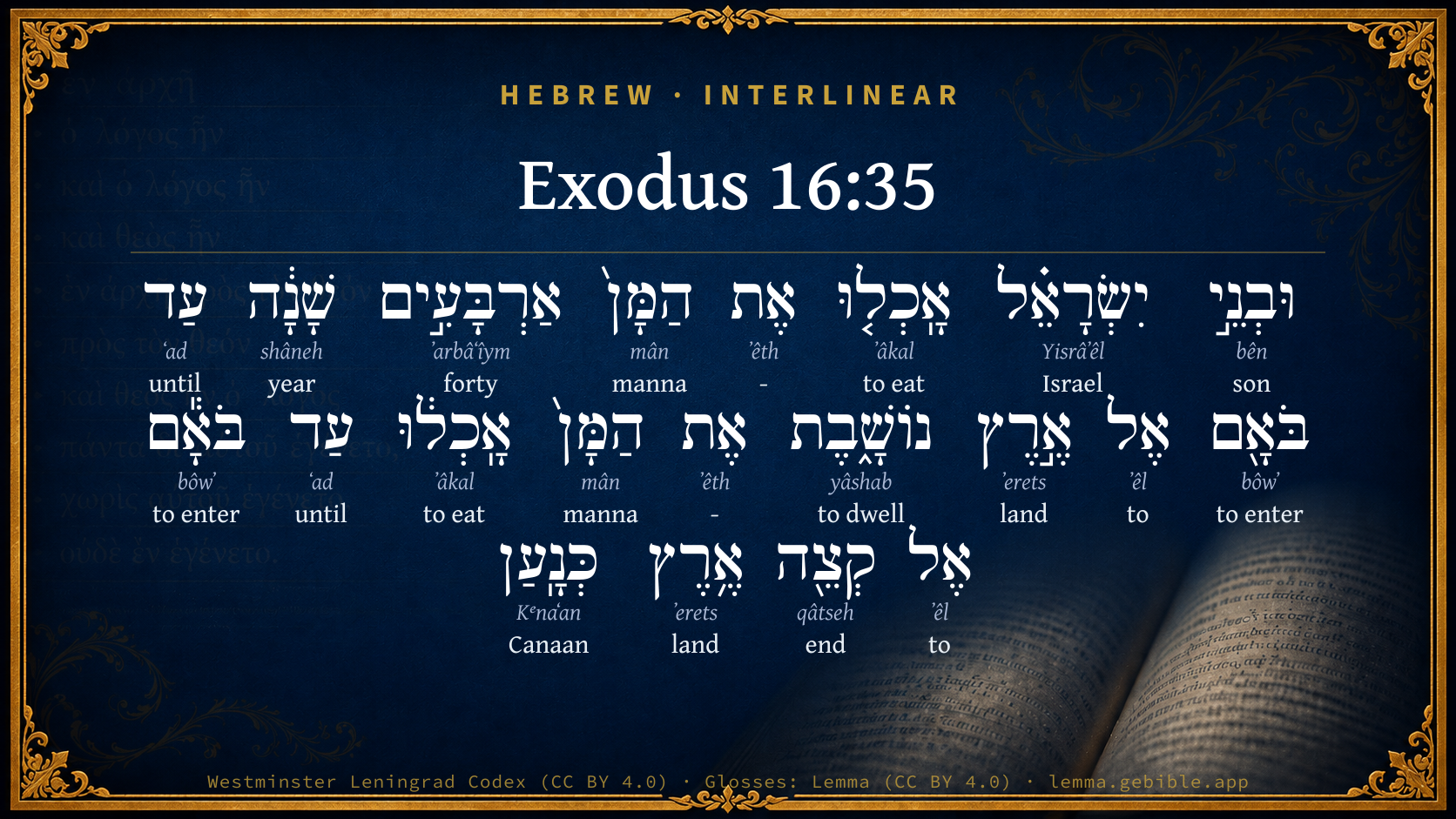
Hebrew (Westminster Leningrad Codex) Exodus 16:35 appears in the Hebrew Old Testament. The text above is from the Westminster Leningrad Codex. Each word links to its Strong’s number, a concise gloss, and parsing drawn from the Open Scriptures Hebrew Bible morphology. Click any word for its full Brown-Driver-Briggs (BDB) entry.
Download image
Cite this verse

Exodus 16:35 (World English Bible). Public Domain. Lemma interlinear Bible study tool, https://lemma.gebible.app/v/exodus/16/35.

Show BibTeX & RIS
BibTeX
RIS
English Translation
The children of Israel ate the manna forty years, until they came to an inhabited land. They ate the manna until they came to the borders of the land of Canaan.
World English Bible · Public Domain
Download a study sheet

One document with this verse’s original text, its word-by-word gloss line, the meaning frame, cross-references with their text, attributed commentary, and full source and license credits — printable, and it pastes into notes with its structure intact.

This verse Autodidact and up

Study sheet (.html) Plain text (.txt)

A passage Seminary Student

Up to 50 verses in one chapter. A passage sheet keeps up to 6 commentary sources and 12 cross-references per verse, in the order this page ranks them, and says so on the sheet whenever that leaves anything out. Ask for a single verse and you get the Autodidact verse sheet above.

Everything on this page stays free to read, with no account — the sheet is a download of what is already on screen, not access to it.

Want to remove ads? Support Godless Engineer
Compare translations 3

The same verse in 3 English versions, stacked beneath the original-language interlinear above. Click any original word for its lexicon entry.

Each is an independent rendering of the whole verse — the interlinear is not word-aligned to these translations.

Highlighted words mark where these versions differ — a whole-verse word diff, not a word-by-word alignment.

  • World English Bible Public Domain
    The children of Israel ate the manna forty years, until they came to an inhabited land. They ate the manna until they came to the borders of the land of Canaan.
  • King James Version Public Domain
    And the children of Israel did eat manna forty years, until they came to a land inhabited; they did eat manna, until they came unto the borders of the land of Canaan.
  • unfoldingWord Literal Text CC BY-SA 4.0
    And the sons of Israel ate manna 40 years, until they came to inhabited land. They ate manna until they came to the borders of the land of Canaan.

unfoldingWord Literal Text — © unfoldingWord, licensed CC BY-SA 4.0. Word-aligned USFM3 via Door43 (git.door43.org/unfoldingWord/en_ult).

Versions to compare (up to 4)

3 of 4 selected

Show all 18 translations

Every available English version of this verse, each an independent rendering of the whole verse.

  • World English Bible Public Domain
    The children of Israel ate the manna forty years, until they came to an inhabited land. They ate the manna until they came to the borders of the land of Canaan.
  • Berean Standard Bible Public Domain
    The Israelites ate manna forty years, until they came to a land where they could settle; they ate manna until they reached the border of Canaan.
  • Majority Standard Bible Public Domain
    The Israelites ate manna forty years, until they came to a land where they could settle; they ate manna until they reached the border of Canaan.
  • King James Version Public Domain
    And the children of Israel did eat manna forty years, until they came to a land inhabited; they did eat manna, until they came unto the borders of the land of Canaan.
  • American Standard Version (1901) Public Domain
    And the children of Israel did eat the manna forty years, until they came to a land inhabited; they did eat the manna, until they came unto the borders of the land of Canaan.
  • Revised Version (1885) Public Domain
    And the children of Israel did eat the manna forty years, until they came to a land inhabited; they did eat the manna, until they came unto the borders of the land of Canaan.
  • Geneva Bible (1599) Public Domain
    And the children of Israel did eate MAN fourtie yeres, vntill they came vnto a land inhabited: they did eate MAN vntill they came to the borders of the land of Canaan.
  • Douay-Rheims (1899) Public Domain
    And the children of Israel ate manna forty years, till they came to a habitable land: with this meat were they fed, until they reached the borders of the land of Chanaan.
  • Young's Literal Translation Public Domain
    And the sons of Israel have eaten the manna forty years, until their coming in unto the land to be inhabited; the manna they have eaten till their coming in unto the extremity of the land of Canaan.
  • Literal Standard Version CC BY-SA 4.0
    And the sons of Israel have eaten the manna [for] forty years, until their coming to the land to be inhabited; they have eaten the manna until their coming to the extremity of the land of Canaan.
  • Unlocked Literal Bible CC BY-SA 4.0
    The people of Israel ate manna forty years until they came to inhabited land. They ate it until they came to the borders of the land of Canaan.
  • unfoldingWord Literal Text CC BY-SA 4.0
    And the sons of Israel ate manna 40 years, until they came to inhabited land. They ate manna until they came to the borders of the land of Canaan.
  • Darby Bible Public Domain
    And the children of Israel ate the manna forty years, until they came into an inhabited land: they ate the manna until they came to the borders of the land of Canaan.
  • World Messianic Bible Public Domain
    The children of Israel ate the manna forty years, until they came to an inhabited land. They ate the manna until they came to the borders of the land of Canaan.
  • Webster's Bible Public Domain
    And the children of Israel ate manna forty years, until they came to a land inhabited: they ate manna, until they came to the borders of the land of Canaan.
  • Free Bible Version CC BY-SA 4.0
    The Israelites ate manna forty years, until they came to the land where they would settle down—they ate manna until they arrived at the border of Canaan.
  • Bible in Basic English Public Domain
    And the children of Israel had manna for their food for forty years, till they came to a land with people in it, till they came to the edge of the land of Canaan.
  • JPS Tanakh (1917) Public Domain
    And the children of Israel did eat the manna forty years, until they came to a land inhabited; they did eat the manna, until they came unto the borders of the land of Canaan.

Literal Standard Version (2020), Covenant Press — licensed CC BY-SA 4.0. Text via the HelloAO Bible API (eBible.org). Unlocked Literal Bible (unfoldingWord) — licensed CC BY-SA 4.0. Text via the HelloAO Bible API (eBible.org). unfoldingWord Literal Text — © unfoldingWord, licensed CC BY-SA 4.0. Word-aligned USFM3 via Door43 (git.door43.org/unfoldingWord/en_ult). Free Bible Version, Dr. Jonathan Gallagher — licensed CC BY-SA 4.0. Text via the HelloAO Bible API (eBible.org).

Word by word

More ways to search: Search by grammar → Find every occurrence → Compare this word →

Practice this passage: Drill this verse → Learn its vocabulary →

הַמָּן֙
mân
H4478
“the · manna”
Particle, Definite Article + Noun, Common, Masculine, Singular, Absolute
Part of Speech
Particle + Noun
Type
Common
Gender
Masculine
Number
Singular
State
Absolute
Full BDB Definition

Origin: from H4100

TWOT: 1208 , 1209

manna - the bread from Heaven that fed the Israelites for 40 years of wilderness wanderings - means 'What is it?'
  1. וּבְנֵ֣י bên H1121 “and · sons of” Conjunction + Noun, Common, Masculine, Plural, Construct
  2. יִשְׂרָאֵ֗ל Yisrâʼêl H3478 “Israel” Noun, Proper
  3. אָֽכְל֤וּ ʼâkal H398 “to eat” Verb, Qal, Perfect, 3rd Person, Common, Plural
  4. אֶת ʼêth H853 “-” Particle, Direct Object
  5. אַרְבָּעִ֣ים ʼarbâʻîym H705 “forty” Adjective, Cardinal number, Both, Plural, Absolute
  6. שָׁנָ֔ה shâneh H8141 “year” Noun, Common, Feminine, Singular, Absolute
  7. עַד ʻad H5704 “until” Preposition
  8. בֹּאָ֖ם bôwʼ H935 “to enter · them” Verb, Qal, Infinitive Construct + Suffix, Personal, 3rd Person, Masculine, Plural
  9. אֶל ʼêl H413 “to” Preposition
  10. אֶ֣רֶץ ʼerets H776 “land” Noun, Common, Both, Singular, Absolute
  11. נוֹשָׁ֑בֶת yâshab H3427 “dwelling” Verb, Niphal, Participle Active, Feminine, Singular, Absolute
  12. אֶת ʼêth H853 “-” Particle, Direct Object
  13. הַמָּן֙ mân H4478 “the · manna” Particle, Definite Article + Noun, Common, Masculine, Singular, Absolute
  14. אָֽכְל֔וּ ʼâkal H398 “to eat” Verb, Qal, Perfect, 3rd Person, Common, Plural
  15. עַד ʻad H5704 “until” Preposition
  16. בֹּאָ֕ם bôwʼ H935 “to enter · them” Verb, Qal, Infinitive Construct + Suffix, Personal, 3rd Person, Masculine, Plural
  17. אֶל ʼêl H413 “to” Preposition
  18. קְצֵ֖ה qâtseh H7097 “end of” Noun, Common, Both, Singular, Construct
  19. אֶ֥רֶץ ʼerets H776 “land of” Noun, Common, Both, Singular, Construct
  20. כְּנָֽעַן Kᵉnaʻan H3667 “Canaan” Noun, Proper

About this verse

These counts appear in no published source. They are computed here, from the morphology-tagged text and Lemma’s own curated glosses. What Lemma adds →

21
words
14
distinct lemmas
Pentateuch
section

Notable vocabulary

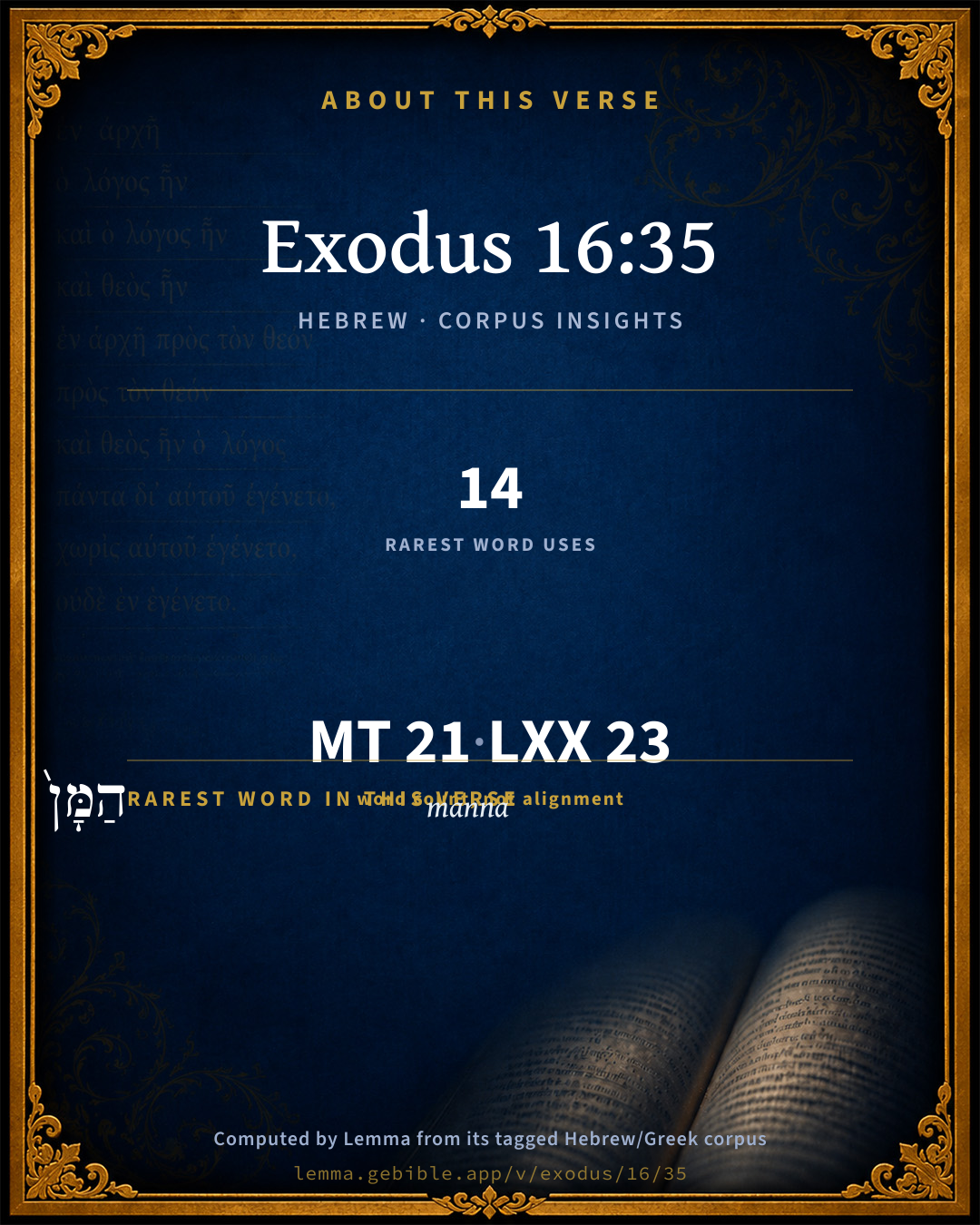
The rarest word here is הַמָּן֙ manna H4478 — appearing just 14 times in the whole Hebrew Bible.

Shared distinctive vocabulary

הַמָּן֙ manna H4478 occurs in 12 verses of the Hebrew Bible. Also found in:

Grammatical profile

  • 5 verbs
  • 9 nouns
  • 1 adjective
  • 4 prepositions
  • 2 particles

Verb forms

  • אָֽכְל֤וּ Qal · Perfect
  • בֹּאָ֖ם Qal · Infinitive Construct
  • נוֹשָׁ֑בֶת Niphal · Participle Active
  • אָֽכְל֔וּ Qal · Perfect
  • בֹּאָ֕ם Qal · Infinitive Construct

Repetition

Words recur within this verse — often emphatic in Hebrew:

  • אָֽכְל֤וּ to eat H398 ×2
  • הַמָּן֙ manna H4478 ×2
  • עַד until H5704 ×2
  • בֹּאָ֖ם to enter H935 ×2
  • אֶ֣רֶץ land H776 ×2
  • אֶל to H413 ×2

Hebrew & Septuagint length

In English translation the verse runs 31 words from the Hebrew and 27 from the Septuagint (LXX English) — closely comparable.

A rough comparison of the two English renderings, which tokenize alike — not a word-level alignment.

Word counts can differ between the Hebrew and the Greek without any difference in meaning — e.g. the Hebrew direct-object marker אֵת has no separate Greek word, and Greek often adds the article ὁ.

In the original languages it is 21 Hebrew tokens and 23 Greek tokens — but the two are counted differently (Hebrew bundles its prefixes and suffixes into one token; the Greek is in lemma form), so that isn’t a like-for-like length.

Cross-references

10

Topical passages linked to Exodus 16:35 in the Treasury of Scripture Knowledge — connected by theme and wording, ordered by reader-vote popularity; previews shown in the World English Bible.

  • Joshua 5:12 The manna ceased on the next day, after they had eaten of the produce of the land; neither had the children of Israel manna any more; but they ate of the fruit of the land of Canaan that year.
  • Nehemiah 9:20–21 You gave also your good Spirit to instruct them, and didn't withhold your manna from their mouth, and gave them water for their thirst.
  • Deuteronomy 8:2–3 You shall remember all the way which Yahweh your God has led you these forty years in the wilderness, that he might humble you, to prove you, to know what was in your heart, whether you would keep his commandments, or not.
  • John 6:30–58 They said therefore to him, "What then do you do for a sign, that we may see, and believe you? What work do you do?
  • Numbers 33:38 Aaron the priest went up into Mount Hor at the commandment of Yahweh, and died there, in the fortieth year after the children of Israel were come out of the land of Egypt, in the fifth month, on the first day of the month.
  • Deuteronomy 1:8 Behold, I have set the land before you: go in and possess the land which Yahweh swore to your fathers, to Abraham, to Isaac, and to Jacob, to give to them and to their seed after them.
  • Psalms 78:24–25 He rained down manna on them to eat, And gave them food from the sky.
  • Numbers 33:48–50 They traveled from the mountains of Abarim, and encamped in the plains of Moab by the Jordan at Jericho.
  • Deuteronomy 34:1–4 Moses went up from the plains of Moab to Mount Nebo, to the top of Pisgah, that is over against Jericho. Yahweh shown him all the land of Gilead, to Dan,
  • Nehemiah 9:15 and gave them bread from the sky for their hunger, and brought forth water for them out of the rock for their thirst, and commanded those who they should go in to possess the land which you had sworn to give them.

Cross-references courtesy of OpenBible.info (CC BY 4.0).

Hebrew and Greek witnesses Masoretic Hebrew ↔ Greek Septuagint

The same verse in the two great witnesses to the Old Testament, shown verse-for-verse.

These are two independent witnesses, not word-aligned to each other, and the Septuagint is shown in lemma (dictionary) form.

Hebrew Exodus 16:35 Masoretic · Westminster Leningrad Codex

וּבְנֵ֣י יִשְׂרָאֵ֗ל אָֽכְל֤וּ אֶת הַמָּן֙ אַרְבָּעִ֣ים שָׁנָ֔ה עַד בֹּאָ֖ם אֶל אֶ֣רֶץ נוֹשָׁ֑בֶת אֶת הַמָּן֙ אָֽכְל֔וּ עַד בֹּאָ֕ם אֶל קְצֵ֖ה אֶ֥רֶץ כְּנָֽעַן

The children of Israel ate the manna forty years, until they came to an inhabited land. They ate the manna until they came to the borders of the land of Canaan.

World English Bible · Public Domain

Greek LXX Exodus 16:35 Septuagint · lemma form

ὁ δέ υἱός ἰσραήλ ἐσθίω ὁ μαν ἔτος τεσσαράκοντα ἕως ἔρχομαι εἰς γῆ οἰκέω ὁ μαν ἐσθίω ἕως παραγίγνομαι εἰς μέρος ὁ φοινίκη

And the children of Israel ate manna forty years, until they came to the land they ate the manna, until they came to the region of Phoenicia.

LXX2012 (modern English Septuagint) · Public Domain

Hebrew: Westminster Leningrad Codex (CC BY 4.0). Greek: Septuagint (public domain); English from LXX2012 (modern English Septuagint) (Public Domain). How the Septuagint differs from the Hebrew →

Targum (Aramaic paraphrase)

2

The Targum is the ancient Jewish Aramaic paraphrase of the Hebrew Scriptures — an interpretive translation, not the Hebrew text itself. Onkelos (literal) and Pseudo-Jonathan (expansive) render the Torah, and Jonathan the Prophets. Coverage is partial: where no permissively-licensed English translation exists for a verse, only the Aramaic is shown. This is verse-level text, not a word-by-word alignment to the Hebrew.

  1. Targum Onkelos Torah (Genesis–Deuteronomy)
    וּבְנֵי יִשְׂרָאֵל אֲכָלוּ יָת מַנָא אַרְבְּעִין שְׁנִין עַד דְמֵיתֵיהוֹן לְאַרְעָא יָתְבָתָא יָת מַנָא אֲכָלוּ עַד דְאָתוֹ לִסְיָפֵי אַרְעָא דִכְנָעַן:

    (no public-domain English translation for this verse)

    Targum Onkelos — Aramaic: “Onkelos Genesis” (public domain); “Onkelos Exodus” (public domain); “Onkelos Leviticus” (public domain); “Onkelos Numbers” (public domain); “Onkelos Deuteronomy” (public domain). English: “Sefaria Community Translation” (CC0 1.0 (public-domain dedication)); “J.W. Etheridge. The Targums of Onkelos and Jonathan Ben Uzziel on the Pentateuch. London: Longmans, Green, 1862” (public domain). Text via Sefaria.

  2. Targum Pseudo-Jonathan Torah (Genesis–Deuteronomy)
    וּבְנֵי יִשְרָאֵל אָכְלוּ יַת מַנָּא אַרְבְּעִין שְׁנִין בְּחַיּוֹהִי דְמשֶׁה עַד מֵיתֵיהוֹן לְאַרְעָא מֵיתִיבָא יַת מַנָּא אָכְלוּ אַרְבְּעִין יוֹמִין בָּתַר מוֹתֵיהּ עַד דְּעָבְרוּ יוּרְדְּנָא וְעָלוּ לִסְיָיפֵי אַרְעָא דִכְנָעַן

    And the children of Israel ate the manna forty years, until they came to an inhabited land: manna did they eat forty days after his death, until they had passed the Jordena, and entered upon the borders of the land of Kenaan.

    Targum Pseudo-Jonathan — Aramaic: “Targum Jonathan on Genesis” (public domain); “Targum Jonathan on Exodus” (public domain); “Targum Jonathan on Leviticus” (public domain); “Targum Jonathan on Numbers” (public domain); “Targum Jonathan on Deuteronomy” (public domain). English: “The Targum of Jonathan ben Uzziel, trans. J. W. Etheridge, London, 1862” (public domain). Text via Sefaria.

Commentary

Notes on Exodus 16:35 from classic Christian and Jewish commentators (each source and its license shown beneath its notes). The classic Christian expositions comment on the surrounding passage and are grouped to its opening verse, so a note may address several verses; the Jewish commentaries on the Tanakh (Rashi and others) are per-verse, so they appear only where the commentator wrote on this verse.

Lemma curates 59 commentaries, every one of them public domain or Creative Commons licensed, each selected and text-cleaned for this edition rather than reprinted as found. About our sources →

Trapp's Complete Commentary

John Trapp

Exo 16:35 And the children of Israel did eat manna forty years, until they came to a land inhabited; they did eat manna, until they came unto the borders of the land of Canaan.

Ver. 35. Until they came.] So, till we come to heaven shall we have need of ordinances.

John Trapp, A Commentary or Exposition upon All the Books of the Old and New Testament (1647–1656) — public domain. Text from a community e-Sword module.

Joseph Benson's Commentary

Exo 16:35. Israel did eat manna forty years — That is, save one month, as appears from Jos 5:11-12. As Moses did not live to see the cessation of the manna, some have supposed that the words of this verse were added by Ezra. But although Moses did not go into Canaan, yet he came to the borders of it, and he perfectly knew, both from the nature of the thing, and by revelation from God, that the manna would immediately cease upon their entering into Canaan; and therefore might well write in this manner.

Joseph Benson's Commentary on the Old and New Testaments (1811–1818) — public domain. Text from a community e-Sword module.

Tyndale Open Study Notes

Tyndale Open Resources

16:35 until they arrived at the land: God’s care for us is normally demonstrated in ordinary ways, as it would usually be for Israel after they arrived in Canaan (see Josh 5:10-12). That care is just as real as when it comes in extraordinary ways, as it did while Israel was in the wilderness.

Tyndale Open Study Notes — © Tyndale Open Resources, licensed CC BY-SA 4.0. Text via the HelloAO Bible API.

Adam Clarke's Commentary

Verse 35. The children of Israel did eat manna forty years] From this verse it has been supposed that the book of Exodus was not written till after the miracle of the manna had ceased. But these words might have been added by Ezra, who under the direction of the Divine Spirit collected and digested the different inspired books, adding such supplementary, explanatory, and connecting sentences, as were deemed proper to complete and arrange the whole of the sacred canon. For previously to his time, according to the universal testimony of the Jews, all the books of the Old Testament were found in an unconnected and dispersed state.

Adam Clarke's Commentary on the Bible (1810–1826) — public domain. Text from a community e-Sword/MySword module.

Ellicott's Commentary for English Readers

(35) The children of Israel did eat manna forty years.—Moses may have added this verse to the present chapter shortly before his death, when the manna had continued for thirty-nine years and nine months. He does not say that it had ceased to be given. We know that in fact it did not cease till the Jordan was crossed by the Israelites under Joshua, and Canaan was actually reached (Jos_5:10-12).

A Bible Commentary for English Readers, edited by Charles John Ellicott (1878–1897) — public domain. Text from a community e-Sword module.

The Cambridge Bible for Schools and Colleges

gen. ed. J. J. S. Perowne

35. How the manna continued till the Israelites reached Canaan. Cf. Jos_5:11 f. (P).

The Cambridge Bible for Schools and Colleges (gen. ed. J. J. S. Perowne; Cambridge University Press, 1878–1918) — public domain. Text from a community e-Sword module.

Albert Barnes' Notes on the Bible

Did eat manna forty years - This does not necessarily imply that the Israelites were fed exclusively on manna, or that the supply was continuous during forty years: but that whenever it might be needed, owing to the total or partial failure of other food, it was given until they entered the promised land. They had numerous flocks and herds, which were not slaughtered (see Num 11:22), but which gave them milk, cheese and of course a limited supply of flesh: nor is there any reason to suppose that during a considerable part of that time they may not have cultivated some spots of fertile ground in the wilderness. We may assume, as in most cases of miracle, that the supernatural supply was commensurate with their actual necessity. The manna was not withheld in fact until the Israelites had passed the Jordan.

Albert Barnes' Notes on the Bible (1834–1885) — public domain. Text from a community e-Sword/MySword module.

Haydock's Catholic Bible Commentary

Land. Manna was withdrawn as soon as usual food could be easily procured. (Haydock) --- In this desert of the world, we are supported by the sacraments. As manna fell in the night, so the mysteries of faith are concealed from the curious researches of men. It melted with the sunbeams; so mysteries confound the idle attempts of those who would fathom their impenetrable depth. Those who ate manna died, but the worthy receiver of the blessed sacrament will live for ever. (Calmet)

George Leo Haydock (1774–1849), Haydock's Catholic Family Bible and Commentary, 1859 edition — public domain. Excludes Psalms (Douay-Rheims chapter numbering differs from Protestant) and Deuterocanonical books (Catholic canon only).

Matthew Poole's English Annotations

This Moses might well write; for though he did not go into Canaan, yet he came to the borders of Canaan. And though he did not see the cessation of the manna, yet he sufficiently knew both from the nature of the thing, and by revelation from God, that it would forthwith cease upon their entrance into Canaan.

Matthew Poole's English Annotations on the Holy Bible (1683–1685) — public domain. Text from a community e-Sword/MySword module.

Whedon's Commentary on the Bible

Daniel D. Whedon

35. Until they came to a land inhabited — Till they left the desert with its nomad inhabitants, and reached a country of settled population on the borders of the land of Canaan, in the plains of Moab. Deu_34:1. It does not necessarily follow that the manna had ceased at the time of writing this, hut the statement is, that this supernatural supply had continued through the desert life. According to Jos_5:11-12, it continued after the Israelites had passed the Jordan and encamped in Gilgal, till “the morrow after the passover” of that year. If, as some suppose, a subsequent writer, living after the death of Moses, had written this verse, he would not have left the statement in this shape, conveying, as it does, the implication, though not making the direct statement, that they ate no manna after reaching Canaan. Such subsequent writer must have known of the above quoted account in Joshua. Thus here is a noteworthy touch of genuineness.

Daniel D. Whedon (gen. ed.), Commentary on the Old and New Testaments (1874–1909) — public domain. Text from a community e-Sword module.

The Pulpit Commentary

The children of Israel did eat manna forty years. Kalisch observes that the actual time was not forty full years, but about one month short of that period, since the manna began after the fifteenth day of the second month of the first year (verse 1) and terminated just after Passover of the forty-first year. (Jos_5:10-12) It may be added that Mesas cannot have written the present passage later than about the eleventh month of the fortieth year (Deu_1:3 Deu_34:10; Jos_4:19) when the manna had continued thirty-nine years and nine months. Until they came to a land inhabited. Kalisch translates "the land of their habitation," or "which they were to inhabit," remarking that they had reached inhabited countries, e.g. , those of Sihon and Og, much earlier. But the words will not bear this rendering. What the writer intends to note is, that the manna continued all the time they were in the wilderness, until they reached inhabited territory, and then further (in the next clause), that it lasted after that, until they came to the borders of Canaan. He does not say that it even then left off. He writes exactly as Moses might be expected to have written towards the close of his life. A later writer would, as Canon Cook observes, have been more specific.

The Pulpit Commentary (1880–1919), ed. H.D.M. Spence-Jones & Joseph S. Exell — public domain. Text from a community e-Sword module.

Scofield Reference Notes

C. I. Scofield

manna

Manna, type of Christ as the "bread of life," come down from heaven to die "for the life of the world." Joh 6:35; Joh 6:48-51. A "small" thing Exo 16:14 having but the taste of "fresh oil." Num 11:8 or "wafers with honey" Exo 16:31, it typifies Christ in humiliation as presented in Matthew, Mark, and Luke; "having no form nor comeliness;. .. no beauty that we should desire him" Isa 53:2. But as such He must be received by faith if we would be saved Joh 6:53-58. To meditate upon Christ as He went about among men, doing not His own will but the will of the Father Joh 6:38-40 is to feed on the manna. This is, of necessity, the spiritual food of young believers, and answers to "milk" 1Co 3:1; 1Co 3:2.

But Christ in glory, and the believer’s present and eternal association with Him there, answers to "the old corn of the land" Jos 5:11 the "meat" of Heb 5:13; Heb 5:14 or Christ as presented in the Epistles of Paul. (Cf) 2Co 5:16.

The Scofield Reference Bible (1917 edition), notes by C. I. Scofield — public domain. Text from a community e-Sword module.

Rashi

Rabbi Shlomo Yitzchaki (Rashi)

ארבעים שנה FORTY YEARS — But was not this period short of thirty days, since it was on the sixteenth of Iyar that the Manna fell for them for the first time and on the fifteenth of Nisan that it ceased, as it is said, (Joshua 5:12) “And the Manna ceased on the morrow”? (cf. the preceding verse which speaks of the day when they ate unleavened bread). But this tells us that in the cakes that Israel had brought out of Egypt and which they ate from the 15th of Nisan to the 16th of Iyar after they left Egypt they experienced the taste of Manna (so that the 40 years mentioned here as those during which they ate Manna may be regarded as complete) (Kiddushin 38a).

אל ארץ נושבת TO A LAND INHABITED — after they had crossed the Jordan, [for that territory on the other side of the Jordan was cultivated (מְיֻשֶׁבֶת, which is regarded as the equivalent of נושבת; cf. Rashi on Genesis 36:20) and good, as it is said, (Deuteronomy 3:25) “Let me pass over, I pray thee, and see the good land that is on the other side of the Jordan”. And the translation of נושבת by Onkelos is יתבתא which means to say מיושבת, “settled”].

אל קצה ארץ כנען UNTO THE EXTREMITY OF THE LAND OF CANAAN — at the beginning of the border before they passed over the Jordan, that is, in the plains of Moab — consequently they (these two descriptions of the locality) contradict each other! But the explanation is that in the plains of Moab, when Moses died (cf. Deuteronomy 34:1) on the seventh of Adar, the Manna really ceased to fall but they had a sufficient supply from the Manna which they had gathered on that day to last until they had brought the Omer on the sixteenth of Nisan in Canaan itself, the cultivated land, as it is said, (Joshua 5:11) “And they did eat of the produce of the land on the morrow after the Passover” (Kiddushin 38a).

Rashi on the Tanakh — English translations: “The Judaica Press complete Tanach with Rashi, translated by A. J. Rosenberg” (CC BY 4.0); “Pentateuch with Rashi's commentary by M. Rosenbaum and A.M. Silbermann, 1929-1934” (public domain); “The Metsudah Tanach series, Lakewood, N.J” (CC BY 4.0); and “The Book of Joshua, Metsudah Publications, 1997” (CC BY 4.0). Text via Sefaria.

Lesson kit

Teaching starters — assembled from the data on this page, not authored interpretation. Every prompt links to the verse data it draws on. Edit before teaching.

Exodus, in the Pentateuch, opens this verse with 21 words (14 distinct Hebrew lemmas). Its most distinctive word is mân (“manna”). A historical commentator’s framing appears above. Read the whole chapter for the surrounding context.

Discussion questions

  1. How does “manna” (mân) shape what this verse is saying?
  2. How does Exodus 16:15, which shares the word «manna», read alongside this verse?
  3. What does the repetition of “to eat” (2× in this one verse) do in this verse?
  4. These translations render this verse differently. What is at stake in choosing one wording over another?
  5. «אָֽכְל֤וּ» is a Qal Perfect verb. How does that grammatical form shape the action described?
  6. Compare how Trapp's Complete Commentary and Joseph Benson's Commentary read this verse. Where do they agree or differ?

Things to notice

Reading settings

Reading text

Shown beneath each verse's original-language words.

Old Testament
Old Testament edition

Read the OT as the Masoretic Hebrew (MT) or the Greek Septuagint (LXX).

English shown for the Greek Septuagint (in the Hebrew ↔ Greek comparison).

Comparing translations? Open the Compare panel on any verse page to stack up to four side by side.