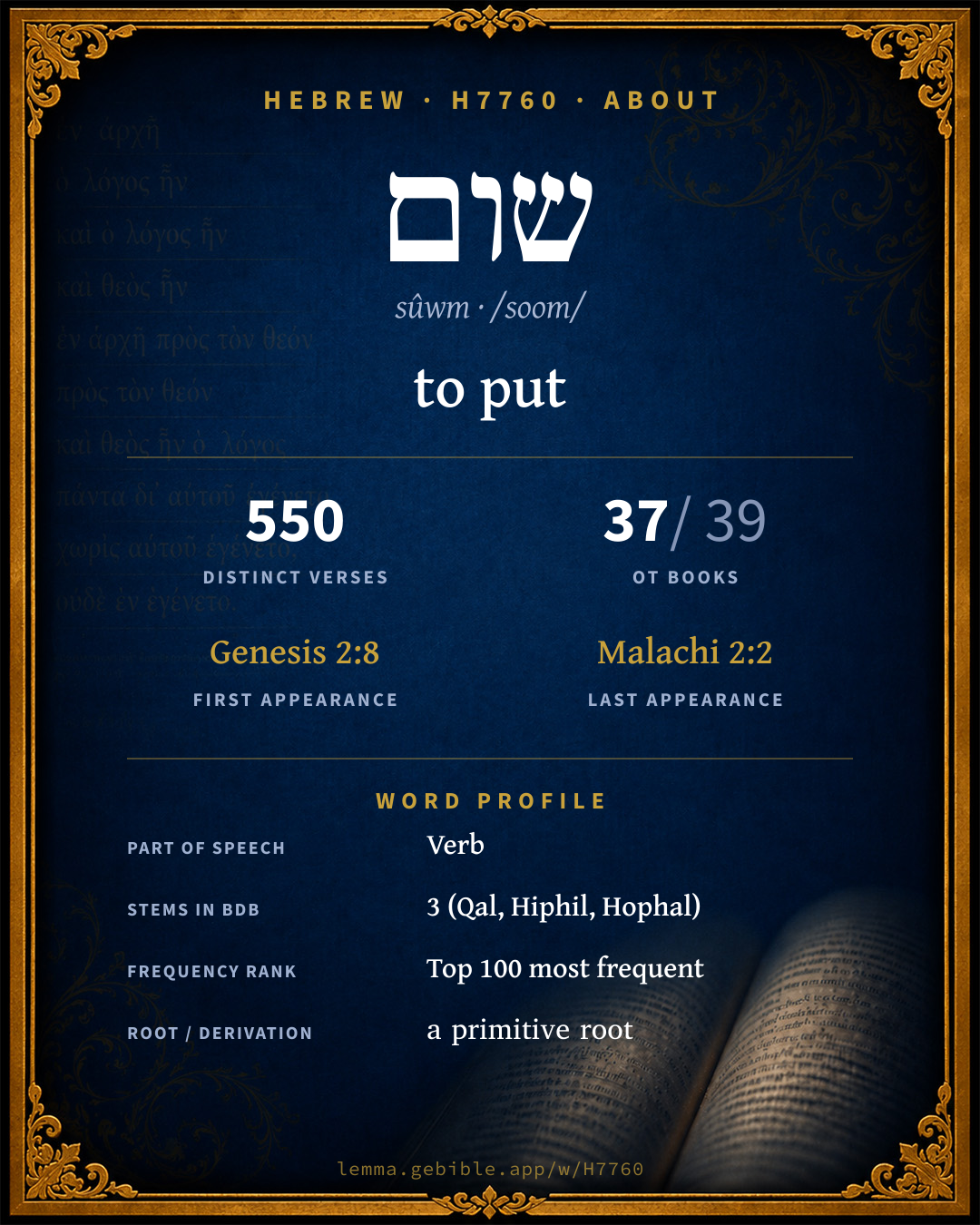
שׂוּם
to put
also: place, set, appoint, make fuller range ↓
Full lexicon entry — Brown-Driver-Briggs (BDB)
From Brown-Driver-Briggs (BDB)
Where this word appears
Grammar key — what these labels mean
Part of speech
- Verb
- An action or state-of-being word.
Stem
- Qal
- The basic, simple active stem — the plain form of the verb (“he wrote”). Here: ‘set’
- Hophal
- The passive counterpart of the Hiphil (“he was caused to…”).
- Hiphil
- The causative active stem (“he caused / brought about”).
Form
- Sequential Imperfect
- An imperfect with prefixed waw — the standard past-narrative form (waw-consecutive imperfect).
- Perfect
- A completed action or state — Hebrew marks aspect (completeness) more than strict tense (“he wrote”).
- Infinitive Construct
- A bound verbal noun, frequently with prepositions (“to write / in writing”).
- Imperative
- A direct command (“write!”).
- Sequential Perfect
- A perfect with prefixed waw continuing a preceding imperfect or command (waw-consecutive perfect).
- Imperfect
- An incomplete, ongoing, or future action (“he will / would write”).
- Participle Active
- A verbal adjective expressing ongoing or characteristic action (“writing / one who writes”).
- Jussive
- A third- or second-person volitional form expressing wish or command (“let him write”).
- Infinitive Absolute
- An unbound verbal noun, often intensifying or standing in for a finite verb.
- Cohortative
- A first-person volitional form expressing wish or resolve (“let me / let us write”).
- Participle Passive
- A verbal adjective expressing action received (“written”).
State
- Absolute
- The independent form of a noun, not bound to a following word.
Person
- 3rd Person
- The one spoken about (“he / she / it / they”).
- 2nd Person
- The one addressed (“you”).
- 1st Person
- The speaker (“I / we”).
Gender
- Masculine
- Grammatically masculine.
- Common
- Either gender — not distinguished for this form.
- Feminine
- Grammatically feminine.
Number
- Singular
- One.
- Plural
- More than one (in Hebrew, generally three or more).
Every verse where H7760 appears in the Book of Psalms — 36 distinct verses. Click any verse to open its interlinear word-by-word view. Verse text shown in the World English Bible for context — . Each verse’s Hebrew form is shown with its reference; the English is not keyword-highlighted, since the data carries no word-level English alignment. Use “Compare translations” on any verse to read it across multiple English versions. This concordance covers the Hebrew Bible; Septuagint (Greek Old Testament) occurrences are not indexed here.
Psalms
- Psalms 18:43 תְּ֭שִׂימֵ/נִי Qal impf 2ms + sfx pers 1cs You have delivered me from the strivings of the people. You have made me the head of the nations. A people whom I have not known shall serve me.
- Psalms 19:4 שָֽׂם Qal pf 3ms Their voice has gone out through all the earth, Their words to the end of the world. In them he has set a tent for the sun,
- Psalms 39:8 תְּשִׂימֵֽ/נִי Qal juss 2ms + sfx pers 1cs Deliver me from all my transgressions. Don't make me the reproach of the foolish.
- Psalms 40:4 שָׂ֣ם Qal pf 3ms Blessed is the man who makes Yahweh his trust, And doesn't respect the proud, nor such as turn aside to lies.
- Psalms 44:13 תְּשִׂימֵ֣/נוּ Qal impf 2ms + sfx pers 1cp You make us a reproach to our neighbors, A scoffing and a derision to those who are around us.
- Psalms 44:14 תְּשִׂימֵ֣/נוּ Qal impf 2ms + sfx pers 1cp You make us a byword among the nations, A shaking of the head among the peoples.
- Psalms 46:8 שָׂ֖ם Qal pf 3ms Come, see Yahweh's works, What desolations he has made in the earth.
- Psalms 50:23 וְ/שָׂ֥ם conj + Qal ptcp.act ms Whoever offers the sacrifice of thanksgiving glorifies me, And prepares his way so that I will show God's salvation to him."
- Psalms 52:7 יָשִׂ֥ים Qal impf 3ms "Behold, this is the man who didn't make God his strength, But trusted in the abundance of his riches, And strengthened himself in his wickedness."
- Psalms 54:3 שָׂ֨מוּ Qal pf 3cp For strangers have risen up against me. Violent men have sought after my soul. They haven't set God before them. Selah.
- Psalms 56:8 שִׂ֣ימָ/ה Qal impv 2ms + sfx h You number my wanderings. You put my tears into your bottle. Aren't they in your book?
- Psalms 66:2 שִׂ֥ימוּ Qal impv 2mp Sing to the glory of his name! Offer glory and praise!
- Psalms 66:9 הַ/שָּׂ֣ם ptcl def.art + Qal ptcp.act ms Who preserves our life among the living, And doesn't allow our feet to be moved.
- Psalms 66:11 שַׂ֖מְתָּ Qal pf 2ms You brought us into prison. You laid a burden on our backs.
- Psalms 74:4 שָׂ֖מוּ Qal pf 3cp Your adversaries have roared in the midst of your assembly. They have set up their standards as signs.
- Psalms 78:5 שָׂ֤ם Qal pf 3ms For he established a testimony in Jacob, And appointed a law in Israel, Which he commanded our fathers, That they should make them known to their children;
- Psalms 78:7 וְ/יָשִׂ֥ימוּ conj + Qal impf 3mp That they might set their hope in God, And not forget the works of God, But keep his commandments,
- Psalms 78:43 שָׂ֣ם Qal pf 3ms How he set his signs in Egypt, His wonders in the field of Zoan,
- Psalms 79:1 שָׂ֖מוּ Qal pf 3cp God, the nations have come into your inheritance. They have defiled your holy temple. They have laid Jerusalem in heaps.
- Psalms 80:6 תְּשִׂימֵ֣/נוּ Qal impf 2ms + sfx pers 1cp You make us a source of contention to our neighbors. Our enemies laugh among themselves.
- Psalms 81:5 שָׂמ֗/וֹ Qal pf 3ms + sfx pers 3ms He appointed it in Joseph for a testimony, When he went out over the land of Egypt, I heard a language that I didn't know.
- Psalms 85:13 וְ/יָשֵׂ֖ם conj + Qal impf 3ms Righteousness goes before him, And prepares the way for his steps.
- Psalms 86:14 שָׂמ֣וּ/ךָ Qal pf 3cp + sfx pers 2ms God, the proud have risen up against me. A company of violent men have sought after my soul, And they don't hold regard for you before them.
- Psalms 89:25 וְ/שַׂמְתִּ֣י conj + Qal pf 1cs I will set his hand also on the sea, And his right hand on the rivers.
- Psalms 89:29 וְ/שַׂמְתִּ֣י conj + Qal wpf 1cs I will also make his seed endure forever, And his throne as the days of heaven.
- Psalms 89:40 שַׂ֖מְתָּ Qal pf 2ms You have broken down all his hedges. You have brought his strongholds to ruin.
- Psalms 91:9 שַׂ֣מְתָּ Qal pf 2ms Because you have made Yahweh your refuge, And the Most High your dwelling place,
- Psalms 104:3 הַ/שָּׂם ptcl def.art + Qal ptcp.act ms He lays the beams of his chambers in the waters. He makes the clouds his chariot. He walks on the wings of the wind.
- Psalms 104:9 שַׂ֭מְתָּ Qal pf 2ms You have set a boundary that they may not pass over; That they don't turn again to cover the earth.
- Psalms 105:21 שָׂמ֣/וֹ Qal pf 3ms + sfx pers 3ms He made him lord of his house, And ruler of all of his possessions;
- Psalms 105:27 שָֽׂמוּ Qal pf 3cp They performed miracles among them, And wonders in the land of Ham.
- Psalms 107:33 יָשֵׂ֣ם Qal impf 3ms He turns rivers into a desert, Water springs into a thirsty ground,
- Psalms 107:35 יָשֵׂ֣ם Qal impf 3ms He turns a desert into a pool of water, And a dry land into water springs.
- Psalms 107:41 וַ/יָּ֥שֶׂם conj + Qal wimpf 3ms Yet he lifts the needy out of their affliction, And increases their families like a flock.
- Psalms 109:5 וַ/יָּ֘שִׂ֤ימוּ conj + Qal wimpf 3mp They have rewarded me evil for good, And hatred for my love.
- Psalms 147:14 הַ/שָּׂם ptcl def.art + Qal ptcp.act ms He makes peace in your borders. He fills you with the finest of the wheat.
About this entry
At a glance — auto-summarized from this page’s data, not written by a person. Every figure links to its source below. This summary describes the numbers; it doesn’t interpret them.
שום (sûwm) is a Hebrew verb most often rendered “to put.” Where the King James Version keeps “laid,” modern versions use “put” — see the renderings breakdown. With 550 verses in 37 books, it is one of the most common word in the Hebrew Bible. It first appears in Genesis 2:8. Read the stem: it spans 3 stems, including Qal and Hiphil. The sections below give every sense, occurrence, and version rendering.
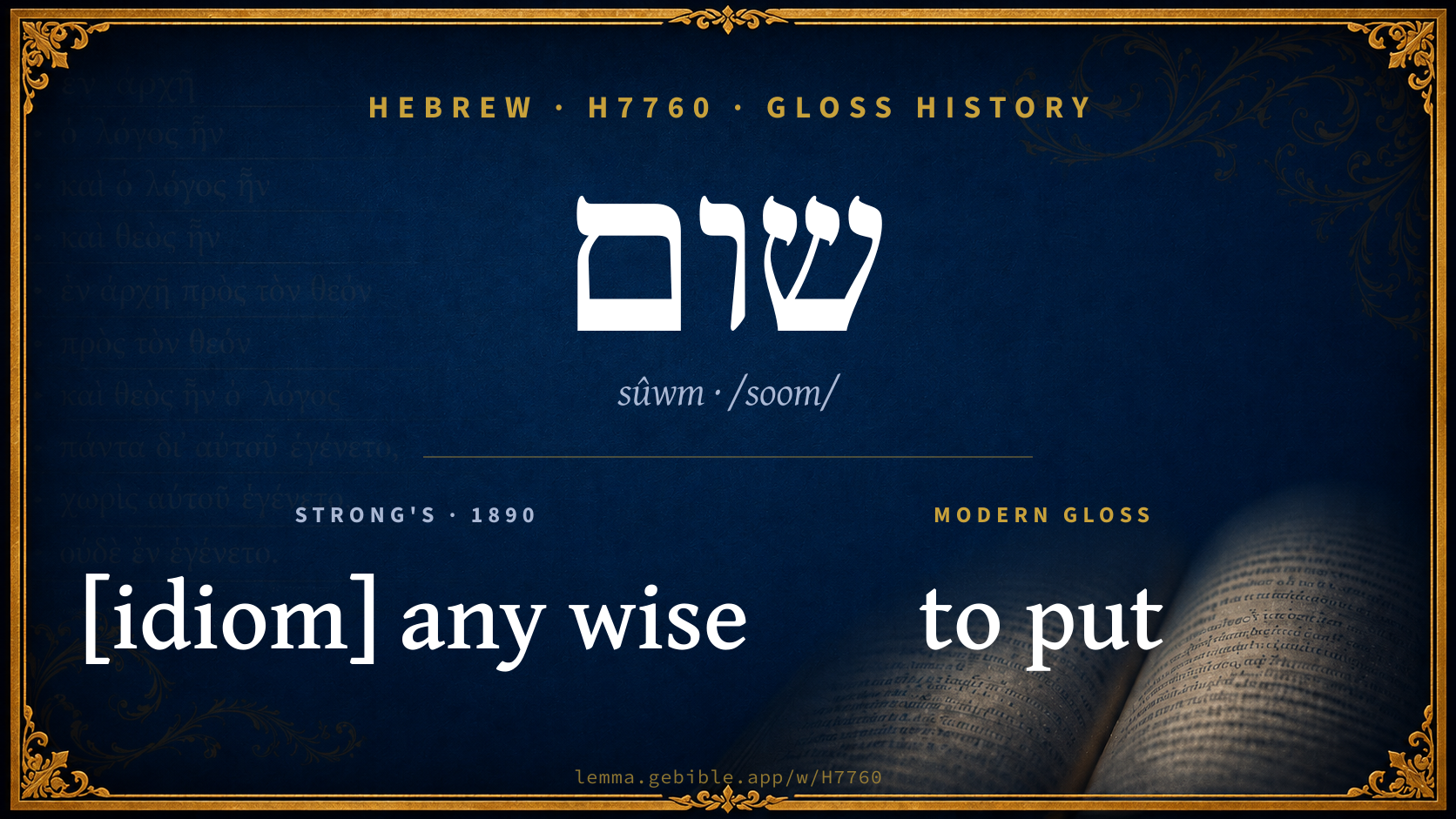
Gloss history
Strong's 1890 vs modern scholarship
About this word
Strong's H7760 catalogs a Hebrew word from the Hebrew Old Testament.
These counts are not copied from any lexicon or concordance. They are computed here, from the morphology-tagged Hebrew Old Testament. What Lemma adds →
- 550
- distinct verses
- The word appears in 550 distinct verses.
- 37 / 39
- OT books
- The word appears in 37 of 39 Old Testament books.
- #83
- by frequency
- Top 100 most frequent Hebrew words (rank 83 of 8,640 Hebrew words by occurrence).
View all 550 occurrences in the concordance →
By section of the Old Testament
By traditional corpus
Conventional, traditional groupings — biblical authorship is debated, so this is a traditional corpus grouping, not an authorship claim. Each share is this word’s portion of its verses in that division of the Hebrew canon. Each figure is a share of the word’s 550 distinct verses.
- Prophets (Nevi'im) 293 verses · 53%
- Torah (Pentateuch) 144 verses · 26%
- Writings (Ketuvim) 113 verses · 21%
How translations render this word
Counts come from each version’s own published word-to-Strong’s tagging or interlinear alignment — an approximate guide to how each version renders this word, not a word-level alignment the data otherwise carries. Because each total is that version’s own tagged count, the per-version totals vary from one another and need not match the appearance or distinct-verse counts above. These counts may also differ from a printed concordance because Lemma counts each distinctly tagged rendering and does not collapse phrase taggings into a single head-word total. This is a fixed set of word-tagged versions (KJV, ASV, BSB, ULT) and does not change with the reading translation you choose elsewhere. Each version’s license is shown beside its name below (and on Sources).
BDB lists this Strong’s number as 3 distinct words (homographs). Each count above pools all of them and is not split by sense — see the Senses section below. A low-frequency rendering may belong to a different one of those words, not the primary meaning.
- King James Version†: Put 74×, Set 42×, Made 18×
- American Standard Version†: Put 64×, Set 41×, I will make 18×
- Berean Standard Bible†: Put 46×, Set 21×, I will make 14×
- unfoldingWord Literal Text†: Put 63×, Set 61×, He put 28×
King James Version Public Domain
Renders H7760 across 583† tagged occurrences — most commonly:
Plus other, less common renderings. Plus 205 renderings that appear only once — usually multi-word phrases or single function words the recovered tagging swept in, not distinct renderings. Not rendered by a distinct English word in 2 further occurrences.
American Standard Version Public Domain
Renders H7760 across 581† tagged occurrences — most commonly:
Plus other, less common renderings. Plus 210 renderings that appear only once — usually multi-word phrases or single function words the recovered tagging swept in, not distinct renderings.
Berean Standard Bible Public Domain
Renders H7760 across 561† tagged occurrences — most commonly:
Plus other, less common renderings. Plus 244 renderings that appear only once — usually multi-word phrases or single function words the recovered tagging swept in, not distinct renderings. Not rendered by a distinct English word in 20 further occurrences.
unfoldingWord Literal Text CC BY-SA 4.0
Renders H7760 across 669† tagged occurrences — most commonly:
Plus other, less common renderings. Plus 165 renderings that appear only once — usually multi-word phrases or single function words the recovered tagging swept in, not distinct renderings.
26 senses and sub-senses in the full BDB
Hebrew verbs can shift meaning by stem (binyan): Qal is the basic action, Niphal is often passive or reflexive, Piel often intensifies or makes it factitive, and Hiphil is typically causative. The senses below are grouped under the stem BDB assigns to each. This entry also uses Hophal (the passive of Hiphil).
What do BDB’s symbols mean?
BDB uses these scholarly abbreviations:
| Symbol | Meaning |
|---|---|
| 𝔊 | the Septuagint (the ancient Greek translation, LXX) |
| 𝔙 | the Vulgate (the Latin translation) |
| 𝔖 | the Syriac version (the Peshitta) |
| 𝔗 | the Targum (the Aramaic translation) |
| ψ | the Psalms |
| √ | root (the underlying root or stem) |
| ‖ | parallel passage (a synonymous or contrasted parallel) |
| † | the dagger: every passage where the word occurs is cited |
The 26 senses and sub-senses the full Brown-Driver-Briggs lexicon distinguishes for this word, in lexicon order (not ranked by frequency), with BDB’s own verbatim wording and sub-sense lettering. Shown in Hebrew script with BDB’s own scholarly abbreviations. The condensed entry is in the Lexicon Entry tab. See also the Forms in the corpus table below.
שום I put, place, set (cf. NöZMG xxxvii (1883), 532
Qal
- Pf. 3 ms. שָׂם Gn 21:14 + (2 Ch 1:5 read שָׂם 𝔊 𝔙 Gi Be Kau Benz), sf. שָׂמוֹ Ez 17:4 +, שָׂמָ֫הוּ 7:20; 3 fs. שָׂ֫מָה 1 S 19:13, sf. שָׂמָ֫תְהוּ Ez 19:5; 24:7; 2 ms. שַׂמְתָּ Je 32:20 +; 3 pl. שָׂמוּ Gn 40:15 +; 1 pl. שַׂמְנוּ Is 28:15, etc.; Impf. 3 ms. יָשׂוּם Ex 4:11, יָשִׂים Gn 30:42 +, יָשִׂם Jb 23:6; juss. יָשֵׂם 1 S 22:15 +; וַיָּ֫שֶׂם Gn 2:8 +; sf. יְשִׂמֵנִי 2 S 15:4, וַיְשִׂימְךָ 1 K 10:9; 2 fs. וַתָּשִׂימִי Is 51:23; וָאָשִׂים 1 S 28:21 +, וָאָשִׂ֫ימָה Ezr 8:17; Ju 12:3 Qr (Kt ואישׂמה); 2 mpl. תָּשִׂימוּ Gn 32:17 +, תְּשִׂימ֫וּן Ex 22:24 +, etc.; Imv. ms. שִׂים Gn 24:2 +, etc.; Inf. abs. שׂוֹם Dt 17:15 +, cstr. שׂוּם 44:7 +, שִׂים Jb 20:4 + 2 S 14:7 Qr (Kt שׂום), שׂימו Is 10:6 Kt (Qr שׂוּמוֹ), etc.; Pt. שָׂם Am 7:8 +, fs. הַשָּׂמָ֫ה Is 51:10 (so read for MT הַשָּׂ֫מָה); pl. שָׂמִים Mal 2:2 +; pass. שִׂים Nu 24:21 (cf. Di), Ob 4; f. according to most שׂוּמָה 2 S 13:32 (van d. H. שׂימה Kt), but v. infr.; שִׂימָ֫ה ψ 56:9 Bae Buhl, but most Imv. ms.;—put, set (often ‖ נָתָן 2, q.v.), c. acc. pers. vel rei (expr. or impl.): e.g. Genesis 21:14
- 1.
- a. put, set, in a place, + שָׁם Gn 2:8 (J), + acc. loc. 28:11 (E) + 5 times +, c. 2 acc. + loc., 2 K 10:8 heads (in) heaps at (acc. loc.), cf. Lv 24:6 (עַל); + ב 40:15 (E), fig. of י׳, put his name, בִּירוּשׁ׳ 2 K 21:7 = 2 Ch 33:7, cf. c. שָׁם 1 K 9:3; Dt 12:5 + 6 times; especially ב of receptacle Gn 31:34 (E), Ex 2:3 (E), Ju 6:19 + often; sackcloth on (ב) loins Gn 37:34 (J), 1 K 20:31, crown on head Zc 6:11; Est 1:17, shoes on feet Ez 24:17; hook, etc., in nose 2 K 19:28 = Is 37:29; Jb 40:26, incense בְּאַפֶּ֑ךָ Dt 33:10, i.e. cause thee (י׳) to smell it; feet in stocks (fig.) Jb 13:27; 33:11; knife into throat Pr 23:2 (fig. of self-restraint, Fl in De); words into mouth Ex 4:15 (J), Nu 22:38 (E) + 8 times, + Dt 31:19 teach to say or sing; into heart Jb 22:22, ins. also 1 S 29:10 𝔊 Th We Dr Kit Bu HPS; trust in God ψ 78:7; (guilt of) blood into house Dt 22:8, cf. Ju 9:24 (עַל pers.; so, c. נָתַן Dt 21:8; Je 26:15; Jon 1:14); something into hand Ex 4:21 (E), of wonders, i.e. enable hand to do them; elsewhere = take, of hammer Ju 4:21, booty 1 K 20:6, so (fig.) take one’s life (נֶפֶשׁ) into one’s palm (i.e. risk it) Ju 12:3; 1 S 19:5; 28:21; Jb 13:14; put eyes בַּפּוּךְ 2 K 9:30 (v. פּוּךְ, cf. Is 54:11); נֶפֶשׁ (= person), בַּחַיִּים ψ 66:9 (subj. י׳); set men at (the use of) implements 2 S 12:31 (prob., cf. Dr HPS; > וַיָּשַׂר(ם) sawed them with, as ‖ 1 Ch 20:3, Th We); 1 K 2:5 (‖ נתן) is dub.; 𝔊L Klo Kit read וַיִּקֹּם; charge something against (ב pers.; properly put in, i.e. attribute, impute, to) 1 S 22:15; Jb 4:18; so, c. ל pers. Dt 22:14, cf. (ל om.) v 17; put בְּקֶרֶב Am 7:8; Is 63:11, בְּתוֹךְ Ez 26:12. e.g. Genesis 2:8
- b. put something upon (עַל) Nu 21:8, 9 (E) + often; jewels, clothes, on person Gn 24:17 (J), 41:42 (E), Lv 8:8 (P), Ru 3:3, turban Zc 3:5(×2); Ex 29:5 (P), Lv 8:9 (P) cf. (prep. om.) Jb 24:15; 36:13 (fig.), girdle Je 13:1, 2, sackcloth 1 K 21:27; שׂ׳ אָדָם עַל־הָאָרֶץ Jb 20:4 (of man’s creation); of siege and siege engines, עַל = against, Mi 4:14; Ez 4:2; 23:24; put, lay, upon (עַל), 2 K 4:29 +; hand Gn 48:18 (J) + 3 times, + upon mouth, in silence Ju 18:19; Jb 21:5, and awe Mi 7:16, so c. ל Jb 29:9, לְמוֹ 40:4, 40, upon (עַל) head 2 S 13:19 (in despair, cf. Je 2:37); acc. of disease Ex 15:26 (J), so (ב pers.) v 26 Dt 7:16; fig., spirit (עַל) Nu 11:17 (JE), name 6:27 (P), duty Jb 37:15 (?), reproach 1 S 11:2, רָעָה תַּחַת טוֹבָה ψ 109:5 (𝔖 Bae וַיָשִׁיבוּ, so, or וַיְשַׁלְּמוּ, Hup Che); שׂ׳ עַל לֵב Ct 8:6 (sim.), so, fig., = remember, treasure up, Is 42:25; 47:7 (‖ זָכַר), + 6 times, c. אֶל 2 S 13:33; 19:20 (‖ id.); c. ב 1 S 21:13; cf. שׂ׳ בְּאָזְנֵי Ex 17:14 (E), impress upon. e.g. Numbers 21:8
- c. put, lay, set, c. ל, 2 K 11:16 lay (violent) hands on = 2 Ch 23:15; put end to Jb 18:2; 28:3; set לְמָרוֹם 5:11; render glory to Jos 7:19 (JE; ‖ נָתַן), Is 42:12; make covenant with 2 S 23:5; set food for Gn 43:32 (J), 2 S 12:20, prep. om. Gn 43:31 (J), so c. לִפְנֵי 1 S 9:24; 28:22; 2 K 6:22; שׂ׳ לִפְנֵי elsewhere Ju 18:21, of precedence Gn 48:20b (E); set laws (as authoritative) לִפְנֵי Ex 19:7; 21:1 (both E), Dt 4:44; God (as moral ruler) לְנֶגְדָּם ψ 54:5; 86:14; שׂ׳ נֶגֶד also Gn 31:37 (E), נֹכַח Ez 14:4, 7; לְעֵינֵי Gn 30:41 (J). e.g. 2 Kings 11:16
- d. put, c. בֵּין Jos 24:7 (E) + 5 times (Ex 8:19 v. פְּדוּת p. 804), + Gn 30:36 (J), 32:17 (E), put space between; c. תַּחַת Ex 17:12 (E), + 3 times (Ob 7 del. לַחְמְךָ We GASm Now al.) + שׂ׳ יָד תַּחַת יָרֵךְ in oath Gn 24:2, 9; 47:29 (all J); put, c. אֶל loc. 1 S 6:11, 15; 19:13a Hb 2:15, אֶל pers. Jb 5:8 commit unto; c. אֵצֶל rei Lv 6:3 (P), מִצַּד rei Dt 31:26 (P); שׂ׳ עִמְּךָ 1 S 9:23 lay up something with thee, reserve it; put, c. יַחַד Mi 2:12 put together = collect (‖ אָסַף, קִבֵּץ); without modifier 1 K 18:23, 25; Jb 14:15; Ez 30:21 apply bandage (‖ נָתַן). e.g. Joshua 24:7
- 2. set, direct:
- a. sword against (ב) Ju 7:22; fig. extend compassion, ל pers. Is 47:6 e.g. Judges 7:22
- b. direct לֵב, לֵבָב (mind) toward, pay attention to, c. ל, Dt 32:46; 1 S 9:20; Ez 40:4; 44:5b; c. אֶל Ex 9:21 (J), 1 S 25:25; 2 S 18:3(×2); Jb 2:3; 34:14 (Bu Du del. לֵב and read יָשִׁיב רוּחוֹ); c. עַל Hg 1:5, 7; Jb 1:8; compl. om. Ez 44:5 a Hg 2:15, 18(×2); Is 41:22; Ju 19:30 read perhaps לְבַבְכֶם for לָכֶם (or עֵצָה for עֻצוּ); לֵב om. Jb 4:20, Is 41:20 (+ רָאָה, יָדַע, הִשְׂכִּיל), c. ב pers. Jb 23:6 (so Bu, who cps. 4:20; 24:12; 34:23, but all cases dub.); שִׂים לֵב, c. עַל = intend Dn 1:8 (obj. cl.). e.g. Deuteronomy 32:46
- c. set face (פָּנִים) toward (acc. loc.) Gn 31:21 (E), + לָבוֹא Je 42:15(×2), 17; 44:12, cf. 2 K 12:18; Dn 11:17; c. אֶל, toward or against (implying opposition) Ez 6:2 + 5 times Ez, c. עַל Ez 29:2; 35:2, c. דֶּרֶךְ of direction 21:2; c. ב (fig. of oppos., subj. י׳): הִנְנִי שָׂם פָּנַי בָּכֶם לְרָעָה Je 44:11, cf. 21:10 Ez 15:7 (‖ נתן), Lv 20:5 (P); c. ל rei (human subj.) Dn 11:18 Qr (ישׁב); c. עַל pers. + לִמְלֹךְ of purpose 1 K 2:15; set eyes (עֵינַים) upon, c. עַל pers. = behold Gn 44:21 (J), = look after, take care of, Je 39:12; 40:4, לְטוֹבָה 24:6, but לְרָעָה Am 9:4. e.g. Genesis 31:21
- 3.
- a. set, ordain, c. acc. rei Nu 24:23 (> acc. pers. Di). e.g. Numbers 24:23
- b. set, establish a law, statute, + ל pers. Ex 15:25; Jos 24:25 (both E), cf. Pr 8:29; + ב loc. Is 42:4 ψ 78:5 (‖ הֵקִים), also 81:6; Je 33:25 + 2 S 20:19 (שָׂמוּ for שְׁלֻמֵי 𝔊 Ew We Kit Bu HPS, cf. Dr); establish something as (ל) law Gn 47:26 (J), 1 S 30:25 (+ ל pers.); establish bazaars (as a right), ב loc., 1 K 20:34; appoint a set time Ex 9:5 (J), Jb 34:23 (reading מוֹעֵד for עוֹד GHBWr Bu), ins. (perhaps) 1 S 13:8 so Dr Klo HPS (> ins. אמר Th We Bu Kit, after 𝔊 𝔗); a place, + ל pers. Ex 21:13; 2 S 7:10 = 1 Ch 17:9, ל rei 1 K 8:21 (+ שָׁם). e.g. Exodus 15:25
- c. set, found a nation, Is 44:7 (si vera l.), establish it ψ 89:30 (לָעַד). e.g. Isaiah 44:7
- d. set, appoint (as ruler, official) + עַל pers. vel gent., Ex 1:11; 18:21 (all E), Dt 17:14, 15(×3); Ju 11:11 (+ ל of office), 2 S 17:25 (+ תַּחַת instead of) + 6 times + Gn 47:6 (J; second acc. = ruler, expressed), 2 S 23:23 (אֶל), עַל in ‖ 1 Ch 11:25; also 2 acc. + ל and ב loc. ψ 105:21, ב loc. 2 S 15:4; 2 Ch 33:14, בְּרֹאשׁ at the head of, Dt 1:13, 2 acc. alone Ct 1:6; c.acc. pers. + ל pers. Gn 27:37 (E), Ho 2:2; 1 S 8:5 (+ inf.); + ל of title Gn 45:8, 9 Ex 2:14 (+ עַל; all E) + 4 times + Ju 8:33 (+ ל pers.), + Ez 44:8 (perhaps read וַתְּשִׂימוּם Hi Sm Co and most); + ל of purpose Hb 1:12; + ב of position, ל pers. 1 S 8:11; c. acc. of office alone 1 S 8:12 (+ ל pers.), so Co Ez 21:27a (שָׂרִים for כָּרִים, v. כַּר sub כרר), 1 K 20:24 (+ תחת), cf. 2 Ch 23:18, + עַל, אֶל, of task Nu 4:19 (P); Jb 7:20 set me as (ל) mark for (ל) him. e.g. Exodus 1:11
- e. set, constitute, make, c. כ pers. vel rei, Gn 13:16 (J) I will make thy seed as the dust, 32:13 (J) 48:20 (E), Dt 10:22; Ho 11:8 + 16 times + (bad sense) Ho 2:5; Na 3:6; 1 K 19:2. e.g. Genesis 13:16
- f. set, determine, fix, bounds Je 5:22 (2 acc.) Jb 38:5, 33 ψ 104:9; pass. determined, settled, + עַל־פֶּה 2 S 13:32 (but v. II. שׂום); appoint, send, frogs לְפַרְעֹה Ex 8:8 (J), c. acc. pers. + עַל against 2 K 18:14. e.g. Jeremiah 5:22
- 4.
- a. set, station, at a post, etc., acc. pers. Jos 8:13 (JE), + ב loc. 2 K 10:24; Je 9:7 + 5 times, + adv. acc. Gn 33:2 (J), + בֵּין loc. Jos 8:12, + ל (against) and אַחֲרֵי loc. v 2 (both JE), + ל against Ju 9:25 (+ עַל loc.), + אֶל against 20:29, 36; doubtful are 1 S 15:2 (c.ל pers.), 1 K 20:12(×2) (עַל־הָעִיר), where no obj. expr. (in MT); either an obj. has fallen out, or vb. (in techn. military sense), here intrans. or inwardly trans. (Dl ZK ii. 397 forward! take direction toward; cf.also [on Sm] We Dr Löhr), or else שׂ׳ is corrupt (cf.HPSSm). e.g. Joshua 8:13
- b. put in position, sacred bread, sword, staves, bars, c.acc. 1 S 21:7; Ez 21:27; Nu 4:6, 8, 11, 14 + 4 times P, Jb 38:10; + עַל Ex 32:27 (E), 40:20 (P), מִמַּעַל ל Je 43:10, מֵעַל Est 3:1; + (various modifiers) 8 times; set in place, תֵּבֵל Jb 34:13 (De al.), but context favours שָׁמַר Bu; Du שׂ׳ לִבּוֹ בְּתֵבֵל. e.g. 1 Samuel 21:7
- c. set up throne 1 K 2:19, altars Je 11:13, memorial stone Gn 18:18 (J), 28:22 (E), 1 S 7:12 (cf.הֵקִים Gn 31:45 +), image, etc. Ju 18:31 (‖ הֵקִים), Dt 27:15; 1 K 12:29 (ב loc., ‖ נָתַן), 2 K 21:7 (ב loc.) = 2 Ch 33:7, cf. ψ 74:4; Is 57:8 and, + ב loc., Je 7:30; 32:34; rods before (לְעֵינֵי) cattle Gn 30:41 (‖ וַיַּצֵּג v 38), cf. v 42, guide-posts Je 31:21, bed 2 K 4:10 (+ ל pers.). e.g. 1 Kings 2:19
- d. = plant, wheat Is 28:25, tree 41:19 (ב loc.; ‖ נָתַן), slip Ez 17:5 (עַל by). e.g. Isaiah 28:25
- e. set, fix (countenance) 2 K 8:11, so usually, but acc. om., and sense dub.; read perhaps וַיִּשֹּׁם (√ שׁמם, cf. e.g. 1 K 9:8), so Klo Kmp Kit Benz. e.g. 2 Kings 8:11
- 5.
- a. make a thing, or pers. (acc.), for transform into (ל), Jos 6:18 (J) make camp לְחֵרֶם, Mi 1:6 make Samaria לְעִי, Gn 21:13, 18 (E), Ex 14:21 (JE), Mi 4:7 (both good sense), Is 28:17; 42:15, 16 + 12 times Is. (25:2 read עִיר for מֵעִיר Vrss Comm.), Je 2:7 + 8 times Je, + 14 times + Ju 1:28 they made the Can. into the corvée; וְיָשֵׂם לְדֶרֶךְ פְּעָמָיו ψ 85:14 maketh his steps into a way (so RV Hup Che Dr, but meaning obscure; De Bae attend to the way of (לֵב om.); Schr Hup-Now read וְיִשְׁמֹר ד׳); c. 2 acc. Jos 8:28 (J), ψ 39:9; 66:2 Mi 1:7; 4:13 1 K 5:23 (prægn. c. עַד loc.), + 29 times e.g. Joshua 6:18
- b. make, constitute, 2 acc., 1 S 8:1; 18:13 (+ ל pers.) 22:7 (לְכֻלְּכֶם, ל of acc.; or וְכֻלְּכֶם), Is 3:7; 60:17 + 6 times, + 1 S 11:11 form people in bands, cf. Jb 1:17 (one acc., form bands), + (acc. pers. om.) Ex 4:11b (J), cf. (beast, in fig.) Ez 19:5; 2 acc. and acc. + ל in same ver., Is 54:12 I will make rubies thy pinnacles, and (transform) thy gates into carbuncles; in phr. of naming, שָׂם שְׁמוֹ יִשְׂרָאֵל 2 K 17:34, cf. Ju 8:31; Ne 9:7; c. ל, וַיָּשֶׂם לָהֶם שֵׁמוֹת Dn 1:7, וַיּ׳ לְדָנִיֵּאל בֵּלְטְשַׁאצַּר v 7; make, fashion, c. acc. rei + ל pers. Ex 4:11a (J; י׳ subj.); grave Na 1:14 (but on text and meaning v. Now Bi SB Wiener Akkadian 1894, Abh. v); c. acc. דֶּרֶךְ Is 43:19 (ב loc.), cf. Ez 21:24, 25 (+ ל inf.); ψ 50:23 is dub., usually order (one’s) way, De Dr prepare way (which), etc., Gr Che תֹּם for שָׂם; make name + ל pers. 2 S 7:23 = 1 Ch 17:21, 2 S 14:7; make for, ל pers. (or give to), c.acc. of posterity Gn 45:7 (E); 1 S 2:20 read prob. יְשַׁלֵּם 𝔊 We Kit Bu HPS, cf. Dr; Ezr 10:44 b is obscure, Gu-Batten del. וַיָּשִׂימוּ and read וַיְשַׁלְּחוּ bef. נָשִׁים, cf. 3 Esdr 9:36 Be Ry Ryle. e.g. 1 Samuel 8:1
- c. work, bring to pass, c. acc. rei, of י׳’s signs, etc., + ב loc. Ex 10:2 (J), Je 32:20; Is 66:19 ψ 46:9; 78:43; 105:27. e.g. Exodus 10:2
- d. appoint, give, acc. rei Nu 6:26 (P), Is 61:3 (‖ נָתַן; both c. ל pers.); a pledge Jb 17:3 (‖ עָרְבֵנִי go surety for me, but read perhaps עֶרְבֹנִי as obj., v. p. 786 b); וְשׂוֹם שֵׂכֶל Ne 8:3 giving understanding (making sense clear). e.g. Numbers 6:26
Hiphil
- Pf. 1 s. consec. וַהֲשִׂמֹתִיהוּ Ez 14:8, acc. pers. + ל, I will make him for a sign (שׁ for שׂ van d. H., √ שׁמם; Co Berthol Toy וְשַׂמְתִּיהוּ (Qal), Krae וְהִשְׁמַדְתִּיהוּ); Imv. fs. הָשִׂימִי 21:21, prob. del as dittogr. Co Krae after 𝔊 𝔖 𝔙 𝔗 Nö ZMG xxxvii (1883), 530 (> Bö Toy al. הִקְדִּימוּ); Pt. מֵשִׂים Jb 4:20 = Qal (לֵב) שׂום (v 2 b), but phr. dub., and text perhaps crpt., v. Me Nöl.c.. e.g. Ezekiel 14:8
Hophal
- Impf. 3 ms. וַיּוּשַׂם Gn 24:33 Qr (Kt ויישׂם Ges§ 73 f) there was set before him (לְפָנָיו) to eat, cf. Ol MB Ak. 1870, 389 Kö i. 435, who read also וַיּוּשַׂם 50:26 he was laid in (ב) a mummycase (for MT וַיִּישֶׂם Di (ed. 4.5.6) allows this. e.g. Genesis 24:33
שום II (van d. H. שׂימה Kt) perhaps n.f. token of unluckiness, scowl
Senses from the full Brown-Driver-Briggs lexicon (Brown, Driver, Briggs; Oxford 1906 — public domain), digitized via Sefaria, supplemented by the OpenScriptures HebrewLexicon (CC BY 4.0). Full attribution on Sources.
Word origin
I. vb. put, place, set (cf. NöZMG xxxvii (1883), 532; NH סוּם Pi. designate, fix, שׂום Ecclus 45:5c; 49:6; Ph. שם, Assyrian šâmu, fix, determine; Sab. שׂים set, set up, SabDenkmNo. 7, 1. 6 CISiv. 1; Arabic شَامَ (ى) is insert, sheathe, also compute; Ethiopic ሤመ: put, place; 𝔗 שׂוּם, Syriac ܣܳܡ, Old Aramaic שים);—
I. (van d. H. שׂימה Kt) perhaps n.f. token of unluckiness, scowl;—2 S 13:82, so EwG iii. 234, H. 172 (abbrev. from שׂמאל; or emend. שִׂטְמָה) We RSEncy. Brit. (9) DAVID Kit, cf. Dr HPS.
I. etc., v. I, II. שׂום.
— Brown-Driver-Briggs (Oxford 1906, public domain), digitized via Sefaria, supplemented by the OpenScriptures HebrewLexicon (CC BY 4.0). See Sources.
Origin: a primitive root
Jastrow Dictionary
A second Hebrew/Aramaic lexicon for comparison, covering Aramaic and post-biblical (Talmudic, Targumic, Midrashic) usage that the biblical-Hebrew BDB does not. Matched by lemma rather than by Strong’s number, so a lemma may carry more than one Jastrow headword (shown separately below), and the entries cover usage well beyond the Bible.
שׂוּם
- v. סוּם) to place, put, appoint, make. Ber. 39ᵇ ששַׂמְתָּ שלום וכ׳ thou hast made peace between the scholars. Mekh. B’shall. introd. במקום הזה שָׂמוּהוּ in this place they (the Egyptians) have put him (Joseph). Ber. 28ᵇ מודה … ששמת חלקי וכ׳ I thank thee, O Lord, that thou hast appointed my lot to be with those who sit in the school-house, and not with those who abide at the corners (idlers); a. fr.
- same. Yeb. 45ᵇ שאתה מֵשִׂים, v. מְשִׂימָה. Ber. 16ᵇ ותָשִׂים חלקנו וכ׳ and that thou mayest place our lot in paradise. Ib. שתשים שלום וכ׳, v. פַּמִילְיָא. Snh. 99ᵇ כל העוסק … משים שלום וכ׳ whosoever is engaged in the study of the Law for its own sake, causes peace to reign &c.; a. e.
שׂוּם ²
- Targ. O. Lev. XIX, 14 (v. סוּם I ch.; Y. תְשַׁוּוּן). Targ. O. Gen. L, 26 (ed. Berl. וסמוהי); Y. II ושמוהי (Y. I ושַׁוּוּן). Targ. Prov. XXII, 17. Ib. XXIV, 32; a. fr.—V. סוּם I ch.
- to be placed. Targ. Hag. II, 15. Targ. Esth. IV, 3.
שׁוּם I
- (cmp. preced.) [to arrange; cmp. עָרַךְ, סָדַר,] to value, estimate; to mark, name. Gitt. V, 1; Tosef. Keth. XII, 2 שָׁמִין להן, v. עִידִּית. Keth. 67ᵃ, v. שְׁוִי. Macc. 3ᵃ כיצד שמין how do we assess (the fine)? Y. Kidd. I, 60ᵈ bot. (expl. נעשח דמים באחר, Mish. Kidd. I, 6) דבר שהוא צריך לָשׁוּם that which has to be prized (which is not itself a standard value). B. Mets. IX, 3 המקבל … שמין אותה וכ׳ if one rents a field on shares and lets it lie waste, we estimate how much it ought to yield &c. Tosef. ib. IX, 9 השָׁם, v. שׁוּם II; a. v. fr.—M. Kat. 5ᵃ (ref. to וְשָׂם, Ps. L, 23) כל השָׁם אורחותיו וכ׳ he who calculates his ways (weighs the consequences of his doings) will be allowed to see the salvation of the Lord (in the hereafter); אל תקרי וְשָׂם אלא וְשָׁם וכ׳ read not v’sam but v’sham &c.; Sot. 5ᵇ; Yalk. Ps. 763; (Lev. R. s. 9 דשָׁיֵים אורחיה).—Part. pass. שׁוּם; f. שׁוּמָה; pl. שׁוּמִים; שׁוּמוֹת. Tosef. B. Kam. X, 1 רואין אוֹתן כאילו הן ש׳ אצל אחרים we consider them (the forcibly taken animals) as if they had been valued (sold for their value) with others, i.e. the robber pays the value of the animals as it was at the time of the robbery; B. Kam. 95ᵃ כאילו היא שומה אצלו בכסף as if the animal had been sold at its value to him (the robber), for cash; ib.ᵇ שומא (Chald. form); ib. רואין … ש׳ אצלו למחצה וכ׳ we consider it, as if it had been valued &c., for the purpose of establishing the additional amount which he has to pay for the increase in value, which is either one half, or one third, or one fourth (according to local usage). Arakh. 21ᵇ וכך היא שומה וכ׳ Rashi (ed. שומא) and so much has it been appraised; whosoever wishes to buy &c.; a. e. e.g. Psalms 50:23
- to be valued, assessed. Kidd. 28ᵃ, v. דָּמִים. Keth. 66ᵇ במנה הנִישּׁוֹם … המתקבל when saying ‘for each Maneh’ (Mish. ib. VI, 4), does that mean for each Maneh as it is valued (by the woman’s relatives), or for each Maneh with which he charges himself (one fifth less)?, v. שׁוּם II; a. e.
שׁוּם
- —Part. שָׁיֵים. Lev. R. s. 9 (ref. to וְשָׂם, Ps. L, 23, v. preced.) דשיים אורחיה סגי שוי (some ed. שגי) he who calculates his way, will be worth much; Yalk. Ps. 763 שגי שוי. B. Kam. 47ᵃ פרה … שָׁיֵימְנָא לך I injured a pregnant cow of thine, and I will estimate (and pay thee) the value of a pregnant cow; a. e.—Part. pass. שׁוּם; f. שׁוּמָא, v. preced. e.g. Psalms 50:23
- to tax, impose fine. Lam. R. to II, 1 (expl. יעיב, ib.) איך ש׳ ה׳ ברוגזיה וכ׳ how heavily the Lord in his anger taxed the daughter of Zion!, v. חוּב ch., a. עִיב.
שׁוּם II
- (preced.)
- 1. valuation, estimate. B. Kam. I, 3 ש׳ כסף, v. שָׁוֶה. Tosef. B. Mets. IX, 9 השם קמתו … את שׁוּמוֹ וכ׳ if one prizes (and buys) his neighbor’s standing corn as ten Cors of wheat, and it yields less or more, the seller has to deliver the estimated quantity (no more nor less); Rabbi Judah says, עשה בפחות נותן לו את שומו וכ׳ if it yielded less, he has to deliver the estimated quantity, if more, he has to deliver whatever it yielded; a. fr.—Esp. the description and valuation of seized property and its advertisement for public sale. Arakh. VI, 1 ש׳ היתומים שלשים יום the advertisement of orphans’ property must be made thirty days in succession (before the sale); Tosef. ib. IV, 1. Tosef. Keth. XI, 2; B. Bath. 107ᵃ שלשה שירדו לש׳ וכ׳ if of three experts called to appraise seized property, one says, it is worth a Maneh &c.; a. fr.
- 2. appraised goods brought into marriage by the wife. Keth. VI, 3 (66ᵃ) פסקה … וכנגד הש׳ וכ׳ if she promises to bring him a thousand Denars, he must obligate himself for fifteen Maneh (as her jointure); but for appraised goods brought to him, he obligates himself for one fifth less than the appraised value. Ib. ש׳ במנה ושוה מנה וכ׳ (Y. ed. ש׳ מנה) if the agreement reads, ‘the goods are charged to the husband for one Maneh and worth a Maneh’, he can claim only one Maneh’s worth of goods; ש׳ במנה היא וכ׳ but if it reads merely, ‘the goods are charged for one Maneh’, she must bring in the value of thirty-one Selaim and one Denar (Tosaf.; differ. in Rashi). Tosef. ib. VI, 6 מקום … מן הש׳ וכ׳ where the usage is not to charge the husband less than the appraised value &c.; a. fr.
- 3. (Chaldaism) name, title; לְשׁוּם in the name of, for the sake of, for the purpose of, in the capacity of. Gitt. IV, 4 עבד … אם לש׳ עבד וכ׳ if a slave was taken captive, and some one redeemed him: if he redeemed him as a slave, he may be held as a slave (of his redeemer), if as a freed man &c. Ib. III, 1 כל גט שנכתב שלא לש׳ אשה a letter of divorce not written with the intention to be used for a special woman. Ib. VIII, 5 כתב לש׳ מלכות אחרת if a letter of divorce is dated in the name of a strange government; (Bab. ed. 79ᵇ שאינה הוגנת, v. הוּגָּן). Yeb. 24ᵇ איש שנתגייר לש׳ אשה a man that embraced the Jewish religion for the sake of a woman; לש׳ שולחן מלכים for the sake of the royal table (v. שׁוּלְחָן); לש׳ עבדי שלמה for the sake of being one of Solomon’s servants; a. v. fr.— [Ib. 47ᵇ לשֵׁם שפחות in her capacity as a slave; לשם שחרור with the purpose of making her a freed woman; a. fr.]—מִשּׁוּם a) in the name of. Maas. Sh. III, 6 ר"ש … מש׳ ר׳ יוסי R. S. ben J. says in behalf of R. José (quoting R. J. as author). Eduy. VIII, 5; a. v. fr.—b) because of, as coming under the category of; for the sake of (preventing). Bets. 2ᵇ, a. fr. גזדה מש׳, v. גְּזֵרָה. Sabb. 17ᵇ מש׳ שמנן, v. גָּזַר. Ab. Zar. 26ᵃ, a. fr. מש׳ איבה, v. אֵיבָה. Sabb. 70ᵇ כלום פריש … מש׳ מלאכות … מש׳ שבת does any one abstain from doing a thing on the Sabbath for any reason but because of the prohibition of labors, and does one abstain from any labor for any reason, but because of the Sabbath? Ib. 73ᵇ חייב מש׳ נוטע is guilty, because the act comes under the category of planting. Kil. I, 9 אינו חושש לא מש׳ כלאים וכ׳ he need not hesitate to use it either on the ground of forbidden mixture, or on the ground of the Sabbatical year (in which planting is forbidden), or because it is subject to tithes. Ib. IX, 8 אין אפור מש׳ וכ׳ nothing is forbidden as mixture of wool and linen unless it is spun &c.; a. v. fr.—Ber. 5ᵇ מש׳ תורה דלא וכ׳ (dost thou weep) on account of the Law, that thou hast not attained much?; או מש׳ מזוני or on account of thy support (that thou art poor)?—משום שֶׁ־, (Chald.) מש׳ דְּ־; על שום שֶׁ־, (Chald.) על ש׳ ד־ because. Pes. X, 5 פסח על ש׳ שפסח וכ׳ the Passover sacrifice is eaten, because the Lord passed over &c. Y. Naz. II, beg. 51ᵈ מש׳ שהוציא וכ׳ because he uttered the word nazir. Keth. 63ᵇ מש׳ דרב זביד וכ׳ because Rab Zebid is a great man &c.; a. v. fr.
שׁוּם ²
- , name. Targ. Gen. II, 11. Targ. Y. ib. V, 2. Targ. I Chr. XVI, 2; a. fr.—V. שְׁמָא.—עַל שׁ׳, מִשּׁ׳, v. preced.
שׁוּם III
- (b. h.) garlic. Maasr. V, 8, v. בְּכִי II; Tosef. ib. III, 14 איזהו ש׳ בעל וכ׳ what species of garlic is named Baal (bek) garlic?, v. זוּר II. Ber. 51ᵃ. Kil. I, 3 הש׳ והשומנית (garden) garlic and wild garlic; Tosef. ib. I, 2; a. fr.—Pl. שׁוּמִים, שׁוּמִין. Sabb. 118ᵇ; a. e.
A Dictionary of the Targumim, the Talmud Babli and Yerushalmi, and the Midrashic Literature (Marcus Jastrow; London, Luzac, 1903) — Public Domain. Digitized via Sefaria. Digitized via Sefaria. Full attribution on Sources.
Forms in the corpus
The 296 distinct written forms H7760 takes in the Hebrew Bible, most frequent first — each parse links to that stem’s occurrences in the concordance. Hebrew forms include their vowel points and cantillation, so a single lemma takes many written forms.
The 60 most common forms are shown; 236 rarer forms follow in the full concordance.
Same root — word family
Other BDB entries built from the same root as H7760, grouped by Strong’s listed origin. These share a root / origin per the lexicon — not necessarily a shared meaning. Each links to that word’s own entry.
Derived from this word
Proper names from this root
People and places named from this root — a name, not an additional meaning of the word.
Compare all same-root words → Showing 4 of 5 — not the complete family. 1 of the same-root words is a proper name (a person or place). They share a root, not necessarily a meaning.
Septuagint verse parallels
This word appears in 518 verses that also exist in the Greek Old Testament (Septuagint), out of the 550 Hebrew verses it occurs in. You can read those verses in Greek by switching the Old Testament edition to the Septuagint.
Read these verses in the Septuagint
- Genesis 2:8
- Exodus 1:11
- Leviticus 2:15
- Numbers 4:6
- Deuteronomy 1:13
- Joshua 6:18
- Judges 1:28
- Ruth 3:3
- 1 Samuel 2:20
- 2 Samuel 7:10
- 1 Kings 2:5
- 2 Kings 2:20
This is a verse-level parallel only — the same verses exist in both the Hebrew and Greek Old Testaments. No word-level Hebrew↔Greek correspondence is claimed: the data carries no such alignment, so no Greek word is shown as this Hebrew word’s translation. Coverage is not total — the Septuagint omits the deuterocanon and renumbers the Psalms, so some Hebrew verses have no direct Greek parallel.