
Joshua 6:18

Hebrew (Westminster Leningrad Codex) Joshua 6:18 appears in the Hebrew Old Testament. The text above is from the Westminster Leningrad Codex. Each word links to its Strong’s number, a concise gloss, and parsing drawn from the Open Scriptures Hebrew Bible morphology. Click any word for its full Brown-Driver-Briggs (BDB) entry.
Download image
Cite this verse

Joshua 6:18 (World English Bible). Public Domain. Lemma interlinear Bible study tool, https://lemma.gebible.app/v/joshua/6/18.

Show BibTeX & RIS
BibTeX
RIS
English Translation
But as for you, only keep yourselves from the devoted thing, lest when you have devoted it, you take of the devoted thing; so would you make the camp of Israel accursed, and trouble it.
World English Bible · Public Domain
Download a study sheet

One document with this verse’s original text, its word-by-word gloss line, the meaning frame, cross-references with their text, attributed commentary, and full source and license credits — printable, and it pastes into notes with its structure intact.

This verse Autodidact and up

Study sheet (.html) Plain text (.txt)

A passage Seminary Student

Up to 50 verses in one chapter. A passage sheet keeps up to 6 commentary sources and 12 cross-references per verse, in the order this page ranks them, and says so on the sheet whenever that leaves anything out. Ask for a single verse and you get the Autodidact verse sheet above.

Everything on this page stays free to read, with no account — the sheet is a download of what is already on screen, not access to it.

Want to remove ads? Support Godless Engineer
Compare translations 3

The same verse in 3 English versions, stacked beneath the original-language interlinear above. Click any original word for its lexicon entry.

Each is an independent rendering of the whole verse — the interlinear is not word-aligned to these translations.

Highlighted words mark where these versions differ — a whole-verse word diff, not a word-by-word alignment.

  • World English Bible Public Domain
    But as for you, only keep yourselves from the devoted thing, lest when you have devoted it, you take of the devoted thing; so would you make the camp of Israel accursed, and trouble it.
  • King James Version Public Domain
    And ye, in any wise keep yourselves from the accursed thing, lest ye make yourselves accursed, when ye take of the accursed thing, and make the camp of Israel a curse, and trouble it.
  • unfoldingWord Literal Text CC BY-SA 4.0
    But only you, keep yourselves from a devoted thing, lest you are devoting and you take from the devoted thing and you make the camp of Israel into a devoted thing and trouble it.

unfoldingWord Literal Text — © unfoldingWord, licensed CC BY-SA 4.0. Word-aligned USFM3 via Door43 (git.door43.org/unfoldingWord/en_ult).

Versions to compare (up to 4)

3 of 4 selected

Show all 18 translations

Every available English version of this verse, each an independent rendering of the whole verse.

  • World English Bible Public Domain
    But as for you, only keep yourselves from the devoted thing, lest when you have devoted it, you take of the devoted thing; so would you make the camp of Israel accursed, and trouble it.
  • Berean Standard Bible Public Domain
    But keep away from the things devoted to destruction, lest you yourself be set apart for destruction. If you take any of these, you will set apart the camp of Israel for destruction and bring disaster upon it.
  • Majority Standard Bible Public Domain
    But keep away from the things devoted to destruction, lest you yourself be set apart for destruction. If you take any of these, you will set apart the camp of Israel for destruction and bring disaster upon it.
  • King James Version Public Domain
    And ye, in any wise keep yourselves from the accursed thing, lest ye make yourselves accursed, when ye take of the accursed thing, and make the camp of Israel a curse, and trouble it.
  • American Standard Version (1901) Public Domain
    But as for you, only keep yourselves from the devoted thing, lest when ye have devoted it, ye take of the devoted thing; so would ye make the camp of Israel accursed, and trouble it.
  • Revised Version (1885) Public Domain
    And ye, in any wise keep yourselves from the devoted thing, lest when ye have devoted it, ye take of the devoted thing; so should ye make the camp of Israel accursed, and trouble it.
  • Geneva Bible (1599) Public Domain
    Notwithstanding, be ye ware of the execrable thing, lest ye make your selues execrable, and in taking of the execrable thing, make also the hoste of Israel execrable, and trouble it.
  • Douay-Rheims (1899) Public Domain
    But beware ye lest you touch ought of those things that are forbidden, and you be guilty of transgression, and all the camp of Israel be under sin, and be troubled.
  • Young's Literal Translation Public Domain
    and surely ye have kept from the devoted thing, lest ye devote `yourselves', and have taken from the devoted thing, and have made the camp of Israel become a devoted thing, and have troubled it;
  • Literal Standard Version CC BY-SA 4.0
    and surely you have kept from the devoted thing, lest you devote [yourselves], and have taken from the devoted thing, and have made the camp of Israel become a devoted thing, and have troubled it;
  • Unlocked Literal Bible CC BY-SA 4.0
    But as for you, be on guard about taking the things set apart for destruction, so that after you mark them for destruction, you do not then take any of them. If you do this, you will make the camp of Israel something that must be destroyed and you will bring trouble on it.
  • unfoldingWord Literal Text CC BY-SA 4.0
    But only you, keep yourselves from a devoted thing, lest you are devoting and you take from the devoted thing and you make the camp of Israel into a devoted thing and trouble it.
  • Darby Bible Public Domain
    But in any wise keep from the accursed thing, lest ye make [yourselves] accursed in taking of the accursed thing, and make the camp of Israel a curse, and trouble it.
  • World Messianic Bible Public Domain
    But as for you, only keep yourselves from what is devoted to destruction, lest when you have devoted it, you take of the devoted thing; so you would make the camp of Israel accursed and trouble it.
  • Webster's Bible Public Domain
    And ye, in any wise keep yourselves from the accursed thing, lest ye make yourselves accursed, when ye take of the accursed thing, and make the camp of Israel a curse, and trouble it.
  • Free Bible Version CC BY-SA 4.0
    But stay away from everything set apart for the Lord, for if you were to take anything you too would be liable to be destroyed, and you would also bring disaster on the camp of Israel.
  • Bible in Basic English Public Domain
    And as for you, keep yourselves from the cursed thing, for fear that you may get a desire for it and take some of it for yourselves, and so be the cause of a curse and great trouble on the tents of Israel.
  • JPS Tanakh (1917) Public Domain
    And ye, in any wise keep yourselves from the devoted thing, lest ye make yourselves accursed by taking of the devoted thing, so should ye make the camp of Israel accursed, and trouble it.

Literal Standard Version (2020), Covenant Press — licensed CC BY-SA 4.0. Text via the HelloAO Bible API (eBible.org). Unlocked Literal Bible (unfoldingWord) — licensed CC BY-SA 4.0. Text via the HelloAO Bible API (eBible.org). unfoldingWord Literal Text — © unfoldingWord, licensed CC BY-SA 4.0. Word-aligned USFM3 via Door43 (git.door43.org/unfoldingWord/en_ult). Free Bible Version, Dr. Jonathan Gallagher — licensed CC BY-SA 4.0. Text via the HelloAO Bible API (eBible.org).

Word by word

More ways to search: Search by grammar → Find every occurrence → Compare this word →

Practice this passage: Drill this verse → Learn its vocabulary →

וַעֲכַרְתֶּ֖ם
ʻâkar
H5916
“and · to trouble”
Conjunction + Verb, Qal, Sequential Perfect, 2nd Person, Masculine, Plural
Part of Speech
Conjunction + Verb
Stem
Qal
Form
Sequential Perfect
Person
2nd Person
Gender
Masculine
Number
Plural
Full BDB Definition

Origin: a primitive root

TWOT: 1621

to trouble, stir up, disturb, make (someone) taboo - (Qal) to disturb, trouble - (Niphal) - to be disturbed, be stirred up - disturbance, calamity (participle)
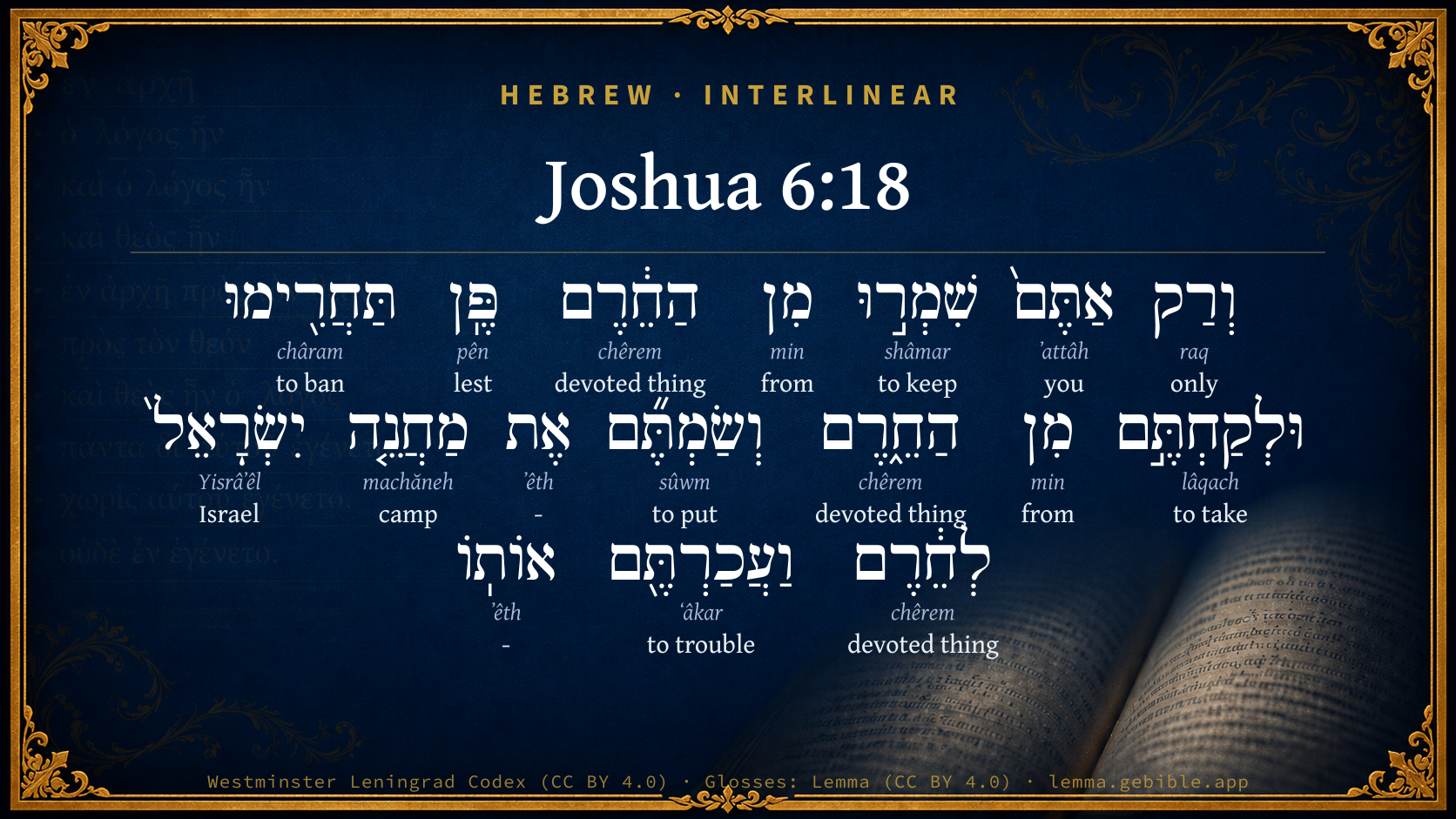
  1. וְרַק raq H7535 “and · only” Conjunction + Particle, Accusative
  2. אַתֶּם֙ ʼattâh H859 “you” Pronoun, Personal, 2nd Person, Masculine, Plural
  3. שִׁמְר֣וּ shâmar H8104 “keep” Verb, Qal, Imperative, 2nd Person, Masculine, Plural
  4. מִן min H4480 “from” Preposition
  5. הַחֵ֔רֶם chêrem H2764 “the · devoted thing” Particle, Definite Article + Noun, Common, Masculine, Singular, Absolute
  6. פֶּֽן pên H6435 “lest” Conjunction
  7. תַּחֲרִ֖ימוּ châram H2763 “to ban” Verb, Hiphil, Imperfect, 2nd Person, Masculine, Plural
  8. וּלְקַחְתֶּ֣ם lâqach H3947 “and · to take” Conjunction + Verb, Qal, Sequential Perfect, 2nd Person, Masculine, Plural
  9. מִן min H4480 “from” Preposition
  10. הַחֵ֑רֶם chêrem H2764 “the · devoted thing” Particle, Definite Article + Noun, Common, Masculine, Singular, Absolute
  11. וְשַׂמְתֶּ֞ם sûwm H7760 “and · to put” Conjunction + Verb, Qal, Sequential Perfect, 2nd Person, Masculine, Plural
  12. אֶת ʼêth H853 “-” Particle, Direct Object
  13. מַחֲנֵ֤ה machăneh H4264 “camp of” Noun, Common, Both, Singular, Construct
  14. יִשְׂרָאֵל֙ Yisrâʼêl H3478 “Israel” Noun, Proper
  15. לְחֵ֔רֶם chêrem H2764 “to/for · devoted thing” Preposition + Noun, Common, Masculine, Singular, Absolute
  16. אוֹתֽוֹ ʼêth H853 “- · him” Particle, Direct Object + Suffix, Personal, 3rd Person, Masculine, Singular

About this verse

These counts appear in no published source. They are computed here, from the morphology-tagged text and Lemma’s own curated glosses. What Lemma adds →

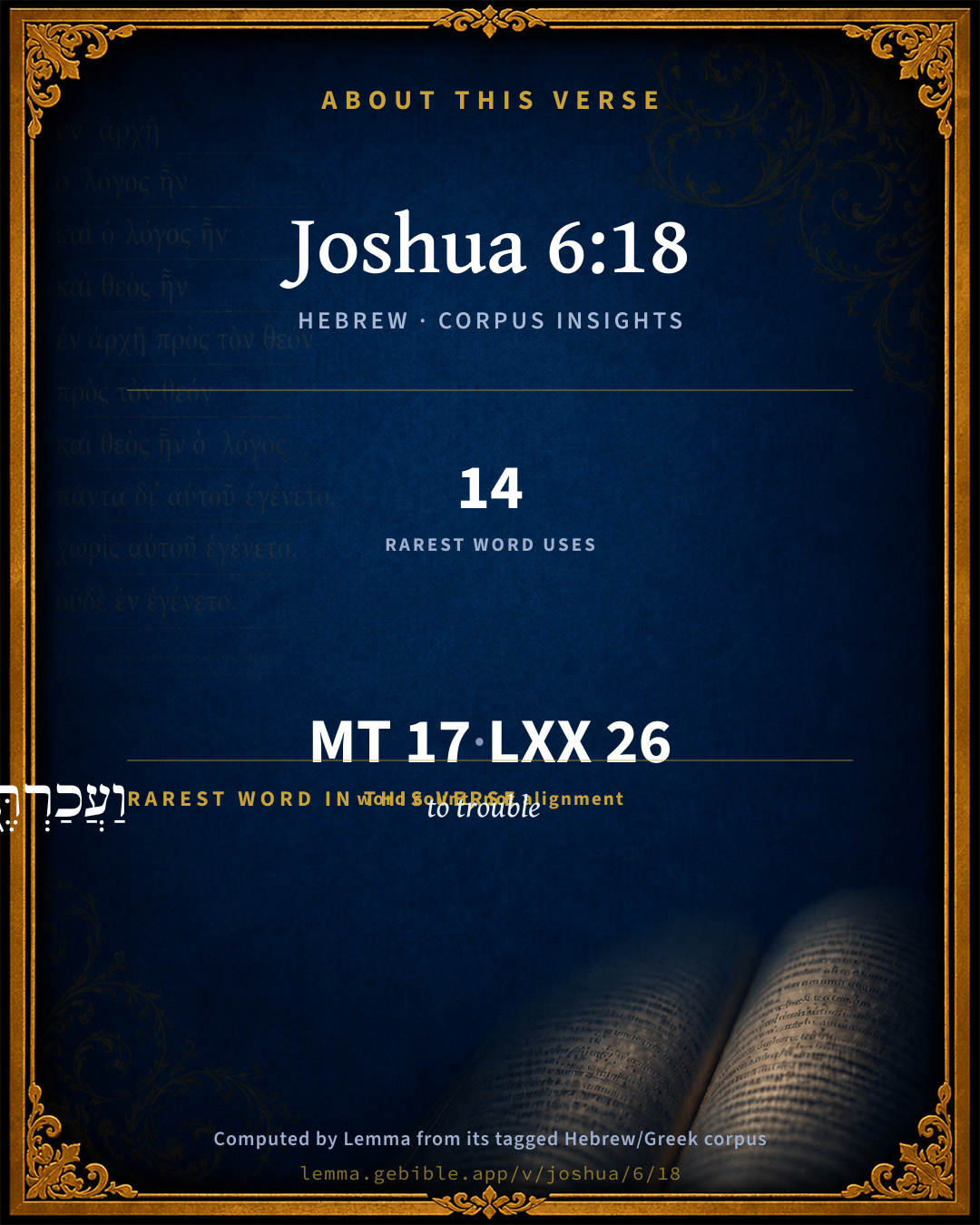
17
words
13
distinct lemmas
Historical
section

Notable vocabulary

The rarest word here is וַעֲכַרְתֶּ֖ם to trouble H5916 — appearing just 14 times in the whole Hebrew Bible.

Shared distinctive vocabulary

וַעֲכַרְתֶּ֖ם to trouble H5916 occurs in 13 verses of the Hebrew Bible. Also found in:

Grammatical profile

  • 5 verbs
  • 5 nouns
  • 1 pronoun
  • 2 prepositions
  • 1 conjunction
  • 3 particles

Verb forms

  • שִׁמְר֣וּ Qal · Imperative
  • תַּחֲרִ֖ימוּ Hiphil · Imperfect
  • וּלְקַחְתֶּ֣ם Qal · Sequential Perfect
  • וְשַׂמְתֶּ֞ם Qal · Sequential Perfect
  • וַעֲכַרְתֶּ֖ם Qal · Sequential Perfect

Repetition

Words recur within this verse — often emphatic in Hebrew:

  • הַחֵ֔רֶם devoted thing H2764 ×3
  • מִן from H4480 ×2

Hebrew & Septuagint length

In English translation the verse runs 35 words from the Hebrew and 36 from the Septuagint (LXX English) — closely comparable.

A rough comparison of the two English renderings, which tokenize alike — not a word-level alignment.

Word counts can differ between the Hebrew and the Greek without any difference in meaning — e.g. the Hebrew direct-object marker אֵת has no separate Greek word, and Greek often adds the article ὁ.

In the original languages it is 17 Hebrew tokens and 26 Greek tokens — but the two are counted differently (Hebrew bundles its prefixes and suffixes into one token; the Greek is in lemma form), so that isn’t a like-for-like length.

Cross-references

17

Topical passages linked to Joshua 6:18 in the Treasury of Scripture Knowledge — connected by theme and wording, ordered by reader-vote popularity; previews shown in the World English Bible.

  • 1 John 5:21 Little children, keep yourselves from idols.
  • Ephesians 5:11 Have no fellowship with the unfruitful works of darkness, but rather even reprove them.
  • Joshua 7:1 But the children of Israel committed a trespass in the devoted thing; for Achan, the son of Carmi, the son of Zabdi, the son of Zerah, of the tribe of Judah, took of the devoted thing: and the anger of Yahweh was kindled against the children of Israel.
  • Joshua 7:11–12 Israel has sinned; yes, they have even transgressed my covenant which I commanded them: yes, they have even taken of the devoted thing, and have also stolen, and dissembled also; and they have even put it among their own stuff.
  • Joshua 7:25 Joshua said, Why have you troubled us? Yahweh shall trouble you this day. All Israel stoned him with stones; and they burned them with fire, and stoned them with stones.
  • 2 Corinthians 6:17 Therefore, "'Come out from among them, And be separate,' says the Lord, 'Touch no unclean thing. I will receive you.
  • 1 Kings 18:17–18 It happened, when Ahab saw Elijah, that Ahab said to him, Is it you, you troubler of Israel?
  • Ecclesiastes 9:18 Wisdom is better than weapons of war; but one sinner destroys much good.
  • Jonah 1:12 He said to them, "Take me up, and throw me into the sea. Then the sea will be calm for you; for I know that because of me this great tempest is on you."
  • Romans 12:9 Let love be without hypocrisy. Abhor that which is evil. Cling to that which is good.
  • James 1:27 Pure religion and undefiled before our God and Father is this: to visit the fatherless and widows in their affliction, and to keep oneself unstained by the world.
  • Deuteronomy 7:26 You shall not bring an abomination into your house, and become a devoted thing like it: you shall utterly detest it, and you shall utterly abhor it; for it is a devoted thing.
  • 1 Samuel 14:28–42 Then answered one of the people, and said, Your father directly charged the people with an oath, saying, Cursed be the man who eats food this day. The people were faint.
  • 2 Samuel 21:1 There was a famine in the days of David three years, year after year; and David sought the face of Yahweh. Yahweh said, It is for Saul, and for his bloody house, because he put to death the Gibeonites.
  • Deuteronomy 13:17 There shall cleave nothing of the devoted thing to your hand; that Yahweh may turn from the fierceness of his anger, and show you mercy, and have compassion on you, and multiply you, as he has sworn to your fathers;
  • Joshua 7:15 It shall be, that he who is taken with the devoted thing shall be burnt with fire, he and all that he has; because he has transgressed the covenant of Yahweh, and because he has done folly in Israel.
  • Joshua 22:18–20 that you must turn away this day from following Yahweh? and it will be, seeing you rebel today against Yahweh, that tomorrow he will be angry with the whole congregation of Israel.

Cross-references courtesy of OpenBible.info (CC BY 4.0).

Hebrew and Greek witnesses Masoretic Hebrew ↔ Greek Septuagint

The same verse in the two great witnesses to the Old Testament, shown verse-for-verse.

These are two independent witnesses, not word-aligned to each other, and the Septuagint is shown in lemma (dictionary) form.

Hebrew Joshua 6:18 Masoretic · Westminster Leningrad Codex

וְרַק אַתֶּם֙ שִׁמְר֣וּ מִן הַחֵ֔רֶם פֶּֽן תַּחֲרִ֖ימוּ וּלְקַחְתֶּ֣ם מִן הַחֵ֑רֶם וְשַׂמְתֶּ֞ם אֶת מַחֲנֵ֤ה יִשְׂרָאֵל֙ לְחֵ֔רֶם וַעֲכַרְתֶּ֖ם אוֹתֽוֹ

But as for you, only keep yourselves from the devoted thing, lest when you have devoted it, you take of the devoted thing; so would you make the camp of Israel accursed, and trouble it.

World English Bible · Public Domain

Greek LXX Joshua 6:18 Septuagint · lemma form

ἀλλά σύ φυλάσσω σφόδρα ἀπό ὁ ἀνάθεμα μήποτε ἐνθυμέομαι σύ αὐτός λαμβάνω ἀπό ὁ ἀνάθεμα καί ποιέω ὁ παρεμβολή ὁ υἱός ἰσραήλ ἀνάθεμα καί ἐκτρίβω ἐγώ

But keep yourselves strictly from the accursed thing, lest you⌃ set your mind upon and take of the accursed thing, and you⌃ make the camp of the children of Israel an accursed thing, and destroy us.

LXX2012 (modern English Septuagint) · Public Domain

Hebrew: Westminster Leningrad Codex (CC BY 4.0). Greek: Septuagint (public domain); English from LXX2012 (modern English Septuagint) (Public Domain). How the Septuagint differs from the Hebrew →

Targum (Aramaic paraphrase)

1

The Targum is the ancient Jewish Aramaic paraphrase of the Hebrew Scriptures — an interpretive translation, not the Hebrew text itself. Onkelos (literal) and Pseudo-Jonathan (expansive) render the Torah, and Jonathan the Prophets. Coverage is partial: where no permissively-licensed English translation exists for a verse, only the Aramaic is shown. This is verse-level text, not a word-by-word alignment to the Hebrew.

  1. Targum Jonathan Prophets (Joshua–Malachi)
    וּלְחוֹד אַתּוּן אִסְתַּמָרוּ מִן חֶרְמָא דִלְמָא תְחַרְמוּן וְתִסְבוּן מִן חֶרְמָא וּתְשַׁווּן יַת מַשְׁרִיתָא דְיִשְׂרָאֵל לְחֶרְמָא וּתְעַכְרוּן יָתֵיהּ:

    (no public-domain English translation for this verse)

    Targum Jonathan — Aramaic: “Mikraot Gedolot” (public domain). English: “Sefaria Community Translation” (CC0 1.0 (public-domain dedication)); “London "Chaldee Paraphrase," 1871” (public domain). Text via Sefaria.

Commentary

Notes on Joshua 6:18 from classic Christian and Jewish commentators (each source and its license shown beneath its notes). The classic Christian expositions comment on the surrounding passage and are grouped to its opening verse, so a note may address several verses; the Jewish commentaries on the Tanakh (Rashi and others) are per-verse, so they appear only where the commentator wrote on this verse.

Lemma curates 59 commentaries, every one of them public domain or Creative Commons licensed, each selected and text-cleaned for this edition rather than reprinted as found. About our sources →

Trapp's Complete Commentary

John Trapp

Jos 6:18 And ye, in any wise keep [yourselves] from the accursed thing, lest ye make [yourselves] accursed, when ye take of the accursed thing, and make the camp of Israel a curse, and trouble it.

Ver. 18. Keep yourselves from the accursed thing.] This was a fair warning to that foul sinner Achan; but Dεινος και παντολμος της φιλοχρηματιας ερως, covetousness is deadly, daring, and desperate, saith Isidor Pelusiot. {a}

{a} Lib. iii. epist. 24.

John Trapp, A Commentary or Exposition upon All the Books of the Old and New Testament (1647–1656) — public domain. Text from a community e-Sword module.

Joseph Benson's Commentary

Jos 6:18. Keep yourselves from the accursed thing — It should rather be rendered, the devoted thing, meaning the spoils devoted to the Lord. These they were not to touch, on pain of being themselves devoted to death. Lest ye make yourselves accursed — Lest you draw upon yourselves the immediate curse of God, and so bring yourselves under the same sentence of destruction as the inhabitants and things of Jericho are under. And make the camp of Israel a curse — By provoking God to punish them for your sin, in which they may be one way or other involved; for the whole camp having sins of their own, God might take what occasion he saw fit to inflict this punishment.

Joseph Benson's Commentary on the Old and New Testaments (1811–1818) — public domain. Text from a community e-Sword module.

Jamieson, Fausset & Brown

Robert Jamieson, A. R. Fausset & David Brown

and ye, in any wise keep yourselves from the accursed thing--Generally they were at liberty to take the spoil of other cities that were captured (Deu 2:35; Deu 3:7; Jos 8:27). But this, as the first fruits of Canaan, was made an exception; nothing was to be spared but Rahab and those in her house [Jos 6:17]. A violation of these stringent orders would not only render the guilty persons obnoxious to the curse, but entail distress and adversity upon all Israel, by provoking the divine displeasure. These were the instructions given, or repeated (Deu 13:17; Deu 7:26), previous to the last act of the siege.

Jamieson, Fausset & Brown — Commentary Critical and Explanatory on the Whole Bible (1871) — public domain (CC PDM 1.0). Text via the HelloAO Bible API.

The Cambridge Bible for Schools and Colleges

gen. ed. J. J. S. Perowne

18. in any wise keep yourselves] A warning, which Achan neglected to the destruction of himself and his family. See chap. 7.

The Cambridge Bible for Schools and Colleges (gen. ed. J. J. S. Perowne; Cambridge University Press, 1878–1918) — public domain. Text from a community e-Sword module.

John Gill's Exposition

And you in any wise keep yourselves from the accursed thing,.... From laying hold on, secreting, and enjoying as their own, what was devoted to another use:

lest ye make yourselves accursed; or a "cherem", also devoted to destruction:

when ye take of the accursed thing; any part of it, be it what it will, gold or any other metal, or raiment, and the like:

and make the camp of Israel a curse, and trouble it; for being done secretly, and not known who did it, the whole body of the people would be chargeable with it, and suffer on account of it, unless discovered and punished, and as more fully appears by an after instance.

John Gill's Exposition of the Whole Bible (1746–1763) — public domain (CC PDM 1.0). Text via the HelloAO Bible API.

Haydock's Catholic Bible Commentary

Forbidden, transgression, sin. Hebrew has always anathema. (Haydock)

George Leo Haydock (1774–1849), Haydock's Catholic Family Bible and Commentary, 1859 edition — public domain. Excludes Psalms (Douay-Rheims chapter numbering differs from Protestant) and Deuterocanonical books (Catholic canon only).

Matthew Poole's English Annotations

Make the camp of Israel a curse, by provoking God to punish them for your sin, in which they may be one way or other involved; or at least upon the occasion of your sin: for, to speak properly God will not (the case of Adam’s sin only excepted) punish one man for the sin of another, as he hath oft declared; but the whole camp having sins of their own, God might take what occasion he saw fit to inflict this punishment.

Matthew Poole's English Annotations on the Holy Bible (1683–1685) — public domain. Text from a community e-Sword/MySword module.

Whedon's Commentary on the Bible

Daniel D. Whedon

18. Lest ye make yourselves accursed — Hebrew, lest ye both devote and appropriate the accursed thing. The two acts could not be harmonized. It would be sacrilege to dedicate the whole to Jehovah and then to take possession of a part for their own use.

And make the camp of Israel a curse — God will not be defrauded. If any one of the camp takes for personal use any thing dedicated to Himself, He will devote the camp to Himself, that is, to destruction.

And trouble it — By bringing distress, and humiliating defeat in battle.

Daniel D. Whedon (gen. ed.), Commentary on the Old and New Testaments (1874–1909) — public domain. Text from a community e-Sword module.

The Pulpit Commentary

Accursed thing. Better," thing devoted, as this keeps up the idea of something solemnly set apart to God, to be dealt with as He thinks fit. Lest ye make yourselves accursed when ye take of the accursed thing. Rather, with Keil and Rosenmuller, lest ye devote the city to destruction, and then take of what has been thus devoted. And make the camp of Israel a curse. Literally, and put the camp of Israel in the position of a thing devoted. And trouble it. (cf. Jos_7:25, Jos_7:26; also Gen_34:30)

The Pulpit Commentary (1880–1919), ed. H.D.M. Spence-Jones & Joseph S. Exell — public domain. Text from a community e-Sword module.

John Wesley's Explanatory Notes

A curse - By provoking God to punish them for your sin, in which they may be one way or other involved; or the whole camp having sins of their own, God might take what occasion he saw fit to inflict this punishment.

John Wesley, Explanatory Notes Upon the Whole Bible (1754–1765) — public domain. Text via the GEBible commentary corpus.

Rashi

Rabbi Shlomo Yitzchaki (Rashi)

And bring disturbance. This is an expression of disturbed waters.

Rashi on the Tanakh — English translations: “The Judaica Press complete Tanach with Rashi, translated by A. J. Rosenberg” (CC BY 4.0); “Pentateuch with Rashi's commentary by M. Rosenbaum and A.M. Silbermann, 1929-1934” (public domain); “The Metsudah Tanach series, Lakewood, N.J” (CC BY 4.0); and “The Book of Joshua, Metsudah Publications, 1997” (CC BY 4.0). Text via Sefaria.

Lesson kit

Teaching starters — assembled from the data on this page, not authored interpretation. Every prompt links to the verse data it draws on. Edit before teaching.

Joshua, in the Historical, opens this verse with 17 words (13 distinct Hebrew lemmas). Its most distinctive word is ʻâkar (“to trouble”). A historical commentator’s framing appears above. Read the whole chapter for the surrounding context.

Discussion questions

  1. What does “to trouble” (ʻâkar) contribute to the verse as a whole?
  2. How does Genesis 34:30, which shares the word «to trouble», read alongside this verse?
  3. What does the repetition of “devoted thing” (3× in this one verse) do in this verse?
  4. These translations render this verse differently. What is at stake in choosing one wording over another?
  5. «שִׁמְר֣וּ» is a Qal Imperative verb. How does that grammatical form shape the action described?
  6. Compare how Trapp's Complete Commentary and Joseph Benson's Commentary read this verse. Where do they agree or differ?

Things to notice

Reading settings

Reading text

Shown beneath each verse's original-language words.

Old Testament
Old Testament edition

Read the OT as the Masoretic Hebrew (MT) or the Greek Septuagint (LXX).

English shown for the Greek Septuagint (in the Hebrew ↔ Greek comparison).

Comparing translations? Open the Compare panel on any verse page to stack up to four side by side.